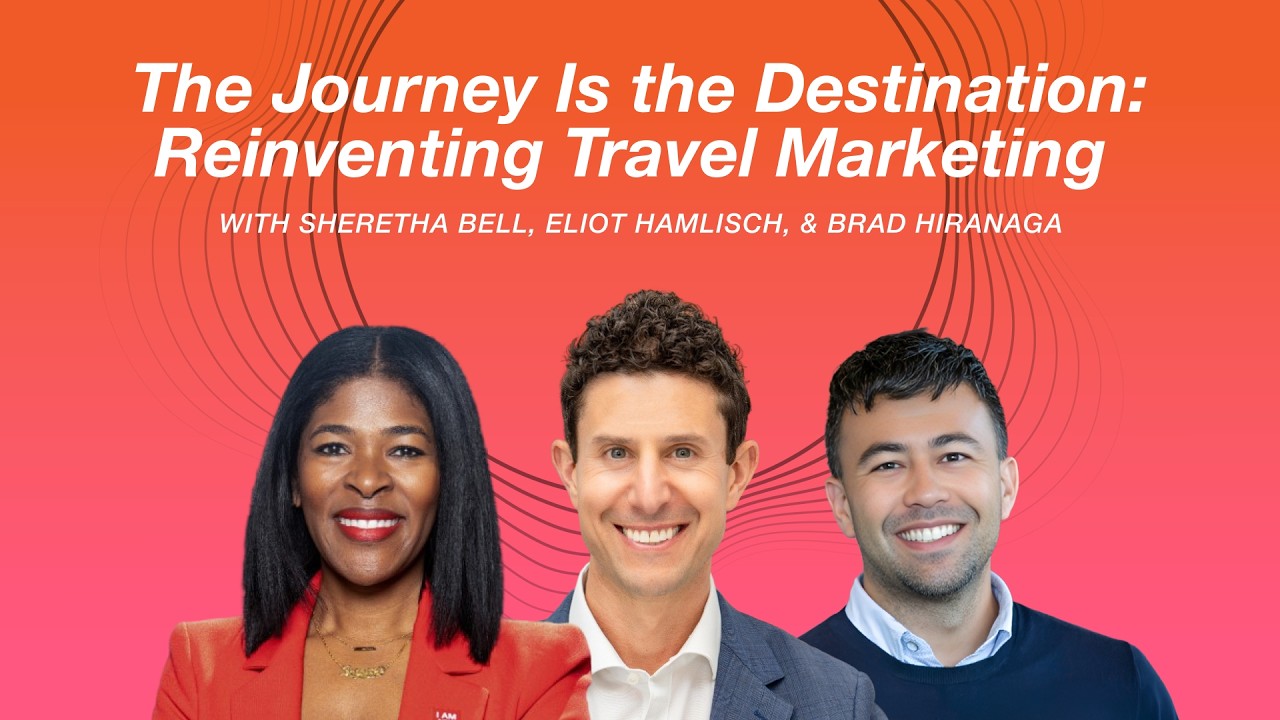
Video summary
The video explores how modern travel marketing is shifting focus from merely reaching a destination to crafting an immersive journey where every step of the trip becomes part of the experience. Panelists representing major hospitality and transportation brands emphasize that consumers today are traveling based on their personal values, identities, and passions rather than just utility. This trend has transformed traditional transit providers like Amtrak into experiential companies focused on onboard comfort and digital engagement, while hotel chains like Marriott are rethinking wellness offerings to ensure travelers do not have to sacrifice health routines during business or leisure trips. The discussion highlights that the journey itself—whether by train, plane, or car—is now a critical component of customer satisfaction, requiring brands to innovate across all touchpoints from booking to arrival.
A significant theme emerging in the conversation is the need for deep personalization and understanding individual traveler needs beyond generic segmentation. Marriott's Brad Hinaga notes that gyms are often underused spaces that could be repurposed or enhanced with wellness-focused services tailored to different trip types, while restaurant partnerships drive both traffic and revenue by offering familiar favorites like those from Steven Starr on Amtrak trains. Atlanta CVB’s Sherita Bell illustrates how destination marketers now blend business and leisure strategies through "bleisure" policies, ensuring that corporate travelers also discover the city's cultural offerings. By integrating insights about sustainability, history, entertainment, and family needs into their narratives, these organizations aim to position themselves not just as logistical providers but as essential partners in creating memorable moments for diverse customer segments.
Technology plays a pivotal role in shaping future travel strategies, particularly through artificial intelligence and loyalty ecosystems that allow brands to engage travelers at the right moment with relevant content. Marriott leverages its massive Bonvoy membership data alongside partnerships with airlines and ride-share services to create a unified ecosystem where audiences can be reached across multiple platforms. Meanwhile, Amtrak uses AI-driven advertising tools to serve dynamic content based on user search intent while simultaneously preserving human connection through initiatives like distributing physical postcards that encourage handwritten messages from travelers to loved ones. The panelists acknowledge the growing influence of large language models in itinerary planning and stress the importance for brands to optimize their digital presence so they appear as trusted, compelling options when consumers ask AI assistants for travel recommendations.
Ultimately, the consensus among industry leaders is that successful marketing requires balancing technological efficiency with authentic human experiences and emotional resonance. Whether through unexpected social media campaigns like Amtrak's viral summer trainacular posts or Atlanta's celebration of local culture via massive postcard parades, brands are finding success by being surprising, engaging, and deeply attuned to what truly matters to their customers. As the industry continues to evolve with new technologies and changing consumer behaviors, those who can seamlessly integrate innovation with personalized storytelling will define the next era of travel marketing. The journey is no longer just about getting from point A to B; it is about creating a holistic experience that reflects who travelers are and what they value most in their lives.
Read the full video transcript
Welcome to Adspeak, AdWeek's podcast
about the business of marketing, media,
and creativity. In this episode, we're
sharing a conversation recorded live at
one of AdWeek's events featuring leaders
from across the industry discussing the
ideas shaping brands right now. Let's
get into it.
Good afternoon. Well, it's fun to see
everyone here. Um, listen, travel is a
fun category. Travel's a good thing to
talk about. Sometimes we get excited
about the destination, but the journey
can can come with ups and downs, shall
we say. So overall, it's all an
experience. And I think as marketers,
brand marketers, it's all about figuring
out how how do you make sure that every
consumer who's going on a travel journey
is um is
feeling like they're having the best
possible experience for themselves.
Personalization is something we're going
to get into. technology, use of
technology, and how you actually craft
an experience that is sort of like to
that point meeting their needs. All of
that in this new age, um it's never been
more complex, but I think that can be
said of any category. So, um I think
what you're seeing up here is a really
cool collection, a mosaic of of
representation in the travel industry.
We have hotel, we have uh train, we have
a city marketer, a destination marketer,
if you will. But I'd love for you each
to go down the line and talk a little
bit about your role right now and and
what you're really focused on. So Brad,
I'll start with you.
>> Start with me. Okay, great. Hi
everybody. Uh I'm Brad Hinaga. I am the
global SVP for brand and design
experiences at Marriott. I've only
actually been uh there since the summer,
so it's pretty new for me. Um new to
hospitality. And uh
>> share a little bit about your
background.
>> Oh, sure. Yeah. So, I was we were just
we it's funny because we're just talking
about travel in the back and I will say
coming from other industries, the people
and the environment is definitely fun.
If you're looking for a fun industry and
travel is where you should check it out.
I came from package food, not quite as
fun. Uh, and I've also worked in
apparel, which is exciting but also
really hard. Um, so had some other
experiences before I came into
hospitality. And well, what I'll say is
there's a lot of folks at least at
Marriott, big company, it's been around
for a long time, that have been in the
industry a long time and have really
been thinking about experiences as a way
of how they go to market on everything.
So, in some ways, like it's been fun to
go in with a bunch of people who think
that way about product and they're very
new for me.
>> Yeah, Elliot,
>> that sounds pretty fun. [laughter]
>> I'm also a little jealous that you can
play the new guy card still.
>> Still as long.
>> Uh, so good afternoon all. Uh Elliot
Hamish. I'm the chief commercial officer
at Amtrak. Been about two years. So I
stopped being able to play the new guy
card roughly a year ago.
>> A good question I should ask of all
panelists.
>> How long can you play the new guy card
for? Yeah, I was told a year.
>> One year. That's one year.
>> Now I'm on my own. Yeah. Uh so yeah,
about two years with the company. We are
very focused on essentially we call
retrain travel. So helping our customers
and those that haven't tried train
travel before to think about the mode
differently. So we we don't really have
any direct competitors for for um sort
of from a traditional standpoint. We
think about cars and planes as the
primary points of competition for us.
And so we spend a lot of time and effort
thinking about how to combat the very
traditional thinking in in our country
about a very highway ccentric and
airport ccentric uh way to travel and
essentially retrain consumers to think
more about trains as their mode of
choice. And so um we've got Nick up here
in the front who runs our social team uh
which we're going to talk about. She
does some great stuff. Um and so we're
we're really focused on that which has
been fun.
>> Awesome. Sharita.
>> Hello. I am Sheretha Bell. I am the
senior vice president of marketing and
brand strategy at Atlanta Convention and
Visitors Bureau. Some of you may know us
as Discover Atlanta on all of our
platforms. I stopped playing the new guy
card about 24 years ago.
So, I'm the old person up here. Um, I've
been with Atlanta CVB for 25 years. And
our focus has obviously changed several
times. That's the reason I've been able
to be here for 25 years is because of
all of the things that change in
marketing. But as of right now, we are
really focused on the mission of
favorably impacting the economy through
promoting Atlanta as the premier
destination for conventions and leisure
travel. So, thank you all for being here
in Atlanta. Love that um Brand Week is
here. And then my responsibilities are
primarily across all of our platforms.
So whether or not that's our website,
social media, we do have some of our
team members here. So glad to see you in
the audience. But we also do print still
and I know that that's not something
that's extremely extremely popular. AJC
yesterday was even talking about how
they're no longer doing print, but it is
working to make sure that all of our
consumers have the content when they
need it, where they want it. And that's
primarily our focus right now is to make
sure that we're doing exactly that, that
we're providing that need um even
sometimes the unspoken need. um when you
want it, where you want it, how you want
it.
>> That's great. It's a great testament to
the city of Atlanta that you've been
here that long. And you're actually not
originally from Atlanta, is that
>> No, no, I'm a Mississippi girl. Um that
is my first home, but my parents were in
the military. So, happy Veterans Day to
any of those that are in the room or
anywhere nearby. So, and so being a
military kid, I've lived everywhere. So,
speaking of travel, that is definitely
been my life experience. But Atlanta's
been my home for 29 years. I'm also a
Spellelman College graduate. love it
here and so that's what I'm talking
about.
>> That's great.
>> Yeah. Awesome. Awesome. Well, I think
what's interesting is like you all are
are dealing with inputs, right? And we
talked about this before um when we were
planning for this conversation. You
know, there's a lot of things not like
every marketer out there, but it's
unique in the travel category. The
inputs or sort of the new the new trends
that you're seeing that are informing
how you're responding and how you're
building product and experiences based
on that input. So, let's start with
what's one emerging behavior or mindset
you're seeing that's reshaping how
marketers or consumers engage or think
about travel? So, anybody can jump in
with that one.
>> I mean, I can talk a little bit about
behavior. Um, I think one of the one of
the emerging trends is that people are
traveling due to their values and their
identities and passion. Uh, we even had
a conversation at lunch today where
we're talking about what that looks
like. That's music tourism and sports
tourism. People are traveling for those
um you know the the Beyonce conference
or the conference. See I'm so used to
conferences.
>> Although the California sponsor I mean
FIFA I would go to a Beyonce conference
but they're traveling. I mean FIFA's
coming up and people are traveling for
these events that are truly experiences.
So, we have to make sure that we're
working with partners at every step
along the journey to make sure that that
truly does become an experience from the
time that you get on the train, the time
that you get on the plane to the time
that you get to the destination. So, I
would say that that's one trend and
hopefully that trend doesn't change
because that's the one almost that
matters most because it's the core to
who you are.
>> Yeah.
>> Yeah. Maybe I'll I'll pick up on that
point. And I think it hasn't always been
the case that actually getting on the
plane or on the train was part of the
experience that you felt about when you
were planning a trip, right? You're
going to a concert or you're going to a
conference or one of the same.
>> It should be the same if it's beyond.
>> Um, but we've spent a lot of time and
effort thinking about how we transform a
company that's been known for we get you
from point A to point B safely and on
time to a company that's focused on the
onboard experience or the digital
booking experience. Right. All of which
is part of that endto- end um
experience, right? Not to overuse the
word. Spoiler alert, you're going to
hear that a lot today.
>> Maybe more than AI.
>> Maybe I don't know. You can place your
bets now.
>> Sorry.
>> That's okay. We can do it later.
>> Uh but I I think that's that's u again a
point that we spend a lot of time and
effort thinking about is what can we do
from a product perspective? What can we
do from a digital perspective? really
sort of the the entirety of the
experience itself uh that goes from
transportation company to what we're
thinking about more as a hospitality
company which is I think very distinct
um at least in terms of train travel
here in the United States.
>> Yeah. And in that context you're not
just a means to an end. You're the end
in and of itself. You're part of the
experience overall. So the getting there
is part of it.
>> That's exactly right.
>> Um Brad, so what are you saying? you
know, especially, and by the way, yes,
you're still playing the new guy card,
and you, by the way, have experience in
your title, experience design in your
idol. So, how what name one thing you're
seeing that's informing what you're
doing right now.
>> Both of those things resonate. I'll
bring maybe a different one to the table
to talk about. I think how we think how
we change behavior around wellness is a
huge trend that we're seeing. Yeah. So,
obviously in food and in that industry
that's that's taken over the last 20
years in terms of how people think about
it. I what we're starting to learn is
that when people are traveling, they
don't want to sacrifice all the things
they're doing in wellness because they
have a business trip or they're going on
vacation.
>> In fact, in some cases, they want it to
be enhanced when they're going on those
trips.
>> So, I think what we've done a little bit
of research to look across the whole
spectrum of of your travel journeys and
by different types of trips, you have
different needs. Obviously, if you're
going for a business trip, you're in and
out. You know, if you're like me, you
bring your workout clothes and then you
bring them home and they're clean with a
huge
>> Tell everybody.
>> So shameful, but I felt like I was going
to do everybody.
>> So, uh, but that wellness journey is
maybe so a little bit different when
you're going on like a week-long trip in
a resort or location where you're like,
you know, you will have time to get up
and do that yoga class on the beach or
you will try to have a different way of
eating during that week that you want to
bring to bear. So, we're really trying
to think through as we like as we all do
probably own thinking about these
journeys that people are going on. Where
do we want to bring in those types of
experiences or the services or new
products maybe that we don't have?
Hotels have gyms and restaurants and all
of that, but people how we're all using
them as we're all like monitoring all of
our health all the time. Like those
needs have shifted and we can track if
we're seeing our travel like we go off
cliff.
>> We're not going to want that to happen
anymore.
>> Yeah. What's the most overused part of a
hotel and what's the most underused?
>> Oh, you would probably you might know
this as well. Um, overused part of the
hotel. Well, it's funny. I'll go
underused first. Gyms are fairly
underused. Now, sometimes they'll say
like it's they no owners are going to
want to get rid of a gym if they have
that in their building because they need
to have it. But a lot of times I think
it's they're fairly empty space. Um,
what can be some of the most profitable
space if it's good is restaurant space.
And so when you have that space down
below off the lobby, you have a killer
restaurant that can drive in not only
traffic that's coming to you that's
traveling there for work or for for
leisure, but also people who live in the
city that want to go to a great
restaurant. So depending on how good our
FnB is can drive a lot of productivity.
>> I used to work in hotels, so I'm be for
the corrections if I get all
>> No, I I think that's all right. One one
thing uh which is somewhat related to
the question um is it's interesting how
hotels think about what matters to their
customers. So I'll give you an example
on this trip. I was upgraded spend a lot
of time in Hilton hotels. I was upgraded
to a large suite. I don't want to be in
a large suite and I'm traveling by
myself. Half the time I forget the clean
clothes that I didn't use going to the
gym because it's in the room over there.
Whereas there are a lot of other things.
If Hilton really knew me, not to pick on
Hilton, uh, but
>> sitting next to
>> Right. All right.
>> Uh, you know, were they to really know
me, maybe they'd ask in advance, what
are the things that I value? Were they
to give me a thing, right? Be it an
upgrade or a food and beverage voucher
or whatever the case might be. Uh, and I
think that's an opportunity for
hospitality companies in general. We're
going to talk a little bit about
personalization as as part of the
experience, but really getting to know
the customer to understand what it is
that matters to him or her.
uh in a more meaningful way feels like a
big opportunity area for the the travel
industry broadly.
>> Yeah. I want to ask you a question
that's a variation on the one I just
asked him, but about the train
experience, you know, where are people
what what are people using most in in
the train? You know, where are they
spending their time? What what do people
really gravitate to? What are the
things, you know, are is it the sleeping
car experience? Is it the you know, the
the food and beverage that's on board?
Like where are you finding like you have
uh opportunities within the train
experience to to lean in based on what
people want?
>> Yeah. So, it's interesting. It v not
surprisingly it varies tremendously by
tripication right so we've got customers
many of whom are probably here in the
room who have gotten on the asella in
Washington heading to Philadelphia or
New York or Boston and they don't leave
their seat right they're happy to take
calls happy is the wrong word uh but
they're on calls they're productive the
Wi-Fi is great and they're just jamming
away right and those I'll speak for
myself I spend most weeks on the train
back and forth from Jersey where I live
down to DC where Amtrak is based and I
don't get up other than walking up and
down to to say hi to folks on the train.
I spend my time productively doing the
the work that I need need to do. That's
my time. There are others who are
traveling for leisure who spend the
entirety of their time, you know,
downing uh glasses of wine and eating
cheese plates in the cafe and that's
great too, right? And so we're we spend
again much of our time focused on those
different and distinct customer segments
to understand what it is that each
customer needs and solving for for those
in different ways. Right? So really
thinking about those journeys and how we
need to be able to offer distinct uh
sort of moments for each of those
customer segments to fulfill whatever it
is that they were looking for in their
application. within you have so many
diverse categories of c consumer that's
going to come on and engage. Um
obviously you mentioned cafe car and
probably other some of the areas in the
train but brand collaborations is
probably something that you're also able
to do. Yes. With in terms of what kind
of food and beverages you bring into the
space.
>> We do. So we've got uh I'll just give
you one one sort of color commentary.
We've got a partnership with Steven
Star, a big restaurant tour uh based out
of Philly who provides uh a couple of
signature dishes for our first class uh
Asella FNB and that has paid great
dividends for us in a number of ways.
Just there there are a lot of
familiarity of the name goes a long way.
It's it's difficult in situations like
that. We you know talked a lot over the
past couple of days for those who have
attended other sessions about
measurement, right? How do you know if
something's working or not? And the
answer is sometimes it's easy and
sometimes it's hard, right? It's
something like that. It's difficult to
say, you know, somebody's willing to pay
$50 more or $100 more or is buying a
ticket to ride on Amtrak versus taking
the Delta shuttle because of the Steven
Star menu. But as we look at our
customer satisfaction index, which is
really one of the the main ways that we
identify is is what we're doing working
or not, those menu items score
particularly high. And we see people
commenting in our verbatims on, you
know, incredible beef dish from Steven
Star's XYZ restaurant. And so it's it's
things like that that are sort of odd
for even though we can't measure it
exactly, we have a pretty good feel that
it's working. And it it seems that the
juice is worth the squeeze in terms of
partnerships like that.
>> That's very cool. Shareth, in your case,
you know, not unlike what we were just
talking about with Elliot, it's you have
actually different groups of people who
you're wooing to Atlanta. There's the
business population, there's the there's
the consumer leisure traveler, right?
And in both cases, you want to be in the
consideration set, right?
>> Absolutely. So talk a little bit about
the strategy and the ways um you know
how much of that is similar strategy for
both of those groups versus how are you
thinking differently when you're trying
to attract a leisure traveler to Atlanta
um and to cons you know get sort of
really up in the consideration step
before they've actually made their
decision because there's that's also the
flip is once they're here you want them
to feel like they have a great time
after they've already made the decision.
Absolutely. who also want to get
upstream and in that sort of area where
they're debating between various
destinations. So let's start with the
leisure and then we can go into
business. Well, it's it shifted over the
years. Um there was a time where we kept
them both very separate. It was sort of
our B TOC and B2B and our team was even
organized in that way so that it was
almost silosed to be honest of our B2B
silo and our B2B and B TOC and we over
time and I I I kind of want to say it
was around the pandemic um we realized
that that bleisure travel yeah was
changing and of course even with some of
the data that's out there now where
bleisure categories are within um the
travel planners categories as far as
even corporate travel is saying we need
to have a bleeder ure policy at this
particular point and that bleure policy
is actually changing the satisfaction of
employees. So for us, we've taken that
into how we plan our strategy so that we
are making sure that there is
information about the leisure experience
in Atlanta when we're talking to you
about the B2B experience. So, when we're
talking to our meeting planners and
telling the story about our logistics
and how easy it is to walk, although
most people will hop in a shuttle
because they don't realize it's that
easy, but how easy it is to walk from
the hotels to the convention center or
how easy it is to um maybe if you do
want to hop in an Uber in an Uber to get
to or Lyft or any of the ride shares
because I don't want anybody in any
particular brand to be like, "What? What
about mine?" Um, but if you want to hop
in a ride share and get to any
particular neighborhood that there's so
many different experiences outside of
the conference once it gets here. So for
us it is all about the leisure and the
business and making sure that we're
telling all of those stories. So I
mentioned again why people travel. We've
also realized that there are people that
are going to make their decision on
which conference to go to based off of
what else can they do when they get
there. Yeah. So for us, we have to
really pay close attention to that of
what are those consumer insights? What
are they traveling for? Why are they
traveling? Are they traveling because of
sustainability? Are they traveling
because of history and culture? Are they
traveling because of entertainment? Are
they bringing family and friends? Or are
they literally trying to get in and out
because Atlanta's a non-stop destination
and I can get my flight on a red eyee in
the morning and I can get out in the
evening? So all of those things, we're
excited that Atlanta has all of them to
offer, but at the same time, that has to
be part of our story. That has to be
part of our strategy on this is the
message that we're sharing is that we
have all of those experiences for you.
Trying not to just be a something for
everyone destination because it's not
that, but we do have something for
everyone. [laughter]
>> Um, so let now let's get that's a great
segue into let's get into tactics for
all of you. You know, where are you
finding the greatest pull? Where are you
finding the greatest um you know ROI?
Yes. For for the mechanisms you're using
to market. Uh so Brad, I'll start.
>> Yeah. I mean I'll start. This is I I
think one of the biggest um and most
useful platforms in Marriott no doubt is
Marriott Bonboy.
>> So if you know if you're a loyalty
member um and part of that program, you
know, you have access to 10,000
properties basically in every country
that you want to go to. And then
obviously is for those folks that are
traveling a lot there's you climb the
the loyalty ladder there's more and more
opportunity for you to create value. So
for us you know having that kind of
channel is such a huge opportunity not
only not only to like stay connected and
be front and center with all of our
members but also to like glean different
insights and different opportunities of
where there might be growth. Um we just
launched a category actually couple
weeks ago called the outdoor category
and the outdoor collection based just
off the insight that people want outdoor
travel. They want to go they want to go
to different places. is we have
locations as a company basically at
every single national park right around
every great ski resort. So passions that
that these guys are talking about too
are real. People want to search for
passions and so we want to put outdoor
front and center versus what city do you
want to go to and start travel
thoughtfulness that way. Yeah.
>> And a secondary place I'd say is where
we're gaining a lot of momentum. still
relatively new in terms of how we are
thinking about oursel as a distribution
channel is Marriott Media which just
launched back in June which is an
opportunity for us to kind of like
follow a little bit of the playbook that
some of the other retail networks have
done to launch because we've got great
partners United, Delta, Uber, Starbucks
that all want to be part of that travel
ecosystem and are already part of it. If
you stayed at the West and you probably
had a Starbucks, you probably came in on
an Uber, probably flown one of these
airlines. These are all partners of of
Marriott and so we're able to kind of
create I think mutual beneficial ways
for us to bring in eyeballs and
audiences and leverage our scale to
allow them to to be a part of that.
>> Yeah. I mean it's strength and numbers.
You've got you've just got the data sets
merged are incredible.
>> Absolutely. As 260 million members I
think in in Marant right now for their
the board programs and growing by very
rapidly.
>> Yeah. Yeah. Um Elliot tactics how are
you reaching I mean social Yes. Um, how
are you taking
>> talk about Anfra social?
>> What do you think, Nick?
>> She's here.
>> Let's do it.
>> So, you know, I I actually Oh, you're
right. Blushing in the front row. Um, so
here's what we found works. Doing things
that are unexpected, right? So, uh, not
to keep calling on Nick, but Nick is
doing a really spectacular job of doing
just that, right? If if you think back
two, three years ago, right? like a big
post for us was maybe their 20,000
30,000 views, right? Like numbers that
aren't big cuz it was sort of boring and
tired and frankly that's what the brand
has sort of felt like for a really long
time, right? Uh and that's not
necessarily bad, right? Part of the
fabric of our country. It's been around
for 50 years and not a lot has changed
about the brand and in some ways that's
good. people know what to expect and
it's consistent and it's reliable and
that's a good thing. With Nick taking
over the helm of our social team and
bringing on some new talent, we've
really started to think about how do we
engage with people in a new and
different way. Many of the folks that uh
we love that have been riding our trains
for 50 years, we know how to speak to
them well, right? Jenzers a little bit
more difficult and it took some new and
different thinking to reach them in new
and different ways. So, I'll give you an
example. Uh, a handful of months ago, we
had a social post called summer
trainacular. Did anybody see our summer
trainular post? Yeah, thanks. Two people
saw said there are no Jenzers in the
audience here. Must be it.
>> I looked at it this morning. 7 and a
half million views, right? Which is more
than 30,000.
>> Uh, and it's in part because it just a
couple just a couple.
>> It's in part because it's unexpected,
right? It's unexpected. It's engaging
for a younger audience that hasn't
historically responded well to our very
traditional marketing text and we're
doing more and more of that engaging
with influencers and and doing things
that uh genzers find interesting and
engaging and it's working right. So when
we we think about sort of the the
tactics uh I think that unexpected
sort of irrespective of of which tactic
you choose has been paying dividends uh
and we're seeing it in engagement
numbers and we're seeing it in revenue
and wrership uh which are arguably the
two most important metrics that we track
and it's gaining good traction.
>> Very cool. Shareth I'll ask the same
question to you the tactics piece. Um,
so before I mention the tactics, I'll
talk about how we got to them.
>> And one is we um, you just know it's
coming. You all already know the two
letters that are about to come up. You
ready? Okay. Let's just see. We warned
us.
>> So, we told you. Um, so with AI, oh my
gosh. Um, but with AI, we've done a lot
of key learnings. And there's a company
that we're working with right now called
Tiki. And with Tiki, we're able to do
advertising, again, I mentioned to reach
you where you are, when you want it. So,
if you're actually searching for travel,
even if you're not interested in Atlanta
just yet, but if you're searching for
travel, you're trying to decide on which
direction where you want to go, then
we're able to serve you advertising at
that particular point. But that
advertising allows you to ask questions
and that takes it another step further
than just putting an ad out there with a
CTA saying, "Discover now, click here."
Well, nobody's saying click here
anymore, right? Okay. Um, but instead of
just that CTA, so you're able to ask
that question and get it answered and
then move that data directly into our
site where we're getting a little bit
more information from that. We're able
to put those insights into our editorial
calendar and make some decisions on
where we're going from there. But we
also took what we've learned from AI to
realize and I think we all know this as
well that even with the data that says
and Accenture had done this great study
with travel respondents that there are
Gen AI users that still want that
personal touch. So we really used that
and ended up creating what we're going
to call the world's largest postcard.
Where's my PR perks at? Oh, the world's
largest postcard. And we had that
postcard at 404 day here in Atlanta. 404
is our area code and we celebrate
Atlanta and our culture and our things
to do all together on April 4th, 404
day. And we had this huge parade in the
city with the world's largest postcard.
Um, but the postcard, we took it a step
further and we actually had actual
postcards that we gave out and people
were able to fill out the postcards.
There's a stamp on them and put them in
the mail. How many people have sent a
postcard in the last year, two years, 10
years, 20 years? We had so many people
who had never filled out a postcard,
barely put letters in the mail, didn't
know they had to put a stamp on it,
didn't have addresses for anybody in
their family, and so it ended up being
just this amazing experience for us. Do
you all have postcards in your seats? Do
they have stamps on them? So now you can
actually be a part of this tactic. Fill
out your postcard, drop it in the red
box that's somewhere around here, and we
will mail it to your family and friends
for you. So that's been something where
we took AI, which again, we all know
what's happening with it. We all know
that there's some way to connect to it,
get great data from it, be able to use
those insights, apply them in certain
ways, but we also know how important it
is to have that personal connection. And
so this is one that we want to get you
involved in. We've had about a thousand
postcards sent so far. So hopefully
after ad week there's more in the
bodega. Hopefully we'll have what
another 2500 5,000 people here.
Hopefully we'll have 6,000 after this
event is over.
>> Love it. Thank you. That's so cool.
Little surprise and delight. We love
that. Absolutely.
>> Um very very cool. So I want to ask just
following on the AI question. Um because
we can't we can't not ask the question.
I mean the new travel agents are LLBs,
right? So, how do you make sure that
you're getting into uh the consideration
set for these machines as they're
increasingly crafting like hourby- hour
agendas for people's trips? Anybody can
jump in.
>> Yeah. And they they literally need to be
trained, right? We spent a long time
figuring out how to optimize search
engines, like decades, and now there's
this new thing, right? These large
language models that don't necessarily
know yet what to pick up, right? and
what they learn early will matter,
right? And so a lot of brands, ours
included, are thinking very actively
about how to do that.
>> And we don't necessarily know all the
answers today. And that's okay, right?
We're we're learning as we go.
>> But we've come to appreciate, you look
at the the growth projections for large
language models, very nent right now,
right? Like fractions of basis points in
the travel industry and a couple years
from now, it's going to be massive,
right? assuming that the pundits are
correct, which I believe they are,
right? And so thinking very proactively
about how to do that, right? What are
the different avenues that we need to
pursue? uh what are the different types
of partners that we need to be engaged
with so that when somebody goes into a
chat GPT or a Gemini or a co-pilot and
searches for help me with an itinerary
to Denver Amtrak is one of the modes
hopefully the top mode that comes up and
the Y and the answers are compelling and
interesting and encourage consumers to
choose us versus other modes.
>> Yes. So
>> very similar. I mean there's a huge
focus on that. Obviously, we're seeing
it in the trends of how people come in
to travel, how they where they even
start their journey with what they
already know on their itinerary based
off of what they what they see. So,
there's a big focus there. The the other
just addition I would probably put onto
that from a from an AI perspective is
for us and for my role, which is a lot
of product development, we're we're
starting to experiment a lot more with
just tools of how we even just concept
and prototype properties. Yeah. And so
that's where it gets really exciting
around how quickly we can watch flows of
traffic and understand where back to
your question of where there's more
revenue, where there's more cost in the
system. And it's been phenomenal to have
a design team who's like so exceptional
in the work they do now start to use
those types of tools and how much faster
they can work. Music 10,000 hotels like
there's there's an ability to need to go
more quickly and that's and those those
uh that technology is really unlocking
just a lot different type of design
thinking that's really exciting as well.
Well, speaking, can I talk a little bit
about like training the large language
models? I think that there's, you know,
as as brand marketers, as marketers that
we have in the room, I think it's so
important to really come back to the
quality of the content. And so, you
know, you think about everything that's
on the back end, all the work that has
to be done with the spiders having to
crawl your website and then, you know,
there's the, you know, spiders crawl,
but they have to eat, too. So it's also
being that you know the fact that you
have to have that expertise and you have
to have the authority and then you have
to have the trustworthiness the e Eat um
but you know the importance of that is
that is having these great content teams
and so for us you know we again we made
a major change at Atlanta Convention and
Visitors Bureau because we used to do
everything with our agencies but we
ended up bringing a lot of it inhouse
because of the fact that you know we had
gone from SEO to GEO and making sure
that that content is helpful for
visitors when they're coming to the
destination. It's helpful for the
meeting planners. And so being able to
do all the work on the back end, but
again, being able to do that work on the
front end of providing great valuable
content that really helps the consumer
again at any point in the journey, but
really helps them to make those
decisions. And so those training models
being able to pull in from brands
content that is trustworthy and not just
you know as as we see you know there's
still some hallucinations out there but
there's also content that you can't
trust. And so whether or not it's
getting into that learning language
model or those I'm sorry large language
models whether or not it's getting into
there and having that trustworthy
content or whether or not it's them kind
of pushing past and getting some of that
um you know getting some of that content
from still our site or from social
media. Big ups to the social media
people because we know what you're
doing. Um getting to all of that good
content that exists I think is still
very valuable and important
>> for the lightning round. But you guys
have given us some great stuff. I'm
going to have you end with I'm going to
go down the line. Um uh dream
destination you've never been to. Brad
>> and I will say for travel. I've gotten
to go to a lot of cool places the last
few months. Um Bali
>> safari in Africa.
>> Sarah,
right?
>> Sorry. or a Beyonce conference.
>> Or a Beyonce conference. [laughter]
>> One of the two.
>> I want to go to a Beyonce conference. I
was going to say absolutely a safari in
Africa, but I Ghana. I will be more
specific. I'd like to get to Ghana.
>> Fantastic.
>> Absolutely.
>> Awesome.
>> Thank you all so much. Please join me in
Damy's awesome pedalish. Thank dear.
>> That was a conversation recorded live at
an ADE event. You can find more
coverage, analysis, and interviews from
across the marketing and media world at
adweek.com. Thanks for listening to
Adspeak. [music] If you like the show,
be sure to follow or subscribe wherever
you get your podcasts.