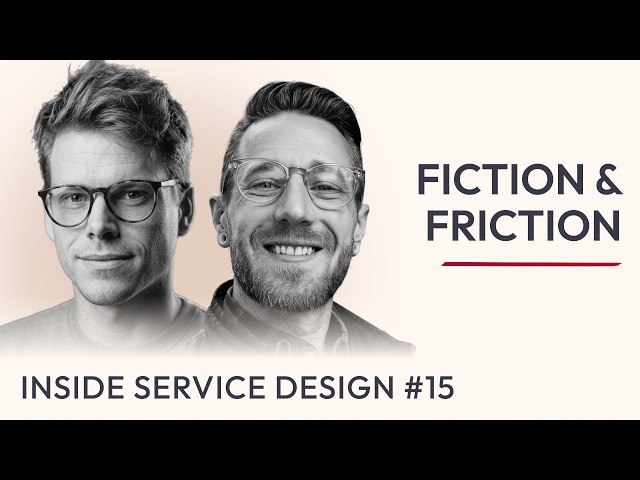
The Job You Were Hired for Doesn't Actually Exist / Zac & Jeff / Inside Service Design #15
Watch on YouTubeVideo summary
The reality of in-house service design roles often diverges significantly from official job descriptions, as hosts Zack Hazy and Jeff Hogwarter illustrate through their personal experiences. Both professionals were hired for tasks that differed from their initial titles or the buzzword-filled postings written by HR, leading them to realize that strictly following a literal job description can be misleading. Zack discovered through freelance work that websites are rarely the root cause of business problems, prompting him to pursue advanced education and eventually secure a role at Kaiser Permanente only after bypassing formal applications to connect directly with a hiring manager who clarified the actual needs of the position. Similarly, Jeff transitioned from museum design into service design without prior UX knowledge, facing stiff competition in government roles where he learned that success depends on understanding the true scope of work rather than just the written requirements.
Beyond the surface-level duties, the hosts emphasize that navigating internal politics and uncovering unstated organizational goals are essential skills rarely taught in design school. Jeff shares his story of resigning after five years when he realized his efforts were misaligned with unspoken company objectives, noting that fighting lost battles against senior leadership was ultimately futile. Zack challenges the industry's obsession with "delight," arguing that in critical sectors like healthcare or tax services, the most valuable outcome is often efficient and unobtrusive service rather than an overly polished experience. He warns that using delight to mask fundamental issues such as access delays or systemic failures can be detrimental, suggesting instead that designers should prioritize core value first and treat delight as a secondary element rather than the primary focus.
The episode also highlights how well-intentioned actions can backfire without a deep understanding of the organizational context, as demonstrated by specific anecdotes from both guests. Zack recounts spending half a day redesigning a workshop agenda to show initiative, only to be corrected by his manager who explained that established processes and unspoken reasons justified the original plan. In another instance, Jeff learned that publishing a research report publicly was perceived as an attack due to a lack of nuance, leading him to stop sharing such documents without first consulting stakeholders after facing a scathing reaction on the company intranet. These stories underscore the importance of measuring progress not just through deliverables, but by looking for internal referrals, completed projects, and deriving satisfaction from enjoyable conversations and positive team interactions.
Ultimately, the discussion concludes that job seekers should practice concise interview pitches using tools like AI and actively seek human connections rather than relying solely on online applications to navigate these complex realities. The hosts urge applicants to look beyond the official charts and understand how decisions are actually made behind closed doors, as the gap between organizational structure and real power dynamics is often vast. By joining their community, "the Circle," professionals can learn these unspoken aspects of service design and organizational navigation, ensuring they are better prepared to thrive in roles where the actual work differs from what was promised on paper.
Read the full video transcript
The job that you've been hired to do
probably isn't the job that you've been
hired to do. I know that sounds a bit
like a riddle, right? But if you've ever
worked in house, you know it's just
another Monday. Our guests today both
have learned this the hard way. One of
them published an honest research report
on the company internet and got invited
for a friendly chat with management. The
other redesigned a workshop agenda
nobody asked for one month into the job.
Both did exactly what they were hired to
do. And guess what? That turned out to
be the problem. Welcome back to Inside
Service Design, the series where we skip
the polished case studies and talk about
what driving change from the inside
actually looks like. Messy, human, and
often slightly political. My name is
Mark Fontine and for this conversation,
we are joined by guests from both sides
of the ocean. Zack Hazy started in
digital marketing, spent years building
websites, and kept running into the same
discovery. The website was almost never
the real problem. That itch took him all
the way to Estonia for a master's in
interaction design. And today, he's a
senior consumer experience designer at
Kaiser Permanente,
one of the largest healthcare systems in
the United States. The title doesn't say
service design anywhere, but the work
does. Jeff Hogwarter, a fellow Dutchman,
studied interior design, then museum and
exhibition design in England and spent
10 years building museums everywhere
from China to Kurasau. Then he switched
to service design without ever having
heard of UX, grew into a lead service
design role and stayed for almost 5
years. And by the time that you are
hearing this, he has transitioned into a
new government job. In this
conversation, we end up spending a big
chunk of our time talking about job
hunting. And honestly, I'm not even mad
about it. You'll hear what to do when a
job description is so full of buzzwords
that you withdraw your own application.
Why Jeff practiced his interview answers
out loud with an AI coach and how his
biggest lesson fits into a single word
shorter. Jeff shares the concept of the
unofficial map. how to figure out where
decisions actually get made before you
waste months on something that was
already decided in the back room. And
Zach asks whether every single service
really needs to be delightful. Sometimes
the best service is the one that you
barely notice. And the light should be
dessert, not the main meal. And make
sure to stick around for the
professional bloopers because we have a
lot of them. As always, these
conversations started at the dinner
table sessions inside the circle, our
community for in-house service
professionals, a space where currently
over 75 members from 20 different
countries meet every single month to
learn from each other and grow together.
We just wrapped up our season on the
political organization and our new
season, the business logic, is already
running. If you want a seat at the
table, have a look at show.com/circle.
But for now, let's find out what the job
really is. Here are Zack and Jeff.
Welcome to the show, Jeff. and Zach.
>> Hi Mark.
>> Hey. Good to have you on. Uh a fellow
Dutchman and uh somebody from Baltimore,
USA. Always nice to have an
international representation here on the
show. We're going to talk about in-house
inside service design. That's the title
of the series that we are been doing for
almost a year now. I think uh you've
both got some uh opinions about that,
some experience related to that. We'll
also um dive into some of the uh
community sessions that you recently
hosted in the circle unpacking the
political organization. But before we
dive into all of that, we often like to
start with how your journey started. So
Zach, if I can start in this case with
you. um could you give us some
background and backdrop of how you got
into
service design and maybe like if you can
share a little bit about how you got
into the position you are today so
that's a big question but like did you
did you study service design do you have
a I don't know how did you get here
>> yeah so I I didn't start off studying
service design I studied uh
communication actually in undergrad
um and out of university many years ago
go. I uh I started off working in a
digital marketing agency. Um so I was
agency side digital marketing
specifically for a number of years and
that sort of progressed into me becoming
interested in web design and web
development um and wanting to sort of be
on the on the building end of that work.
Um so I did web design and web
development for a number of years mostly
in a freelance capacity for smaller
businesses but uh also worked in a
couple of agencies in that role. And
what I started like discovering these
problems kept cropping up um was that
businesses would come to us or come to
me and they'd say like, "Zack, we need a
new website to to solve business problem
X, right? Like for we need more sales
and the b the website's the problem or
um we're not getting enough um like
brand recognition and the website's the
problem." And more often than not, as I
started to doing a bit of discovery, the
website was not the real problem. it was
some other business issue further
upstream that I wasn't being hired to to
to solve at the moment. And if I would
try to raise that in a conversation,
usually it was politely shut down and
just said like, "Hey, like we hired you
to build the website, like just go do
that thing, right?" And it was around
that time where I was having these sort
of recurring conversations um that I
sort of discovered like design thinking,
specifically the design sprint
methodology with with the book with Jake
Knap came out. Now it's very popular.
Uh, and then just like human- centered
design as as a more broad discipline.
And I got really interested in like this
idea of design not only as like an
aesthetic
way to make things look nice, but an
approach to solve problems, right? Like
a strategic tool that you could use. Um,
so I went down that rabbit hole a little
bit and and that sort of introduced me
to this master's program in Estonia that
I pursued in 2022. So I got my masters
in interaction design from the Estonian
Academy of Arts. Um and that sort of has
led me to where I am at now, which is
sort essentially applying service
design, human center design, whatever we
want to call it, whatever flavor you're
into. Um to problems in healthcare. So I
work for a large healthare system here
in the US. Um and I think Mark, your
second part of that question was how am
I how did I get that role in system?
>> Yeah. Yeah. Was there was there uh a
position open for a service design
professional or was there a different
label?
>> Yeah, so that's a really good good
question. So my current title as it is
is not doesn't have service design in
it. So it's I'm I'm currently a senior
consumer experience designer or CX
designer on the consumer experience
architecture team within the larger
enterprise consumer and patient
experience department at this healthcare
system. So, in no way is that sort of
tied directly to service design, but the
day-to-day work that I do and that my
team do is is very much aligned with how
we would all define service design. It's
it looks just like what service
designers are are are doing in other
organizations. The way that I got this
role was was quite random. I I reached
out to someone on LinkedIn who was doing
interesting work in healthcare and and I
was interested in connecting with this
person and learning a bit more about
them. We had a nice conversation um and
she suggested, hey, like I know this
team um at Kaiser Permanente, which is
the healthcare system I work for, is is
hiring designers. You might want to look
into it. And at first I read the job
description and I was like, this is not
for me at all.
>> But I thought, why not, right? Like I'll
apply and see what happens. And you
know, long story short, here I am
working in that position. So
>> what what made you doubt the uh
position? What did you read?
the [sighs] So, the job description was
just
um mostly buzzwords if I'm being honest.
And to be like totally transparent, I
applied, I submitted the application,
and a few days later, I just felt like
this wasn't going to be the right fit.
And I didn't want to waste my time or
the hiring manager's time. So, I did a
follow-up email and I said, "Hey, like
look, I I want to I want to essentially
resend my application." And they were
like, "No, no, no, hold on. Like, let's
just get on a quick phone call. I can
walk you through what this role might
look like. Uh, and that was just I'm so
grateful for that conversation because
it was like a human like I spoke to who
is now my manager. And she was like,
I'll admit this job description isn't
the greatest. I didn't write it. It was
written by HR. Here's what this job
really looks like. I think you'd be a
good fit, but if you don't want to move
forward, it's up to you, but like I this
is what it is, right? And that was super
helpful for me to understand, okay, this
is actually the type of work I want to
be doing. it's just sort of presented to
me in a way that isn't very attractive
which could be a lesson for other
service designers too looking for work
is that like if you can connect with a
human being at some point do that wow
yeah this makes me wonder we've indexed
over six and a half thousand job
descriptions over the last five years on
service design jobs how many of them
actually live up to the the to the
description yeah it would be
>> it's a great question
>> yeah
I wouldn't uh feel that percentage is
quite high That's that's
Thank you for sharing that. I hope this
is sort of an inspirational and
motivational u uh story for everybody
looking for a job like just get through
the job position like read post the uh
the listing and just get to talk to a
human. Maybe we'll do a whole episode on
that later. Um okay, super interesting.
Thanks, Zach. I'll pause here for a
second and sort of hand over the mic to
Jeff. Um, did you also study
communication or did you go to Estonia?
Where did your journey start, Jeff?
>> No, I didn't go to Estonia. I went to
England which is uh not as far as would
have been for you Zach but uh um
[clears throat]
no I I I started out uh my my design
career in interior design uh interior
design school and uh afterwards I um
went to England and studied museum and
exhibition design and I had a a master's
degree in MA master of arts degree in
exhibition design and and that's that's
how I got started. started there from
schooling on. Anyway, uh afterwards I I
moved back to the Netherlands and I uh
you know it was the financial crisis so
it was a little bit of a tough uh tough
time to find a job but I was lucky
enough to get like an internship uh at a
exhibition design company and I I worked
there on and off for a few years and
eventually landed a uh uh
a a a full-time position there and I
worked there for about 10 years uh
working all over the over the world. Uh
I went to China,
Kurasau for like all all all places
where where museums are and I worked
with local teams to to set up uh museums
and design uh mostly science and and and
and culture museums which was a very
very very nice job to be honest. But uh
at one point I was got a bit tired of it
because it was very repetitive.
Uh but we were doing these um studies
into like the user and uh doing
workshops with our clients and uh my
wife at the time uh no my girlfriend at
the time still uh she's my wife now
she was like oh you need to apply for
this job here and uh then I worked uh
and I did it and I got a service design
job uh which I I had never heard of. UX
was a completely new thing to me at the
time. Uh I I I just didn't know it was a
thing. So I just went and gone and did
it. And uh after two years I moved on to
the current role I have. Uh I'm I'm a
lead service designer currently. Um
and uh I have
a little bit of news just resigned from
that position and accepted a uh a new
job somewhere else. I think when this
comes out would have probably already
started there.
>> I think so.
>> Yeah.
>> Yeah. [laughter] So Jeff Yeah. This was
Thank you for sort of giving this uh um
uh layup for me because I wanted to dive
into it. What's your experience with the
um it's not the job market but applying
for service design roles like can you
say something about the the actual job
listings versus the process versus how
did you experience that?
Honestly, very tough. It was very tough.
I've been um looking uh for almost
3/4ers of a year uh before something
really landed. Um but I was looking for
something more more specific like um um
which which has like societal value is
like most humanentric. There were like
jobs in like banks and and and
things in the finance where I'm
currently at and I wasn't as interested
in that. I I actually really wanted a
job in the government. So I was looking
into specific roles there. Um, and I did
eventually land a role in government,
but it was it was tough. Um, because
even though uh I think I'm pretty
experienced, um, the the the the
feedback that I got most of the times is
like, oh, there's there's like 30 people
who are more experienced than you are. I
was like, "Oh, that's that's surprising
to be honest because you know within the
Netherlands, I didn't really expect that
many many service designers to be
looking for a job at the same time and
also to have more experience than I
have. I've got like just just short of
20 years of experience, you know, like
that's that's tough. How how can I beat
that? That's just I can't." And and
>> and for Yeah. So, how did you eventually
uh manage to get this role? How did you
get through all the 30 compet
competitors?
>> Yeah. So, I was I was talking to uh a
person last week was because uh I went
to a first meetup last week of my new
position and he was like um uh I had to
review those 30 positions and uh he was
like, "Oh, the the the things that like
really stood out is like the words that
you were used uh in on the CV and the
and the application letter because you
know at at one point you just start
scanning these things for like the right
words. Um, and uh, you know, the right
words, the right vibe, the just just
just the click, let's say.
>> Um,
>> yeah, that makes it so hard because it's
almost like black magic, right? How do
you
>> It is. Yeah.
>> Yeah. It's so
>> yeah, it's really tough to be honest
because because because I I I think uh
eventually I I was also looking at okay
maybe I should you know dim down my
expectations of like like going for a
senior function and maybe go for like a
media function or something and also I
um uh I got into like the last one to a
few times but uh I'm not a very salesy
person [snorts] and it always came down
to like you know selling
your story and I really practiced that
kind of the selling of the story in the
last last interview um um
whatever uh and and I I think that they
did as well. So the you know this the
selling the story the the the more
practiced um
>> so what does that mean if somebody would
approach you now for advice somebody's
looking for a job and they said Jeff you
know what's the golden tip you can give
me
>> practice yeah practice what uh I
literally used AI to pose me questions
and I responded to AI uh vocally uh like
with the microphone phone tool and they
gave me tips and I responded again. I
just literally practiced with AI and
that was very helpful.
>> So what was the biggest lesson? What was
your biggest gap blind spot?
>> Uh shorter, less theoretical, less
method methodological
uh shorter salesy pitch it you know 60
seconds you know this is what I did.
This is how I reached it. That was the
eventual goal. Uh, just shorter.
>> Shorter. Maybe that's going to be the
title for Okay, we're done with this
episode. That was it. [laughter]
Uh, okay. Uh, I I want to pose this one
to uh, Zack to you as well. I didn't
expect that this would turn out to be a
job hunting uh, episode, but like uh, do
you have any like key lessons or things
you wish you would have known applying
for a job or if somebody's looking for a
role and would ask you for advice? like
what's the what's the one thing you'd
tell them?
>> Um, going back to something Jeff said,
um, don't wait till you need the job,
especially if you're looking for
something specific, right? So, in my
case, if I wanted to continue working in
healthcare
and I was looking for a new job, I'd
start, you know, at least one year
before I was seriously going to to maybe
um make that change. um if for no other
reason than just to sort of keep my eye
out on these opportunities that pop up
because
service design jobs, especially here in
the states where service designer is the
job title specifically, are not common.
And then even less common are those job
titles in a very specific vertical that
you're looking for, whether it be
government or healthcare. So like that
job might come around once a year and so
you might miss it, right? if you don't
have some type of job alert set up or
you're just not like in the practice of
sort of casually reviewing. So, I would
say like that's one thing. I love the
idea Jeff gave of of using AI as like a
a coach um and going back and forth. I
never thought of doing that. I think
that's brilliant and I will be doing
that if if I find myself in in the job
market again.
The only other thing that I'll say is,
you know, I spent quite a bit of time
doing the normal application process,
which is essentially open applying to
any opening that I saw on LinkedIn or
any other job listing website, right?
Like, you know, tailoring my resume to
the point that I could and submitting it
into what felt like a black hole of like
no human ever looking at this CV,
resume, what have you. And so what I
started doing was if there was a job
that I really felt passionate about or
or felt that I was a good fit, I would
apply through the the recommended
channel, then I'd also always try to
find a human connected either like the
manager of that team or the hiring
manager and send them a nice sort of
like non intense note, right, on
LinkedIn just to say like, "Hey, here's
who I am. I applied, but I want to
introduce myself, right?" Sometimes that
worked, sometimes it got ignored. But
either way, I feel like there needs to
there needs to be some type of human
connection at this point if you're
really looking for something. Um, just
because otherwise, yeah, your your
resume is getting thrown into that pile
of 30, 40, 100 other people who are
getting scanned by an AI as the first
pass most likely, right?
>> Yeah. Yeah. Uh, yeah. good takeaways and
good things to remind ourselves of to
look for positions when you're not in a
dire need and the positions might not be
like listed on the service design and
also maybe the positions that you're
looking for aren't online at all like
they might come from the people who you
know and who you uh follow. Yeah. Uh
okay. So here are some good tips if
you're looking for a new position. Um
let's wrap up this section because I
think this is an interesting uh bridge
to uh our next chapter in this uh
episode and that is about the
conversations that you hosted in our
circle community. For anyone who's
listening for the first time to this
podcast, uh there is a community called
the circle which is specifically for
in-house service design professionals
whether they go by the title or not. Uh
that's what we've been doing for the
last 5 years. Right now we're with about
75ish members from 20 different
countries and every month we host uh
which we call dinner table conversations
where we explore a topic and Jeff and
Zach hosted both one of these dinner
tables. Um let's dive into what they
were. They were in the season of which
we called the political organization
spicy juicy uh topic. Um Jeff, you
titled your session the unofficial map.
Sounds mysterious. What is the
unofficial map and why did you go for
that topic?
>> Yeah, it's a bit of a a bit of a selfish
one for this one which you always advise
us to do, right? But uh [clears throat]
yeah, I was looking uh because I've just
uh accepted a new job like okay polit
politics is is is as far as I understand
it you know the decision making and
there's a lot of times the thing that we
as service designers struggle with is
you know getting the right decision out
there or a decision being made without
uh us being involved or the the customer
being uh involved in in the decision at
all. So um I I was looking at like okay
so when I start a new job how can I
preempt the decision by
you know making sure that I know what
the political landscape is. How can I
influence the the decisions before they
are made?
How do I know who the people are who
actually make the decision unofficially?
Uh because that that's that's where the
name comes from, right? There's the the
official process, the official uh way uh
like say like gate stages, whatever,
right? Uh and there's like the the the
unofficial
uh
bros meet at a bar, you know, just
broing out. uh [laughter]
um you know how how do you know that
before before the decision is being made
so you're not wasting your time and
effort uh in in in in in mapping
something out while the decision is
already made in back rooms that's that's
kind of looking at
>> yeah yeah I I guess everybody who's
listening right now feels this where we
sort of have the u orc chart and we have
the HR model of how things flow through
the organization what the official
processes are. Uh and then there's
reality where like you say everything is
messy and it's about who knows who and
when is the next promotion and uh what
the stakes are, when the deadlines are
uh that really influence how decisions
are made and it often doesn't have to do
anything with for example the quality of
your work or the talent that you bring
but like there are other power dynamics
involved. Okay. So super interesting.
I'll get back to you in a second to sort
of uh hear what some key takeaways were
from uh that session. Zack, you also had
a very provocative uh [snorts] um
session. Uh it was about the politics of
the light. Uh we all love the light,
don't we?
I
>> I mean I love it personally. Yes. I
would like more of it in my life.
>> So what was the session about?
Well, I I was arguing that while I think
all of us would want more delight in our
life, that doesn't necessarily mean that
maybe every experience that we as
designers are working to strive towards
should be centered around this idea of
delight. Um, so this sort of
conversation
again, same same idea as Jeeoff, I took
this on selfishly because ever since
working in healthcare over the last
fiveish years, this has been something
that's been in the back of my mind is
that there seems to be a disconnect
between the reality that patients face
when they engage with healthcare
services and the context in which
they're doing so and the aspirations of
leaders in healthcare to sort of make
healthcare a delightful experience.
I I I I posed questions to the group
around, you know, what does it mean to
design for undesirable experiences such
as going to the doctor or, I don't know,
paying taxes or um I use the the the
example of the DMV, which folks in the
United States know that this is just
like a um a very famous painful
experience that everyone has to do and
and hates doing, right? Um, and and
maybe these experiences shouldn't have
ever meant to be delightful in the first
place. It's the wrong metric to use,
right? Um, and and maybe we wanted to
design for something less, I don't know,
aspirational when we're designing in
those contexts. But what does that look
like when you have to have those
conversations internally? And that's not
a popular thing to say, especially to
your boss or your boss's boss to say
like, "Hey, people don't want this thing
that we offer really if they had a
choice." And so how do we design with
that context in mind versus trying to
you know mirror what Disney is able to
deliver or Starbucks or Apple or
something like that.
>> Yeah. Yeah. If I remember correctly
there was recently a book published
around Disney and healthcare that made
some waves. Uh yeah
>> we love Disney and healthcare for for
some reason that I'm not totally sure
of.
>> Yeah. But you're right. It's um um there
are services where the best service is
the one that you wouldn't actually want
to use, right? Uh it's a service that
gets out of the way and it's transparent
and it's like totally unremarkable and
just gets the job done in a very quick,
efficient, and sort of un unintrusive
way. Um, but you don't score points
internally most often by uh saying that
you're going to remove things and that
you're going to simplify things. Um,
that's not what gets you a promotion.
So, um, how did the group respond to to
this uh, provocation?
Um I I appreciated that there was some
push back from from from some of the
designers in the discussion um who who
were sort of sort of took issue with
this idea that like why why can't we why
shouldn't we try to make any experience
even the painful ones delightful which
on the one hand like I I see where
they're coming from. Um and I don't
necessarily disagree that in an ideal
world like everything would be
delightful right even the painful
experiences.
Um, but on on the other side of that, I
think something that I really anchored
to was this theme of of what what are we
masking when we design for delight,
right? And I really liked that framing
of of the approach. Um because you know
I I feel like we can sort of gloss over
a lot of uncomfortable things that maybe
our our user base are facing and and
difficult things for us as designers to
design for if we just say well we'll
just make it more delightful. We'll just
remove friction or we'll just I don't
know put some little whimsy in the app
and and that will make them feel a lot
better about I don't know having to file
an insurance claim for the car accident
they were just in or something like
that. And you know, I don't know if it
always works that way.
>> Mhm. Yeah.
Do you have any examples or stories
where you've seen this happen where sort
of people are I like the word mask
actually like trying to hide and behind
trying to hide behind the light as uh
yeah no trying to hide behind light any
any stories that come up? So I will say
more broadly in healthcare specifically
I feel that
this rush to sort of cram AI into every
service that we offer is almost masking
some of the real fundamental issues that
faces healthcare in the United States
which is access right it's it can be
upwards of three four five weeks to get
an appointment with your primary care
doctor in the United
that's a very difficult problem to
solve. Um, and so instead of sort of
tackling that and facing that and
acknowledging that, we're sort of
saying, well, you could just like talk
to an AI to sort of triage some of your
problems and maybe maybe that like takes
care of it. And I I I feel like while we
should be pursuing ways to sort of
incorporate AI into care processes, I
don't necessarily know that that should
distract us from solving more more of
those those thorny those wicked
problems, right? That aren't as sexy to
fix, but are fundamentally part of like
why people are engaged with us in the
first place.
>> Mhm. Yeah. Uh good point. There are some
uh good conversations recently on the
service design show related to this
topic uh as well. Um, I'll need to look
up some of the episodes and put them in
the show notes. Okay. Um, again, I'll
I'll get back to you in a second, uh,
Zach for sort of the key takeaways. But
Jeff, I we left off, uh, looking into
the unofficial map, how decisions
actually get made. Um, what did you
learn? What was your takeaway? Because
you said, uh, this is a topic that I
picked quite selfishly, which you
absolutely should. So, what did you take
away?
>> Ooh. Uh [laughter]
I think I think this this is a bit
twofold. Uh um
yes you can influence decisions and uh
you need to have the relationships and
and the people to do it which has been
like a recurring theme right
relationships people it's always the
thing that comes up. Um
but on the other hand there was uh a a
something that stood out to me is it's
also also one of the reasons why I made
the decision to to to you know resign my
current position and look for another
job is you know uh do you just accept a
decision and and not die on that hill
and because
uh sometimes decisions are above your
pay Great. And you know, uh, should you
even care enough or even bother to fight
it? Because, you know, the the the the,
you know, the the the the the the
romantic story is like, oh, you should
keep fighting, right? Keep pushing with
with the with the right data, with the
decision, uh, with with everything that
you've gathered in your research. But
you know if the CEO makes a decision
based on what they know uh who are you
to to to to fight that almost right uh
and
uh it's like do you accept and move on
and and go and do another thing even
though that can be very disheartening um
uh or or um one of one of the reasons
why I quit my job is like like that
happened a too many times and I just
chose to uh move on to another uh
another environment and it's like
>> so so Jeff can I ask a personal question
and feel free to sort of skip it if uh
if you don't want to get into it but at
which point did you know that like all
right this this isn't going to work I
need to look beyond this
>> right yeah um I think you know I've I've
been in in this uh position for almost 5
years and we started out with almost
nothing. So, I've been building up and
building up uh for about four years
until I hit this this this moment of
like, okay, maybe this is not going
anywhere. Um and and I think that was
driven by my own ambition and the
ambition of the people around me uh of
getting getting stuff done and getting
stuff set up. And also at one point we
got the right tools and we got the right
methodologies with those tools and it
allowed us to do stuff. But uh I think
at one point I just hit a wall and um I
was like I I think I also listened to
one of your podcast
>> and [laughter] yeah
>> sure blame you.
>> Well I wouldn't blame you but I
definitely tipped the scales a little.
Um uh it was uh it was there was a point
made of uh this person used a sort of um
a decision matrix of like four points of
like uh can you use the right
methodology? Are you embedded in the
team? Uh can you uh actually link your
efforts to company goals? Do you feel
right about it? Uh I don't recall who
this person was but it was quite um
profound I must say. And I was looking
at those metrics for myself and I was
like, "Oh, those score really low." And
is this then enough for me to decide,
all right, Elmo, let's uh let's move on.
All right. Uh let's let's find another
Maybe this isn't the right environment
for me to practice service design.
>> Oh, not not anymore. Maybe, right?
Because you evolve, the company evolves,
right? Yeah.
>> Yeah. Yeah. Yeah. Exactly. Yeah. Yeah.
I've learned a lot. I I can't deny that.
It's like this position has allowed me
to uh develop my my service design
skills tremendously. This is like quite
quite quite quite something. Uh but I
think yeah at one point you just need to
decide.
>> Yeah. And moving into a new position and
like this is looking into the glass ball
into the future. Do you think you'll be
better equipped now to sort of recognize
a signal sooner?
>> I hope so. I'm not sure.
>> Okay. what what what signals will you be
looking at maybe more often or quicker?
I think I think one thing that that
stood out to me um is me
misunderstanding uh the or not
misunderstanding maybe um the company
has a vision let's say uh a northstar
which I got hired on and uh
well one of the things is that to become
very humanentric
I totally went for that you know with my
lead and um from from from my experience
and my in [clears throat] agency you
just you just go for it and you produce
the stuff and I think 2 years in I
started to realize all right that might
be the vision but that's not where we're
currently at and the stuff that I've
been producing is not um is not the
stuff that people actually want. So, I
was just getting into action without
understanding
the actual goals of the company. Uh, and
and I'd been uh reading the first 90
days um by Michael Wat Watkins. Uh and
and and one of the points that he makes
in the beginning is right you need to
understand the culture, the the the the
politics. You need to understand the
real metrics that people want to make.
you need to understand the real
decisions that need to be made. And I
think in the beginning of of my current
position, I just went for it. I I didn't
I didn't go I didn't understand I didn't
talk to the stakeholders. So, I just
went
>> and maybe um because when you share this
uh and the 90 days, great book, by the
way. Uh also try to link it in the show
notes, but uh maybe this is an
experience that you sort of have to go
through at least once to understand what
what you're missing because it's it
feels so hard to explain when you say
you need to understand the culture and
the real magic. Like roll up your
sleeves and just get the work done and
people like build it and they will come.
Like that's the attitude, right? Um but
often Yeah. That's that's the trap.
>> Yeah. And I think I think this is also
always one of the questions, right, with
uh uh the difference between agency and
and in-house. Uh my experience from from
agency roles is uh you get hired to do
the job and people want you to do the
job. uh so you do the job [laughter]
and and and uh the biggest difference
for me uh is that I've from that
experience been very output driven. You
make the thing and over the over the
years uh I've realized that the thing is
not what we are about in house and
that's that's a reality check that is
very very tough. If you've like done 15
years of output driven work making the
shift to almost you know it's not about
the output it's about you know the
weekly nudging and it's about the
influences about the levers
that's that's a really big big shift and
I still struggle with that that's that's
very difficult
>> yeah it almost feels quite unfair to get
design professionals in this position
where because design inherently feels
like it's it's about creating. We should
have we should have recruited
psychologists and change managers and
anthropologists uh into these positions.
Okay, Jeff. Uh sorry. Yeah, thanks for
that Jeeoff. I wanted to say Zach, any
any comments before we uh sort of look
into the highlights of your uh dinner
table? Any comments on what Jeff's just
shared? No, I was just resonating so
much with my my same feelings around,
you know, sort of coming into this
in-house work with a naive sense that um
yeah, I was hired to do this job and and
I was sold this vision and let's just
push for it, right? with without sort of
understanding all of those underlying
um internal dynamics and and and
relationships and and context and you
know stated goals versus like um I don't
know tacit goals that you don't know
until you sort of like talk to the right
people. Um, and just thinking, you know,
like I guess I don't know what the what
the right term is, but like political
navigation is absolutely like a
fundamental skill that needs to be part
of the in-house designer toolbox. Now,
um, whether fairly or unfairly, Mark,
like you brought up the point, I agree
it's not necessarily what we learn in,
you know, if you go to design school,
they don't teach you how to sort of
navigate internal politics as part of
the curriculum. But if you're going to
work inhouse and you want to really be
impactful, I think that's something that
you have to try to learn as quickly as
possible. And it's not easy.
>> It's super hard.
>> Yeah. you almost like I said you need to
be a u I said anthropologist but uh the
there's a different word that I'm
looking for but like an organizational
anthropologist a detective like when
when you read about stated goals or
stated agendas or stated deadlines you
sort of should take note of them and
then always assume that there [laughter]
there are a lot of unstated goals and uh
things that you haven't discovered yet
because when you said this Zack. I was
like, when you get hired into this
position, how can you know? Like, you're
assuming that people aren't lying to
you, right? They're they're they're not
trying to fool you or to sort of deceive
you. Like, it it's often very hard for
them to even express these these hidden
dynamics. So, like it's it's hard to
blame anyone in this situation, but
>> Yeah. Yeah. Does that make sense, Jack?
>> It makes sense to me. Yeah.
>> Yeah. Okay, cool. Okay. So uh wrapping
up this uh unofficial map uh thing,
let's uh also wrap up the uh politics of
delight. Anything that you took away or
the key thing that you took away from
your session in Zach?
>> Sure. Yeah. So, so beside this this sort
of idea of
um using delight to mask maybe more
fundamental issues, I would say a couple
of like really nice framings that I
appreciated that the group came back
with was, you know, this friction
between improving the good parts of your
service or your product or what have you
versus reducing the bad. Um, and sort of
like what does that look like? what are
the politics wrapped up in in uh
indexing on one one end of that spectrum
or the other. I really liked sort of
that. Um, and then this idea of like
using delight as dessert instead of the
main meal I thought was really a fun way
to look at it. And and
it sort of anchored back to something
that I'm feeling is like look, we can we
can we can pursue delight as a design
goal once we've sort of um made sure we
have the fundamentals of whatever our
service is down, right? And so if you're
thinking about, I don't know, again,
healthcare, right? are you delivering um
good health care outcomes and and
delivering accessible healthcare to
people, right? Like that's like
healthcare 101. If you're if you're not
doing that, that's where you should be
focusing. Once you can do that with
consistency and and value um and
quality, okay, then let's sprinkle on
some delight as a dessert.
>> Yeah. Yeah. And I guess it it also
matters a lot the industry that you're
in. Like I can I can imagine again if
you're Disney, sure the roller coaster
needs to needs to work like you need to
get the hygiene factors in order. Uh but
the light might like the light will be a
different shader, a bigger
differentiator there than it is at the
DMV, right? Is you don't have to design
for the light to to gain a competitive
advantage, right?
>> Or in your taxes. Yeah.
>> Um cool. definitely a topic that's uh
worth exploring further and I'm sure
that we'll continue doing that in uh in
in the community. Um again, if you're
listening to this and you're like,
"Geez, that sounds super interesting,
fascinating. I want to talk more about
the political organization." Too bad uh
you're too late. We're wrapped up that
season. The next season that we're going
into is also an interesting one. It's
called the Business Logic. So, I think
we'll also have some interesting
conversations there. Um, check out the
show notes for more info about the
circle community and there you'll need
uh hopefully Zach and Jeff as well. Um,
all right, moving into the third section
of our conversation here. This is
usually the section where I sort of try
to do some midbusting around service
design. A few random questions and I
usually like to end on a positive note
and maybe we'll do that. I want to try
something else and um and that is sort
of uh look and listen to your bloopers.
So if I ask you Jeff like um when I ask
you [clears throat] what's the time that
you felt you really messed up like that
you that you made a mistake that you're
like oh jeez I wish I wouldn't have gone
through that experience. Is there
anything that comes up and let's keep it
work related to that.
[laughter]
Oh. Uh. Oh, I was going to go now. Um.
Ooh. Bloopers. Oh.
Um.
Well, may maybe one that that stays uh
that keep that
sorry words. [laughter]
uh one to come one that comes to mind is
that I had written this report uh about
um and then the first two years of this
job I did this like this explorative
research a lot of interviews um [snorts]
uh just finding out how people interact
with and you know perceive the service
and I basically come up with oh it's all
>> [laughter]
>> um
which is very much for my own
perspective and I wrote this this report
and kind of almost scathing uh sections
in it and I just put it on on on the
internal um how how do you call it like
the port internet
visuals? Yeah, [laughter] very visual,
very front to center. And uh yeah, uh I
got a few messages. I was like, "Okay,
uh that's that's you should really do
that." And yeah, I got uh
I got um Oh, and you say you get called
on the mat. [laughter]
>> Yeah. Got called into the office. Yeah.
Yeah. Yeah.
>> Yeah. Uh um god uh yeah not to rewrite a
couple of these things right it's like
okay a little bit more nuance is is
appreciated [laughter]
>> that that's that's also part of the
politics and the diplomacy I guess right
what can you state and what um what will
sort of offend uh people around you you
don't want to go out well maybe you do
in some cases but usually you don't want
to go out making enemies
>> no and I was very used to you know
writing just very honest reports from my
agent Sounds pretty Dutch. Yeah.
[laughter]
>> Yeah. Yeah. Uh, no, it wasn't that
appreciated.
>> Uh, [clears throat] how did you change
your approach based on that experience?
>> Well, what one big change is to stop
writing reports because they weren't
moving the metrics anyway. Um, and also,
you know, first uh first talk to the
stakeholders. I didn't even know
stakeholders was a thing at that time at
that time. Um, so first, you know, go to
the stage gates and not, you know, post
stuff very publicly. You know, what's
the point? Uh,
>> h well sometimes I can imagine that this
uh this might be a strategy in your
toolbox if you want to shake things up
and at least provoke and get a reaction.
Um, [snorts] yeah, but that I would use
that quite sparely uh and know what
you're doing. Okay. Interesting. Thanks.
Thanks for sharing that, Zach. You had a
moment to think about your uh sort of
painful experience. Uh like out of all
the things you could have picked, which
one did you go with?
>> Yeah, I mean the the one that's coming
to mind is one where I really wish I
would have had Jeff's session and an
unofficial map to navigate. Um because
um I was fairly new in a in a role. um I
want to say you know no more than a
month maybe and I was on a project and
there was discussions of of uh
organizing a workshop and I just felt
like that we were missing it wasn't
organized in a way that I I thought we
could we we could be doing it and and we
were missing some parts and so I thought
well okay this is my opportunity to sort
of show that I'm uh like a go-getter and
I can like get work done and so I took
it upon myself to sort of re redesigned
the agenda of what I thought this
workshop should be and should include.
Um, and I spent like a good, you know, a
half day on this thing and I submitted
it and, you know, an hour later my
manager asks to talk to me and, you
know, it wasn't a I I didn't get called
to the mat as they say, but [laughter]
it was um it was a suggestion that next
time I have those thoughts to maybe go
to my manager instead of presenting them
back to the team because there was
[snorts] all of these underlying
political
um sort of pseudometrics, all of these
things we've been talking about, Jeeoff,
that your it sounds like your session
was was anchored on that I had no idea
about because I was only a month in,
right? And I'm just thinking like, well,
this doesn't feel right. I got hired to
do this job. I'm going to do it right.
Like, I'm going to take action. I want
to be seen as this person that brings
value and does the work. And yeah, it
was a it was a very quick lesson for me
to learn to sort of take a step back,
try to evaluate why are we approaching
it this way? These are also very smart
people. There's probably reasons why
it's being done this way, right? And so
to try to understand that before you
sort of put something on the company
internet or send a reply all to everyone
with a brand new agenda that they didn't
ask for. [laughter]
>> Oh, sounds so classic. And I I think all
of us have gone through something like
that. And again, this is with you're
doing this with all the best intentions
and sort of striving for the best
quality, best outcomes. Uh, and like you
said, like you're doing just the work
that you've been hired for, but
sometimes uh there's a reason why person
A makes the agenda and not person B,
right? And
>> yeah, [clears throat]
>> like
>> it feels like uh we should um we should
get a few books to read when we get into
a new role or some kind of manual. uh
because the job that you've been hired
to do probably isn't the job that you've
been hired to do, which sounds quite
cryptic, but uh that's the that's the
sense that I'm getting from all these
conversations with folks like you. Yeah.
Um cool. Thanks. Um we still have time
to end on a positive note and I I
definitely want to do that. So, um Zach,
I'll continue with you and then Jeff
will have some time and breathing space
to think. Um, one of the uh questions I
often ask is how do you know that you're
actually making progress? So, on a
Friday afternoon, how do you know that
this was a good week?
>> It's a really good question. Not every
Friday feels that way, Mark.
Um,
I think
some of the signals that I've been
looking at recently actually are
are there people who we haven't
interacted with as a as a either like a
a design team or a broader experience
department who are actively seeking us
out and asking us to sort of come into
their work. Um, and the more often that
happens to me, those are signals that
okay, like the people we have been
partnering with are talking about us in
a way that is in inviting others to come
and join the party. Um, so we're getting
sort of that word of mouth marketing
internally. I look at that as like a
metric of like, okay, we're doing we're
doing something right. Cuz if you
weren't, they'd be like, hey, don't work
with those guys. They're a pain in the
butt. It takes too long. They don't get
the job done. Whatever, right? Um, so
that's one metric. Um, another one would
just be like are you
finishing projects? I think in service
design, especially in-house service
design, that's for me at least like the
holy grail of like a a project
completed. Sometimes it just like goes
off into pilot land and I never see it
again. Um but yeah I I look at like you
know are there people who are want
actively seeking us out as collaborators
and asking us to be part of work or
seeking our expert opinion on something
before it moves forward when they don't
have to. Right. I think that that for me
is a is a good indicator of success.
>> Yeah. Yeah. Sounds and I've heard this
more often that uh you're looking for
referrals like if you'd be a business
you want your customers to be referring
you to become ambassadors of the work
you're doing. uh and that is a great
metric of success. If that's happening,
then like you're doing something right.
Uh whether you call that service design
or they call it service design doesn't
really matter. You're giving them
results that that they were looking for.
Um and you should like you should
reflect every Friday on what a win looks
like because I think uh there is always
something you've always made progress
even if it doesn't uh look or feel that
way. Uh Jeff, what about you? like when
you reflect on Friday days.
>> Yeah, I [clears throat] always find this
a bit of a tricky question because you
know uh as I said you know the whole
output driven thing kind of messes that
up but um I think I think I' I've been
thinking about this question a bit in
the last few months and I think for me
right now it comes down to job
satisfaction. you know, do I feel
satisfied with the work that I've done?
Am I happy about
uh about spending the time uh right you
know um and and if if that is uh
whatever it you know whatever artifact
made or whatever people that I talk to
whatever influence that I if I feel
satisfied about that at the end of the
week I think I think that's a for me
that's doing it you know um have
>> have you ever um and try to unpack that
and sort of peel the onion because
satisfaction like I think it's great to
to sort of rate your job satisfaction at
the end of the week on a score of 1 to
10 and then give it a I don't know an
eight but like internally your gut
feeling is basing that on something.
>> Yeah. Uh I think beforehand it was
always like uh did I move the needle or
was did I get something done? Uh I think
it's less and less that and it's more
you know uh did I enjoy the
conversations? Uh did I have a good team
meet? Uh
did I produce smiles in meetings? I like
joking around, you know. um uh you know
those kind of things. It's much more
human I think than than than
the job description actually says.
>> I wish we had more OKRs with goals like
that. Uh that would make work so much
more fun and enjoyable and probably so
much more productive as well, right?
>> Yeah. Yeah. Okay, cool. One very final
question to wrap up with and that is we
like to end with a better question than
we started with. So, Zach, if you'd be
in my spot and you could ask our fellow
service design professionals a question,
what would you ask them? How do you
continue to stay
curious and motivated as an in-house
designer over the years when you're
starting to see the same types of
problems crop up that you've been asked
to fix or work on in maybe different
ways, different flavors, but essentially
the same business problem and it hasn't
been addressed or resolved for whatever
reason. How do you maintain that sort of
sanity around continuing to chip away at
that and be curious to know how other
people deal with that? Yeah, so do I. We
spent a whole season, three months on
the resilient self. Uh it feels like it
has some connection to that as well, but
yeah, would love to hear that as well.
Um Jeff, what about you? What would you
ask our fellow service professionals?
>> Yeah, I first wanted to ask um uh how do
you know when it's enough and you need
to move on? uh which uh but I'm I'm also
thinking you know my my session was
really around how do you know the
politics and like how can you self how
can you give yourself a crash course in
the politics of the organization before
taking action
>> it feels like something we should uh put
out there into the world as a circle
like a crash course
and navigating the organizational polics
as a service design prefer politics as a
service design professional. Yeah. How
do you navigate that? What is the what
does a crash course look like? [snorts]
That would be such a like
[clears throat] Okay, sort of reframing
or adding to your question, Jeff, and I
want to see some comments here. If you
could add a a chapter or a paragraph to
the crash course the of navigating
internal politics, what would you add?
Super interesting, right? Let's see if
we can co-create this together. Um,
awesome. Thank you, Jeff. Uh, thanks,
Zach, for uh, in your case getting up
early in the morning, uh, doing this
call with us. Uh, Jeff, good luck with
the new position. Would love to hear how
that is evolving in a few months.
>> Uh, awesome. If you're still with us,
listen to this whole conversation, make
sure to check out the show notes. Uh,
and well, once again, thanks, Zach.
Thanks, Jeff.
>> Thank you.
>> Thank you, Mark.
>> I keep coming back to that line from the
start of the episode. The job that
you've been hired to do probably isn't
the job that you've been hired to do. It
sounds cynical until you hear how both
of our guests proved it. As we've heard,
Jeff wrote a research report, published
it on the internet, and learned that
honesty without nuance can land like an
attack. Zach redesigned a workshop with
the best intentions and learned that
smart people usually have reasons for
doing the things the way they do.
Neither of those mistakes was about our
craft. They were about skipping the step
where you figure out how the place
actually works before you try to change
it. The other thing I can't shake is
Zach's question from his dinner table
session. What are we masking when we
design for the light? When it can take 5
weeks to get an appointment with your
doctor, a bit of whimsy in the app is
not going to fix that. Fundamentals
first, delight as a dessert. And maybe
that's true for our own work as well.
When I asked Jeff how he measures a good
week, he didn't mention a single
deliverable. It was whether he enjoyed
the conversations and produced some
smiles in meetings. That might be the
most honest job description for in-house
work I've ever heard. If you want to
have conversations like these with peers
who actually get it, I invite you to
join us in the Circle community. [music]
It is the closest thing I know to a
shortcut for learning everything that
isn't in [music] job descriptions or in
service design courses for that matter.
Have a look at serviceeshow.com/circle
[music]
for more details on how you can become a
member and that link is also in our show
notes. My name is Mark Fontine and
thanks [music] for listening to the
service design show. Keep it shorter and
I'll get you in the next