Video summary
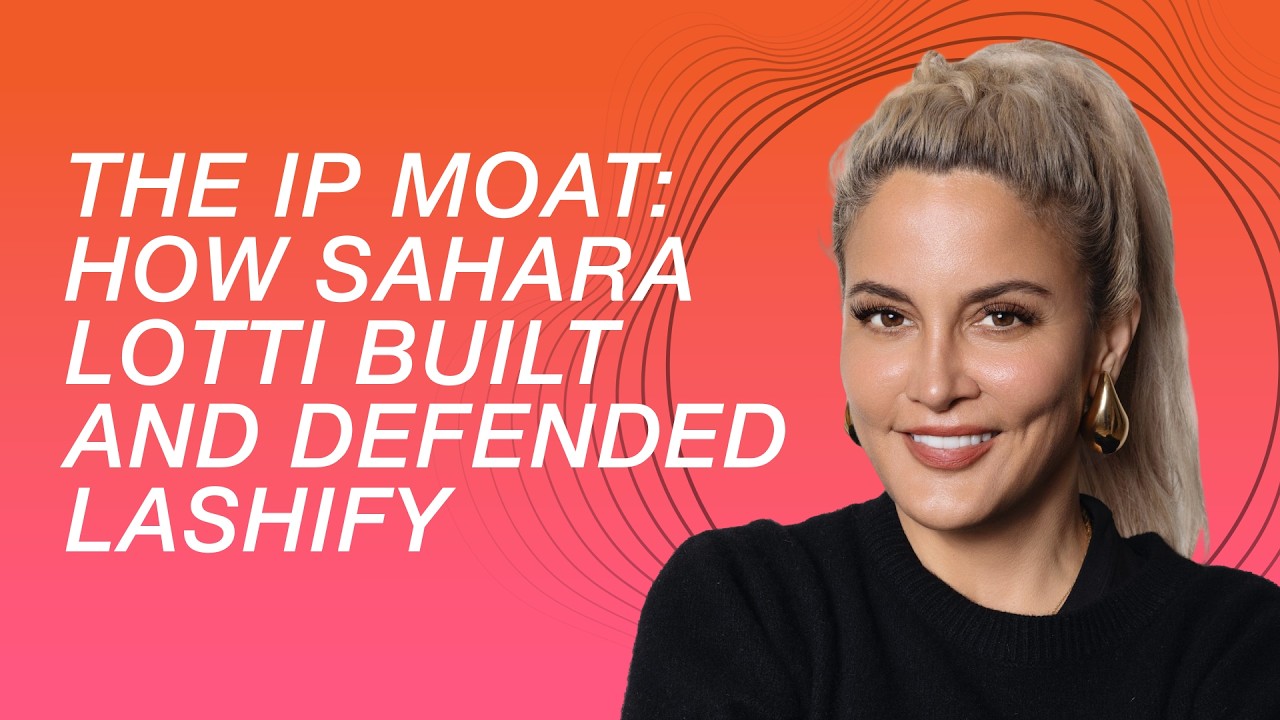
Sahara Lotti's journey into beauty began not with a business plan, but with a personal frustration over her addiction to lash extensions and the inability to apply them herself due to existing limitations in the market. In 2016, she identified a gap where consumers needed a system that mimicked professional extensions without requiring super glue or complex application skills. Her solution involved inventing a unique synthetic fiber made of PBT that could be melted flat to attach directly to natural lashes, paired with a specialized adhesive and a horizontal clamping tool for precise, underneath-the-lash-line application. This entire ecosystem was developed through her own prototyping rather than relying on private label manufacturers, distinguishing Lashify from the typical beauty industry model where major brands like Estée Lauder or L'Oréal act primarily as marketing companies that buy finished goods from factories they do not own.
The core of the discussion highlights the critical role of intellectual property in defending innovation against a culture of copying and "duping" prevalent in the beauty sector. Lotti emphasizes that while many brands operate by stealing ideas and mass-producing knockoffs in Asia, true innovation requires strong patent protection to prevent market saturation and loss of generational wealth. She recounts her difficult legal battles, including a major trial in Texas where she successfully sued an overseas factory supplying counterfeit products, setting a precedent that encouraged other inventors to seek similar protection. However, she also warns that patents are only as valuable as the resources spent enforcing them, noting that without active defense, innovators can be easily crushed by larger entities or aggressive marketing campaigns designed to tarnish their reputation and force them into dropping lawsuits.
Looking toward the future, Lotti is expanding her mission beyond lashes by launching a new company called Nibble, which features click-on nails designed for athletes and musicians who need hands-free functionality. This initiative stems from her desire to mentor young inventors like Hannah, who developed the concept independently, illustrating how Lashify aims to create an incubator that supports creativity rather than letting it get stolen. Her advice to other entrepreneurs is to be transparent about their struggles, build a genuine community around their brand story, and ensure they own their intellectual property from the start by filing broadly and strategically using mechanisms like the PCT system. Ultimately, Lotti argues that protecting one's IP is not just a legal necessity but a moral imperative to encourage original thinking and prevent the beauty industry from becoming solely a game of copycats, ensuring that inventors can reap the rewards of their hard work and creativity.
Read the full video transcript
Welcome to AdSe Week's podcast about the
business of marketing, media, and
creativity. In this episode, we're
sharing a conversation recorded live at
one of AdWeek's events featuring leaders
from across the industry discussing the
ideas shaping brands right now. Let's
get into it.
I'm Audrey Ken from AdWeek's AY's
reporter. We're closing the day with a
really interesting conversation about
power, ownership, and beauty. Our guest
is Sahar Lahi, founder
founder and CEO of Lashify, the inventor
behind the first DIY lash extension
system and the holder of more than 750
global patents.
Thank you, Rockstar,
which you all get to try today. So, that
makes it even better. [laughter]
Tonight, we're discussing how
intellectual property isn't just legal
paperwork. It can actually shape
culture, control category growth, and
build a brand moat, so to speak. Sahara,
thank you so much for being here.
>> Thank you. It's a pleasure.
>> Yeah. And so, before we get into the
world word patent and people's eyes kind
of glaze over, uh, I would love for you
to set the stakes. What problem did you
walk into beauty in 2016 that made you
say, "I have to invent something totally
new?" So really at the at the core of it
was my own vanity. You know, I I got
lash extensions done in 2004 and at the
time you had to go to Korea Town in Los
Angeles to get them done. And once I got
them done, I was like, I am so cute.
Like I was like, I look so freaking
good. And you know, you get out of the
ocean and you looked good. You'd wake
up, you looked good. And so I was
addicted, like genuinely addicted to
getting my lashes done. And at one point
I was going away on vacation and my lash
girl couldn't get me in. And it was like
I felt like somebody was like destroying
my life, you know? And I was like, and I
was like, I got to got to be way cuz I'm
a DIYer. Like my core I I like to DIY
things. So I was like, oh, I got to be I
could put this on myself. And I started
looking and there was absolutely no way
to put your lashes on. They had at the
time these little tiny hairs that were
like these little clusters that had
maybe five lashes on them and you needed
super glue in order to apply it and like
you couldn't do it cuz your eye couldn't
be open. And so I'm like well there must
be a way and so I started searching and
when I tell you like I'm a shopper I
search I'm a really good searcher and
there was absolutely nothing. Russia,
Japan, Korea like UK absolutely nothing
than these little tiny cluster things.
And so I wanted to invent I wanted
something that looked just like my lash
extensions. So naturally I took strip
lashes and I tried to stick those
underneath and I was like, "Oh, oh well
that and I put them underneath because
because I couldn't get them on top." And
so I was like, "Well, that was a lot
easier." I'm like, "But that doesn't
look like lash extensions." So then I
started going backwards and I figured
out, "Oh, lash extensions are made of
PBT, which is a synthetic silk." And so
then, you know, it went from there.
>> Wow, that's incredible. And so, can you
explain kind of in layman's language
what you actually invented, what we'll
all be trying?
>> Yeah. So, basically, and what I figured
out was that I couldn't get strip lashes
on. And for those of you that have tried
them, it's a skill. Like, you need like
a PhD, it's not easy. And so what I
realized was that I needed a new kind of
lash that instead of sticking on your
skin would connect to your natural
eyelash. So it was hairto- hair
attachment, but it couldn't be so thin
that I needed super glue because if I
needed super glue, I was going to blind
myself. So, what I realized is that I
was looking at like how the lash tech
puts on lash extensions and they come in
and they isolate each lash and they they
superglue cluster after cluster after
cluster like little tiny. So, I was
like, okay, let me go backwards. What am
I trying to create? So, I thought, what
if I take these silk fibers and I heat
them together so that there's no strip,
right? Cuz strip lashes have a strip.
instead melt them together and make them
super flat like a piece of tape so that
they're going to
lay underneath my eyelash. And then what
if I come in and create a new type of
adhesive that's like a mascara and I put
that on and then this thing because
they're both acryates in some form. It's
a form of plastic are attracted to each
other. And then I was like and I need to
create a tool that has a horizontal
clamp form. I mean horizontal clamp
force. So it's like this versus
precision like this. So then I had to
create that and then I had to create a
new way of applying them which was
underneath the lash line. So instead of
So it's like you're basically recreating
a lash line. So when I invented all of
those different components then you
could do your own DIY lash extensions.
>> I love it.
>> Yeah. I geeked out. I really geeked out.
Yeah.
>> Which is why you had to get patented,
right?
>> Yeah. And so what people are holding in
their hands right now, this wasn't
private label from a lab. You prototype
this yourself. And that's incredible,
right? And you know, that's not
something that a lot of beauty brands
can say, right? I mean, u many like are
actually marketing companies as you've
described.
>> That's what something a lot of people
don't realize is that almost every
single beauty brand is actually a
marketing company. So Estee Lauder,
L'Oreal, they don't own one lab. They
don't own one pooling factory or one
filling factory. What they are is they
buy everything private label
essentially. You know what I'm saying?
Or they have a lab make it for them,
etc. And then they come in and they put
their money behind marketing. And so the
lipstick, you know how they say, "Oh,
well the lotion that you get at Neiman
Marcus is the same as CVS." It's 100%
true, right? So, the lip liner product
that you're getting for $35 at Sephora
is the same one that you're getting at,
you know, Walmart for $7 because there's
only so many ways and there's only so
many labs. And so, they want to get all
pieces of the market. So, they want the
high-end, they want the mastige, they
want the mass, and then they want the,
you know, super low affordable,
>> right? And Lashify wasn't that. Lashy
was an invention, right? And so you've
said beauty has this kind of unspoken
belief that you know dupe brands can
essentially just steal
>> well because that's what they do because
everything is about like I'm telling you
like everything's a copycat of the other
thing right [clears throat] so like one
second you have this one lip liner well
everybody has that same lip liner and
everyone's fighting for that piece of
the market essentially so there's this
this thing in beauty where it's like oh
dupes dupes are amazing no there's It's
theft. Like, if it has a patent, it's
just as illegal as if you make a
knockoff iPhone,
>> right? But no one's selling falsifones
in Walmart. Like, they're just not. But
they're selling false era, right?
>> You know, and so and you and so I was
like, whoa, why does everyone feel so
entitled? Like, I got a patent
>> and you assume that, oh, you have a
patent, you're safe.
>> You're not. It doesn't, you know what I
mean? Really patents just mean patents
are as valuable as your softball trophy
when you know what I mean unless you're
willing to spend a lot of money to
fight.
>> Right. Right. And it is very interesting
to see certain industries whether it's
right smartphones or semiconductors and
that IP is very much protected.
>> Well, they're male-dominated. Right.
Right. And so the thing is is that a lot
of people don't realize is every single
nail invention, every single hair
invention, every single lash invention,
it's coming from women every single
time. There isn't one. The factories
come in and massroduce it. So they look
at American IP, they see what's out
there. Then they come in and they
literally massproduce it. And all of the
factories in Asia especially, they get
together, they know exactly what they're
doing, and they're like, "Oh, new wig
style." Like one of my clients invented
the upupart wig and it was like hugely
revolutionary and then the factories
come they pay the influencers more money
>> and then instead of you know people
spending $400 or $500 for a wig now
they're spending $29.95 and they're you
know taking her entire market share and
they're like well it's cheaper but it
might be cheaper but it's actually
getting in the way of innovation in the
United States because if you don't
incentivize the people that are
innovating they're going to stop
innovating,
>> right? Absolutely. And this phenomenon
kind of came to a head for you
personally when you know there was a
major overseas factory
>> um and you took them to court. You went
to trial in Texas and you won. Tell us
that story and what changed for you
after that. Okay. So, basically there
was one factory that I had met with
early early on that like really pursued
me and I was just kind of suspicious and
I I just and I basically said sign sign
an exclusive and they wouldn't sign the
exclusive because they realized that by
making my knockoff they would they could
make a lot more money. So all of the
American companies that were knocking
off Lashi were being supplied by this
factory. So they came to Las Vegas
Cosmopro and they were showing and so we
hit them with a with a yeah not even a
you know basically saying we're going to
sue you and if they receive it like they
have no choice they have to show up if
they don't they get sanctioned blah blah
blah. So dragged them into court in
Waco. We did a full trial and we
literally slaughtered them because they
were just lying the whole time, you
know, and um that set a big precedent
for a bunch of other companies to come
in and be like, "Okay, okay, what? Like,
how can we get a licensing deal with
you?" So now over 60 companies are
paying us licensing deals, but I had to
like, you know what I mean? I had to get
dragged through the mud to make that
happen.
>> Gosh. Gosh. And yeah, I mean, thank
thank God that you essentially set a
precedent, right?
>> What's so crazy now is that now the girl
that invented bounce curl brush, I don't
know if you guys know that's a curly
hair, right? Her she's getting
slaughtered all over the place and now
she went to my attorney and she's like,
"How can I, you know what I mean? Can we
fix this or can you help me?" Because
now a bunch of innovators are like,
"Wow, since you won, I feel like I can
do it." I mean, I'm telling you, it's
America's dirty little secret that a lot
of people don't know about. You know
what I mean? And then they they're you
know I remember what who the person that
taught me was the magnetic lash girl.
Her name is Katie SOA. She came out with
this incredible product and literally in
a matter of months it was all over
Facebook. Magnetic. Magnetic. Magnetic.
And I was like what's And it turns out
she was getting infringed. So she went
from $15 million to 0.
>> Wow.
>> In a matter of one year.
>> That's insane.
>> Yeah.
>> Yeah. And so this major dupe brand, they
also hired like a fleet of influencers
to attack you.
>> That's another one. So more Yeah. So
more recently, a company called You Cool
Me on Tik Tok was making tens of
millions of dollars selling to Gen Z and
selling like really shady formulas, but
also, you know, products infringing. So
we took them uh we got a we got an
injunction against them and their way of
responding was they had a big influencer
program to basically pay their
influencers to trash me. So let's say we
injuncted them in June. By July I was
homophobic. I was xenophobic. I was
racist. I was it was like and it was to
pressure me. And they they left a poster
like drop the lawsuit or we'll destroy
your business. Like and so basically I
mean it just went on and on thinking
that that would sort of make me back
off. No, that just made me crazier. I'm
a woman. I'm not I'm not backing off,
right?
>> You know. Yeah.
>> Yeah. And it's interesting because I
think Gen Z in particular really
embraces this kind of new culture.
>> It's the weirdest thing cuz Gen Z is
supposed to like save the universe and
be all about like doing right and then
at the on the other hand they're like
dupes, you know? So they're like,
"Respect this, respect that." And then
it's completely
>> it's the hypocrisy is incredible. But I
think people really don't understand
what patents are. And patents are as
simple. You buy a house, it's your
house, right? And if all of a sudden a
bunch of squatters move in, your house
isn't worth anything anymore. So you got
to get the squatters out. So I have 750
patents. That means I've spent a lot of
money on my IP. if I don't get them out,
the value just goes down. But it's also
getting in the way of generational
wealth.
>> You know what I mean? Because there's
some of us that are just creatives,
right?
>> And why is it that like the business and
the finance guys are the guys that are
getting rich all the time? What about
the artists, you know, and the real
creatives? Like, you know, it's it's on
one hand, it's like we democratize
lashes, but it doesn't mean we don't
believe in, you know, a capitalistic. I
mean, we're all here because we
obviously believe in making money and,
you know,
>> so I think that we just we just need to
sort of turn it around a little bit.
>> Yeah. Yeah. Absolutely. And you yourself
come from a creative background as well.
So you business
>> Yeah. And so you kind of understand that
IP is a big a big part of the marketing
journey. What is something that like
marketers don't understand about IP and
patents? Well, patents basically you're
creating the trend, right? And you're
creating your own space and you get to
create a moat around your business. You
know, there is something to being the
innovator. You know, like Dyson, they
were very strong when it But you know,
Dyson suction, right? You're like, "Oh,
yeah. Dyson means suction, right? But
Lashify, Lashify means underlash, right?
But it's like I I had to fight a lot
harder than Dyson had to fight if that
makes sense. And it's also because it's
easier to make,
>> you know? What else did marketers I'm
trying to think?
>> Yeah. I mean, I think that a lot of
people think that IP is just um legal
speak, right? That they don't really
have to consider it. Do you think that
marketers should kind of regard IP as
more of a
>> Yeah, you know, IP is really important.
And I think that I think that not only
is it a legal way of protecting your
business, but I think it also stands for
innovation. You can't It's not easy to
get a patent. It's really hard to get a
patent.
>> It's very interesting. So, if you're
getting the patent, it means you're
doing something new and original.
>> Yeah.
>> And speaking of new and original, and
speaking of innovation, you're not just
stopping at lashes, right? No. And
you're going to create something
entirely new.
>> Yeah. So, this is kind of exciting. So,
basically, I've been through so much,
right? Like I've had to fight my ass
off, okay? Like I've had to fight. I
never thought that I would be fighting
this hard for something that I invented.
And the reason, by the way, I won all
those lawsuits is cuz I had like video
tapes where I was like, "Hey, my name's
Sahara Lahi. I'm the founder CEO of
Lashbi. It's going to change the whole
world." And these are from 2016. You
know what I mean? So I all of my journey
like Tik Tok didn't exist, but I
basically recorded myself the entire
time. But anyway, so on Tik Tok there's
all these really great innovations
coming out and I see this girl and she
has this click on nail invention and
it's like nails that click on and off
and I saw it and I was like oh my this
is incredible. This is going to
literally change the entire nail
industry which is by the way 20 times
bigger than the lash industry. And so I
knew she was gonna get destroyed like in
a mat. And I I know it sounds weird, but
it's like I know it's very hard to
explain how painful it is unless you
you're in it. But it's kind of like
birthing a kid and then having them take
your kid from you.
>> You know what I mean? Be like, "No, it's
my kid." You're like, "No, it's my kid."
So anyway, so I got in touch with this
girl. She was 18 years old. It turns out
she just lost her mom. She had this
innovation and we basically brought her
into the the Lashify fold and have
incubated her and I'm starting a
separate company and it's called Nibble.
Nailed it by Lashify and it's all about
these click on nails that are
incredible. Like you know how imagine
press on nails but you don't want to
invest that much in a press on nail
because you're gluing it. These are
nails that you basically just have these
mounts on your fingers and then you can
click them on and off. like she was a
volleyball player, she couldn't do
sports. So, it's going to change
everything for like girls that play
basketball, etc. Piano. They'll be able
to just click them on and off.
>> Yeah, absolutely. And it's launching
January January.
>> Correct.
>> Yeah.
>> It's very exciting.
>> Yeah. I mean, it makes it makes sense
cuz I have all this knowledge. What am I
going to do with it? I might as well
help other people.
>> Yeah. And what did you see in Hannah?
Right. Her name is Hannah. Teenager.
>> Myself.
because I'm a person that like don't
tell me I can't do something. You know
what I mean? Like don't I figure it out.
So even with Lashify, I made the first
sample myself. I I had my heating iron.
I had my PBT fibers. I had my curler and
I made the sample and then I sent the
sample to the factory and that's how
they nailed it. But like Hannah did the
same thing. She taught herself cat
design. She taught herself engineering.
It was absolutely unbelievable.
>> Yeah.
>> Yeah. So you guys should follow if you
get it's called Nibble Nails and you'll
see it on on Tik Tok. Yeah.
>> Yeah. So you're not just selling nails,
right? You're trying to normalize that
innovation and beauty deserve
protection.
>> Well, let's look at look at all the
influencers. Look at the I mean, not I
have nothing against influencers, but
look at who we're elevating. We're
elevating these girls that are like, you
know what I mean? And there's genius
girls out there, too. And I want to make
it cool to be really smart and to be
really inventive and to be like, "Oh
yeah, I'm an inventor." You know what
I'm saying? Instead of being embarrassed
about being an inventor, like, you know,
Yeah. Oh, so and so, she's an inventor.
Not just, oh, so and so, she's a rock
star. No.
>> Do you know what I'm saying? But like,
cuz we're inventing stuff like And thing
is is that it doesn't serve big company
because a lot of these companies make an
entire business off copying and
stealing. I mean, we know this. They
That's what they do. And so, they don't,
you know, they're the ones that are
like, "Oh, don't talk about your IP.
Like, you're unprofessional." No, talk
about it. Talk about it. Be loud. Be
obnoxious. Let everybody know.
>> You know what I'm saying? Because the
only people that are benefiting from
your being quiet is
>> the is them.
>> Exactly.
>> Yeah. That's so well said. And so, you
know, you're launching something
genuinely new. What is step one? Is it
to get a patent? Is it to build
community? Is it to be loud on social?
All the above. What advice do you have
for other inventors in the room?
>> For first of all, if you're going to get
the patent, realize that you're going
you're giving your recipe away.
>> Okay. So, a lot of these companies study
patents and seeing what's out there and
then try to tweak it.
>> If you're not going to spend a lot of
money enforcing your patent, don't
bother getting a patent. Get your get
your money. Like, do it. Just come in.
be first to market, build a community,
be transparent, be yourself, take them
on your trials and tribulations. You
know what I'm saying? Like we've had
issues in Lashify where like we have
like really screwed up. Like for example
during co, you know, all the ovens were
down and so we had a set of lashes that
>> they looked like tubes, okay? And I
basically was like, "Yo, you guys, we
really screwed up here and these look
really mad." and I said to them and then
it became like something we all laughed
about. That's better than receiving them
and thinking it to yourself. You know
what I'm saying?
>> So, it's like keep it transparent. Keep
it honest. You know, lies catch up to
you. Be yourself because if you're not
yourself, you're going to attract some
weird tribe that's not your real people
and they're going to eventually leave
you anyway. Does that make sense? It's
like be you. Build community. Get to
market first, you know, share your
story. every it's why shows like
American Idol do so well. People want to
be on that journey with you.
>> I love it. I think that's a great point
to end on. Sahara, thank you. I guess
you know that the main takeaway. Yes. Do
you have a question?
>> So, how are you affording to protect
yourself in these hats? Yeah. Because
women founders receive less funding.
Yep.
>> I've clearly got your own incubator when
you're supporting other investors. M
>> tell me a little bit about your journey
for how you're funding and protecting
yourself. Okay. So, you want me to tell
you really really all in all honesty?
Whatever you're comfortable telling me.
My price was outrageous in the
beginning. So, if I was getting
something for $1, I was selling it for
at least $10 or $20. And then I was
direct to consumer. I didn't bring in
any middleman. Said no to Sephora, no to
Bloomingdales, no to everything because
I didn't want to give 60% of my margin
away,
>> right? And so I did it all myself. If I
could do it myself, I did it myself.
Website, oh, I don't need to hire some
guy and pay him 50 grand. I'll teach
myself Shopify. That's the point.
Marketing, no problem. I can teach
myself Adwords. I can do that. Do you
know what I'm saying? Like, you just as
much as you can do yourself, you do
yourself. And when you're making that
money, you get on a subscription
business, right? So, that way I didn't
have to constantly focus on acquiring
new customers. I had my subscription
paying for stuff. And so, that's just
what I did. like my my I between at
month three we were profitable and I
started small. I started with 300 grand
and then by literally the end of the
year I'd made $8 million and then the
next year and it was all myself but I
was smart about it. I didn't get caught
up in like everyone wants to be like oh
for 50,000 you can do this or for 40,000
no I'm going to do I shipped it myself.
I did all of the distribution myself. I
hired pe people I paid them hourly. The
salaries were low in benefits and
insurance was high. you know. Yeah. 750
Pat. Yeah. Incredible. Now, now Yeah.
Yeah. I couldn't afford it at first, but
once we started making money, we were
making real money and I basically just
that's where I put all my money. If I
didn't, I've had I'd have a lot of money
in the bank right now.
>> Yeah. So, so what is next beyond this
incubator? I mean uh as you think about
how you extend your brand, how you build
more companies, what what excites you
about this process? Are you still
inventing?
>> Still inventing. Still inventing.
Because like I said, look, in the beauty
space, it's a copycat game. It's a
marketing game. No one's doing anything
original. And some are, but like one out
of every 50,000 to 100,000 is doing
something original. So the market's huge
for people that have engineering minds
that are really, really creative. And so
I want to come in because what I know
how to do now is how to protect the
brand and I know how to scale a brand.
So I want to come in and help all those
people and of course make money myself,
but also I don't want anyone else to
feel what I felt.
>> Does that make sense? And through that
like this nibble Hannah, this girl's a
genius. You know what I'm saying? And
like if I, you know, normally a company
would just take her innovation and copy
it, but why? I've got the genius right
there. Let me work with her, right? Let
me elevate her and also elevate myself.
>> Yeah.
>> You know, win-win.
>> Yeah.
>> Clarify me. And I know you're not
attorney.
>> I might as well be at this point. I
[laughter]
>> can you clarify for me like when you're
doing a P like country. So circled
said passion said I Yeah.
But how how does that work? Is there
just like is there like you get a patent
for the I know pat is cotton rush trade.
>> Yeah.
>> So basically you get a patent in the
United States and then you get a PCT you
have I think a year from that date to
then expand it into other countries. So
the if once you have that the other
countries will respect that this is your
filing date. Okay. So what's really
important in patents is your filing
date. Now, it's really easy to want to
go and like patent everywhere. Like I
had patents in Israel and like Russia.
I'm like, "Yo, and
please let those go. We don't need it."
But like, for example, if you're if you
know that China is where your stuff is
getting made, you go directly to China.
So, you get the patent in China. But you
first get the PCT date in the main
country that you're planning on
patenting in. Then you you start getting
patents and then you have one attorney
that coordinates all of it for you. Does
that make sense? And so it's not like
you have to go personally find some guy
in China, find some guy in Australia.
Your one main attorney in the United
States becomes like the hub, you know,
and then it's really, to be honest, it's
actually a lot cheaper to get the
patents in other places because you've
already written it in the United States.
Does that make sense? Like the the US is
where the big money is going into. And
one thing I want to tell you about
patents that I wish somebody had told
me, the less precise you are, the
better. meaning you want that thing to
be as broad as possible. So let's say
you invented um a glass. Okay, this
glass is holding water. You don't say,
"Oh, it's a shiny clear thing that holds
water." Because at that point, the only
thing you can protect is something
that's shiny, something that's clear,
and it's something that hold right.
You're going to be like a vessel that
holds some kind of liquid or not a
liquid. It could also be powder. It
could also be da da da. Does that make
sense? It's like you want to be broad
and so I had a problem that I thought I
was like doing a really good thing by
being details and no I hurt myself.
>> Interesting.
>> That's super sound advice. Um I hope
that everyone comes to brand week later
this week batting their lashes.
Unfortunately I think that's all the
time we have but
>> we got lashes. Find some is a wealth of
information.
>> Yeah.
>> Thank you so much.
>> Thank you. Thank you.
>> That was a conversation recorded live at
an AD week event. You can find more
coverage, analysis, and interviews from
across the marketing and media world at
adweek.com. Thanks for listening to
Adspeak. If you like the show, be sure
to follow or subscribe wherever you get
your podcasts.