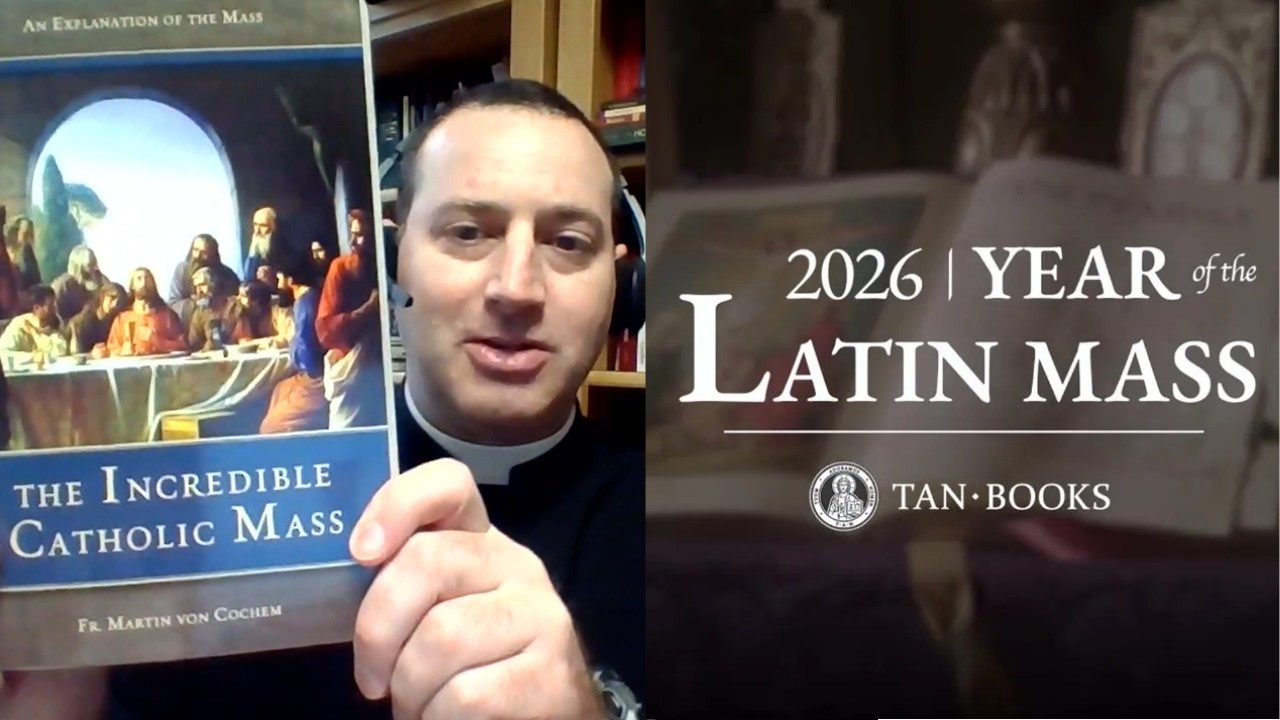
Video summary
In this second installment of his review on Father Martin von Cochem's book, *The Incredible Catholic Mass*, Fr. William Rock offers several constructive critiques regarding the work's historical accuracy and liturgical perspective. He notes that while the author effectively illustrates how various events from Christ's life are made present in the Eucharist, he fails to sufficiently distinguish between the different modes of this presence; for instance, the crucifixion is sacramentally present as a sacrifice, whereas the Incarnation and birth exist in a distinct mode. Furthermore, Fr. Rock points out that von Cochem occasionally relies on outdated scholarship concerning the historical evolution of Mass ceremonies and approaches the liturgy primarily through the lens of Low Mass rather than Solemn High Mass. This perspective leads to some inaccuracies regarding the roles of servers versus deacons during prayers at the foot of the altar, as well as a three-part division of the Eucharistic liturgy that Fr. Rock argues should be expanded into four parts based on Christ's specific actions at the Last Supper: taking bread (offertory), blessing and giving thanks (Preface and Canon), breaking it (Fraction), and distributing it (Communion).
Beyond these structural critiques, Fr. Rock synthesizes key theological principles scattered throughout von Cochem's work to provide a clearer understanding of grace and supernatural benefits within the Mass. He clarifies the distinction between actual grace, which is a temporary light for specific moments that must be used or lost, and sanctifying grace, which elevates the soul into a new state of existence and persists unless forfeited by mortal sin. The priest emphasizes that participating in the Mass offers access to these graces independently of receiving Holy Communion, framing the liturgy itself as a primary source of supernatural benefits alongside the reception of the Eucharist. This theological framework helps believers understand how they can draw spiritual strength from their participation regardless of whether they are physically present at every celebration or if they receive communion daily.
The video concludes with an in-depth exploration of the three "fonts" or sources through which the faithful derive supernatural benefits: the ceremonies, the priest himself, and the Mass as a sacrifice. Fr. Rock explains that liturgical ceremonies function as sacramentals whose efficacy varies based on their complexity; consequently, Solemn High Masses offer greater spiritual fruits than Low Masses due to the richness of their ceremonial actions. The second font is the holiness of the celebrating priest, meaning that more benefits are offered when a holy celebrant presides, which underscores the importance of praying for one's priests both for his own sanctification and for the benefit of the congregation. Finally, he details the four categories of fruits derived from the Mass as sacrifice: general fruits available to all members of the Church universally; special fruits granted to those who contribute materially or spiritually to a specific celebration even if not physically present; very special fruits reserved for the priest himself; and ministerial fruits applied specifically to the intentions listed in the bulletin. Fr. Rock encourages listeners to make morning offerings with an intention to draw from all these sources, ensuring they tap into the universal graces of every Mass celebrated worldwide throughout their day.
Read the full video transcript
Hello.
I am Father William Rock of the Priestly
Fraternity of Saint Peter.
And this is TAN Books Year of the Latin
Mass.
And this is the second of two videos
discussing this work,
The Incredible Catholic Mass by Father
Martin von Cochem. And again, I hope I'm
pronouncing his name correctly.
Uh this is the second part, as I said,
discussing this book. And I'd like to
begin with some general critiques that I
think are helpful, or at least that
I came across in reading this work which
might be helpful for readers.
The first is that in chapters 4 through
10, the author goes through the various
ways that various events and incidences
from our Lord's life and mission are
made present in the sacrifice of the
Mass.
Um but I feel that he didn't do
maybe a strong enough job of
emphasizing that the way that different
things are present in the Mass are
different, that there's different modes.
So, for example, say, well, you know,
our Lord's crucifixion is present in the
Mass, but also our Lord's incarnation
and birth is present in the Mass. But I
feel that while that's true, um that
they're not present in the same mode.
The crucifixion, our Lord's sacrifice,
is made present uh sacramentally,
uh but his birth and incarnation are
there in a different mode. And I just
feel that the distinction wasn't
necessarily clear that he was presenting
that. He sort of just presented that
though, you know, all these different
events are of our Lord's life are
present, but not necessarily specifying
that, okay, there there is a difference
between the way some of these things are
present.
Um be that as it may, I mean, the
information is still very good. It's
good for reflection and to bring to mass
with us, but uh the distinctions maybe
could have been a little bit stronger
there.
Also, he does seem to have some
historical misunderstandings
about certain ceremonies and
developments in the mass over time.
Uh this could just be due to the
scholarship that was available at the
time when he was writing. Scholarship
that's since been expanded and updated.
Um so definitely I would say you could
use this book for theological purposes,
for devotional purposes, but not as
necessarily history of the mass when
he's talking about different historical
things. There are more recent works that
go into more detail about the
uh the mass and how the ceremonies
evolved over time.
Um
but maybe not so much this work would be
a reference for that.
I would also point out that he does have
what could be called a low mass
mentality where he is approaching the
celebration of the mass and the
explanation of the ceremonies as the low
mass being the point of reference.
And given the time that he's writing,
this is understandable.
Uh the low mass was much more prevalent
at that time.
Sung masses, solemn high masses would
have been rare
and or at least rarer than it would be
today. So it's understandable that he
would be approaching from a low mass
perspective cuz this is what uh most of
his readers probably would have been
familiar with. Um especially maybe in
Germany with the way things were done
there with the mass.
Um but so for example, he would say say
at the prayers at the foot of the altar
and at the response they are at the
fratres that the servers are acting on
behalf of the faithful.
But it's more probably accurately say or
I would say it is more accurate to say
that they're actually at those points
acting on behalf of the deacon and
subdeacon.
Now there are parts in the mass where
the servers are acting on behalf of the
people,
but not every instance are they. Uh
because if you look through the lens of
a sung Mass or solemn high Mass,
during the prayers of the foot of the
altar, the choir is singing
the introit chant, the entrance chant.
They're singing the Kyrie maybe,
depending on how things are moving along
with the Mass. And at a solemn high
Mass, the celebrant with a deacon and
subdeacon and the servers are praying
the prayers of the foot, but they're not
audible to the faithful.
And because the solemn high Mass really
should be the reference, it is the
normative Mass,
um even if it's not the one that's
celebrated most frequently and most
frequently, it is the normative Mass.
And so, at a low Mass, really the
servers are taking the place of the
deacon and subdeacon. The same would be
true with the Orate Fratres. It's
spoken, it's not sung. It's said in in a
little bit of a lower voice. And the
deacon and subdeacon are the ones who
make the response, not the faithful.
Um this is maybe a little thing, but it
does sort of help frame the approach to
the Mass to make sure that we are uh
approaching the Mass through the proper
lens. Uh my final critique has to do
with the second part of the Mass or what
we would call maybe the Eucharistic
liturgy or the Mass of the faithful. And
that he divides it up into three
different parts where he says that
there's the offertory, there's the
consecration, and communion. And he's
basing this division based on Christ's
actions at the last supper, but I think
a fourfold division would actually be
better cuz if we take a look at what uh
is written about our Lord and the last
supper particularly with the bread, it
said, you know, our Lord who the day
before he suffered took bread into his
holy and venerable hands, with his eyes
lifted up towards heaven unto thee, God
his almighty Father, giving thanks to
thee, he blessed, broke, and gave it to
his disciples.
And again, this is from the canon uh of
the mass.
And but we actually see that there's
four things that our Lord did. First, he
took bread, which can be corresponded to
the offertory in mass.
Where it says, he lifted up his eyes
uh towards heaven unto thee God as
almighty Father, giving thanks to thee,
blessed it.
And this would correspond with the
preface and the Canon.
The looking up to God, giving thanks,
and blessing it.
Uh especially in in the Hebrew
tradition, to give thanks and to bless
are basically interchangeable. So, we
get to see this is one action, which is
the
the main Eucharistic action, the
combination of the preface and the
Canon.
And then, that our Lord broke it, which
would correspond to the fraction, then
gave it to his disciples, which is
communion.
So, I think a fourfold division of the
Eucharistic action of the mass of the
faithful
is more fitting, where there's the
offertory as the first part. Second part
is the preface and Canon. The third part
is the fraction. And the first fourth
part is the communion, reception of
communion.
So, that all being said, I'd like to go
on to some theological points that the
author uses throughout his work, but
maybe doesn't um
spend too much time developing them, or
that it's kind of scattered, and I'd
like to kind of bring it together for my
a tighter explanation of these
theological principles.
The first has to do with grace.
Uh so, generally speaking, we can say
that grace is a supernatural gift from
God, which produces a real change in the
recipient.
And there are two types of grace that we
can generally identify. One is actual
grace, and the other sanctifying grace.
And both are referenced by the author.
Now, actual grace is
generally described as a light to the
mind and a strength to the will to do
good and to avoid evil, order towards
one's sanctification or growth in
holiness, depending on where one is in
one's uh faith journey.
Now,
the thing about actual grace is that
this light to the mind and strength to
the will is given for that particular
moment. So, it's given by God for this
particular moment. One either uses it or
one doesn't, and then it's gone.
Which is different from sanctifying
grace. Sanctifying grace is a grace
which elevates the individual into a new
supernatural mode of existence. It
produces a real supernatural elevation
in the one who has it, and it remains
with the individual unless
the individual, God forbid, commits a
mortal sin.
So, with an actual grace, it's something
that's given, it's either used or not,
and then it goes away.
Sanctifying grace is something that
remains with the possessor unless it's
lost through mortal sin. Again, God
forbid that that were to happen. And the
last theological point I'd like to touch
on, which the author uses throughout the
work, although he doesn't sort of
explicitly call it out in these terms,
are the fonts of supernatural benefits
which are present in the mass.
And this is distinct from the reception
of Holy Communion. So, if someone
receives Holy Communion, they receive
certain graces and supernatural benefits
that go along with it, but the mass
itself, considered apart from Holy
Communion, the reception of Holy
Communion,
is also, and additionally, a font of
supernatural benefits to those that
participate in the mass.
And the author is making use of this
throughout the book, but I think it is
helpful to give a more sort of concise
understanding of this. So, when he's
kind of referencing things here and
there, um we can understand what he's
trying to explain.
So, we talk about the fonts of the
supernatural benefits of the mass,
the theologians recognize that there are
three general fonts
from which the faithful can draw
supernatural benefits. The first font is
the ceremonies of the mass.
The second font is the priest himself.
And the third font is the mass as
sacrifice, and we'll just sort of
briefly discuss each of those in turn.
So, the first font is or are the
ceremonies of
the liturgy being celebrated. Now, it's
important to note here that the
ceremonies which accompany the mass or
which are present in the mass, which
accompany the consecration, are all
sacramentals.
Now, most of us are going to be familiar
with the idea of a sacramental being a
blessed object like a blessed rosary.
But, the actual church's understanding
of a sacramental is broader. There's
actually four different types of
sacramentals. The first
type of sacramental recognized by the
church or what we could call independent
ceremonies such as blessings. The second
would be
the blessed objects themselves. And the
third would be the use of the blessed
objects. So, for example, the ceremony
used to bless a rosary is a sacramental.
The blessed rosary itself is a
sacramental. And the use of the blessed
rosary is also a sacramental.
The fourth type of ceremony or
sacramental ceremony are those which are
used to frame the sacraments. So, the
various ceremonies you say in the
celebration of baptism, confirmation,
the anointing of the sick, the
celebration of mass are all also
considered sacramentals.
Now, it's important to note that the
efficacy or the power of a sacramental
is based on the ceremony that's used.
And this is why, for example, there are
10 or so different types of blessed
water in the Roman Ritual, because each
of them have a different ceremony, each
of them have a different efficacy, and
different effects. And the intended
effects or the expected effects, the
expected efficacy of a sacramental is
based upon the ceremonies which are
used.
And so, if we take that over to the
mass, that means the sacramental
efficacy or power of the mass is going
to vary depending on the ceremonies
used. So, for example,
there is going to be more sacramental
efficacy in a sung mass than there will
be in a low mass because there's greater
ceremonies.
And similarly, there's a greater
sacramental efficacy in a solemn high
mass than there would be in a sung mass.
And even more so again than a low mass.
So, the ceremonies of the mass do
matter. They do affect the amount of
supernatural benefits that are being
presented to those that are
participating in it.
But here, I think it's important to note
that there is a distinction to be made
between what is received by a given
individual and what is offered.
Cuz what is received by an individual is
going to be based on their disposition.
So, it could be that at a given mass,
you have the priest who's celebrating,
and then there's the pious old lady near
the back of the church who's praying her
rosary.
And it could be that even though more is
being offered to the priest, and we'll
get into the reasons why in a little
bit, but if more is being offered to the
priest, he might actually be receiving
less than the lady praying her rosary
because she's actually better disposed
than the priest is. So, for example. So,
it's it's how you have to take into
account both the disposition of the
individual and what's being offered to
get an a sense or an idea
of how much one is benefiting from the
mass supernaturally.
So, moving on from there. So, again, the
first font is the ceremonies, the
sacramental ceremonies surrounding the
celebration of the Eucharist,
surrounding the consecration. The second
font is actually the priest himself. So,
the holier the priest, the more will be
offered to the faithful, the more
benefits will be offered to the
faithful.
And the author actually does a pretty
good job on pages 305 and 306 of
explaining why that is. So, I would just
encourage you who are watching to
go back and read read that in the book
itself.
Um as he does a good job there. But,
this does mean that the condition of the
priest does actually affect what is
being made available to the faithful in
the celebration of mass. So, please pray
for your priest so they can be good and
holy
for their own sake, but also for your
own.
And the third font of the supernatural
benefits
is the mass viewed as sacrifice. And
these are specifically called the fruits
of the mass. And under this category of
mass as sacrifice, there are four
categories of fruits that have been
identified by the theologians.
The first
uh set is what are called the general
fruits.
And the general fruits are the
supernatural benefits offered to all the
members of the entire church
at every celebration of mass. So, every
time mass is celebrated, fruits,
supernatural benefits are being made
available to every member of the church,
whether or not they are physically
present at the celebration of mass.
The second group, second set of fruits
is or are what are called the special
fruits.
The special fruits are what are
specifically offered to those who are
somehow participating in this particular
mass being celebrated right here, right
now.
And
uh this primarily would affect those who
are attending the mass in person. So,
those who are attending the mass in
person would be offered special fruits.
Uh but there are other ways that one can
be offered special fruits.
Because anyone who is in any way
contributing to the celebration of this
particular mass will be offered special
fruits.
So, for example, if someone bought and
donated the vestments and these
vestments are being used, they would get
special fruits for that. If someone
purchased and donated the flowers or
helped set up the flowers being used,
then they will get special fruits in
that way. If those helped pay for the
church or the candles or anything like
that, the sacred vestments, the sacred
vessels, they will be offered special
fruits for each and every instance that
they contributed to that.
Uh and in order to receive these type of
special fruits, one does not even need
to be present at mass. So, if one
donated, for example, the candles that
are being used at this mass, even if one
is not physically present, because the
candles are being used, then those
fruits are being offered to that
individual.
And within this category of special
fruits,
one can have more than one source one is
drawn from. Someone could be physically
present and also donated the candles,
then there's going to be two sources
that are giving fruits to this
individual, rather than one who is just
attending but didn't donate the candles,
then they won't get the the candle sort
of direction or donation uh benefit.
Uh
>> [snorts]
>> but also too, that means special fruits
would be offered to the servers at mass
over those that are participating just
in the pews because they're more
involved in the mass. And so, there's
various ways that this can play out.
Uh the next set of fruits are called the
very special fruits and those are given
to the celebrating priest himself.
And the last set are what are called the
ministerial fruits.
And the ministerial fruits are those
which are offered to those for whom the
mass is being offered, particularly as
the mass intention.
So, if you ever go to a mass and maybe
beforehand an announcement is made, it
says, you know, this mass is being
offered for this particular intention or
the intention is listed in the bulletin
for a particular mass,
the fruits the of the mass, particularly
what are called the ministerial fruits,
or what are being applied to that
intention.
So, you have the ministerial fruits,
again tied to the mass intention, which
the priest is making based on
whatever is going on in terms of the
bulletin or donations or a list or
however it might be that it's being
worked out, but it is something very
special. So, having a mass set for
someone or for an intention means that
you're tapping into the ministerial
fruits of the mass. Now, regarding these
various ways of getting supernatural
benefits from the mass, it is important
to note that for some of them, right,
one does not need to be present. So, as
we talked about with the general fruits
and depending on the special fruits and
the ministerial fruits.
And this is why it's very highly
recommended that in one's morning
offering,
one makes the intention to gain all of
the fruits or all of the supernatural
benefits that are being offered to them
throughout the course of the day from
all the masses said throughout the
world,
even if one's not attending mass that
day, because it could be maybe someone
is having a mass said for for you. And
that means so you could draw from the
ministerial fruits or maybe you donated
candles that are being used this week at
the church, which means you could draw
from the special fruits, even if you're
not present at mass. And of course,
we're always being offered the general
fruits of every mass being offered every
day throughout the entire Catholic
world. So, we want to make sure that
we're tapping into that. By way we can
do that is having that intention in the
morning to gain all of the fruits that
are being offered from all the masses
throughout the world that day and that
they be fruitful in our lives.
So, I think that brings to an end what
I'd like to say about this work, The
Incredible Catholic Mass. Again, this is
part two. So, if you haven't seen part
one, I'd recommend that you go back and
watch that as well.
Um that will be good. I think that's all
for now. God bless and we'll see you at
Mass.