Video summary
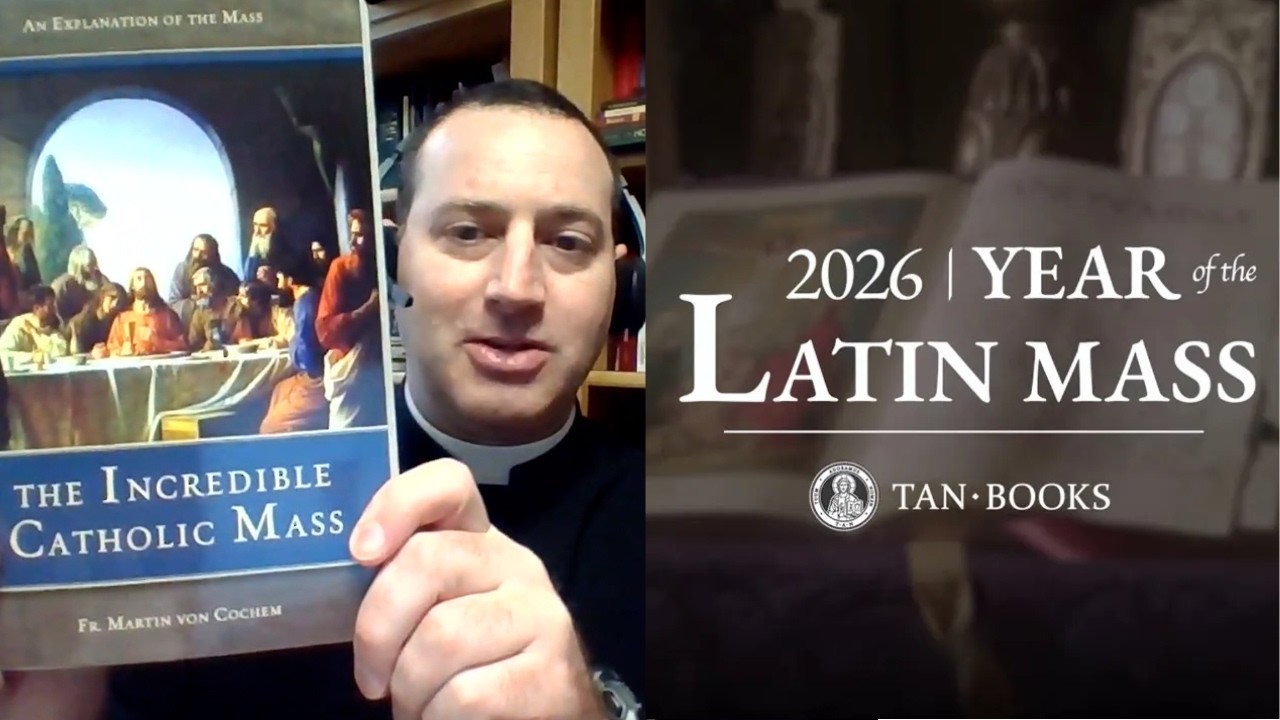
In this first installment of a series on TAN Books' "Year of the Latin Mass," Father William Rock introduces readers to *The Incredible Catholic Mass* by the renowned German theologian Martin von Cochem, who lived from 1630 to 1712. The book's origins are deeply rooted in historical necessity; during the devastating plague that struck Europe following the Thirty Years' War and specifically when it hit the Rhinish country in 1666, many faithful were left without pastors due to closed novitiates and study houses. To combat this spiritual ignorance among the afflicted population, Father Martin dedicated himself to writing accessible treatises on religious truths and duties. His most famous work, initially published in German as *The Holy Mass for Everyone* in 1704, was a comprehensive effort that took him three years of intense research into Scripture, Church councils, patristic writings, and the lives of saints to condense an abridged yet profound account of the Holy Sacrifice.
Father Rock provides a helpful structural overview of Cochem's substantial volume, which spans approximately 400 pages and is best approached as a theological study rather than a devotional guide for use during Mass itself. The book begins with a glossary to assist those unfamiliar with technical terminology before moving into chapters that define the nature of sacrifice in relation to the Eucharist. Cochem emphasizes that Christ serves simultaneously as both the priest and the victim, an offering made by both the ministerial priest and the faithful together. He draws heavily on Old Testament typologies, such as Melchizedek's priesthood described in Hebrews and the prophecies of Malachi regarding a clean oblation offered everywhere to God's name, arguing that these ancient shadows find their ultimate fulfillment in the Mass where bread and wine are transubstantiated into Christ's body, blood, soul, and divinity without physical spilling of blood.
The text further explores the dignity of the Mass through detailed examinations of church dedications, priestly ordination ceremonies, and liturgical vestments, illustrating how these grandeur-filled rituals reflect the supreme importance of the sacrifice Cochem presents. It is important to note that while Father Rock clarifies some theological points regarding ordination—specifically referencing pre-Vatican II traditions like *traditio instrumentorum* which were later clarified by Pope Pius XII—the core doctrinal explanations in the book remain universally applicable across both Eastern and Western forms of the Mass because they reflect the Church's universal theology. Cochem also enriches his theological precision with numerous stories of individuals whose lives were transformed by attending Mass, offering a practical approach that balances deep doctrine with real-world impact.
Father Rock concludes this introduction by advising readers on how to best utilize such a dense and scholarly work: it is recommended for reading outside of the liturgy to prepare one's mind and heart before entering church, rather than being read aloud during the service like an exposition book. While Cochem does include a play-by-play explanation of ceremonies at the end of his text with symbolic meanings attached, Father Rock suggests highlighting specific passages that resonate personally so they can be reflected upon mentally or spiritually while participating in Mass. As this is only part one of two videos dedicated to exploring Fr. Martin von Cochem's legacy and the enduring popularity of his work since its translation into English in 1896, viewers are encouraged to purchase the book for themselves to fully appreciate its seraphic eloquence and sincere piety before joining Father Rock next week for Part Two.
Read the full video transcript
Hello. I am Father William Rock of the
Priestly Fraternity of Saint Peter.
And this is TAN Books Year of the Latin
Mass.
This will be the first of two videos
discussing this work, The Incredible
Catholic Mass by Father Martin von
Cochem.
I hope I pronounced his name correctly.
Father was born in 1630 and died in
1712.
And he was a renowned German theologian.
I would like to read a little bit from
the the introduction of the book to get
a little bit more background about this
work and about the author. Says, "Of the
evils which befell Europe in the
consequence of the Thirty Years' War,
1618 to 1648,
the plague was by no means the least.
And when in 1666,
it made its appearance in the Rhinish
country, such were its ravages that it
became necessary to close the novitiates
and houses of studies of the order that
Father belonged to.
Just at this crisis, Father Martin was
left without any special charge.
And in company with his fellow monks, he
devoted himself to the bodily and
spiritual comfort of the afflicted.
What most distressed him was the
religious ignorance to which a large
number of the faithful had fallen victim
on account of being deprived of their
pastors.
To combat this sad condition,
he resolved to compose little popular
treatises
on the truths and duties of religion.
And in 1666,
he published at Cologne a resume of
Christian doctrine
that was very well received.
It was a revelation to his superiors who
strongly encouraged the author to
continue in this course.
And then skipping ahead a little bit,
Father Martin's other works embraced a
great variety of subjects, the life of
Christ, legends of the saints,
edifying narratives,
the setting forth of certain points of
Christian asceticism, forms of prayer,
methods to be followed for the worthy
reception of the sacraments, etc.
These widely different themes have as
point of similarity a pleasing graceful
style, great erudition, and a truly
seraphic eloquence.
They bespeak for their author sincere
piety and deep religious sentiment,
coupled with an intimate knowledge of
the popular heart and the special needs
of the time.
But the best known of all the learned
Capuchin's work is unquestionably the
Holy Mass, which is this work,
upon which, according to his own
statement, he spent three entire years
pursuing Holy Writ, the councils,
the fathers and doctors of the church,
and the lives of the saints,
in order to condense into a small volume
a properly abridged account of the Holy
Sacrifice.
As soon as it appeared, this book proved
a light to the Catholics of Germany,
nor has it yet lost any of its
popularity,
and since a translation to several
languages
may be said to have acquired universal
renown.
It demanded a great expenditure of
energy on the part of this worthy
religious to bring these undertakings to
a successful issue.
When in his convent, he spent most of
the day in directing souls and following
the observances prescribed by the
Capuchin rule.
Therefore, it was time set aside for
sleep that he was accustomed to give to
his literary labors.
Sometimes after the office of matins,
with the same permission of the
superior, to go to Frankfurt to confer
with his publisher.
This accomplished, he would return on
foot to his convent, catechizing little
children, hearing confessions, and
visiting the sick along the way.
At the age of 82,
while still in the midst of his labors,
he was attacked by an illness to which
he soon succumbed.
And he concludes by saying that father
wrote numerous books, of which 21 were
published during his lifetime.
So, I just wanted to provide that to
give a little bit of information about
the origin of this book and a little bit
about the author.
So, it was originally published in 1704
in German under the title as the Holy
Mass for everyone.
And then first published in English in
1896
as Cochem's explanation of the Holy
Sacrifice of the Mass.
This work was then reprinted in 1997 by
TAN Books under the title The Incredible
Catholic Mass, which is how we have it
here today.
>> [snorts]
>> Now, I'd like to go over sort of a
division of the book so readers can
understand what to expect. I know even
though it's said in the introduction
that it was kind of a slim volume, it is
about 400 pages. So, it's relatively
hefty, not too bad, but it's not
something that can necessarily be sat
uh sat with and read in one one reading.
But, in terms of the outline of the
book, uh there is a table of contents,
but I think it's helpful to divide it.
And I've done it according to the
following method. This again, this isn't
provided by the book, but something
which I think is helpful. It does begin
with a glossary of terms. So, for those
who are unfamiliar with certain
technical terms or spiritual terms or
theological terms the author might use,
there's the glossary there to uh
recourse to.
Chapters 1 through 3 go over topics such
as what the Mass is, and types and
prophecies of the Mass in the Old
Testament.
Chapters 4 through 10
discuss what is renewed or made present
in the Mass.
Chapters 11 through 17 talk about
sacrifice and satisfaction.
Chapters 18 through 25 discuss whom the
mass benefits.
And the final chapters, chapters 26
through 31,
is information on how to attend mass,
and exhortations to attend mass, and
includes an explanation of the
ceremonies of the mass.
As was somewhat touched upon in the
introduction,
the general approach used by Father in
this book is to draw from Holy
Scripture, to draw from fathers and
theologians, and to draw from
magisterial teaching, particularly from
the Council of Trent, in order to lay
out his teaching about the Eucharist and
the Holy Mass that he presents within
the book.
But, one of the things that's also very
interesting, and which is sort of
charming, is that he also includes a lot
of different stories to illustrate the
theological points. So, throughout the
chapters, there's stories of different
individuals and groups of people, and
how the mass impacted them one way or
the other. So, that kind of helps to
break up sort of the the theological
precision with sort of a more practical
approach to things, the day-to-day kind
of
worthiness of what's being discussed.
Now, I like to touch a little bit about
some of the information given in the
first three chapters, and I'll begin
with chapter one with Father's
definition of sacrifice, cuz he's very
insistent that mass is a sacrifice, so
this definition is important.
He gives the following definition. He
says, "Sacrifice is an offering external
to ourselves, made to the most high God,
and consecrated or hollowed in a solemn
manner by a lawfully appointed and duly
qualified minister of the church,
to recognize and testify to the supreme
dominion of a mighty God over all
creatures."
In the sacrifice of the mass,
the author is insistent to point out
that Christ is both priest and victim.
So, even though there might be a
ministerial priest who is leading the
ceremonies, it is actually Christ
himself who is the priest. And Christ
himself is also the victim in the mass.
He also makes pains to point out that
the offering of the mass is done both by
the priest and the faithful together,
although in different modes or in
different roles, but it is a sacrifice
of the people as much it is of the
offering priest, the ministerial priest
of the church.
He then goes on to discuss primarily two
different prophecies or types of the
mass and of Christ as priest in the Old
Testament. The first is Christ and
Melchizedek, pointing to references in
the letter to the Hebrews about how
Christ is a priest forever according to
the order of Melchizedek.
Now, Melchizedek was the priest-king of
the city which would eventually become
known as Jerusalem, and it's recorded in
Genesis that he offered a sacrifice of
bread and wine.
So, if as the author argues,
Christ is a priest in the order of
Melchizedek, then Christ must have also
offered a sacrifice of bread and wine.
And when did this happen? He'll argue,
"Well, it happened at the Last Supper,
where he took bread and wine and through
the sacrifice, they became his body and
blood." Now, according to the argument
of the author, if Christ is a priest
according to the order of Melchizedek,
as St. Paul claims in the letter to the
Hebrews, then it must be that there is a
sacrifice which Christ performed which
involves bread and wine. And the author
argues that this was fulfilled at the
Last Supper in the first place, and then
later on in all the masses that will be
celebrated until the end of time.
Because in the sacrifice of the Last
Supper and the sacrifice of the mass,
Christ takes bread and wine and divine
power transubstantiates them into his
body, blood, soul, and divinity, and
thus makes present in a mystical and
sacramental manner, but in a true
manner, the sacrifice of the cross. The
second reference in scripture that the
author makes reference to in this
chapter is a prophecy in the Old
Testament from the prophet Malachias,
Malachi.
Where it is written, "From the rising of
the sun, even to the going down, my name
is great among the Gentiles.
In every place there is sacrifice, there
is offered to my name a clean oblation."
And the author goes on to argue that the
fulfillment of this prophecy is the
sacrifice of the mass is in a certain
sense is a clean oblation cuz blood is
not actually spilled. Our Lord's blood
is in a sense mystically spilled in the
sacrifice of the mass, but it's not a
sort of physical, actual bloody
sacrifice as the sacrifice of blood and
goats and things like that. And so in
order for this prophecy to find
fulfillment, it must be a sacrifice
which is offered by the Gentiles and in
every place throughout the world and is
clean, and this will be the sacrifice of
the mass. In the second chapter, the
author goes on to discuss the dignity of
the mass. And in order to do that, he
touches on several ceremonies and things
that accompany the mass.
So first he talks about the dedication
of churches and the grand ceremonies
that are involved in that. And he goes
through detail and comments on the
ceremonies to show how much effort the
church puts into providing a fitting and
suitable location for the sacrifice
because of the greatness of the
sacrifice.
Then he goes on and explains the right
of priestly ordination to show the
grandeur of the mass by the grandeur of
the ceremonies used to ordain its
ministers.
Although sort of a word of caution here,
uh he's writing before the decree of
Pius the 12th which
uh settled the question as to what the
matter and form are regarding the
ordination to the priesthood. Prior to
this, there was some theological
disputes over what constituted the
matter and form
of the ordination to the priesthood. And
so the author does follow the tradition
of what's called the traditio
instrumentorum, so the handing over the
instruments. So he argues or presents in
his work that the priestly ordination
occurred when the candidate received the
chalice and the paten with the wine and
bread and was given the authority to
offer sacrifice, the power to offer
sacrifice.
And this was one of the theological
positions held prior to the
clarification
of Pius XII who stated that no,
authoritatively, it's not the traditio
instrumentorum, it is the imposition of
hands and the preface. So just be aware
of that if it doesn't seem to be what
you're familiar with theologically, it's
because he was writing at a time before
this question was settled by Pius XII.
Then he goes on to explain the
ceremonies and material requirements of
the mass itself such as the vestments
and things of that sort and shows by the
greatness and grandeur of those again
reflecting the greatness and grandeur of
the mass.
Then in chapter 3, he discusses other
Old Testament types of the mass and
Christ as priest
including the sacrifice of Abel,
sacrifice of Noah, of Abraham,
Melchizedek,
of Aaron and the other priests of the
Old Covenant.
So that's kind of a quick summary of the
first three chapters
to sort of wet your appetite for them.
And then I won't really be going over
the rest of the chapters too much,
although in part 2 I'll be touching some
of the things he does bring up. I think
it's hard to summarize those chapters in
a way that would be
fitting for this type of format and I
would just encourage you all to get out
and buy the book and read it. I think
that's the best way to handle it. Um but
knowing that then the question can be
asked to what mass or form of the mass
would this work apply?
So the explanations, especially the
theological explanations, the scriptural
explanations, the magisterial
explanations would be applicable to any
form of the mass, Eastern or Western.
Uh because it's displaying the church's
theology of the mass, which is
universal.
But in terms of the ceremonies that he's
discussing, particularly the commentary
of mass that he provides at the end of
the book, it's clear that he's following
the traditional Latin mass.
Um
and at the end, like I said, he does
give an explanation of the mass. It's a
general overview of the ceremonies with
some symbolic meanings discussed, but
overall this is sort of a here's what
happens sort of play-by-play for the
reader.
And how's the best way to use this book?
I would recommend reading it outside of
mass
and maybe if there are things that seem
like they'll be beneficial for you
during mass to maybe highlight them or
note them and then read them during
mass. It really is not something to be
used during mass per se. Uh again, it's
very dense. It's about 400 pages. So
it's not really devotional work. It's
more of a theological work that is then
used to prepare you for mass as opposed
to something like a exposition of the
mass, which can be used to pray along
with the mass.
So I think that's all for now. Uh please
tune in to part two as we finish
discussing this work. And God bless and
we'll see you at mass.