The Fossils Being Formed Today Will Show how Humankind Dirsupted Life on Earth - Prof Mark Williams
Watch on YouTubeVideo summary
Professor Mark Williams argues that human activity has fundamentally altered Earth's biosphere to such an extent that we have entered a distinct geological epoch known as the Anthropocene. In this new era, humanity acts as the second-fastest disruptor of life on the planet, following only asteroid impacts, and is driving the world toward a mass extinction event within two centuries if current trends continue. Unlike traditional fossils formed over millennia, the present day is generating a unique biological record characterized by "technofossils" like plastic and rapid shifts in species distribution. This geological signature is already being written into sediment layers globally, marking a period defined by rapid consumption, atomic fallout, and the profound disruption of planetary boundaries.
The specific evidence of this disruption is visible in sediment cores from locations as diverse as San Francisco Bay and Leicester, where invasive species have rapidly replaced indigenous life. For instance, the introduction of non-native organisms such as the golden apple snail, Chinese mitten crab, and Himalayan balsam has homogenized ecosystems across biogeographical boundaries, leaving immediate fossil signatures in the geological strata. A striking example of this biological concentration is the chicken, which now accounts for seventy percent of all bird biomass on Earth; their rapid morphological changes over the last seven decades will serve as a clear time marker for future geologists deciphering these layers. Similarly, international shipping has facilitated the translocation of thousands of species like avocados and the Southern gastric-brooding frog's tragic decline, creating a fossil record dominated by globally distributed human-associated species mixed with evidence of local extinctions.
Despite the grim reality of negative disruption, Williams suggests that there is hope for humanity to become "positive disruptors" through conscious changes in behavior and practice. Future civilizations will likely find a permanent record not just of destruction, but also of managed landscapes where indigenous practices fostered biodiversity and symbiotic relationships were valued over zero-sum competition. By adopting sustainable agriculture, reducing consumption, and rewilding urban spaces, we can alter the trajectory of this epoch. Ultimately, the fossils being formed today will tell the story of how humankind has reshaped life on Earth, offering a chance to leave behind a legacy that balances technological advancement with ecological restoration rather than irreversible collapse.
Read the full video transcript
This year sees the 300th anniversary
of the birth in Edinburgh of the man
considered to be the father of modern
geology, James Hutton.
Just 14 years before the founding of our
society, Hutton visited a location
Sicker Point on the Bericure coast
and found the evidence to support his
theory that the Earth was vastly older
than the then popular theory of about
6,000 years.
He and his two companions
basically looked and even said they
looked into for the first time the vast
abbyss of time. This evening we'll be
turning our attention in the opposite
direction
towards the far future.
Leads you to think what might some being
of some sort
in the future tens or even hundreds of
millions of years.
Hence,
learn about humankind as they probe at
some curious little layer of sediment,
perhaps a few centimeters thick, and
find whatever they might find.
It's only a week or so before Burns
night, so maybe I can just about get
away with um taking a liberty with a
couple of lines of his taken wildly out
of context and paraphrase slightly.
Oh, what some power the gifty gear us to
see yourselves as others may see us.
This evening
the gifty will begin to us by our
speaker, Professor Mark Williams. Mark
is professor of paleobiology
and earth sciences at the University of
Leicester. He's something of a polymath
whose interests have crossed over into
architecture, business, and other
fields.
and he has had a particular interest in
developing the theory that we have
entered a new geological epoch, the
anthroposine.
He also explores how humans might avoid
causing a mass extinction of life.
Tonight's talk is entitled, "The fossils
being formed today will show how
humankind disrupted life on Earth." Over
to you please Mark.
>> Firstly, thank you very much to Campbell
for that wonderful introduction and also
thank you so much for the invitation to
come and speak to the society. I'm
really honored to be here and also
really humbled to see how many have have
come to listen to me talk tonight. Um so
thank you very much. Um I'm going to
talk about future fossils um or the
fossils that we will leave behind and
the way in which they will give a real
signature to any geologists long into
the future of what we've done to the
earth system around us. And particularly
I'm going to focus on life on Earth.
Um just for fun um I Googled I did a
Google AI search yesterday future
fossils. What would humans leave behind?
And Google AI told me that actually
there would be a very limited signature
of biological fossils. Maybe a few bones
of domesticated animals, maybe a little
bit of a pollen signal from uh
agriculture, um maybe from the the vast
number of species we've transllocated
around the planet. Um I mean to show you
that Google AI is wrong and that in fact
we have left an absolutely profound
signal.
One of the things that Google AI will
tell you is that we've left a really
good signal of technosils. Now, I agree
with that. We most definitely have. And
by technopossils, I mean things like tin
cans, plastic bottles, concrete, all the
kind of flatsom and jetsum that you
might expect humans to leave behind.
We've left definitely left a signal of
that too. Um I'm not going to talk about
that so much this evening because I
don't have time in a single talk. Um,
and in any case, I want to show you that
the biological fossils that we will
leave behind will really show a profound
and unique signature of the way in which
we have affected all of life on this
planet. And I use my chicken bones as an
illustration of this. They're going to
feature several times um as we go
through this talk.
We really have left a massive signature
of change on this planet. um just about
to coordinate a Royal Society volume on
the biosphere in the anthroposine and
it's going to be published next week. Um
and as part of that we try to put
together in a single figure all of the
changes that you and I and everyone else
has made to this planet. And it's
actually really difficult to go anywhere
on the planet now and not find some kind
of signature of humanity and indeed as a
result of that some kind of fossil
signature of humanity as well. um which
I'm going to demonstrate to you this
evening.
Now, what we tend to think of generally
as fossils are those things that we
might go and search for at the weekend.
And for me, as a child, I would be out
with my hammer and chisel and the local
rocks where I grew up because I grew up
on the Carboniferous um looking for
fossils. Um because you have wonderful
fossils in the Glasgow neighborhood. I
was wondering if Neil Clark would be in
the audience this evening because I saw
him on the BBC website I think on the
27th of December talking about um this
sh this shark fossil. Um now that's what
we typically think of I think as
fossils.
Um it's fossils of course which give us
the main insights we have into how life
has evolved on our planet over hundreds
of millions of years and indeed billions
of years. Um in my career I've been
lucky enough to look at some amazing
fossils. I've had access to this deposit
in China um called the Chang Jang biota
in Junan Province and the Chang Jang
biota is really unique because it
preserves all of the soft anatomy of the
fossils. Um you can see the fossils
there on the right hand side and that's
how we reconstruct them. Now of course
it's this fossil record of those things
that have gone extinct. 99.9%
of things that ever lived have gone
extinct. It's this fossil record that
tells us how the biosphere has evolved
over huge amounts of time.
It shows us both negative and positive
changes to the biosphere on planet
Earth. And the negative ones are the
things I think we can all immediately
relate to. Um perhaps the most famous
geological boundary anywhere is that of
the asteroid strike of 66 million years
ago in the Gulf of Mexico that defined
the Cretaceous Paleogene boundary and
was definitely a negative impact on the
biosphere. It caused very very
significant biodiversity loss. Something
of the order of 75% of all of the
species on planet Earth went extinct at
this point in time.
What I think is less well known about
the paleontological record is it also
reveals to us incredible events of
innovation which have led to greater
biomass, greater amounts of life on
planet earth and greater biodiversity.
One of the really good examples of that
is the evolution of flowering plants in
the Cretaceous around about 160 million
years ago. It's an event of singular
importance as I'll show you a little bit
later because flowering plants have been
instrumental in making the biosphere a
much better place. So we have both these
negative events and we have these
positive events clearly revealed in the
fossil record of planet earth.
The question is what are you and I going
to be? Are we going to be negative
disruptors of the biosphere? a bit like
the asteroid strike 66 million years ago
or are we going to be positive
disruptors of the biosphere like the
evolution of flowering plants down in
the Cretaceous? It is a question now of
singular importance to us because in
this epoch of geological time that many
of us are now trying to work to become a
component of the geological time scale,
humans have become de facto the most
important geological agents at the
surface of our planet. And so we'd argue
that we'd left the holosene epoch of
geological time and that we've actually
entered this new epoch called the
anthroposine which is dominated by
humanity
and it would seem that we are
predominantly negative disruptors of the
biosphere at present. Um I think that's
really well encapsulated in this quote
from a research paper that I'm going to
come back to a little bit later in this
talk. Um, and I also found this image of
the boy with the Goliath grouper, um,
taken on Key West, I think sometime in
the early 1960s, as a real metaphor for
the way in which we now dominate the
world around us. You can see the quote
there. Um, industrialized societies like
our own use something like 50 times that
of place-based societies. And by
place-based societies, I mean those
societies which are intimately
interrelated with their environment.
indigenous um cultures for example it is
that massive rate of consumption which
is degrading the earth system and which
is producing the anthroposine in the
geological record.
Now those patterns of consumption are
really nicely encapsulated in these
graphs made by a chap called Will Stefen
who was a professor at the Australian
National University and Will was part of
the group the anthroposine working group
that I'm also part of. He's now sadly
passed away. Um, but this is really
brilliant work that they did about two
decades ago to try to quantify the
degree of change. Um, Will did many
different graphs. I've just put a few of
them up here, but of course there's one
that everybody always focuses in on. Um,
it's always the spread of burger
restaurants on planet Earth. You can see
though since the middle part of the 20th
century, there has been a massive
increase in the way that humanity
consumes. Um, there are indeed 39,000
McDonald's restaurants on planet Earth,
19,000 Burger Kings, and 32,000 KFC's.
And that growth really is since the
middle of the 20th century. Um, it's a
real good example, I think, of the way
in which we consume with impunity.
I just want to give you a few figures to
give you a kind of definition of how we
feel the anthroposine should be
conceived. We are the major movers of
Earth at the surface of our planet. You
can see the figures there. 150 cubic
kilometers of sediment every year. An
order of magnitude more than all of the
world's rivers.
We use a vast amount of water around
about 4,000 cubic kilometers of water
every year. I can't visualize that. I
don't know what that looks like, but I
do know it would be the equivalent of
humanity draining one of the giant East
African lakes every two years. And I
just want to bring it a bit closer to
home to you. It's the equivalent of
draining Loch Ness every 6 hours. That's
what humanity does in terms of its
consumption on planet Earth.
I don't think I even need to mention the
atmosphere to you. I'm sure you all know
that we're having a fundamental change
on changing that component of the earth
system.
Most of what I'm going to focus on in
this talk is about the biosphere, but I
wanted also to give you a sense of
what's happening to all of the different
components of the Earth's system as
well. Changes to the biosphere are
really, really fundamental and they have
left already a very, very distinctive
fossil signal on our planet.
All of these different components,
changes to the atmosphere, to water, to
the earth, and to life, they've all left
a signal in the geological record long,
long into the future. Of course,
plastics as technop fossils are going to
be one of those big signatures millions
and millions of years long into the
future.
When we were trying to define the
boundary of the anthroposine, we decided
that the middle of the 20th century was
the inflection point when humans started
to really consume at an incredibly rapid
rate and we needed a geological marker,
something that we could find everywhere
across the planet to indicate the same
age time. That's what we do as
geologists when we're defining
geological boundaries. And we found that
the radiogenic fallout from atomic bomb
tests in the 1950s gave us that signal.
Indeed, anywhere you look on planet
Earth, in the rivers and lakes around me
and Leicster, I've got PhD students
researching these, we find that
signature in the Antarctic ice, wherever
you want to go on the planet and almost
certainly in the sediments of the Clyde,
it's everywhere you look. It's a really
good marker from a geological
perspective, but of course, from a
philosophical perspective, it doesn't
really reflect very well on us as a
species.
You can kind of quantify those changes.
Um this is a graph produced by my
colleague Colin Waters on the
anthroposine working group and it's just
showing you that mid 20th century
inflection of things like radiogenic
fallout from those Abomb tests. The
cumulative production of concrete um the
massive production of plastics and the
global black carbon. The black carbon
comes from combustive processes,
industrial processes. It's also left a
signal wherever you go. It's been
falling out of the atmosphere. If you go
down into sediment successions and lakes
and things, you'll find that signature
there. All of these as key indicators of
this anthroposine epoch of geological
time.
Now, that was just to give you a kind of
preamble entry to the anthroposine. What
I'm going to focus on for the rest of
the talk is very much what we've done as
a species that will leave behind a
biological signal in the fossil record
of huge change. I'm going to ask three
questions. The first is how have humans
actually changed the biosphere. The
second one is I want to show you how
that's been recorded in the stratal
record, the the rock record of our
planet. And the third one is I want to
ask you the question, what kinds of
disruption to the biosphere are we
causing? Will we be negative? Will we be
positive? And how might that appear to a
future geologist?
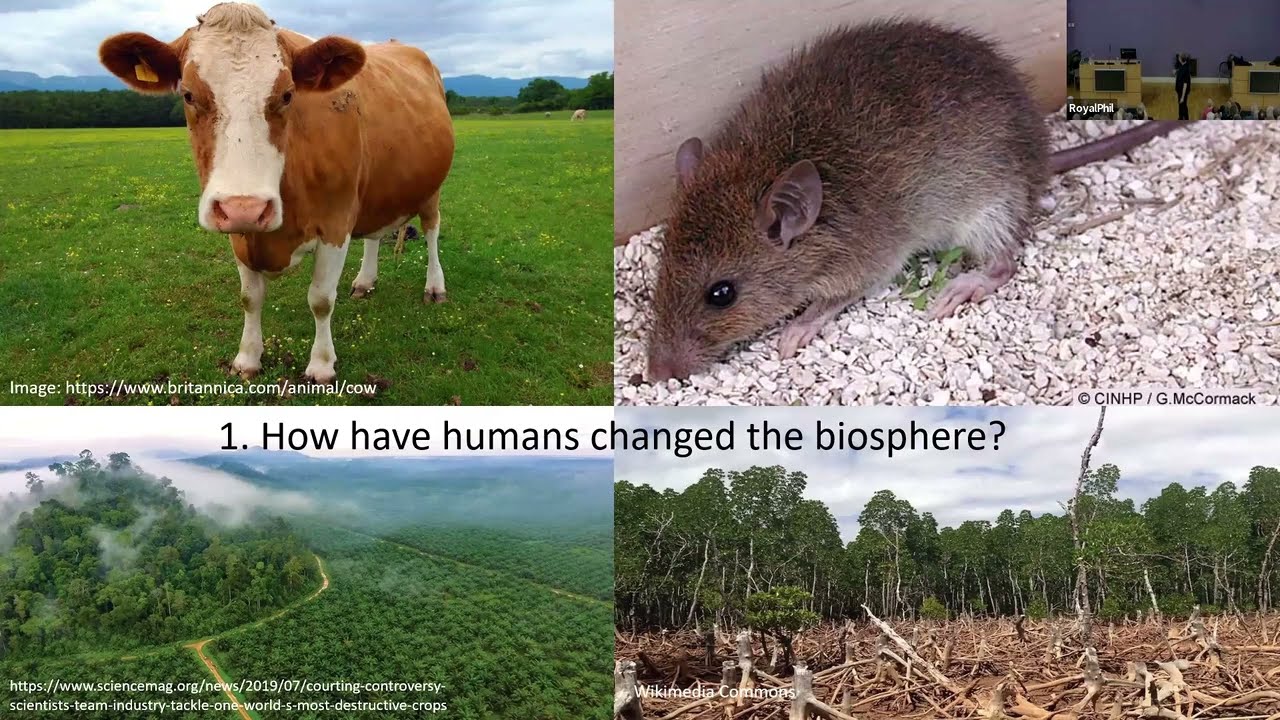
How have humans changed the biosphere?
I've tried to just neatly summarize it
in this figure here. I'll go into a bit
more detail as we go through the the
talk, but the cow is representing
concentration way in which we've stored
mass in the things that we like to eat.
The Pacific rat is showing you how we've
transllocated lots of species around the
planet, tens of thousands of them.
um that oil palm plantation plantation
in Calimantan in Indonesia is talking
about the way that we've reconfigured
ecosystems globally on this planet. And
on the right bottom bottom side, I'm
showing you the way that we appropriate
a massive amount of energy from the
biosphere. We're really greedy as a
species in terms of the amount of energy
we suck out of all life on this planet.
And I'll try to quantify some of these
for you as we we go through this talk.
This is a figure I put together recently
just to try to show these patterns in a
graphical form. Perhaps the one I think
that is the most worrying here is that
living planet index. If you look at the
one on the left hand side, the living
planet index is based on about 35,000
monitored populations of 5 a half
thousand vertebrate species on this
planet over the past 50 years. And over
the past 50 years, it's shown a 73%
reduction, which really terrifies me.
Um,
then we can look at all of the other
different kind of parameters here. The
number of species transllocations
currently running at around 300 a year.
These are the species we take out of
their native range. Um, wild terrestrial
mammal biomass versus domestic mammal
biomass. We and the animals we eat are
98% of it and everything else is 2%.
um molllesk extinction now running at we
think about 13% of molllesks lepidoptran
abundance I've used as a proxy for
insects so there's those are butterflies
and you can see also mammal extinctions
there
the key thing for me as a paleontologist
is pretty much all of these apart from
the lepidoprine diminishing uh patterns
there have left a geological signal and
I'm going to demonstrate that fossil
signal to you as we go through this talk
a fossil signal which I think will be
permanent um over thousands and millions
of years into the future.
Now this again is a complicated figure
so I apologize for this but I want to
put it in um just to show you how you
compare with all of the big events in
deep time. So on the bottom of the scale
there we have a scale which is showing
positive change that's towards the right
and towards the left is negative change
and I must give due deference to the
posttock who's working with me on this
Tom Wong hearing because he's been
brilliant in quantifying all of this
different data. So you've got negative
change to the left positive change to
the right. Um you can see kind of
neutral through the middle and above
that in the area that's kind of
highlighted pink and also below it those
are past
negative disruptions to the biosphere,
lots of them quantified over different
geological time periods. The numbers you
can see to the right are numbers in
millions of years. And at the bottom
also you can see the Cretaceous
Paleogene boundary. That's when that big
asteroid hit our planet um 66 million
years ago. And then in the middle what
we've tried to do is quantify the degree
of biodiversity loss and the rate of
loss and also the rate of biomass loss.
What we see when we compare it with deep
time is that you and I are now the
second fastest changer of the biosphere
in Earth history certainly through the
past 539 million years. Um, I want to
come back to this a little bit later.
Um, because there there's also the
chance that we can move towards being
much more positive disruptors if we play
our cards right. Um, but we are now the
second fastest disruptor in a negative
sense to the biosphere in Earth history.
1 million species at risk of extinction.
Do we even know? Because we haven't even
quantified the number of species there
are on planet Earth, but it's obviously
a sign significant amount.
If you Google extinct animals, what you
get are the things that you um would
expect. The dodo, of course, that went
extinct in a few decades um of Maitius
after humans arrived. Um beautiful
animals like the Caribbean monk seal,
not seen since 1952.
The Yangy dolphin, not seen since 2007.
It's part of a much bigger extinction.
Those are the big things that appear
when you Google them. But if you dig a
bit deeper, you'll see that this is
really now quite a major extinction
event. Um Rob Cowi at the University of
Hawaii is one of the leading people in
trying to quantify the impacts on
mollisks on planet Earth. Um on a why
they've had real problems with their
indigenous mollisk populations. Most of
them have been extrapated or or have
gone extinct. And you can see what Rob
and his team have done here. They're now
suggesting that over the past 500 years,
something of the order of 260,000
species of mollisks may have gone
extinct. That's much much higher than
the red list would tell us. And we can
show that. We can actually demonstrate
this change in the fossil record. I'll
show you some of this a little bit
later. So, we're now in a very, very
significant extinction event.
I also alluded to the living planet
index and the diminishing of populations
of species on planet Earth. Now, we're
not yet in a mass extinction, as in we
haven't lost 70% of biodiversity, or we
think we haven't so far. But the but
because we're losing so much populations
of all of these different species, we're
pushing up the extinction debt. The
extinction debt means we're actually
getting closer and closer to a mass
extinction, which we've tried to
illustrate in this figure. So, not in a
mass extinction event yet, but very,
very close to it if we could carry on
with the same trajectory.
Now, extinction is a big part of what
we've done as a species, and it has a
demonstrable fossil record. Um, but
actually, we've done much more, much
bigger disruptors than just extinction.
Um, for example, we've concentrated mass
and the things we like eating. Um, I
alluded to this in that summary figure.
I'm now going to go into this in a bit
more detail and show you what we've
done. So, this is a nice plot from a
paper by two panological colleagues in
North America. Very good piece of work.
Um, just showing you the rise in
consumption of things like pigs and
sheep um, and cattle. Um, and you can
see also on this figure that there's
something of an inflection in the middle
part of the 20th century. again speaking
to this idea of an anthroposine.
So we've obviously extended our
populations of farm animals very very
considerably.
I want to break this down to one
individual species just to give you a
sense of just how colossal the human
impact is. So on planet Earth at present
there are 26.56
billion chickens.
That's at present every day of the week.
They are 70% of the mass of all birds on
this planet. So one species is 70% of
the mass of all birds
locked into this single species.
We profoundly changed these organisms
for our benefit. The Chicken of Tomorrow
breeding program in the United States in
the 1950s set a course to increase the
mass of chickens. We've increased their
individual mass four-fold um in the
space of about seven decades. Um their
growth rates are incredibly accelerated.
So they go from egg to being called in
between six and 8 weeks. Um so if you
buy one of these chickens that's not a
freerange chicken, it's been alive for
about 6 weeks. Um and the other thing is
they've been engineered in such a way
that they really can't live beyond 6 to
8 weeks because their bones are so weak.
Their necks snap after that. So, it's
not not a good livelihood for a bird
whose ancestors lived for about 8 to 14
years in the jungles of Southeast Asia.
We eat 70 billion of them each year.
There are more than 32,000 KFCs on
planet Earth in more than 150 countries
and proudly boasting on their website
over $ 34 billion of sales so far. the
link is clear between the way that we
consume um and the way that we're
affecting life around us.
So that's concentration. But what about
transllocation? So this is the way in
which we've taken species and either
directly or indirectly moved them around
the planet. And pretty much everything
you can think of humans have had a hand
in moving around the planet. So, um,
invertebrates, things like mollisks and
arthropods. Um, plants, things like
Himalayan balsam up there on the left.
Um, frogs, snails. Um, snails have been
wonderful in in the damage that they've
done as they've been transllocated
across the planet. We've done this many
thousands of times.
Think about it. Things like the
transllocation of maze after the
Columbian exchange. It's now become the
the one of the three most important
commodity crops on planet earth and it's
left a fossil signal of that
Columbombian exchange. So if you go to
African lakes, lakes in East Africa, you
can find a pollen signal of maze from
the early part of the 18th century
indicating this kind of colombian
exchange event.
It's an accelerating process. um a whole
set of nice graphs from the uh uh from
the biologist Hannah Sebans at the
Senkenberg in Frankfurt also showing you
the number of species that have been
transllocated across the planet.
And if you think about it, it's
inevitable because this is our
international transport networks of
shipping. Um this is a a grab a snapshot
of this in time. You can watch this in
real time. watch all the transponders
from the shipping moving around the
planet almost mimicking the kind of
great surface ocean currents of planet
earth. Of course, much of this trade has
developed from the middle of the 20th
century. Certainly, things like the
panacific trade has really accelerated
since the middle of the 20th century.
It's this means of redistributing
species around the planet.
And that redistribution ignores um long
founded biogeographical provinces. So I
think we've all learned about Alfred
Russell Wallace and the Wallace line in
Southeast Asia. It's actually very
complicated when you come to look at all
the different biogeographical boundaries
in Southeast Asia. But golden apple
snails don't care. Golden apple snails
were introduced into East Asia in about
1979 1980. They have now flooded their
way through Southeast Asia. They
particularly like human modified
ecologies, patty fields for example. and
they couldn't care less about Alfred
Wallace, Alfred Russell Wallace's line.
They just bound straight across it. So
those longheld biogeographical divisions
that we've kind of grown up with are
being broken down by this homogenization
of the biosphere.
And this is going to be really unique.
Um I've picked on avocados because
avocados in particular have been
explosive in the way in which they've
been traded around the world since the
1960s. But think about this. In the
middle of the avocado is that big solid
endocarp, the pip if you like, that goes
into landfill. And they really do go
into landfill. Um, and they're going to
go into landfill in so many places
around the world, so far beyond the
native range of where avocados grow. And
also, they're going to go into landfill
with no representation of the actual
plants that they came from. That's going
to leave a very very strange signal for
a future paleontologist to find. And
avocados is just one component of this.
All of these detached parts of organisms
that can only happen if you've got a
human in interceded.
We also reconfigured the landscape. Um,
I showed you those oil palm plantations
in East East Asia in Calibantaman, but
this is a really nice plot produced by
Earl Ellis of the University of Maryland
just showing you the way in which humans
have now dominated the landscape. Um, so
here in 1700 you can see used
components, those kind of heavily human
impacted parts of the biosphere are only
a tiny percent.
When you come forward three years, three
years, 300 years, um you can see that
50% is used and 75% of the ice-free
landscape is in some way impacted by
humans. In fact, it's higher than this
now. Um maybe up to 90% in some
estimations. So again, a real real
indication of human change.
In fact, if I paraphrase Earl, he would
say that the world is no longer
dominated by natural ecosystems with
humans disturbing them, but rather is
dominated by human systems with more or
less modified natural ecosystems
embedded within them. That that's a
profound statement because that now is
saying that you and I are the dominant
component of ecosystems on the planet
with remnants of the of the pristine
biosphere embedded within them.
And as I've already said, we appropriate
a huge amount of energy from the
biosphere. We were already doing this in
the 19th century, by some estimates,
perhaps taking 10% of all of its
production. And that's trickled really
over the past century. So now we're far
beyond what is actually sustainable from
a human um multiecies kind of
interaction.
So I hope I've shown you that your and
my impact on the biosphere is absolutely
profound. Now, what I want to show you
is how that might find its way into the
fossil record or indeed how it has
actually found its way into the fossil
record. Hence my um back to my chicken
bones again.
I'm going to look at concentration first
of all and then I'm going to look at
transllocation with you. Um
concentration as we've already talked
about this is concentrating mass into
those animals and those plants that we
like to eat. And I particularly picked
on chickens because I think it's
emblematic of this change.
So if you look at the way that humans
have changed chickens over the past
seven decades, the morphological
differences are really quite profound.
Um again, this is some work of a PhD
student from a few years back, Caris
Bennett. Um and you can see from the
data here that chicken bones stay pretty
much similar through most of history. Um
and then when you get right up to the
present in the past kind of 70 years or
so, they suddenly become gigantic. Now,
for me as a paleontologist, I would
definitely see that in the fossil
record. In fact, I'd probably say, "Oh,
something's happened here. This is a new
species. It would be a real marker, a
time marker for me." And of course,
millions of tons of chicken bones are
going into landfill every single day of
the week. So, therefore, there is almost
certainly a really profound
palentological signal of this.
Sometimes the whole carcasses go into
landfill. Um I think during the COVID
pandemic this was happening. Chickens
were getting um tipped in this manner.
Um there's a really poignant story
associated with this website if you want
to go and follow up cuz a passer by
driving here spotted two chickens still
alive picked them up and rescued them
which I thought was a lovely story in
what is otherwise a fairly dreadful
situation.
Now, that I could interpret as a
paleontologist. It would be a weird kind
of concentrated deposit. But what on
earth am I going to do with a whole
deposit just of chicken drumsticks
or chicken wings or the breastplate?
Because that's exactly what we're going
to find in landfill. We're going to find
places where we've just got the
drumsticks or the wings or maybe the
other bits of the chicken. That's weird.
I can't really think of a similar kind
of fossil setting anywhere in the
geological record. And of course, it can
only happen with a human intercedent.
So, our future geologists are going to
look back and say, "What on earth were
they doing with chickens?"
A lot.
And they will be captured. I absolutely
countered what AI says in terms of
there'll be no biological signal of
this. There are millions of tons of
chicken bones going into landfill every
day and there are thousands, tens of
thousands of landfill sites across
planet Earth. They will definitely leave
a distinctive fossil signal long into
the future.
Back to that paper by Plotnik and Koi
where they plotted up um the changes in
cattle and pigs and things going into
the 20th century. And now a focus on the
state of Michigan just to see what the
fossil signature of all this change
might be in that one state. Um what
you're seeing here are landfill sites.
Those are the ones in circles and the
crosses are cemeteries, places where
human remains are deposited. Um they've
plotted of course the changing patterns
of um these different animals in the
state of Michigan rising very rapidly
and they argue very coherently that this
is also going to leave a profound signal
of you and me long into the future both
in landfills and also in cemeteries.
So these kind of places which are now
dotted across our landscape also are
going to leave a fossil signature of you
and me long long into the future.
And that fossil signal is going to be
really weird. It's again going to break
down the kind of biogeographical
patterns that we might be familiar with
because the distribution of many of
these farm animals reflects culture, the
way in which we consume. So water
buffaloos are going to be typical
fossils of South Asia and Southeast
Asia.
Pigs are going to be particularly in
East Asia, in Europe and in North
America. Chickens and cattle will be
everywhere in terms of their fossil
signature. Not reflecting biogeography,
paleo geography if you like, but
reflecting the patterns of different
groups of humans and how they consume
and the different things they consume.
again completely reconfiguring the
fossil record long into the future.
The second one I want to look at you
with is is transllocation. So this is
the movement of non-native species
around the planet and the kind of fossil
signature that leaves. And this is the
one that I have the strongest interest
in although I haven't worked on the
hippopotamus and in Colombia. What on
earth are they doing in Colombia? Yeah.
Well, we know what they're doing there.
I'm going to take you first of all to
San Francisco Bay because I think it's
one of the best places on the planet to
show you how profound the changes are to
ecologies and how that leaves a
distinctive fossil record wherever you
look. So, we're going to go into San
Francisco Bay. It's a place where there
are lots of non-native species. Um,
that's not surprising if you think about
the fact that it's sitting on the west
coast of North America and it's really
embedded into this panacific trade. and
we're going to be able to demonstrate
how that panacific trade has altered the
ecology of San Francisco Bay.
It's a classic piece of work by Andy
Cohen and Jim Carlton about three
decades ago actually tracked all of
these non-native species coming into the
bay over the past 150 years since the
California gold rush when San Francisco
really began in the 1850s. Um, there's
something of an inflection on this
graph, too. And for example, the Manila
clam arrives in the middle of the 20th
century. Again, what on earth is the
Manila clam doing in San Francisco Bay?
Because it's pretty obvious where it
comes from. Um, it's been brought in by
international shipping. Um, and the
thing I think which is most striking
here is they found that in some parts of
the bay, pretty much all of the
organisms and all of the biomass is
nonnative.
So, all of the native stuff expuned in
many parts of the bay.
I'm going to take you out into the bay
and we're going to pick up some sediment
core. We're going to go out on the
United States Geological Surveys
research vessel, the RV Snaply. We're
going to be out there with a French film
crew who were interested in kind of
filming these changes and also with my
good friend Mary man who's been one of
the real leaders in trying to understand
these paltological changes of the
anthroposine.
So here we're out into the bay and this
might be a bit noisy but we thought the
noise would be really good to to to
listen to. So I'll try to speak above
it. Um, but you're going to hear the
sound of the drill rig. And if you look
in the background, you'll see the Golden
Gate Bridge, so you'll know exactly
where you are. So, here we are. We're on
the RV snally. We've put this shallow
drawing piece of shallow drawing pit
over the side. It's gone down into the
bay. It's going to bring up about a 2 m
sediment core for us. And that 2 m
sediment core we can date by various
means. We know it's going to cover about
the last 100 years or so. It's going to
give us a good signal of everything
that's been happening in the bay over
that period. You can just see the core
coming up now. That's Dan in the in the
fall in the in the background. And
that's Mary, my colleague at the at the
USGS in the in the foreground. Mary,
just making sure that they don't snag
the lines as the core comes up.
Okay, the core's come up and it's now on
the vessel. You can see the cing device
and inside that is this 2meter grab of
sediment from the seabed. It's a
recording device because that 2 meters
of sediment is going to give us the past
100 years of accumulation of sediments
in the bay.
We're going to take that core back to
Mary's lab at Menllo Park in California
and we're going to sample through it.
We're going to pick out the microossils
or the things we can find in the core.
That's exactly what Mary's done here.
And she's now got some of those fossils,
very recent fossils, but still fossils
under the microscope. And you can see
them there in the background. And it is
amazing when you see what's found its
way into San Francisco Bay and where
it's come from. So now if we magnify
them, you can see where some of these
things are actually arriving from. So A
to C, they're ostrac. Ostricods are tiny
by valve crustaceans. They look a bit
like a lobster but inside a inside a
tiny shell about a millimeter long. And
you can see the A and B come from East
Asia. One is from China and Japan and
the other one is from Japan. C is also
an ostricod and that comes from the east
coast of North America. So it's also
being moved from the east to the west
coast. Um D that's a a group of
organisms called for aminifra. They're
single cellled organisms to make a
shell. And there's about 40,000 species
of them documented documented on planet
earth. And that particular one comes
from the seas around Japan. And then on
the right you have a mollisk called
Potamo Corbula Amurensis or more
colloally known as the Aml River Clam.
The Amal River lying on the boundary
between Russia and China in the far
east. So here you go straight away in
the core. It's full of things that have
originated in East Asia and have been
transllocated across um the sea by
international shipping mainly in the
ballasted water of large shipping.
That's how these things have got across.
I just want to show you the impacts of
one of these on the on the fauna in San
Francisco Bay.
So you can see here's the Am River clam.
We know it arrives in 1986 because
that's the observational record. Um, it
rapidly became the most abundant mollisk
in many places. And then within a couple
of years, there were 2,000 individuals
per square meter. And then within about
5 years, there were up to 20,000
individuals per square meter. So much so
that these mollisks expuned space for
all of the other life in the places they
were colonizing in the bay. They had a
really dramatic impact on
in San Francisco Bay.
They wiped it out basically in those
places where they became dominant.
Then we have this forinifra that arrived
from Japan. Um and it's done the same.
So the forominiferans in San Francisco
Bay have been living there happily for
thousands of years. They were dominated
by that species Helidium excavatum.
That's the indigenous species. And then
Trokamina had arrived and you can see
that within a few years um it too had
become the dominant entity in the bay.
Now as a geologist and a strategrapher
what I tried to do is to look at the
fossil record to use them as time
markers. So we have evolution changing
species as we go through time and we can
use that to give us a relative
indication of time. I could do that 100
million years ago or 500 million years
ago, but nobody's tried to do that
through the past 70 years. Um, well,
Steven Hson, who is a PhD student that
Mary and I supervised, he did exactly
that. He took these cores in San
Francisco Bay and he studied the
incomings of all of these different
non-native species and he was able to
replicate the observed timing of when
they arrived in the bay with the order
of sequence that they arrived in the
cause.
We do that in deep time, but we don't
typically do that in shallow time. So,
forgive me because I'm a child of the
1960s, so I remember the Bay City
Rollers really well. Um, around about
the time the Bay City Rollers were the
most popular pop band on planet Earth,
those Ostricods arrived from Japan into
San Francisco Bay, middle part of the
1970s.
And then, because my formative years
were in the 1980s, because that's when I
was a teenager, and I like groups like
Simple Minds, so I've used Simple Minds
here. um in the 1980s that for aminifra
and the mollisks arrived and the order
of arrival in the core replicates the
observed time that they came in. So here
you have a incredibly detailed record of
fossil changes in a sediment core which
are signaling these wider changes to the
biosphere.
I can take you anywhere in the planet
and demonstrate this to you. I'm going
to take you to just a couple more
places. Um,
one is 4,000 kilometers away across the
Pacific into the Hawaiian Islands in one
of the most remote places really on
planet Earth from a geographical
biogeographical perspective. But you can
see the number of non-native species
there in Hawaii. And here in Hawaii,
which is the place where Rob Cowi works,
the chappie looks at mollisks. You can
see the fossil record of these incoming
non-native species again and you can see
their impacts on the indigenous snails.
So here in the middle figure, you've got
a record of the snails that have been
found in this sinkhole on the right. So
we take a sediment core and you analyze
the different layers. And you can see
that at the bottom of the core, you've
got lots of molllesks, lots of snails
that were indigenous to this island,
Kawaii. And then at the top, all the
indigenous snails have gone to be
replaced by giant African snails that
were introduced in the middle part of
the 20th century. I don't know why
really. And then the cannibal snail was
introduced to try to control the giant
African snails. Didn't have a good
effect on the indigenous snails. Um,
it's left a distinctive signal of
extinction followed by non-native
species, which again is a pattern that
we're starting to see emerging around
the planet.
Last place I want to take you to is to
my home county of Leicster, where I
work, just to show you that these
patterns really are emerging everywhere.
Um, well,
we have these animals in our water
systems and they're most definitely not
native.
The river saw cuts right through the
center of Leicester. Um, for a long time
this was a pretty dire place to go, but
more recently the city's really tried to
work on making this a conservation area
and it's actually had a very good
impact. And now you can see in fact that
industry, light industry is actually
cheap by jowl with nature which is
really good. But there's a big problem
here because the systems in the river
saw are being invaded. Um we have clams
from East Asia which tend to out compete
the native clams and along the river
banks in all of the repairarian habitats
we have himalayan balsam um which most
definitely isn't native. Um and it's a
beautiful plant. You might have seen it
as you've been walking around in your
neighborhoods, too. Looks like an
orchid, smells beautiful in summer, and
it attracts lots of insect life. It's
got some positive benefits. The problem
is it grows so prolifically that it
expunes everything else from the habitat
around it.
And it's prolific. Again, picture from
Amy Risdale, one of my PhD students,
working on this, actually calculating
the way that Himalayan Bolsman's spread
through this island um over the past 100
years or so. And you can see that in the
past 50 years or so, it's really been
prolific. Um it's definitely in your
neighborhoods too, as I'll show you in a
moment. Um so, we went to the river c
river saw and we caugh it. We brought up
sediment cores. We dated those sediment
cores by various different methods and
then we looked to see if we could find a
pollen signature of of Himalayan balsam
um in those cores
and that's exactly what we see. So
that's the pollen of Himalayan balsam
there on the left against the flower on
the right. Um and when you go to the
sediment core, if you pick through it
very carefully in the way that Amy has
done, you go through a whole series of
layers, you can see the core um depth on
the left hand side there going down
about a meter and you can see the dating
that that we've used. So we've captured
about 200 years here. Um if you're very
careful like Amy, you go through the
core, you sample it for the pollen, and
you tot up the abundances of the pollen.
There are lots of plants there that
would be very familiar to you like salix
which is willow which you'd expect to
find growing next to a river. But then
hopefully you can see the big purple
spike at the top of that. That big
purple spike starts to come in in the
1960s and then it really begins when you
get into 1980s. That's Himalayan balsam.
That is the fossil signature of a
non-native plant in our landscape
leaving a very distinctive signal. We've
got it not just in this core but in
other cores. And that means that I can
basically as a paleontologist correlate
from San Francisco to Hawaii to
Leicester to see exactly the same
patterns emerging everywhere on the
planet. This massive pattern of change.
This was just a summary figure really to
show you all of the different kind of
species that are moving about the planet
very very rapidly and can be used to
make this kind of strategraphy of
change.
What about recent change in Glasgow?
Now, to my knowledge, nobody has gone
out and caugh the River Clyde to look
for these kind of signatures. If
anybody's interested in doing it, we'd
really be interested in in looking at
that because I think, you know, in a in
a city like this with its history of of
connections around the world, you're
going to have some really profound
palentological signals. Um, I mean,
well, Chinese mitten crabs arrived about
a decade ago. They'll have left a fossil
signature in their carropase, but they
also borrow sediments like hell. So
they'll have made a big big physical
change that you'll be able to signature
in your sediment succession. And in your
river catchment, Himalayan balsam is
growing everywhere. It too will almost
certainly have left a pollen record in
the sediments that will signify these
huge changes to the biosphere on planet
Earth. Again, if anyone's interested in
doing this, we'd be really interested to
look.
The fossil record of all of this change
is eye-catching. I think I hope I've
demonstrated that to you. Now, I hope
I've shown you that AI was completely
wrong on this one, as it often is on
lots of things, as we know. Um, the
fossil record is eye-catching, but it
isn't yet a mass extinction. It's not
far off, but it's not quite a mass
extinction. And so finally in the last
bit of this talk, if you could bear with
me just for another 10 minutes or so, I
want to ask the question of what are we?
Are we positive or negative disruptors
of the biosphere? And I've used this
planetary boundaries figure that some of
you may know produced by the Stockholm
Resilience Center. It looks at the nine
planetary boundaries that we need to
maintain in order for in order to have a
habitable place on this planet. Um, and
the depressing thing is that as this has
developed over the past 20 years, the
number of boundaries that have been
perturbed by humans is going up and up
and up. We've now perturbed seven of the
nine boundaries. And the one that really
frightens me the most, although they're
all quite frightening, is the biosphere
integrity one. You can see that's
classified as genetic and functional. So
the genetic is, if you like, the
diversity, and the functional here is
defined as the amount of energy we
appropriate from the biosphere.
It's causing a massive disruption.
It seems to be rapidly evolving towards
one of the big negative disruptions in
deep time.
Um, I already showed you this figure and
sorry it's very horribly complicated. I
know that. But all I really wanted to
point out to you is by our calculations
at the bottom there, we are now the
second fastest disruptor in a negative
sense of the biosphere on planet Earth.
But could we do this? So what we've
plotted here now on the top are the
positive disruptions. Things like
flowering plants and the way in which
they increased biodiversity, the ways in
which they increased the mass of life on
our planet. Could we actually push the
biosphere in that direction?
This is a nice paper by Mike Benton. If
you you know Mike Benton, he's a a
paleontologist at Bristol University.
And it's just summarizing all of the
kind of positives if you like of the
evolution of flowering plants, the way
in which they were able to extend
habitability across the planet to
improve the efficiency of capturing
energy from the sun and the wonderful
symbiosis and mutualisms that they
formed with so many different organisms
on our planet, invertebrates and
vertebrates. Really, we have a huge
amount to learn from flowering plants in
terms of our interaction with the
biosphere.
But, and I'm sure many of you know this,
there are a multitude of examples of
where humans have been wonderful at
fostering biodiversity on our planet.
I'm going to just use a few examples at
the end of this this talk because I
think it's really important that we
focus on these because these are the
positive disruptors, the things which
emulate the kinds of patterns that we
can see with flowering plants.
In the western Australian desert, for
example, where people have been living
for thousands of years, they have
learned to increase the heterogeneity in
the landscape. And by increasing the
heterogeneity, they have fostered
biodiversity. They are super generalists
in their landscape. When they are there,
the landscape is much more biodiverse.
And when they're not there, the
landscape is much poor poorer.
Unfortunately, government policies in
the 1960s which were probably racist and
colonial um deliberately moved people
off the land and that resulted in a
simplification of the ecology because
the humans were the super generalists.
They were the ones really trying to
nurture the diversity in that landscape.
Um, I showed you this paper right at the
start when I gave you that quote about
humans in industrial societies like ours
consuming 50 times what indigenous
communities do. Um, in that same paper
is a wonderful image of the way in which
humans used to be super generalists in
those western Australian deserts. At the
center of this incredible food web and
diversity and then they got locked into
the international system which is there
depicted by the bag of flour and the tin
of ham. And you can see how that
impacted the biosphere. It simplified
it. It degraded the diversity.
There are lots of examples of this. Cork
oak savanas in southern Europe and in
North Africa. Again, managed landscapes
that people are interacting with in
which the diversity can be enhanced. Um
but changing practices are having having
a a major impact on these two because we
often buy bottles of wine with screw
tops and not corks and therefore things
like that are impacting the livelihoods
of people who work in these kinds of
landscapes.
and the indigenous fishes of the North
Pacific who use a whole range of
different methods to catch fish which
are very spec specific to the kinds of
fish they want don't damage the kinds of
fish they don't want and they have a
strong mutualistic relationship with the
fish they have a vested interest in
preserving those fish populations long
into the future they are what sustained
them um again I think this is a a
wonderful paper oops that's appeared in
the wrong place um but doesn't really
matter and it's clipped the top of it.
Um top left you would see indigenous
approaches to fishing and top right you
would see kind of industrial approaches
to fishing. And I think the only one
that I really need to emphasize here is
the social ecological resilience at the
bottom of there. The indigenous approach
means that people can sustain their
livelihoods and the biosphere around
them over thousands of years. Whereas
the industrialized approaches, our
approaches don't.
in Glasgow, you're doing this, too. Um,
I was just looking the other day to see
if I could find really nice examples of
people trying to nurture their
biosphere, and I found the hidden
garden. Who's been to the hidden garden?
It looks wonderful. I haven't got time
to go there, but I I wish I could
because I didn't just see a fantastic
landscape where people were trying to
enhance biodiversity, but was also
getting people involved in understanding
nature. So, I don't know whether some of
you organized this in the room, but I
thought that was lovely. That was a
really good example of humans as
mutualists with the with the biosphere.
Okay, I've come to the end. Um, and I
wanted to finish on a positive note
because I think we can really still be
positive disruptors of the Earth system.
What fossil record will we leave for a
future geologist to find? It's going to
be one of globally distributed species,
often demarcating novel or farmed
ecologies. I've shown you that we'll
find aquatic species mixed with
terrestrial deposits that will
definitely include bones of chickens in
the landfill. That's going to be really
curious from a propelontologist
perspective.
Selected parts of organisms, so bits of
uh chicken drumsticks or avocado seeds
that suddenly become global and occur
far beyond the environmental range of
the parent.
extinction of local indigenous species.
I've shown you that in Hawaii, closely
associated with the arrival of
non-native species and probably often
associated with technoposils with things
like plastics and tin cans, etc. That's
where we are now. And a future geologist
just above those levels may find a mass
extinction event.
I want to finish with this slide.
It's of a frog
Rioak Trackus Silas. I like to call her
Silus actually. No, it's a a male name,
but Silus will do because it's a nice
nice thing to to finish on. There is
Silus pickled upside down in a jar in a
museum in Australia. It's kind of a sad
end because this species is extinct. Um,
first recognized in 1973 and probably
extinct within a decade. It's a
wonderful species. The common name gives
it all the way. The southern gastric
brooding frog. This frog swallows the
fertilized eggs. The female nurtures the
eggs in her tongue and then the little
froglets emerged. I think that's
wonderful. It's such a fantastic example
of how incredible the biosphere is. It's
even better. This frog could swim
frontways and backways. It could hold
its breath under water for hours. It's a
marvelous animal. It's now extinct.
In the 2010s, some scientists thought of
deextincting it, bringing it back. But I
can tell you, I think Silus is telling
you now, don't worry now about the
things that are extinct.
>> Keep questions short and and snappy.
Keep them as questions rather than
statements. And that way we can get more
questions in.
Can we invite some questions now,
please?
One right at the very back back row.
Hello. Thank you. It's It's just a
question about your chickens in
landfill. Now, I don't eat chicken, but
I understand that chicken's legs will be
a lot weaker because they're being bred
to be so big and not living long.
But also, shouldn't we put be putting
all our food waste in our food waste bin
that won't go to landfill? It'll go for
compost. So, how does that affect what
you might find out in the future?
So, so if I understood you were saying
that many people trying to compost
chicken bones now, which is a really
good thing to do because they will they
will compost. Um, and I guess if they're
composted, they'll they'll probably
leave very little palentological signal
for me for me to find. They might leave
some kind of chemical signatures. That's
possible. that might be longer lived but
they wouldn't necessarily leave me a
palentological signal but they have
already left a massive palentological
signal for everything I showed you. Um
there are other uh scientists working on
recycling things like chicken bones,
making them into food stuffs. Um you
know, making them into a paste that can
be mixed with um materials that would
then go into human food stuffs, I think.
Um and one could argue that's again a
good way of recycling and using
everything
um in the most efficient ways we can
possibly do. Um, but you're right,
things in compost probably won't occur
in the fossil record. Um, but things in
landfills definitely will.
One, two, three. Yes.
Um do you think there's any evidence of
the possibility of humans creating
obviously we've because of the
homogenization of species due to our
desire to eat specific things etc. Uh is
there any way that our desire to eat
specific things could maybe create new
species like we have created like in in
food especially in in uh fruits for
example there's a lot of things that
exist now that wouldn't have ex we've
actively created so maybe I suppose
do you think that it would be possible
for us to consciously
increase biodiversity from a a
like
a agricultural perspective
So, so there's already that's a great
question and there's already a lot of
evidence that that is actually
occurring. Um, particularly I think
hybridization with plants um because so
many plants are being transferred across
the planet. I mean there's a a scientist
at York Chris Thomas who you may have
come across some of his work and Chris
has argued actually that we may be in
the period of one of the greatest
accelerations of speciation in plants in
geological history. Um, now that would
be great if that's the case. Um, and
there's evidence that that, you know,
that hybridization and speciation is
occurring. Um,
but it shouldn't undermine our
understanding of the fact that we're
actually losing species at an alarming
rate. And, um, I think it's it's it's
important to try to think about both. So
one is yes trying to foster those kind
of environments that generate greater
speciation. You know the kind of novel
ecologies that are developing in cities
and in in farms where there's kind of
multi-purpose use. Um but I don't think
it's I I think we also have to think
about all the things we're losing and
try not to lose them as well. So it's
not a kind of simple one in one out
approach. Um, but I think that's a
really good question and and yes indeed
there is evidence that that that
speciation may be accelerating which is
which is good. Um, as long as we don't
lose all the things we've already got.
Hello. Um, that was a fascinating talk
and also quite depressing and scary. So
I was a we bit surprised at your
optimism. I was very pleased to hear
that you're optimistic but slightly
surprised. One of the slides towards the
end you said you were concerned about um
particularly concerned about biosphere
integrity. One of the other indicators
on that slide was climate change now
given what we all know about climate
change deniers. Isn't there a massive
education job here? And are you really
optimistic about that that we'll be able
to to bring about change by people being
better informed and educated?
Yes, definitely. I mean that again
that's a great question. I think one you
have to be optimistic. Um but but there
are signs of optimism. Um so um you know
there lots of scientists now suggesting
that we've got to peak agriculture and
therefore peak agriculture might
actually allow us to start more land
sparing. Um and that's one thing that I
think is potentially positive. Um, one
of the things I talked about was trying
to we talked about biodiversity increase
and that's one good thing that humans
can do potentially. Um, but we may may
actually be able to improve the way we
capture biomass um through various kind
of agricultural techniques. So that's
another kind of positive that that I I
take from this. Um, and that doesn't
kind of um take away all the problems
that climate change is going to present
um for um for many ecosystems on planet
Earth. And some of the projections are
really quite terrifying certainly for
lower latitudes both in the oceans and
on the land. But but I I see now
patterns emerging whereby we may be able
to give more space to nature. That's my
optimism. And the other part of your
question was around education which I
think is absolutely critical. Um I also
see now lots of people putting in um
research proposals for projects that
will deal with school level education
about the anthroposine for example
because the anthroposine's become a kind
of touchstone for for all of these
different changes. There's a there's a
colleague in France who's just won a
large grant to do that to go into
secondary schools and show what's
happening to the system because that's
where we really need to be grabbing
people's attention. Yeah. So, so there's
there although there's lots of things to
be pessimistic about and I I know I
showed you a lot of pessimistic things,
but I kind of have to because I have to
show you how the biosphere's changed as
a result of human impacts and and the
fossil record it's left. But but I think
there's everything still to play for and
we have to be optimistic and I mean
hands up. So how many people in the room
have have got a garden
and how many of you have left wild
spaces in your garden?
Because that that's an example of you
being a mutualist. Yeah. If you live in
a city or the countryside, you can
potentially really enhance the
biodiversity in your garden by by rewing
spaces. My garden, as you can probably
imagine, is pretty wild. And and over
the past few years, as I've rewalded it,
I've just been amazed at the number of
insects and mammals um and birds that
come into my garden. Now, it was a when
I moved into the house, it was an
ecological desert, a moan lawn. Um you
can barely see a moan lawn now. Um and
if you do that, you're being a
mutualist. Yes. You're trying to help
biodiversity in a small way. It's a
small way, but if everybody does that,
it will it will help. Certainly will
help with the city ecologies. Doesn't
help with the consumption patterns, but
it's it's going in the right direction.
That was great to see so many people put
their hand up and say they've wed
rewalded their gardens.
Um, on the subject of pessimism,
Scotland's a good place to come to for
pessimism. So, here's one for you. Um,
does, as species are interdependent,
does survival, the fittest, mean that
inevitably all species will become
extinct?
>> That's a really good question. But but
but I would say that Darwin was not
completely correct. I don't think that
that that the the ecosystems function on
a zero sum game. It's not all me and
nobody else. As you said, the species
interact and actually symbiosis and
mutualisms are at least as important. Um
we've lost that. We seem to have
forgotten that completely. We are just
playing a zero- sum game with nature.
Yes. Um but that will ultimately pend
very badly for us as well. Um but I
think again a lot of the work I'm seeing
now is really emphasizing the kind of
symbiotic relationships. Um and I think
that's I was trying to emphasize that
and some of the things I was saying. So
I think you know Darwin's ideas were
good but they were not all the way
there. Yeah. And science has evolved a
lot over the past um century. Um you
know I think things like you know Gaia
hypothesis, Lim Margolus, Jim Lovelock
all part of that. Yeah. thinking about
symbiotic systems at the global
planetary level but also at the local
ecology level.
>> Thank you for your talk.
Uh yeah, thanks a lot for your lecture.
I since you mentioned that you're on the
entropyine working group um I was
wondering since last year or a year and
a half ago they voted against right um
officially
uh defining the anthroposine. Could you
tell us something about the current work
of the group and where it's going after
this um sort of closure of the debate
for the moment?
>> That that's a great question too. So um
a year and a half back the international
commission on strategraphy or at least
its quaternary subcommission voted on
whether or not to ratify the
anthroposine as a discrete geological
division of time. Um we spent 15 years
collecting data which I thought we all
thought was really profound and I've
shown you quite a lot of that data
tonight. My own specialty from the
biological side but lots of other data.
Um the the decision obviously the
decision was made. Um we don't agree
with it. Um you've probably you may have
seen some of the contested battles that
have been fought over it in the
literature media sites. Um we continue
to work as an anthroposine and working
group. Um we've now mutated into an
independent group. We're no longer part
of the international commission on
strategraphy. Um we've diversified um
the people who who were part of that
group which is really important because
it was mostly geologists. Not all
geologists. quite a few disciplines in
the we're carrying on collecting the
data and the data we are amassing which
I've shown you some of just shows that
this is a profound change in the middle
part of the 20th century it's it's a
macroeolutionary
change on the scale of the big changes
in deep time
so I think in eventually we will be
living in the anthroposine it's just
what kind of anthroposine we want
I think thanks for the question it's a
good
Thanks very much Mark for a really
interesting talk. Um, one of the things
that ecologists often do is to look at
species abundance and distribution and
in part use that as a measure of
success. So, I'm thinking of a
paleontologist a long time in the future
looking at all these chicken bones. May
they think chickens ruled the world? Uh,
>> yeah.
>> And and if you think they won't, why
won't they? Because they're going to be
everywhere.
>> That's that's a great question, Pat. Um,
I think so. I would agree that cats rule
the world and I think that cats have
really been very clever at manipulating
humans. Um, you know, and we'll find
probably find catbones all across the
planet as well. Um, I think the marks
the mark of why a future paleontologist
would know that the relationship between
chickens and humans was not a good one
is all the wear marks on the bones from
knives and forks and teeth marks. um
that will clearly show they were being
predated on a massive scale. So I guess
arguably you could say that chickens
have increased their biomass for and
that's that could be seen as
evolutionary success. Um
it's an interesting philosophical
question that one isn't it? I really
like that one.
But I think all the wear marks will show
will show otherwise.
you didn't define when a mass extinction
occurs.
Uh so given the current trends, many of
which you showed, if those current
trends continue as extrapolated, when do
you think that that uh mass extinction
might be declared? So a a colleague of
mine on the anthroposine working group
called Tony Bonoski it's very much his
specialty and you might have come across
some of his work. um he's the one who's
really tried to quantify when he thinks
a mass extinction event will occur and I
mean he thinks with um present
trajectories within two centuries or or
much quicker two centuries maximum and
that will then leave a very profound
signal of human impacts clearly
recognizable to
crystal ball a question for you given
the huge change in the biosphere that
the end perian And in the end,
Cretaceous created.
Would you like to predict what would um
how the biosphere would change and what
the dominant organisms would be after
us?
>> That's a that's a Dougal Dixon question.
Yes. And uh and I think his is his is
rabb best example of that. So you know
the rabb in in in in one of his books.
Um so this is you know generally species
tend to survive ex extinctions. Uh, and
um, rabbits may well be one of them
because they're all across the planet.
Um, and they're pretty good generalists.
Um, and you know, so a million years
hence you might find mountain rabbits
and desert rabbits. Yeah. Um, they look
quite different from um, extent rabbits
at present, but their their obvious
feature will be the really long ears.
Yes. Which I thought was wonderful. Um,
so I mean it's the generalist that
typically survive. Yes.
um and then go on to radiate into lots
of different um settings. So I could
certainly speculate quite clearly about
the things that um will survive. I'm
sure you could too. Yeah, probably
humans because we're super generalists.
Yeah, quite possibly we would in a very
degraded biosphere. Um cockroaches,
rats,
rabbits obviously. So um yeah, difficult
to speculate but but
I mean the patterns that would emerge
would be radically different from from
what we've seen in the past. Yes.
Because the patterns that have
controlled radiations after extinctions
have been things like geography and uh
and and that now is being degraded by
human impacts. Yes. There's never been
any time in Earth history, even when
Pangia was altogether about 250 million
years ago, one big superc continent,
there's never been the exchange of
organisms on the scale that humans have
caused in the past century. That's
utterly unique. So therefore, the start
point will be quite different.
Good question.
Thanks for a great talk. um in the past
150 years or so the things from human
point of view that have happened are um
there's many more of us and we consume
much much more. Do you think that we can
stop uh a mass extinction without
dramatically
um reducing either our population size
consumption or probably both? So, so I
that's a great question again and I
think that again comes back to this
question of where we are with things
like agriculture and whether we have
indeed reached peak agriculture in terms
of the amount of land that we now need
need to use to to produce the the
biomass that we need need to feed a
human population. Um
if if we have reached peak agriculture
then there's real hope that we can spare
a lot of land and therefore hopefully
reduce the impacts on the broader
biosphere. Um
so I am optimistic from that perspective
that we can and also you know each and
all of us can actually change our
behavioral patterns. That's another big
part of this. Yeah it's about the way we
consume. So there is the city itself and
we talked about the the environments in
the city. you know, you can rewald them
and increase the biodiversity. But when
you look at the way a city consumes
beyond the immediate vicinity of the
city, I mean, Glasgow sits in what would
be um I guess would it be a Caledonian
forest here or would it be Celtic
broadleaf? Some somewhere kind of on the
boundary, I think, between those those
two biomes. Um but the city doesn't try
to interact with those biomes. It's
basically shut them out. There's no kind
of mutualistic relationship. And then of
course a city like Glasgow is consuming
on a global basis. It's how we try to
pull ourselves back into our local biome
to give us a sense of how we can consume
in a more moderate manner. And I think
there are ways that we can consume in a
much more moderate moderate manner.
Change your eating habits. That's one
thing that we we can all do. Um you know
there are really simple engineering
things that we can do. I wonder how many
buildings in the city capture water on
the roof and repurpose it into the into
the system. They don't do we don't do
these things which are really simple.
Some cities do it really well. Um some
Belgian cities are really good at
repurposing water but we we generally
don't. All these things could really
help to lower our patterns of
consumption um because most consumption
is happening in cities. Most pollution
is being produced in cities. So um
that's almost a whole series of talks in
itself I would say but it's a good
question but I'm still optimistic that
we can
but we need to do it quite quickly.
>> Just time for one last question
and we got two hands up. Felicity could
on your right Richard.
Um, thank you. That was really
interesting. I wanted to ask about the
image that you used as the backdrop to
your title and to a number of your sort
of summarizing slides.
Uh, I haven't seen it before. Did you Is
it yours?
>> No, it's not mine. I've I've given the I
just I found it and thought it was such
a marvelous way of thinking about um
It's a It's actually an amalgam of
technos. Not not biological.
>> No, I saw goggles and I saw flippers and
I think I saw coat hangers
>> making up the ver the the the the rim.
>> Yeah, it's it's a fantastic work of art.
>> The link is in there if you want want to
follow it.
>> Thank you. I'm sorry. Wasn't a
>> I also thought it was a great image. So
squeeze one more in. Richard, there's
two.
Thank you. Although we can't tell what
the future will bring, the dominant
species on Earth which is causing all
this disruption
seems to have a peculiar quality of not
wanting to reproduce itself in the way
it used to. We seem to be as a species
when we gain education and more wealth
to be less interested in growing our
population which is a very peculiar
thing I don't think has happened before.
I mean that's that's a global trend.
Yes. That as societies become more equal
um that they gen the the reproduction
rate drops. Um and that is good because
we've we've obviously crossed the stage
of peak population growth. Um and it
will probably stabilize sometime in the
middle part of the 21st century. And
that again is one way I think that buys
us hope if we can increase agriculture
from less land and spare land for um
more of wild nature and that could be
one of the bonuses of the 21st century.
I'm not worried about population growth
slowing down.
>> Just before we we uh thank Mark, can I
just mention the uh next talk is on the
28th of January. It's entitled The Roots
and Fruits of Scotland's Global History
and it's by Murray Pitk, Bradley
Professor of Literature at the
University of Glasgow. We hope we'll see
you all then as well. and uh
refreshments will be available in a
couple of minutes. But firstly, just to
thank yourself, Mark, very much indeed
from all of us. You've given us a
completely different slant I think on
humans influence on the planet. Um the
planet ruled by chickens and uh
I as I ask the audience to to show their
thanks, I'll present you with a future
fossil which is the paper weight of the
society here. They'll be scattered
widely through the UK and great to great
puzzling future geologists. Thank you.
Thank you. Thank you. Thank you very
much. Thank you. Bye. Thank you.