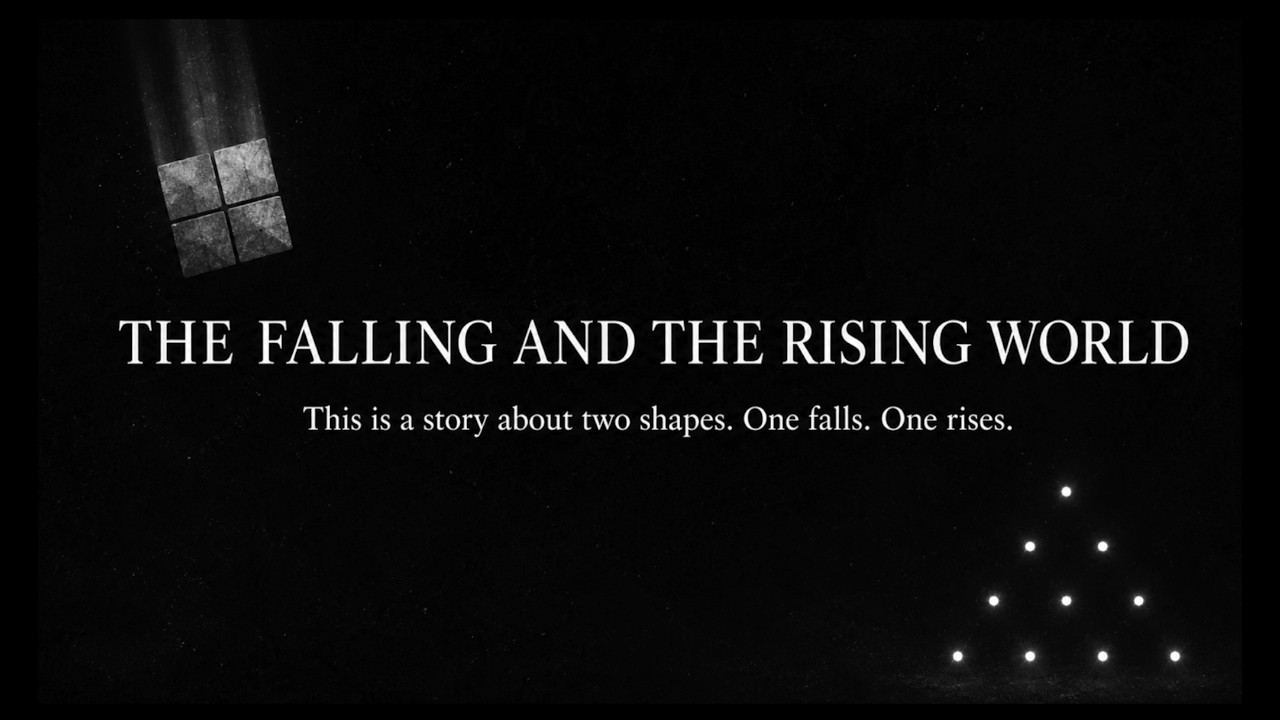
Video summary
The video presents a profound contrast between two geometric shapes that represent opposing ways of living: Tetris and the Tetractys. In 1984, Alexey Pajitnov created Tetris in Moscow using simple bracket characters because his computer lacked graphics; this game became a global phenomenon where falling pieces are uncontrollable forces that players must react to instantly. The core mechanic involves completing lines which then vanish from the screen, symbolizing how modern society often values only immediate results and measurable scores while erasing the process of creation itself. This "Tetris life" has come to define our current world, reducing complex human endeavors like health, attention, and environmental stewardship into mere monetary transactions that lack memory or a future horizon, leaving individuals in a state of perpetual exhaustion where even rest is difficult to maintain.
In stark opposition to the erasure found in Tetris stands the Tetractys, an ancient Greek figure composed of ten points arranged in four rows representing unity and health for over two millennia. Unlike the passive acceptance of falling pieces in Tetris, this shape represents a philosophy where individuals actively choose their own components through reflection rather than reacting to external chaos. The video illustrates this through a practical exercise used by the speaker, where people construct their own triangle using ten words: one defining what matters most about them, two describing how that manifests on Earth, three outlining their higher purpose, and four detailing their daily mission. A retired physician's journey serves as an example of this transformation; his personal Tetractys evolved from fear of losing his professional identity into a rich list of values like compassion, healing power, listening, and guiding, thereby turning retirement not into an ending but into a meaningful transfer of purpose where accomplishments remain visible rather than disappearing.
The narrative further explores the philosophical distinction between these two shapes through concepts like compossibility and eudaemonia. While Tetris represents equivalence in denial—where only what can be measured survives—the Tetractys embodies the capacity to judge what things can live together, a skill Leibniz called compossibility. The ancient Greek concept of eudaemonia is introduced as full vigor or a good dynamic relation to the possible, suggesting that true health involves actively choosing which possibilities we allow into our lives rather than passively accepting whatever falls upon us. Hospitals are critiqued for playing Tetris by erasing cases from records and exhausting caregivers with disappearing achievements, whereas asking patients what they can still become reopens the question of compossibility, inviting a focus on potential growth instead of just current deficits or costs.
Ultimately, the video concludes that health is not merely a static state but an act of navigation where each person holds their own course to discover new paths for living well. The falling world of Tetris offers only numbers and scores without context, while the rising world of the Tetractys invites us to substitute the question "How much is it worth?" with "What can live together?", a query that yields not a number but an entire world. By shifting from reacting to uncontrollable forces to composing our own lives through chosen words and values, we reclaim freedom and ensure that what we accomplish remains part of our ongoing story rather than vanishing into the void. This shift transforms us from mere players in a relentless game into citizens who actively cultivate health as a continuous practice of bringing diverse elements together in harmony.
Read the full video transcript
This is a story about two shapes. One
falls, one rises.
In 1984 in Moscow, a young Soviet
researcher named Alexey Pajitnov
was supposed to be testing a computer.
Instead, he wrote a game.
The machine had no graphics, so he built
his falling pieces out of bracket
characters,
four squares each.
He called it Tetris.
Within years, it had escaped the Iron
Curtain and conquered the planet.
This film is about why.
And about an older shape
made of 10 points that we forgot.
In Tetris, you do not choose what comes.
The next piece falls whether you are
ready or not.
You only decide, very fast, where to put
it.
It is a real art composing with what we
did not choose.
No life can do without it.
But here is the cruelty of the game.
A completed line disappears.
Accomplishment is erasure.
All your work becomes one number, the
score.
And Tetris cannot be won.
You continue or you are buried.
One world has adopted this game,
our world.
To every question of value,
we demand one answer, how much?
Health, attention, forests,
the future of our children, everything
must translate into money.
But money has no memory
and no horizon.
The score rises.
The planet waits.
So our lives became Tetris lives.
The inbox empties and refills.
Each finished project vanishes
into the next.
Even rest is now a strict
to maintain.
And yet,
Tetris leaves one thing behind.
Not the lines,
the player.
The hands grow faster. The brain learns
the falling shapes.
Players even see them
as they drift into sleep.
What remains of the game is the player.
The citizen transformed as player.
So here's the question.
Where does your life
deposit
what it accomplishes?
25 centuries before Moscow,
the disciples of Pythagoras swore their
oath
on another figure of four.
10 points in four rows.
One,
two,
three,
four.
The Tetractys.
A nation fragment says they called it
the principle of health.
It is not a relic. It is a movement. One
becomes two. Two becomes three.
Three becomes four.
A principle becoming a world.
In my practice of philosophical
counseling,
I have set it in motion again.
An exercise. A person composes their own
triangle
in 10 words.
One word at the top,
what the universe is about
for them.
Two words,
how that shows on Earth.
Three words, their higher purpose.
Four words at the base,
their daily mission and roles.
A physician near retirement feared
losing his reason for being with his
white coat.
His triangle came to be
compassion,
healing power,
serve to relieve,
listen,
guide, support,
right.
Retirement stopped being an ending.
It became a transfer.
In Tetris,
the pieces are given. Here,
the words are chosen. In Tetris, what
you accomplish is erased.
Here,
it remains and works.
Leibniz had a word for this skill,
compossibility.
Not everything possible can exist
together.
To compose a life or a planet
is to judge what can live together.
Every prize quietly makes that judgment,
then hides it.
Equivalence is compossibility
in denial.
The Greeks would have called the
capacity to reverse this denial
eudaemonia,
a good dynamic relation to the possible.
Old medical dictionaries define it
as full vigor.
It was already a word of health.
Our hospitals, too, play Tetris.
Beds to free, cases erased from the
screen.
Caregivers exhausted by the
disappearance
of what they accomplish.
To ask a patient not only what they
have, but what they can still become, is
to reopen the question of what can leave
together.
So,
two shapes,
Tetris,
is the mirror of the age. A perpetual
present, a score
without a world.
The tetractys of philosophical health
is the exercise of freedom.
10 words for what we believe,
what we aim for,
what we do.
To the question,
"How much is it worth?"
Let us substitute the question it hides.
"What can leave together?"
That question
does not yield a number.
It yields a world.
Health
is not a state.
It is a navigation.
And each of us can hold the course
and discover a thousand streets.