Video summary
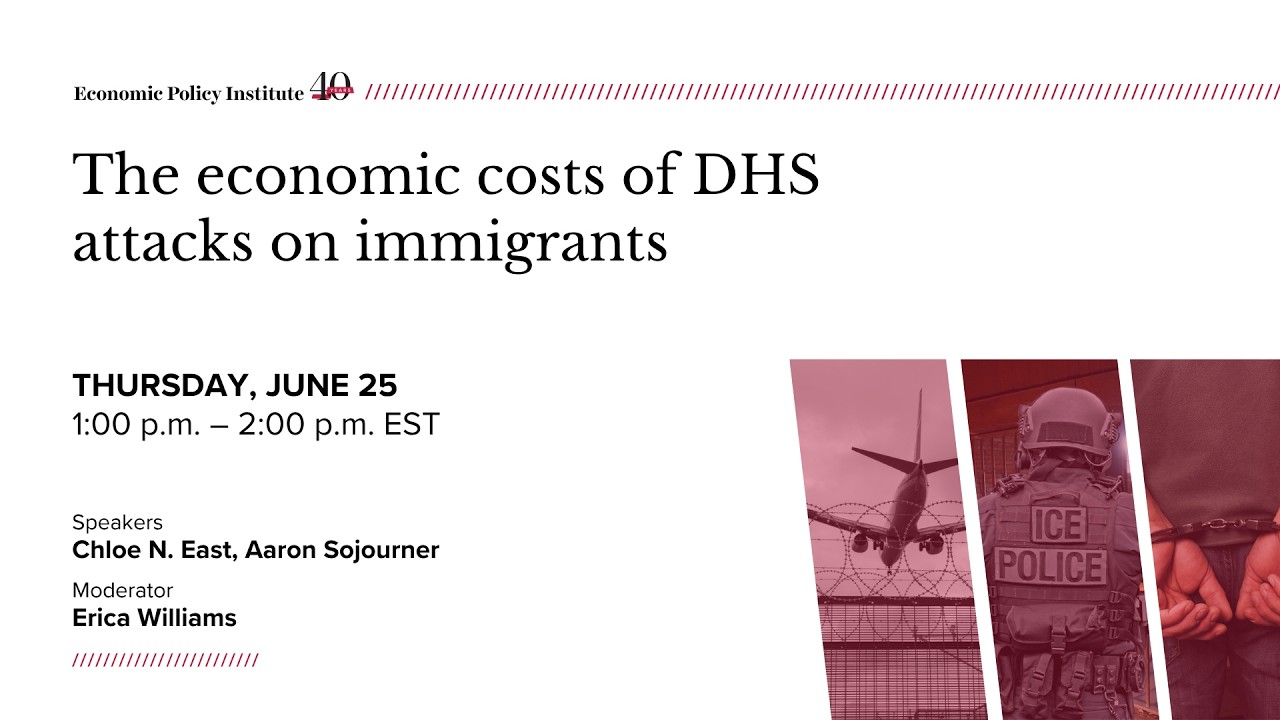
The webinar investigates the severe economic repercussions of intensified Department of Homeland Security and ICE enforcement actions under the Trump administration, directly challenging the notion that such policies benefit American workers. Research presented by experts Chloe East and Aaron Sojourner reveals a dramatic surge in arrests, which have increased by approximately 200% compared to previous periods, with a significant spike occurring during the second term of the administration. Notably, only about 30% of those arrested currently hold criminal convictions, indicating a strategic shift toward mass deportations rather than targeted enforcement of serious crimes. This aggressive approach has disrupted local labor markets, as evidenced by data from Minneapolis where hourly work declined by 2%, employee participation dropped by 3%, and the number of operating businesses fell by 2% during specific operations, resulting in an estimated loss of over $100 million in wages for local workers.
Contrary to the belief that deportations create jobs for U.S.-born citizens, studies demonstrate that immigrants and native-born workers often serve complementary roles within the economy, such as laborers versus skilled tradespeople in construction. The enforcement crackdown weakens worker bargaining power, leading to increased on-the-job injuries and widespread wage violations. Furthermore, a profound chilling effect has permeated communities; for every single arrest, there is a reduction of seven immigrant workers and nine U.S.-born workers remaining in the country due to fear. This atmosphere of insecurity has led to decreased school attendance for children in mixed-status families, an increase in teen labor among those students, and historically low levels of immigration inflows, including international students avoiding staying in the United States. The fiscal impact is also negative, as undocumented immigrants are net fiscal positives who contribute roughly $74 million annually in taxes to Washington, D.C., alone while receiving no benefits from Social Security or Medicare, meaning mass deportations threaten the long-term solvency of these essential programs.
The economic damage extends beyond immediate wage losses to include lasting trauma and recessionary effects on affected areas, including Washington, D.C., alongside significant harm to innovation and growth. The policy is described as self-defeating because it fuels a "detention industrial complex," where private companies like the GEO Group have seen their stock values rise due to increased federal contracts for detention, creating a revolving door between private profit and public enforcement power. Ultimately, the speakers argue that these actions cause deep economic harm rather than providing relief or security. The discussion concludes with a strong emphasis that a more humane immigration system would support and strengthen the economy rather than drain it, calling for collective action to address this critical issue.
Read the full video transcript
Thanks so much, Jen, and welcome
everyone. It is really great to see this
kind of turnout, uh especially in light
of today's Supreme Court ruling allowing
for the end of temporary protected
status and some humanitarian protections
for some migrants. I I know we're all
going to be um
digging into what that means for people
in our communities all across the
country, but it is heartening to see
folks from all across the country join
us today. It gives me some hope that
we're going to have the kind of
solidarity and people power we're going
to need to turn the page on this era
that we're in and to end the kinds of
enforcement actions that we see today
through the Trump administration.
There has been irreparable harm done to
families and communities across the
country, and it's been intentionally
done in cruel, inhumane, violent, and
racist ways. Um And you know, these
morally republic repugnant attacks on
immigrants also come with substantial
economic costs, costs that are mounting,
and we're going to dive into that topic
today with our two speakers as they lay
out their really important and timely
work to document more of the damage
being done to workers, to businesses,
and the broader economy, including a
case study in Minneapolis, and I will
add a few details about what's happening
here in the district as well. So, we're
going to start with a few opening
remarks from each of us.
Uh the And then the conversation will
start with sort of the national picture,
we'll narrow into the local, and then
we'll jump into questions that uh many
of you sent in ahead of time, and we'll
um have folks answering questions that
come through the Q&A in real time. We
may have time to take some of those live
as well. So, with that, let's get
started with Chloe. As you heard, Chloe
East is associate professor of economics
at the University of Colorado Boulder
and the vice president of her union,
United Campus Workers Colorado. And she
has been studying US immigration policy
and its economic effects for over a
decade and is going to present us some
of her new research. So, let me hand it
to you, Chloe.
>> Thank you so much, Erica. Thank you all
for being here.
I am very excited to share my work with
you on this topic even though it is a a
fairly depressing topic.
And I will say that I am
I see a lot of people from Texas in the
chat. So, I'm just going to flag that I
actually even though I live in Denver in
in Canyon, Texas right now in between
Amarillo and Lubbock
on a road trip from Austin where I'm
from back to Denver.
So, good to see lots of folks from that
area here.
So, I'm going to share some slides just
to guide
the conversation.
Um,
I have sent a request to share my
slides. Sorry, I should have checked
that before getting in. I'm assuming you
can see them.
Um, all right. So, as
Erica said, Do you want to see my slides
actually before I dive in?
Okay, good.
Um, so as Erica said, I have been
studying immigration policy including
ICE activity um
for over a decade and actually started
studying this topic
focused on the Obama administration.
And the current work that I'm doing
right now is joined with some fantastic
people, Caitlin Cutler, Ellie
Austin Hooker, Adam Sawyer, and Jenna
So, I'm just going to dive in here a
couple of
papers that I've been working on
recently and kind of set the stage for
the research that I've been doing. So, I
just wanted to give a brief history of
kind of how we got to where we are in
terms of um
what one might call immigration
enforcement, but what I'm increasingly
calling ICE activity and not immigration
enforcement. And we'll sort of talk
about why that is as we go through the
webinar. But this just gives you a sense
about the number of
people removed from the US year over
year from 2003 through 2024. Orange are
border removals, blue are interior
removals.
And you can see um
why I have previously studied the Obama
administration in this graph because um
prior to the current moment, that was
when we had uh the largest number of
removals from the US, especially from
people who were already living in the
US, those interior removals. So we can
talk a little bit about how what is
happening today is different than that,
but I kind of wanted to flag that this
is a a trend that we've been seeing for
a while in the US
um
that we've been kind of building to to
today.
So to give some more context for what
we're seeing in the second Trump
administration, I'm going to talk about
a paper that I just got accepted at PNAS
um
which is looking at ICE arrests during
Trump's first and second terms. Um and I
think the link to that paper will be
posted in the chat.
So very briefly, there's a lot I could
talk about in this paper, but very
briefly um I'll talk about the scale of
ICE arrests we see in this Trump
administration compared to the prior
Trump administration.
So to do so, I'm going to show you these
two graphs here. Um they include about
the year and a half after the first
Trump inauguration on the left and a
year and a half after the second Trump
inauguration on the right.
Um so the horizontal axis here is time
relative to inauguration, which is shown
in the red line.
Um so the main thing to highlight here
is that while we did see a spike in the
number of arrests in the first Trump
administration, the spike we're seeing
in the second
is truly unprecedented, even
unprecedented relative to the first
Obama administration.
Um and I know we'll talk some more about
these particular spikes, but basically
overall we've seen about a 200% increase
in arrests in this administration.
Um then the next thing I'll talk about
briefly is who is being arrested by ICE?
And of course we can talk about this in
lots of different ways which I'm sure we
will, but to start I'll talk about this
in the sense of um
who is being arrested who has a criminal
conviction. So these are the same two
graphs I'm showing you before.
Um but the added to the black line I was
going to show you the green line which
corresponds to the right hand side axis.
And this shows you the percent of people
who are arrested by ICE who have a
criminal conviction.
And again you can see that what we're
seeing in the second Trump
administration is really unprecedented
even compared to the first Trump
administration. We're at a pretty much a
new low in
um the lack of targeting people who have
a criminal conviction. We're at about
only 30% of people who are arrested by
ICE today
who have a criminal conviction.
Um so then briefly I'll talk about
economic impacts and then we'll want to
spend some more time talking about this.
Um I have studied this in the current um
administration in Trump 2.0 which uh
that research is out as an NBR working
paper which was posted in the chat and
then I've also studied this in the past
in the Obama administration.
So just to kind of give you the the
highlight um
you know the the broad shape of what I'm
saying,
uh this graph is showing you the change
in the employment rates of likely
undocumented immigrants on the left hand
side bars and US born workers on the
right hand side bars. And what we find
is that as the number of ICE arrests
increase in a local area, the employment
rate of both undocumented workers and US
foreign workers falls. And we'll talk
about the mechanisms for why this
why this is
as we get into the discussion, but
broadly what we're seeing is no positive
impacts
of
the ice campaign in Trump 2.0 for US
foreign workers. We also look at wages
and see no evidence of improvements in
wages in Trump 2.0 for either immigrant
workers or US foreign workers.
So, I will go ahead and stop sharing now
and look forward to the
questions and discussion. Thank you.
>> Thanks, Chloe. Thanks for
giving us a little bit of a basis for
our conversation and we're going to hear
a little bit also from Aaron. Aaron
Sojourner is deputy director of research
at the W.E. Upjohn Institute for
Employment Research, which is a private,
non-profit, non-partisan, independent
research organization that's been
studying policy related to issues of
employment and unemployment since it's
founding in 1945.
And
Aaron formerly worked as senior
economist for labor at the White House
Council of Economic Advisers in the
Obama administration and the Trump one
administration.
And he lives in Minneapolis and so that
is where his research takes place and
I'm going to hand it over to you now,
Aaron.
>> Thanks so much
Erica and
EPI for putting this together and all of
you in the
audience for spending your time with us
to learn about this. It's really
important issues um
and appreciate your attention. So, you
guys see the slides?
Uh
>> [clears throat]
>> yeah, okay. So, this is joint work with
um Aaron Rosenthal who's research
director at the North Star Policy Action
which is like
um what part of the Earn Affiliate
Network uh
based in Minnesota.
Um and basically I'm going to tell you
about some research we've been doing to
document the impact of Operation Metro
Surge, which was the DHS enforcement or
DHS activity that took place in
Minnesota
uh over January, February
uh
of this year.
Um just to give you some context uh the
H this Operation Metro Surge was very
intense.
Uh I'm sure everybody knows
uh roughly about that.
Um this is a from a newspaper article
from the Star Tribune, the Minnesota
Star Tribune. It's based on uh
data crowdsourced kind of data
um
that you can find in the link there.
But basically it compares like community
reports of enforcement act of uh agent
activity um in LA, in Chicago, and in
the Twin Cities.
Um and what you can see is that like the
scale between LA and the Twin Cities is
similar,
but
what to know about that is that LA has,
you know, six times more people than the
Twin Cities. They boosted the number of
agents here by
um
something like 16 times the usual
amount. Uh
and
you know,
so the the the black lines here scale
that um
LA activity down by six times. The black
line here scales
the Chicago activity down by 2.7 times.
So, roughly you can think of those lines
as comparable to the
uh Operation Metro Surge in the Twin
Cities. That's how much activity was
happening,
you know, um it many times more intense
enforcement activity
uh
or agent activity in the Twin Cities
over those months than in other places.
The agents
count maybe was similar, but just like
applied against a um a much smaller
community.
Um what we have been trying to
understand and and estimate is
how did that change the labor market um
in the
MSP Minneapolis-Saint Paul metro area.
How did it affect the labor market in
the state of Minnesota? We've done a
couple pieces of analysis. I'm going to
show you two.
The first one's going to focus on daily
data that we're able to get from a
um payroll and timekeeping system called
Homebase that um a lot of small
businesses, retail, restaurants use to
track their employees like swiping in
and swiping out and getting paid every
day.
Um we're able to get data at the daily
level for the um
number of employees swiping in, the
number of hours worked, uh the number of
locations that had any employees swipe
in
uh
for MSP metro area and also for other
metro areas around the country. And that
data is available back about 5 years and
so we can
uh look at how did
um activity in MSP metro area change
after Operation Metro Surge
um started compared to
uh what would have been expected based
on changes we see in other other metro
areas and the
um
it
and we can do that at the daily level.
And then we did separate analysis using
data from the Bureau of Labor
Statistics. This is much more standard
uh kind of data
that's collected every and published for
every month
um for the whole state for the leisure
and hospitality industry in the state.
We can measure the number of jobs, hours
worked, earnings, employee earnings.
And we can compare trends in Minnesota
compared to trends in other states that
usually are on a similar trajectory. And
so the the basic thing we're doing in
all in both of these situations is
looking at which metro areas or which
states
in the past years track Minnesota's
trends and then using that as like a
good comparison group for what would
have happened in Minnesota if there
wasn't an Operation Metro Surge. And
then we can see what did happen in
Minnesota with Operation Metro Surge.
And we're going to measure the effect of
Operation Metro Surge as the difference
between
what would have happened based on what
happened in similar
uh basket of states
uh or metros and what did happen in
Minnesota.
So, this is like the first set of
results. This is for um MSP metro using
that home-based data.
And what we what we did was like
look at all the years leading up to this
and then we can estimate at the daily
level like what how is it different in
Minnesota in MSP compared to what would
it be expected um
given this other data and the
relationships we typically see. And what
we can see is that in the months leading
up to Operation Metro Surge
Minne- MSP looked just like you'd
expect. There's no difference. These
blue dots are very similar to to the
regular line. But once the agent surge
starts, you see uh
the number of hours worked falling in
MSP and relative to other places. And so
we see
um
you know, a 2% decline overall in the
number of hours worked in uh MSP. We see
a 3% decline in employees working. Uh we
see a 2% decline in the number of
businesses operating. This is for the
whole, you know, multi-county area.
Uh [clears throat]
and that persists, you know, this dot
down here is the day of the general
strike that took place.
Uh so, it makes sense that that was a
big
uh decline in the in hours worked.
Um
and look, you you've read the news
stories. I don't need to describe what
happened it it here, but basically like
people were scared to go out in public,
especially people of color, especially
uh because the DHS agents were
you know,
uh targeting people based on the color
of their skin, based on language,
uh and it made it unsafe for people to
go outside. It made it unsafe for people
to go to work, to go to restaurants, to
go to church, to go to uh
mosque, uh
and
um you know, it was
very
uh new kind of risk in the community.
And what we saw was people pulling back
from all these activities uh
be to manage those risks. Uh and it was
very uh disruptive.
Um if you take that uh number of impact
on the number of hours and you try to
put that into dollars, what it means,
like we did a very conservative
estimate, uh what it means is workers in
in the Minneapolis-Saint Paul area lost
about over over a hundred million
dollars in wages.
And like in COVID times,
people also had a risk from going in
public. People also had a risk from
going to work.
People also lost earning opportunities,
lost wages, but it was a big difference.
The federal government was sending a lot
of support to families and businesses at
that time.
Here, the federal government was sending
the risk. Was sending the danger
and was not sending any support and
hasn't sent any support. In fact, has
been trying to cut off supports.
Um we also looked at the leisure and
hospitality industry for the state.
Um and what we found here is similar
like in the year leading up to Operation
Metro Surge, Minnesota's leisure and
hospitality industry looked just like
you'd expect based on prior data, but
once the operation starts, we see this
decline. Uh we estimate that it caused a
loss of about 4,600 jobs, 5% of total
hours in the whole state's leisure and
hospitality industry, $71 million in the
whole state's leisure and hospitality
industry lost earnings.
Um I'll just flash this up here. I won't
go through it. There's a lot of reasons
why
um
you you can dig into this if you want. A
lot of reasons to it. Like the simple
story is, "Oh, immigrants are
competition for American workers."
That's wrong in That's true in maybe to
some extent, but it's also very
incomplete and wrong in a lot of ways
that are really important and uh
maybe overwhelm that simple story. So,
that's what I got. Thank you.
>> Thanks so much, Aaron. I think that's um
just
incredible the impact. I think we all
know there's um more than the economic
impact, but it's important to have the
data and the analysis to show that this
sort of talking point of the Trump
administration that this is somehow
going to lead to more jobs for American
workers uh for US citizen workers
um that we need to be dispelling that
myth. So, thank you for that. Uh you
know, we don't have this level of
analysis here for the district um but as
another of the front lines of escalating
attacks on on democracy, on immigrants,
on rights, I am feeling confident that
we have probably experienced some of the
same kinds of effects on our own
economy. DC is home to about 95,000
immigrants. That's 14% of our local
population.
Um about 47,000 were non-citizens.
Um about 25,000 are estimated
undocumented.
Immigrants are 16% of our workforce,
uh account for 15% of economic output,
are 21% of business owners,
um and are contributing in all kinds of
ways including tax contributions from
undocumented immigrants, which are about
74 million a year. So, you know, the
Trump administration's federal
occupation of DC, which has been
ongoing, has been quite damaging in all
kinds of ways. It's meant an
unprecedented an intense level of
enforcement, um removing people from
their families, their communities, their
workplaces.
Um this all started last August when
Trump declared a crime emergency without
evidence, of course.
Um that allowed him to basically
infiltrate the local police force
uh and brought a surge of National Guard
to the district.
Um and we've been occupied ever since.
We have a new surge right now because of
the 250th anniversary of the country.
And uh so, we've got 5,000 National
Guard here uh today.
And I would just say that in a
geographically small place like DC,
we're talking like 68 square miles.
It's we've all felt and seen it just up
close and personal, right? The
um
the National Guard, the ICE
uh
raids and um
attacks. And really, we've got the
entire alphabet soup of federal agents
that are terrorizing communities here.
Um they are right actively riding along
with MPD officers on just every day
uh
kinds of stops. And um we've seen them
go after school employees, show up at
our schools. They've come to our child
care centers
uh and terrorize child care workers.
They've racially profiled people in work
trucks and uh you know, causing people
to flee. They've uh
come into our restaurants. They've
arrested street vendors, all of it in
plain sight. It's generating a ton of
fear. And as was mentioned, when people
are really scared, they retreat from
daily life. And the And the fear isn't
just from undocumented immigrants
because of the way this is rolling out.
It is also folks who do have status, and
it's folks who are just black and brown
and are afraid of all the the law
enforcement on the streets.
And so, um you know, I And I would I
would be remiss to not mention that the
attack on immigrants and the level of
enforcement here really greatly
exacerbates the already troubling
interactions of law enforcement with
DC's non-immigrant black communities,
right? Including arrests that have led
to black residents being shot at or
killed. So, um
you know, that's our status here. And
because we lack full rights and
representation, because the federal
government ultimately has control over
what happens here, we really just don't
have the same tools as other places. We
don't have the same kind of legal
recourse um that other people's have
peop- other other states, other places
have to really kind of provide some
buffer or try to intervene.
And so, we know that there's a lot of
harm happening here. Um and you know, on
the economic front we think there are
really big risks to critical set sectors
um with large percentage of immigration
workers. So like our child care
industry, our health care industry. We
have a lot of
nurses and doctors, our hospitality
industry for sure, which we really are
relying on right now especially amidst
all the DOJ layoffs that have led to a
lot of federal workers losing their
jobs. Um and you know, I think all of
this all of these things combined the
the immigration attack attacks on
immigrants
and others, the layoffs and the other
kinds of federal tax we're having on our
budget and on our taxes,
um
how we raise and use our local resources
is having a downward pressure on our
economy. We're in our own special local
recession. So
um you know, we see this sort of playing
out in a lot of different ways. Um and
so it I am
uh
really glad to have more research that
we can be using to make the case that
this is um absolutely abhorrent
uh status situation that we're living
through but also one that is damaging in
the short and long term for our economic
well-being in this country. So I want to
jump back in with Chloe for a minute and
you know, you talked about how the
deportation agenda is actually harming
US-born workers. I wonder if you can
just say more about that and how that
happens, how that works.
>> Yes, absolutely. Um I know there were
some audio issues before. Is it a little
bit better now?
Okay.
Uh apologies. So
um
I want to pick up actually on something
that Aaron's saying in his um
presentation, which was the idea, you
know, the sort of um myth that we're
told by politicians and others that uh
there's one substitution between um
immigrants who arrive to the US and want
to work and US born
um
workers. Sorry, I was looking at the
about the audio.
Um
so I think that my research and other
research has really shown that that is a
myth and that there are a couple reasons
for why that's a myth. Um
the first is that the types of
industries and the types of jobs that uh
US born workers work in and immigrants,
and especially on
undocumented immigrants work in
are from
uh shown as in
recent
in the
chat.
Uh
because of this, um when immigrants come
to the US, they are generally not um
taking jobs that US born workers would
otherwise take. And what I have shown
even sort of beyond that is that the
jobs that immigrants take help US born
workers um continue to work. Uh they're
actually complementary to the jobs that
US born workers generally take. And so I
think the best example of this that
we're probably um
all familiar with is um
the idea or sorry, I'm trying to fix the
audio here. Um let me do one thing and
see if that makes it better.
Okay, I'm going to try that. Um
probably an example we're all familiar
familiar with is a construction site. So
when you think about workers at a
construction site that you've driven
past or worked at yourself, um most of
the construction site laborers, the sort
of most manual tasks are done by
immigrants themselves. And then
um the other tasks like uh electricians,
uh architects, construction site
managers are done by US-born workers.
And so when construction companies
actually have a hard time finding
immigrant workers to be construction
site laborers, they build fewer homes,
the research has shown, and they hire
fewer US-born workers. And so there's
not just this Oh, good. I'm glad the
audio improved. There's not just this um
lack of substitution, but there's
actually a complementarity between
immigrants and US-born workers um on the
whole.
Um I do also want to highlight some um
good research on the Obama
administration that shows that
um
immigration enforcement uh
weakens workers' rights, weakens
workers' bargaining power, and leads to
an increase in on-the-job injuries, and
increase in minimum wage violations from
employers. And so while the previous
story I was telling you about
construction site laborers might lead
you to think like this is
um
this is leading us to down a path we
don't want to go down as labor
organizers, I think there's other really
good research um that shows that um
immigration enforcement is actually
really harmful for all workers'
bargaining power um sort of regardless
of the jobs that they do.
Um so that's one story uh or one sort of
mechanism through which um
deportations are actually bad for
US-born workers. The other thing I just
want to highlight and then maybe we
could pass uh to Erin is um
that especially what we're seeing right
now uh where ICE is
acting so indiscriminately and um so
widespread um across cities, it's having
this kind of new negative economic
impact that we maybe haven't seen before
in prior administrations
that Aaron was sort of referencing where
people I mean even US foreign people are
afraid to leave their homes and Erica
you're referencing this too
because it might lead to an interaction
with ice and you know lots of other
things that people are trying to avoid
and so we see in our work that that is
also causing US foreign people to stay
home from their jobs
because of that fear.
>> Thank you. Yeah, Aaron do you want to
jump in on that too and maybe
>> I mean the thing I'll just draw out I I
agree with Chloe's message there.
There's a lot of other channels that
that can generate these positive
spillovers from having
um
immigrants here and author and working
so
um yeah, we we can talk about those if
people want but one thing I'll just
highlight is the shift away from
targeted enforcement to
mass deportation
is like a big important shift that in
its it's it's quite different because
you know
the public is spending public resources
uh going out
um and
moving people
and it used to be
you know when it's targeted by
definition you're
like assessing possibilities you're
looking for the highest benefit
sort of people
to to to
go after people who've maybe hurt
members in the community people who are
convicted of murder or rape or things
like this like the worst of the worst
that's targeted enforcement
in the extreme uh
you know
obviously it's like sometimes it's less
than that but uh when you shift to mass
deportation, now you're you're not
targeting the worst of the worst. Now
you're
you're targeting people who by
definition
didn't hurt people in the community.
People who are being productive, who who
are getting along with and contributing,
who are following all the rules, who are
like here and contributing to their
local community, to the to their local
economy,
and like
using public resources to up to attack
them, uproot them,
remove them from the their community, it
and our community, it that is
damaging to the economy. That is
damaging uh, to
the the community.
Like
just almost by def- like it it
it it's hard to um,
shift away from
targeted enforcement to mass deporta- to
mass deportation, like the sign said,
without going after productive
con- you know, people who are
contributing great things to the to the
community and the economy, so.
>> Yeah, actually, I'm going to insert an
extra little question here. Um, you
know, cuz I I see uh, Chloe that you put
in the chat uh,
a paper on
school attendance and you know, we're
talking about removing productive
members of society from from society uh,
in different kinds of ways, either by
actually deport- you know, detaining and
deporting them or keeping them from
doing what they would otherwise be
doing. I wonder what you both think
about sort of the longer term effects of
this. Um, you know, you're measuring
sort of what's happening in the here and
now, but I wonder about the longer term
implications.
Either of you can jump in. Go ahead,
Chloe.
>> Yeah, absolutely. Um, so I put out a
report um,
that is uh, linked in the chat earlier
this year looking at um, children in
mixed status families,
particularly teens in mixed status
families to see if they are
increasing their work and decreasing
their school attendance to kind of make
up for loss of parental income either
because their parents were detained or
deported themselves or because their
parents are afraid to work. And what we
showed is that there was a striking
increase in 2025 in teen work in mixed
status families and decrease in school
attendance that that accompanies that.
And then there's some other work on
younger children that I posted in the
chat that shows that school attendance
has also gone down. And I think this
relates to some work that is happening
by other social scientists that I'm not
as involved with but that is arguing
that having a parent who's impacted by
ICE by immigration enforcement should
really be considered
a very dramatic and life-altering
event and should be up there with having
a parent
lose a very steady job or a parent die
or parents divorce. You know, it's a
very traumatic event that's going to
have impacts on kids for decades to
come.
And a lot of my other work shows that
you know, what happens to children early
in life really has these persistent
effects on both their health and
economic outcomes in the longer run. So
I think we should expect to see that
particularly coming from kids in the
long run.
>> I'll just
again I agree with Chloe
and I would add
in the long run like if you look
economists have done a lot of studies
about immigration and innovation,
entrepreneurship, economic growth and
found consistently that
immigrants are really important to
America's success. It to the engine of
growth and innovation and um
the the things that keep America vibrant
and keep America uh moving forward and a
leader in the world.
Uh
and
you know, closing down paths
and w- like
bulldozing paths by which uh generations
of people have contributed to the
American dream and generated um like
avenues, not just for themselves and
their families, but for other people in
America, other people in the community
to uh be a part of these new
enterprises, new technologies, new
innovations. Like
it's
it's very self-defeating. It's it's it's
very
um there's real economic harm that comes
from that. And there's real like harm to
our place
in in the world and to our um the
opportunities our children will have.
So, and and we will have like right
around the corner.
>> Yeah. So, I mean, actually, Aaron, maybe
we'll stick with you for a second. Um
you know, I think we've
um
you know, the the attacks of DHS
ICE agents, yes, other DHS agents in
Minnesota um may have kind of
uh receded from the headlines uh for all
of us nationwide, but we know that just
because things disappear from the
national news, uh they doesn't mean
they've stopped happening. So, I'm
wondering um what you know, things look
like now on the ground, what
ramifications are still being felt um
and you know, impacts you're seeing
continue um
you know, across kinds of businesses or
different sectors. Just give us a little
more of what's happening right now.
>> Yeah, I think um
it was interesting hearing you talk
about DC because it sounded a lot like
like a a lot of the things you were
saying were very recognizable to our
experiences in the Twin Cities
and and in Minnesota.
Um
and
uh
yeah, it's definitely not just impacting
negatively
you know,
people are here without authorization or
whatever. Like it's impacting all
anybody here
all BIPOC people, like anyone with uh
dark skin, anyone who looks
anyone who speaks up in the wrong way,
like
was subject to attack, was subject to
uh harassment, subject to
uh coercion, physical you know, legal
coercion.
And
you know, it's just it it's unloosing uh
abusive state power in a way that I have
never witnessed
in my life and on a scale like I've
I know that it happens
uh
and I'm
but like it was on a scale
that I have never seen.
Um
And
so I don't know.
What's it like now is
uh
yeah, I think we're going to see this
lingering trauma in families, in kids,
in you know, people missed health care,
people will have lingering health
issues, mental health issues from
trauma, like
um
uh so
again, like people are
like
at the same time, the community really
did rally in a very decentralized like
leaderful way people have said. Like I
can't remember the name of the person
who said that but like that was a very
accurate
and like there was a lot of
uh solidarity and mutual aid and
community self-defense and like it was
um
very positive it it
in many ways but it was awful like it
was awful in many ways that this was
necessary.
Uh and so I think people are still
trying to recover from you know the the
lost income the lost
health care the lost education
and I don't see those things like
snapping back quickly like those are
going to be scars
um that people uh carry forward for a
long time I think.
>> Yeah, I do think this is going to be you
know you you can't fully
predict what the
uh future's going to hold. I think we've
all disabused ourselves of the notion
that we can like know what tomorrow's
going to bring um
and you know knowing that the damage has
been really
severe and that the trust is um broken
for sure
um
so I think you know it'll be really
important to be kind of documenting over
time like what what are the outcomes of
all of this.
I wonder um
if either of you wants to answer this
question from the audience um
and it is a little bit about the the
long-term as well as that the
deportations and immigration
um actions are going to harm our ability
to fund Medicare and Social Security and
there's some interest in hearing how
that would be problematic
um and how we could quantify some of
that. I also, you know, think
there's a question here about what are
some of the other
costs of detaining immigrants and
migrants and asylum seekers um
and sort of
in any system there's somebody who's
benefiting. So, like who's benefiting at
this moment from those kinds of actions?
Um so, I'm going to throw those two
questions out there and uh I don't know
Chloe if you want to jump in first.
>> Sure. Um
I don't have a great number off the top
of my head for Social Security and
Medicare, but other economists have
written on that and I can post some
links in the chat about that. Um
uh essentially um
well, especially undocumented immigrants
um generally pay into
Social Security and Medicare and don't
receive any benefits um from those
programs. Um for immigrants with some
kind of legal status this is a little
bit more complicated, but most estimates
um suggest that in a you know, taking a
long run view um immigrants especially
their children are net fiscal positives.
Um so, I can link to some of that
research. Um
so, certainly I think we will expect
that all of this is going to be harmful
for Social Security and Medicare. Um
Do you want to jump in? I have thoughts
about the sort of who is profiting off
of this, but Erin do you want to jump in
on sort of other economic costs for
>> Well, I'd yeah, I'd just second that and
say that um
like
from a human development perspective
like
we in it we invest in children. You
know, for 18 years we at least you know,
we're we're
um
educating and feeding and housing and we
do that in our families and we do that
uh
in our public
communities
and
you know, immigrants, adult immigrants
who come here, like other countries made
those investments and now they're coming
and they're um contributing to our
economy and they're paying into our tax
systems and our yeah,
uh public benefit systems.
And um
you know, they they're making important
contribu- valuable contributions in most
cases.
Uh
and it's um
>> [clears throat]
>> it's
it's uh
yeah, there's real cost to like
throwing that away and uh attacking them
and um
so, I'll just stop there and
throw it back to you to talk about the
other thing and come back on that.
>> Um sounds good. So, I I do want to flag
I do think it's an important point to
note and something I've been thinking a
lot about um
you know, in this moment when
we have we have done immigration
enforcement, we have done mass
deportations in this country before. The
research is clear even before this
period, you know, what are the economic
consequences of that. So,
what are the things that are keeping
people um
you know, why do people still support
this? Um and I think that racism, which
has been mentioned today, uh is a real
reason. Um but I also think that there
is a real part of our economy that is
profiting off of uh mass detention and
deportation and that that's worth
acknowledging um as well. Um I'll put a
link to a really amazing book that I'm
reading right now, um
written by some geographers,
um
about the both
um
revenue generating that uh state
governments and local governments can do
uh, because of immigration detention,
uh, but also the private companies that
are profiting off of immigration uh,
detention. And
uh, I think we're seeing this even more
blatantly in this administration. So, in
um, the Denver area where I live, uh,
the we have one of the largest detention
centers in the country, which is led by
the GEO Group. Uh,
and their stock value rose
astronomically after Trump was uh,
elected president. They get about half
of their revenue from the federal
government uh, to do immigration
detention. Uh, and one of their previous
executives is now the head or has a
leadership role in ICE. Um, so we're
really seeing the sort of revolving door
and sort of impacts of money within the
detention industrial complex, I think,
right now in a way we haven't seen
before, even though this has been
something that motivates uh, these
decisions for a long time, I think.
>> Yeah, I'll just I'll just add that you
know, if
we don't have enough oversight and
accountability, it's hard to say how big
and, you know, the extent of these
problems are.
Um, but outsourcing like coercive public
power
to private entities, to
profit-maximizing
entities,
it like invites a lot of abuse. It it if
you're in the business,
if you're maximizing profit in the
business of jailing people, of detaining
people,
you have really strong incentives to
push
to for depri- deprivation and forced
labor. Like, th- there's just no
other in- like, so it's very hard to
keep
those incentives at bay and to like run
uh,
uh, uh,
such an an ethical or like human rights
consistent uh version of that. There's
just like so much uh
profit pressure pushing you to cut
corners and to uh do the wrong thing.
>> Yes, all the ways that we incentivize
exploitation. [laughter]
Um
I wonder I'm going to throw a couple
more questions out there. I We have had
some folks who are interested in what
the
um
economic damage has been for farmers or
and like what the impact has been of the
deport mass deportation agenda in rural
areas. I wonder if either of you have um
things to say about that. Um and we also
have a question about the the chilling
effect of ICE enforcement or ICE
attacks, ICE activity um on in migration
even of uh folks with documented status
who would be coming here and and what
the impact of that is. So I'm
uh throw those couple questions out
there.
Go ahead, Aaron or Chloe, if you want to
start.
>> Um yeah, so I actually unfortunately I
don't have a great answer to the to the
agriculture question. Um
mostly because the data on agricultural
sector is fairly hard to come by and
harder to come by than on some other
sectors that I've focused on and that I
think Aaron's focused on too. So I think
we uh together have shown that sort of
the hospitality sector has been really
impacted, the construction sector has
been really impacted. Um in my past work
I've looked at child care and shown that
that's been really impacted. Um
but I think we don't have great data yet
really on agriculture or on rural areas
unless you know of any good research on
rural areas and that I don't know about.
Yeah.
Yeah, so unfortunately, I think we'll
have to stay tuned for that analysis,
but hopefully that will be coming soon.
>> Yeah, I think it it the data on
agricultural sector is worse and the
data
is it's not reported as well either
because of like confidentiality in small
places.
So, it's it's a particularly hard
sector to understand um for for using
our tools.
Um
but it is important and I yeah, I mean,
I think we can all guess the sign. Like
we can all guess the direction of these
things, but the exact magnitudes are are
tougher to nail down.
>> And um and then in terms
>> Oh, go ahead. Oh, go ahead.
>> Go ahead. No, no, no.
>> Well, I was going to pivot a little bit
um to to the chilling effect. So, one
number that I didn't actually get to say
in my slides, but I do want to say and
relates to the chilling effect point
although in a slightly different way is
that we show in our NBR working paper
that for every one arrest, there's a
reduction of um
seven immigrant workers who still live
in the US. So, this is not immigrant
workers who have been physically
removed, but these are immigrant workers
who are still living in the US and
that's what we argue because of a
chilling effect. Um and then we actually
find that for every arrest, there are
nine fewer US born workers. So, the
effect on US born workers is even larger
than the effect on immigrants. Um partly
I mean, they're a larger population. So,
um so that's part of it. But uh
I think that's an important thing to
note. And then
for what we're seeing for in-migration,
I mean, I think it's
at a historic low uh
that
most of us I mean, I know I would not
have predicted. I also wouldn't have
predicted uh the ICE activity to be as
extreme as it has been. Um but we are
certainly seeing um seeing that. And I I
mean, just as on a personal note, I see
that with my own students. Uh many of my
international students do not want to
stay in the US, um which is a new
phenomena. Um
they if they're applying to graduate
school, they do not want to stay in the
US. Or if they're you know, they're
looking for a job, they they want to go
elsewhere.
Yes.
>> Well, thank you so much to both of you
for sharing your research, for doing the
research, for sharing your research, for
helping us to document um what we know
are sort of devastating effects of the
the Trump administration's actions
against immigrants. Um
we know there's more to come, um and
it's going to be so important for all of
us to have shared understanding of what
the what's at risk, um and
um
and to be thinking together about like I
said, turning the page and what we need
to do next. I know there's lots of
brilliant minds out there thinking about
what a more humane immigration system
should look like, and it
um undoubtedly would be one that
actually buoys our economy, not um
drains it. Um so, I want to thank you
all, and I'm going to hand it back over
to Jen to close us out. I know we're at
the hour.
>> Thank you. Thank you. Thank you so much
to you, Erica and Aaron and Chloe. And
thank to every thank you to everyone who
joined us for a weighty topic that is so
big, we all need to come together to
address it. Um I will return you to real
life and ask you to take 2 minutes to
fill out our our survey, and we look
forward to hopefully coming back to you
again with better news soon.
Stay strong everyone.
>> Thank you.
>> Thank you. Take care.
>> Thank you so much.