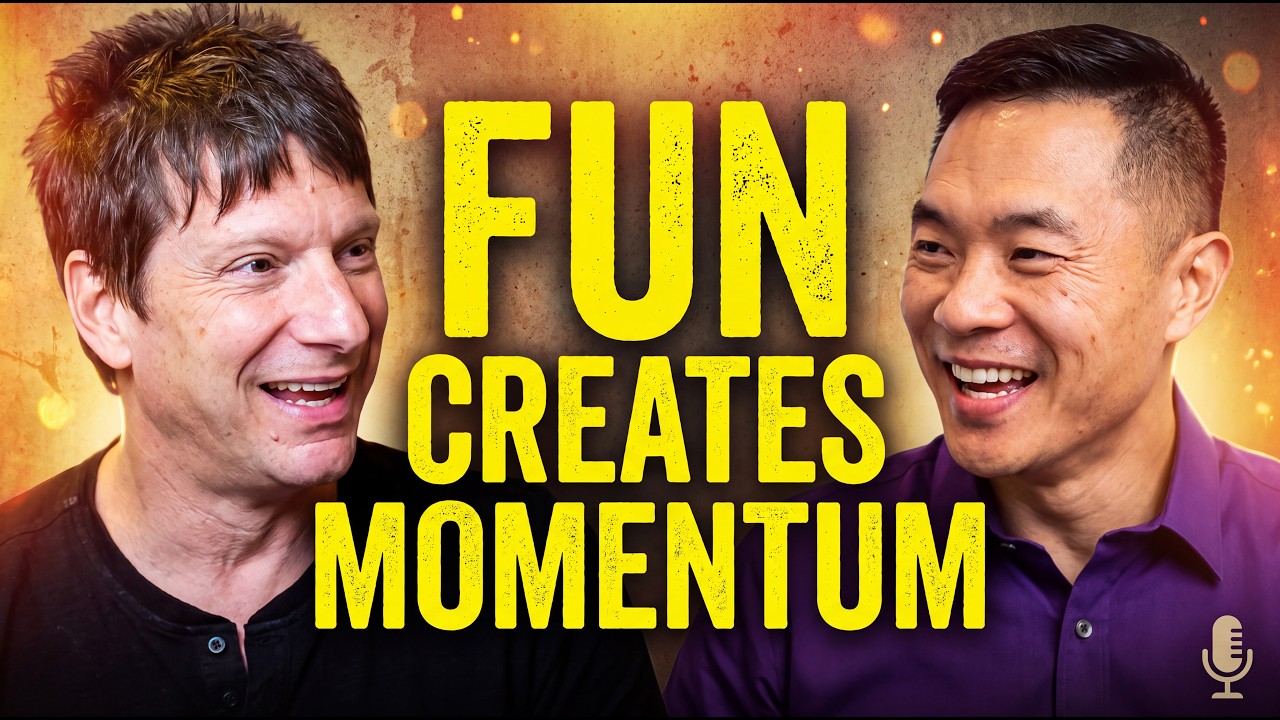
Video summary
Jia Jiang challenges the traditional notion of discipline as a grueling battle against human nature, arguing instead for a sustainable approach he calls "easy discipline." This method relies on aligning goals with genuine enjoyment and core values rather than forcing oneself through pain or dread. When an activity is inherently fun, the natural desire to continue eliminates the cycle of procrastination that often plagues tasks we dislike. By identifying what you love most—whether it is writing, speaking, or connecting with people—and making that your foundation, you create a self-sustaining engine for achievement where motivation flows naturally from interest rather than willpower.
To maintain long-term engagement without falling into boredom or burnout, Jiang emphasizes the importance of repetition with variation, avoiding the trap of doing the exact same thing every day. He illustrates this by citing NBA coach Joe Mazzulla, who varied daily drills to build resilience, and shares his own technique of writing from different characters or perspectives to keep the process fresh. This strategy treats habits like physics; once momentum is built, it becomes easier to maintain forward motion. By adding value, new information, or slight changes to every interaction or task, you create a "momentum loop" that keeps the routine dynamic and prevents the stagnation associated with rigid routines.
The core of this philosophy involves shifting from a purely task-oriented mindset to an "artist mindset," where failures and rejections are viewed as creative ingredients rather than obstacles. Jiang explains that fear often stems from focusing on external outcomes, whereas embracing adversity allows one to create art from difficult circumstances. He points to director Jon Chu, who turned a rejection based on racial connotations of a song into an opportunity by sharing his personal story, ultimately securing the necessary permission. This perspective reveals that unique ideas and personal authenticity are far more valuable than simply mastering specific tasks or following a rigid script for success.
Ultimately, Jiang encourages individuals to aim at what moves them personally rather than chasing external validation or generic advice on what "works." His own journey from trying to emulate Bill Gates to discovering his true passion for writing demonstrates that internal alignment leads to greater success and fulfillment. By removing friction from daily routines, such as working out at home, and adding mental stimulation like listening to podcasts, one can sustain a healthy lifestyle and creative output. The video concludes by inviting viewers to explore rejection therapy further, noting that early supporters will be immortalized on a wall, reinforcing the idea that building a path based on personal authenticity is the key to lasting achievement.
Read the full video transcript
There's not something wrong with you. A
lot of people have this feeling like I
should do this. I should do that. Like
you're you're shooting yourself. You're
shooting yourself to death. I should do
this. I should do that. Then because I
should do this, if I'm not doing exactly
that and then I am not a useful person,
right? There's something wrong with me.
We're all built differently. Every
person is extremely unique based on what
we like. What I would say is try to find
the most the things you like the most
that will get you closer to your goal
and then just do that over and over
again. Do that. Make that foundation of
your achievement journey. Not the things
that you don't want to do but but you
should do because you will never get
there.
[music]
>> [music]
>> Welcome to the show, Jaws. It's great to
have you.
>> Awesome. Good to be here. Nia and
Johnny,
>> I'd love to just jump in and break down
what easy discipline is because I feel a
lot of our listeners are huge fans of
traditional discipline, pushing hard,
working through pain, suffering,
building grit. What do you mean by easy
discipline and how can we use that to
our advantage? Yeah, as you mentioned
AJ, traditional discipline is all about
grinding, right? Going beyond yourself
and pushing the boundaries. I think
there's some truth to it, but the thing
is it's just like physics like you're
going against um gravity because you're
human nature for a long term. We want
pleasure. We want to do fun things. We
want to be able to do things easy.
That's why you see some of the biggest
technology companies, they deliver
things to you to make your life easy.
Now the traditional disciplines going
against that gravity, going against
physics, a human nature to be like I can
forever just push harder. But easy
discipline is the opposite. It's a
system or a mindset and system that make
you go with your human nature. So
instead of constantly trying to be like
I'm going to do things I do want to do
because it's good for me you do things
that you want to do that's fun for you
that's more artistic for you that that
that make you get pleasure and you but
by doing that thing you actually you're
actually working hard so easy discipline
is a way for you to achieve discipline
with uh with your human nature and
through through easy system. So that's a
long answer. I should uh rehearsed that
better. [laughter]
>> Well, I think many of our listeners feel
that that might be a struggle for them
because they've tied so much of their
self-worth to their ambition
and then that identity of having grit
and powering through. And even on social
media, when we think about the videos we
watch, the content we consume, a lot of
it is about, oh, I worked harder than
everyone else. I ran an ultramarathon. I
push beyond my limits and that's the
message that we get constantly
reinforced as well. So then hearing this
view of discipline feels just counter to
what I've built my identity around and
and what I value.
>> I mean that's a problem isn't it? We
glorify
uh this hardworking. We think hard
results should be also feel hard. We
should through ambition somehow require
us to sacrifice in the way that we hate
ourselves in the way. Right? So that's
why you see in the late 2010s and and
and you see a lot of uh uh Navy Seals
writing books about how they're pushing
themselves and you know what what had
like what has it done right for the past
10 years if you look at statistics we at
the beginning of the new year we're like
we're fired up we're going to do things
it's going to be a different year end up
9% of the total population keep their
new year resolutions no matter how
motivated you are at the beginning at
the end you just fall off because you
are going against your human nature over
the long term. Human nature wins. So um
that's that's why I want to be like
let's reverse that. Let's have your
human nature to go with you and you can
roll downhill and to in a way that you
don't stop. So if if you if you someone
if if someone tells you I achieve all
these things because I work harder than
everyone else. I can tolerate pain more
than everyone else. innately we feel
that's awesome. We feel like that's you
know that guy or that gal is like a
super person. But if that person tells
you I'm doing work I can't stop. I just
having so much I I I just work a lot and
because I I feel like there's I'm having
a great time. You you think that person
has problems. you're like, "Hey, go see
a therapist." You know, but the thing is
that's a pro. But the thing is, if you
look at the people who achieve real
long-term success, just look at the
people in the industry, right? The
people who change industry um at the top
of their field, you ask them how hard
are you working? Are you here because
you work harder than everyone else or
because you are achieving, you are
having a great time, you are living?
They will all tell you, right? They love
their work. They'll all tell you they
don't want to stop. They can't stop if
they force them to. So that's the type
of discipline I'm helping people to
achieve. We all have that urge to just
tap into our willpower. And we see these
examples of people who appear to have
limitless willpower, pushing through
injuries to run races, outworking their
competition, talking about how hard it
is and to achieve what they're after.
And then we turn that around and judge
ourselves for not having that willpower,
for not being able to show up for these
goals that we value so much. So, how can
we shift that perspective to start to
think about willpower as a finite
resource and not something that we need
to beat ourselves up over, but recognize
there's another path?
Yeah, that's why I uh I wrote this my
new book and I for a long time I for a
long time ever since I came to America
you know I came to America 116 I was in
that former camp I want I started the
first book I read was or these self-help
books you know and talk about how to
toughen yourself up for a long time I
had this ambition I wanted to do that
like every year every day I would have
plans and I falling into just overcome
and over and over again I just felt
straight up just on my face you know I I
fix planned in all different ways just
and I started just hating myself you
know honestly just because I I couldn't
do it but then I started thinking what
do I like to do you know what is the
thing that man [clears throat] if I just
sit there I will do naturally okay other
than all the entertainment all the like
the video games and stuff like that like
even even with that I learned a lot
about myself I learned that hey I uh I'm
someone who love to write I'm someone
who actually responds to this type of a
you know innate you know artistic
expression then what if I can just do
that what if I can actually use that as
a strength and do things I like and then
so that's really the enjoyment part the
easy part so I I talk about there are
different ways you can make you like
things more right. You can like you can
you can light things more gify it you
know and and uh and put in little
momentum every day you can uh and then
make you go forward and then the next is
a like I said easy right I'm be artistic
meaning before I saw the world as a goal
trying a goal I'm trying to conquer I
have this goal I'm going to go every day
to uh to achieve it but then I I start
forgetting about that goal. Don't worry
about that goal because when you think
about that goal, you're you're still
very far away from that goal. You you
know and sometimes if you're are not
moving forward toward it, you feel like
very the your gap is not getting closer.
You feel discouraged. But what if I
instead of thinking about the long-term
goal, I try to be think about just be
present. I think about how do I be the
best of the day. I stick I think about
how to actually take every moment I see
every moment I do and make art out of
it. That's really the you know I see
this moment between you and me this
between us that's a moment that will not
be replicated even though we might see
each other again someday in a convention
or maybe at the grocery store but I but
I'm never going to replicate this
moment. What if I just be the best self?
So in this way I didn't think about how
to have a great u interview with you. I
just think about how to have this great
conversation with you at this moment. So
those are the first two things I do you
know make things fun make things you
know uh enjoyable. Then nextly how to
make things artistic think in a artist
mindset with everyday move. So those are
the first my go-to moves.
>> You brought up some very important
points. I mean, for a lot of our
listeners, I'm sure a lot of them are
thinking, "Well, that's just great if
you like what you do." [laughter]
However, um, one of the first things
that we do with all of our clients is
get them aligned with their core values,
the things that are important to them,
the things that make that give them
meaning in this world. And for a lot of
them, they don't understand how that
works. Well, you just you just brought
up a very big point. When you turn
everything into something of of work, of
art, well, then there's a core value
tied to that of perhaps creativity.
And for those people who don't have
that, they have to look deep within
themselves to find a different core
value that uh that aligns with finding
some sort of enjoyment or fulfillment in
the task they are doing. I'm now 52 and
have been an entrepreneur for the last
20 years, which means I have I have had
to reinvent myself
[clears throat] and learn new skills
multiple times over those two decades.
And there would have been no way I would
have been able to do that without having
an understanding what my core values
were to get me through all of the bits
of learning that suck to get to a point
where I'm now enjoying things. You
mentioned a point about core value,
right? I'll share a story with you. I
met Bill Gates when I was six when I was
14. He came to China to promote Windows,
the first uh the the the the in
the coolest guy in the world. I thought
I'd be like that's my guy. I want to be
like him. Okay. Probably not. Probably
not nowadays. Okay. He's not on in the
news for the wrong reasons. But back
then he was really cool. You just have
to trust me. And when I saw him, it's
like that I want to be the Chinese
version of Build Base. That goal drove
me to come to America to get to to take
a computer science degree in college to
get jobs and start companies. That goal
drove me so much and almost I mean drove
me to the ground. I mean it did take me
through the tough times I I had but also
it drove me to the ground because later
on I found huh actually the idea of
wanting to be a Bill Gates wanted to be
a billionaire and the the actually the
thing that are doing that take you to to
get you there aren't the same the things
are about you got to hire you got to
fire you got to build product and stuff
I can I can be pretty good at I read so
books like I I listen to all the
podcasts in the startup world. I go to I
went to all the conventions, all the
conferences to learn everything
possible. But then one day, you know,
the pandemic hit and the um uh you know,
everyone got depressed for a bit because
you're also really isolated and to feel
better. I'm just like I'm going to write
just to feel better. And then I just
wrote more and more and more. I just
feel like ah I feel better and better.
Then I look look back like I I'm a
writer actually. I didn't know that
about myself. I thought I was bull. I
thought I'm on this past or just grind
myself into this glory. As it turned out
inside me, I'm a writer. So I started
writing and that completely turned my
life around. I became so much happier
and I became really good at writing. I
landed the pool the two book deals, you
know, with major publishers. I become a
speaker, the one of the only speakers of
East Asian descent, you know, and and I
go do public speaking. All of that
because I actually found out what I like
and instead of fighting that, instead of
saying, "No, I'm going to be I'm going
to be this entrepreneur someday. I'm
going to ring the bell and ask that
whatever, right?" But now I'm like, I'm
actually doing things that I enjoy
that's in inner alignment of who I am.
That takes a long time to actually
listen to yourself to to figure yourself
out instead of just keep suppressing it
because you want to achieve an external
goal.
>> Yeah. And there's an internal battle
that goes on and for you to actualize
that. And that internal battle needs to
be embraced as difficult as it may be
and for the people around you while
you're going through it. [laughter]
>> Absolutely. Absolutely. One of the first
signals many of our listeners are facing
is procrastination.
So we've identified, hey, I want to be
Bill Gates. I I want to be the next
president. I want to be a Nobel
Prizewinning scientist and I'm going to
study hard. I'm going to get the
advanced degrees. I'm going to follow
the path of the people that I idolize,
that I look up to. And then you start
that journey. And it's hard. It's not
easy to achieve these great levels to
become famous enough that you are sought
after by other people. And then I don't
want to do this today. This doesn't feel
good. This is uncomfortable.
>> You know, I don't want to go to these
conferences. I don't have a company. I
don't have an idea yet, but I want to be
a startup founder. And we start to
procrastinate and do things for pleasure
that don't move us to our goals. What is
that procrastination signal?
under the guise of easy discipline. How
should we be looking at procrastination?
>> I'll give you u a personal example,
right? A lot of times when you're
procrastinating,
what is happening is you are fighting
against a feeling. The feeling is you
are doing something that you should be
doing, but when you do it, you're like,
"Oh, this sucks." Right? And I'm like,
okay, when that feeling is not good,
what you what you do is, hm, all right,
let me feel better. Let me feel better
about doing something that I actually
like to do. Let me do something that
that distracts me. And that usually
comes in a way of maybe scroll, you
know, you you know, you scroll on your
phone, you watch you watch stuff and and
then
then time pass. Now what? You feel
worse. You're like, "Oh, shoot. I just
wasted two hours. Instead of working to
my goal, I have wasted two hours on this
dis that's pleasurable. Okay, what do I
do? Let me get back to work. Okay, work
hard. And guess what? You feel even
worse this time because not only you're
filing the same task that makes you that
brings you no pleasure. Added the
feeling that you just wasted 2 hours.
Now guess what? This feeling is even
worse. What do you do? Oh my gosh. Let
me distract myself a little more. Let me
do a little bit more dream scrolling. So
you have this loop of feeling bad and
get distracted uh loop. That's why
people procrastinate. What I tell people
to do is is there ways how about you
number one thing you find is can I make
the thing that I want to do can I make
it fun? Can I make it crazy fun? Can I
make it something that I I just like oh
what is possible? I'll give you an
example. I I actually became I become I
became known because I did this thing
called 100 days of rejection therapy. I
did this over 10 years ago on YouTube.
>> I remember that.
>> Uh yeah. So I started out by thinking,
you know, I was afraid I was doing this
entrepreneur thing, you know, grinding
through, right? And then I was like and
I got I got rejected with the
investment. I was like, "Oh my gosh, I'm
I feel quit. This sucks." And uh but
then I'm like I'm so afraid of
rejection, I should be overcoming my
fear of rejection. Maybe I should have
some fun with rejection. How about
instead of running away from rejection,
let me go look for rejection once per
day for every day for 100 days. You
know, I started out by asking $100 from
a stranger. And then later I then the
next day could get a burger refill. The
next day I try to get a like Olympic try
to get an Olympic donuts. get a try to
get a box bonus that look like Olympic
rings just by asking what end up
happening is extremely counterintuitive
because this no one likes rejection. I
didn't like rejection, but 100 days of
rejection therapy, the idea of me
looking for rejection and filming myself
then putting on YouTube was fun, right?
It was pleasurable. But because I did
that and that was and I I couldn't stop
doing, you know, I come in with the idea
of I'm going to make art. I'm going to
have fun this today. I'm going to talk
to that person and see what happens.
this thing people sometimes people like
you couldn't pay people to do this but I
do it by on purpose because it was fun
and so I did it not it it just blew up
my that was the that my um YouTube
channel blew up and I got millions of
views of people I don't do YouTube
anymore but for that period I had a lot
of fun um so by letting fun by letting
this curiosity drive me I opened up a
whole door of possibilities I didn't
know that thing could exist
You know, I didn't know what, you know,
YouTube channel was. I didn't know that
other people are also afraid of
rejection and they're living their fears
through my eyes. It becomes therapeutic
for people. It changed my opened all
kind of doors. Open changed my career.
Oh, I did that because I turned
something that was hard, that was
grinding into something that was fun
into something that I want to do, I'm
curious to do. And the results was
amazing. So I advise all the all the u
listeners that if you feel like man
you're up against it and and today right
you're you feel like you're you have do
something you don't want to do and if
that feeling repeats over and over again
don't try to fight it every day if you
do it you're going to start failing
you're going to start hating yourself
you lose confidence you think there's
something wrong with you no try to find
the fun the thing that intrigues you and
then Try to use your own curiosity to
see what if I do this, you know, what if
you're a salesperson, you know, instead
of writing code sales pitches and you're
like, "Oh man, this sucks." Or maybe
give it to AI or whatever, right? You'll
be like, "What if I camp some ride? What
if I do something that always intrigue
me? What if I write a a love letter to a
stranger and I don't know like I'm not a
saleserson, but think about the things
that that intrigues you or that makes
that make it fun. Try that. those things
might open doors and you can find a
different person inside you.
>> I I think one area that many of us find
procrastination comes up going along
with your New Year's resolution is is
working out, exercising, going to the
gym. We know we want to be healthier.
Maybe we want to lose a couple extra
pounds. Maybe we got some bad news from
the doctor that we want to change our
health trajectory or we're just thinking
about longevity and we want to live
longer. But that procrastination of
getting to the gym and actually sweating
and doing the hard stuff can feel like
pushing a boulder up a hill. So what do
you say to that person who's facing that
procrastination to make it fun? How can
we reorient ourselves to break through?
>> I'm going to use the exact that example
because I changed my life. Like I um in
my early 30s I was diagnosed was
hypertension. You know that's very early
for somebody in their 30s to get high
blood pressure, right? And I'm like, "Oh
my gosh, if I don't control this, I'm
going to be in trouble. So, I need to
start exercising." So, uh, and so I
mean, but I don't want to go to gym.
This idea of me going to the gym,
driving there every day, just just
driving. I bought gym. I bought like two
years worth of gym membership pretty
much. I used pretty much I went there a
couple times like, "Ah, you know what?
I'll go the next day and then never go."
And they just spend the money. That's
how gym make money. I'm like, okay, what
if my biggest friction is for me to
drive to the gym? What if I just live at
home? Like, what if I just do also
instead of my I feel like my biggest
friction point that I procrastination is
me changing my clothes and go to the gym
and sitting there deciding what to do.
All right, I'm going to do this and I'm
going to do that and what do I do? So I
found I found I I I started just looking
for things that be like you tell me what
to do instead of me doing it instead of
me trying to figure out uh what to do.
So I did P90X that really changed my
life. I'm sure a lot of you have heard
that. The reason is that simple. You
know P90X did Tony Horton, this great
trainer, he tells you what to do. He's
funny, right? You just do what he does
and you don't have to even think about
it. And guess what? I got addicted to
doing that. So I started doing that. I I
I followed to Cordon and later I did uh
uh this woman called Caroline Gervin. Uh
she's amazing. Um there's this Irish
woman and and now
it it I can't stop working out and also
I bet I I s I also bought a palaton you
know and because it's at home I don't
have to go out and I'm just in my you
know I just in my workout room I did
palon at one day the next day I do
weight training with uh with with
Caroline uh on on YouTube she's on
YouTube by the way and I I just do this
every day and the thing and then I
started adding things that I want to do
into this, right? So when writing
Pelaton, I watch TV, right? I just watch
TV, I ride a Pelaton and and but when I
do when I do a workout, I listen to
podcast, I listen to a few episodes of
yours, you know, just just doing
workout. Uh and and so I now I reduced
all the fictions that was holding me
back, this procrastination.
And then I added a sugar. Oh, actually
not sugar. Don't do sugar. Put the
sugar. really sugar in real workout. But
I added mental sugar into my workout.
Now every day I I came every day. This
this is my stable. Every time every day
I get I got up I do workout. I had a lot
of fun and I just actually just did that
before I came to this report. So remove
all the frictions you have all those
things that you want don't want to do.
Try to do if you can do it at home do it
at home. Um if you don't that's fine. Go
to gym but remove the things you hate.
And then also add fun. You know this
thing this idea of called habit st this
idea of kind of habits uh stacking. Add
the things you want to do to the things
you don't want to do. You feel this hard
and together they are a nice meeting.
>> Well I think many of us have heard
discipline is pain and what you're
talking about is being that discipline
to show up and do it again and again.
That's painful. And now I'm as the
pleasure- seeeking side of me, it's
like, but I don't even want to get
started in something so painful. And how
should we look at discipline now?
Recognizing that, hey, hard discipline
might not be the way for me. And that
might be taking me off course.
Yeah, absolutely.
First of all, the biggest mindset shift
is there's not something wrong with you.
Okay. A lot of people have this feeling
like if I'm not doing the things I'm
supposed to do, right? I should do this,
I should do that. Like you're you're
shooting yourself. You're shooting
yourself to death. I should do this or
should do that. Then because I should do
this, if I'm not doing exactly that and
then I am not a useful person, right?
There's something wrong with me.
There's not like we're all built
differently. There are things that we
that I like that you don't. There's
there just every person is extremely
unique based on what we like. What I
would say is try to find the most the
things you like the most that will get
you closer to your goal. All right? And
then just do that over and over again.
Do that. Make that foundation of your
achievement journey. Not the things that
you don't want to do but but you should
do because you will never get there. Do
the thing you want to do and do that
again again and again and then you can
start adding other on top of it but
always have that core action. You know
for me is I love to write and love to
speak. So I write every day that becomes
a core action right for you. I don't
know like if if you know you're in the
in you're in a corporate world if if
you're a people person if conversation
with people making connection that's
your core thing make that your
foundation. Talk to people every day.
Every day. And and and and gain energy
from it and religiously every day talk
to people. Network. Talk to people.
Build relationships. Talk to people.
influence. If you like to teach, right,
and every day think about how you can
teach something to someone. And if you
like to write every day, make that your
core, right? If you find that your core
and just do that thing and make make no
apologies about it. There's nothing
wrong with going crazy on your the
things that you love.
>> Well, I think what I'm I'm hearing that
I'm sure a lot of listeners are are
saying, "Okay, well, repetition. I just
got to do repetition to arrive at
mastery.
And then we burn ourselves out through
that repetition. We we feel bored. We
feel like we've struggled to do the same
thing day in and day out. And it's
counter to what you're saying around
creativity. I I I'm starting to
understand I want to be creative. But
I've been told to master something, I
got to do it 10,000 hours. I got to do
the same thing day in and day out to
reach that level of mastery.
>> Yeah. That's the biggest uh probably the
the most useful and most damaging thing
all at the same time. This idea of
Malcolm Gladwell's 10,000 hours, right?
A lot of people think 10,000 hours, man,
I can I can't even do one hour. Like 5
minutes later, I'm gone. So, how can I
do 10,000 hours, right? So, when you
think about repetition, I I in my book,
I talk about this tool called a
repetition with variation, right? I do
this every day but differently. So every
day I create a different scenario. So um
I use this uh story of uh you know this
guy uh is if you're if you're a sports
fan you know this uh if you're NBA fan
you've heard of him. He's the coach of
the Boston Celtics. His name is Joe
Mazula. So what happens is he's got a
really talented team, right? But his
team could never get over the hump. He
could never to win their championship.
They were in the in the final four of
the NBA for like years, but they could
never win the big one. That was because
when things get really tough, they
mentally break down. They get out of
their comfort zone. So, the first thing
he became the coach is like, how do I
get these people out of their comfort
zone every day? How how can they become
more resilient in different situations,
right, when things get tough? So he
started this idea that every day his um
practice is different every day. He he
events a scenario for his players every
day. So one practice he would have
people just you cannot dribble the ball.
That's why you have to dribble, right?
No. Nope. Today's game you can't
dribble. You can only pass and shoot.
Now that involves everyone moving and
practicing. The next day he's like okay
today we're going to do football.
Basically everyone hackers each other,
right? the the the defense will be like,
you know, very physical and you can't
get mad, right? And then there's another
day it's like uh you play he would play
Simpson, he would play Mozart in the
background and then now you're I don't
know being a like making music and and
making art play basketball. So he would
change up these things every day and do
a different scenario, right? He's doing
practice. That's all practice but
there's repetition with a variation and
I started using this with my own uh my
own work right every day when I write I
for example I started adopting a
different character today like if I'm if
I'm getting bored with my writing right
like okay today I'm this guy tomorrow
I'm I'm a little bit melancholy and
think of you I'm kind of reflecting on
life the next day I'm the best joke
writer ever I'm just going to write
jokes. I'm having a great time. The next
day I'm become this inspiration guy. I
become this like here's what I'm going
to teach you. The next day I'm a coach.
I'm a personal just being oneon-one. I'm
speaking to your heart and I start
changing things up for every day I do.
And it's so much fun. So this tool um
whatever you do, try to come up with a
different scenario every day and that
that makes your goal fun.
Yeah, I love that idea because I feel
even for myself, some of the things that
I enjoyed the most have naturally built
that variation in. So Johnny knows I
love cooking and part of what I love
about cooking is not cooking the same
dish like him every single day, day in
and day out. Burnt chickens and
vegetables. I like trying to learn
different cuisines and different
techniques. And through that variation,
I've been able to consistently be
cooking for our family day in and day
out without feeling like, oh, this is
drudgery. This is hard work. This takes
discipline for me to home cook every
meal. So that variation has naturally
been there for me. And I think for many
in our audience, if you think about the
things you've stuck with, there has been
a level of variation. Whether it's
playing new styles of music or watching
different types of exercise or trying
different activities to work on your
mobility or your strength, mixing it up.
I think that variety actually creates
the sustainability to get to your goals
100%. That's why I I I think when it
come came to the home gym uh you know
revolution right in the 20 early in
early late 2000s early 2010s right I I I
would think P90X was actually a big
breakthrough and I learned a lot about
you know uh workout because he you know
they would start doing something
different every day now it's very normal
you go on YouTube there are different
programs that people do it but the trick
is you don't do the same you do a
different work and Even you work on the
same muscle groups, the next work is
always different. You always you always
change it. This way you keep yourself
engaged. You keep yourself fun and this
otherwise you do the same thing over and
over that becomes drive very quickly.
For another aspect of that, it is the at
least the for myself the the parts that
I am not excited about, I make them
routine so that I'm just doing I'm
they're part of what I'm doing every
day. So, it's going to get done. But
then uh within that routine, I try to
find the one little kernel that gives me
some satisfaction. And that is where I
get to create that. That little piece is
where I get to have fun. Where the the
everything around it is just routine.
It's just happening. It's going to
happen regardless. Even if I'm having a
bad day, it's going to get done because
I have built a routine around that. But
on the days that I'm excited, I'm
focused on that one little thing that I
get to enjoy within that routine and
process. And that helps that helps
in certainly in learning new things
because when you're learning everything
is new and so there's so much failure
going on around every aspect of it. So,
the routine part allows you to slowly
get better at one little new piece every
day while enjoying that one little
kernel that's wrapped inside of it that
you that you get satisfaction from.
>> When I first came to America, right, uh
I was a 16 year old. I didn't speak a
word of English and I I learn I mean I
can say hi. I can say thank you and
that's pretty much it. I say okay. Okay,
I know I know how to I knew how to say
okay. And I was the culture exchange
student, right? And then I went to rural
Louisiana of all places, my whole and uh
the way people speak there is a little
bit different than than everywhere else.
So uh and and the social isolation and
the idea of learning English was just
overwhelming. It was overwhelming the
culture shock and everything that that
that the school work. So I for for for
for the first two months were just
miserable because I couldn't talk to
anyone and I was bad. I'm just
constantly beating myself up like why
can't I speak like that person so I so I
thought about maybe I should go home you
know maybe I should this is not for me
then I talked to my uncle he's a great
he he's he is a great um also come from
China but he became a very well-known
lawyer and he speaks impeccable English
so he taught me saying instead of doing
all the things that that you think you
should do and the idea that you got
speak, you got to write, you got to do
grammar. How about you try to find one
thing that you like? You do you develop
a routine on that? And I I was like,
okay, what is that one thing? So, I
develop a routine of me writing every
day. I will go through a day and I see a
lot of words I don't understand, right?
I would write down every word that I
that I don't understand and put them in
this write on the on a index card. Then
I run a you know I write definition on
the back index the the words on the top
and I put them random pile right every
day I will put out 15 of them and I I
learn the word and also I try to have a
conversation I have to use that word uh
in that conversation and some of these
words are tough you know and and then
like you know gang a gang say like I
learned that word I'm like what the
it's tough to use that word and people
are like what's wrong with you right but
there are words are pretty easy and that
was actually fun. So I I help I was I
look forward to that one thing every
day. When I was happy, I did that one
thing. I I did that that index card and
and when I was sick, I did that. When I
was sad, I did that. And that become my
my foundation every day. And that was
repetition was variation because every
day I got try different things. I
started just having conversations and
that became my English blew up and I you
know I I started writing better and now
I'm I do I'm a professional speaker
right of course I still speak with a
with an accent but it's fine this is who
I am this is like you know actually my
trademark so people pay me a lot of
money for to hear me talk now and that
was all because I found that one thing I
like and build a routine over that.
Well, what it sounds like you did is you
built momentum. And I think for many of
us, the challenge with a lot of these
big goals that we set for ourselves is
we fail and then we stop. And then the
longer we stop, the harder it is to
start again. And then the gym clothes
are collecting dust. The guitar hasn't
been picked up in months. You haven't
gone out of your house and tried to
speak to new people. And you've avoided
that rejection because, well, I stopped.
And the cost of getting started again
just gets increasingly more difficult.
the longer you stop. So, how can we
create momentum where the stopping is
out of the equation and actually feels
like we're moving towards our goals
consistently? Because that start stop is
what breaks for so many of us, even our
coaching clients who are like, "Oh, I I
want to be more social. I want to have
better relationships, but I didn't feel
like reaching out today. Oh, I it was
easier for me to watch Netflix, or I
didn't really want to go on that date
because I have a lot of work at home, so
it's easy for me to cancel last minute."
And that cost of start stop keeps us
from the action that makes things fun
that actually moves us forward.
>> Yeah. You you you mentioned momentum,
right? A lot of what I write uh is about
is based on physics, you know. I'm I'm
actually like a big physics guy. When I
see physics, it doesn't mean like, you
know, the hardcore physics. I see like
it's like a it's like a like like
Newton's law, right? If something does
is not moving, it's hard to get started.
But once things start to get moving
faster and faster, it's hard for that
thing to stop. How can I get moving a
way that's hard for me to stop? Is
actually by doing this thing with
variation, but also added momentum. So I
um I started finding out like when I did
100 days of rejection therapy, right?
Every day I would go out and do
something and I people will tell me,
"Jo, you're so brave by asking stuff uh
to strangers." I'm like, "I can't stop.
This is so much fun." Why? Because I
will learn what I did that day, right?
That what that person tells me what you
know what is my interaction was I would
write it down. I would write what is
what what what did I learn that day and
I would next day I would apply that very
skill um you know that very observation
the next day and then I gain a little
bit more knowledge that day so that I
add it again. So every day I became a
better like a communicator. I become a
better negotiator and that just start I
just start catching momentum. By the end
I became so good. I could ask anything
from anyone anywhere. I felt I was have
the capable because of this this
knowledge momentum. All right. Momentum
can be knowledge and momentum can also
be the things that you do. So a lot of
the people I know they would um you know
whether they they write uh or rather
they write you know they do outreaches
to sales people or they do corporate
outreaches right sometimes you have to
write someone email when they're not
expecting you right and you pitch them
something or you ask them to do
something it could be sales could be
corporate world most people when they
write something they just write right
they write and and they get ghosted
They're like, "Huh, okay." Then there's
like, "Hey, just want to bring this to
your attention. Just want to then no one
says anything. Just want to follow up,
right?" Then after three times, you feel
like, "Ah, man, this is a this is a I'm
I'm heading to a dead end. You know, I'm
getting ghosted." But what if you start
adding momentum to this conversation, to
this emails? And this is what I do now.
When I reach out to people, I reach out
to people the first time, right? I ask
people and hopefully they respond. If
they don't, I the next time I never
follow up with them. I never be like,
"Can you do this?" I always added
something. I was like, "Hey, I did this
and I found out this insight I want to
share with you." Right? Then I forward
to that the the initial emails. Now my
next this one has a little bit momentum.
If they don't respond again, the next
time I'll add again and I say, "Hey, I
found this about you." You know, I found
this about your company. I found this
about your team. So now I had I did
three things that has momentum even
though the other person hasn't responded
yet. And you know what the salespeople
who actually do this instead of trying
to buy other people over and over again
but they try to add momentum and value
to every outreach they make three to
four times. They are the people who get
the sales because because other person
feels like oh there's something new.
Momentum it works in physics. It also
works in your habits, your your tasks.
It works in everything. So I would I try
to create this thing called momentum
loop in everything I do.
>> So how should we be approaching those
first three assets, those first three
moves to jump start the momentum.
>> Yeah. Get your uh get yourself ready.
You know what I'm saying? So like I I I
like the example is u you know in
writing people emails right think about
the different things you can talk to to
to to to that people right add a little
bit of variation every time you do um if
you are thinking about uh if you're
thinking about doing something right if
you if you think about I'm going to
learn something always add what you're
doing today based on yesterday right
always added that that that added
knowledge to what you do. If you're
thinking about uh writing uh writing
blogs or or you always you add you make
your what you're writing a for progress.
You tell a story based on what happened
yesterday. You you you based on what you
wrote yesterday. So now everything you
do is added on and that creates momentum
on its own.
So looking at those in our audience now
who are recognizing I have these big
ambitious goals. I don't have any
momentum. I feel stuck. And in a lot of
ways I'm not finding fun in any of it.
But I have bills to pay. I can't just
start creative writing. I got to show up
to work. I got spreadsheets I have to
crunch. I have patients I have to talk
to. I got a business to build. How do we
handle that tension and that duality
where the stuff that actually pays our
bills isn't fun, doesn't feel fun. The
fun has been taken from us through the
act of having to do that work.
The the thing that pays your bills is
not a task. It's the value that task
brings. Okay? So, a lot of people think
that we have to do this particular thing
to be able to get paid. you people who
get paid the most are the thing that are
the people who do their thing but bring
the most value. Now
what you want to try to find is how can
I bring the value I'm bringing in or
even a lot more based on things that can
be different. I'll give you an example.
Okay. Um I work with a lot of tech
workers and in in the valley I live in
Northern California. I live in Silicon
Valley. A lot of tech workers are very
anxious now nowadays because they they
feel their work is going to be taken
over by AI. So a lot of people are even
writing building this thing and they
feel like man I'm writing I'm I'm
working myself out of job because
everything I do you know is recorded in
AI. Sometimes AI would do it and I'll be
out of job. Someone is so sure I have
have two people told me that I'm going
to lose my job by the end of this year.
I know that for sure. I know that this
because it's coming and and this I I
should move to a different country. You
just see this drudgery coming, right? So
I was like what if you change your
mindset instead of fearing it instead of
h how about you just having fun like you
never know what's going to happen
tomorrow with uh AI or whatnot instead
of having this drudgery what if you
change your mindset to say how about I
do the most AI how about I make this on
my company AI ready AI ready how about I
become the AI expert how about if I try
to say uh you know say how can we make
AI the most added value for myself, for
my team or for everyone. If you change
that mindset, right, you started
creating moment, you start seeing things
a different way. You start seeing things
as a task you have to do. Then what you
end up doing is you're going to bring
the way more value by being in that role
than this confined role you give to
yourself. Don't be task oriented, right?
Think like an artist. An artist would
see everything that happens in the day,
every day, everything, even failures,
even potential threats. Those are your
your potential ingredients to make art,
right? Those are your ingredients to
actually to to create something that was
not there. Having that mindset shift can
actually make you do [clears throat]
things differently and see things
differently and feel differently. In the
end, how you feel about things
determines whether you do them, how well
you do them.
>> Well, what strikes me in all this is
many of us fear failure. We fear
rejection. And that fear stops us from
taking the actions that can even create
the fun, that can create the momentum
that can open up this new perspective
and new way of thinking about ourselves
and shift our identity. So to those in
our audience who've felt overcome by
that fear of rejection from talking to
someone new, sending that cold outreach,
connecting with someone they don't know
on LinkedIn, stepping outside of their
comfort zone, or the fear of failing,
like picking up the guitar and and not
playing a single note, opening up your
notebook and saying, "I want to write
today." And and not being able to put
pen to paper and create anything. What
do you say to them to help them overcome
that fear? Because that fear keeps us
from the action that creates the
momentum and opens the doors to fun.
>> People have fear of failure and
rejection because what they focus on is
the perceived success. It's the
perceived acceptance. They think that's
what where opportunity lies, right? If
someone says yes to me or I get to do
what I want to do, that's I made it,
right? What if you change that mindset?
What if you're like what if the failure
itself whatever okay failure success
whatever happens next is the opportunity
what if I just lean into that rather
than having to get from A to B this
perceived outcome for example
there's this famous uh uh Jam Chu right
he's a famous director he uh he's the
director for you know uh for for Wicked
you know the the you I'm sure if you
watch the movie uh I think they won the
Oscars last year I think. I I could be
wrong, but he he became famous. he came
to know he became famous uh in this uh
movie uh Crazy Rich Asians back in 2016
when he it was the first movie that's
like all Asian cast and he wanted to
write um uh use the song Yellow at the
end of the the the movie and uh and so
uh and the yellow that mean it was um by
Coldplay right so he was like hey
Coldplay can I use your song at the end
of my movie. They're like, "No, we don't
want to turn our son into a slur, right?
There's a lot of racial uh, you know,
stereotype. We don't want to use that
word for that particular movie." That's
a failure, right? They said, "No, that's
a rejection." And then John Chu, he
wrote a letter to to to uh to them and
he's like, you know, for when I I grew
up in I was born and raised in America
for a long time, this this word yellow
has a very complicated relationship with
me, right? It could be uh you know it
could most time is not good but for the
first time when I listen to your song I
felt the word can be so beautiful. I
felt this phrase can be describe the
most beautiful thing I can hear in the
world. I changed my perspective with the
with the word and that's why this song
is so important to me and I want people
to associate this term and this song was
the most beautiful thing they they can
think of. It will be half an hour they
saw we copied saw this this letter
they're like sure let's do it. So most
people when they get rejected like that,
they just leave it like that. They're
like, "Okay, that's fine." To me, what
John Tru did was he made art out of that
rejection. He wrote a love letter to
this song, right? And he would not have
been able to do that had he not been
rejected.
That's that's where artist mindset lies
into. when you get rejected, when you uh
feel things don't go your way, instead
of complaining, instead of like being be
mad. Yeah. Get creative. Think about
what opportunity you can create based on
that failure. When you have that, now
sometimes I look for rejection. Like I'm
like I'm like, "Okay, I ask people
something. If I get a no, if I get a
yes, great. If I get a no, awesome. Now
I get to see a hug and turn that
around." So that's that's how you lose
that fear.
So coming out of that experiment and I
know it was over a decade ago. What was
the biggest aha moment for you
personally that changed the trajectory
of your life? Because going through that
many nos, that many rejections, asking
for outlandish things on camera, getting
this huge YouTube following personally,
how did that impact you outside of all
the extra attention that it brought on
you?
>> Oh, it changed me as a person. Uh
because
before I think I thought the world go
with a script right you have a goal you
the goal requires you to perform a
certain task if you master those tasks
and do them well you achieve your goal
it's pretty simple I thought the world's
world uh worked like that and that's the
world I couldn't succeed in because I
hated to do those tasks
>> but since that since then I And the
world the world is so different than us
than I thought and and there's so many
ideas so many innovation so many
creativity that's killed here because I
thought this these things don't follow
that script these things are just cast I
should focus all the single focus
single-mindedly focused on that
particular task and then I disregard all
those things that came to me those ideas
came to me after 100 days of rejection
therapy
I learned that it's those things those
weird things those weird ideas those
wacky thoughts you come to you those are
your opportunities because those things
actually say something about you and you
are the biggest weapon or asset in your
achievement not the script not the not
the how hard you work it's it's not the
script it's you who you are I did 100
days reject therapy because it spoke to
me. I felt wacky, felt fun to me. So I
started just building everything based
on me, based on what I that what speaks
to me. The results was I'm able to make
art, write books, give speeches, you
know, give interviews and talk to
people, have conversations,
work with clients the way I knew how and
the the best way I can do it. But it's
also there's a unique way that only I
can deliver. So find that thing that
speaks to you. Don't aim at what works.
Aim at what moves. Move what moves you.
That's really the starting point of your
your success.
>> Beautifully put. What a wonderful way to
end this great episode. Where can our
audience find out more about the work
you do, Joe?
Yeah, you can uh find me uh if you're
interested in rejection therapy, you can
go to rejection therapy.com. I bought I
actually bought the website. I bought
the the cars. I bought all the asset,
but it was a lot. You want to uh go
overcome your fear of rejection and
that's uh that's where you go. Rejection
therapy.com. If you want to um
pre-order, you want to buy my book, you
know, you can I build a wall of all
supporters. You can your name can be
forever uh uh forever uh be with the my
new book right and that wall will never
change. So you if you buy a book and uh
go to jajjang.com j I a ji a
n.com/10,000
my first the first 10,000 uh you know
purchase of my book get to be on the
wall. So if I upload your name you get
to be on the wall and that wall will be
forever. Thank you so much for joining
us, Jaw.
>> Thank you. Thank you for having me. Have
a great time.
>> Thank you.
>> [music]