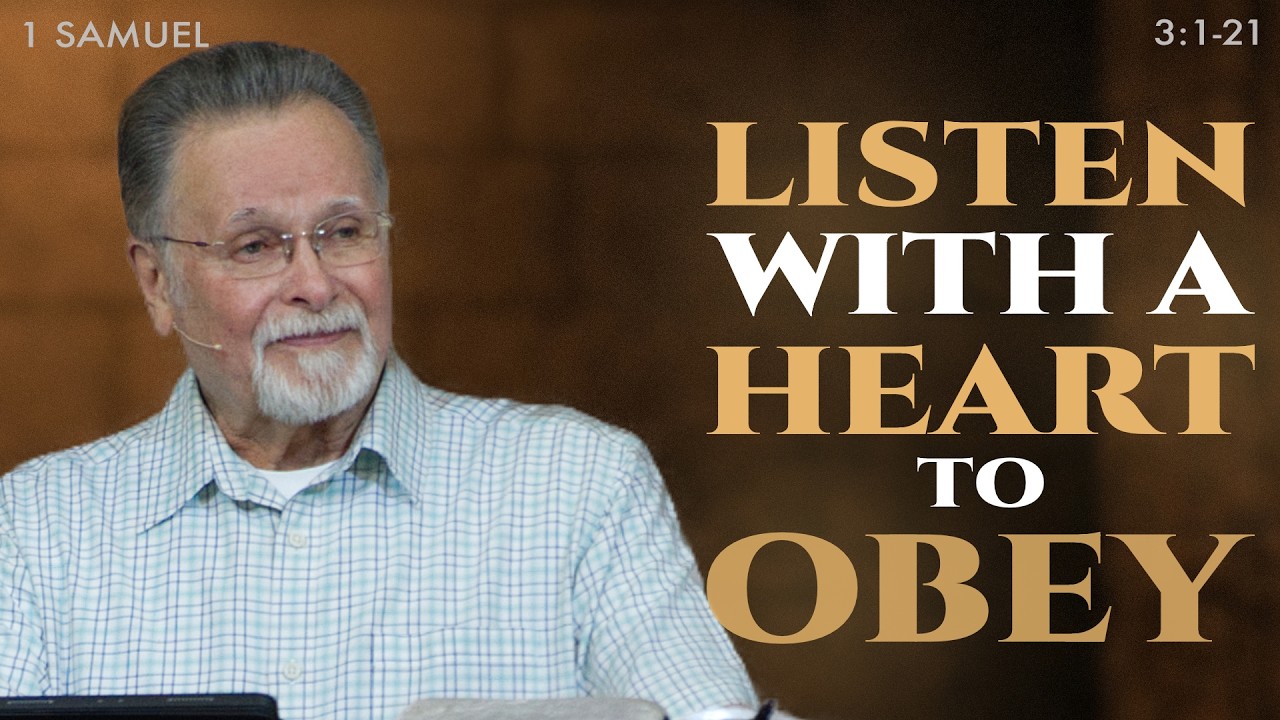
Video summary
The video explores the biblical account of Samuel's call found in 1 Samuel chapter three, emphasizing how God often calls individuals while they are engaged in ordinary tasks or during quiet moments rather than spectacular events. The speaker highlights that at this stage, Samuel was a young man serving under Eli, an elderly priest whose sons were corrupt and had led Israel into sin due to their lack of discipline. Despite being raised in such a flawed environment, Samuel remained spiritually distinct because he had been properly trained by his grandfather, who mentored him with care unlike the neglect shown toward his own children. The narrative sets the stage for God's rare communication during that era, noting that widespread revelation was scarce due to Israel's cycles of rebellion and idolatry under the judges, making Samuel's encounter a pivotal moment where God began to reveal Himself personally through prophecy once again.
The core of the story describes how God called Samuel three times in the middle of the night while both Eli and Samuel were sleeping near the tabernacle. Initially confused because he did not yet know how to discern God's voice from that of his mentor, Samuel ran to Eli each time thinking it was an old man calling him for assistance. It took until the third call for Eli to realize that this was a divine summons rather than a mundane request; consequently, Eli instructed Samuel on how to respond if called again: "Speak, Lord, for your servant hears." This interaction underscores two vital spiritual principles—humility and obedience—as Samuel learned not just to hear God's voice but to listen with a heart prepared to obey. The speaker uses this event to illustrate that true hearing involves more than auditory perception; it requires a willingness to act on what is heard, echoing Jesus' teaching in John 14:21 that those who keep His commands will have Him reveal Himself to them.
The message concludes by drawing profound parallels between Samuel's experience and the broader application for believers today regarding parenting, spiritual discernment, and eternal impact. The speaker reflects deeply on Eli's failure as a father due to his neglect of discipline, contrasting it with the responsibility parents have to raise children in the ways of the Lord so they can recognize God's voice when He calls them later in life. Using personal anecdotes about family time that will eventually end forever, he urges listeners to cherish every opportunity to teach and love their children, grandchildren, or others before those moments pass irretrievably. Ultimately, the video encourages a lifestyle of consistent obedience and attentiveness, asserting that as believers submit to God's leading through His Word and Spirit, He progressively reveals deeper truths about Himself, transforming ordinary lives into instruments for lasting spiritual impact just as He did with Samuel in Shiloh.
Read the full video transcript
[music]
Um today we're going to look at the call
of Samuel found here in chapter 3 of 1
Samuel. So I'll begin at uh verse one in
chapter 3. And I'll begin by just
reading verse one giving you some
information because uh you're going to
see that there's something said here
that will provoke me to be able to lay
this foundation. And then we're going to
be looking at the call that God placed
on Samuel or his initial call as we'll
see it here in chapter 3. And so in 1st
Samuel [snorts] 3:1
it says the boy Samuel ministered to the
Lord before Eli
and the word of the Lord was rare in
those days. There was no widespread
revelation.
And so as we look at this couple of
things just to lay the foundation and
all uh when it says the boy Samuel
ministered to the Lord before Eli
there's a few things I want to point out
here because at this point in 1 Samuel
Samuel is no longer a small child. He
actually has grown into his teenage
years because the word boy here is not
speaking of a small child and I just
wanted to point that out. It [snorts]
speaks of a young man or or a youth. Uh
later on in uh in in 1 Samuel, we're
going to see this in chapter 17 when
Saul uh calls David a boy. And that word
boy there means a youth. And that's what
he refers to him in chapter 17:33
when he speaks of uh David. He speaks to
him as simply being a youth. And so the
word boy can speak of a young man. So
Samuel was probably at this point in his
early teens. And so the point that we'd
be making as we initially look at this
is that uh Samuel has grown into young
adulthood.
Now it seems obvious that Samuel hasn't
been influenced by the sons of Eli. The
sons of Eli were Ha and Phineas and they
were corrupt even as we've seen. They
were robbing God of his offerings. They
were violating women. And it's uh it's
something to see in that though he was
raised in the same environment as these
other uh young men, Samuel grew into
young adulthood without being influenced
for their evil. They had no influence on
him. You see, Samuel, it seems, had a
spiritual inclination. There was
something in his heart that drew him to
worship God. And Eli had properly
trained him. And Samuel was in the
process of learning how to minister. And
this is going to be something we're
going to look at in just a moment. And
so, one of the commentators I use said
that Eli more than likely ne uh
regretted his neglect of his own sons.
And so, he didn't repeat the error when
he was ministering to this young man
Samuel. And so, Samuel, the scripture
says here, and I want you to see it in
verse one. It says, "The boy Samuel
ministered to the Lord before Eli." So
when it speaks about him doing that,
when it says Samuel ministered to the
Lord before Eli, that means under the
inspection or the watchful eye of Eli.
So Eli was watching him and instructing
him in the ways of the Lord. So he's
mentoring him. He's teaching him how to
serve the Lord. And that's in contrast
to the sinfulness of Hoffne and Phineas.
Samuel instead of going in the corrupt
way that these others had gone is busy
learning how to minister to God. Now
notice it says in verse one it says the
word of the Lord was rare in those days.
There was no widespread revelation. Let
me touch on that for just a moment.
There was no widespread revelation.
Now
in order to develop this I need to
remind you of a couple of things. God
had said to Israel that he would make
himself known. And when he did so, he
would do so through the prophets. It
says in Amos 3:7, "Surely the Lord God
does nothing without revealing his
secret plan to his servants, the
prophets." In Numbers 12:6, he said,
"Hear now my words. If there's a prophet
among you, I, the Lord, make myself
known to him in a vision. I speak to him
in a dream." And so God would reveal his
secret plan through his servants, the
prophets. And so when it's speaking
concerning the fact that the there was
no widespread revelation, there's a
reason for that. Unbelief and rebellion
had provoked the Lord to cease
communicating. And that's why it says
the word of the Lord was rare. There was
no widespread revelation.
When you look at a little bit of the
history of of of Israel from the book of
Joshua to uh to Samuel to 1 Samuel,
you'll see that there were there was a a
group of people that would exercise
authority that were referred to as the
judges. And so they judged Israel from
the time of Joshua until Samuel. And so
what would happen during their time of
judgment or judging Israel is Israel
went through certain cycles and you see
it when you read the book of judges. You
see that Israel would be blessed. Then
Israel would forsake God and enter into
sin. Israel would begin to serve idols
and they'd end up oppressed by their
enemies. They would cry out and they
would cry out to the Lord to be
delivered and God would deliver them.
But once again they would start serving
him and when the judge died they would
revert again practice idolatry and the
cycle would begin once more. So they had
a some have numbered it as seven seven
cycles that they would go through. And
so what happened is sin and rebellion
had made hearing of the word of the Lord
rare in those days. And so it was during
that time that God established a line of
prophets that he might reveal his will
through them. You see, the priesthood
was so ungodly that the Lord began
speaking through these prophets. And so,
priests and prophets as well as kings
became very important in the nation of
Israel because they foreshadowed
Messiah.
And so, it was rare for this to take
place, for God to reveal himself. And
that's why it's very noteworthy when we
saw in chapter 2 27 how a prophet had
come and spoken to uh Eli and had told
him that judgment was going to come upon
him. And so there is a a lack of
communication through the revelation of
God through prophets at this time. But
now we see the call of this young man by
the name of Samuel. In verse two, it
goes on to say, "It came to pass at that
time while Eli was lying down in his
place, and when his eyes had begun to
grow so dim, he couldn't see. And before
the lamp of God went out in the tabern
tabernacle of the Lord, where the ark of
God was, while Samuel was lying down
that the Lord called Samuel, and he
answered,"Here I am." So he ran to Eli
and said, "Here I am, for you called
me." And he said, "I didn't call you.
Lie down again." And he went and lay
down. The Lord called yet again,
"Samuel." And Samuel rose and went to
Eli. He said, "Here I am, for you called
me." He answered, "I didn't call, my
son. Lie down again." Now Samuel did not
yet know the Lord, nor was the word of
the Lord yet revealed to him. We'll look
at that in just a moment. The Lord
called Samuel again the third time. So
he arose and went to Eli and said, "Here
I am, for you did call me." And Eli
perceived that the Lord had called the
boy. Therefore Eli said to Samuel, "Go
lie down. And it shall be if he calls
you that you must say, speak, Lord, for
your servant hears." So Samuel went and
laid down in his place.
This is the details of how Samuel
received his call. Let me just remind
you of a few things that we're looking
at. Eli is sleeping in his quarters. His
quarters would have been a small cubicle
in the courtyard there in the
tabernacle. He's old. He's losing his
sight. Samuel is there to minister to
him. He's there to help him when he
needs help. And uh what we're seeing
here is the Lord as he's calling this uh
young man into service. When you read
your Bible, and we could we could take a
long time looking at this. There's so
many stories to look at, but it's
interesting to see how people were what
they were doing when they received the
call. It's interesting when you look at
uh the lives of some of the the ones
that we're familiar with as we read the
scripture. It's interesting to see what
they were busy doing when they received
their call. You look all the way back in
the time of Abram for example, Bible
tells us that he was in a place called
of the Caldes. And when he was there in
of the Caldes, which we're told it was a
place that was filled with idolatry, his
father was an idol maker. When he was
there in this particular place, of the
Caldes, in Genesis 12:1, the Lord said
to Abram, "Get out of your country, from
your family, from your father's house,
to a land that I will show you." So
Abraham was living amongst the pagans
when God called him out. When you look
in the life of Moses, Moses was tending
the flock of his of his father-in-law, a
man who is referred to in scripture as
Jethro. And he was in the wilderness,
the scripture says, of Sinai. When you
look at the wilderness of Sinai, it's in
southern Egypt. And in Exodus 3:es 9 and
10, as he was tending the flock, it
says, "Look, the cry of the people of
Israel has reached me, and I have seen
how harshly Egyptians abuse them." And
God says to them, "Go, I'm sending you
to Pharaoh. you must lead my people
Israel out of Egypt. He had been tending
the flock and he sees a a a bush that is
uh on fire but is not being consumed.
And he approaches that that um that
amazing thing and all and the Lord
speaks from that that that burning bush
and and he says, "Take off your shoes or
sandals for you are standing in holy
ground." And then the Lord speaks to
him. So he was in the midst of simply
doing his job. He was tending a flock.
That's how he was that's all he was
doing. And yet God says, "I'm going to
send you." There's um a prophet by the
name of Amos. And Amos was speaking
concerning what he was doing when he was
called. It's found in Amos 7:15. And he
simply says, "The Lord took me from
following the flock and said to me, "Go
prophesy to my people Israel."
It's interesting when you begin to look
at the lives of these people how they
were doing so very often very ordinary
things very ordinary things taking care
of some sheep you know just just in the
midst of pagans whatever in the New
Testament in the Gospel of Mark in
chapter 1 verses 16- 20 it speaks
concerning when when the Lord Jesus
called uh Peter Andrew James and John to
follow him. And it simply says that they
were fishing or repairing their nets.
That's what they were doing. They were
fishermen, but they were busy about
their business. In Matthew chapter 9:9,
Matthew himself was just sitting at the
tax office when Jesus said to him,
"Follow me." Where were you when the
Lord spoke to your heart? What were you
doing? Probably something pretty
ordinary.
probably not some spectacular thing,
something pretty ordinary. And the Lord
says, "It's time." And so what we have
here is we have a young man who's
asleep. He's just laying there and he's
hearing the voice of the Lord. And he
was just resting when the Lord calls
him. It came to pass, it says in verse
two, uh, while while Eli was lying down
in his place, when his eyes had begun to
grow so dim that he couldn't see, before
the lamp of God went out in the
tabernacle of the Lord, where the ark of
God was, and Samuel was lying down, that
the Lord called Samuel, he answered,
"Here I am." It was not yet dawn, is the
picture that we have here. And that's
when the Lord is calling him. It says in
verse four that the Lord had said uh had
called Samuel. He answered, "Here I am."
So he ran to Eli and he said, "Here I
am. You called me." And he said, "I
didn't call. Lie down again." He went
and lay down. The Lord called yet again,
Samuel. So Samuel arose and went to Eli
and said, "Here I am. You called me." He
answered, "I didn't call my son. Lie
down again." And so he's being he's
hearing the voice of the Lord and he's
waking him up. You see, Samuel was
asleep and suddenly he's awakened by a
voice calling him. He has a a quick
response. By the way, I want to note
that with you. He responded very
quickly. And the fact that he is
responding very quickly is revealing his
character because he hears a voice. He
thinks it's Eli calling him. So, he
immediately arises from where he is at
and he goes in to speak to Eli. you
called me because he was there to serve
Eli as well as serve the Lord. So his
quick response is really uh here I am.
But he's thinking that Eli is calling
him again. Remember Eli is old. He's
weak with age. Samuel's taking care of
him. And it happens twice. And both
times Eli says to him, "Go back to bed."
Well, this is interesting in verse 7
because and I want you to note something
and I'm going to develop this for a
moment with you.
In verse one, it had said, "The boy
Samuel ministered to the Lord." But
notice verse seven. Samuel did not yet
know the Lord, nor was the word of the
Lord yet revealed to him. What an
interesting thing to look at. Samuel did
not yet know the Lord,
nor was the word of the Lord yet
revealed to him. What are you speaking
about there? H how's that possible?
Well, one, Samuel was aware of God in
the most basic sense, but he wasn't yet
aware of how God moves in a personal way
in somebody's life.
He did not know yet how to discern the
voice of God in contrast to the voice of
men because he's hearing the voice and
confusing the voice of God with the
voice of Eli. So he has yet to learn how
the Lord communicates. He hadn't
experienced how God speaks. He has yet
to understand how God calls.
And the fact that he keeps coming and
speaking to Eli is actually a testimony
to Eli because Eli is going to become
aware this isn't something that's
normal. Something's taking place.
So this is Samuel's first encounter with
God. It's God's first communication to
Samuel.
And this is his way of being introduced
into the way God moves and how God
calls.
in the book of uh of Job. We went
through the book of Job not that long
ago. Many of us have read it and studied
it over the years.
And you know the story, I'll just
condense it to make a point.
In the book of Job, it begins in the
first two chapters with uh something
going on between God and and Satan in
terms of relation to uh this man Job.
And when God speaks concerning Job and
you know how how that goes, Satan had
come and and uh God began to speak to
him and the Bible tells us that God
began to question him. Where have you
been? And then Satan responds and he
says, "Well, I've been going to and fro
throughout the earth." And as we go
through the book of Job, what he is
saying is, "I've been up to no good."
And what God is doing at that point is
actually calling him to account. What
have you been up to? God already knows.
So he says,"What have you been up to?"
And Satan says, "I've been going to and
fro throughout the earth and it's I've
been up to no good." And then God says,
"Have you considered? Have you looked at
have you made a discerning judgment of
my servant Job?" So God is aware of the
fact that Satan is up to no good and is
examining different people to see what
he can do to destroy their lives. And
therefore, God questions him about Job.
Have you considered him? Have you
weighed him? Have you thought about him?
What do you want to do with him? Well,
yes, of course I've considered him. He
says, 'But you've you've you've
surrounded him with protection. There's
there's nothing I can do. I can't I
can't I can't do anything to this man
because God had said that he's the most
righteous man. And we know what happens.
And so from that point on, even though
God is declaring him to be a righteous
man, all through the rest of the book,
when God allows Satan to to do his best
against him, all through the book, we
see that Job holds fast to his
integrity.
And yet, when we get to the end and God
says to him, "You have been questioning
me." Because throughout the book, Job
does that. He says, 'G yourself like a
man. Let me question you.
And God begins to question Job. And
after he asks him several questions, Job
42:5 gives to us the response of Job.
Job said, "I have heard of you by the
hearing of the ear, but now my eyes see
you." Samuel had an awareness of God. He
was being trained in ministry,
but he only has a fundamental a basic
knowledge. This is his call. This is
where he connects with God. This is when
he begins to hear the voice of the Lord
and to understand how the Lord works and
how he speaks. And this is what is
taking place here as the Lord begins to
minister to him. And that's why verse 7
says, "Samuel did not yet know the Lord,
nor was the word of the Lord yet
revealed to him because this is his
call. He was not yet aware of how God
moves in a personal way in someone's
life. This is his first encounter, his
first time that God actually
communicates to him. And in this
introduction, God is calling him to be a
judge and to be a prophet. And so verse
8 says, "The Lord called Samuel again
the third time. So he arose and went to
Eli and said, here I am. He did call
me." Eli perceived that the Lord had
called the boy. Therefore, Eli said to
Samuel, "Go lie down." And it shall be,
if he calls you, that you must say,
"Speak, Lord, for your servant hears."
So Samuel went and lay down in his
place.
Eli realizes that God is speaking to
Samuel. So he gives him advice. Go and
lay down in your room and wait.
The Lord will speak to you once more.
And very often the Lord will speak in
silence.
In Psalm 62:1, truly my soul silently
waits for God. From him comes my
salvation. Wait on the Lord and wait
until he calls you. Just remain peaceful
and calm and just wait on him. Lay down
and be quiet. Shut up, boy. Listen to
what God has to say. Verse N again. Go
lie down.
You've grown up in the most holy place
imaginable.
You need to respond properly.
And so when you respond to him, verse n,
say, [snorts] "Speak, Lord, for your
servant hears."
Respond with humility.
Respond with obedience.
Respond with reverence. When you hear
his voice, your upbringing should have
prepared you to re to be receptive to
him when he speaks. This is what you
have been trained in all this time since
you were small and delivered to me to
raise you up in the things of God. This
is the moment that God is finally
breaking through to you.
As I was preparing this study, I I was
considering some things and and all and
and in my notes and I'll just read what
I was what I was thinking. A home filled
with spiritual life will create a
receptivity to the things of the Lord.
When children are surrounded by faith
and prayer, when they
are surrounded by service to God and
commitment,
that causes our children to be prepared
to hear the voice of the Lord when he
calls them when he speaks.
When somebody is raised in a home that
has no fear of God and when the home has
no knowledge of God,
there's not going to be a spiritual
filter. They're not going to have
spiritual discernment.
And if the Lord were wanting to
communicate to them, they're not going
to recognize his voice because they're
not familiar with it. And that's the
reason why we as parents, those of us
who are parents, that's the reason why
we raised our children in the knowledge
of God. That's why we gave them Bible
studies. That's why we gave them
devotions. That's why we spoke to them
concerning the things of the Lord. We
wanted them to be prepared to hear his
voice when he would speak to them. And
Eli had been doing that with Samuel. Eli
had been training him what ministry is.
But now God is actually ministering to
Samuel and speaking to him. Samuel
doesn't know that because his first
ministry was to Eli. So when he hears
the voice of his name being called
Samuel, immediately he's going to think,
well, that's simply Eli. He needs
something. He's an older fella. He's
blind. I take care of him. Naturally,
his heart is going to go to that. And
Eli, on the other hand, he doesn't know
what's going on with Samuel. Samuel's
waking up to hear a voice. you know what
do I know about that when he keeps
coming in and he comes in he says this
is the Lord so seeing that it's the Lord
and this is where mentoring comes in
seeing that it's the voice of the Lord
if he speaks to you a third time which
he will you need to speak to him in a
certain way you need to say your servant
is hearing
you need to be ready to hear what God
has to say and so in verse 10 it says
the Lord came and stood and called as at
other times Samuel Samuel, Samuel. And
Samuel answered, "Speak, for your
servant hears." I have to be honest with
you, man. If I was in my room and I was
a young teen and I had a voice going
calling me, I don't know. That would be
a very scary moment. I have to be real
with you about that one. And so what
happens? Well, the Lord actually is now
speaking to him. It's not a dream. It's
not a vision. This is an actual event.
The Lord is communicating. And so Samuel
responds, "I'm listening." When it says
he responds reverently, reverently that
he hears that that is speaking that I
hear you with a heart to obey you. I'm
hearing you with a heart that will do as
I am commanded.
It's not enough that he has the
capacity, in other words, to hear some
some audible, if you will, voice. When
he says speak because your servant is
hearing, he's saying whatever it is
you're saying, I'm going to do. If you
want to know the Lord in an experiential
way,
you need to take heed, like it says in
Luke 8:18, you need to take heed how you
hear.
Sometimes we can go to Bible studies
even like this. Sometimes we can go on a
Sunday or whatever. We can listen to a
radio broadcast and we want to hear what
the word of the Lord is, but we may we
may not be listening with an ear of
faith or an ear that is is trained to
obedience.
We may be simply hearing. A lot of times
when you go to a Bible study, your mind
is thinking not of the Bible study
itself. You're thinking of a variety of
things beyond that Bible study because
sometimes we get distracted. That just
happens. And so he's teaching them,
listen, when he's when you're speaking
to the Lord, let him know that you're
hearing him not just with the hearing of
your ear. Let him know that you're
hearing with the willingness of your
heart. Whatever it is you're saying,
that's what I will do.
How can I
know the Lord in a very deep and
experiential way? How is that possible?
If you want to know how to have a deeper
experience with God, let me tell you
how. Listen to God's word with the
desire to obey what you hear. In John
14:21, Jesus said it like this. Whoever
has my commands and keeps them is the
one who loves me. The one who loves me
will be loved by my father, and I too
will love them and reveal myself to
them.
One of the ways the Lord reveals or
manifests himself in the most particular
way is when you're obeying him. When
you're hearing him and doing what the
spirit says. Early in my Christian life,
it wasn't really that early, but it was
many years ago. Now,
Maria and I went to a um it was a a
Christian concert that was being held in
Anaheim.
And Marie's younger brother,
Ronnie, didn't know the Lord. And it it
was a concert that I thought the music
would be appealing to him and the
message was going to be given. And so I
asked him, I said, "Ronnie, would you
like to go to uh with us? Marie and I,
your sister and I are going to go to a
concert." He was a young boy at the
time. And he said, "Yes, I'd like to."
So we went and it was at Melody Land and
it was a theater in the round. Some of
you are old enough to remember that it
was a theater in the round that it sat
around 4,000 people, but it's a theater
in the round and they have various
entrances to it. And so we got there and
the concert was already going and the
interior, all the lights were pretty
much off at the time, so you really
couldn't see. And we were supposed to
meet two other couples.
And so Ronnie, Marie, and I walked in
and we're standing looking around and
I'm and I said, "I don't know. We're
supposed to meet some friends." I said,
"Marie, honey, you just go around this
way and I'll go around this way and
maybe we'll run into him." Which the
chances of doing that was pretty low
because there was nobody in in the uh
you know, in that area. And so as we
were walking,
the the spirit of the Lord said to me,
"Tell Ronnie that you're going to
connect with these two couples
at 7:00." I still remember [snorts] that
at 7:00.
And I said, "No,
I'm not going to say that. This has got
to be heartburn. I mean, that can't be
the Holy Spirit speaking to me." And so
I said, "No, it no." And I I remember
this very well. True story. I was
arguing within my heart and I heard
again, "Tell him that you will connect
with them at 7:00 and I looked at my
watch and it was like 6:59
and there's nobody out there in the in
this hallway." And so I'm I'm walking
and Maria's left me and it's just Ronnie
and me. And as we're walking,
here comes the two couples at a door.
They were at the door and I walk up to
the glass door and I opened it up. When
I opened the glass door up, Marie came
walking around and we all connected at
and I looked at my watch 7:00
and I turned to Ronnie and I said,
"Forgive me, Ronnie." I said, "The
spirit of the Lord had told me to tell
you we were going to connect at seven
and I didn't tell you." What a witness
that would have been to this young man.
You know, it would have been a prophetic
witness and he would have had an
opportunity to see something about God.
But because I was so unsure that it was
the voice of the Lord, I had yet to
really learn. And I still am learning
how to hear his voice. Well, Samuel was
in a similar place. He knew certain
things of ministry. He had been trained
in certain ways. But now God is
revealing himself. And that's why Eli
says, "You tell the Lord, speak, Lord.
Your servant is listening. I'm listening
not only to hear, but I'm listening with
a heart to obey." Because Jesus said,
"When you keep later on, Jesus would
say, when you keep his word, I will
manifest myself to you. I'll reveal
myself to you in a very special way." So
once the Holy Spirit teaches us through
the word of God to obey, that's how God
begins to train us up in his ways. He
begins to show us himself in a very
personal way. So Samuel in verse 10
answers and says, "Speak for your
servant hears." The Lord said to Samuel,
"Behold,
I will do something in Israel at which
both ears of everyone who hears it will
tingle. In that day I will perform
against Eli all that I have spoken
concerning his house from beginning to
end. For I have told him that I will
judge his house forever for the iniquity
which he knows because his sons made
themselves vile and he did not restrain
them. And therefore I have sworn to the
house of Eli that the iniquity of Eli's
house shall not be atoned for by
sacrifice or offering forever. So God
tells Samuel, "I'm going to carry out
the judgment that I've already warned
and told Eli about. It's going to be so
severe
that people will be shocked with horror
and pain." And I He's saying, "I am
going to bring judgment that will not be
stopped and will not be removed. And no
number of sacrifices, no number of
offerings will stop me from what I've
determined to do." And so again, when
God closes a door, there is nothing that
can be done to open it. Nothing.
That was literally true during the days
of Noah when God had told him to enter
into the ark. God had said to him that
he was going to bring judgment on the
earth. We know the story. It's found in
Genesis. And uh he said, "I'm going to
bring judgment and everything that
breathes air is going to die." And so he
says you need to have, you know, two by
two and a variety of others that are
going to come in. And uh and then what
happens according to Genesis 7:16, the
ark had been built and God begins to
draw the the animals in. It says uh
those that entered male and female of
all flesh went in as God had commanded
him. And here's the words that that I
want to emphasize. And the Lord shut him
in.
The Lord shut him in.
Can you imagine? Why do you think the
Lord shut him in? Well, it's obvious
that he did for a variety of reasons.
One of the things I can't help but
wonder about is that these are people
that no one knew who were in the same
area with him. They were the ones who
mocked him for many years for the years
of him building that ark. And can you
imagine what it was like? Because during
that day there was no rain. During that
day there was a mist that watered but
there was no rain. And what God was
going to do is puncture what is called a
water belt and he was going to bring
torrential rain. And the rain was going
to provide the flood. That's how it was
going to take place. And so when when
Noah was saying that God is going to
bring judgment through the floods, they
wouldn't have known what a flood was.
And therefore, they mocked him because
we have no idea what you're talking
about. And yet, man was going more and
more corrupt even as God was patiently
awaiting. And he gave him 120 years. And
so Noah builds the ark and the mocking
and all that took place. If you can
imagine what that would have been like
for all those years
until one day God shut him in. And when
I was first reading that as a newer
believer, I thought the Lord shut him
in. Why would that be? Well, for a lot
of reasons again, including the fact
that I would help can't help but wonder.
I'm I'm only wondering out loud
whether Noah would have wanted to open
up that ark to let the people he knew
and friends perhaps to come in. I don't
know. But I do know this. When God
closes a door, no man can open it. And
when it's done, it's done. There's no
second chances. There's no no other
chance. Hebrews 10:26 says, "If we sin
willfully after we've received the
knowledge of the truth, there no longer
remains a sacrifice of sins." If you
reject the Lord completely, ultimately
you're rejected by the Lord. And so,
verse 15, Samuel laid down until morning
and opened the doors of the house of the
Lord. Samuel was afraid to tell Eli the
vision. So, Samuel had slept. He was
going about his duties and he was
opening up the doors to the tabernacle.
But he was afraid verse 15 to tell Eli
what had happened.
He doesn't want to tell Eli because he
loves him and he honors him and he
respects him. He he doesn't want to be
someone who is bringing such bad news.
And so he resists. He doesn't want to
say anything. And so verse 16, Eli
called Samuel and said, "Samuel, my
son." He answered, "Here I am."
And he said,
"What is the word that the Lord spoke to
you?
Please do not hide it from me. God do so
to you and more also if you hide
anything from me of all the things that
he said to you." How would you feel
having to tell this older man who has
raised you like a son and you love him
deeply,
how would you like to be the one who has
to bring that kind of news? Samuel
Samuel doesn't want to.
Eli's words reveal the great tension
he's dealing with. He'd already been
told by a prophet that judgment was
coming upon his house. And so verse 18,
Samuel told him everything. He hid
nothing from him
and he said, "It's the Lord. Let him do
what seems good to him."
Eli knows that God is keeping his word
and he re resigns himself to it.
Lamentations 3:39 says, "Why should any
living man complain when punished for
his sins?"
Eli had failed to correct his sons and
Eli was receiving judgment for this.
They had sinned greatly. They hadn't
been restrained and God judged them all.
Someone said that there are different
forms of child neglect and the effects
can linger over lifetimes
and the one that is eternal is
neglecting to discipline children in the
ways of the Lord.
There are different forms of neglect.
You know, I I I'll say it like this
because I think about this fairly often.
So, let me say it like this. I am very
blessed that we have people who come to
Bible studies on Wednesdays. I really
am. That is not to say I'm not blessed
that people come on Sunday. I'm blessed
when people come to a Bible study
anytime. But to me, it's something that
with you guys, you actually you you get
ready, you come. I'm blessed that you do
that because that indicates to me by and
large that you have a sincerity of
faith, that you want to grow in your
faith. And not only that, but if you're
parents, that also indicates to me that
you care about your children and you
want your children to know the Lord. You
want them to have a relationship with
God. And so, you come to be equipped.
Not everybody does. Not everybody has
that heart. And that's why I really took
to this quote when they said there are
different forms of child neglect and
neglecting to discipline children in the
ways of the Lord is the most severe.
The Bible in Ephesians 6:4 says,
"Fathers, do not provoke your children
to wrath. Bring them up in the training
and admonition of the Lord."
So there's there's a a a lifetime of
teaching. But something the Lord laid on
my heart as I put together my notes is
this. There is a last time that you
teach your children. There will be a
last time that you pray with your
children and there will be a last time
when you get to minister to your
children. Never forget that because one
day the last time will be the last time.
And I don't say that in a negative or a
weird way. is just true. One day the
last time will be the last time. And
that to me is something I think about
quite often. You know, I have a a
granddaughter.
I have several of granddaughters. Thank
God for them with beautiful babies. One
in particular, one in particular is real
spoiled by Grammy and me. Really
spoiled.
and and she'll come and climb into my
bed with us. And she says, she she told
me one day she says cuz I won't let her
sleep in our bed with us. I like to
sleep. I don't feel like having her
little feet on my face or whatever.
And she said, "Papa, can I sleep? What
can I sleep in bed with you?" Well,
sometime in the future. Yeah.
You know what she told me a while back?
She says, "Papa, in heaven, will I be
able to sleep in bed with you?" Yeah, I
know.
And so she comes into our room
and she'll bring what she calls her
family, which is which Blue is Bluey and
Bingo. And I'm learning all their names.
And she brings the family and she'll put
them in my bed. And so I have to play
with Bluey and Bingo and and Marie and I
do that.
And our mama has come in and has said to
us, we we can we can take her out. We
can take her out. You need to go to
sleep. And and you know what what I have
said to her? I'll say I've said this.
One day the last time is going to be the
last time.
Some of you parents know what I mean.
One day, the last time you carry the kid
to kindergarten, and I tell my son, he
carries his baby. Sometimes she doesn't
want to walk, so he carries her to
kindergarten and he says, "She's getting
big and she's getting heavy and it hurts
my back." And I'll say, "Yeah, I know.
But the last time will be the last time.
So enjoy it
because one day you will never do it
again."
You parents know what I mean by that.
One day it'll be the last time. One day,
guys, there's going to be the last time
you kiss your child. It's going to be
the last time you pray with them.
There's going to be a last time you see
them. I know that. I live in that
knowledge. So, every last time is going
to be the best time. And so with my
kids, following Christ has always been
the most important because the last time
I share with them will be the last time
I share with them. Right? So that's why
I take parenting and grandparenting
seriously because I know that eventually
it'll never happen again. Eventually
they're going to move on. Eventually I'm
going to go to heaven. So I try to make
sure that everything I do is aware of
that. I I believe that children are
formed by consistent modeling of values
and expressions of our love and they
trust and they believe us their parents
grandparents because we love them
completely. Well, in the case of Eli,
Eli neglected discipline and the result
was his entire line was rejected by God.
And so it says in verse 19- 21, Samuel
grew, the Lord was with him. Let none of
his words fall to the ground. And all
Israel from Dan to Beersa, those are the
borders, knew that Samuel had been
established as a prophet of the Lord.
And the Lord appeared again in Shiloh.
For the Lord revealed himself to Samuel
in Shiloh by the word of the Lord. And
so he was faithful to God. And God
established him in the sight of Israel.
And God fulfilled all that he had
spoken. His credibility as a man of God
was established. God was with him. And
God continued revealing himself to
Samuel. And he did so there in Shiloh at
the in the tabernacle. As Samuel uttered
prophetic pronouncements, God continued
to develop relationship with him,
manifesting himself. And Samuel was
inspired to speak. And as Samuel was
inspired in his relationship with his
God, God was revealed in a deeper way
within him. The Lord, as you open up
yourself to him and you begin to obey
him, God reveals to you deeper things
and deeper things still. That's what
Jesus said. He said, "If you love me and
obey me, I will manifest myself to you."
And you'll learn the ways of the Lord as
the Lord continues to give you deeper
knowledge and experience of him. How can
I grow in my understanding of God? Obey
him.
If I want to know the Lord deeper, I
need to learn to obey him. And as I obey
him, he reveals himself to me. And
that's what was happening in the life of
Samuel. God was revealing himself in
deeper ways as he's bringing him into a
place of being a prophet over Israel.
And father, we ask that we would learn
these simple truths, Lord. That we would
learn to be obedient. That we would
learn to hear your voice. That we would
be those who say, "Speak, Lord. Your
servant is listening."
May we hear, Lord, what you say. May we
read our scriptures and
do so with a heart to obey what you
teach us.
May this congregation become deeper and
deeper in your things, in your ways, and
understand you. And Father, I ask that
you would manifest yourself to us, Lord.
In these last days, I I especially would
pray that we would become more and more
willing and obedient to not only hear
but to do those things the spirit that
the spirit communicates to us. And so,
Lord, we lift our lives to you now. And
I pray that you would move in each one
of us in such a way that you would be
honored. Father, we yield ourselves to
you. And we ask that you would continue
to reveal yourself to us and through us.
And even as our eyes are closed and our
heads are bowed, perhaps the spirit of
the Lord is speaking to you and you need
to get right with him even right now.
Before we close, I'd like to pray for
you. And if you need to get right,
whether you're rededication or saying,
"God, I just need you. I want to know
you." Whatever the case may be, if you
need prayer, would you raise your hand?
Let me pray for you right where you're
Father, you see these hands. You know
the reason why these hands are being
raised to you right now. You know the
need. We're simply casting them at your
feet. May your Holy Spirit do the work
in their hearts as they yield to you.
May you just fill them with your
presence. Wash them, Lord, from any
iniquity. Fill them with your spirit.
And from this moment on, Lord, may they
be encouraged to walk with you, to love
you, Lord, to to study your word, to
read, to pray, fellowship with other
believers, and grow in their walk. Lord,
I lift them to you now. And I thank you,
Lord. Bless you. You can put your hands
down.
And perhaps some may have a physical
ailment that you'd like prayer that God
might touch you. I'd like to pray for
you. If so, would you raise your hand?
Father, you see these hands. There's so
many. Lord, I pray that you would reach
down and with your mercy and your
compassion that you would touch people,
Lord, even right now. Father, that you
would do a work in them and that healing
would occur. You are the healer. We're
simply asking and by faith we would
receive. Thank you, Lord, for hearing
our cry. Now, I pray that you would
move. And Lord, we we yield to you now
and we bless you. Thank you, Lord. Bless
you. You can put your hands down. And
Jesus, I ask that you keep moving in all
of us as we're about to leave. In your
name we pray. Amen.