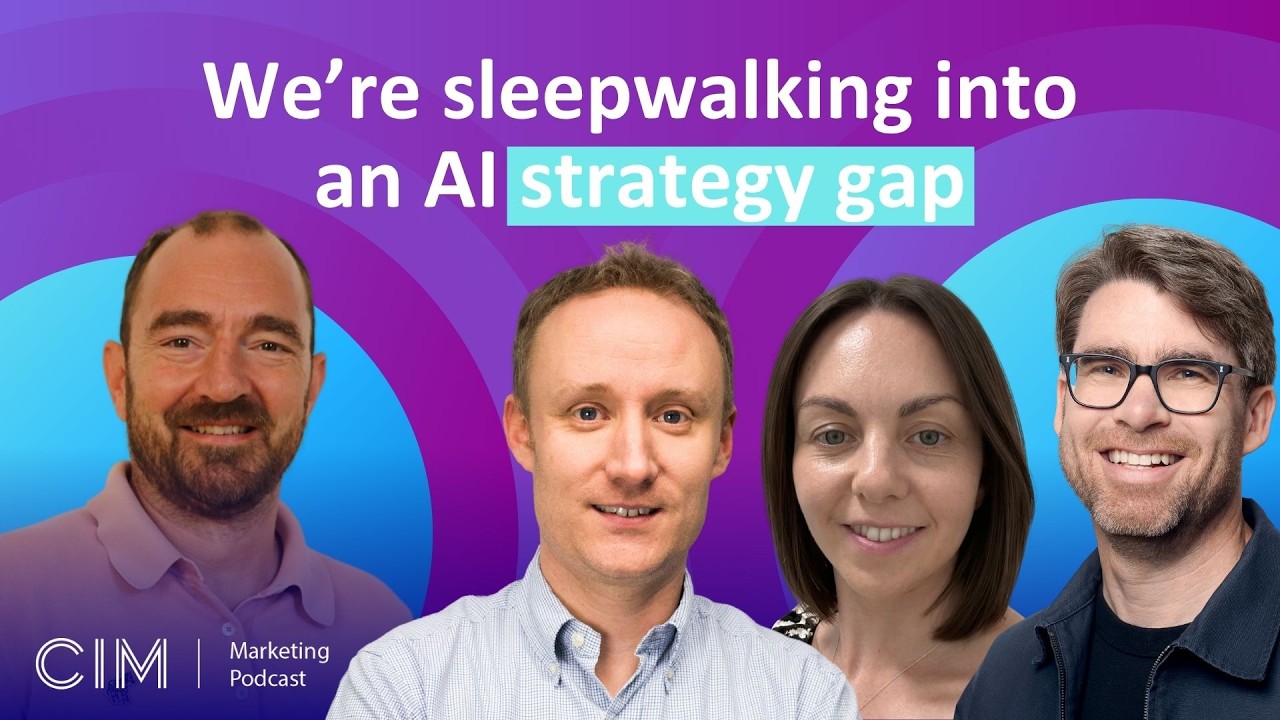
The AI strategy gap: Why 40% of marketers don’t expect ROI before 2030
Watch on YouTubeVideo summary
Recent research from Yugov and World Media Group highlights a significant disconnect between current AI adoption rates and future expectations for return on investment, revealing that 40% of marketers do not anticipate seeing tangible results until after 2030. This hesitation is particularly pronounced among smaller businesses, where over half expect delayed returns compared to just one percent of large enterprises. The study identifies a growing "strategy gap," noting that many organizations lack the formal strategies and skills development necessary to leverage AI effectively, often resulting in inaccurate data concerns for SMEs or fears of brand homogenization for larger firms. Furthermore, there is widespread skepticism regarding generational trust; notably, 79% of Gen Z consumers would lose faith in a company using visible AI-generated content, while the public overwhelmingly demands stricter regulations on personal data usage due to discomfort with how algorithms handle private information.
The implementation landscape shows a clear divide between operational efficiency and creative execution, effectively splitting marketing into "back office" and "front office" functions. While large organizations are increasingly utilizing AI for price optimization and routine administrative tasks like spreadsheets, smaller firms often struggle without established policies or formal strategies to guide their adoption. Experts argue that while AI excels at handling data crunching, translations, and generating ad variations, it cannot replace human judgment in critical areas such as complex customer support, cultural nuance, and high-level creative strategy. Consequently, the industry is moving toward an "orchestra" model where humans act as orchestrators who oversee synthetic tools rather than letting automation dictate processes entirely; this approach ensures that if metrics like renewal rates falter due to AI errors or a lack of context, operations can swiftly revert to human handling without compromising customer delight.
To bridge the gap between technology and trust, leaders are advised against adopting a "factory assembly" model where human oversight is eliminated in favor of a collaborative framework akin to a newsroom. In this structure, AI manages junior tasks such as research and reporting, freeing up marketers to focus on high-impact creativity, storytelling, and strategic thinking that require genuine emotional intelligence. Transparency has emerged not just as an ethical imperative but as a commercial necessity to maintain consumer confidence, especially given that 69% of consumers hold brands fully accountable for AI mistakes rather than the software providers themselves. Ultimately, successful integration requires organizations to track talent trajectories, fill skill gaps, and ensure output remains measurable, allowing teams to automate media buying processes while encouraging staff to utilize their saved time for networking and innovative problem-solving over simply increasing content volume.
Read the full video transcript
For the first time in many years, this
is a new technology that's coming into
the market where younger people trust it
less than older people. And I think from
a marketing perspective and we've all
been in the industry long enough that
you know there was there was the web and
then there was mobile and apps and
social, there's a new thing that comes
along and the whole industry races to
embrace it as quickly as possible.
normally because younger consumers and
future consumers are crying out for
brands that are active on mobile or
vertical video or whatever it is. That
doesn't seem to be the case right now
where in fact younger consumers are
pretty skeptical about brands who are
visibly using AI. [music]
Welcome to the CIM Marketing Podcast.
This is the first in a two-part series
examining CIM's latest research on
marketing in the age of AI with none
other than Yugov. And I'm delighted to
say that from Yugov itself, we have none
other than Miss Gemma Connor and join an
associate director in the political and
social research team at Yuggov. Um, and
she's mainly responsible actually at the
pollster for panuropean polling, but she
also leads on Welsh polling. And I have
to say in the recent Welsh uh elections,
the Senate election, um she was the most
accurate of all pollsters. Gemma, great
to have you on the show. How are you?
>> Hi, I'm very well, thank you. Thank you
for having me.
>> It's great to have you on the show.
Great to have you on the show. And the
great hot guests do not end there
because we also have with us today Mr.
Jamie Kredland. Now Jamie, many of you
will know he is of course chief
executive of the World Media Group. Uh
before that he spent 15 years as a
marketer at the economist and before
that was agency side at UN. Jamie, great
to have you.
>> Great to be here. Thanks Ben for having
me.
>> Fantastic having you on the show. And
last but not least, many of you will
know Mr. James Bells. Now James is head
of PR and external affairs at the
Chartered Institute of Marketing. He's
of course a chartered marketer himself
and a CIN fellow. He brings more than 20
years of experience leading agency and
in-house marketing teams, but most of
all, he's back on the show after what is
a prolonged absence. Mr. Dell, we we're
trying to count up the years, but it's
great to have you back. I'm going to ask
you, James, um, you know, AI has
transformed the marketing landscape. We
know we're all using it. Why did you do
this research now? Why launch this
report at this moment? just felt the
perfect moment Ben because marketers
have kind of moved from experimentation
to widespread deployments. We're not as
clear man promps more AI is now
hardwired into marketing teams. Um but
that acceleration has really created um
a real ordinary paradox. Balls
everywhere are looking at Gen AI through
quite a narrow lens at the moment cost
reduction um margin improvement and in
some case real headcount decision. So it
just seemed the perfect time to look at
some of really big issues, drill down as
the data with UDA and to come and really
provide marketers with a kind of where
we are now and where they want to go in
the future.
>> Joe, cost reduction and headcount
reduction and not phrases that generally
meet well with the ears of marketers.
Um, can you tell what you found in your
research on those issues particularly?
>> Yeah, so overall AI is being used for a
variety of purposes by marketing
decision makers. If we look at the
sample of that group, around a quarter
are using AI to improve operational
efficiency on the non-creative side with
similar proportions using AI to take a
closer look at their competitors and
track market trends. Around a fifth are
using it for price optimization.
However, when we look at how AI is being
used and actually the extent to which
it's being used to achieve their ROI, it
does seem to depend on the size of the
organization. Large companies with more
than 250 employees are far more likely
to be using AI to achieve their return
of investment than smaller companies. Uh
for example, 53% of marketing decision
makers working for larger companies say
they're using AI for price optimization
compared to just 15% of those who are
working for a smaller or medium size
enterprise.
>> That's interesting. Um what else in
there did you find that you think is a
big headline finding in terms of the
usage of AI in the sector?
>> Um it's interesting how many businesses
do not expect to achieve any return of
investment from using AI before 2030.
It's 40% of marketing decision makers
are saying that that's not going to
happen.
>> 40% are going to use this before 2030 or
they're not going to expect a return
since 2030.
>> Absolutely. And that increases massively
when we look at smaller companies. So
52% of micro companies or small
companies, those with less than 50
employees. So they're not expecting that
return on their investment. And 47% of
small and medium enterprises. Whereas
large companies, those with 250
employees or more, and just 1% are
saying they're not expecting to see that
return. So there's a real difference
depending on the size of the firm.
>> Real difference, James. Um big findings
there that the size of the firm is
making a massive difference in terms of
the expectations ROI. Uh and indeed the
size of the firm also seems to make a
big difference in terms of what they're
using it for. These dread phrases cost
reduction, these dread phrases of
headcount reduction. You've done a
series of roundts on this very matter.
You met organizations, you've met senior
marketeers. Um what were their reactions
to these findings?
>> Yeah, it's quite interesting. So we
obviously did the research with Jeremy's
team and we really wanted to stress test
it to basically take it out and find out
what people ordering but what way people
in the front line what they actually
felt of the findings. So we held two
roundts with IBM in the renovation
center in central London. Um they were
attended by between about 30 and 40
market professionals. Everything from
seniors TMOs at global banks all the way
down to IBM's AI team sim course
directors to give an academic view. We
had young interns in there and then we
had senior marketers kind of operating
on the front lines and you could just
see people's how the energy changed in
the room when we put the figures up on
the screen and we discussed them as a
team. We laid all the figures out with
everyone to really dig into them and
there's a real consensus that AI is
splitting marketing into sort of two
distinct operation. Front office.
>> Yeah.
>> So the back office everyone was really
positive. Great. It's going to take away
all my effort around my mix modeling my
automation of internal reports or my
data sets and they really positive. You
could physically see people's faces
light up when they could see that the
cobs woring and I'm going to clear all
this rubbish off my plate. And then when
we moved it to the front office and
started talking about things like
customerf facing copy, creative
execution, brand storytelling, you could
just see the room got a bit quieter and
then people were distinctly more
cautious and we try and conversation
about things like guidance and legal and
how we would do it. So I think a lot of
people when they looked it through could
see the massive benefits but also they
could see some of the kind of the
warnings such as like 63% of adult lose
trust in a brand when they see poor AI
content. So a lot of them saw as a
really big wakeup call. It's not the big
silver bullet where they can just load a
whole bunch of content into it drive
productivity and output. actually they
need to make sure it's really of high
quality otherwise people now are getting
some step towards that and are
particularly looking at some of those
content and going you know what I'm
going to step away from that brand
because I don't think they value me or
the content they're putting out isn't
good so there is a bit of a trap there
we need to watch out for so they were
the kind of things that came out it's
really interesting how it really quickly
split two sections how it was going to
be used completely changed people's
physical response to the data
>> it's absolutely fascinating Jamie you've
been nodding furiously during James's
testimony. Um, the pace of change has
been incredibly rapid and you probably
spent most of your time at CAN this year
discussing that pace of change. Are we
adapting to this stuff properly?
>> I think I mean it's the perfect time to
be talking about this report. I think as
you say I was at Cam Lions last week um
and WMG World Media Group. uh we spend a
lot of time dealing with advertisers who
tend to be at the larger corporate
advertisers, the larger B2B kind of
brands and um there is there across the
whole festival of and conference in can
there was a real noticeable shift this
time 12 months ago there was unbridled
optimism about AI that every single
every single process and uh skill within
the marketers toolbox was going to be
replaced and you know in in fairness in
the last 12 months marketers really have
embraced this. I didn't you don't meet
any marketers who aren't using AI in
some way within their workflow. um many
people have been encouraging their teams
to adopt it and you know people are very
excited about this technology but I
think perhaps there's also a little bit
more realism kicking in about which
tasks AI is really fantastic at as James
says some of those back office tasks um
and which tasks AI might have some value
to but it's not a replacement for human
oversight the more front office pieces
and I think this additional thing which
is you know is highlighted in the report
but it really is coming out many many
places in many different categories and
industries can this piece around trust
and the truth is that what you do in the
back office um I think often consumers
are not potentially that interested in
how you're doing your media mix modeling
that that's fine um but as soon as
you're putting something in front of a
consumer that is obviously AI generated
or touched by AI I think you know either
you have to be transparent with the
consumer or there's a real risk to trust
um if it's not clearly labeled and the
other piece around that which I think is
also in this report but for the first
time in many years this is a new
technology that's coming into the market
where younger people trust it less than
older people and I think from a
marketing perspective and we've all been
in the industry long enough that you
know there was there was the web and
then there was mobile and apps and
social there's a new thing that comes
along and the whole industry races to
embrace it as quickly as possible
normally because younger consumers and
future consumers are crying out for
brands that are active on mobile or
vertical video or whatever it is. That
doesn't seem to be the case right now
where in fact younger consumers are
pretty skeptical about brands who are
visibly using AI. So I there's a lot of
enthusiasm um but there's also a certain
amount of healthy skepticism I think
which wasn't there previously. It's
interesting you rais that said about the
generational aspect of skepticism
because I was reading this report last
night. I was looking to get a hold of a
embargoed copy from CIM pre-publication
embargo embargoed copy locked down
version and that was the thing that
jumped out to me that the younger
generation if you like the Gen Zoomers
um were the most skeptical of uh uh of
all of the generations of this stuff and
were almost sort of you got the
impression that they were sort of almost
looking out for AI Gemma and if they
could spot it would then walk away from
the brand.
Yeah, this group is actually really
interesting because in polling we tend
to see that the youngest age group, so
in this case the 18 to 24 year olds, are
normally most likely to say they don't
know about something. And actually in
this polling, they're the least likely
to say that and they have very strongly
held views about AI and how the use of
AI in advertising and marketing really
impacts their trust and their view of
the brand. So across the whole
nationally and politically
representative sample of 2,000 adults in
Britain, 63%
felt that they would lose trust in a
company that was using AI generated
content. That number increases to 79%
amongst 18 to 24 year olds and which I
think is surprising. I think people kind
of grow up in that digital age and we
kind of expect them to be the most savvy
with AI and to be perhaps most on board
with it. Actually, eight in 10 of this
group say they'd lose trust in a firm
which is just a really interesting
finding. When I read this report
yesterday evening, I sat there with a
cup of tea and I thought there's an
element that there's an under there's an
undertone here, a little bit of a
bandwagon jump by this industry,
probably by other industries getting on
this train before we've got the right
drivers. Getting on the train before
we've got safety measures in place.
Almost like the technology, the train is
getting ahead of the people it's
supposed to be carrying. Is that fair
analogy do you think?
>> I think that's probably the case in some
different ways. And like I say, I think
previously the message from senior
marketers to their team because there
was some concern about AI use within
marketing. A lot of senior marketers
were just saying to their team, I don't
care how you use it. Just make sure
you're using get on that get on chat GPT
every day. I want you to be using it for
everything. And that's a completely
reasonable response because you want to
develop these skills within your team
and get people comfortable with it. I
think that's very sensible. I was
talking to um a couple of people at
large professional services uh firms uh
over the last couple of weeks with
global operations who have been taking
that kind of approach and have now
suddenly realized they have teams in
Europe and teams in the US building
things that are completely duplicative.
Right? they're completely wasting energy
because everybody is doing all this
stuff on their own and there hasn't been
a central uh organized process of okay
these are the projects we're going to
use AI to deliver and these are the
teams that are going to work on those
specific tasks. This comes out in the
research report as well, but we're
talking about a technology. This
technology isn't going to replace the
need for a marketing leader to structure
a team, set clear objectives, set
priorities. And at the moment, you know,
it's great fun. Everyone's gone off and
built all kinds of widgets and bots and
who knows what what else. Um, but
especially if you're a larger
organization with thousands of people,
you need to at some point make sure
everyone's on the same systems and
summing from the same hint sheet. It's
interesting, Gemma, that that that leads
me to this other thing that I spotted
yesterday when I was reading the report
that there seems to be a large
discrepancy between those who are
expecting return on their investment
versus how many of them have actually
got a strategy in place. You know, you
could almost call it a strategy gap,
couldn't you, from by looking at the
research.
>> Yeah, absolutely. So, as we were saying
earlier, there's 40% who say they're not
expecting to achieve any return on their
investment from using AI in the
certainly in the next few years. Um,
however, among the same group of
marketing decision makers, almost half
are saying that their company's not
developed a formal strategy to address
the new skills that are needed to use
AI. So maybe that's why they're not
going to see that return. they've not
made that investment in the right areas
of the business to understand actually
how AI can lead to a return in
investment. It is a much bigger problem
again for smaller businesses and just 4%
of decision makers at large companies
say they don't have a strategy in place
yet amongst ummemes it's 55% and 60% of
those working for micro or small
companies say they just don't have that
policy in yet
>> James another trap isn't it? Yes,
basically. And it was something that
came out loud loud and clear on when we
talk to all these sex. I mean, you've
probably heard that, you know, JP Morgan
are spending more tokens than they spend
on salaries. You know, Uber exhausted
their entire AI coding budget by April.
You know, Microsoft have basically
revoked all their claw code licenses
because of spiring costs. It goes back
to Jamie and Gemma's point is that there
isn't the the AI skill strategy in place
in lots of firms and it may they may
well have an overarching one but what's
that mean for department level what's
that mean for marketing and so there's
that came through an awful lot is that
you could say we are sleepwalking into
an issue at the moment and it's the gap
between approving an budget and actually
driving AI strategy that's where the
issue is having as Gemma said like 47%
of decision makers and new bought said
they had no formal AI skill strategy in
place. Everyone's chasing an immediate
return and sometimes they're
restructuring roles without reskilling
people and the bottom line it hits
twice. It hits um first where's
commercial risk and then there's the AI
trust penalty which Jamie talked about
earlier. If we automate everything
using AI then the entry level roles are
reduced that that's basically where the
staff seem to be getting cut from. But
then it's really where's the next
generation marters going to come? How
are we going to learn their trade to
then move up the level and how are they
going to develop that that you know the
judgment when the AI telling them stuff
that that's not actually correct and if
we cut the bottom of the pipeline then
the bottom line suffers just you know
two or three years down the line. So I
think we you could say we're
sleepwalking into it. I would also say
that you know this does sound very
negative but this technology wasn't
around 10 years ago. So everyone's kind
of scrambling and upskill and employing
it and there is some really good stuff
that brands are doing. Yeah,
>> it's just a watch point. We need to make
sure we empower the staff, give them
these new ways of working in a bit of a
controlled safe environment but with the
guidelines in place
>> because otherwise back to Gemma's point
is you know without central strategy we
are going to waste AI resource. But on
the point of the strategy gap which I
think is a real worry,
there's actually a quote in the report
itself from Sam Winston of Salesforce.
I'll read it out. was quite an
interesting quote I thought which says
the real strategy gap isn't about tools
but it's about AI fluency the ability to
embed agents or AI agents into a team's
culture to reclaim the time to create
and focus on high impact human judgment
and innovation talked about the pipeline
but what does this AI through marketing
look like to you James
>> well I think it's probably the antidote
to the problem I just discussed if you
can build a AI fluent team. It's going
to look less like a factory assembly
unit where everyone's been bits and more
like as a former newsroom where AI is
running around acting as like junior
researcher shifting data spotting trends
handling programmatic buying sending
stuff back to you sending drafts back to
you and then the humans don't step back
they step up into the editor kind of
role at the very top and then they can
use machine intelligence to the back
office stuff and give themselves time to
create and that really kind products the
value I think of humans in the AI
process but you've got to ship that kind
of that cultural internally as well
because you can create infinite amount
of AI content cheaply but it's the human
creativity that gives you the USP
>> so I think that building those AI fluent
teams is going to be difficult but that
could be the way forward where we really
see the real benefit of these AI tools
>> some AI tools are being used more
prevalently than others. There's some
nuggets in the researchers on the Gemma
about what the industry what tools the
industry is using.
>> So mainly people are using the backroom
stuff, the things that we've been
talking about the operational efficiency
um the the tracking what's going on in
the market um and also the price
optimization. But how it's being used
does depend on the size of the company.
Uh those larger companies are more
likely to be using it for price
optimization or yield management. and
they're also more likely to be using it
to to make their operations more
efficient. And those smaller companies
are much more likely to have not not
really worked this out yet. It's the
larger companies that are really leading
the way in terms of using AI in their
background um workings.
>> It's interesting, isn't it Jamie, that
price optimization for the bigger firms,
these are the firms with the 250 plus
employees is the most popular use.
not a fairly close second is the
operational efficiency.
think that the marketing industry
historically loves an easy to measure
metric and then tends to not worry too
much about whether that's the right
metric to be measuring in the first
place and and we've seen this happen in
the world of online advertising with you
know clicks and impressions become
totally meaningless metrics but the
entire industry obsesses about I think
likewise you know AI it's a wonderful
tool I don't want to sound like I'm not
in favor of using it across the business
but if the only metric is cutting your
costs
I mean the the absolute best way to cut
your cost is don't do anything at all
and that um that's guaranteed to work.
Uh so a you know you you lose a lot of
the creativity and the the specialness
of what makes marketing. The other thing
though is I heard this new expression
last night from um someone at PWC of
tokconomics, you know, the economics of
tokens. But I think as James was getting
at, um I met some people last week who
had uh reduced their team of web
developers uh by I think 10 to 15 uh
people because of supposed uh AI cost
savings and were now spending more on
tokens than they were on the staff. You
know, it seems like it's a really quick
win to just get rid of junior staff. And
as James already said, there is a
question that raises for the pipeline
for future talent, which is really
important. But also on a just purely
financial basis, it's not obvious
actually how much these AI tools are
going to cost. And also, however much
your tokens cost today is probably the
cheapest they're ever going to be
because as marketers build these
relationships with two, three, four
major LLMs, right? And that, you know,
there's not that many players in the
market. We've seen it before. You know,
think about Microsoft in the 90s. You
know, once we were all on Microsoft
Office, no one was leaving it. And there
is a point if you build your entire
business around systems that are
delivered through claudic
understandably say we're going to
increase the token cost by 10%. Your
business has very little negotiating
power whereas having people within your
own team you can always move around the
tasks that they're doing. You can always
you know scale them up and down. You
have a lot more control as a marketer.
So I think it's interesting you know
there are absolutely tasks and I think
you know pricing analysis very heavy
data pieces. Um this is exactly what AI
is designed for. I think some of the
junior tasks are perhaps not as much of
a cost saving as people think. And then
finally I think we we shouldn't forget
what AI is which is you know it's a
really really fantastic tool to predict
the next word in a sentence. By its
nature it regresses to the mean. that
that is literally what it's designed to
do and that's fantastic for for many
many things. But if you are looking for,
you know, creating a tone of voice for
your brand that is provocative and
different from everything else in the
market or you're looking for a creative
idea, not I don't just mean in terms of
a 30-cond TV ad, but in terms of a
creative idea for your strategy, there's
a real need for humans in that process.
And just to I think James was right, his
newsroom analogy I think is really
interesting. So at WMG we our partners
are many of the world's largest most
trusted news organizations. So we have
Wall Street Journal and the Washington
Post etc. All of them are using AI in
the newsroom that all of them are
crunching data with with AI. They're all
doing a lot of analysis with AI. None of
them are replacing journalists with AI
because you still need a human touch to
work out, huh, what is it about this
story that's really interesting? What's
the angle here that's going to resonate
with my reader? what's the next question
I want to ask to take this story further
and I actually think taking that that
attitude or that approach in the
marketing room uh like a newsroom is
kind of an interesting metaphor I think
that works quite well
>> I thought I thought that was a great
metaphor it appears in the reports as
well and I thought it was an outstanding
uh analogy but there's a risk there
there's a risk there go too far and we
get this similarity you know this this
this uh the thing that we're looking for
as brands as marketers is
differentation. We're losing that very
thing uh that we uh seek. And Gemma, in
the reports itself, there's some
interesting nuggets about that, is it?
The risks that companies perceive to
going too far with this technology.
>> Yes. So AI is something that people
pretty universally are wary of and there
is a wealth of Hugo polling data to
evidence that from the last few years.
It's something we've been really focused
on. But for this particular project for
marketing decision makers as a whole
after data privacy and kind of beyond
that initial issue the biggest dilemma
that people say they've experienced or
they expect to experience in the future
is AI producing inaccurate or misleading
data. That concern is fairly uniform
across the sample regardless of company
size with around a quarter saying that
this is the biggest risk facing them.
However, if we dig into that data a
little bit further, there is a slightly
different story. So if we start to look
at responses by the size of the
respondent's company, um while
inaccurate data is the biggest concern
for those working at small and
medium-siz companies, those working for
larger companies are more likely to be
concerned about marketing becoming too
similar across brands with the use of AI
with 35% of that group saying that this
is the biggest risk they exper they have
experienced or they anticipate facing in
the future.
Well, corporate risk, James delves,
managing corporate risk. There's a
tension in the market, isn't there,
between the desire to accelerate with
this technology and actually manage the
risk of using it, spend all this time
with the IBM Ryan tables. Um, how do we
balance it? How do we balance the
freedom to innovate with managing risk?
>> And it's a big thing which everyone is
basically slowly come to terms with and
trying to work out what it means to
them. The thing you need to really
consider is how do you manage the risk
without killing your team's pace.
>> So one of the big takeaways from the IBM
round table was that innovation without
government isn't agility, it's
liability. And it's not only a real
challenge for big multinational teams
either. leaner small theme teams stand
to gain hugely by not going with the big
LMM brands but picking smaller task
specific AI models that give them tight
control they lower the risk they close
alignment to the brand's voice um and by
focusing on picking the actual AI tool
that actually meets their needs rather
than just the big shiny one that may
work much better for that kind of
mediumsiz to small enterprise but
leaders need to be really clear and need
to have a frameworks in place that
protect their IP, secure the data
privacy while still giving their teams
the kind of sandbox to play in to
experiment safely to work out how these
tools work.
But going back to Jamie's point earlier
is that you know 69% of consumers hold
the brands entirely accountable for AI
errors. 33% blame the AI software
providers if there was an issue. So
basically the burden is on us is on
marketers. So we need to use
transparency like a core signal. It's
not about ethic. It's about almost a
commercial necessity. So it's really
putting those guard rails in place
getting that governance really tight and
then letting people still be creative
and still have the time to play with the
stuff but do it in a way where it's not
going to cause you know government
issues etc. And I think that's easy to
do in a small organization, but it's
going to be really really key going
forward. And I know a lot of
organizations are trying to work out how
they do that and it's going to be a an
an ongoing challenge.
>> Gemma, is there much evidence is there
any evidence that consumers trust this
stuff much at all?
>> Not really. No. Um, so we've done lots
of polling on AI in in various
industries at Yugov as part of our
commitment to public data. Um, and
people are very wary of it, not just in
the UK, but with my my European hat on,
it's it's a real issue beyond the UK
borders as well. People are very very
cautious about how it should be used.
Um, in terms of how it's used in in work
and in across different industries,
there's the line seems to be kind of
decision making and when ethics come
into it. So they're quite happy for AI
to be used for administrative tasks to
speed up processes um to kind of take
the faf out of your day-to-day life at
work. Um but the when it comes to
actually making decisions um and
something that might actually impact
people's lives then they want a human to
step in. So in uh 2023 we did a white
paper about AI across um education,
police um and or the the judicial system
um and uh medicine and people were very
clear that it was fine for kind of AI to
be used to book GP appointments but they
wanted to see a doctor. Um juries should
be people rather than AI. Um there's a
real limit to what what people are
willing to put up with in terms of what
AI is used for. And we see this in the
CIM polling as well. Um people hold the
the brand responsible if there's a an
error or harmful content in AI generated
advertising. It's the brand that that is
responsible rather than the developer.
um seven in 10 say that it's the brand
that that should hold responsibility for
that mistake. Um compared to just a
third saying that it's the the AI
developer. Um and there's a real clear
view from the public that this is not um
regulated enough and particularly um
through the CIM lens. AIdriven
advertising should be more tightly
regulated is very clear coming through
this polling. 73% say the regulation
currently isn't enough and that's in
line with other use of polling. The
public want to see regulation over AI
innovation.
>> We'll dig into the regulation aspect a
little bit little bit later. Um what
about personal data? We love a bit of
consumer data, personal data, don't we
Gemma in marketing people happy to give
this stuff over to robots?
>> Absolutely not. No. uh 78% say that
they're uncomfortable with AI using
their personal data. So this is a really
quite an overwhelming finding in polling
terms. Um again the younger people are
not particularly pleased about this. Um
80% of that group the older generations
are really really uncomfortable with
this. The over 65s 88% of that group say
they're uncomfortable with AI having
access to and using their personal data.
This is not something that people are
willing to to give up and they they want
humans involved in that aspect.
>> Finally, we found something to unite the
boomers and the zoo. It's taken a while,
but we found something, Jamie. Um, how
are we going to deliver personalized
experiences when neither Boomer nor
Zoomer and probably most other
generations don't like giving our robots
the data?
>> I I think it's a it's a really core
issue for advertisers in general and it
hasn't AI has massively accelerated this
issue, but I don't think it's a new
issue, right? We've all had um a brand
use our data in what feels like a
slightly creepy way when you get an
email that you know references some
piece of your personal information that
you didn't expect it to or something
like that. So from a marketing
perspective, you know, and I understand
I absolutely understand those consumers
being very concerned about AI using
their data, but I think for a marketer,
the rules are kind of the same as they
always have been, which is one, be as
open and transparent as you possibly can
be with your customers about how you're
using their data, what you're trying to
do, what data you're gathering. Don't
gather data that you, you know, don't
need for just because you can do it
doesn't mean you should do it. And if
you are going to use that data, use it
in a way that actually delivers some
value for the customer, not for you as
an organization. So, you know, when you
go to the supermarket and you get a text
on your phone on your way in saying,
"Oh, by the way, you always buy this bag
of crisps. We're going to give you 10%
off that bag of crisps." Lovely. I will
I will happily take your 10% off that
bag of crisps. when you get a slightly
creepy message when you're not not
thinking about the supermarket at all
saying we know that you've spent xund
quid on Christmas in the last year and
by the way here's some diet bills for
you that's not a good feeling it feels
awful and I'm you know from marketing
perspective it might make perfect sense
but from a customer perspective it's
lousy um and I so I I think that is
probably been true for a while the other
thing that um I see as an opportunity
area actually is this whole piece around
contextual advertising certainly online
on the
where you know contextual basically just
means you're choosing to place your ads
on pages that are relevant for an
audience. So you don't need to do
complicated things with cookies and
demographics of who that audience is.
But if I'm reading a website which is
the top 10 new loudspeakers for your
living room or something and you want to
advertise a loudspeaker, that's a
perfect place to do it. And AI is
enabling advertisers to do that in much
much faster ways than they were before
in terms of understanding the content on
the page and what messages might be
relevant for that page. So it's still
targeting. It's still delivering
marketing efficiencies, but it's not
creepy as a user. you're like, "Oh, this
is a brand who has found the right
moment to talk to me. This is adding
value to my experience. Lovely. I'll go
and find out more about that brand." And
so that, you know, that's using AI, but
not in a way that I think the consumers
are worried about when they're answering
that question. I think when they're
answering that question of I don't want
AI, um, using my data. They're talking
about AI using their personal data. Um,
which I completely understand. I think
there's ways that marketers can embed AI
in the process that gives them gives a
personalized experience without being
invasive.
>> Some might say that better regulation
might be the answer. Um, you've touched
on it earlier, Gemma, do you want to run
us through what you found about
attitudes to regulation in marketing
these AI in the research?
>> Yes. So given we've discussed such high
levels of distrust and discomfort with
AI, it's probably no surprise that the
public find the current approach to
regulating AI generated content
lackluster. Um just 7% say that the
current amount of regulation is correct.
Um compared to 73% who think it should
be more tightly regulated. Um as before,
18 to 24 year olds feel more strongly
about this than other groups with 80% at
least age group saying more regulation
is needed.
>> It's interesting, isn't it? I just put
the graphs here and I scribbled Z MX and
B on there for Zoomer Millennial Gen X
and Boomer and again it's another one
where the youngest Zoomers and the
boomers are most pro- regulation. So
again it's something else that this
nervousness about the technology does
seem to be something that unites those
two generations
probably for different reasons that I
think that's what's interesting. It's
they're they're driven by that that
reasoning behind that opinion is coming
from completely different places. I
think that the older generation is a
real fear of the data but not
necessarily haven't been exposed to it
that much. Um and that's maybe where the
fear is coming from but then the younger
groups it's they have been exposed to it
and they don't like what they see.
>> Interesting. Interesting. Um do we think
Jamie that regulation is keeping up with
innovation?
No, that I think I think that's that's
the easiest question of the afternoon.
Uh, fantastic. I I think when we talk
about AI regulation, it's
>> Yeah, for the purpose of this
conversation, I think part of what we're
talking about is is labeling on ad
creatives that have had AI involved or,
you know, those kind of directly
consumerf facing marketing executions.
But, you know, for the members of WMG,
there's extremely little regulation, if
any, about these tools scraping the hard
work of journalists and creators and
feeding them into their systems. So
whether you're a major news organization
or whether you're a small singer
songwriter, all of that content and you
know, published authors, all of that
content is being taken in with no
copyright pay.
Um you have severe concerns around
mental health particularly around young
people but in fact you know in general
um of unregulated uh lack of regulation
on tools like open AI where these tools
are then giving mental health advice or
other medical advice this whole space
needs some regulatory overview and in
fact I think marketers because of their
um it it's in marketers interest to
create trusted environments and to
support trusted environments I'm I'm
optimistic that marketers who tend to
self-regulate, right? In the UK, we have
a self-regulatory body for the for the
most part in the advertising space. I'm
pretty confident that advertisers in the
UK will get together and say that this
is what best practice looks like and
we're going to support it. And I'm sure
CIM will be leading the charge there.
Unfortunately, we live in a globe
economy where that might not be the case
everywhere. And that lack of regulation
um it's it's concerning. I I think it's
it's a real concern and marketers should
be concerned about it too because if you
get to a point where consumers are
absolutely distrustful of the messages
they are receiving, it makes it much
harder for marketers to to talk to
people and you know it's not in any of
our interest to have a distrusted media
environment.
>> No, it certainly isn't. Um does bring a
question though we we can split hairs
over the generational thing. There is a
generational aspect to this, but overall
threearters of people nearly think that
ARdriven advertising should be more
tight tightly regulated. As Gemma says,
it's an overwhelming demand from the
public. It does beg a question though,
does it not James Delves, that within
our own organizations, who should own
this governance? Is it us as marketeers?
Is it legal team? Is it the IT team? It
goes right to the jams of this world,
the chief executive. You could boil it
down to two things really. Part of the
conversation is around marketing
capability. If you have the skills and
you have the discipline and you produce
a really tight marketing campaign that
adheres to everything, then you don't
have a problem. It's when you don't have
those skills, you don't have the
guidelines in place, you don't have the
infrastructure or the support etc.
um then it's going to become
exceptionally more difficult and risky
to basically customers because you're
not adhering to traditional marketing
principles. A lot of the things which
Jamie mentioned around AI
if you look at you know things code of
conduct you just wouldn't do because
they're just not correct but you could
roll it back to that going back to your
question about who governs it. It's
really interesting. We've had
conversations with HR teams saying we
need to own it. We've had conversations
with board members saying it needs to be
up the board. It's way too big for
market. It needs to be at the base of
the board. But it goes back down to, you
know, marketers often know they're the
kind of the connection point on a lot of
brands to the customer. So they are
connected with the customer. They do
understand what the customer wants and
what they need. And to Jamie's point
earlier, this technology is going so
fast that putting any legislation in
place is really difficult. And you know,
I've I've I've followed the AI
regulation act through government. It's
difficult because it is moving so fast.
So I think probably it's governance
across multiple areas of the business
and everybody needs to have a say in it
rather than own it. And once we get that
in place, you're probably in a safer
space to operate.
>> Interesting. Let's let's let's look
ahead. Let's look a little bit ahead of
it. One thing we do know about this
technology, regardless of the advantages
and the opportunities and the threats
and the risks associated with it, is
that it's ever advancing, right? It's
it's gently generally getting better.
It's becoming more potent. We've even
noticed it, haven't we, all on on a
micro scale with the likes of chat GPT
compared that to three years ago, it
accuracy and so on to to its ability
now.
Nevertheless, that prompts a question.
Well, it does for me anyway, which is
are there some elements of our business
which should never be done by AI
regardless of how good the technology
becomes. For example, could we see a
difference between whether we deploy it
in, you know, generating advertising
versus offering customer support? Jamie,
is there some areas that are sacrosan
that always should be commanded by
humans and humans alone?
>> I I hesitate to to name a specific area
because I think time will not be my
friend and and it will have moved on. Um
but I I do think you know there is so
much evidence you know the other trend
that is happening in the world of
marketing at the same time as AI is this
growth of the creator economy led by
individual personalities and the growth
of in-person live events people meeting
and you know having brand experiences in
experiential web those two things are
connected right and it's because your
customers are crying out for a human
connection on some level so while you
might be able to you know I' I've used
chat bots on on websites to answer my
tech questions with a particular product
and that's fantastic. But if you have a
real problem and your product isn't
working to get hold of a human being on
a telephone is is gold dust and can
leave you with a really valuable brand
experience at the end of it. So I I'm
I'm really cautious to say oh that this
is the limit and this is what should
never be done. But I think every
marketer needs to really think through
not just okay what's the what's the cost
saving I can do by automating this
tomorrow. what's the customer benefit of
keeping this as human or automating it
and yeah and that's complicated and I
think there was um there's a great quote
in the report from Matt Burns from
Rolls-Royce and he talks about a future
team being an orchestrator of talent
which I really like and this idea that
you're going to have people in the team
and some form of synthetic bot who are
also working together and it's this
unified team. It's a wonderful metaphor
except we don't know who's in the
orchestra yet. The instruments are still
being built. We don't know yet what
those technologies are. So yes, we
should test. We should see what happens
if we make all the call centers run
through AI and and see if we can
automate that because it could save us a
ton of money. But the minute we start
seeing signals that say it's not
actually your customers renewal rate or
your lifetime value of a customer is
dropping away, you should be very
prepared to say okay this this is not an
AI suitable capacity. We're going to
keep this human le. James Dell, have you
had done that flash dance with
technology where you got your technology
broken and the person you want to fix it
is anything other than a robot?
>> Yes. Yes. My recent laptop I had same
issues. I did certain amount of trouble
spotting with um an AI tool. It was
really helpful. But then I had to speak
to somebody to say look as part of the
process it's not quite there. I get to
this point it doesn't work. Spoke to a
person. He cleared it up in absolutely
no time. So that combination of AI and
person work really well for me. The
other thing we obviously hear about it
is when it comes out things like
cultural judgment then when you're going
out internationally or you just need to
read the room or you need to basically
understand how different cultures react
to things differently that I still think
is a there's a really strong case for um
a human to be involved in that process
because as we know scraping all the data
to James point earlier probably doesn't
give you a view of actually what's
happening at this precise moment in time
and you know the various different um
sort of nuances you need to know to
really make your messaging land with
local population.
>> Do you think that there are some areas
where we're overestimating AI's
capabilities? The implication of my
question is yes, but there may be other
areas, Jamie, where we're
underestimating its capabilities.
Do you think we've got the balance right
into in how much value we're affording
to its various roles?
>> Yeah, absolutely. So I I think James's
uh description in the beginning of front
office and back office is actually
really helpful and I know you know
marketing is a complicated function.
There's a lot of things going on. Front
office back office is probably a
simplification but I think it's useful.
I think we are overestimating
the impact AI is going to have in the
creativity space. Like I of course it's
going to cut 50 different versions of
the same ad. Absolutely. It's going to
do different versions. It's going to do
translation. It's going to do all that
stuff. Great. But it's not going to
leave lead creative strategy and really
know thought leadership and content
generation. I think that humans are
harder to replace in that space at the
quality end than maybe we think at the
moment. On the flip side, you know, and
we've only lightly touched on this, but
we've all had to do time sheets and
invoices and completing spreadsheets
and, you know,
>> so much of what we have thought of for
the last 50 50 years as part of office
work is either going to become
instantaneous or basically extremely
quick to do. So, I think it makes you
think differently about what you're
really doing that adds value to the
business as a marketer. And if if what
you're historically have been really
good at is reporting, that's not going
to be that very that interesting for the
business because that's just not going
to be a skill people need. It's going to
be automated. It's going to be country
through that very quickly. If your skill
is, ah, I can understand a strategy
document and then I can I can build off
that and then decide where we're going
to take this and do something that
surprises and delights our customers.
Wow, that's going to be super valuable
in a world of AI slot and instantly
generated content. So I think your this
thing about differentiation is is going
to become really valuable and loads of
the other business stuff we're getting
there. I think that's I think we are
still struggling to understand how much
of that is going to disappear. I I
because really you you you shouldn't
need to be doing fiddling around with
Excel sheets anymore. You shouldn't need
to be uploading invoices for a
particular month's report or all that
stuff which like it for not for a lot of
people that is big part of our jobs.
>> Yeah. I prompts my final question people
then my my final questions are usually
about crystal ball gazing which is not
popular with people because they feel
they're going to be held to it. But at
least for this one we're going to limit
that gaze the term of that gaze to 18
months which in AI world I suppose is
still quite a long time.
With that in mind, Jamie, how do you see
an AI native marketing team looking like
within the 18month period? You know,
what does it look like if you can gaze
into the future 18 months? We come into
a well-run, responsible, effective AI
human marketing team. What does that
look like? I I mean I think this is
really cool partly because if you look
at marketing and James knows this better
than I do. If you look at what marketing
teams look like today, they're very very
different at different organizations,
right? Depending on whether they're B2B
and B2C or international or the scale of
the business, etc. Um but I do think you
know things we should be aiming for
within the next 18 months are that uh
certainly some of the more technology
and data parts of the media buying
process are automated. there are huge
gains to be had there that everyone in
your team understands how these
technologies work and has a shared view
of how they're going to benefit the
business and maybe that doesn't mean
everyone you doing everything all the
time means dividing and conquering those
tasks and hopefully then also a view of
what marketers should be doing with any
time that they save as a result of those
technologies so I think this is a bit
that's maybe missed out but if you're
saving hypothetically an hour a day
Thanks to using AI tools, what are you
going to do with that hour? Are you
going to use it to really think outside
the box of some new creative idea? Are
you going to meet your peers across the
industry to have a coffee with them and
understand what's happening in their
business? Are you going to meet with
suppliers and vendors to understand
better how your company can use their
services? There's lots of other parts of
the marketing job that get underserviced
at the moment. Everyone is in front of
their screens tapping away. So I in an
ideal world I think you'd have a
marketing team where we understand what
we want to automate and we're going as
fast as we can to automate it but then
we understand what we don't want to
automate and marketing leaders are
encouraging their teams to do more of
that stuff.
>> James, did you want to come in there?
>> I completely agree. Um to completely
steal some ideas of one of our course
directors, he basically put it down into
talent trajectory traction tracking. You
got to get the people in the right seats
and then give them tools to do it.
You've got to basically know where your
team's skills need to be in the future
and in fill those gaps. And then when it
comes to abstraction, the tools only
work if they're actually built into the
marketing process you want to do. The
tools shouldn't be driving what you do.
It should be you have a marketing
process and the tools enable it. And if
you can't show the output per person,
you can't defend investment. So you
should you shouldn't just be using tools
the sake of it. And if you get that kind
of balance right, the whole newsroom
approach, I think you can do some really
interesting stuff with AI tools. But it
goes down to empowering people to use
their spare time for creative and you
know interesting things, not just do
more stuff, produce more content. I
think we really need to um avoid that.
I have to say fascinating show guys.
Thank you very much for joining us
today. Um, it's also a fascinating
report and we're going to that's going
to be offered to the CIM membership in
around about a month's time. So, this
was a special uh preview, a little bit
of an exclusive preview into that
report. Thanks you to Gemma Connor from
Yugov. Gemma, it's been fantastic to get
your insights on the report today. Jamie
Kredland who is CEO of the world media
group and of course Mr. James Dell's
head of PR and external affairs at CIM.
Now, a quick plea before we go, do
complete the survey. Uh the link is in
the description to help us improve this
show. We do actually read every response
you send. We value your input. So, it's
your chance to shape uh the future of
the CIM Marketing Podcast. Please give
us of course a rating and review on
whichever platform you're using. Thank
you very much again everyone for joining
us today. That's the CIM Marketing
Podcast. It's been a great show and
we'll see you again very soon. [music]
Searching for a way to build your
organization's marketing capability?
CIM's company affiliate program provides
a simple strategic route to a more
confident, high-erforming department.
Get in [music] touch with our experts
today to discuss how we can help you
develop talent and deliver better
commercial results. Head to cim.co.uk
and search company affiliate. The
contents and views expressed by
individuals in this podcast are their
own and do not necessarily [music]
represent the views of the Chartered
Institute of Marketing or the companies
they work for.
>> [music]