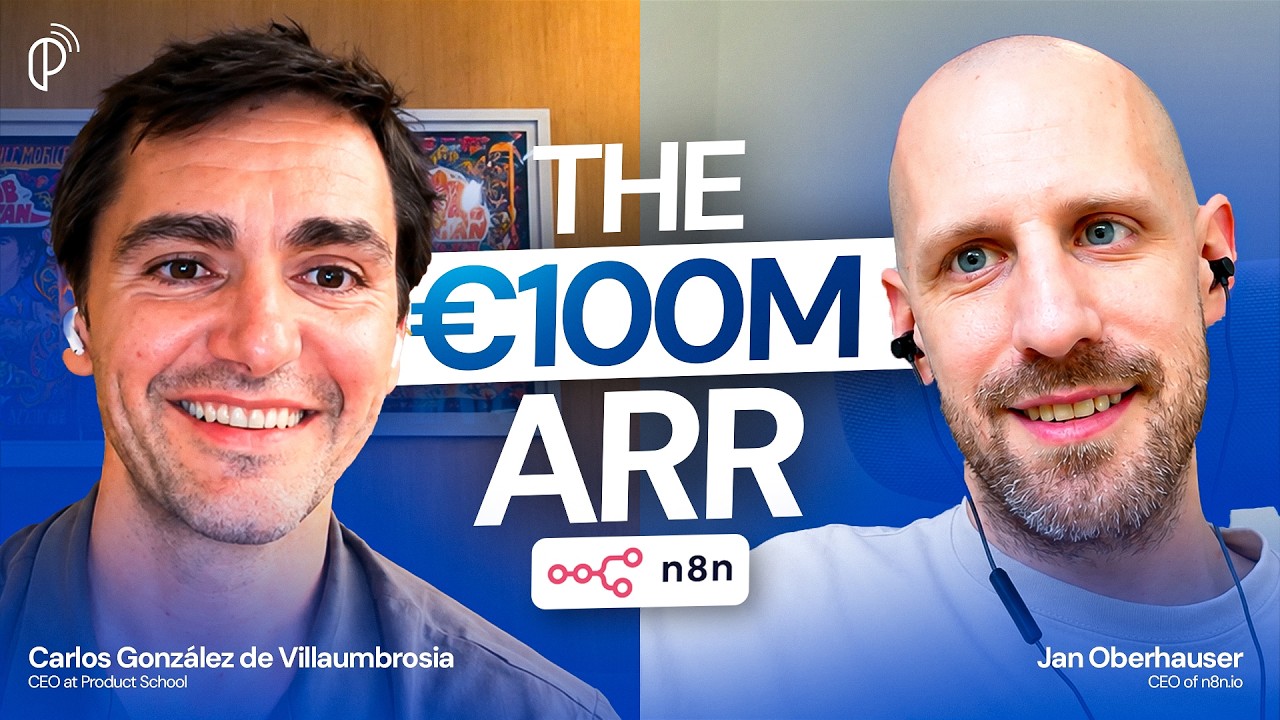
The AI Product Rule That Grew n8n to $100M ARR | Jan Oberhauser, CEO n8n
Watch on YouTubeVideo summary
Jan Oberhauser, the CEO of n8n, shares how his company evolved from a solo project into an open-source automation platform valued at $5.2 billion and generating over €100 million in annual recurring revenue by prioritizing power, flexibility, and community trust early on. Unlike competitors such as Zapier or Make that often limit scaling users quickly, n8n focused on preventing customers from outgrowing the solution while offering a unique "fair code" license model. This approach allows for free self-hosting to ensure data security and transparency but prohibits commercial redistribution of the software itself, enabling massive adoption among large enterprises like Meta and Nvidia without forcing immediate payment or creating vendor lock-in regarding AI providers since users bring their own API keys.
To integrate artificial intelligence effectively rather than simply adding it as a superficial layer, n8n deeply embedded Large Language Models into its orchestration layer to build proper agents equipped with memory, multiple model support, and human-in-the-loop controls. This architecture supports dynamic agentic loops where agents can call tools and respond dynamically, facilitating complex use cases like customer support automation that handled 75% of requests while increasing satisfaction compared to traditional human assistants. The platform now features an AI assistant capable of automatically generating intricate workflows based on natural language descriptions, which users can iteratively refine using a community library exceeding 10,000 templates, all within a system designed for reliability and auditability that large organizations require for production deployment rather than just demonstrations.
Regarding growth strategies and internal implementation, Oberhauser advocates for a hybrid approach driven by both bottom-up product-led growth and top-down executive mandates, accelerated through partnerships with system integrators like Accenture to help agencies build custom solutions. He strongly recommends against fully centralized teams maintaining all automations; instead, organizations should empower employees to build their own agents while central departments provide guidance and guardrails, ensuring maintainability because domain owners understand the processes best. When measuring return on investment, he argues that tracking simple time savings can be misleading due to varying automation frequencies versus manual effort, suggesting companies define custom metrics aligned with specific goals such as improved customer experience or speed, utilizing n8n's dynamic data logging capabilities to track arbitrary values like Net Promoter Score or revenue impact directly within workflows.
Ultimately, the value of AI extends far beyond mere cost reduction; it offers superior performance through 24/7 availability and multi-language support that justifies higher spending where speed is critical for business outcomes. Success in this ecosystem is determined by whether actual business results improve rather than isolating specific variables in a complex environment, with n8n's strategy ensuring that systems are robust enough to handle the demands of modern enterprise needs without compromising security or creating fragmented versions across teams through planned dynamic credential assignment.
Read the full video transcript
I just went to your website and you have
this big [music] button that shows your
GitHub repo with almost 200,000 stars
and it's right there next to signing up.
>> Obviously we prefer people use our
hosted solution and actually pay us
because obviously it allows us to
reinvest the money, but at the same time
like if you use us for free that's
totally fine as well. Like they're just
two different ways of using n8n.
>> Jan Oberhauser, CEO of n8n.
>> What made us special is like very early
on kind of really focused on the
community very heavily. Created an an
amazing platform but also really ensured
those people had a great experience in
there.
>> They support each other. How is it
possible for people to train their own
agents as they execute some of these
workflows?
>> Then it's very powerful. [music] You can
build very complex systems there. I can
just say here something happens there
that actually sent to do something with
it. Output sent it to another agent then
they can use it again as an input and
people can build really really complex
use cases.
>> How you seen the companies that are more
advanced kind of take that AI option
metric a little further down the line?
>> AI cannot do anything. It's not supposed
to be doing.
>> Hey, this is Carlos, CEO at Product
School and your host [music] on the
Product Podcast. My guest today is Jan
Oberhauser, the founder of n8n, [music]
the open source automation platform
that's crossed 100 million in ARR at a
5.2 billion dollar valuation with nearly
[music] 200,000 GitHub stars. In this
episode, here's what we cover. The fair
code license bet, why he rejected
traditional open source and still
[music] won, why sprinkling AI on top
kills products and what to do instead,
how n8n beats Zapier and Make by giving
the code away, who should actually build
automations,
>> [music]
>> hint not the product team, the metric he
uses to know if an AI feature actually
works, how one company wrote 75% of
support through an n8n agent with
happier customers. Let's get into it.
Welcome to the Product Podcast, Jan.
>> I thank you for having me. Great to be
here.
>> I had to start with this. Why did you
call your company n8n, man?
>> It caused a lot of confusion out there.
And the simple reason is I'm a solo
founder, so then like I started n8n
started to program and then you had
before I launched it I have to kind of I
need a name for the product, but I also
need to kind of make or break the
company. So, I just said, "Okay, like I
find a name. I kind of time box like an
hour." And then I just started. I wrote
down like all of the names I I liked.
And all the ones I liked they were
already taken. As you know, all the good
domains are always gone.
So, one name was left, which was Note
mation. The idea was there's kind of
it's a note based system and automation
combined it. But the name was quite
long. It didn't really look nice or
exciting. So, I thought, "Hey, maybe I
can make it more exciting." So, I
thought I'd do the same like Kubernetes
K8S and then eight letters N. This is
the same thing actually. And then N and
N stuck. N and N.io was available.
After the seed round I could buy N and
N.com for 5K as well. We don't use it
right now, but at least we we own it to
make sure it doesn't get more expensive.
You know, everybody has to say that's a
strange tongue breaker. And there's so
many different ways of saying N and
which I didn't even imagine like from
like nation, naten, Nathan. We have N
and N.
And acht N in German. Like there's like
million different ways. Quite exciting
to see
what people come up with.
>> You made it work. Like people recognize
the name. It's obviously not not very
common, but still, you know, like the
product works. People will find a way to
remember it. You started just this
journey over seven years ago, like way
before LLMs became mainstream. So, I'm
very curious to but you should really I
start hearing about you maybe two, three
years ago. So, I'm very curious to know
kind of how did you see this opportunity
of LLMs and you said to pivot into that.
>> It's just that we started with AI and
honestly I didn't imagine at all we're
going to ever do anything with AI at
all. And but then obviously ChatGPT came
along. We saw like a large language
models getting kind of strong and strong
and better. And so, we just were
wondering like like how do we ensure
that like N and N isn't just part of the
the like it's not just a future of N and
N, but we actually participate um in
this amazing AI wave which we kind of
realized will be the future. So, we kind
of took a step back and we just looked
like what are we doing? What are
competitors doing? And all of them are
including ourselves honestly we just
sprinkled some AI on top then and then
we thought okay like to really kind of
make use of it really make sure we are
part of the value chain that actually
people are not just using AI with and it
and but actually people building AI
powered applications agents with and it
and
and that's when we then realized that we
actually ended and fits in perfectly
like what do this kind of large language
models actually need they need a lot of
data from different sources like no
matter if it's your from Google Drive is
it from your local files is it from
Salesforce or whatever it does something
with the data it transforms it makes a
decision and then it outputs the data
again
again into a system or writes it to a
file again and so on and we just
realized we had all of those pieces
already in place but the in between
piece like this agents that has had to
be done like externally or like just
very limited by HTTP request nodes we
just realized by really kind of adding
this kind of capabilities like in front
and center of end-to-end we really kind
of are able to kind of create something
really amazing and powerful and just to
not just again kind of allow people to
build simply automations but really
build really powerful agents as well
>> Already that this should make sense in
retrospect right because we're all using
agents and understand now the concept of
agentic workflows but back in the day
that wasn't obvious at all and
there was also a lot of competition
there were so many other platforms that
maybe were more well known at least in
in the US and you guys are you you you
announced you crossed over 40 million
dollars in annual recurring revenue you
had massive funding rounds that are
latest one at 2.5 billion dollar
valuation with participation from Nvidia
so there's definitely something unique
there so I'm curious to know if what was
that kind of unique thing or secret
sauce that helped you be on the map with
this incredible traction
>> Sure and let me first to clarify we
actually over 100 million euros ARR
already and we are valued at five 5.2
billion dollars right now with kind of
our launching our partnership with SAP
so we are growing so nice we don't
announce the
the exact revenue numbers but just
people we are we crossed 100 million ARR
a while ago. And so and and and the
question was like what what enabled
that? The this experience user goals.
>> By the way, I love to be wrong about
those things like
oh my god, now it's over a hundred
million dollars ARR. So, there's so many
tools out there that were trying to do
something similar. In fact, you were in
the first mover, right? There's so many
other platforms like Zapier and Make and
others that where they already had had
more market share. But you kind of came
out of nowhere in the last two three
years and achieved this incredible
traction. So, I'm curious to know it.
Earlier, this what helped to get that
initial tailwind?
>> I think like from the very beginning and
it and was all about like power and
flexibility. Like I think this what they
kind of missed with a lot of the
existing platforms. Just kind of think a
lot of the existing platforms you kind
of got something built very fast. But if
you if you wanted to get a bit of and
bring it in production or you actually
kind of wanted to scale it, you kind of
this this platform really maxed out.
That's why we kind of made a decision
kind of really focus on power and
flexibility and kind of really um ensure
people don't outgrow our solution. Um
and I think what what made us special is
like this focus but also our focus on
the community. Very early on kind of
really focused on the community very
heavily and kind of created an an
amazing platform but it also really
ensured those people had a great
experience in there. Like they support
each other, we supported them. We
provided um a great great support. We we
create we had uh online events. Now we
we do offline events and we just making
sure like putting those builders which
is really at the center of
and and is about empowering people. And
even our kind of one of our core company
values is we are builders. Like like we
are builders, our community are
builders, our users are builders. I
think like having like this this kind of
this alignment between um everything
kind of really ensures that you kind of
attract the right people. Um and it
really kind of provides that value and I
think especially that in combination I
think we grew very nicely the first
years but when it really took off is
when you then focused on the AI as you
mentioned before. But I think there were
a lot of other platforms out there but I
think none of the other platforms kind
of really had like this kind of very
deep, very um powerful um
AI capabilities. Like we had them, like
all of them had like some AI
integration, so you could kind of call
out to I don't know, an open AI or
anything like that, but like what we
really did from the very beginning is
kind of really ensuring that it's not
just building like calling out to an to
an to an API somewhere, but you actually
built like proper agents, like agents
anything from memory. You can have like
multiple models, you can have um
different tools, you can configure them
very easily, you can add scripts. Um the
kind of this kind of power and
flexibility that was nowhere else
available, and I think that's what
people really craved. In combination
obviously of other advantages like um
for example, in case of force us, that
people really appreciate that tested and
know where the data actually lies,
knowing they can run it behind a
firewall, they can scale it um they like
we have a big focus on on reliability,
like reliability is scalability, and and
auditability. I think where you can just
very easily understand what's actually
going on there even in more complex
flows.
>> Let's unpack some of the concepts you
mentioned because you're right. I mean,
obviously you you build a visual layer
that makes it easier for people, you
call it AI builders, to to create these
type of agentic workflows. And and I
think that expanded the market because
this is not just a technical audience.
Technically, anyone could be a builder.
But I think you also mentioned something
that I think is quite unique compared to
other platforms, which is you allow the
possibility to self-host your own
product. What was the rationale behind
making that decision?
>> I think that that was very core
incentive for the simple reason like
when I started NLnet, I wanted to
ensure multiple things. First, I really
wanted to make sure that we have the and
the possibility to become like the
default tool out there. And if you want
to become the default tool, you have to
obviously make sure a lot of people can
access to it and get access to it for
free.
Um and so I think that's why I always
say especially like a lot of
yeah, I think like I think that's that's
a really a requirement to really kind of
really get to that. The other thing is
like I saw a lot of open source tools
out there and I saw that they were able
to build these amazing communities that
really kind of made that success and
this kind of
um usage even
just what possible in the first place.
So, then again it was very clear I want
to make um it available for free and
again open source was one of the one of
the directions I should do that. I went
down a slightly different path very
early on where I saw that a lot of the
open source companies actually decided
to kind of change the license and kind
of change it to something more
restrictive. And I saw that the
community object got very angry about it
less because of the license it shows
mainly because they actually the company
suddenly changed the rules. Said, "Here,
first I I can do all of this." And
suddenly take took like some rights
away. And that really pissed people off
a lot. And I thought, "Hey, I you cannot
afford it like building up a a
successful community is very hard. It's
also like suddenly very easy to lose
it." So, I thought, "Hey, I got to be
very up front about it from the very
beginning." So, I said, "Hey, I like
make it available for free for everybody
because I'm a good person. I actually
want to build a business. I want to kind
of pay my own salary at some point. I
want to hire a lot of people that kind
of provide value and I wanted to ensure
that this money actually goes back in
the company because I knew we kind of
reinvested into our support, into our
docs, in our product, and in doing quite
great events. Only like this we can
really kind of keep on growing and kind
of make a build a successful company.
So, from the very beginning I chose this
little different license which we now we
call it a fair code license. So, we say
you can do more or less the same thing
as you can do with open source. The only
limitation you have is that you cannot
commercialize the code. So, you can use
it commercially so you can use it in
your company at any kind of scale you
want, but you cannot build a for example
a hosted version of it and then charge
other people for that. But we thought
again it's it's a quite fair ask. That's
why it's called the fair code license.
And I think that's um we did So, from
the beginning we thought about hey, how
how can we enable the scale? How can we
ensure we build a very great community
can really build up the trust because I
think trust is really the center of a
community. What what's really important
is like people can say a lot of things
and they can also change their minds
tomorrow, but only if you kind of are
very consistent and from the very
beginning people say see that the things
you say you actually do and you not just
saying one thing today and another thing
tomorrow. You can really build up this
very strong community. So it was very
important to kind of really show that
from the beginning and I think over the
last 7 8 years people can definitely see
that.
>> I mean, I just went to your website and
you have this big button that shows your
GitHub repo with almost 200,000 stars
and it's right there next to sign up. So
it's a really I would say unique
approach to first of all pursue this
open source path with self-hosting
option and still finding a business
model that enables you to run a business
while also making your product widely
accessible to to people. I've seen that
approach in other another companies but
not in in your own specific space. Like
we hosted the SVP of product from What
is this database company? Well, a
FiveTran just acquired DBT and and we we
had them here and then MongoDB was still
the example. But uh I think you're kind
of the first mover in that automation.
And by the way, how do you define your
industry? Because I've seen terms
floating around automation,
orchestration, now loop engineering.
>> Yeah, like we say we are more like
orchestration layer. So like
orchestration is probably how I would
put it like an orchestration platform is
how I would define it. That's
how I would call it. But also back to
the previous point, I think like a lot
of open source products start as as as
open source and they kind of are very
proud about it and at some point they
start to hide it. The source code is
still there, but they kind of try to
hide it more and more and kind of get
people try to get people down the paid
path and we are very deliberately say
hey like we honestly like obviously we
prefer if people use our hosted solution
and actually pay us because obviously it
allows us to reinvest the money, but at
the same time like if people use us for
free that's totally fine as well. Like
there are just two different ways of
using InfluxDB. And then the free one
like the free one is a very important is
actually super important for us like how
we got adoption of all of these large
organizations that we get used from
anywhere from I don't know meta, Nvidia,
Dell, Accenture, in Germany Voda- like
Vodafone, Deutsche Telekom, Mercedes,
like all of those companies. And we got
adoption the same way as by people
having a problem, starting with our free
version and bringing it into this
enterprise organizations. I think that
is what what people really
underestimate. I think very short-term,
they think, "Hey, how can I ensure that
this person pays me tomorrow for my paid
hosted offering?" versus thinking
long-term, I think making ensuring that
these people have a very great
experience to get a lot of value out of
the product. When they get a lot of
value out of the product, at some point
they're going to become a paying
customer. Even if not, like most ones
will. So, I think like again, back to
the adoption piece.
>> Even if someone chooses the free option,
I imagine you start connecting to
different LLMs. And I know that you
allow the possibilities to switch
different LLMs. So, I guess there are
open-source LLMs, non-open-source LLMs.
So, how do you go about enabling those
that optionality and still allowing
people to, you know, pay when they have
reached a certain level of usage?
>> Like in the end,
what what make us is different with N
and N and total most other tools is like
people bring their own key normally.
Like we we have some functionality
inside that you can get some some test
credits. And we also working on a
feature that you kind of kind of use
this LLMs via N and N and kind of to
also pay with them. But
up to this point in time, people are
bringing their own key. So, they say,
"Here, I want to use an Anthropic model.
I want to use an OpenAI model. Or I want
to use something else via I don't know
Hugging Face." And they bring their own
key and connect it. So, kind of
depending on the use case, depending on
on how much money they have available,
they kind of just decide by themselves
which one they want to choose. But I
think the very important thing and the
powerful thing is also kind of you can
switch later on. Like you can switch
like it's probably like theoretically
you can switch off off a second just
with deleting one node and putting in
another one. But obviously but at the
same time, you still have to make some
adjustments there where we also kind of
have the functionality that people can
create evaluations inside of N and N
just to kind of test what does this
change do and how do I have to adjust,
for example, my prompts to make it
possible, but again this is quite simple
and much simpler than other platforms to
actually change any model provider there
from one to another, especially if it if
you change for example I don't know use
open open AI model by open AI or then
hosted by Microsoft tomorrow. This lets
you switch over a few seconds.
>> Yeah, I mean there's all these chatter
now, right? With the Chinese open source
models
performing apparently better than some
of the US based models. I think clearly
having the optionality for the user is
an advantage. It allows you to not be
locked in with any of the providers and
ultimately you can see you are in the
news a lot of the time when uh Anthropic
or Open AI releases a new a new model.
There's all these headlines. This
company just killed 10 other startups,
right? So I'm curious to know from your
perspective, what is your market
positioning and how you're thinking
about uh the modes, but also like the
relationship that you you have with
these different uh providers.
>> I think why why people choose like I
think there's a definitely a lot of
killing going on. I think like the thing
killing a friend against a lot of um
clicks. That's why I think the that
happens literally daily that something
kills kills another thing. So I would
probably not take it too seriously. Most
of the killed startups are are doing
still very well. Obviously not all of
them. So I think partly there is
something to there. But then like what
what makes Eden AI special is like our
focus on kind of really audibility, like
flexibility, um like the self-service
ability and and the security piece and
kind of really giving people really
control. Like you can only you can see
more or less like you can say the LLM is
kind of the engine and and we are kind
of the car and also kind of the the
rules and the kind of the traffic the
the whole the roads and and and the
whole system. Like we kind of really
connect everything and kind of be the
kind of connecting tissue between all of
them to to kind of make use of this kind
of pile of different models and agents
and business systems and bring it into
kind of a extra process you can actually
use. I think that is um is like we we we
all need each other. We we need those
those those model providers. The good
good thing is you can replace them, but
again you have a lot of models. You have
a lot of different assistance you
connect to and you kind of bring it all
together and allow you not just to kind
of build a nice demo out of it, but we
we have a like a very big focus on
actually building like reliable systems
that are secure, that you can actually
understand what's happening. So, if you
build an automation with N and you know
exactly how your data flows, that way
it's using those tools, it's not going
to do anything else. You see it when
something goes wrong, what what exactly
went wrong and I think that is again why
especially large organizations choose us
for business critical use cases because
they can already get real ROI. They
actually they can deploy us in
production, not just for a nice demo out
there.
>> I think we've we've talked about the
product enough. Now it's time to show
it. And I love that you were the the one
who volunteered to share screen and and
demo what you got. So, Jan, I would love
to see your product in action.
>> So, in the past people built
workflows themselves manually.
But obviously with with things like
cloud code and cloud code work, people
realize that actually building can be
much simpler and we also obviously
realize it as well. We obviously want to
give the great same great experience to
people inside of N and also just allow
literally anybody to build. Like I think
a lot of feedback we always received is
that N and was a kind of a more complex
system, focused on more technical users.
And the goal was always to kind of lower
the bar and thanks to AI, we now finally
able to kind of really empower everybody
to build. So, what you can see here is
our new AI assistant. We we just
released it
1 and 1/2 weeks ago, but what it can do
more or less see kind of describe what
you want to do. Like we give you some
examples. You can say, hey, I have a
marketing use case. Um SEO and then you
can just kind of define what what it
should build out for you. I already
prepared something because it takes um
definitely a few minutes to actually
build something. So, like here we have
actually I just make it a little bit
smaller. You can see better and kind of
scroll up. Here I kind of just asked it
to build me like a personal work play
agent, um a kind of personal agent that
kind of work with my emails with my
calendar. And it starts with a chat
trigger so I I actually talk with it. I
told it what my email address is and
then I told it like all the things it
should be able to do here.
Um and then I also made sure that again
you can see with human in the loop that
means like certain actions I want to
ensure that it's not just a AI just does
the stuff by itself. Like I don't want
it to send an email in my name without
me actually confirming that. So I just
told it, "Hey, please ensure that
certain steps can actually not be done
unless I approve them first." Um so it
then started building.
A kind of um said it and then it told
what uh what's going on and then it
asked back a first question. It kind of
wanted to know like um actually where
was the first question? Uh here. It kind
of asked like which model should use
because it can obviously there's a lot
of different models out there. I waited
and simply said, "Hey, um we actually
want I I saw it's on here. This is the
first question." David then said for
example, um "Hey, please um use Claude 2
or open router." Then it asked some
other questions as well and you kind of
see the answers down here as well how it
should work.
Then it kind of kept kept on building.
Like normally you don't have to care
about
those things here but again for the more
technical users actually want to
understand what's actually happening
there. They can actually open up here
and kind of see exactly what's the kind
of the AI system that it is doing and
how it kind of starts to build its
workflow. Then it was was building a
while um and at some point it it said
it's done but then I also said, "Hey, um
actually the the way you currently build
it um
I want to get it changed slightly." Then
it kind of went in there and and kind of
made changes to the workflow and then in
the end it was done and you can now see
here you see like one of the artifacts
which you can also see in the side is
that the workflow that has been built.
So you can go in here and let's also
make it a bit larger that you can see it
better.
Um and that's the workflow that that the
system built by itself. You can see like
it's it's quite easily understandable.
Like here you for example you have like
if you start with a chat node here the
whole conversation starts. You input the
data. It flows into this agent. This
agent by default uses
um of Claude 3 5 but we also have it
configured that as they're not you know
Entropic is not always that reliable, we
also have a four back model you can say,
"Hey, if this model is currently not
available, fall back to uh GPT uh 5.4
via open router." And then you see here
all of the different tools we had
defined previously. You can sort of list
recent emails um or you can have like um
it can get emails for you, it can even
create draft and so on. And here we go
we see the whole human in the in the
loop steps. Then you can say, "Hey, it
can send an email, but it can only do
that if I get approval before." We kind
of can see the configuration of each of
those nodes by going in there. So, we
can see here like here we say, "Bef- for
approval, it kind of shows this message,
send this email, please provide it
before it goes out." It gives you like
an overview of who's going to send it
to, the subject, and the body.
And so before it actually does that, it
kind of does always the confirmation. We
can see the same thing here as well for
kind of sending a reply or for like
creating calendar events.
>> Mhm. In this In this case, so I'm seeing
that two different workflows, right?
Ones that could be fully automated and
ones that require a human approval
before they're executed.
>> Exactly. Like the the end like at the
end can totally exist in the background.
You can say, "Hey, every time a new lead
gets created um in in whatever system,
create something in Salesforce for me."
And it just does it totally
automatically. You can also have like uh
an internal chat system like this one I
I'm showing off here where you can just
say, "Hey, I create a personal personal
personal assistant for myself." Which in
this case kind of works through our chat
like you can test in here or you can
also use it for example via Slack or I
can enable it via Telegram.
Um or you can have in have something
exposed to to your users. We have for
example uh a big
online travel agency which kind of
automated a lot of the support actually
via an AI assistant built within it in.
They literally like 75% of the requests
of the customers go through that agent
where people can change uh hotel rooms,
change bookings, can ask questions, and
so on.
Um and again, the nice thing about that
example is even that the people that
used a AI assistant like this AI
customer representative,
people actually seven like actually
happier with with that than with a human
um um assistant there, which is
obviously amazing, which shows AI is not
just about kind of lowering the cost and
so on. It's actually providing also
really use real value for the users.
They can literally literally again
anything from fully automated to
literally everything in it probably can
build anything. Got it.
>> And just to clarify also on the this
visual graphs was created automatically
based on the configuration that you did
before, right?
>> Exactly. That was built automatically.
Um we actually we did actually normally
you have to kind of sometimes select for
example like which credentials to use.
To give you an example, here we for
example
a cloud sonnet, we can say here use the
internet building credits or you can say
here use my own API key. And you can do
this can could do it with literally any
tool here. You can say hey yeah I it's
connected to those credentials of of my
Gmail account and so on. So you can then
still you can build it automatically and
then you can say hey I can actually now
go through and and make sure I can
understand what actually has been built
because I think the the problem with a
lot of if you write code code like you
have normally 10,000 lines of code that
you hope does the right thing, but
actually kind of reading and
understanding them is almost impossible
because it takes you honestly more time
to partly understand it than actually to
kind of create in the first place. And
here it's just very simple. You can
literally say here here I have a chat
node. I I get a message here for
example. You can say show me my last
five emails. Then the data flows through
here and then you can see ah here now I
have this AI assistant as a AI agent.
And you can see here now it's a system
message that tells me hey I'm I'm an
assistant, I have those tools, I have
like certain rules in place. Here I get
the the chat message and then I call I
have access to those different tools.
And you can very easily add more tools
like this. There you have a you can even
add code tools. You can have like you
can do actions in in in different apps.
Like you can see a lot of them. Anything
you can probably your heart is asking
for.
>> Question about those those tools. So I
saw on your website you have over 500
integrations with with tools. And so how
do you go about that? Is it something
you have to set up one to one with each
of those tools? Or is there a more of
automatic way for you to create
integration?
>> In the end like we have
different kind of integrations
in multiple levels. They're like certain
built-in integrations that that we
created ourselves, we're maintaining
ourselves. This is for example like all
the most important ones like for example
anything with Google for example or
Salesforce. We created them and we
maintain them. Then there's also like
custom like community integrations. The
community built them and then we check
them and make sure they're actually
secure. And then people can also access
them on their cloud solution as well or
can manually install them. They're
actually a lot more than those 500 out
there. And then even if there is no
integration built by us and no
integration built by the community, you
can still kind of connect to the system
manually via an HTTP request in order to
kind of say make a get or post request
to a certain endpoint. You can also ask
the AI assistant to build it for you as
well to kind of configure the nodes for
you. But in the end you should be able
to connect to literally any kind of API
based system out there.
>> Yeah. I remember the first time I set up
my OpenGl again it was quite an ordeal.
I mean and I'm very really technical but
still there was no visual layer. So here
I can imagine you can choose to drag and
drop and and set it up. And I guess you
also don't need to buy a MacBook or a
Mac Mini, right?
>> No no no it's running totally in the
cloud. You can also just like test very
easy. It's literally so see what's going
on. If I say say now for example let's
say I can say send an email to James at
I don't know email.com saying hello.
And then I can literally see here how
it's actually going through the data.
The message got received and now the
agent starts building. It kind of adds
data to the memory. It calls out to the
model,
and then it kind of tries to figure out
what to next. And then you can see that
it's going to call one of those tools
actually going to answer. In this case,
it said, "Hey, send out this email.
Please review before I send it out." So,
you actually see it went here, and
because we said, "Hey, there's actually
a human in the loop." It actually stops
now and it kind of keeps on waiting till
it actually says it should send it out.
So, I could now say, "Send it." Or
"Don't send it." "Send." Or "Cancel."
And you can see that would go on or
actually stops here. So, like it's again
you can
And if something would have gone wrong,
you would see like a notice red here,
and you can just very easily debug.
And again, now you can also just go in
here and see, "Hey, what actually
happened?" You can see the logs. I got
the input, I got the model, I I sent
this kind of input to it. Then it kind
of called the tool with that kind of
data. It kind of
kind of asked for approval, so you can
literally go through the whole to to
everything that happened very easily and
kind of debug and understand what if it
actually does the right thing you wanted
to do. You can do that for literally any
execution that happens.
>> So, as you know, loops are hot now,
right? This whole concept around Now you
can train your own agents, or you can
set a goal and they will self-improve.
How do you think about that, and how is
it possible for people to train their
own agents as they execute some of these
workflows?
>> Like that what what happens there is is
a kind of loop like
you you call the agent, it calls a tool,
it goes back to the agent like to the
model, it calls another tool, it can
respond to the user, and then can can go
back here again. You can also literally
can like you can literally loop like
literally can just tell it to kind of
talk to itself if if I want to by just
adding this connection here.
And it is very powerful. You can build
very complex systems there. I can just
say here something happens there, then
actually send do something with it
output, send it to another agent, then I
can use it again as an input. Like
people can build really really complex
use cases. And also like maybe actually
let me share this one here. This is our
website. You can see here templates.
And you can see there's like over 10,000
templates that our community created. So
you can say here I want to use something
like a sales in sales for example. You
can see here um nice things people
built. Or you can say here I want to
have something with I don't know Google
Sheets. And you can see like a nice
example how you kind of auto create
TikTok videos or anything else out
there. And then you can kind of click
there and they kind of can see here
literally the actual um automation that
actually has been built. They kind of
already explored. So like the same way
you can like like just explore it. You
can see here what's actually happening.
How did it get set up? And then you can
literally just say I want to use it. You
can copy it. And then you can just
literally copy it um in here. So let me
just um start a new one. Just create an
new workflow. Now I just literally just
copy paste. And you can see the whole
thing is in there. And now I can kind of
configure it with my own settings. For
example, now here in this case it's it
has an OpenAI model. So I could say I
can use my own credentials or use the
OpenAI ones. So you can Oh, sorry. I
didn't I just forgot. I had forgot to
share that I had to do
>> Yeah, I I get it. I think this is this
that goes to the important problem we
see in the product, which is the
starting with a blank slate sometimes is
hard. So having some sort of recipe that
allows you to validate what you need and
you still have the ability to to edit
it, right? Based on the tool stack that
you have or the specific use case that
you need.
>> Exactly, yeah. And um maybe also to
finish the the previous example, I think
like
um I said I said before like we had our
assistant here and and it it again now
it built it out. Like and I have now
this workflow here. But I can actually
as well like can actually now say hey
that it's great what you built here, but
I actually want to kind of extend it. So
I can for example say now
they have the existing workflow already,
but now to add for example this like
calendar tool where I want to book my
one-on-ones with people. I want to have
consistent formats. They have like
always 30 minutes and so on. And now I
can just send it to the agent. And
again, now I can see like how it
actually works. Like also way it it does
some thinking and then it kind of will
start to extend the existing workflows.
You can say hey you can start very
simple and you kind of not you don't
have to kind of build and like go
totally crazy and kind of come up with
the whole solution from the beginning
but actually can also do it iteratively.
You can say hey start with the most
basic version and then I want to add
this this other things in time as well.
Now I can see now it's it's working here
and now it kind of it it does some
reasoning there. It kind of goes back
and thinks about what it should actually
be doing. It will probably going to take
like a few minutes. It's a good
addition. I need a Google contacts tool
name.
Again it figures out kind of the
different nodes it needs. It looks up if
credentials already exist for example
and says hey I need Google contacts
credentials. It says hey I already have
an existing one so I can actually
connect to to to Google already
and then it will hopefully be done in in
less than a minute and then you can
really see that it extended the existing
workflow as well. And again that's and
the amazing thing is that
what what what to show here is that
again literally everybody can do it like
because they have to know what you
actually want to build and if you know
what you want to build you just describe
what you want to have done and it goes
out there and it actually does it for
you and again and then you can just
again literally test it by yourself and
and and show it it actually works in the
right way and then it can very easily
deploy it in production and kind of use
it on a daily basis.
>> I want to ask you a question about the
main bottleneck that I see these days
with this type of assistant. So people
are able to now create their own they
call it second brains or AI chief of
staff or assistant
that seems to work really well for their
own productivity. But the multiplayer
bottleneck is real right? Like how do
you now create a shared environment
where people can benefit from the work
that others have done and they can
really collaborate instead of creating
their own versions of their own
assistant.
>> And then like we just I think I'm sure
if you released it yet, but it should be
closely if shortly before releasing is
where instead of kind of just creating
your own, like connecting your own
credentials, you can actually say, "Hey,
assign this credentials dynamically."
So, in this case, if I interact with it,
it would
use my credentials and would access my
Gmail account and my calendar. If you
would actually chat with it, you can
give it access to your calendar and they
can do it for you. I think that this is
very important piece where you can trust
again, every if you've done 10,000
people in an organization where you have
10,000 people building
something separately, you can actually
have literally anybody just having one
of them deployed and then the whole
organization gets access to the same
thing as well.
And generating workflow, I said, "That's
fine that they can do that." And I think
that's this is very important piece
as well.
>> Totally, cuz ultimately, we got a super
agent manager, right? Like you have all
of these different agents doing
different things. Sometimes those agents
are yours, sometimes it's your
teammates, and so, what ends up being
the the control panel, kind of the the
surface for the product leader to really
understand what's going on and be able
to make any type of modifications?
>> Yeah, I agree that is so important.
Also, by the way, here you can also
already saw maybe very fast, not just
spinning the workflow, it's actually
kind of already kind of tested it for
you as well. So, that actually you can
be sure that when you build something,
it it kind of it is already it's in the
in the working state.
>> Really cool. And the other thing that I
that I noticed it's it's becoming
challenging for especially large
organizations is the
deployment into production. I like these
these type of
demos work very well when you have full
control over the tools you're trying to
connect to, but as more people join the
party, then you also have more controls
and checks, right? So, and it we're
talking about large enterprises that
already use and and like how were you
able to get over all of those
procurement and guardrails problems to
make sure that they trust your solution?
>> First,
like we talked about before,
self-hostability. I think that's just an
important piece already that people
actually know where where it actually is
running. Um and they can also very often
they kind of use their own local models,
for example, to actually deploy N and N.
Um and then other thing the other piece
is like literally like
if you build something with with with
AI, like it can go rogue very easily.
Again, for example, I don't know, it
deletes data it shouldn't delete or it
sends out emails it doesn't what
shouldn't it shouldn't send. But again,
because we make it very simple, like
literally this agent can do only those
things. It cannot go rogue. You have
exactly specified all the things it can
be doing. Again, also the things it can
only be doing once actually a human
approved. So, it means like before those
things can go in production, somebody
else can very easily review it again.
And they don't review again 10,000 lines
of code to actually review a workflow
that they can easily understand and go
through and kind of know exactly what
it's going to be doing. But I think
that's just makes it very easy for these
enterprise organizations to not just
again have a nice demo, but actually
kind of release it in production much
faster than other systems.
>> I think this is a very common challenge
for a lot of companies that maybe
started more on the SMB segment or
direct-to-consumer people who are like
really curious and building something
and then they're bringing it to their
enterprises.
So, in addition to just proving that you
have the right security checks, like
what does go-to-market motion look like
because PLG can only take you so far?
>> First, like we got into the most
organizations like via bottom-up PLG
growth. And interestingly, it's not just
bottom-up, we got into a lot of into a
lot of organizations as well, literally
top-down as well, where
people on the board, where C-level, I
don't know, the CTO or the CEO, whoever
saw content around N and N and just was
one like, "Why don't we do the same
thing in our organization as well?" And
they kind of bring it into organizations
and then very often find that they're
actually already using N and N just in a
more limited way. And then it makes it
much much easier than to actually do
that. Um at the same time, obviously
like at some point you want to
accelerate things.
Um another nice way to accelerate things
is definitely partners. And I think that
is one thing that is also works very
well for us. Like we have a lot of we
talked about the community before like a
lot of the community consists of people
that have agencies that build up
agencies around and at the end it really
kind of not just again they go out there
and say, "Hey, I could I can actually
help you to build this workflow. I can
actually maintain it for you." Um I I
help you to kind of even figure out what
can can be automated. They're kind of
this this accelerator. We also work with
For example, just a month ago we
announced a partnership with Accenture
as well. And we talked with other system
integrators as well. There other
partnerships getting announced very soon
um on top there. So that we're looking
for this kind of accelerators that can
really help us to kind of reach more of
our user base and and therefore reach
more of the opportunity easier because
we can obviously not have a one-to-one
relationship with everybody. So we we
have to ensure to actually kind of use
all the channels that are actually
available to us.
>> So as you partner with these companies,
consulting firms, and others as your
implementation partners or FDEs, call it
however you want, it seems like one of
the challenges that these companies have
and by the way, we do that for a living
as well is that you get the you do the
initial sprints with the client, they
they see the magic, they love it, but at
some point you want them to be more
self-sufficient. They also want to be
more self-sufficient, right? So I'm I'm
thinking about the actual adoption
curve. Like maintenance, like what is
the approaches that you are seeing now
for this type of large enterprises? Is
it like having their own center of
excellence or chief AI officer that is
overseeing all the AI implementations?
Do you see more functional leaders
trying to handle their own automation?
Like what is your your vision on that?
>> We we definitely see all of it
theoretically. Like all of it is out
there. Um but what like just the the
thing they're doing internally as well
that we um
suggest for our partners as well is not
just not having it only centralized.
Like I think that you can definitely get
if you have a centralized team that
builds automations or AI assistants or
agents in whatever way for other people
like you can reach like I think you get
a lot of value. But you don't really
empower people. You build for them and
again it's at some point it becomes
unmaintainable because you suddenly like
this this this department literally has
to kind of maintain hundreds of
thousands of of automation. It doesn't
work. It's also the opposite of why I
created N to N. Like the reason why I
created N to N is was because I saw that
the people that had the problems were
dependent on other people like myself
who actually helped them to kind of
build things to build automations or or
build agents. And at N the idea with N
to N was that the people that have the
problems can solve it themselves.
Because again this is why we we try to
make it simpler and simpler and simpler.
So like this again we have an an AI and
automation department internally as
well. But what they're supposed to be
doing is like still help like the idea
is about empowering people inside of the
organization. Again the people that have
a problem should be empowered to build
it themselves. They're still there for
you to say hey I don't know how to do
this one thing then they help you out
there. Or they help you kind of try to
figure out first what is actually
possible to build. They kind of trying
to kind of the idea is kind of help the
people to fish because in the beginning
they have literally no idea what's
actually possible. And they're kind of
getting started with something small and
kind of empowering them more and more.
That's how we really see how we can
really build it up successfully and then
obviously document what they did. Kind
of ensure you have to kind of the right
the right tools in place but it we kind
of see them as kind of creating the
guardrails kind of they they they own N
to N their own everything around it
their own education but the building
should be owned by the people that
actually have the problems because
they're like nobody else can do it
better than them. They actually know the
whole process by heart. And explaining
it to somebody else is just super
inefficient. It's never going to be the
same thing and for literally any problem
you have again any simple change you
have to go back to another person again
that has the same context and it it's
just super inefficient.
>> Yeah. And and that exactly and that is
why it's thing is so complicated to
measure ROI. right? Because first you of
course need to understand what's
possible. And once you taste that magic,
it's hard to go back.
So, adoption seems to be a good way to
get started. But at some point, people
start questioning, okay, but all of this
productivity goes where? Right? But at
the same time, you can't fully give a
one-size-fits-all
answer to all the companies. And here's
how you measure ROI of your AI
implementation. So, curious to know what
is your take on how you're seeing the
companies that are more advanced kind of
take that AI option metric a little
further down the line.
>> I think that's I think that's definitely
also something we struggled with as
well. That's something because there's
so many like I said, so many different
ways to actually measure like the the
impact. And again, like we we also
started the initially thought, hey,
that's the simplest thing that you can
also do very easily with and then it's
literally just track like how much time
it actually saved. But I think that's
actually not not not not the best
measure. We kind of realized it's also
like very easily kind of you can just
cheat very easily in a kind of in
certain automations like even though
they run every minute, it's not just
and and it would take you 10 minutes to
run it every time manually, it doesn't
mean like it it saves you crazy amounts
of time there. So, like what we actually
now looking I think one thing is is the
ROI piece, but what we are kind of in in
actually internally, we care less about
the ROI kind of measuring the right way
because we just know that it's like it
it it has a lot of impact. What we
actually want to drive forward and want
to ensure is that actually change is
happening. That actually every
department actually thinks about like
what can they be doing to kind of drive
change forward. How can they make sure
that they actually not that they think
differently, how they kind of have more
impact. And that's why each department
has to define like their AI vision and
kind of really kind of define the
certain things they want to achieve
every quarter. And then we as a company
ensure that each that each department
kind of reaches those goals and we as a
whole company actually reach
at least 90% of those AI targets have
been set. I think again, you can measure
anything. I think. Again, also I think
it's not one thing one size fits all.
And maybe for some of them it makes
sense to kind of check again of how much
time is saved or how much money is
saved, whatever. I think you have to
decide it yourself, but I think
honestly, the most important thing is
right now certain things you can take as
a given. You know it provides impact.
And then you just have to kind of think
it's still want to make sure like I
think it becomes then problematic when
you have like on one side an unknown
outcome and on other side you have a lot
of a high very high spends. Because then
it is not very clear anymore. And I
think that's again why people appreciate
and it end very much is because the cost
of running an AI assistant built with an
end is much lower than in other systems
because we're not just saying, "Hey, AI
solution for everything." We say AI is
one piece of it. Again, what you want,
you need AI, but at the same time you
still want to have deterministic logic.
In this case, for example, the step
approved those emails or I don't know,
do X or Y depending on a certain number.
That's a deterministic logic. Like it
doesn't need an AI to actually do that
for you because AIs are expensive. If
you just figure it out, they're not very
reliable and they're very slow. Like why
would you do it with an AI? And then you
still have to have the human in the loop
again, which again ensures that you
cannot just use it for a nice demo, but
you actually can use it for a business
critical use cases because you know the
AI cannot do anything it's not supposed
to be doing. And I think that is again
why that the cost of running an AI
system is actually in built in and that
is actually quite low. And then over
that
the ROI um is very clear again. In the
most simple form, start with just and
start to track time saved. And then you
can actually go further and kind of
literally kind of track your own things
like in an end you can even do it
dynamically. You can just say, "Hey, I
have this this arbitrary metric." Um and
again, for each execution save that
number. It would maybe get saved as time
saved, but you can literally kind of use
it for anything you want. Just to make
sure it has to kind of the impact which
actually organization is aiming for. And
again, one last thing I want to say
there is the example I gave previously
with this kind of AI assistant for this
online travel agency, I think people
like I think this ROI thinking is one
thing is great if you want to have ROI,
but very often like the advantage is not
just money saved or anything like that.
Very often it's also better customer
experience as well. Again, people prefer
the AI assistant. Why? Because never
gets tired, it can speak any language,
it works 24/7, it has the perfect
context. Like that's great. And yeah,
and I think that is this other thing is
like certain things it's not just
normally one value that certain things
you can drive forward and say, "Hey,
maybe I don't want to set about saving
money, it's about having better customer
experience or it's about saving money."
I don't know like whatever your your
your company is driving forward, you
should measure that one thing.
>> I like that cuz sometimes with the
introduction of new new tools it seems
like we're forced to now coming up with
10 new metrics to measure the specific
impact of that new tool into our
business, while in reality it's all
intertwined that it's just hard to
isolate a specific variable. So, using
the same business metrics that your
business uses to measure productivity,
outcomes, performance, ultimately I
think is the easiest and most reliable
way to see if okay, how you're getting
there is actually helping or not. But,
um, that's at least also how I try to
measure the own impact of our own AI
implementations in the business. Like,
okay, are we seeing a NPS of the
customer go up? Are we seeing revenue
grow up faster? Then great, it seems
like what we are doing in the house
seems to work or not. But, it's like if
you go to a restaurant and order a
chicken, if you like the taste of the
chicken, who cares where that olive oil
is coming from if it's AI or non-AI?
>> Exactly. And I think like the thing is
like you can even say very often it's
maybe the right thing to actually spend
more money because of AI because like
what you care about is for example
speed. It's like if a it's a difference
if I have a human that does it and it
takes him for example 15 seconds, I can
do with the AI which does it maybe in
three seconds. Like maybe that's worth
paying five times that, but it really
depends on your own business, um, and
what what is important for you.
>> Jan, it's been a pleasure to have you on
the podcast and see you demo, to you
also explain the product, go-to-market
strategy, and thank you so much for your
time.
>> Well, thank you for having me. That was
great.