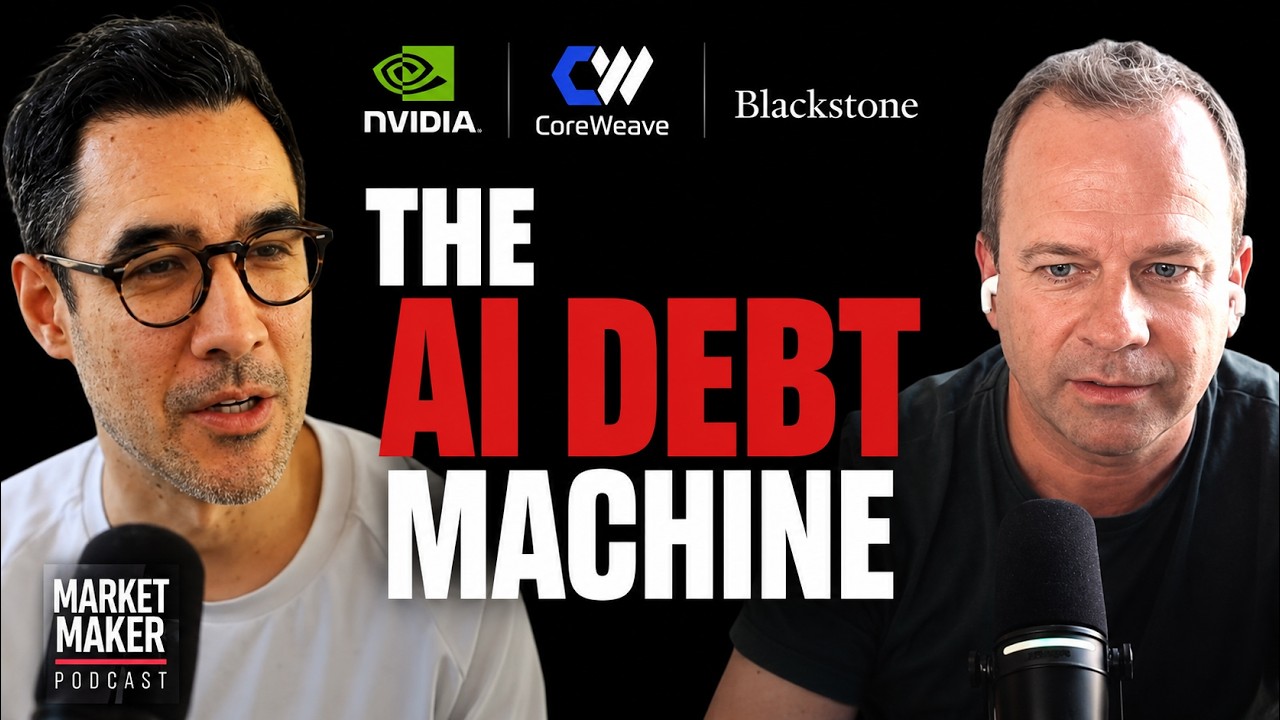
Video summary
The podcast episode explores a fundamental shift in artificial intelligence economics, moving away from simple model competition toward intense capital expenditure requirements for data center infrastructure. CoreWeave serves as a prime example of this new trend, operating as a "neo-cloud" that specializes exclusively in AI hardware like Nvidia GPUs and liquid cooling rather than traditional cloud services. Despite reporting staggering revenue backlogs exceeding $104 billion and an 112% surge after its second quarter earnings, the company faces significant losses driven by massive spending on infrastructure and interest expenses. To support this unprecedented boom, Nvidia has partnered with major private capital firms to mobilize approximately $500 billion in financing through a circular mechanism where institutions lend money backed by Nvidia's strength; borrowers then use these funds to purchase chips that generate revenue to service the debt.
However, this aggressive expansion model carries substantial systemic risks that could threaten its stability if not managed correctly. The primary concerns include concentration risk due to heavy reliance on Nvidia's monopoly and a limited number of hyperscaler customers such as Microsoft, Meta, and Amazon; execution risk regarding whether capacity can be built fast enough to meet demand before the return on investment is proven; and geographic risks stemming from data centers concentrated in specific US locations facing regulatory hurdles for power and construction. Skepticism remains high among some investors who worry this structure resembles a "house of cards," particularly given concerns about chip lifespans versus corporate capitalization periods, though current evidence suggests GPUs remain valuable for five to six years thanks to software ecosystems like CUDA which sustain their utility beyond pure hardware obsolescence.
Beyond the specific challenges facing AI infrastructure companies, the episode also touches on broader economic indicators and upcoming Federal Reserve events that will influence market expectations. Recent US CPI data showed inflation slowing to 2.5% year-on-year, the lowest rate since March 2021, which eases pressure on interest rates even as computer software costs rise due to AI chip demand. While new Chair Jerome Powell is generally opposed to providing forward guidance and may offer only brief acknowledgments or remain silent during upcoming events rather than signaling September market expectations, these macroeconomic factors continue to shape the investment landscape. The discussion concludes by inviting listeners to share their thoughts on investing in artificial intelligence while thanking the guest for his insights into this rapidly evolving sector where technological advancement is increasingly tied to complex financial engineering and regulatory navigation.
Read the full video transcript
Hello and welcome back to the Market
Maker podcast and Piers I was going
through some of the analytics and
looking at the performance of some of
the recent episodes and
and just as you might expect anything
with AI in it seems to be outperforming
and I don't want to be one who's like
chasing clicks but if that's what the
people want then who am I to deny them
of that
so
>> Give the masses what they crave.
>> [laughter]
>> So in this episode we would normally do
a bit of review of the week so what I've
tried to do here from the research
perspective for this this episode is
blend together some of the news that's
been happening this week with the
dominant kind of narratives that of AI
and on macro on inflation US CPI which
came out yesterday from when we're
recording this so it's kind of framed
around this shift we spoken about a few
times in recent episodes between who
builds the best AI model to now who has
the trillions of dollars needed to build
the data centers to run them and that's
distinctly tied to a headline of which
we'll cover shortly.
>> Yep. Absolutely and like just to look at
the numbers hitting the tape
this week so as a pure play AI cloud
provider
uh who you'll know the name of when we
get to it but basically they've been
showing a staggering 104.2
billion dollar
revenue backlog.
I know that's a bit of a mouthful
but
the order book
what
I don't think in the history of mankind
there's ever been an order book
that looks like this um
anyway we'll get on to that the next up
is then we'll Nvidia teaming up with six
of Wall Street's heaviest hitters
um to basically mobilize a new 500
billion dollar financing machine
And then we've got global AI capital
expenditures pacing towards one trillion
dollars annually, that is
um in terms of the if you like the
hyperscaler
uh spending splurge that seems to be
continuing to accelerate.
>> Yeah, so we'll we'll we'll try and go
through this in the next kind of 30 40
minutes. Been loving the comments by the
way. Recent videos has really take taken
off. People sharing their ideas,
>> Mhm.
>> agreeing, criticizing. Actually,
you know, if you do like the
conversations in the show, do that,
please, because it really help the the
show perform on the different different
platforms. So, we'd love to hear from
you. So,
really dissecting then the financial
plumbing, we can call it, behind this AI
supercycle.
When it comes to that company you
mentioned, that company is Coreweave,
and Coreweave had an earnings blowout. I
think their shares went up like almost
20% uh when I was watching Bloomberg
yesterday.
Brings up the question then, what are
neoclouds,
and why their revenue is doubling, and
how they manage their massive debt
loads. I mean, the numbers are quite
staggering, actually, which I'm sure
you're going to unpack in a moment.
With Nvidia, their 500 billion Wall
Street consortium, so the names involved
in this, the ones that everyone likes to
hear about, the Blackstones, the
Apollos,
and I guess trying to explain how
they're transforming GPUs into a brand
new financial asset class, uh which we
were just talking offline about, which
is which is really interesting. And I
think a good point to note, particularly
if you're a student going into some of
these conversations, that application
season coming up. And then the CAPEX, of
course, ongoing tug-of-war.
This massive hardware spending is
triggering volatility in tech stocks and
driving a bit of a rotation some of the
broader market sectors. So,
let's dive into this
theme, CoreWeave's Q2 earnings report.
Uh I I went on the about section of
CoreWeave and I was like, "Okay, what's
the easiest way to try and explain this
business?"
So, so here here here's the best uh way
of doing it. And the reason why a lot of
people look at it, it's become like this
ultimate bellwether for
AI hardware demand. And we'll talk about
circular financing in a moment, but it's
really important within that ecosystem.
So, what is it? Specialized cloud
computing provider that builds data
centers packed with these Nvidia
graphics processing units
to rent high-performance compute power
to AI developers and major tech
companies. So, that's what it is.
Top-line revenue
surged 112%
year-over-year to 2.58 billion. They
also raised their full-year guidance
range to around 12 and 1/2 to 13.2
billion. So,
112%
year-over-year revenue. You can't top
that, surely. You haven't you haven't
got any numbers that can get better than
that.
>> Well, I can, cuz that wasn't the most
impressive thing in the report. Um even
though that
in of itself
is just outrageous.
Um the most crazy crazy number
was as I mentioned, this 104.2 billion
um revenue backlog. So, I mean, what is
that? So, firstly, right?
So, they made 2.58 billion. That was our
revenue. That's for the quarter that's
behind us, okay?
They've given guidance for the full year
that we're in to say that on this full
year that we're currently in, we might
get to 13 billion, okay? So, that I
think about those for some numbers. Even
if you take the 13 billion and they hit
that this year, 13 across a whole 12
months, their revenue backlog, that is
basically book their order book. That is
orders committed
is 104 billion.
Which
>> What what's the legal um what's the
legal tying for that? Are they Surely
that could change though. That number
could could flex or I guess they'd
they'd probably have to pay a penalty,
right? If you pull the order.
>> Yeah, absolutely. Look,
some the bears out there will talk of
this circular financing or put in a
easier way to understand, the house of
cards. And whether all that that's going
to come
collapsing down. We're going to talk
about that in a minute, all right? But
let's just
let's just bask in the glow of this
unbelievable number. So look, that that
order book um backlog, 104 billion,
right? That's up just the backlog now
has increased by 246%
year-over-year.
Okay, so this is all it's like in the
last 12-months and
well, it's been in the last 24-months,
but at the exponentiality
of the way this is ramping is just
staggering, right? And by the way, then
that being that, right? Right after the
quarter ended, so not in these figures,
they just landed another 25 billion
dollar
in net new customer commitments. 20
another 20 another 25. So that their
backlogs now basically 130 billion,
which is 10 times
their forward-looking revenue for the
for the year that we're in now.
Um
I mean,
words just fail me at this point. But
look, what you know, so here we're
talking about the long-term contracts
from the big guns, all right? So it's
your Metas, your OpenAIs, your
Microsofts, okay? And obviously you can
split and you might say, "Well, okay,
that sounds all amazing, but when might
this revenue you know, when when are
they committing to this revenue?" And
actually, so 40% of that 104 billion is
committed in the next 24 months.
You then got another 39% that's
committed 25 to 48 months, and then 21%
the remainder is committed for 48 months
plus. So, we're we're obviously talking
about a very long,
you know, runway
um of commitments here, which is awesome
for this business. I mean, look, you
know, we're talking about valuations and
so on. Like, your order but your
forward-looking order book is is
everything, right? Cuz if you're buying
shares in this company now, well, of
course, you're buying
future growth. And I mean,
they've got committed growth that's just
in insane.
>> Maybe we could take a step back for a
second, and you know, this essentially
is cloud, but when people think of that,
a lot of people think traditional cloud
providers, so Azure from Microsoft or
Amazon AWS, Google Cloud.
Yeah. So, maybe we could just explain
for a moment, what is a
What is this? What is a neo cloud rather
than traditional cloud providers?
>> Okay. So, your traditional hyperscalers,
so they're, you know, they those big the
big three as you've mentioned, right?
So, Amazon's AWS cloud, you've got
Microsoft's Azure, and you've got Google
Cloud. So, they're built I mean, they've
been building those platforms for
decades,
and they are general-purpose
computing.
All right, we're talking web servers,
whatever, enterprise databases,
app backends. I mean, we are a big
user of AWS, like Amplify um ourselves.
That's our cloud provider that we use,
right? But, it's general-purpose.
The Neo Cloud, well, we're talking
specialization here. These are
specialized providers built ground up
exclusively for artificial intelligence.
They They are optimized for AI, right?
So,
Coreweave uses things like liquid-cooled
racks, custom high-speed inter-
interconnect networks.
Um they use bare-metal GPU deployment.
>> So, outside of computing, you can kind
of think of it as
uh Volkswagen and Tesla both make cars,
but Volkswagen will try and use the
traditional
uh manufacturing plant and tweak it a
little bit to make the electric
vehicles, whereas Tesla's built ground
up. Is that a similar kind of comparable
top level?
>> You might say, yeah, Volkswagen's
mass-market, trying to build cars for
everyone in the entire system.
And maybe Ferrari,
who're trying to build a car
that can race around a track the
fastest.
And so, it's that specialization that
has attracted
all the big guns, because they're
they're very specific spend from these
hyperscalers, their very very very
specific spend is for this AI.
>> Is that why people buy Ferraris?
>> It's apparently.
>> [laughter]
>> I don't think many people buy Ferraris
to race it round tracks.
>> No, but from an engineering point of
view,
>> Of course. I know you're such an
engineering purist.
>> And that's what attracts people to buy
them, cuz they're buying into that
specialization and the and the thought
of it, yeah. Anyway.
>> Okay. So, then, let's talk about the
flip side of the the hypergrowth then,
the cost structure of this.
Cuz giving you a couple more numbers
from their earnings release that we had
this week. So, they reported an adjusted
net loss
of $567 million for the quarter. Their
GAAP net loss was $1.14 per share.
Check this figure out, though.
Cuz everyone goes a bit CapEx crazy when
they're talking about the fragility of
the sort of stock market rally we've had
based on the spend. So, the capital
expenditures hit 9.4
billion in Q2 alone. So, the company's
spending 9.4 billion in the quarter.
They're
just net loss of half a billion
on the CapEx spend. What I thought I'd
do is look for a comparable, and I know
there's a bit of a defensive nature of
Apple, and they're not the biggest
spenders on CapEx, but I just thought
from a magnitude of company, given that
not many people even know CoreWeave
exists in the kind of public domain.
So, that 9.4 billion, Apple's CapEx in
Q2
2.5 billion.
I mean, that's just insane.
>> Yeah. So, look, whilst those revenue
figures, the revenue growth awesome, the
revenue backlog, i.e. the order book
looking forward, is
disgustingly unbelievable in a positive
way.
They are racing to try and keep up with
demand
to the point where they're having to
spend
and spend and spend to try and keep up,
but the spending rate is right now
obviously much greater. Like that 9.4
billion spend in Q2, their revenue was
only 2.5.
So, they're spending three and a half,
whatever that multiple is, three and a
half, nearly four times
their revenues, right? So, obviously
they're making a loss, but the point is
that they can't capture that 104
billion
order book. They can't capture the money
that's been committed without investing
in their growth now, right? So, it's
about rapid expansion. So, they're
taking tens of billions in debt
to buy Nvidia chips
and build out mega facilities.
And in fact, you know, quarterly
interest expense alone
surged to $640 million.
So, just to service the interest on the
debt they're having to take on to try
and build out capacity to try and
capture this revenue commitment in the
future, right? So,
a couple of more stats then. Power
capacity
um
So, CoreWeave's active power footprint
at the moment
is 1.5 gigawatts, all right? Well,
that's what they're monetizing.
Um they've got contracted power, so what
they've committed to
to build out is to reach 4.2 gigawatts
at the moment. So, they're at 1.5 gig
and they've got a pathway to 4.2, right?
Just to put that in perspective,
1 gigawatt powers about 750,000 homes,
right? So, if you think about
CoreWeave's contracted power pipeline,
it basically matches the electricity
consumption of a city of 3 million
households.
So, that's the kind of power roadmap
that they're trying to fund.
And right now, the revenue's not quite
caught up.
So, they're still losing money.
>> So, if you want to know why you're sat
in England right now and it's 38°
outside,
uh you could probably pin some of the
blame on these these guys uh
contributing to that. But, so, the the
demand pipeline definitely is legit. I
mean, looking at those percentage splits
and it seems very weighted to the near
term, which is a good thing. So, 104
billion backlog. Is this like you've you
often talk about this when you and I
talk about more traditional markets, um,
this priced for perfection idea? So, is
this an execution risk
scenario?
>> Um,
for sure, it's an execution risk, but
I I would say more than anything,
it's a it's a funding risk.
Um, and we'll come on to it's the house
of cards risk, or maybe it's a solid
foundation.
It's kind of all intertwined,
and people use this word circular
financing.
But I I would say it's a funding
risk above everything else.
>> Okay, well, on that point then, look,
that ties into that other big story
we've had of the week.
Uh, and that was Nvidia announced
strategic partnerships with six of the
world's premier private capital
institutions.
Those being Apollo,
BlackRock, Blackstone, Brookfield,
Goldman Sachs, KKR. They've got all of
their hands in on this.
>> It's It's It's the big guns. They're
basically What's the mandate? Basically,
they're mobilizing over $500 billion of
dollars
of third-party capital over time to
underwrite this this whole AI
infrastructure buildout.
>> Yeah, and thinking about the sheer scale
of this, historically, chip makers sold
hardware to companies that funded
purchases out of corporate cash flow or
standard corporate bonds.
But to quote
the main man in the center of all of
this action, uh, Jensen Huang of Nvidia,
the CEO,
he said, "In AI, compute is revenue."
In his words, "We're helping create a
new class of productive investable
infrastructure,
i.e., these AI
factories. So, I thought that's quite a
good then segue from what you said as to
trying to then unpack this idea of the
business model and this advent of a new
asset class in terms of how these big
institutional pockets of money
>> Yeah.
>> Blackstones and Apollos and KKR's, how
are they engineering this? These are
clever people.
There's definite risk here.
So, how have they done it in a way to
mitigate that risk to maximize the
opportunity?
>> Well, I mean, let's try and break it
down. You know, how is this financial
engineering actually working? So, like
historically,
tech I mean, if you think back pre-AI,
tech hardware
used to depreciate very quickly.
That's just because,
you know, the new version is going to be
I next year, right? So, in terms of in
terms of what value can you extract from
an asset?
You know, what's its lifetime
worth to you as a business? And if you
buy it this year,
and if you're going to buy something
else and replace it next year, well,
obviously you've got a super short
one-year time frame. And so, you can't
really,
you know, you you have to write off all
that cost in this year.
Number one, and you can't use that as a
tangible asset to borrow against
because next year it won't have any
value, right?
That's how it used to work. But, the
game in town now is basically Nvidia's
CUDA, right? That's their compute
unified device architecture.
Um their their kind of software
ecosystem
gives these GPUs
a much longer
flexible software life
across different models and operators.
Okay, so there's this thing called the
value cascade concept that they've come
up with to try and
give this a a kind of basically a new
category, but basically the core
argument is that the GPU stays cutting
edge for 6 years.
So even though
I think about
Nvidia
and we talked about it on previous
episodes, their engine engineering
kind of cycle is 12 months. So each 12
months they're trying to bring out the
latest chip and the the latest chip is
always, you know, several X factor
better than the previous one. So isn't
it the same?
If you bought a chip last year, well,
it's worth nothing this year. Well, the
answer is no. So they're basically in
this in this CUDA system, these older
chips stay valuable. So chips basically
move down a hierarchy of workloads
as it ages
and at each stage it still generates
revenue.
So years three to four we call this
supporting the secondary life, real-time
inference, right? And then you got years
five to six, there you support tertiary
life. It's more like batch inference and
analytics workloads. I mean, what does
that mean? You know, when you're on
Claude at the moment
or chat GPT or whatever, you can choose
which of its systems to use, right?
Depending on the job you want it to
have.
Um and basically think about it like
that. I don't want to use the Ferrari
every single day, you know, just to
drive to Sainsbury's.
>> [laughter]
>> Okay? So
I want to use my my Volkswagen Golf to
go to Sainsbury's. So even though the
Ferrari's much much better still going
to use the Golf and it's going to give
me value. Basically, these companies can
continue to generate revenue
>> Mhm.
>> for
five, six, I don't know. People are
talking 10 years, right? And obviously
we don't know yet about the 10, but do
we know about the five or six? What I
will say is Michael Burry,
the famous dude from The Big Short,
who nailed the financial crisis and made
an absolute fortune. He's closed his
hedge fund. Closed it.
Um, I think it was at the end of last
year.
Closed it. Why?
Performance is shocking. Why? Cuz he was
taking the other side of this argument.
This This precise argument. He was
saying, "These chips
only have a 12-month lifetime.
These companies are buying them,
and then they're spreading and
capitalizing that cost and spreading the
cost over 6-7 years,
and this artificially inflates
their profit."
And so you're trading these stocks at
valuations on the idea they're making
these profits. He was saying they're
false.
However,
Michael Burry's wrong.
And he's now out of business cuz we're
already seeing
this this cuz we were talking, when was
it, last week? OpenAI launched its kind
of consumer-facing product in 2022.
We're almost four years in now,
and these chips are still
producing revenue. So it looks like the
companies are right and Michael Burry
is wrong.
>> I'm reading a book at the moment called
Superforecasting,
>> Mhm.
>> which is this research theory about
trying to determine
really who has an ability to forecast
things in the future. And why this is
particularly relevant in a financial
context is like trying to identify,
you know, who can predict
what's going to happen in a certain
event. And so therefore you have to
think about multiple different layers in
order to arrive at that decision. One of
the qualifying factors early in the
chapters is about when you have these
people, particularly in finance, talking
heads, people who go on Bloomberg,
sell-side institutions, Michael Burry.
>> Yeah.
>> Never, ever will explicitly put a
timeline on the forecast, and that null
and voids the forecast in which they're
making.
Because if you're going to say this is
an AI bubble, that's a house of cards,
but you don't define the timeline, well,
then basically it's an open-ended
statement that has zero commitment and
zero predictability power behind it.
>> So, if it does fail, you can expect
Michael Burry to be like, "Right,
Netflix, where's my you know, the big
short part two? Because I want to get
paid out now, cuz I was right about
everything, like I'm right about
before."
>> Well, of course, that's what happened in
the financial crisis.
He
he was so early on that trade, the trade
being that the housing market's going to
collapse. He was so early, he was almost
too early. He was like starting to put
these trades on 2005,
2006.
We got into 2007, and it was still going
against him and against him, and he was
getting margin calls
from the banks who he'd done
over-the-counter options and kind of
derivatives deals with to kind of
position himself for this strategy, and
he almost killed him.
Before then, just just in time, he was
right, and fine, made a fortune. So,
maybe there's maybe there's an argument
there that
he's right, but not for 5 years.
>> Yeah, the other one is just not right.
>> The other one was Ray Dalio. There's a
book called The Fund, if you read that
one, and he was back in the '80s talking
about all this negative stuff, and very
doom and gloom.
But, yeah, I mean, he he ends up being
right, but like a decade or two off the
off
the uh
off the needle. But, okay, so look,
summarizing then what you've said, so
because these GPU clusters generate
predictable, long-duration cash flows
via these
you know, when you're dealing with these
hyperscalers,
these are long-term contracts off of
very established, deep-capital-pocketed
companies who are spending big time.
So, we even when you think about the
others like Anthropic, but then the
traditional ones like Meta. So, Wall
Street is treating them right to say
like
real estate or aircraft fleets, or or
probably the more correct definition,
infrastructure assets.
Is that how you'd see it?
>> Yeah, absolutely. Yeah, it's that
classic
you know, if you want to lend someone
money
well, then
as the lender, you know, you're
obviously going to assess the credit
risk and you're going to assess
well, what's the opportunity for the
person I'm borrowing, or sorry, lending
to here?
And is there any tangible asset that I
can under or they can underwrite a loan
with? So, it is if if it goes wrong and
the wheels come off, what am I left with
as the lender
of value that I can extract at least
some of my money and get it back. And
yeah, so, you know, a very old-school
way of financing like a manufacturing
business was you would lease your you
would basically sell your machinery
you know, on your production line
and and basically lease it back. Or or
you would borrow money with the
machinery being the collateral to
underwrite the loan. You know, it's
these physical, tangible things
from which you are able to generate
value and generate the revenue that you
do, right? And so, that's it. These
chips or these data centers, if you want
to kind of just zoom out a bit, these
are the infrastructure plays
of our time.
>> Hm. It's interesting you said that, cuz
I know your your brother's in a bit of
this space with the manufacturing
plants.
>> Yeah.
>> think of it like that. So, actually,
this isn't a new model. It's a different
type of machinery, I eat the technology,
chips, but the model is a traditional
one.
>> This this model is, oh my god, it's
decades decades decades decades old.
>> Mhm.
>> Yeah.
>> Okay. Well, look, that leads us on then
to the the somewhat elephant in the
room, which is that word, the circular
financing.
The when you go on YouTube, it's like
that's that's the buzzword because
everyone wants the house of cards
because we're human.
We love to see the world burn. It seems
to be the way that people like to look
at these things. So, yeah, let let's
dive into a little bit about
when what happened to Nvidia when some
of this news was breaking with this
funding because you would think, hang
about, they're all they're they're
forming a consortium, they're going to
they're going to give you a half a
trillion dollars in cash to fuel
the dream,
and then your shares fall.
Like
>> Yeah.
>> how does that work?
>> Well, so, on the news that broke earlier
this week about this $500 billion debt
debt deal that Nvidia have spun up,
their stock their share price dropped
2.9%.
And like for them, that's a lot when you
kind of spin it into market cap terms,
that's 60 billion
market cap just just vanishes, right?
Just in that 2.9% drop.
And this is because you know, critics
point to the circular nature of these
deals, right? So, Nvidia invests in or
helps structure debt
for its clients,
the Neo clients,
CoreWeave, for example, right? Those
clients,
they then use that borrowed cash
to buy Nvidia GPUs.
Nvidia records that as revenue.
That's your circular bit, right? Let
let's kind of let's say
Go on.
>> Hold on.
Given what you also previously said, are
they not also like a seed investor in
open AI and therefore telling open AI
you should have multiple series of
models that users can deploy so that we
can extend the lifetime value of the
chip clusters.
>> So, this is it, right? This is the house
of cards. So, basically Nvidia
they're using their balance sheet
strength.
Obviously, monster balance sheet they've
got
cash flow
that's just unbelievable, okay?
Massively strong balance sheet and
they're using that and their reputation
to back its key customers.
So, how are they doing this? Like
CoreWeave, they'll they'll go and buy an
equity stake,
right? And then in return, they're going
to get purchase commitments from
CoreWeave.
And basically, from the lenders' point
of view, you know, if you're Apollo, why
would I lend into this this circular
machine? It's because
basically Nvidia is the backstop
guarantor for the loan, right? It's not
a straightforward loan, this. You've got
the payer of last resort
is Nvidia,
the biggest company on the planet who's
got
hundreds of billions of cash on their
balance sheet, right? So,
these arrangements they typically come
with strings, though. So, as we've
alluded to, CoreWeave commits
to buying and deploying Nvidia's latest
chips. So, when you think about
CoreWeave's 104 billion, you know,
revenue backlog,
well, well, you know, some of that is
from obviously Nvidia and this loan, but
anyway, we'll come back to that. So, the
actual debt financing
um that these
build-outs comes mainly from the private
credit and the kind of banks and the
insurers, right? So, Nvidia's backing is
part of what makes that debt investment
grade.
So, investment grade is important here
cuz CoreWeave have issued their own
debt.
They issued an 8.5 bits. This is
separate to the Nvidia 500 bill thing,
right? They issued a corporate bond for
8.5 billion.
Um and it was rated A3 by Moody's. This
is March of this year.
Um and that is the first GPU-backed loan
to reach investment grade status.
And the re- and the only reason it's
investment grade. So, investment grade
status just means it's cheaper for
CoreWeave to borrow cuz the credit risk
is lower.
If you like, the risk to the lender is
lower, and it's all lower and a lower
interest rate as a result because Nvidia
and their role in that debt stack is
basically It's so it's less lender and
it's more
the entity who's backstop makes the debt
investment grade in the first place. So,
because Nvidia are propping this all up,
it makes it cheaper for their customers
to borrow to then
buy Nvidia chips.
That's your That's your kind of circular
nature, right? But to kind of finish
this off,
as long as CoreWeave can build that
compute,
which is dependent on hyperscalers
keeping their commitments to buy that
compute,
then fine, revenues flow and the debt
gets serviced, okay?
The moment that Basically, the moment
the hyperscalers
stop
spending
or they're not They're not going to
stop.
Currently, there's an exponential
acceleration in spending. This The
moment we get
evidence of a deceleration in spe- It
only needs to be a deceleration.
Worse would be
flattening.
So, we're going to carry on spending,
but only at the same rate.
Even worse would be we're going to start
to reduce our spending. Right, you've
got different grades of problem here.
Even worse, I'm in the absolute
Armageddon, is we're going to stop
spending, right? Which isn't really
going to happen, but
but just to finish,
if they stop spending, then
obviously,
there's there's multiple Nvidia
exposures here. There's revenue, like
Nvidia's revenue drops, their equity
stakes in all of the
the pies they've got their fingers in,
well, that devalues and and basically
then the backstop obligations become
mount up and become maybe unserviceable
and and you get hit simultaneously,
which is then that systemic
concentration risk that analysts are
flagging.
>> Yeah, and and
>> Just on that point of the concentration
risk, uh I read a
a research paper from Columbia
University, and I know it's just a neat
way of just summarizing that in three
categories.
>> Mhm.
>> So, one that you've just been talking
about is Nvidia's near
um
mon- monopolistic position in AI chips
compounds the concentration risk.
>> Yeah.
>> I mean, it blows my mind
that the authorities can let this
happen.
I mean,
it's just kind of cops and robbers, I
guess. When when there's money to be
made, you can move as fast as you can.
Uh the reg- regulators are too busy
trying to work out who's who's got power
rather than sort out this sort of stuff.
But the entire ecosystem's stability
depending on one company's financial
health, strategic decisions. So,
the monopoly that Nvidia have, they're
so they're like the
the center of the universe. They're the
sun, if you like, in this instance.
>> Yeah.
>> Then you've got the geographic in
infrastructure concentration. So, you
remember several months ago, this is the
additional layered risk. If you remember
the word Stargate,
that was the one you remember when all
of the all of the AI bros were with
Trump
in the Oval Office and they were like,
"Right, yeah." And then there was the
SoftBank was there as well, Oracle.
>> Mhm.
>> And they were talking about
>> SoftBank man.
>> Oh, yeah. They're all there. And they
were talking about a multiple hundred
billions in cumulative spending across
five
US sites. So, that in itself creates a
concentrated exposure to specific
data center locations and power
infrastructure.
I mean, such as
everything diversification is key and
this is not that. And then you've got
the customer concentration, which you've
kind of alluded to.
Amplifying, compounding the systemic
nature of the risk. So, your Microsoft,
Alphabet, your Amazon, your Meta's. So,
>> Yeah. And maybe
maybe like Nvidia's the sun,
your hyperscalers, that's the fuel
that's powering that sun, right? As long
as Microsoft and Alphabet and Amazon and
Meta carry on spending, shoveling in the
fuel,
then we're fine,
okay?
There is another risk,
which is more of a regulatory risk for
the US, I would say, because you got
those massive commitments. Oh, we're
going to build data centers here and
there and whatever and all these states,
there's a real regulatory
lots of regulatory hurdles slowing
everything down.
So, actually in the end, so you've got a
you've got a compute capacity
problem. You just can't build the stuff
quick enough partially because the
regulators get in the way and block it.
Then you've got a power
problem,
which is are there enough electrons
in the world to to actually power all of
this kind of planned build out. And that
that's also back to regulatory stuff in
the US,
you know,
trying to build more nuclear reactors. I
mean, basically takes 10 to 15 years to
from start to finish to get a to spin up
a nuclear reactor, right? I think China
do it in 12 months.
So, I think from a from a geopolitical
race perspective, yeah, the US
they want to be careful they don't score
an own goal here by regulation
regulating their way,
you know, out of the front position that
they're currently in.
>> Well, let let let's step back a bit and
let's tie this into some of the macro
context. Firstly, of
how does this fit then within the
investment thesis or or strategy, so to
speak?
>> So, the fuel
that they're shoveling into the sun.
So, AI hyperscalers, their CapEx, this
is an estimate for 2026, so a 12-month
period, they'll spend 730 to 800
billion.
That's just the four hypers or
the four or so biggest companies, right?
If you take everything, it's thought
that we're going to break a trillion
dollars this year, right?
Um
so, like if you think about
Goldman's and JP,
so their projected global AI, so if you
if you're trying to forecast this out,
as you said, it's very difficult. Um but
Morgan Stanley estimates that the total
cumulative hyperscaler spending will
cross 3.5 trillion
over the next 3 years.
3.5 trillion.
So, if Morgan Stanley are right,
if these hyperscalers carry on stepping
up their spend, which they will only do
if
they can prove a return on investment
for this spend.
Then this
this engine, this circular financing
engine, will carry on firing like super
hot.
But if at any point
there's not an ROI
sort of
evidence,
then this is where your
kind of wheels come off this circular
financing machine.
>> In order to sort of hedge yourself then
in this scenario,
is this where Stephen and I were talking
about this a few episodes ago? So this
is where you what? Diversify by moving
into the other parts of the supply
chain, namely as you were just talking
about energy.
>> Yeah.
>> Is the ingredient energy and utilities
and data centers requiring power,
driving demand for nuclear,
nat gas, grid infrastructure, then
you've got the industrial material
orientated category, so electrical
transformers,
cooling systems, construction, so forth.
Interestingly I I was with my friend
from uni at the weekend and he's a
surveyor
and he was saying it's it's crazy
where Google has these like secret
entities that it goes around just buying
up swabs of like real estate so they
don't get basically charged a ton of
money and they just trying to find any
location in proximity to natural water
>> Right.
>> to cool down some of these centers
and it's going crazy. And then there's
the value and defensive, so high
dividend sectors
providing that stability
while the mega cap tech digests its
capex investments. So
maybe we could
to kind of finish this section off then,
um
one other thing that we did see was
Anthropic.
>> Mhm.
>> And the FT just broke a few hours before
we were recording this.
The valuation of two trillion.
I thought we were at one.
What have I missed? Have I I've blinked,
I've missed it.
Revenue growth. That's what you've
missed. We're a little bit in the dark,
right? If you go back to the start of
the year, we know that at the end of
last year they were on a 10
um a 10 billion dollar
revenue run rate.
So in that month of December,
if you just took what they did in that
month, multiplied it by 12, then that's
10 billion.
They were at 1 billion
at the end of 2024.
So that's a 10x growth, right? Now at
the start of this year, everyone was
going,
they can 10x again.
So 1 billion to 10 billion to 100
billion, they can 10x again here, right?
And everyone's going, "No way, not
possible, not possible." In May, which
is the last official revenue kind of
news we got, they're at they're already
at 80 billion.
Now they're in a blackout phase
because they've filed for their IPO,
they go dark. So we actually haven't
heard anything much from them. But you
know, people who were in the know,
they're talking about they're talking
about by the end of this year, forget
100, they're
110, 120 billion, which would be a 12x.
So the the the growth rate is
accelerating. And then you're talking
about people saying, "Well, it's going
to 10x again the year after."
So they'll do that people are saying
they'll do a trillion dollars of
revenue,
or the run rate at least will be a
trillion dollars by the end of 2027.
Bare in mind the biggest companies on
the planet
do what? 400 billion? Like the
hyperscalers,
they do 400, 500 billion revenue a year.
We're talking a company that didn't
exist 5 years ago.
Didn't exist.
Doing it double that trillion dollars
by the end of 2027. Look, that's that's
the that's the bull case, right? Um
So, the point about valuation then,
well, cuz that is hard, right? How do
you compare it
to
you know, what's what's the kind of
market comp here? And you could look to
people like Palantir, for example, or
Nebius, right? These other they're
obviously much smaller, but they're
trading at 55 times revenue in the open
market now, right?
So, if Anthropic's growing
basically was like 1,000% a year,
um then you would think, you know, even
at the low end,
they'd be getting 30 times revenue. Like
low end,
30 times revenue would be 3 trillion,
not two.
Some are saying 2 trillion is an
absolute steal. So,
>> Slight caveat though, when I was reading
this report in the FT,
the person quoted in saying these
numbers, you're right, let's let's say a
blackout period, not allowed to speak,
just so happens to be an investor
in the company.
They're you know,
talking their book up. I mean,
I don't think they're wrong. Don't get
me wrong, but I think it's a
Yeah, it's so funny. This is like the
marketing
uh the marketing person just juicing
just you know, we haven't heard from
Anthropic in a while, it feels like.
It's been a couple of weeks. Hang about.
Back front and center, please. All this
CoreWeave CoreWeave, go away. Come on,
this is Anthropic story. This is October
3 trillion. Here we go. So, yeah,
interesting.
Um so, one thing then to wrap up this
bit, and we'll talk to close on US CPI
and tie this to the macro. Cuz as you
said, the two major narratives for
markets definitely are this AI
infrastructure
and where it might go and the spend
around it.
Given the magnitude of the companies
involved in it lifting the stock market
to these record highs, but also the
macro climate in regards to inflation
and interest rates.
Before we talk US CPI,
is Wall Street's $500 billion private
credit pool
a masterstroke then in scaling this
global compute infrastructure,
or is it too much leverage before the
RRI has even begun to be proven? I don't
want your answer, Piers. I want anyone
listening.
Cuz this is quite divisive. What do you
think?
Yeah, I'm I'm I've got a feeling
everyone's going to be slightly bearish
here, but I'd love to see the thesis
behind the bullish or bearishness that
people have.
Um all right, let's let's say Let Let's
talk about the US CPI report then cuz
lo and behold, stocks did rise on the
back of this, and it was
uh a bit of a surprise. There were the
one that Bloomberg and the rest of the
financial media were latching onto,
rightly or wrongly, was the core CPI.
That came in at 0.2% month-over-month,
2.5% year-on-year, the slowest annual
pace since March of 20 21.
So, how do you How does that fit then to
where the market is at with its thinking
with the new Fed chair, Walsh,
uh and interest rate expectations going
out for 2026?
>> Yeah, so it's a good report.
Um
2.5%
You're right, it's the lowest since
March 2021. However, it matches
January and February 2026 numbers. So,
we have been here.
>> We don't say that. We don't say that.
Doesn't sound as sexy to me. You don't
Why did you have to go and mention that?
So,
look, we had I I I I think
obviously it's tied all to Straits of
Hormuz and what goes on and energy
prices and how that filters down through
the system. But look, we're back to pre
Straits of Hormuz.
Right? That's the point here. January
and February before things kicked off in
the Gulf,
we're at 2.5 and we were expecting the
downward trend
of the previous couple years to continue
and that back then, remember, we were
expecting couple of rate cuts this year.
If that trend were to continue, it
obviously didn't. We boxed higher. So,
we went 2.6 March, we went 2.8 April, we
went 2.9 May.
But now it's toppled back down. June
2.6, July 2.5. So, it's like, all right.
That inflation concern maybe's over. So,
just means Wash doesn't have to hike.
I think you forget, oh,
we've got one more So, this was
inflation for July, right? We will
actually have the August inflation data
announced before the next Fed meeting.
But based on this,
>> Yeah, the the Fed Watch
tool, which allows us to look at
short-term interest rate futures. So, it
basically gives us an implied
probability of how the markets are
expecting what for when. And so, that
now sees a September rate hike odds down
to 38%.
>> I think that's too high.
I'd be selling that.
Myself.
I'm a seller.
Um there are there there is the one
thing in the mix in the basket that's
causing
concern.
Computer software and accessories.
That part of the basket's up 21%
year-on-year. Why? Because of everything
we just spoken about, right? The demand
or the lack the demand supply imbalance
for everything AI
has meant the cost of these
semiconductors, chips for example, has
just gone through the roof. So obviously
that's feeding through into inflation,
but it's not enough. That component's
currently not big enough
to or I mean, you could argue
the basket isn't set up
appropriately for the modern days
expenditure. So I don't know, there's
two sides to that argument, right? But
for now, the way the inflation basket is
measured at the moment that computer
software and accessories classification
isn't enough to kind of
take the whole inflation number back
higher, right? Um so there is one thing
in the basket, just as a quick aside
biggest down biggest faller in the
basket
lettuce
the price of lettuce
dropped 16.4%.
There you go.
>> I can I can stack my burger now with
tomato and lettuce.
>> There's a disease there's a parasite or
a disease
in the Midwest in the US
in lettuce.
People aren't buying it cuz they don't
want to get
stomach bug. So you've got now over
supply cuz the demand has dropped. So
you've got lettuce down 16.4%. So
there's a supply and demand case study
if you want to go and
grab hold of that.
>> And then one thing on the timeline also
to be aware of
next month is Jackson Hole.
>> Mhm.
>> The Jackson Hole symposium is one of
those
platforms where the Fed chair gets to
give a keynote speech. That's happening
at the end of August, I think 27th
through to 29th. He's normally like the
main headline act, like the Glastonbury
headline.
And
it's definitely outside of the fixed set
schedule of Fed events that happen eight
times a year. That's the other one where
if there is a little signal to be issued
to the market about what's going to
happen in September, the likelihood is
he might give some some some things or
not given what he's like. I don't know.
Yeah, don't hold your breath. He'll come
up and go, "Hi, nice mountain scenery.
Thanks very much."
>> [laughter]
>> He's going to say nothing.
I think that's Yeah, I I know
historically that I'm not I'm not I'm
not not a thing anymore.
I don't [clears throat] think Well, I
think
it's definitely going to become less and
less a thing whether it's he's only just
got into the seat, so maybe it's still a
thing, but I doubt he would
use that platform
to signal forward guidance given that
everything he's about is
not giving forward guidance, right? So,
>> It's good night life though out in
Wyoming. He might have a few beers the
night before
and then the genuine Kevin comes out to
play.
And then we can have some trading
activity there.
We can trade him.
>> [laughter]
>> Uh okay. So, that concludes the episode.
As I said, love to hear your thoughts on
what you think about a lot of the
particularly the AI investing side of
things. Uh let us know, but thanks very
much, Piers, and thanks very much for
listening.
Thanks a lot.