Video summary
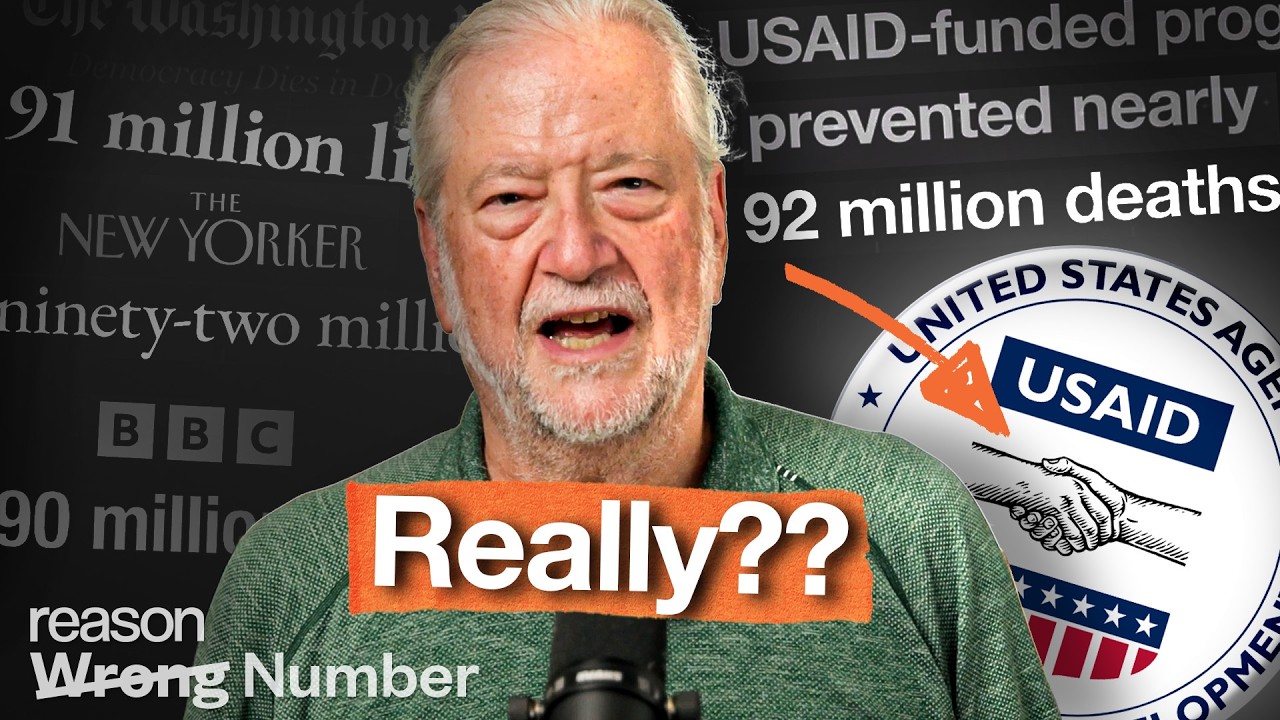
The video critiques a controversial 2025 study published in The Lancet, which claimed that USAID prevented approximately 91.8 million deaths between 2001 and 2021—a figure the author argues is mathematically impossible and scientifically unsound. Despite being cited by major news outlets like NPR, the BBC, and The Washington Post without scrutiny, the study's central assertion fails basic arithmetic because it attributes more than 100% of the global decline in mortality to USAID alone. During this period, worldwide death rates fell naturally due to broader factors such as a significant reduction in extreme poverty driven largely by China's economic growth, which accounted for 60% of the global improvement; yet the study ignores these variables and instead credits only a fraction of total foreign aid with saving lives that were already being saved through general progress.
The core flaw identified is the reliance on correlation rather than causation, where researchers simply observed that USAID funding increased while mortality decreased over two decades and falsely concluded one caused the other without isolating specific impacts. To force their desired conclusion, the authors engaged in methodological manipulation by excluding inconvenient data points from four years when global mortality actually rose (2009, 2015, 2020, and 2021) as well as a year when USAID funding dropped, effectively deleting five out of twenty-one years to create an artificial upward trend. Furthermore, they cherry-picked their sample by excluding 117 countries from the initial pool of roughly 250 without providing transparent criteria for those exclusions beyond vague academic jargon about maintaining internal validity, thereby ensuring their model only reflected a pre-selected narrative rather than objective reality.
Recent developments further undermine the study's apocalyptic predictions regarding future deaths if USAID were dismantled; specifically, data from Egypt—a major recipient of aid—showed fewer deaths in May 2025 after funding cuts than the Lancet model predicted would occur without it. While this single data point cannot definitively prove causation or account for lingering effects of previous grants, it casts serious doubt on the extrapolated claims that shutting down USAID would lead to millions more unnecessary deaths by 2030. The video concludes that while foreign aid undoubtedly does good work and correlation is not always equal to causation, advocates must demand scientifically rigorous analyses rather than accepting politically motivated statistics that ignore complex global realities or rely on manipulated datasets to produce headline-grabbing but false conclusions about saving tens of millions of lives.
Read the full video transcript
Before USAID was dismantled by Elon Musk
and the Trump administration, it
prevented 91,839,663
deaths over a 20-year period, according
to a 2025 paper published by the world's
most prestigious medical journal. It's
amazing that NPR, the BBC, the AP, NBC,
The New Yorker, and The Washington Post
repeated this finding. None of them
picked up on its absolute absurdity. The
New Yorker's legendary fact-checkers
didn't catch it, nor did The Lancet's
editors and the paper's peer reviewers.
With some basic arithmetic and a bit of
common sense, you can see why it's
nonsense. The lesson here is that when
people cite data that confirms what they
already believe for political reasons,
check their math.
>> [music]
>> Let's put the claim that nearly 92
million people were saved by USAID
between 2001 and 2021 into perspective.
During this period, the world's total
death rate fell substantially. [music]
If it hadn't, meaning if the death rate
prior to 2001 had remained steady for
the next 20 years,
>> [music]
>> about 79 million additional people would
have died, according to data from the
UN. So, how could USAID have saved 92
million lives? That's more than 100% of
the global mortality decline, meaning
that not only was USAID responsible for
saving all 79 million people who didn't
die thanks to the fall in the global
death rate, but it saved an additional
13 million. [music]
Foreign aid likely accounts for part of
the mortality decline, but USAID was
only a fraction of total foreign aid
worldwide. And there were plenty of
other factors that contributed to the
decline in mortality,
>> [music]
>> such as the 64% fall in extreme poverty
from 1990 to 2025. China accounted
[music] for 60% of the global decline in
mortality. That undoubtedly has a lot
more to do [music] with China's
staggering 8.7% annual GDP growth rate
than the 73 cents per person [music]
that China received from USAID during
the study period. The Lancet paper also
fails to grapple with the fact [music]
that the least developed countries and
the ones that got the most money per
capita from USAID saw their death rates
rise. There were 8 million extra deaths
in those nations. [music]
That doesn't mean USAID was to blame for
those extra deaths and it doesn't mean
that the agency didn't do plenty of
good. Correlation isn't causation.
However, it does make the claim that
USAID saved 92 million lives even more
suspect. The authors failed to establish
that USAID saved any lives at all
because they built a statistical model
based entirely on correlation. Funding
for USAID doubled during the study
period. Since global mortality fell over
the same time span, the two trends
correlate, which is all their evidence
adds up to. The [music] authors did do a
lot of complex statistical hocus pocus,
which they explained in a dense
technical online appendix,
>> [music]
>> making the analysis look sophisticated.
But all they were doing was correlating
two lines with no evidence that one
affected the other. Swap out the upward
trend in USAID funding and the same
model could have been used to credit
anything that rose over this period.
[music] The S&P 500, the US national
debt, the proliferation of selfies. Pick
your variable. The methodology
guarantees the answer. The
straightforward way [music] to study the
impact of USAID on mortality is to
compare the rate of decline in countries
with substantial [music]
USAID funding to that in countries with
little or no USAID funding. The authors
would need to do additional work beyond
that, but this approach at least avoids
the reality that unrelated things go up
or down all the time. The Lancet study
authors only managed to conclude that
USAID saved more than 100% of the
decline in global mortality by excluding
inconvenient data. In four of the 21
years, 2009, 2015, 2020,
and 2021,
global mortality rose, undermining the
study's conclusion. So the authors use
something called dummy variables to
scrub the effect of those years from
their estimate. They also erase the
effect of 2008, in which USAID funding
declined. The remaining numbers cover
only the 16 years during which global
mortality fell and USAID funding
increased. The justification for
effectively deleting five out of the 21
years was to adjust for major economic
and health shocks. That's academic
jargon that means we erased inconvenient
data and we're not going to tell you
why.
An actual justification requires
explaining why USAID funding seemed to
increase global mortality at times and
what specific criteria the authors used
to exclude years. The authors also
cherry-picked countries. They started
with about 250 nations and territories
that received USAID money and excluded
117 countries. 71 of the excluded
countries were left out to ensure the
internal validity of the study
maintaining a more consistent and
[music] relevant scope. That's a jargony
way of saying it's none of your
business. For the other 46 countries
excluded, no reason was given, just a
color-coded map. I first wrote about
this atrocious study for Reason last
July and since then others have
challenged its findings. [music] In
December 2025, The Lancet published two
formal critical letters and an author's
reply. Daniel Krugman, a PhD candidate
at Brown, and two other researchers said
the paper's key assumption collapses
under minimal scrutiny, calling it an
example of how numbers feed preconceived
narratives.
The authors defended their study by
claiming that based on their knowledge,
no published analyses have [music]
reported effect sizes or magnitudes
meaningfully different from these
estimates. In other words, our errors
don't matter because we haven't read
anything different. [music] The Lancet
paper extrapolates from the 92 million
lives saved claim that without USAID, we
could see more than 14 million
additional deaths by 2030. Since [music]
I first wrote about the topic, the UN
has gathered a tiny bit of actual data
that cast doubt on that prediction.
[music]
Egypt, a major USAID recipient, is one
of the few low- and middle-income
countries that report mortality data
reasonably quickly. The Lancet model
would predict roughly 58,000 [music]
deaths in Egypt in May of 2025 following
the demise of USAID. Yet, the data show
46,365
deaths that month. Fewer people died in
Egypt in May 2025 after the cuts than in
the same month
To be clear, this is just one data
point. It's also possible that some of
the awarded money was still being spent
in May of 2025. And just because deaths
fell in Egypt after USAID was zeroed
out, doesn't mean that its grants
weren't doing any good. Egypt also isn't
the poorest country in the world, and we
won't have full data on truly low-income
countries for a couple more years. But,
this single data point does at least
raise doubts about the apocalyptic
predictions of what shutting down USAID
will mean. UCLA's Dr. James Manc one of
the co-authors of the original Lancet
paper, was quoted by NPR last July
reflecting on whether USAID was a good
use of resources. "We found that the
average taxpayer has contributed about
18 cents per day to USAID," he said.
"We've been able to translate that into
saving up to 90 million deaths around
the world." He seems more interested in
producing political slogans than in
doing basic science. I'll add that his
math is wrong and that taxpayers
actually contributed more like a dollar
a day to USAID, but that's beside the
point. The implication is that anyone
who supported axing USAID valued pocket
change over tens [music] of millions of
lives. You might think that killing
USAID was reckless and cruel. You might
think that foreign aid saves lives, as I
do. Even so, you should advocate for a
scientifically sound analysis that takes
an honest look at the evidence,
>> [music]
>> even if it's a messy picture that
doesn't produce a headline-grabbing
finding. When you hear an outrageous
statistic, don't be afraid to apply some
basic math. A person spouting that
eye-popping number is probably betting
that you won't bother. To keep up with
Wrong Number, including bonus content
and more, click the link in the
description to enter your email address.
By joining the list, you'll also have a
shot at winning a copy of my new book,
Wrong Number: How to Extract Truth from
a Blizzard of Quantitative
Disinformation, which has a whole
chapter that goes into even more detail
on the Lancet's faulty USAID study.
Thanks for watching.
>> [music]