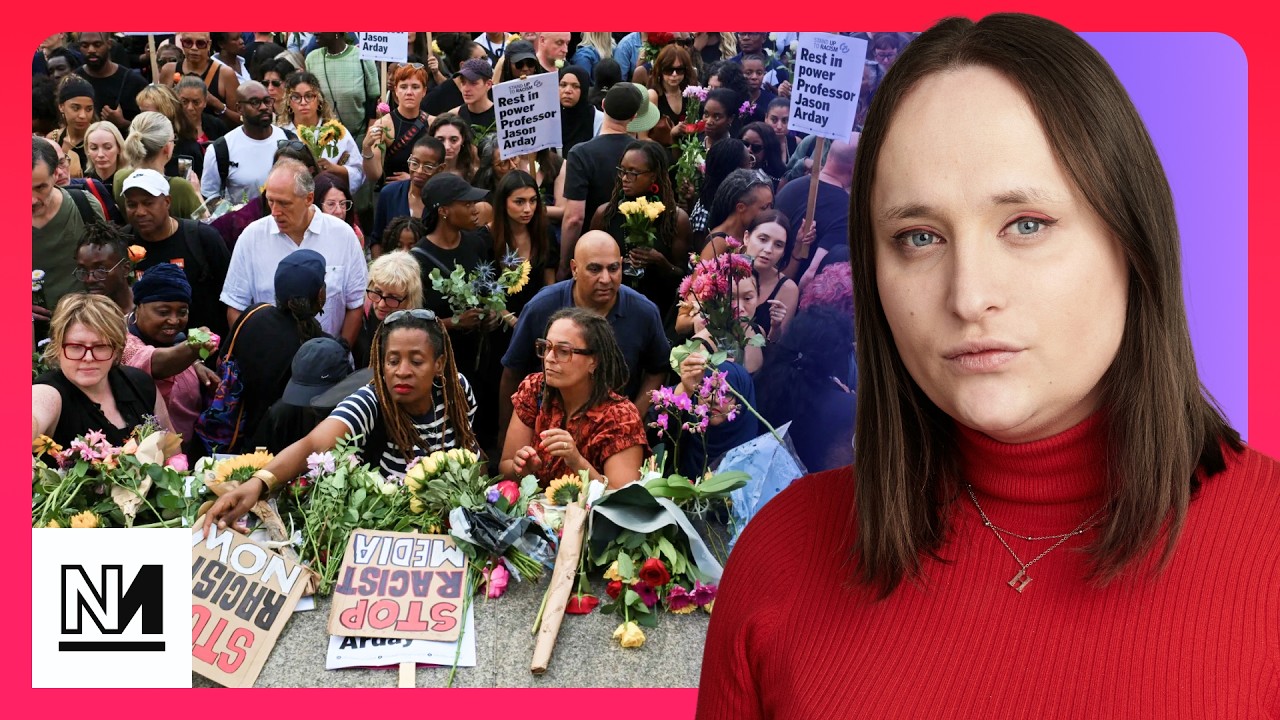
Video summary
Tens of thousands gathered in Trafalgar Square for a vigil honoring Professor Jason Arday, who passed away after enduring weeks of intense media scrutiny. The event served as a platform to condemn the relentless and often racist campaign against him, with Navara Media co-founder Aaron Bastani issuing a public apology. Bastani acknowledged that his own characterization of Arday as a "con man" was based on a video lecture taken out of context and admitted that the coverage went beyond racialization into outright racism. He criticized mainstream outlets like *The Times* and *The Telegraph*, as well as social media figures, for pursuing the story aggressively even after Arday resigned from Cambridge University in August and despite clear warnings about his deteriorating mental health. Speakers at the vigil, including prominent Labour MPs Diane Abbott and Dawn Butler, described the media assault as vicious, noting that it targeted not only Arday but all people of color within academia, a sentiment reinforced by a family statement that emphasized Arday's legacy of kindness and urged the public to remember him with peace and respect.
The focus then shifted to the political fallout surrounding Reform UK's proposal to cut £50 billion from welfare, specifically targeting disability benefits like Personal Independence Payment (PIP). Robert Jenrick, Reform UK's Treasury spokesperson, argued that the current system represents "suicidal empathy" and proposed replacing cash payments with non-cash services managed by local authorities, a move critics dismissed as a political maneuver designed to create a narrative of the "undeserving poor." The hosts and analysts highlighted a stark disconnect between this rhetoric and the realities faced by vulnerable citizens, pointing out that PIP is assessed based on functional ability rather than specific medical diagnoses. They warned that removing cash independence from disabled people would further stigmatize them as burdens, citing evidence that previous austerity measures have been linked to excess deaths among those with mental health conditions. The segment also featured perspectives from callers who illustrated the system's complexity, such as a cancer patient expressing horror at the prospect of losing benefits while working part-time, and refuted claims that many claimants abuse the system by explaining that 66% of PIP claims require appeals.
Ultimately, the analysis suggests that Reform UK's welfare plans risk alienating its core electorate, which is concentrated in post-industrial, working-class areas where reliance on welfare support is common, while simultaneously driving young voters toward left-wing populist parties like the Greens and Labour. Critics argue that the party misaligns its policies with its voter base by ignoring structural issues such as housing unaffordability and intergenerational inequality caused by policies favoring older generations, such as the triple lock on pensions. In contrast, figures like Labour's Andy Burnham are praised for making targeted concessions to shore up support before potential deeper cuts, underscoring the danger of a political strategy that frames youth unemployment and welfare claims as a crisis while ignoring the generous social benefits crucial for keeping youth unemployment low across Europe. The consensus is that such reforms will disproportionately harm the financially insecure, driving a wedge between age groups and failing to address the genuine needs of the most vulnerable members of society.
Read the full video transcript
Welcome to Navara Live. Coming up
tonight, tens of thousands have attended
a Trafalga Square vigil to pay tribute
to the late Professor Jason Aard and
reformers proposed a 50 billion pound
welfare cut which would include changes
to disability benefits for millions. I'm
Helena aka Justice MCG and tonight I'm
joined by Bana Cambe. Baseka, how you
doing?
>> Hi, nice to be here with you.
>> It's good to have you on the show. Good
to have on the show. Now, before we
begin our show tonight, we have a
personal message from Navar Media
co-founder Aaron Bastani. Before our
first story tonight, I want to talk
about my own role in the weeks preceding
the death of Jason Arde and to
apologize. I'm not going to speak about
whether the journalism covering the
story was merited or if there was a
public interest in the media following
the story. That was covered to some
extent on last night's show and you can
find discussions about it elsewhere.
There are a few things I want to say
though. First, it's beyond doubt that
much of the deluge of coverage aimed at
Jason Day wasn't just racialized, but
racist. That applies to the likes of
Nathan Kofnas who led with the story
when the Times higher education
supplement did not as well as many
voices on social media. But it also
applies to titles like the Times and the
Telegraph who categorized our day as a
DEI poster boy. As my colleague Ashar
wrote yesterday, "White people when they
do wrong are allowed to be individuals.
Our day was made a standin for critical
race theory, DEI, and black
participation in higher education."
Like many others, I suspect that if
Jason Arde Day were a white person, he'd
still be alive. Then there's the fact
that much the media, despite warnings
Arday was at his psychological limit,
carried on chasing the story regardless.
They continued to hound him even when
Cambridge announced a new investigation
and after Arday resigned from his post
on August 5th. Reasonably, then Arday
must have thought to himself that
nothing, literally nothing, would stop
the media from pursuing him. It was
ferocious, never ending, compulsive.
I've been in situations before where I
felt helpless. People have tried to
remove my own PhD from me. I've lost
jobs because of coordinated political
campaigns based on what I believe. But
none of it comes remotely close to what
Jason Arde endured. Between the 24th of
July and the 14th of August, when his
death was reported, the British press
published 249 articles about Jason Arde.
Importantly, most of those were
published after he'd resigned from his
post. The argument for the public
interest, given his mental state, which
was relayed to many in the media,
including myself, as well as the fact
he'd left his job, clearly should have
changed the media dynamic. It clearly
should have meant that the media stop
and reflect.
Except it didn't.
Of course, Jason Arde was an influential
person. He was successful. That
shouldn't be evaded, wiped out, ignored.
I've seen him referred to as a obscure
academic. That's not true. He was a
professorial chair at Cambridge, a guest
editor on the Today program. He was a
panelist on BBC Question Time. And with
influence comes scrutiny. That applies
to myself as well, by the way. But Aray
was also a vulnerable man. Firstly,
because of his neurode divergence.
Secondly, because of his state of mind
in those final weeks of his life. a
state of mind which was widely relayed
to the media.
Speaking personally, I lost sight of
that second part of the vulnerability.
After being told of his state of mind by
someone I trust and admire, I said I'd
stop talking about the story, which I
did. But that doesn't excuse what I'd
already done. Again, I won't touch on
our reporting here, nor seek to defend
it, not least because I personally was
guilty of something much, much worse.
On the 7th of August on X, I refer to
our day as a con man. Now, I'm not the
Times or Telegraph or the Sun newspaper,
but I do have 180,000 followers on X.
That's a decent number. And with that
kind of following comes responsibility,
not least because it's plausible Jason
Arday himself saw that post. So, what
was the basis of it? What was the
foundation of saying something so
decisive and vicious and nasty?
It was a lecture he gave at UCL where I
studied in 2021 posted to YouTube. Now,
I've watched that lecture back. Imagine
if someone watched a video of you or me
on a bad day or just a middling day,
frankly. Maybe you were unprepared
because of a family emergency or you
were unwell. Maybe you just had bad
news. You had too much on your plate.
and they proceeded to impugn your
character and your credentials on the
basis of a single video to almost
200,000 people. If that was me, I'd feel
distressed.
But if that happened while the media
were undertaking an unprecedented
excavation of everything I've ever said
or done, I'd be despondent.
Actually, I'll be honest. I don't know
how I'd begin to feel. It's literally
unimaginable.
So naturally, after reflecting on that
post in particular, I'm sorry. I
apologize. That wasn't journalism.
Journalism is when you seek the facts.
It's a quest for the truth. You reach
out to sources. You engage with diverse
viewpoints. This was anything but. It
was bile. It's everything I dislike
about the modern media. It's why we
started Navara.
Now, it's important to add that I said
that on my own exac account, not on a
show, not in a Navara media article, but
I co-founded this thing. So, I accept
that for many, quite rightly, the two
are interchangeable.
Except an apology isn't enough, is it? I
wish I could ask Jason for his
forgiveness for what I said, but I
can't. What I can do is ask for the
forgiveness of his friends, colleagues,
and family. Now, they might not want to
forgive me. That's their right. That's
the point. Forgiveness is theirs to
give, not mine to take. It's about them,
not me. But when you've done something
wrong, something gravely wrong, which I
did, you need to seek forgiveness. You
need to reflect, learn, and ensure it's
not repeated. Professionally, I ered,
but ethically, and that's what I really
care about, I really screwed up. I can't
make amends obviously, but I'm going to
reflect on my behavior in all of this
and how I can use my energies more
productively. More productively to cover
those issues our audience really care
about. Those stories that really matter
and on how I can make a difference for
the better, not the worse. Our top story
tonight.
Last night, tens of thousands of people
gathered in London's Trafalga Square to
remember the life of Professor Jason
Aard, who died last Friday. According to
organizers stand up to racism, some
30,000 people attended the event with
friends, supporters, and countless
others mourning while standing in
solidarity with the academic and leaving
flowers beneath Nelson's column. Many
were dressed in black with some carrying
signs reading rest in power. In the
weeks leading up to Arday's death,
including in the days following his
resignation from Cambridge University,
he was the subject of an unrelenting
media onslaught. As we reported
yesterday, 249 articles were published
about him in around 3 weeks alongside
relentless social media commentary,
breaking news alerts, and video reports.
During speeches from friends,
supporters, and MPs at the vigil, the
media was a frequent focus of fury. This
was Labour MP Diane Abbott. recent
weeks,
the attacks on Professor Jason Aday
reached a climax
and he felt he had no choice but to
resign.
And he must have felt that if he
resigned,
the attacks on him would stop.
>> But in fact, they got even worse. Yes.
>> From his resignation
to his suicide last week was just 3
weeks,
>> but the newspapers printed 249
articles about him.
>> This was a vicious campaign, but it
wasn't just a campaign against a
professor. It was a campaign against all
of us.
>> All of us.
>> And that is why it is so important and
to come together and fight for justice
for Professor Jason Ar.
>> Diane Abbert also described the genesis
of that delution of coverage.
We have to remember
that the campaign against him wasn't
just a matter of a few weeks.
>> He was first appointed as a professor in
Cambridge three years ago.
And for those three years, he has had a
vicious campaign, a bitter campaign by
anonymous people, by other professors
who just didn't believe that a black man
should be a Cambridge professor.
Amongst
those, one of the leading people
campaigning against him was a
prophetical Nathan Cathnos.
>> He calls himself
a race realist.
>> He was dismissed by Emanuel College
because of his racism.
and he insisted he campaigned over three
years against
>> evil.
>> He claimed
that Jason
was not smart enough to be a Cambridge
professor.
He claimed that race is linked to
intelligence
and that without diversity, equity, and
inclusion initiatives, there would be no
black academics at top universities. We
created the university. He is well, he
is well known for saying that. But stop
and think how many people at Cambridge
and other top universities think exactly
the same.
>> Photographer and activist Misan Haramman
was a friend of Jason and he spoke about
how he thought Jason should be
remembered.
Jason should still be here today.
>> And those who knew him, those who love
him, those who have joyful memories of
him should cherish it like a bird with
broken wings. It is important for
Jason's children's children to know how
he lived, who he was. His legacy must be
one of change and hope. Yes,
>> the impunity of the fourth estate must
stop otherwise more lives will be lost.
>> In the last 48 hours, these papers have
been deleting social media posts
>> and articles without shame,
>> showing their culpability in plain
sight. Yes.
>> What kind of nation are we if we allow
our fellow citizens to beounded in this
way?
>> We have to see the humanity in each
other just like Jason did.
>> Otherwise, who are we?
I will finish by saying that Jason's
name
must mean accountability over impunity
and community that this country should
be proud of.
>> Another friend and mentor of our days,
Lord Simon Woolly, principal of Hington
College, Cambridge, described what
happened once the young academic was
appointed to his professorial chair at
Cambridge.
>> And when he arrived at Cambridge, I was
the happiest man in the world.
But from that moment on,
>> the dogs of hell started on Jason
>> Ar
>> because they couldn't handle
>> a black man,
>> a loving man,
>> a decent human being
>> to be in a place like that.
And over those three years, I've watched
them again and again and again
until the pylon.
Remember this. Hold on to this.
This wonderful man never stole a bag of
crisps.
>> He He was exonerated from plagiarism.
Yes.
>> Yes.
>> But the dogs of hell,
>> literally hell,
>> the hounds of hell.
>> Yes. Demons. Demons
>> sought to pursue any inaccuracy
that they could say
Jason is a bad man. Jason doesn't
deserve.
Jason doesn't deserve to be in Cambridge
for them. Jason doesn't deserve to be
alive.
>> That there that there needs to be some
reckoning.
>> 100%.
>> There there needs to be some justice.
But today, today
>> today for all of you,
>> today with all of you, SAY AFTER ME. I
AM
>> I AM
>> PROFESSOR JASON ADAY.
>> PROFESSOR JASON AR.
>> I AM
>> PROFESSOR JASON ADAY.
>> PROFESSOR JASON AR.
>> AND I WILL NOT BE DEFEATED.
>> AND I WILL NOT BE
>> I WILL NOT BE CRUSHED.
>> I WILL NOT BE CRUSHED. WE WILL STAND
STRONG.
>> WE WILL STAND STRONG.
>> AND WE WILL WIN. THANK YOU.
>> AND WE WILL WIN.
>> Labour MP for Brent East, Dawn Butler,
also spoke at the vigil, calling for a
clear response to Jason Aard's death.
>> Now is the time to bring down the
systems
>> that don't protect us.
Now is the time to expose those systems
>> and seek transparency
>> and fairness.
>> We can recognize and we must always
recognize the racism, but this isn't a
battle against black versus white.
>> It's a battle against right versus
wrong. Yes.
>> It's a battle against good versus evil.
>> And it's a battle against the racist and
the anti-racist.
>> Are you an anti-racist?
>> It is something that is an active. You
have to actively be an anti-racist. You
can't just say it. You have to do it.
>> You have to be it.
Martin Luther King said, "If you're not
careful, the newspapers will have you
hating the people who are being
oppressed and loving those who are doing
the oppressing."
>> This battle hasn't changed. It's just
the method and system that it's
different.
>> But you know what else is different? We
are different.
>> We are different. There are enough of
us. There are more of us than there are
of them.
>> And we have the different generations
together, uniting together. We can hold
them to account,
>> but we have to do it together.
>> We can also support each other. We can
also lean on each other.
>> We can say hello to each other.
>> We can say WE LIKE WHAT YOU'RE WEARING.
>> We can love each other.
The thing that will conquer hate is
love.
>> The vigil closed with Bel River Riberro
Adi, the MP for Clappam and Brixton Hill
where Jason Aday was from, reading this
statement from his family.
>> This has been an incredibly painful time
for our family and we are still coming
to terms with the tra tragic loss of our
beloved Jason. What has become clear
over the past 72 hours is the profound
impact he had on people. We are grateful
to all
who have created light in this dark time
through kindness, generosity, and
solidarity.
Your presence here to remember him this
evening means a lot to us. And while we
cannot be there in person, please know
that we stand with you in spirit.
The public cruelty Jason was subjected
to was too much for any man to bear. The
outpouring of love, support, and grief
since his death means so much to us.
Although it is bittersweet,
now kindness is needed in life, not just
in death. We'll never know what might
have been different had he experienced
more of it while he was still here.
What we do know is how deeply he was
loved. And we wish to especially thank
those who knew Jason in life and tried
to get through to him, who supported him
in his darkest hour and who saw the
person in the middle of this awful
storm.
Above all, we wish for Jason to be
remembered for the wonderful person he
was and all that he achieved. A selfless
and gentle soul, he tirelessly uplifted
others through his words and actions.
His achievements were great and we do
not want misrepresentations about his
character to overshadow them.
>> By continuing to share memories and
stories of the positive difference he
made, we hope to remember the fullness
of his life.
As we move forward, we ask that people
honor Jason in the way he would have
wanted
with peace,
respect,
and grace.
>> We trust people to act in that spirit
and to be mindful of local permissions
which may be required for public events.
We hope people will understand that as a
small and grieving family, we are not
able to review or lend our endorsement
to events organized by others.
Finally, we'd like to share some words
from our beloved Professor Jason Arday.
Every human life has a purpose.
Imagine what might happen if we're all
united in the just cause of valuing
human beings equally. Then maybe, just
maybe, all kinds of great things might
be possible.
Let that be our Jason's legacy. And may
he rest in peace,
>> Van. Obviously, the vigil was had lots
of number of people in attendance. It
was a very deeply moving I think and um
very unique as well. What were your
impressions of it?
>> Yeah, I think I think it was a really
moving event. I mean, the turnout is
really significant, right? that that
tells us a lot about the the the emotion
that this particular event has struck
the the death of of Jason Aray 30,000
people kind of at last minute's notice
you know the vigil I think was only
organized Friday night Saturday morning
perhaps at the at the latest so that
really says something about the way in
which this has really impacted people
and you know just with my interactions
with people what I've seen on social
media you know the outpouring of grief
about this has been you know really
really significant I thought some of
those speeches as well um that you
showed uh were really really important.
Dian Abbert I think is right about the
manner of this being a vicious campaign.
You know, this really was a campaign out
to get a particular individual motivated
a lot by race and by the racism in
particular of one individual who seemed
to have quite personal awful grievances.
because I know we're going to talk a bit
about Nathan Kfass who was who was
mentioned a little bit in the in the
segment as well and she said something
else really important as well and Dian
Abbott is someone of course I think who
knows a lot about what it means to be
you know a person of color a black woman
in the spotlight you know to have your
uh your right to be there kind of
unfairly questioned to be unfairly
scrutinized by the press right so she's
got real skin in that game but she said
something else really important as well
which was that you know it's a threat to
all of us I think she's right about that
there is a a real threat to all of us
about a press that is able to go on the
rampage in this manner and is able to
target a particular individual. So kind
of, you know, in a way that's completely
out of scale and completely
disproportionately and is able to do so
like at least in part by being motivated
by a racist individual, a kind of racist
uh uh uh scholar at at Cambridge. And
that that's something that should touch
all of us and should worry all of us
because I do agree that this probably
won't be the last time that we see more
very hardight racist kind of
mobilization of these types of things
and using the press and using the media
as a means to do it. So I think that was
a really really significant kind of
intervention that that she made. 100%
100% agree like any of any any minority
background as well as any person who is
uh not from like like the white majority
in this country anyone tomorrow who's
even like a vaguely public figure could
be the next target and in that realm
right like the media has come under like
a lot of scrutiny uh during the speeches
but also in terms of the discussion
after after what happened uh I mean more
plenty more to come I'm sure what would
you like to see happen next
>> yeah I mean there's questions isn't
there about the media And and that's
where I think most people's grief and
and kind of anger and frustration is at
at the moment is in the media. And
you've got kind of two sides to this,
right? You've got the mainstream media
in particular. And thinking about the
scale and the the proportionality of the
way in which they reported this, the
manner in which, you know, we I'm sure
many of us have seen screenshots of of
advertisements, for example, about, you
know, advertising or or pushing a kind
of minor story about Jason Idea for for
clicks and, you know, for money. That's
really quite gling, isn't it? That the
kind of transactional nature of, you
know, financially of what it meant to
the press becomes very clear then,
doesn't it? Which is, you know,
extremely worrying. That's not really a
press which is acting in public
interest. That's a press acting in the
interest of profit and kind as well.
It's cyclical as well because as soon as
they publish more pieces about it to
generate all of the AdSense revenue,
whatever it is, it becomes even more of
a public story which draws in more
audience and then it's a self-fulfilling
prophecy that the story will become even
more overinflated even than it already
was at the time.
>> Yeah. And I think Will Self wrote a very
uh long piece about this which I think
is is worth looking at which kind of
really unpicks the media's role in this
and and he talked about the concept of
like you know the grid used in kind of
like mainstream media, right? and and
the ways in which they're they're very
specifically looking at, you know,
analytics of of what is playing well and
what isn't. I think it was mentioned by
one of the speakers there that that the
media attention really rockets up post
resignation which logically you would
think it would do the opposite, right?
If especially if you're thinking
anywhere near the realm of public
interest, it should decline and instead
you get a rocketing up and and that's
clearly because you know that they must
have seen a profit incentive in doing
that as well. So I think that the
mechanisms of capitalism within our
media system are very much intertwined
but
>> they smell weakness right is resigned
right as soon as there had been like a
victory for as far as the press line on
this was concerned and of course the
broader kind of the right-wing and the
more kind of racist elements of the
coverage were concerned right they'd
they'd won someone had gone like they'd
got what they wanted they had removed uh
the person who they feel shouldn't have
been there because of his race in lots
of cases is. And so what else do they
have left to do other than stick the
knife in and do a victory lap around
around this man's career? You know, it's
really sadistic in a way.
>> Yeah. Deeply deeply sadistic. The other
side of it as well, which I know the
show touched on quite a lot yesterday,
is is also the role of alternative
media, right? Or or leftwing media and
media that says it's it's going to be
different. You know, we want to do
something different, right, compared to
the mainstream. that's why we're here,
you know, and I think it's incumbent on
me to also reflect a little bit about
some of my involvement in the commentary
on this story, you know. Um, I think
there was a lot of grief and a lot of
upset about elements of things that I
had said and I want to, you know, in the
spirit of just being completely
transparent, offer my full apologies for
that. I think one of the things for me
to think about as somebody on the left
in media and in alternative media is is
that there are choices, editorial
choices to make about whether you try to
counter a story like this or a
manufactured story like this uh or or
whether you just choose not to cover it
at all. And it may be reasonable, I
think, in this case, to say it might
have been fair or better, particularly
given the wider context of of what was
playing out with this sheer amount of of
media attention that was already on uh
Mr. day to have just not talked about it
or not covered it. Um, and I think
sometimes as well, and this is just
personal to me, I know I can't speak for
Navara and I'm not speaking for Navara,
but for me, I think sometimes in in
rushing to not allow the right to
dominate the narrative because these
narratives are scary that that the right
propagate, right? You know, um, trying
to push out this idea that it's it's DEI
gone mad and now black and brown people
have got all these juicy spots in
academia at the expense of white people.
And I think sometimes in in an attempt
to try and counter that with a leftwing
alternative, you know, that that can
kind of take people do derail people off
that, you know, slipping down that that
line of thought, I think you end up
talking about the arguments, but you
know, I can forget that there's an
individual here and there's an
individual who also deserves empathy and
consideration and and a person at the
heart of this and and for that, you
know, I'm I'm really sorry and I really
do regret that as well. So there's
there's lots on here for alternative
media to reflect about how it moves
forward with this for there to be a bit
of a reckoning with us as well because
if we say that we're going to be
alternative media then we have to mean
it and we have to do it. Yeah. There has
to be an actual because again all of the
coverage was around everyone else's
discussion of him as a person the role
that he had less than institutional
critique in lots of cases which there
was there was institutional critique
from some people but there was the
predominant coverage that we saw from
obviously purely right media but then of
course like alleged left media as well
and of course independent media also
covered individually his story rather
than what was going in the background.
the reason why it was even being covered
in the first place. I remember when it
first kind of broke, I I didn't even
think very much of the story and then I
turn away and I come back and suddenly
it's dominating every single headline,
every single newspaper, every single
magazine is covering it. Everyone and
even then, even outside of the media, on
social media, in just the broader like
discussion in the public realm, it was
it was everywhere. You couldn't avoid
it. Every single person had their own
take. They used tweets and Facebook
posts and posts on Instagram and Tik Tok
were going viral everywhere. It was the
talk of this made its way to the United
States and made its way to other
countries. It became a a global story.
It kind of metastasized out of control.
Uh and you know, every single extra
voice that goes into that is feeding
into what again what we'd heard from how
Jason spoke to his friends and his
confidants about how he felt like he was
un he was it was relentless the way he
was being covered.
>> Yeah. And he clearly felt like he had no
other way out. and that kind of human
cost to a a story. It's it's an
incalculable cost that the loss of
somebody's life, you know, and and that
has to be some kind of a a watershed
moment um in in a lot of ways, I think,
including here in sort of alternative
and leftwing media as well.
>> 100%. I mean, like what this story
reminds me of actually as as a kind of
crawler, there's a I don't know if you
knew about the story of Dr. to Beth
Upton in Scotland who became part of a
media storm around like a high-profile
case in terms of the NHS with somebody
uh taking the NHS to a tribunal over the
fact that she was transgender and people
were sharing a space with her right and
basically Beth Upton the doctor in
question she was cleared of any
wrongdoing but NHS was found to have not
followed procedure but they it became
like part of the right-wing kind of
discussion of the day of the discussion
doo sure and again reams and reams of
articles social media posts it was all
part of thing and she moved to
Australia. She fled the country to move
to Australia because of the the level of
kind of the press scrutiny level which
had upturned her life again for nothing
other than existing transgender
basically and the media followed her to
Australia. They posted stories in this
country and a in Australia go look what
got this look what this doctor did look
don't you know who she is and she
basically couldn't even in another
country of the world and and again like
when the press can act like this in the
way that it did to Jason Hardy again
it's it's tragic and it is it shows that
the level to which that these things can
take a mental toll on people and it's I
mean because social media especially and
of course the public media too and media
we are part of public media more broadly
in an internet world it's just
impossible to ignore it's impossible to
extricate self
>> from where the discourse goes online.
And unless we check ourselves and
everyone of course again we we covered
this on our show and people cover this
individually and unless we all check
ourselves in the level to which that we
understand how these things can get out
of control so quickly. There's a broader
discussion how the public realm has to
take account of the fact that in an
online world it's it's it's so different
to what it used to be in terms of public
coverage.
>> Yeah, absolutely. Completely agree.
Now, we saw Dan Abbott mention Nathan
Kofness there, the white supremacist
philosopher who triggered the media
deluge that overwhelmed Jason Aday,
posting on Twitter, he couldn't resist
inserting himself into other people's
mourning, writing this shortly after our
day's vigil came to a close. There is an
anti-offness hate rally in Trafalga
Square with 15,000 attendees. If I were
in London, there's a real possibility
that I would be murdered. Thousands of
academics and journalists knew the truth
about Jason Aday for more than a year.
Now, you know why no one said anything.
Now, first of all, I'd like to contend
with the idea that somehow that there's
been a truth that's been established
here. Lots of these things are still up
in the air and plenty of things that
have been shown like the claims were
made who's been cleared off. For
example, the plagi claims by LGMU for
example. And second of all, I mean, I
don't think, you know, necessarily
people are paying for uh people being
murdered here. But I don't think you
understand, Nathan, just how much like
the hatred you pedled and why people are
reacting in such of a way. It's
interesting the bubble that he's in
where, you know, he's so convinced that
he's uncovered an ultimate truth that
people just too unwilling to hear rather
than someone who's a peddler of crank
pseudocience. Um, who is denigrating
entire demographics and then wondering
why there might be a harsh backlash to
his, you know, pretty hateful comments
and his despicable ideology. Banana,
what do you think of his comments?
>> It's the usual kind of victimhood
mentality, isn't it? Somebody who's
actually wielded an extraordinary level
of power as an individual. you know,
he's he's managed to not only get Jason
ID to resign, but consequences of course
far far worse. Then that is now playing
victim. You now that people are
gathering together, as is their right
completely to do in a country that's
supposed to have free speech and
people's freedom of speech protected,
the right to gather assembly,
that's that's wrong. Now, this this
victimhood mentality twinned with with
somebody who's actually got an
extraordinary amount of power is, you
know, the level of delusion that that
must must require is, you know, really
quite astonishing. I mean, when I first
heard about this this gentleman, you
know, and the idea that he called
himself a race realist, it's an
oxymoron, as you pointed out, right?
There's no there's no such thing as
being a race realist, like race is a
it's a socialized it's a sociological,
pardon me, category, categorization of
things. It's invented. It's made. You
can't be you can't claim it's real.
Realist about what? It's made up, you
know? It's completely completely
ridiculous. And of course, that's just a
pseudonym anyway for saying you're
you're racist. You know, that's who that
man is. He's racist. And he's very
clearly, I think, been driven by racism
in this story. You know, that the things
that he's talked about in terms of
saying, well, you know, black and brown
people, you know, they need DEI,
otherwise they would never be good
enough on merit. You know, it's totally
ludicrous and ignores, of course, the
fact that, you know, there are plenty of
middle class white, you know, male
professors, I'm sure, out there who, you
know, probably wouldn't have got to
where they've got to if they weren't
middle- class white and male. So, you
know, how do we account for for that?
So, I I just find him to be a kind of
highly distasteful individual. And it's
one thing for him to be a distasteful
individual on his own. That's one thing.
But it's another thing for him to have
been able to wield that level of power
and be taken kind of so seriously, I
think, suppose, within our kind of wider
structures. And that's that's something
of concern, right? It's one thing for
you as an individual to just be quite
horrible and have these kind of really
awful backwards racist views. It's
another thing for that to be then
twinned, of course, with with power. Um,
that's the really scary thing.
>> Yeah. And none of the I mean, a very
precious few outlets that commented on
this story mentioned the source of this.
M
>> they talked about the claims that Jason
that that they'd allegedly been able to
dig up, right? But at no point did they
pinpoint the fact that all of this kind
of media ferore came because you know
right-wing media channels were trolling
right-wing blogs for for scandalous
stories that they could then promote.
They there was a real kind of
dereliction of duty I think from lots of
corners of the media to give this guy
the cover of not you know making it
clear that the reason why this
discussion is happening is because of
what is essentially as far as I in my
opinion kind of racist crank
pseudocience masquerading as proper
inquiry.
>> Yeah. Uh and I did a Sky News segment on
this on on sort of Friday evening in the
wake of the news and and one of the
things they said to me was well this
investigation originally was coming from
the Times higher education uh
publication and they they didn't mention
the origins of of it either. So yeah,
there's been a real amnesia and and a
real blind spot to put it kind uh kindly
in terms of uh the reporting on this and
and where the kind of racist core
origins of this story have come from.
>> Absolutely. Absolutely. On Sunday,
Reform UK's Treasury spokesperson Robert
Generick penned an article to the
Telegraph proclaiming that the welfare
state was neglecting young people and
briefing a set of brutal cuts to the
welfare state. He started by admonishing
the rise of those claiming disability
welfare.
Some 6.9 million people are now entitled
to receive disability benefits, 2.5
million more than 20 years ago. More
than 20,000 join the personal
independence payment case load each
month. And twothirds of those who began
claiming in 2017 were still claiming it
5 years later. By 2031, health and
disability benefits will cost £110
billion a year, £3,600 for every family
in the country. This is not an epidemic
of broken backs and lost limbs. Since
2002, the share of working age people
claiming for mental health and
behavioral conditions has tripled. This
is not generosity. It is suicidal
empathy.
It's not the first time the right-wing
have invoked the concept of suicidal
empathy. a cannard that has breached
containment from the hard right in the
US to pervade through UK political
discourse. Its invocation suggests that
the country is so keen to show empathy
for those with mental health concerns
that is causing the entire country to
collapse. It implies that somehow the
vulnerable and those that care for them
are to blame for the social malaise of
modern Britain. But the claims that this
is down to the rise in PIP claims is
difficult to justify when 66% of PIP
appeals are successful and people stay
on the health element of universal
credit long term. Suggesting that these
are not people on the take but those
with genuine concerns that the welfare
state is there to help. Also, there's no
such thing as claiming for mental
health. PIP claims are based upon the
ability to perform certain tasks. It is
not awarded based on condition. Generic
then went on to lay out the kind of
savings that Reform UK would be
proposing.
On Monday, Reform will publish Making
Welfare Work, a 50-page plan for the
most comprehensive redesign of the
welfare systems machinery in a
generation. The scale is enormous. The
coalition's welfare savings under Ian
Duncan Smith, then regarded as the outer
limit of political possibility, total
20.5 billion. The Conservatives today
proposed 23 billion.
Our changes, which go far beyond
disability benefits, are more than
double that. 22 billion pounds of our
reforms will take the form of changes to
the disability program alone.
A reminder for those at home that Ian
Duncan Smith reforms to welfare that
Reform UK wants to eclipse in scale by a
factor of two were part of an austerity
program that studies suggest cause up to
33 330,000 excess deaths. The initial
reporting by the Telegraph on Sunday
reported that Reform UK were planning 50
billion of welfare cuts in total,
including scrapping PIP and LCWA
altogether and instead instructing
belleaguered local authorities to
provide non-cash services and support
through local disability accounts. Ref
removing or modifying the benefits of
almost 3 million people. And what's
interesting here is that the biggest
thing that I think is probably one of
the only good things you can say about
things like PIP and its predecessor
disability living allowances, what they
provided in terms of cash payments were
the way of providing the disabled who
were able to claim those things even if
maybe they weren't large enough in scale
or in terms of their generosity. It gave
them independence through cash payments
to be able to decide for themselves what
they should use their disability welfare
for and how would best help them on an
individual case because no disability is
the same. But by taking away cash
payments and then saying look here's the
burden that we can place upon local
authorities and then go through all of
the different bureaucracy that that
would entail essentially again further
this idea that the disabled people are a
burden. They can't look after
themselves. They can't be given
independence. They must be treated as a
burden upon local authorities and be
doled without support just as the state
would require them to have rather than
them choosing what support is best for
them. Again, which is going to tie the
disabsal
paperwork in bureaucracy and also remove
the sense of independence that they've
been allowed to gain over the last
however many years in which that we've
come to better understand the individual
needs of each disabled person. Now, on
Monday, Generick unveiled their welfare
reforms in a press conference. However,
there was one substantial change in
rhetoric from the briefings at the
weekend.
>> Unable to return to work will go through
a single rigorous disability needs
assessment, replacing today's many
overlapping assessments. Cash support
above standard universal credit rates
will be reserved for severe cases. And
those who need additional help beyond
living costs will receive it in kind
through disability support accounts. and
the most vulnerable will continue to be
supported through personal independence
payments reformed and enhanced as PIP
health security allowances. It appears
that at least rhetorically reform UK
have realized that eliminating an
entirely disability welfare scheme such
as PIP wholesale isn't popular,
preferring to change tone and imply that
PIP will continue in some altered form
for a mythical cohort of the most
vulnerable that they have yet to define.
Now, this was confirmed by Genrich
during the Q&A.
>> In terms of people who are currently
claiming uh for example PIP, well, what
we're saying today is that PIP will
continue, but it's going to be reformed.
We're going to create a new version of
it and we're going to ask those people
who have mild conditions, principally
mental health conditions, to be
reassessed. I think that's common
sensical because we see the vast
increase that we've had in recent times
of those conditions. For other people,
what we're proposing today will actually
be better, will provide more security
because instead of being reassessed on a
rolling three-year basis, these are
people with serious disabilities. We're
going to give them the peace of mind
that I think they deserve and we're
going to say that they're not going to
be reassessed for the next 3 years and
then they'll be reassessed in the normal
way thereafter. So for the people who
really need the benefits the most, this
is actually a significantly enhanced
position with greater security.
Now I don't buy this for one minute, but
what we're definitely seeing here is the
invocation of the deserving poor versus
the undeserving poor, the the people who
are trying versus the skyvers. When in
reality, if you're going to try and get
22 billion pounds of welfare cuts purely
on the disabled alone, the idea that
you'll leave everybody who deserves it
untouched and only attack the people who
are undeserving is total nonsense. It's
totally unworkable. No amount of mass
will be able to make that up. Because
again, the of course the problem here is
is that he doesn't understand what he's
saying here. The idea that I know there
are lower level mental health concerns
that are being taken up by PIP that
doesn't exist because people are judged
as I said previously based upon their
ability to perform certain tasks. You're
not judged based upon your individual
condition. It's how your condition
affects you and how it how you struggle
with such a condition and what extra you
need to be able to mitigate that
condition through cash payments which is
how PIP works. And this is the three
card trick that every single welfare
reformer tries to do when DA was
replaced with PIP and when PIP will be
replaced by whatever crazy mad system
reform want to replace it with. The way
in which they justify is always well the
previous system let so many people who
don't deserve it through the cracks and
allow them to claim fortunately but we
will protect everyone who does need it.
What happened when we replaced DA with
PIP when Ian Duncan Smith got his hands
on the welfare system? Huge numbers of
people who did need it ended up not
getting access to welfare. Remember
ATOSS miracles? Remember the obscene
stories that we saw about people being
declared fit for work or having been
declared as if they weren't actually
disabled when clearly that they were
when they had been in remission from
cancer and recovering for example. These
are many many cases that we saw. It is
always the case that people are
overegged in terms of the amount of
people who are are undeserving of these
welfare benefits especially when it
comes to fraud when it is close to 0.2%
2% according to the DWP's figures which
actually aren't claiming uh in the
veracity in which they should be. So I
don't buy any of these arguments from
Robert Jenri for a moment. But when it
comes to PIP and them saying actually
not getting rid of it, they're only
reforming it. Why the partial U-turn?
Well, this next clip might be why. Most
of your target seats are in areas where
people with a high proportion of people
on welfare. Frasen Nelson did some
analysis yesterday showing that your top
20 target seats. You don't just have 20
target seats.
>> Your top top 20 target seats.
>> Sorry to break the news to the times.
We've got a lot more target seats than
that.
>> I said top top 20 target seats are PIP
uh hot spots. People listening this
morning uh who might be feeling
frightened hearing that that kind of
vital lifeline could be cut. What's your
message to them? And do you think that
might be a difficult message for you to
sell at the next general election?
>> Well, let me be very clear uh if I
haven't been so already. We are going to
protect the most vulnerable in society.
Nothing that we talk about today is
about pensioners. In fact, part of the
motivation is to continue to provide the
support that pensioners need. It's by
doing tough things like this that we can
continue to sustainably pay for the
triple lock, for example, for
pensioners. We're ensuring that children
who are currently claiming or their
families are claiming on their behalf
disability benefit will be protected.
And we're saying that those people who
really need this are always going to be
protected under a reform government.
We're not abolishing PIP. People are
obviously familiar with that. But we are
reforming it and ensuring that it works
better. and in particular looking at the
minority of people who for whatever
reason have been able to claim it
particularly for mental health
conditions which I think most people in
the country now agree with us is not
sensible is not sustainable that is the
issue that we're really looking at
>> the reform is running into the same
problem that Labour did last year
everyone believes that they are part of
the deserving poor and that everyone
else is part of the undeserving poor
triangulating around popular polling
support for welfare reform reaches a
hard reality when a country actually has
to contend with what welfare cuts might
entail. There is no goldilock zone where
welfare can be dissected entirely down
to those who genuinely deserve it and
filtering out all the chances as then
the systems allow genuine claimments to
fall through the cracks. And it's not
just theoretical. Reform voters have
reacted to the weekend's briefings with
horror. This is what happened when a PIP
claimment interrogated Genrich on Talk
TV.
You know when you go out canvasing and
you meet people that you have to
convince. You're going to have to
convince our next caller. George is in
Dundee. George, you through Robert
Gener.
>> Hi. Yeah. Hi. How are you doing?
>> Hi. How are you?
>> Good. Um I was a reform supporter but
after thinking about what you said
yesterday the last 24 hours you've kind
of lost a couple of votes in our
household. Uh I'll tell you the reason
why. I take it you've never claimed
benefits. Right. We have been through,
my wife claims the equivalent of PIP in
Scotland and she's been through hell
three times trying to reclaim it. And
part of the problem was your
Conservative government last time who
tried to reform these uh benefits.
People fall through the net and every
politician I hear just says the people
who will need help will receive help.
Bull. Absolute and utter bull. cuz you
don't know enough about the system and
how it works. Tens of thousands are then
cut off and have to reclaim. It is an
absolute faro system. So, I'm sorry. I'm
no prepared to take that risk for my
wife. So, you will not be getting my
vote.
>> Robert, well, if I can give you some
reassurance, what we're proposing is to
to keep the current system of PIP. So,
uh, your wife shouldn't be, uh, losing
that, but we are going to reform it so
that we get those people who frankly
shouldn't be on it,
>> tennis elbow,
>> back off it and back into the workplace,
which does not, I mean, I I don't want
to pry into uh, your wife's condition
unless you want to share it with us. Uh,
but it does not sound as if uh, she's
one of those people who's taking
advantage.
>> Now, the caller is absolutely right.
Generic knows naff all about PIP or the
welfare system or how it works,
especially when PIP is an income
supplement, not income replacement. So
trying to imply that cutting access to
PIP would get people back into the
workplace would add as the opposite of
reality. A sizable number of PIP
claimments are in work. They are in fact
less likely to stay in work without
their income supplement that allows them
to make the reasonable adjustments to
their life that are necessary to keep
them there. Luckily, however, for Robert
Genrich, a belligerent Jeremy Kyle
stepped in to save his skin from some
actual scrutiny.
George, you would accept the people are
taking advantage, wouldn't you?
>> I would say not as many as they think
under the current rules. What they
should do is have set illnesses.
>> Hold on one second. Are you telling me
that there are two million people? See,
this is where I This is just my opinion,
mate. And I respect you ringing because
that's the whole point of a democracy.
The system was set up to help people
like your wife. It was not set up, mate,
to give people with tennis elbow the
ability to sit on their ass and do
nothing or have six months off because
they've gone online on a computer and
ticked a box and they've got anxiety.
And it strikes me whatever the political
party, I've done this with the tries,
I've done it with reform, I've done it
with the Liberal Democrats, whenever
anybody talks about truthful answer as a
man here, right changing the system, the
genuine, which is what I said 25 minutes
ago, the genuine claimants get really
fearful and they think, "Oh my god, it's
going to be taken away." But what you
don't say to yourself is there are
hundreds of thousands of people milking
this system that are making it more
difficult for your wife to get the money
that all the people know she should get.
Pal.
>> Well, that's where you're completely
wrong. And again, you have no experience
of this. You don't know if my wife's a
mangerer or not. You've no idea. I have
no said witches. Right. Secondly, the
people that are claiming for mental
health are doing so under the current
rules. What any political party should
do instead of this can you get out your
bed on a Tuesday? Can you lift your harm
arm above head height on a Wednesday?
You get it? It should be set illnesses.
If you're an ampute, you get it. If
you're blind, you get it. If you've got
motor neurone disease, you get it. It's
simple.
Robert.
>> Well, look, I I just say that this is
not by and large about physical
disabilities at all. It is about these
cases of relatively mild conditions. And
I'll give you a few stats. At the
moment, 214 people are signing on for
disability benefits every single day for
mild anxiety. I just don't think that's
right. And and I don't think it's right
for those individuals either because I'm
sure in most cases sitting at home, you
know, watching telly, doom scrolling on
your phone is much worse for somebody
who has mild anxiety than being out and
about getting a proper job.
>> And again, I just want to take this mild
anxiety claim to task one more time for
those at the back. No one is claiming
PIP for mild anxiety. To be able to
claim PIP, you have to demonstrate to
the GWP that you have significant
amounts of problems doing daily tasks,
whether it's mobility or daily living,
there are two different sections for
this, right? When it comes to the daily
living component, you have to prove to
the state you find it very difficult to
do so many different things to be normal
for everybody else. Right? If you are
able to cross that threshold and show
that your condition is debilitating
enough that you can't do those things,
then you qualify for PIP. If you can't
demonstrate that, then you don't. And I
will reiterate 66% of PIP claims are
granted on appeal having previously been
denied. This is the what the cases when
people have not just mild anxiety but
lots of cases anxiety disorders. There
is a difference by being anxious and
having an anxiety disorder. Those two
things are totally different. The fact
again that Robert Generick is trying to
pedal this nonsense, this lie, this this
fabrication that mild anxiety is somehow
part of the things you can claim PIP
for. when again you're not even assessed
on your condition. You're assessed on
how your condition affects you. And on
top of this, people who are claiming for
anxiety or having an anxiety disorder
can also be claiming for other
disabilities at the same time. These
things are all noted down if you suffer
from a myriad different conditions. I
would be willing to bet that lots of
people with physical disabilities also
have a lot of anxiety around those
things. Two, as long as you are above
the threshold, you score enough points
in terms of how it affects your daily
living, then you can claim. If you can
claim it and you are suffering what is
as far as I can see significant impacts
on your daily life, your condition is
not mild. I want to make that expertly
clear and also want to say I disagree
with the caller too. I think the way the
system works in far as how it judges who
are supposed to be eligible is good. I
just wish the assessment criteria was a
little less humiliating and clearly it
is very difficult given how many appeals
are had and how successful those appeals
are. Now Genrich wasn't the only one to
have to face their own electorate. This
is what reform counselor Laya Cunningham
faced when guest hosting LBC.
>> I do not agree with getting rid of PIP.
I have a I am a cancer patient. I work
part-time. Metastic breast cancer. PELB
B2 gene carrier. Unfair dismissal
protection goes. I'm out of a job. I'm
out of my home. I'm 57 years old. I'm a
pal got a palative hair care care
husband. 15 different disabilities. He
worked for HMRC. the HM government
kicked out 10 years ago. Get rid of his
PIP. No trips to hospital. He's got
liver failure. He's blind. He's
epileptic. I can't even get a council
property despite having the overall
point. How the heck is hell am I
supposed to vote for reform?
>> I'm so sorry.
>> What's reform going to do for me?
Nothing.
>> Elizabeth, I hear you. I hear you. And
we we genuinely care about the people in
vulnerable positions like you. It's why
we got into politics. And and it's not
about cutting benefits from people who
actually need it. It's about telling
those who could work that they should
work to protect exactly the benefits for
the vulnerable that need it. And I'm so
sorry that you're dealing with cancer.
Um it it's a very tough time and and
you're in Haringay. I I'll come and see
you, Elizabeth. I'd love to.
>> I'm sorry, Ila. You got into politics to
protect the vulnerable and the disabled.
I call Like not only did you
yet again claim that you needed to slash
peep pip to get people into work when
quite literally speaking to someone who
just told you they claim pip whilst
working. the fact people like this can't
even scrape the mental wherewith
altogether to Google how does pip work
before hosting a high-profile discussion
program but to claim about the disabled
to came to clare sorry to came to claim
to care about the disabled whilst both
the party you belong to and the rest of
the right-wing media in this country
having been engaged in a multiple
year-long campaign of manufactured
consent for the mistrust of the disabled
is quite frankly despicable. The UK has
an incredibly strict and humiliating
disability welfare system. His only
saving grace is that Pippa affords cash
payments to allow the disabled some
degree of autonomy and reform wants to
take that away too. Banska, what did you
make of those clips?
>> Yeah, it's always interesting, isn't it,
when you see reform kind of cornered on
these things when they talk about their
kind of natural comfort zone, i.e.
immigration, you know, they can kind of
really write the rules and set the
paradigms and set the narrative. But
once we take them away from that comfort
zone and away from their ability to just
kind of lapse into that, we see a
different side to them. we we see a side
where I think like they are really kind
of struggling a bit. Completely agree
with what you said um with regards to
the actual quite high threshold that
there is for access to PIP and the idea
that you can't just claim it off the
back of you know mild mild anxiety. But
I thought it was also really interesting
that you know Robert Genrich said you
know lots of people have got mild
anxiety and that just can't be right.
But he's got zero curiosity as to why
lots of people might actually have quite
a lot of mild anxiety regardless of
whether or not that allows them to to
access PIP or not which is that there is
a kind of whole infrastructure and way
of living now which has been dismantled
you know by his politics. This is his
politics of action and he is dealing
with the consequences of that which is
what we're seeing now. You know this
neat crisis is another kind of outgrowth
I think in in many ways uh of that as
well. I know we're going to talk about
young people in a minute too. So there's
this just this kind of zero curiosity
from Robert Genri. you know, they just
can't be right. Yeah. Need to look in
the mirror. I think actually you need to
have a look at some of your policies.
Reform is now in a bit of a real
constriction. You know, can they really
build a base of voters out of enough
people who essentially are not going to
be relying on various different types of
of welfare? Right. Me and you were
talking earlier about this idea of a
shrinking middle class, which I think is
is definitely happening. I spent several
week uh weeks ago a bit of time in
Johannesburg in South Africa for example
where there's this very stark class
distinction where that there's virtually
no middle class. You know there you're
either very poor or you're well off but
that there's kind of no no middle
ground, no middle class, which is kind
of a snapshot of of where really we
could get to. Right. There was a study
done a couple of years ago in 2024 from
the financial uh fairness trust that
said that you know middle classes
earning up to 60k a year was struggling
materially. So you've got this kind of
shrinking base of people in this country
and and if reform are trying to appeal
to those people well those people
increasingly they don't exist you know
so they need a bit of a material lens I
think really on on on their politics to
understand their voters actually a bit
better rather than being I think kind of
lazy and just trottting out the same old
well-worn conservative Tory party ideas
about you know welfare and expecting
that to work you know they are in effect
perhaps going to be a victim of their
own policy
Many of these people are in effect
rampant neoliberals, however much they
want to dress themselves up as being for
the working man. They may well find
themselves to be a victim of those same
those same policies and that same
ideology, you know, when it comes to the
the ballot box.
>> Well, that's the thing, right, is that
lots of people who are proposing this
like Robert Genrich is a Tory Ktoff
himself. It's a party full of Tory
Ktoffs, right? And you made a really
sient point there that they don't
understand who their own electorate is.
still working a lot of these extoories
on the premise that they are speaking to
the electorate that voted for them
during the George Osborne period right
the aspirational middle class obviously
the homeowners who clearly still part of
more of the older generation who tend to
vote for both the tries and reform but
in terms of the areas of the country
it's not the London commuter belt it's
not the more kind of affluent areas of
kind of rural Yorkshire that these
places that are voting for reform though
no it's post-industrial poorer more lots
of whiter areas lots of lots of more
workingclass areas of this country and
you there's a lot of correlation here.
High instance of people who claim PIP in
these constituencies was mentioned in
the question to Robert Generick at their
press conference. And what that ends up
meaning is that they've totally
misaligned where this policy is supposed
to go and they've immediately disabused
huge numbers of their voters in terms of
not real at least ex Labour voters in
lots of cases or you know or non- voters
who've been brought into the fold by
reform speaking for a very spec specific
electorate of people who are concerned
with immigration but less so concerned
on cost of living the economy and stuff
like that. That's what a lot of the
polling shows. Whereas conservative
voters rank the economy as higher than
like migration and probably they
probably conservatives have welfare
similar well probably higher than than
reform do in terms of their policy
perspectives. I was also note Andy
Burnham's response to this too on the
you know on the on a provisor that we
understand that some of these people can
be ex labor voters ex- labor
constituencies post-industrial like
northern towns and in the in the country
like Alex can you roll the clip of Andy
Burnham's response please? Some rules
you look at and just think, "How can
that be fair?" One of them is the 9:30
a.m. restriction on disabled people's
bus passes. Need to get to work,
college, or hospital appointment? Well,
you better hope it's after 9:30. It
makes no sense, and I'm changing it.
From April, disabled people will be able
to use their bus passes for free at any
time on any day. Scrapping the 9:30 a.m.
restriction is something I did as mayor
of Greater Manchester, as well as
bringing in a two pound cap on bus
fairs. Now I'm doing both nationally so
more people can make full use of
Britain's most popular form of public
transport and you can get where you need
to be for less. So whilst of course the
Labour party have talked all about
disability reform. We'll talk about that
in just a second. At the very least Andy
Bernham's you know he's clearly noticed
that there's going to be a lot of
negative backlash to reforms
announcement on PIPS and he has
immediately gone and said okay well look
well we're going to jump into the media
ecosystem going here's the thing I'm
doing for the disabled right. Do you
think is there there's a notes like the
the change in strategy from the burner
administration?
>> Yeah, I mean definitely right there's
there's a deafness to this and and I
know some people want to say it's it's
just comms. The comms are a lot better.
Yeah, for sure. But the the policy
strategy, not just the way in which the
policies have been communicated, but the
policies themselves and the policy
strategy is I think is remarkably
better. you know, K Sama, if you think
about it, in many ways, I think he paid
a big price for himself, you know,
career-wise, um, in terms of really not
taking his base seriously and really not
understanding who Labour voters were. He
completely took them for granted, you
know, and that was kind of a real, you
know, a kind of real fatal mistake, I
think, for the kind of Kama Morgan
Mweeny project, right? Um, so I think
Andy Barnum, um, Andy Bernham, pardon
me, is being very smart and very deaf, I
think, in this announcement. you know,
that that's not to say that I think
there won't still be really big
decisions to come on welfare. I'm going
to be, you know, watching that first
budget like a hawk because it's going to
be really interesting and really
important to see about how they get that
balance right. They have talked about
the idea of the welfare bill overall
coming down. So, I don't know if there's
going to be some difficult decisions to
be made along along the way, but but for
now, I think that he does seem to be
kind of lasering in with these small,
you know, cumulatively it's big or it
feels big, right? But in terms of the
individual policies, they're small,
right? And I think that's quite a smart
strategy to kind of keep feeding in
those gaps and and just doing these very
small concessions towards cost of living
which is on everybody's mind and doing
so in a way that serves and shores up
his voter base.
>> 100%. It's clear that there is an
attempt to make sure that K's favor now
to be able to generate some level of
public support, public benefit of the
doubt and public buy into him as prime
minister before then launching into the
bad stuff later which is again the
biggest mistake that Kana made is when
in when it's a government go everything
sucks. you're gonna get poor and there's
nothing that you can do until things get
better later on which immediately soured
all public relations towards him. And
now we see the difference here least
popular prime minister ever. Andy
Burnham plus 19 in the approval stakes
which is higher than we've seen for any
mainstream politician in decades as far
as I can see. And again I think you're
right. I'm pretty certain that we'll end
up seeing those swinging cuts happen
eventually once the the public kind of
bare that doubt has kind of been been
set. But until then, it's clear that,
you know, immediately as soon as you
hear reform announce policy that, you
know, affects people in Labour's former
heartland voter bases. And you go, look,
I'm going to support the people the
reform are clearly trying to tell not to
vote for them anymore, which again,
despite me dis disagreeing with the
broad scale of Labour's welfare policy,
it's certainly a good strategy. Now, one
other thing that I noticed from the
rhetoric of Robert Genrich is that in
both his Telegraph article and his
speech on Monday, his main target was
young people. In fact, he was explicit
in his speech in wanting to ensure
pensioners didn't deal with any welfare
cuts at all. Heaven for fend that
someone might dismantle the bureaucracy.
And again, like they didn't talk about
attendance allowance, only PIP. Now,
this follows on from Labour's plans to
tackle young needs, those not in
education, employment, or training. It
follows on from Generick's article that
echoed Labour's rhetoric about how the
state is failing the youth by allowing
them to claim welfare in the first
place. In the long run, the current
number isn't anything special in UK
terms, even though it is rising
currently. These figures are also higher
now than they were in the 2000s when
working age welfare was a higher
percentage of GDP than it currently is
after IDS's welfare reforms. It also
follows data showing that youth
unemployment is higher across Europe,
although statistics do vary. EU youth
unemployment is around 15% roughly
similar to the number in the UK and
there are countries such as Greece with
high youth unemployment and less
generous welfare too. So I don't really
buy that welfare cuts will encourage the
youth into work. In fact, this review of
European welfare systems showed that
quote generous social benefits for young
unemployed people are a crucial element
in every route to keep the neat rate
low, directly contradicting right-wing
received wisdom on long-term youth
unemployment. Another proposal, Jennifer
floated a Dutch style approach to
sickness support linking employers to
insurance schemes to cover those off
work sick. But appears the government is
already looking at the Netherlands for
welfare reform ideas. According to a
policy announcements announcement
published by the Sama government, the
governor is open to almost 180 Dutch
style youth hubs over the next two years
to tackle rising youth unemployment as a
nation needs number hits 1 million. That
report goes on to describe how while
visiting the Netherlands, the work and
pension secretary saw how Dutch and Punt
youth points are bringing youth services
under one roof, helping them record
Europe's lowest need. and also says that
the secretary of state vows to learn
from the Netherlands approach where
young people are given multiple chances
through work study pathways, employer
partnerships and apprenticeships to
build a system where inactivity is the
last resort. Now, there's nothing
intrinsically wrong with looking to
other countries for successful welfare
states. It's just a shame they all seem
to ignore the data showing that other
countries getting better outcomes by
being more generous, not being more
draconian. What I will say though is
that the constant refrain of the youth
being the main problem for the welfare
state when they only make up only 20% of
working age welfare recipients is
especially gling when the biggest
welfare expense and the fastest growing
welfare expense is the state pension of
which every member of the uni party
refuses to touch like the triple lock is
staying in place for the foreseeable.
Now on the subject of the uni party the
Tories have made their pitch to the
youth and it's not exactly barnstorming.
Remove young people's working protection
to save summer jobs. atory say, "Yeah,
take away workers rights from the
demographic that voted overwhelmingly
for the party who just passed the
Employment Rights Act." Now, this is
what the shadow chancellor, Andrew
Griffith, said about the plans.
Simplifying rules about when young
people can work and take breaks will
help save the summer job and give
employers the confidence they need to
hire a young person. Only the
Conservatives have the team and the plan
to get Britain working again and stand
up for summer jobs by slashing
unnecessary red tape and scrapping the
job destroying parts of the Employment
Rights Act. Don't worry kids, I know the
Tories tank the economy, gave us a
demand unstable employment, gives us on
demand unstable employment and oversaw
the biggest drop in living standards
since the Napoleonic Wars. They're
saving the summer jobs now, so why not
forget the 14 years of mismanagement?
Banska, what do you make about the skew
in terms of welfare coverage towards
specifically targeting young people? And
is there any party that actually has a
comprehensive plan that speaks to young
people rather than reviving the
boomeracy?
>> Boomer communism seems to be the flavor
certainly on the right. Right. I mean we
were talking earlier about this idea
that when sort of like reform started
making inroads. There was this concept
of like generation right you know maybe
an emergence after a long period of
generation left this emergence of maybe
like you know young men predominantly
who would be voting for reform who' be
courted by them perhaps because they
were more socially conservative and that
simply hasn't materialized and it never
existed in the first place. Yeah, like
it's a myth, right? You know, lots of
column inches about it, but it never
really kind of materialized in quite
that that same way, right? You know, and
and that's not because there aren't men
who are socially conservative or young
men who, you know, find perhaps some of
the uh anti-migration sentiment
appealing, but I just think there isn't
a material reason for them personally to
to vote for reform or to vote for the
right in general. You know, there was a
point at which in sort of 2024, if you
look back at the the 2024 reform
manifesto, I believe they called it a
contract rather than a manifesto. And
they had a few points in there. It
wasn't loads, but they had a few points
in there where they were trying to
appeal to younger people, you know, and
that they talked about, for example, a
policy of lowering interest rates on
tuition fees, for example. So,
recognizing that there was a bit of a
burden uh on younger people with regards
to to that. And soon enough, I think
once they started getting traction, once
they started building up more of a base
and and and attracting, I suppose, more
exory voters, they they kind of quietly
abandoned that stuff and and then the
framing became very different and it was
all about, you know, young people are
being too lazy. Get them back in the
office. You know, they're on benefits.
They've all got all these, you know,
mental health issues that aren't really
mental health issues and that needs to
change. And and so there was no there
was nothing really that they were they
were kind of giving a young people. And
and this was something that even Rbert
Low, you know, whose politics of course
I do not endorse, you know, he he noted
that there was a gap on on the right as
well where he said, I think he actually
said at one point, I see why young
people are voting want to vote for
Dalansky's Green Party because they they
talk in a way that is appealing and
actually appeals to young people's
material circumstances.
um you know on the on the left of things
I suppose with the Labour party Andy
Bernham is making young people a kind of
cornerstone it seems of his his policym
which is really interesting and feels
quite strange because I don't know if
I've ever lived through a period of time
where that was a thing um a part of me
almost doesn't know how to react to it
like oh this is this is strange um and
and there are some things about it which
are good you know he's talking about
having more jobs for young people um
create job more job creation for young
people that type of stuff potentially
subsidizing you know employers so they
can you know financially perhaps look at
hiring more more young people as well
and and that's all great. Um but at the
same time, I think there are also bigger
issues going on than just merely kind of
like a labor shortage or a labor crisis,
right? Um you know, young people's
well-being, I think, is is also a real
problem. And that starts much much
earlier, right, than before you're at
the age where you're starting to look
for a job. So, this idea of just simply
kind of creating more jobs, chucking
them off the welfare, and then that will
kind of fix the the so-called neat
crisis, I think, is maybe a bit limited,
right? You know, there was a really good
article in I think it was the London
Review of Books um where they were
looking at at some of this and and they
said that there was a considerable
number of of young people who were
regarded as neats um who were not
actively looking for work and not out of
a a laziness or or because you know they
they just want to be on benefits. They
weren't claiming welfare either, but
because they they just weren't active.
They weren't trying to participate
almost in a sense in in society really.
And so I think a lot of that is about on
the kind of pathway that young people go
through and the transitions young people
go through thinking about what's
happening much much earlier. You know
what's happening in schools uh the
pressure that young people are under the
material conditions families you know
being a child growing up in a family
where you know having a home and having
a roof over your head is becoming
increasingly difficult. These things all
massively impact your ability once
you're you know 18 19 looking for a job
or looking to get into education
training. these things all massively
impact and I think warp your ability to
be able to then participate more in
these things. So it would be nice to
have a government who who that is also
willing to look at that whole pathway
that young people are going through and
all the transitions and really try and
do do that kind of holistic work of of
the many different multifaceted factors
I think that are impacting young
people's uh ability to participate in
life and that are really creating this
this neat crisis. And another problem as
well is that in terms of the retail
policy like it it's it genuinely feels
like these people are telling young
people not to vote for them, right? They
have you cultural reactionary values
that young people just do not gel with.
All the statistics show that this is the
case, right? The whilst I think there
are probably some young people who are
at least somewhat kind of compelled by
like anti-migration rhetoric like the
youth in this country is very diverse
that ever stretches into outright racism
or even implied racism. It puts
everybody off, right? And on top of
this, when you look at, for example,
their approach to planning, their
approach to housing, their approach to
public spending, for example, like they
don't support nationalization, which all
of the young people in this country do,
or the vast majority of the young people
in this country do, no matter which
party they vote for, even Tory voters
want nationalization, but they block
housing development. They continue to
want to support landlordism and allowing
them to continue to have more power and
opposing any kind of legislation to take
away the power of landlords again
because those landlords are the most
likely going to be either the
corporations who have always been
supported by the rightwing or indeed the
older generations who got onto the
mortgage boom of the 2000s or indeed who
got cheap rates in the 2010s when we're
in the liquidity trap. So there are so
many vested interests both in terms of
pensioner spending in and things like
the triple lock for example in terms of
the way in which the housing having
turned into a commodity having been
provided in terms of home ownership in
such huge amounts to the older
generations and been moved away from
young people because you can't have
both, right? You can't have a
continually appreciating housing sector
and an affordable and available housing
sector for new buyers to get into. Those
things are pulling each other apart. And
they know they can't put old people into
negative equity. They know they can't
reduce the people's house prices who
want to sell it to go and pay for the
adult social care that they refuse to
provide because they want to, you know,
slash access. Reform councils are
cutting access to social care around the
country. And so all they can do is
continue to enable the boom of the
gerontocracy and push house prices up,
shovel even more spending into pensions
when again the pensions are the biggest
part of the welfare bill that is rising.
Again, I'm not I don't want to scrap the
state pension or cut the state pension
or means test the state pension. I just
want to not have the state pension grow
bigger than the economy and grow bigger
than wages because that isn't that's not
an effective use of expenditure. And I
think fundamentally it's unfair to the
working people who ensure the productive
capacity is there to afford the triple
lock, right? I don't want to cut it or
anything. I want to keep it at least at
the current rate it is and then increase
it with wages is my is my proposition
here. But all of the vested interests in
outside of like capitalist vested
interests electorally side with the
older generations and has done for a
very long time. And the current
generation of young people who's growing
up in this country, they're pretty angry
that they I mean I saw Kem Baitnock on
George Osborne's podcast of all things
talking about like how reform is
grievance politics and the Greens are
grievance politics on the populist left
and right. Like young people have a
legitimate grievance.
legitimate grievance in this country and
the social contract has been wrestled
and it's not because of disabled people.
It's because of politicians taking the
easy way out and pandering to a giant
cohort of older people. Again, not that
saying that having a welfare state for
older people is bad. Clearly, I support
it. I don't want to cut it. But housing
especially and the narrative about how
they talk about young people, they they
literally talk about young people like
the dirt in their shoe
>> is is is going to leads to a further
consolidation of the vote amongst young
people amongst the left and that cohort
is growing.
>> Yeah. And when you think about if you
take about yourself back to the 1980s
and you think about the kind of leeway
that Margaret Thatcher has at sort of
the the start of neoliberalism, she's
got a bit of leeway to to do things
where she kind of can reward people who
are not very well off. you can do the
whole selling off of council houses for
example, you know, terrible policy of
course, but it's it's a policy that
provides real dividends in the moment,
certainly in the 1980s, electorally for
her, you know, and and you know, quite a
lot of younger people voted for Margaret
Thatcher, right? You know, they voted
for her because she was able to kind of
provide something for them materially.
If we fast forward to now, you know,
2026, you know, there isn't really any
of that stuff to be able to give to
younger people anymore, as you said,
right? And so the the the class politics
and the class war that I think
neoliberalism has always been waging on
people is now very starkly along age
lines as well. And I think your age is
now becoming, you know, almost an
identity group that means it kind of is
synonymous with with your class.
>> I mean it's an interesting thing, right?
In so far as when you break down how
people vote ideologically, the class
divide is broken down. Whereas
previously working-class people voted
left and the more upper class people
voted right and it was a kind of a
pushpull over the middle class center to
be able to win general elections that
has flipped now and now the biggest
ideological derivative is age and young
people vote left and older people vote
right that's that's completely changed
if you map ABC1 in terms of like the
kind of choppy NRS social grid I don't
really believe in it but it's a
reasonable kind of appropriation there
uh against C2DE and then you market it
like age versus left or right, they
overlap. There's no difference between
the two as once you control once you
control for age and then you plot it. So
it shows that the biggest divider
between whether or not you're leftwing
or rightwing is age. But
controversially, there is still a
definition between populist and
establishment which is class linked.
Whereas if you actually take these two
left and right blocks worth of voters
and you map them by whether they're
financially secure or whether they are
financially insecure, the financially
insecure people go for the populist
options which is reform and the Greens
and the financially secure ones go for
labor to live them
>> regardless of age. regardless of age.
Yeah. Although I mean although within
those cohorts so the older ones are
mostly voting rightwing and out of that
rightwing cohort there's a reform voter
precarious block and a Tory voter who
are establishment block and then amongst
young people there's a broader kind of
green populist financially insecure
block and a labor establishment
financially secure block.
>> Fascinating. You hold so much
information and data in your head. I'm
always very impressed by that. When
you're a YouTuber got plenty of time to
look through to look through all the
different articles. It's a blessing.
It's a blessing really. Uh anyway, thank
you very much for joining me tonight.
important show tonight.
>> Thank you so much for having me. I
really appreciate it.
>> My absolute pleasure. Absolute pleasure.
And thank you as always everyone for
tuning in at home as well. Come back
tomorrow for another live stream from 6
p.m. For now, you've been watching
Novara Media. Good night.