Temperature in space - how and why we make consistently accurate measurements in the most inhospitab
Watch on YouTubeVideo summary
Ben, a spacecraft electronics engineer from RAL Space, introduces his presentation on achieving consistently accurate temperature measurements in space despite extreme environmental challenges. He outlines three main themes: an overview of infrared telescopes and their instruments, the history and function of surface temperature measurement missions like SOSSTR, and the critical importance of calibration over time. While acknowledging that space telescopes are highly international collaborations with significant contributions from Europe, Canada, and beyond, he focuses specifically on radiometers used for climate science rather than standard imaging cameras. These specialized sensors measure broad bands of radiation to detect minute changes in Earth's surface temperature, which is essential for understanding the drivers behind global warming and creating accurate climate models.
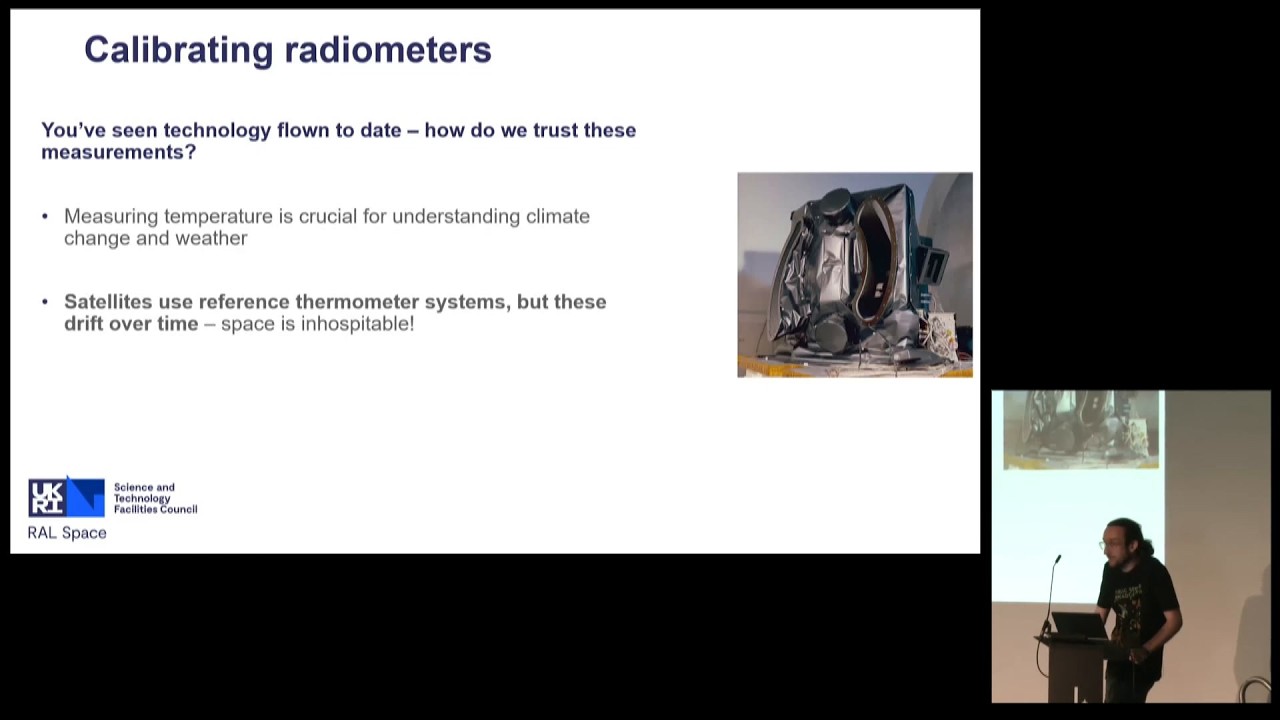
The necessity for such precision stems from the need to detect very small signals, such as a rise of just 0.02 degrees Celsius per year over vast distances like 700 kilometers up in orbit. Instruments inevitably drift due to radiation exposure, temperature fluctuations, and component aging during long missions that can last decades. To counteract this, engineers utilize black body calibration sources—essentially metal buckets coated with a special material called Vantablack—that emit predictable infrared radiation based on their known temperature. By comparing sensor readings against these stable references, scientists ensure data remains trustworthy even as the electronics themselves change properties over time.
To maintain accuracy without relying on ground-based equipment that cannot survive in space, engineers have developed innovative solutions involving phase-change materials like gallium. As this material melts at a specific temperature, it provides a fixed reference point that does not drift with environmental interference, allowing for continuous recalibration throughout the mission's lifespan. This technology has evolved from early prototypes to modern designs used on upcoming missions scheduled for 2035, significantly improving measurement precision while reducing weight and complexity compared to older cylindrical PCB systems. The speaker concludes by sharing a high-definition recording of an Antares rocket launch he attended in 2019, offering listeners the immersive experience of hearing the engine ignition and liftoff sounds directly from his personal archive.
Read the full video transcript
[applause]
Hello, EMF. Uh, my name is Ben. I'm a
spacecraft electronics engineer down in
Harwell. Uh, before we get really going,
is this going to There we go. So, this
is my project from the EMF this weekend.
Um, this picture is part of my
installation, the EMF sky survey. Uh,
and this was taken purely on Thursday
night. So, if you want to hear anything
about this, then come and see me at test
village and we can show you the
telescope that took it. Uh, but I'm
going to talk mostly about actual
telescopes today. Um, so my talk is kind
of in three general themes. I'm going to
go through some infrared telescopes and
talk a bit about what uh what general
types of instruments you might find on a
space telescope. Uh then we'll go and
get a bit narrower and we'll talk about
the SOSDR mission and the uh the full
climate program that goes around looking
at surface temperature measurements. Uh
that's been going on since about the
1980s and that's primarily what I'm
working on at the moment. Uh and then
finally we'll look a bit about
calibration. Um so space telescopes have
very accurate calibration but their
calibration doesn't last. So we'll talk
a bit about why uh recalibration is so
important in space and the hardware that
lets us do that. Um, so I have to start
with a disclaimer. Uh, this is a going
to try to be a non-technical talk. Uh,
however, it's an extremely technical
subject. So, I'm going to try and get it
down the middle and if there's any
really detailed technical information in
the slides, you kind of don't need to
understand it to get the point. Um, so
hopefully I I keep it in uh an easier to
understand framing. Um, there also going
to be lots of pictures of flight
hardware. If you've never seen space
telescope flight hardware, that's quite
cool. Uh so
next slide. If you make it to the end,
uh I have a highdefinition recording of
this launch. This is the NG11 Antares
rocket flying from uh Wallops Air Force
Base. Uh this was in 2019 and I was
lucky enough to go there with the NASA
social program. Uh and I got a very high
definition recording of that launch. So
at the end I will play that through
hopefully some very nice speakers. uh
and it will get close to what it feels
like to have been there in person. Uh so
who am I? Uh I mostly work on uh sensor
frontend electronics. So that's the big
box of electronics that primarily drives
the uh actual silicon sensor on space
telescope cameras. Uh mostly I work on
climate missions but also uh helio
helioysics missions. Um so most recently
uh NASA's Punch mission flying for small
spacecraft to monitor the solar
coronosphere. Uh and then also a company
called Spy flying a new type of
instrument looking at more accurate
weather observations on Earth. Um so you
can see some flight hardware here. That
box at the top that's the instrument box
for the punch mission on the NASA uh
punch mission. Uh so that's got four uh
PCB cards in and it's probably about
this sort of size. Uh and then at the
bottom here, this is the prototype for
the HIMS cubet mission. Uh which has got
a microwave sounder on it. And our
little box of electronics is that little
gold box there. Uh and I work for
Ralspace. Uh Ralpace are a public funded
body. We're basically a government arms
length body. Uh we are the UK's national
space laboratory. If you're at all
familiar with NASA guard, you might kind
of uh draw some parallels to what our
role is in the UK science sector and how
we uh design instrumentation or test
facilities for uh industry and other
space agencies.
Uh so I'm going to start generally. So
hopefully you all know what this
telescope is. Uh if you don't, I don't
know why you're in this talk. Uh this
[laughter] is the James Web Space
Telescope. It's got four instruments on
it. Uh this one is generally pitched as
being uh an American mission. It's in
fact not. It's probably the most
international space telescope ever
launched. Uh MIRI in particular, the
mid-infrared instrument was led by a UK
consortium with contributions from
Europe and at least one of the other
instruments has a pretty significant
European contribution too and another
one has quite a big Canadian influence
too. So although the Americans built uh
most of the spacecraft bus itself with
all the mirrors and optics um the actual
instrumentation inside is very very
international. Uh so there's a few types
of instruments on board. Most of these
types are kind of in each of the four
instruments. Um but they have various
different functions and modes and
different types of spectrum they look
at. Um first one's quite obvious. You
hope all know what cameras do. It's a
two-dimensional array of pixels. it
takes values from those pixels and those
become an image. Uh spectrographs are a
little bit different. They break the
light down into the spectrum and take
more of a one-dimensional measurement.
Uh so you can see the components of that
light frequency instead of the amounts
in different places. Uh and then finally
the other common one on the web space
telescope is a coronagraph. Uh that is
basically a the front stage of the
camera optics that block starlight. So
you can see uh planets or other faint
objects nearby uh without the starlight
blowing out the image.
So uh this is some flight pictures of
Mirie. Uh this was when it was being
tested at Ralph Base down in Harwell. Uh
so you can see at the top there, this is
it going into the thermal vacuum chamber
for for testing. This is that one there
is the actual flight unit. Uh I think
this one here is also the actual flight
unit undergoing alignment testing and
field of view testing. Uh and then the
graphic over here kind of gives you an
idea of what the field of view of that
is and the types of instrumentation
inside MUI.
Uh and if you uh saw the Laura from
space talk yesterday, I think it was
then you would probably have seen quite
a lot of pictures of our test facilities
which part of this comes from. So this
is kind of an example of what comes from
MI. Uh this is a Wolf riot star. It's
surrounded by quite a lot of radiation
and dust. Uh it's four light years
across. It's 8,000 light years away. And
to give you an example of how difficult
this image is to take, this instrument
is currently cooled down to 6.7 Kelvin.
Uh so that's minus 266°
C. Uh and if you don't do that, then the
latent heat in the detector makes this
image basically impossible to capture.
Uh so you have to get down right to the
limit of literal physics to be able to
take these kinds of infrared pictures.
uh to give you an idea about the
accuracy and how accurate these
instruments are. Uh this green blob is
the most distant uh object ever taken in
image uh it's a galaxy called MOM Z17
uh it was discovered last year and the
red shift if there's any astrophysicists
in the room uh is quite extreme a 14.4
red shift figure basically means you
look at the wavelength of the light when
it was transmitted uh and you multiply
that by 15.4 for uh and that becomes the
wavelength when we see it. So that's
quite extreme. Uh the table here shows a
bit about how far that light has
traveled to a given zed figure. Uh a z
of 10 means it's moved 13 billion years
pretty much. Uh and a z of 14 means it's
moved 13.5 billion years and that object
is now 33.8 billion lighty years away.
So these instruments have to be
incredibly sensitive to be able to make
these kinds of measurements to any level
of accuracy. And I think that Z figure
is accurate to within a couple of
hundreds. So it's it's within maybe 100
million light years or so of of
distance. Um more specifically and the
instruments I'm going to be talking
about for the rest of today are
radiometers. So radiometers are kind of
like cameras uh except instead of
looking at two dimensional arrays of
pixels uh it's a bit more
one-dimensional and instead of looking
at specific wavelengths we kind of look
at a big band of wavelengths. Uh and
then we want to very accurately measure
the amount of radiation that's being
emitted from those uh from the object
that we're looking at. Uh so these are
generally designed to be incredibly
precise. Uh and the reason we need them
to be precise is because uh we need to
do very accurate climate science and
climate modeling with these
measurements. Uh so this one at the top
here I think is one of the models for a
mission called SOSTR. Uh and there's
some more flight images of that one
there. This is all going into the
thermal vacuum tech chambers over at RA
space.
Uh so why do we need to take these
really accurate measurements of these
really specific bands? Well, we need to
know how this works. This is the global
mean sea surface temperature and we have
to have a very clear model of what these
drivers are that are driving uh these
rising temperatures. And the only way we
can work out exactly what these drivers
are doing is by incredibly accurate
measurements of this sea surface
temperature. And this graph will kind of
show how all of these little factors
contribute to the overall rising
temperature. Uh and the other reason why
they have to be so accurate is they need
to detect a 0.02 degrees Celsius rays
per year. Uh uh this is also from space.
This is 700 km away. Uh and it's this is
obviously a very small signal to try to
detect. Uh and the other problem is
instruments tend to drift while they're
in space that their calibrations change.
Uh so this is a very difficult level of
accuracy to get down to. So this all
started in the 1980s. This was the along
track scanning radiometer. Uh this was
built in the UK with a consortium of
British and Australian organizations. Uh
and basically this was the first
detector ever designed to measure uh sea
surface temperature specifically for
climate change. Uh there were three
versions of this uh detector. Uh one was
flown in 1991 and the most latest one
was flown in 2012. Uh you can see
there's two kind of banana-shaped
apertures which is where the main uh
detection happens on the right there.
That's for calibration on the ground.
And I also want to draw your attention
to the two cylinders at the top and
bottom. This is the black body
calibration sources. And we're going to
talk about those in a little bit. Uh so
very briefly about how this works. Uh
the two banana-shaped apertures form two
sets of scanning uh channels. So you've
got one that goes straight down and
another one at an angle out in front. uh
and that's used to do at amp
corrections. So ensuring we get a very
accurate ground measurement.
Uh so here's the the free that launched.
Uh you can see there's some different uh
it's evolved over the over the three
programs. Um they added a lot of
capabilities to measure things like
aerosols, land temperature, atmospheric
temperature, cloud temperature uh over
the three programs. Um so this was this
was quite evolving quite quickly. This
was over 20 years. Uh this is the
current gen. This is SLSTR on ISA's
Sentinel 3 mission. Uh you can kind of
ignore all the technical detail, but
this is the same kind of double banana
aperture. And if in the middle you can
kind of see the bucket covered in foil.
That's the black body calibration
system. So Sentinel 3 has flown twice so
far. Uh there's another one flying uh
next month, I think two months. Uh and
another one next year most likely. Uh
and right now uh as part of my day job,
we are now working on the nextG. uh we
have only just started designing flight
hardware for the next gen that will be
flying in 2035.
So this is the kind of data we expect to
get out of this. This is from AATSR
which was the third one in that initial
program. So this is the kind of uh sea
surface temperature map that we're going
to intend to get out of this mission. Uh
and we use that data to produce data
sets like this which give you trends for
surface and air temperature. And these
are the kind of models that we have to
have incredibly high accuracy to get uh
accurate models of climate change.
So
that's how we get to those measurements.
How do we know that we can trust them?
And that's the biggest issue in climate
science really is is consistently trust
trusted measurements and models. Um we
use reference thermometers. Everything
you put into space will drift. So the
resistance values will drift. the
properties of the circuits will drift.
This is all caused by radiation, uh
temperature swings, reliability of
components. Um you you cannot have a
calibrated mission that's been set up on
the ground and expect it to work to the
same accuracy uh for a 10-year mission
duration. So, uh we have lots of
uncertainties being introduced. Uh we
have differences between the same
instruments on different spacecraft. uh
and we don't get any trust between these
measurements unless we correct it. So
this is the type of hardware we use to
correct it. This is called a black body
cavity. Uh for reference of scale, it's
about this big. It's probably about a
football size. It's basically a big
metal bucket. Uh inside that metal
bucket uh is a layer of vantablack or
very similar coating. Uh and the purpose
of that is to produce a thermally ideal
object. Uh so this inside this cavity
this will emit basically only infrared
radiation. So from that we can use the
temperature of the top of the cavity uh
to give us a very accurate calibration
for our infrared optics.
So we use all of these electronics
around the side. There's probably about
10 or 12 uh thermometers on top of that
cavity and we produce incredibly
accurate models of the temperature of
that base uh with which to compare the
measurements from the instrument so that
we know that our measurement is very
accurately aligned to what the actual
temperature of that bucket is. Uh so
that's that one. Uh the next gen ones
are on the order of 10 millichelvin uh
temperature accuracy. So 0.01 of a
degree.
Uh, and yes, if anyone asks that top
one, that is a cylindrical PCB. It was
an absolute nightmare to build and we
are not building them anymore.
I have yet to see one by the way, but
it's very cool. Uh, so uh the problem we
have is uh as mentioned before, all
electronics in space will drift. Their
properties will change. Uh, on the
ground we use incredibly accurate
resistor bridges to kind of
pre-calibrate these and get them set up.
Um, these bridges don't exist in space.
it's not possible for them to exist in
space. Uh they would also drift with the
rest of the instrument. So how do we
calibrate the calibration electronics?
Uh we can't have calibration electronics
all the way down. It doesn't work. It
would all drift. So we have to do some
quite tricky things to consistently
produce measurements that we can trust
through a 10 or even 15 year mission
duration. Um the way we do it uh in the
nextG is quite clever and it involves
phase change. So uh if you imagine phase
changing uh when you got a solid that
melts uh the temperature of that
material will rise uh and that rises
until it starts to melt at which point
uh it will stop rising until it's fully
melted. Um so we use this property and
I've got a nice graph uh here. We use
this property to have a fixed reference
point for temperature that doesn't
change uh when
the space environment uh interferes with
your electronics. So that's temperature
of the of the gallium inside our phase
change cell. As that melts that
temperature will stop rising and we use
that as a very specific known reference
point. So if you imagine we've got drift
uh inter interfering with all our
climate measurements. Uh so red is the
line of what would happen if we didn't
correct this drift at a amount of 0.5
Celsius per year. Uh from earlier we saw
that uh we need to be measuring 02 to
have anything like an accurate
measurement. So with these annual
corrections through these phase change
uh we can get that down under 02 which
is how we are now able to measure uh
long-term very accurate climate data.
So this is uh some of the nextG stuff.
This on the left here was a uh a model
called engineers which was basically a
massive rigid flex network instead of
that horrendous cylindrical PCB. Uh this
one measures temperature much more
accurately than the previous one did.
It's much lighter. It's infinitely more
easy to build. Uh you can kind of see
some pictures of it here. That one on
the left. This this red based one is the
SLSTR uh black body and it's got a
massive box of electronics next to it.
Uh this one is the engineers one and all
the electronics are inside this cavity
area on the left here. And you can kind
of see at the top uh that little bolt
looking thing is a little phase change
cell. It's about this big. There's about
half a gram of gallium in there. And
that's what we use as a reference point
uh to consistently recalibrate the
calibration system. Uh this is
semiflying at the moment. It's flown on
the HIMS mission which I mentioned
earlier. That's a cubat testing out this
technology before they fly on a
constellation. Uh and right now we are
using this technology on the new
generation of Sentinel 3 missions uh
which will be flying on uh the next
Easter program in 2034 2035.
So that is I think it but I do have a
rocket launch for those of you who made
it to the end.
So, as promised, this was from 2019.
And I believe this is my hurricane.
5 4 3 2 1
We have engine ignition.
We have liftoff
into the ice into the full
I don't know if you could feel the
rumble, but I can up here. That's quite
like what it is in real life.
And uh they're going to perfect I think
there's a set on Sunday evening who's
going to play this in no sector. So if
you want to hear it in really big bassy
speakers then you might actually feel
the the bone shaking in the nose sector
speakers. So uh yeah that is me.
[applause]