Teddy and Alice Historical Talk #3 - Roosevelt's Accomplices
Watch on YouTubeVideo summary
In this concluding lecture of the series on *Teddy and Alice*, Dr. William Hanser shifts focus from the central figures to their historical associates, adversaries, and allies who shaped Theodore Roosevelt's political landscape. The discussion begins with Henry Cabot Lodge, a quintessential Boston Brahmin and TR's closest friend and mentor since 1892. A distinguished historian and politician, Lodge was instrumental in launching Roosevelt's early federal career through his influence as an Assistant Secretary of the Navy. While they shared a zealous commitment to reform and strong beliefs regarding American sovereignty—culminating in Lodge's successful opposition to the League of Nations—their relationship exemplified the deep political bond between two men who viewed each other with profound loyalty, despite Lodge's sometimes haughty demeanor.
The presentation continues by examining Elihu Root, another key "crony" described as an analytical and disciplined lawyer from upstate New York. Root served in both McKinley's and Roosevelt's cabinets, first organizing the War Department to create a modern National Guard and later serving as Secretary of State where he advocated for democratic yet paternalistic administration of overseas territories. Though often perceived as cold or detached by some contemporaries who felt he viewed the American public with skepticism, Root was revered by TR as the ablest man he had ever met and credited him most for his own rise to prominence. Their partnership highlighted a pragmatic approach to governance that prioritized fundamental truths over novelty, allowing them to work together effectively despite Root's unemotional nature.
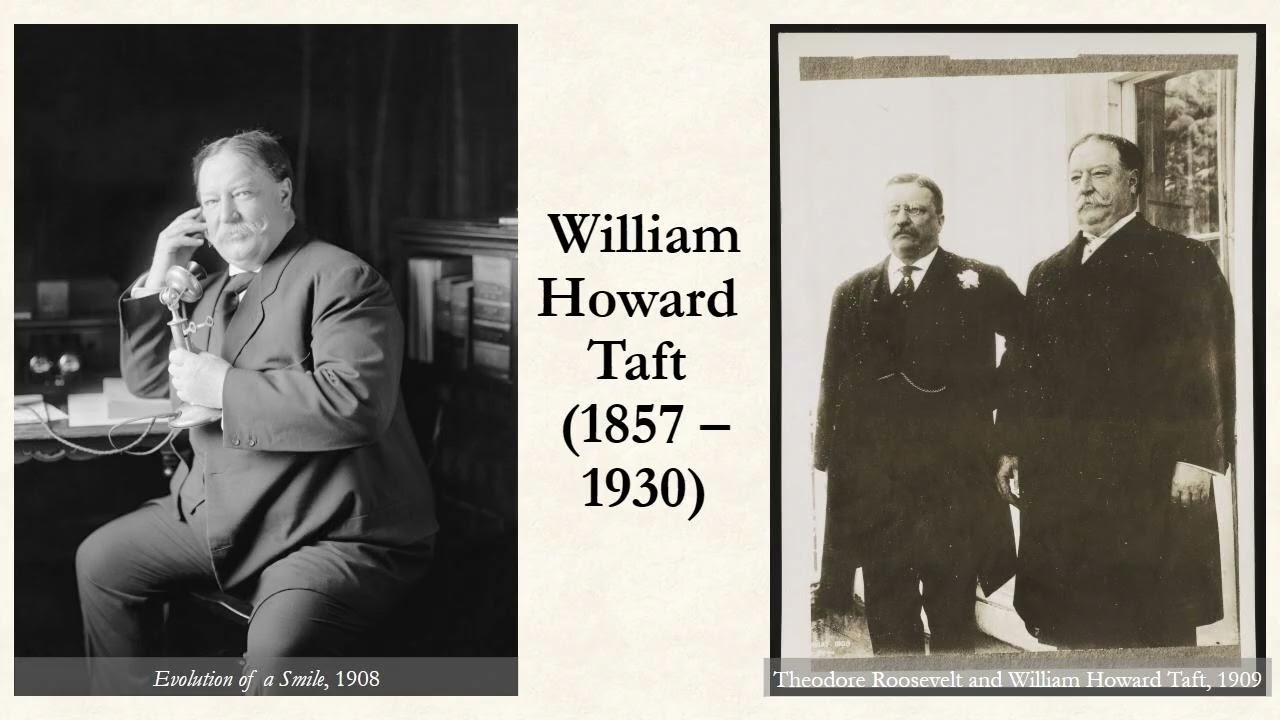
The third major figure discussed is William Howard Taft, Roosevelt's successor who represented a complex mix of friendship and eventual estrangement due to differing administrative philosophies. Unlike TR's energetic style, Taft was deliberative, institutional, and deeply anxious for approval from his youth until he achieved his lifelong ambition as Chief Justice of the Supreme Court. While they shared many moral views, their paths diverged significantly regarding executive power; Taft preferred existing laws over new regulations, leading to a rift that only healed years later in Chicago. The lecture also covers prominent businessmen like J.P. Morgan and Edward Harriman, who wielded immense economic influence through railroad consolidation and financial stabilization before the Federal Reserve existed, alongside labor leader Samuel Gompers, whose early confrontation with TR regarding tenement cigar manufacturing marked a pivotal moment of alliance between reformer and unionist.
Finally, the talk highlights Ida Tarbell, an investigative journalist known for her groundbreaking work exposing Standard Oil's monopolistic practices, which ultimately led to its breakup despite ironically increasing Rockefeller's wealth through stock value appreciation. Her meticulous, fact-based approach earned TR the term "muckraker," though he sometimes felt she focused too narrowly on corruption without addressing underlying causes. The segment concludes with Belle Hagner, who effectively created the modern role of First Lady by organizing White House social events and managing correspondence under Edith Roosevelt's guidance. Together, these diverse figures illustrate the intricate web of relationships that defined Theodore Roosevelt's presidency, balancing personal affection with political necessity while navigating the challenges of a rapidly changing American society at the turn of the century.
Read the full video transcript
Well, thank you everybody for being here
for historical chap number three, the
third and last in the uh series that
I've done. Um, for those of you online
watching this who don't know me, my name
is Dr. William Hanser. I am a historian
here at the Theodore Roosevelt Center at
Dickinson State University. Um, and
we've been talking about the, you know,
life and times of the characters in the
1987 Broadway musical Teddy and Alice.
In the first of these three talks, we
talked about Teddy and Alice themselves,
their mannerisms, their relationship,
what their lives were like. In the
second, we talked about the rest of the
Roosevelt Roosevelt family, his wife
Edith, his other five children, uh, and
Alice's husband, Nick Longworth. Today,
we're talking about who I'm calling
accompllices, associates, and
adversaries. basically the rest of the
characters in the show who have a name
uh who are real historic figures uh that
we can draw upon and talk about uh what
they were like and what their
relationships with TR in particular were
like. Uh and with that I'm going to get
started with Dr. Henry Kavat Lodge. Uh
now in the show uh he is one of a group
of three cronies as they're called who
are sort of doing TR's bidding or
working against his bidding in some
cases behind this fact. Um, now in real
life, Henry Kev Lodge was uh TR's
closest friend and political ally. Um,
he's from Boston or Boston area. Uh,
he's descended from two very wealthy
families in Boston. He is very sort of
prototypical upper class Boston Brahman
type of person. Um, he becomes uh the
Republican senator from Massachusetts,
one of their two senators in 1892.
remains a senator until uh his death in
1924.
Uh he uh first gets a law degree and
then he becomes one of the earliest PhDs
in history in America in 1876.
Uh and one of the first three doctorates
at Harvard ever period. Um and then he
will join their faculty there of
teaching history. Um he's also a very
popular historian, not just an academic.
He's publishing popular biographies of
figures like George Washington, uh, uh,
Alexander Hamilton, Daniel Webster, sort
of these early important figures. Um,
and so he also actually later on will
publish a book with TR as well about
some of these important figures. Um,
he's a member of a lot of very important
societies like Whoops, I'll jump
forward. No, okay.
There we go. um you know the American
antiquarian society so on and so forth
he's really involved in these things um
as a politician as a statesman he's a
very strong believer in the Monroe
doctrine and enforcing you know American
empire having a powerful navy overseas
territories very aggressive approach um
he's a partyline a Republican voter um
he is he is very very strong in his
beliefs
um and later on he will come most famous
actually for very bitterly opposing the
Treaty of Versailles terms at the end of
World War I and the American entry into
the League of Nations and ultimately he
will be successful in preventing the
United States from joining the League of
Nations because he believes it violates
American sovereignty. Um now he's a
friend and mentor uh uh to to TR even
though he's only just a little older
than him. Um, and as far as his
personality goes, another fellow
historian, Henry Adams, will describe
Waj as an excellent talker, a voracious
reader, a ready wit, an accomplished
orator with a clear mind and a powerful
memory. Um, and he puts a lot of
literary references, especially
Shakespeare, into his speeches and his
writings. Um, one historian who writes
about him later, uh, looks up accounts
of him and things and describes him when
he speaks says, uh, his thumbs adjusted
in his armpits and a copy of Shakespeare
in his pocket. He spoke in rasping tones
words that were brilliant but often
bitter. Uh, so he is a very sort of
almost arrogant sort of Boston Brahman.
Um, he himself will describe his voice
as like the edge of a saw being fighted.
So, he has a very raspy uh voice that he
speaks in, but apparently it's not quite
as grading as he's describing because
he's, you know, popular as a speaker.
He's an accomplished ortor, but he
certainly had a rat to his voice. He
could be very sharp, uh, very haughty,
very combative in his speech, but again,
he's he's going to become Roosevelt's
closest friend and political ally.
Roosevelt will call him the most loyal
friend that ever breed. Uh they will
first meet in 1884 at the Republican
National Convention and they will stay
political allies throughout their lives.
Um it will actually be Elaj's influence
that will get Roosevelt some of his
earliest federal positions as a civil
service commissioner as assistant
secretary of the Navy. Um and they will
bond over their shared politics
especially really zealous in their want
for reform desire for reform. Um, again,
Roosevelt will say, um, that Lodge is
not only the staunchest friend I've ever
known, but the very staunchest friend
I've ever read of. And the more I see a
public life, the more I realize and
appreciate what he is and what he has
done. Um, and so they are really, really
close.
Let's move on then to the second of the
three cronies, as they're told, in the
show, and that will be Eli Mut. Um,
Elijah Brute is a man from upstate New
York. He's the son of a math professor
there, uh, in Clinton, New York. He's
encouraged to become, uh, minister. His
family is Presbyterian. He's encouraged
to go into the ministry. Um, he will
take up law instead. Um, within two
years of graduating New York University
in 1967, he's a partner in his own firm,
uh, working in corporate affairs,
basically banks and railroads and so on.
uh and he becomes a very very powerful
uh corporate lawyer, a very very uh
wealthy uh corporate lawyer. He uh in
1883 will become the US attorney for the
Southern District of New York, which is
one of the most important attorneys in
the United States, both then and now. In
private practice, he's going to take on
some of the biggest and most wealthy
corporate clients, people like JP Morgan
and Edward Henry Haram, who we will
actually talk about later in this
lecture. um and sort of will represent
other moneyed interests as well. Um he
will later become the secretary of war
um under President McKinley and then he
will become the secretary of state after
that. Um so he is serving in McKinley
and Roosevelt's cabinets as a as a
prominent statesman. Um he will briefly
return to private practice between those
two moments but not for very long. Um
this is a man who is considered very
analytical and very disciplined but also
very creative in his problem solving. Uh
he is approach to to solve a lot of of
legal problems. Uh and uh he's
considered very comprehensively skilled.
Um when he's in the war department he's
going to reorganize the administration,
found the war college. He's going to
open branch schools at West Point. He
basically creates the modern National
Guard uh with federal funding and
uniform drills and all these kinds of
things. Um he really approaches this
very strongly. Uh as Secretary of State
uh he's pushing uh for um uh in the
overseas territories, a very sort of
democratic administration but very
paternalistic of the overseas
territories. Um he's considered
pragmatic, logical, unemotional, precise
in his calculations, not really a
politician um but certainly a lawyer. U
he is humane uh in his treatment of
people. He's humorous with people, but
he is sort of also viewed as cold in
general overall. He can be friendly with
you, but he was seen as a sort of a
detached person. Um and in particular,
he was sort of disillusioned with the
American public sometimes. The New York
Times will remember him later and say he
did not suffer fools gladly and he was
often inclined to think he the American
people were fools. Um but he's clear and
straightforward. Uh Roosevelt will say
of him uh he is the ablest man I've ever
met, the man on whom I most rely to whom
I owed most the greatest secretary of
state we have ever had as great a
cabinet officer as we have ever had save
Alexander Hamilton alone. U Root is also
of course very impressed by TR. will say
that he did not originate great new
truths but he drove old fundamental
truths into the minds of the hearts of
his people so that they stuck and
dominated old truths he insist upon
insisted upon enlarged upon repeated
over and over never straining for
novelty or for originality but always
driving home the deep fundamental truths
of public life. So they are they uh they
get on very proudly.
And the third of the cronies we will
come to is William Howard Tap. Uh now I
did a fair bit of research to play
William Howard Tap only to uh discover
yesterday that I would be asked to play
Theodore Roosevelt instead.
Thank you. Thank you. Uh I am uh uh
certainly uh going to do my best to to
take on that uh that opportunity that
has been offered me. Um Taft, however,
is also a very interesting figure that
we should devote some time to. Um he's
the son of a prominent lawyer and
statesman who was Secretary of War and
attorney general. He's from Cincinnati,
Ohio, from a very large family. As as a
kid, he's very athletic despite already
struggling with obesity. He's an
excellent student. Uh and really he has
a desire to be loved and respected from
the time he's a little boy. He really is
anxious for everyone's approval very
much so. Um and really from the time
he's you know a teenager or at least a
young man he's got a lifelong ambition
to be chief justice of the Supreme
Court. That is what he wants most. Um he
will graduate from Yale, become a
prominent Republican attorney attorney,
excuse me, through appointed posts, um
appointed, you know, political posts in
part to his father's connections and
also just having some good timing. He
will say, uh that uh he always had his
plate the right side up when offices
were falling.
So he just sort of was in the right
place at the right time. His wife Nelly
also uh pushed pretty hard for him to to
go higher and higher in his career. Um,
President McKinley will appoint him
governor general of the Philippines. Um,
he's pretty sympathetic to the
Filipinos. He tries to improve life for
them through economic initiatives,
building roads and schools. Um, he does
sort of have still a paternalistic view
that they're not able to govern
themselves, but he tries to improve life
in the Philippines. He's actually twice
offered Supreme Court appointments while
he's governor general by President
Roosevelt and he turns them both down
because he feels he still has work to do
that and it's important that he stay
there and do his work even though being
on the Supreme Court is what he always
wanted. Um uh when that tenure ends
though he will become actually secretary
of war under President Roosevelt. Um in
general as a politician or at least as
an administrator as a lawyer he's
opposed to executive overreach. and TR
clash on this. Uh he prefers to use
existing administrative law and
regulations. Um but he shares many of
TR's views and morals and wants to
achieve some same some similar things.
Um he's seen as a very charming,
engaging man. He's very jovial,
warm-hearted. Uh he's somebody that that
people really love to be around. Um the
Roosevelt will say to Archie in 1908, I
almost envy a man possessing a
personality like Tabs. People are always
be possessed by him. one loves him at
first sight. He has nothing to overcome
when he meets people. I realized that I
have always got to overcome a little
something before I get to the heart of
people. Um so, you know, Chap was
somebody who is very approachable. Um in
his actions, he's deliberative but not
always decisive. He really loves to
ponder every angle of a question, but
that doesn't always get you to what to
do about it. Um he's very institutional,
very conscientious. There are ways to do
things and you should do them that way.
Um he's very irritable and depressed as
the president. He does not want to be
the president when he later uh becomes
TR's successor. Um and in fact that will
break their friendship because Tap will
not do the things that TR expected him
to do and everyone expected Tap to do.
In fact there was a joke that Tap stood
for take advice from Theodore. Um but he
did not quite do things that way and so
that will break their friendship until
1918. They will reconcile though when
they have a chance meeting in Chicago.
Um uh he will eventually become chief
justice in 1921 like he always wanted
and he will say I don't remember that I
ever was president. Uh so he kind of
walks it out. Um he was a man who talked
plainly in a very clear unacented
deliberate speech. Um and he was you
know very straightforward in most of
what he did. He actually refused to be
embarrassed by any of the jokes about
his weight or his you know the things
that that caused. he helpful would fall
asleep in meetings or at concerts and he
took those jokes and comments about that
in stride. Um so that's that's an
interesting thing about him. He probably
had sleep apnea actually that caused
that. Um and also he loved golf and will
contribute a lot to popularization of
golf in the United States. By the time
he's finished with his presidency the
number of golf players on in the United
States will have doubled.
And so now then after we've done the
cronies, we're going to move on to a
couple of the prominent businessmen. And
I better check the time because you like
to talk about those guys for a long
time. All right. So we'll talk now about
JP Morgan. Uh JP Morgan is a person who
a lot of people have heard his name,
maybe know he was an important banker,
businessman, but probably don't know
very much about him. At least I knew
relatively little um compared to what I
learned researching for this. uh he is a
son of a financier himself. Uh he's from
a very wealthy influential family in
Hartford, Connecticut. He will be educ
educated in the United States and
Germany and then will work his way up
through the finance world. uh he will
reorganize a sort of existing finance
company to become his own in 1895 and he
will ultimately become or or his firm
will become one of the most powerful
banking houses in the entire world
really of all time not even just in his
own time but certainly then um because
he'd been educated in Europe and because
he had European connections um he's
going to get especially British capital
to flow into US industry and really
allow it to grow um the main thing he
does with this company at least at first
is he's got to reorganize railroad
companies that are competing with one
another into new uh either into new
corporations or to what's called trust
which are assembly essentially holding
companies that hold multiple
corporations together sort of umbrella
companies. Um this is going to stabilize
them. It's going to minimize competition
but it's going to create monopolies. And
his method of doing this actually comes
to be called morganization uh because it
is so unique to him. Um and through this
sort of corporate restructuring he does
he's going to create the modern version
of US Steel which uh after buying out
Andrew Carnegie this is the first
billion dollar corporation in the world.
Uh he's going to create the modern
version of General Electric and he's
going to electrify uh New York City
alongside uh Edison using his financial
uh abilities there. uh and also creates
international harvest as we know it now
by combining multiple agricultural uh
equipment companies.
And when he does all these things with
all these companies, he actually takes
board positions as part of this
structuring. And so he puts himself in
charge basically of US corporate finance
and structuring because he's on the
board of nearly every major company
there is. Um he's going to also be
essentially a central bank of the United
States before we have one. there is no
Federal Reserve before 1913. Um, and so
he's going to relieve financial panics
by forming syndicates to replenish gold
stocks when gold is running low in one
panic. Uh, supplying liquid assets when
the United States government needs it.
And so they called him sometimes the
lender of last resort. And the Federal
Reserve will in fact be created in part
to make sure that the government never
has to rely on a single private citizen
to, you know, bail out the US government
again. Um but before the finance system
that exists in 1913, he is sort of US
finance. Um he will be called upon by
Roosevelt's administration to intervene
in a coal strike that happens in 1902.
Um and he will get involved in part
because of his own railroad interests
that are involved in this coal strike.
Railroad companies that operate mines
that transport the coal so on and so
forth. uh he will with Eli root uh
create a compromise uh that leads to an
arbitration commission because the mine
operators don't want to say that they're
recognizing the union bargaining with
the union. So instead they're bargaining
with this arbitration commission as a
sort of neutral third party. Um he was
very authoritative, very demanding, very
blunt in his speech. Um even arrogant uh
especially when speaking one-on-one or
in small groups. Uh he's got a very
nasal barking voice. Um but he avoids
crowds. He actually does not, you know,
he's not authoritative or or demanding
in big crowds. He's actually intensely
shy. Uh interestingly enough, very very
private. Uh he's self-conscious in part
due to his uh condition of rosacea that
causes, you know, him to have this
larger uh and bumpy nose. So he's very
self-conscious of that. Um he's also got
a more tender side. He's a very sincere
polymath. he becomes a great art and
book collector. Um the Morgan library is
one of the great institutions of the
United States today for uh books and
art. Um and he believed that he deserved
to be sort of the demanding and fun
person that he was because he was a
great force in history uh and because of
his importance in the economy. Um he
will clash with TR and TR's first big
trusting p tr trust busting case for
Northern Securities uh which is one of
those railroad trusts hold multiple
railroad companies but they're going to
find common ground over working toward
stabilizing the economy essentially.
Let's talk next then about Edward Henry
Haramman. Eh Haramman uh was another
sort of very big businessman, one of the
robber baronss as they're sometimes
called. He's a name that's kind of
forgotten now, but at the time he was
just as well known and just as
significant as Morgan, as Rockefeller,
as Carnegie, as any of these big names.
Um, but for whatever reason, his name
has has not uh continued in in fame like
those other gentlemen. U, he is from
Long Island, from the same uh county as
Theodore Roosevelt. Actually, he's the
son of an Episcopalian minister. Um, he
will work with his uncle Oliver on Wall
Street as an Aaron boy. At 14 years old,
he actually quit school to go work with
his uncle on Wall Street. Uh, he'll work
his way into management of an investment
firm eventually, and he will become a
member of the New York Stock Exchange by
22 and establish his own firm. He buys a
seat there. Uh, he does very well with
that. Uh, at 33 years old, he will
acquire a small railroad that's kind of
beaten down this railroad company. he
will reorganize it and sell it for a
profit and this will become his career
sort of reorganizing individual railroad
companies and and selling um he will
continue to acquire railroad companies
and build them up. He will become
massively wealthy and powerful. He's
worth several billion in today's dollars
at the time of his death. He controls
five railroad companies with 60,000
miles of track, including the Union
Pacific Railroad, a steamship company,
and Wells Fargo Express Shipping
Company. Uh, so he is extremely powerful
man. Um, he's considered to be a
logistics genius in the way he, you
know, reorganizes these railroads. He
will actually personally inspect
thousands of miles of tracks to find out
what he's doing. He's also got very wide
interest. He will sponsor a very famous
scientific expedition to Alaska to
catalog flora and fauna. Also sponsors a
pretty big jiu-jitsu exhibition. So he's
a man with a lot of interest. U he's
small in stature but he still projects a
lot of power. According to John Mureer,
who was involved with this finalist who
was involved with this Alaska expedition
I described, he is a person who people
do not like very much personalitywise.
He very hard, disagreeable, coldblooded,
abrasive. He really hates both small
talk and long speeches. He just wants to
get to the heart of the matter. Um but
he was actually vocally extremely quiet
sometimes almost as to be inaudible or
in fact would be silent rather than
speak. Um and he's very reserved in his
manner, but he was uh deeply loving and
tender to his wife and children. They
remember him very fondly and he's he's
good with children in general. He will
found an organization that is today the
Boy Club of New York. Um so he is he is
ruthless but even he has a soft side.
So from business we move on to labor uh
to one of the most famous lab labor
leaders in United States history and
that is Samuel Gumpers. U Gers is born
uh in London in the east end to a
workingass Jewish family. as a teenager,
they will move to the lower east side of
Manhattan. Um, and he will help his
father to manufacture cigars in their
home, in their tenement home. This is a
very common thing at the time, but it's
very dirty, dusty, disgusting work. And
the cigars that come out of these
tenementss are not always of high
quality. Um, it's it's a pretty rough
business. Um and because he is in this
you know very uh uh rough you know
unpleasant business he will uh become
very involved in labor leadership. He
will uh eventually become president of
the local cigar makers union. He will
join the predecessor of what is now the
American Federation of Labor. He will be
the first president when that actual
organization was created in 1886.
Um he's president for all but two years
uh until his death in 1924. So he is the
leader of the American Federation of
Labor. Um he fights for what he calls
pure and simple unionism which is
basically just fighting for better
conditions and better wages practical
things rather than making big political
moves or trying to change the system
entirely as other uh labor movements are
trying to do. uh he opposes socialism in
general, sort of anything that changes
the political status quo. He's
conservative with a small C in his
thing.
He will first meet TR in 1882 while TR
is an assemblyman uh in the state of New
York. Um and Gers at this time is
campaigning to end for a bill to end
cigar manufacturing in the tenement
houses. Uh Roosevelt is in opposition to
this bill until Gumpers tells him put
your money where your mouth is. come on
a tour of the tenementss and slums and
see this cigar manufacturing firsthand.
Uh when TR does this, he absolutely
doesn't about face and he campaigns very
hard for this bill to end cigar
manufacturing in tandem houses. Uh it'll
eventually be passed, but it will be
found unconstitutional by the New York
Supreme Court. U but it is something
that that TR is changes his mind on uh
because of Gers. Uh many times they're
going to be in agreement on things.
Goffers will support the SpanishAmerican
War. He's big on military preparedness.
He's opposed to, you know, radicalism
and socialism. He and TR agree on these
things. But they will come to split over
the role of unions in society and how
much power unions should have, so on and
so forth. And they actually in 1917 will
almost come to blows literally when
they're both on stage at an event and
they're debating u causes and
appropriate reactions to a race riot in
East St. Louis. Um, personalitywise,
this is a man who is very charismatic,
very magnetic. People talk about him
having a lot of vitality in his
speaking. He's got a lot of conviction
and determination, and he's got a really
big, booming, deep voice. He's very
emotional in his speaking, very
theatrical. He will take dramatic
pauses. Uh, he's a very theatrical
ortor. Um, so his his speeches are very,
very popular. And he's one of uh quite a
few people at this time who will tour
what's called the circuit. basically
sort of adult self-study education and
give uh educational and political
speeches.
That brings us next to Idatarbell, a uh
very famous journalist of this period,
one of the best journalists of this
period. Um Idatarbell is born in a log
cabin in a log cabin on a farm in
Pennsylvania to a poor parents who at
first are teachers, although they will
go for a couple different careers. uh
his or excuse me, her father will uh
eventually start a small oil business.
Uh um he will first make wooden barrels
to store oil in and then he will
actually be uh extracting and refining
some oil. Um, and what will happen
without getting too much into the weeds
is that some shady practices by Standard
Oil uh will lead to that small business
and several others in the Pennsylvania
oil fields being closed uh due to sort
of unfair competition and unfair
methods. So even as a young person, Ida
Tarbell is being exposed to sort of
shady ruthless dealings of Standard Oil.
Um she initially dreams of being a a
scientist, specifically a biologist. Um
but the sort of professional sciences
were more or less closed to women at
this time in society. It was not really
something that you could easily if at
all do. So she instead will go to
Alageney College and she will get both a
bachelor or the equivalent of a
bachelor's and a master's degree and
become a teacher. Uh she will teach
science, math, and even languages,
multiple languages. First she will teach
in Ohio, then she will return home uh to
Pennsylvania. She will briefly write for
the Chiakwan magazine. Again, this
Chiakwa institution, this adult
education movement, she will write for
that magazine. Um, and later, uh, she's
going to move to Paris and sort of
strike out on her own. She's going to
study at the Sorbon, uh, and she's going
to write freelance for American
magazines. While she's in Paris, she's
also going to study the work of French
historians who are sort of
professionalizing their career at this
time. um and she's going to start
writing books and articles of all kinds.
She writes over the course of her career
about 20 books and dozens of articles.
Um many of these are biography. She
writes a biography of Napoleon. She
writes multiple books on Abraham
Lincoln. Um
and she uses the sort of methods that
she learns at the Sorbon as a from the
historians uh in her journalism uh to
look at primary sources in particular.
Um she's most famous certainly though
for um what is first a 19-part magazine
series and then a book uh written from
1902 through 1904 on the history of
standard level again. So this published
in magazines and then becomes a book. Um
she's going to pour over hundreds and
hundreds and hundreds of pages of public
records of court records of newspaper
stories anything you can imagine. but
also through her connections in the
world of journalists and also uh to
other sort of bigname people at the time
like Mark Twain, she's actually going to
get interviews with many of the
executives at Standard Oil including uh
John Rocke himself. Um so she is
absolutely going to get at the heart of
the matter as best as she can as many
facts as she can gather. Um, and this
book when it comes out is hailed as a
masterpiece is still considered sort of
the cornerstone example of investigative
journalism today is something people
still look to for her command of facts,
for her fairness. Um, again all of her
work is considered very thorough, very
fair, very factual with a lot of
intellectual integrity in what she does.
Um, and so this book uh will uh create
some greater awareness of the issues of
monopolies that's going to lead to a
public outcry for reform and eventually
an antitrust lawsuit will break up
Standard Oil into multiple smaller
companies. Although the grand irony of
that is it will actually increase John
Rockefeller's wealth. The value of the
stocks will go up uh by all these
companies. It will it will actually have
a positive effect on the stock market.
Um she is a woman who's considered very
meticulous and analytical, scientific if
you think about her first, you know,
interests. She's very independent in
her, you know, in her life, very
unintimidated by others. She actually
describes herself as having a bachelor
of soul. Um she is somebody who strikes
it out on her own and is happy to do so.
When she speaks, she's very calm and
reasoned in her delivery uh very
factual, not emotional, very direct in
the way she delivers information. Um,
and she and TR have a sort of
interesting uh long ongoing uh
relationship and it's sometimes
combative, sometimes friendly. Um, TR
will actually coin or popularize the
term mukbreaker to describe her brand of
investigative journalism. Uh, it's
referring to the uh classic Christian
allegory story, The Pilgrim's Progress
by John Bunan. There's a character in
that book uh the man with the muck ring
who is so busy scraping the muck that he
never looks at anything good. Uh and
this is what TR sometimes feels about
these people who are scraping up the
muck of the corruption of American
society. Although in in the same speech
even that first one where he says that
he will also recognize the value of
needing to get at corruption. They will
maintain a good working relationship
even if they butt heads. um she will
often feel that he does not do enough to
make further progress in dealing with
corruption. She will say he hammered at
the effects of privilege, pursued
malifactors of great wealth, but was not
willing to do the hard studying of the
causes which produced the malifactors.
Uh so she felt that he did not do as
much as he could have done. We have just
one more person to talk about and that
is Bel Hagner, the first White House
social secretary. Um uh Bel Hagner uh is
born uh to a wellcon socially
well-connected doctor in Washington DC.
She first has a very full social life,
parties, dancing, concerts in
Washington. But sadly at 16 16 years
old, she will be orphaned. Both of her
parents will die and she will be left to
care for her three younger brothers on
her own. Um she will end up taking work
as a secretary to various wealthy uh
residents of Washington DC. Uh, one of
these people will be Theodore
Roosevelt's sister, Karen. Um, and when
she works for Karen, she then is
introduced to Edith Roosevelt, who is
very impressed by her organizational and
secretarial abilities. She will ask Bill
Hagner to organize Alice's coming out.
Um, and she does such a good job at that
that Edith will then employ her
full-time as the very first White House
social secretary, which is still a
position that we have today. and at the
same time sort of creating the modern
office of the first lady by doing this.
Um so uh Belhagger will manage
correspondence. She will plan events
even writing invitations herself,
drawing up seating charts herself. Um
today in DC in the administration, those
are actually jobs all their own. There's
somebody whose job it is just to write
invitations for example. Um she will
implement event protocol that was not
there before. She's even going to assist
in e shopping. Um she's going to be in
charge of releasing official photos of
the family to sort of curb the
paparazzi. She is absolutely invaluable.
Um she's basically going to become an
unofficial member of the family. Edith
in particular sees her as something of a
daughter. Um the children will see her
as a sort of mother. She's very very
loved by the family. She's invited to
shows and events with them. She will
visit Sagin Hill several times. um she's
considered very loyal and very discreet
in what she does which are both
important uh qualities for a political
secretary um and also having enough
energy to handle this job.
And that is all the people I have to
talk about to you today. So I will thank
you again for being here. As always I
will let you know that you can contact
me for anything you may want or need.
And now I will gladly take any questions
that you may have.
I have a question not really related to
anybody that you talked about kind of
first kind of establishing the office of
the first lady or the predecessor to it.
>> Sure.
>> In that time there was probably no
budget for that. How would Edith go
about financing any sort of events or
>> That's a good question. Now I know that
I know I've read that somewhere but I
don't know that I can remember. know
that she is officially Bel Hagner for
example is on the government payroll. Um
so where that money comes from I would
have to look into that because it's it's
true that like even the president uh you
know was going to have to pay to
entertain out of his own pocket. Um they
that he does get a salary but all that's
going to have to go right back into
entertaining and things. Um so I know
that they do find government money for
some of these things not all of them.
And again, like they might pay bill with
government money, but then the party,
they're going to have to pay their own
money to have it. Um, so I'd have to
look more into the actual specifics of
how that is arranged. But, you know, um,
the the first lady, you know, she was,
you know, Edith was doing official
government work. You know, she was a,
you know, just as much as the president
was, and yet she wasn't being paid for
it. Um, and of course that is still a
debate that's being had today over
whether the first lady should receive a
salary and how much that salary should
be. Um, and that's something that
basically starts with Edith, although
Edith never asks for a salary. Um, but
the idea of the first lady being more
than just the president's wife begins
with Edith and it's able to happen
because she has Bill Hagner to run these
states. So,
all right. Seems like I covered it
pretty thoroughly there. Fantastic.
Well, again, for online people as well,
you have any questions, be sure to let
me know and I will gladly answer them if
I can. Um, but with that, I will thank
you all again for being here.