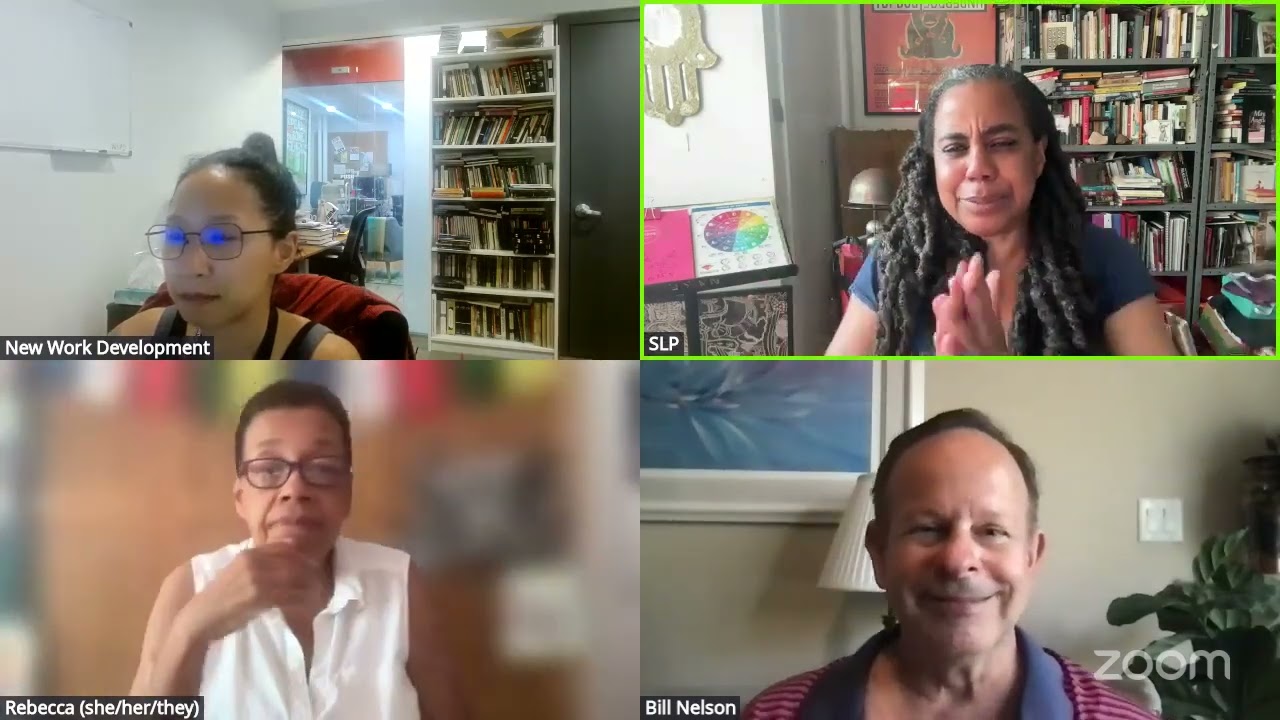
Suzan Lori Parks' Watch Me Work with the Public on Monday 3 August 2026
Watch on YouTubeVideo summary
In this episode of "Watch Me Work," playwright Suzan-Lori Parks hosts a live session where she guides participants through twenty minutes of focused writing followed by forty minutes of discussion regarding their creative processes and challenges. The segment begins with an introduction to the format, which has evolved from in-person meetings at the Public Theater to virtual Zoom sessions since the pandemic, allowing creators to connect regardless of location. A key part of the session involves answering audience questions about collaboration, character development, conflict generation, and handling feedback, all while maintaining a supportive and encouraging atmosphere that emphasizes moving forward with one's artistic vision.
One significant topic addressed is how writers can effectively integrate collaborators into their projects without losing momentum or creative control. When a participant asks when it is appropriate to bring in a musician for a musical project, Parks advises waiting until the writer feels ready but also acknowledges that hesitation often stems from insecurity rather than necessity; she encourages bringing partners on board once there is a solid foundation of ideas and scenes developed. Another common concern involves managing plays with many characters or complex settings, where participants worry about production feasibility. Parks reassures them by highlighting the importance of doubling actors to manage budgets and suggests focusing on what each character truly wants versus what they are willing to do to get it, which naturally generates dramatic tension even in seemingly mundane situations like hanging laundry outside.
The conversation also delves into specific techniques for crafting conflict and giving voice to minor characters. Parks uses vivid metaphors, such as the physics of clothespins fighting against gravity on a line, to explain how opposing forces create electric points of tension that drive a story forward. She emphasizes getting specific with cultural details rather than relying on vague generalizations, citing August Wilson's work as an example where deep cultural specificity creates powerful narratives. Furthermore, she addresses the challenge writers face when dealing with their own insecurities or past traumas in fiction, suggesting that characters should not apologize for existing but instead be given a "volume dial" to ensure their voices are loud enough and distinct on stage.
Finally, Parks tackles the difficulty of processing feedback from readings without becoming overwhelmed by conflicting notes. She advises writers to sift through comments with a critical eye, keeping only those suggestions that spark joy or genuinely resonate with the core intent of the play, while discarding advice that feels forced or overly academic just because it comes from someone prestigious. The session concludes with an inspiring exchange about one-person shows and how performers can find their own character's desire within themselves to create a cohesive narrative arc. Throughout the hour, Parks reinforces her central message: trust your instincts, turn up the volume on your unique voice, and remember that every character, no matter how small, has something vital they want to say if given the space to be heard.
Read the full video transcript
Hey, hey everybody.
It's five o'clock. We're gonna start
Watch Me Work. Um, we've been doing this
for a million years. Not a million
years. I don't want to misrepresent
the enterprise, but we've been doing
Watch Me Work for a long, long time,
about 17 years. U, we used to do it in
person in the lobby of the Public
Theater. And then when COVID came, we
moved on to Zoom and we've been zooming
along ever since, which is just a joy
because we can meet you literally, we
can meet you where you're at. So yeah,
um what we do is we work together for 20
minutes and then we talk we spend the
rest of the hour 40 minutes talking with
you about your work and your creative
process. And that's uh a lot of fun. We
get to talk shop while we don't have
time to share work. Like if you're
working on a piece of choreography, you
won't have the opportunity to dance it
out for us, but um we do talk shop and
and we we have a lot of fun doing it and
we've helped a lot of people over these
years um take steps forward. So um we
thank uh Zoe in the new work development
project at the public theater is helping
us out today. Um, you want to tell
people how they can ask questions if
they're not familiar with the process,
please Zoe?
>> Yeah, of course. Hi everyone and welcome
to Watch Me Work and Happy August. So,
as some of you may know, after our quiet
work session, we'll start to get some
questions going. If you would like to
ask a question to SLP, how you do that
is by raising your hand. You can find
that function in the react button at the
bottom of your Zoom screen. if you can
click raise hand um that that way I'll
know a queue of names and I'll call on
you and you can ask your question and
that's how we'll do it.
>> Perfection. All right. So here we go
with our work session. Here we go.
>> [bell]
>> All right. All right. That's 20 minutes.
Uh hopefully you all had a good work
time. I sure did. If anybody has any
questions about your work and your
creative process, please feel free to
ask away.
>> Yeah. Raise that hand. Let me know.
Sorry, you're the best. Raise that hand.
Let me know. Or we can sit in silence
and drink water up.
>> All right, Tracy, please unmute and ask
your question.
>> Hello. How are you guys? I hope you're
all doing well. Um, I I'm curious to
know how soon
do I
Well, Tracy, I think you're breaking up
a little bit. And
>> I got Tracy. I got How soon?
And the rest of it I can't
>> a collaborator on
>> Can I guess what you're saying? How soon
does one bring a collaborator on board?
Is that it? Is that the question?
>> On a piece that we're going to be
working on together. Uh I'm working with
a
musician to create a musical. The
collaborator.
>> Great. Great.
>> Oh, sorry. Can you guys hear me? Okay.
>> Now I can hear you. Great. I think
sometimes you're um
>> Yes, that's correct.
>> When we uh turn off the uh video.
>> Sorry. Sorry. I'm in uh
>> So, say it again, Tracy. If you could
state it again, that would be great.
>> If you could
>> If you could state your question again,
that would be great.
>> If you could state your question again.
>> I'm going to turn off video in hopes
that uh that helps Wi-Fi.
So, I'm curious to know how soon to
bring in a collaborator. We're going to
be working together on a musical. She's
a musician, and I'm just curious to know
how soon is too soon.
>> All right. Um, great. That's a great
question. And collaboration is one of
the great joys of working in our
business. Um, do you know, I mean, I
know you know the musician, but do you
have you ever worked with him before?
>> I have not. I have not.
>> Okay. Have they done uh musicals before?
>> Yes. Yeah, they're a professional
musician. Uh they've done uh she has
lots of albums and she writes for
children.
>> Great. Great. Okay. Um that's great. It
sounds like you've got an amazing
collaborator. Uh do you know the story?
Do you have a sort of a outline or a
strong idea of the story?
I do. I have the first um four scenes of
the play and I'm to the point where um I
almost don't want to write anymore until
I work with her because
uh I I I want to have her input as well.
>> Great. Well, you just answered your own
question. If you don't want to write
anymore until you bring her on now is
the perfect time.
>> But but that could be my own insecurity,
too.
>> Yes. But that's all we ever have.
Bring her on. Bring her Bring her on. It
sounds like you're ready. You You have
an idea of what you want to write. You
She's amaz She sounds amazing. U you
don't want to write anymore before you
until you bring her on. I It sounds like
it's time to bring her on.
[laughter]
>> Thanks. That's all I needed to hear.
>> Okay. You're welcome. Good great
question. Thank you.
>> Thank you, Tracy. Hello, Lauren. Please
unmute and ask your question. Hi
everybody. Hello. Um, I been working on
my play. Uh, I get a lot, not a lot, but
a little a couple of cute times over the
past two years, maybe three years I've
been working on this project. Um, people
say I have a lot, you know, it's going
to be difficult because I have more than
like five characters
in more in a lot of different locations
this play takes place in in Washington
DC.
Okay. And they they it's it's
you know unfortunately it's
the economics of it makes sense but I
think I need I you know I just want to
tell the story that I I I have that I
see the way I I know I need to tell it
and not worry about it. But it makes me
wonder, you see, once I complete, you
know, when I get to the final draft,
am am I going to really have a difficult
time getting people to consider it
because it has too many pe you know, has
like eight or nine nine 10 people
roughly.
>> So, okay, great question. You u you're
writing a play that seems that that
people say has too many characters.
question. Characters or requirement for
actors?
>> No, characters. They they they have a
distinct purpose.
>> Yeah. If you if they don't have a
purpose, if they if they don't need need
to be there, they're out.
>> No, but what I'm saying, Lauren, is are
you going to need 10 actors?
>> Is there any opportunity for doubling?
>> Exactly. I have a great plan for
doubling.
>> Great. Great. So, okay, great. So, you
have 10 characters and you're going to
need five actors.
>> Probably five or six. Let's say six.
Six.
>> Yeah.
>> Six is great. Six. Six actors. You've
got a great plan for doubling. That's
amazing.
>> Yeah. I mean, I am so impressed with
actors and how you can have the same
person and then they take in the same
play and they do another role and it's
incredible. And I'm like, okay, we can
handle it, you know. Fantastic.
Fantastic. No, I said I think you've got
it covered.
>> Don't let that noise get in the way of
telling a story. Yeah. Okay.
>> No, no, no. Not that noise. Not
>> okay. Okay.
>> Not anyway. But it sound What's what's
wonderful about what you've done so far,
Lauren, is you have a great plan for
doubling, which it's just it's because,
you know, at the end of the day, yes,
theaters are concerned. They want to
make sure that they want to produce
things in within a budget. And if you
need five or six actors, I think that'll
that's doable.
>> Yeah. Okay. Okay. Not enough. All right.
Thank you. Oh, thank you. Welcome.
>> Hey.
>> Thank you, Lauren. Hi, Hector. Please
unmute and ask your question.
>> Hey. Hi, Susan.
>> Hi, [clears throat] Hector.
>> Hi. Hi. Can you hear me? Well,
>> yes. Thank you. Uh, Susan, well, I'm one
of your biggest fans. Um,
>> yeah, I've met you several times. You
probably My camera has an issue. So, um,
I think I can turn it on. I first met
you, uh, in Forward, Texas, and, uh,
yeah, then I've been an admirer of your
work and your career.
>> Oh, thank you, Hector.
>> Yeah, I've seen you several times in New
York as well. Uh, I have a hard
question, I think. So um uh I think the
question will be um basically how do you
as the great playright you are move a
play along um meaning where do you find
the conflict just to avoid uh that that
sounds like it's mere conversational so
that it's just not people talking about
stuff um and how do you
uh you know make things explode
>> yeah great question, Hector. No, that's
great. Um, so are you very clear in your
play that you're writing, and it also
works in screenplays, it also works in
novels. Okay, so this is something that
can help all of us. Um, are you very
clear about what each character wants?
>> Uh, good question. Uh, I think so. Yes.
>> You think so?
>> Okay. So you might want to spend some
time sharpening that focus.
>> So instead of I think so, you might want
to say yes, I'm very sure about what
they want. You know what I mean? So, you
want me to because because the conflict
or making things explode is when, for
example, um Sally wants to go to
uh to Fort Worth to the rodeo and Joe is
like, "No, you're not going because the
last time you went to the rodeo, you ran
around on me and you're not going."
>> Right? for example. So one character
wants to do some one thing and the other
character wants something else.
Fidelity, a stable marriage or a stable
relationship, right? So what they want
is in opposition,
>> right?
>> Right.
>> And that's where the and those are the
points of tension.
Or you could think about it like um um
have you ever hung wash out on a line?
Like you know you do your laundry and
maybe that's old school but anyway back
in the olden days people used to do
laundry and hang it outside on the line.
>> Yeah. Yeah. Oh yeah. Yeah.
>> Okay. Great. Okay. So you have like the
tension between gravity, the thing that
wants to pull the clothes down and throw
it on the ground and the will of the
person who's doing the laundry and you
have the clothes pins. So one thing's
pulling one way and one thing's pulling
another way and the two things those are
the points of tension and that's what
keeps it kind of exciting and electric.
Not an explosion but just points of
tension where the contact the tension is
very strong,
>> right? where the clothes pin is pulling
up, holding on, and the gravity is
pulling down and it goes along, people
talking, another point of tension.
Right? So, you want to as much as you
can identify, number one, identify what
each character wants just on their own,
what they want, what they're willing to
do to get it. Okay? All the things
they're willing to do to get it. Sally
wants to go to the rodeo. She got a
whole game plan, right? I'm just saying
rodeo because there's a really good
rodeo in in in Fort Worth, right?
>> That's the background. Yeah.
>> Okay. Okay. Well, great. So, that's her.
She wants to do that
>> and then the other person, what was his
name? Joe or something.
He's got what he wants and all the
things he's going to do to make sure
that he gets what he wants
>> and then in those places you can find
points of tension.
>> Is that true for all the characters?
Even if there are minor characters,
>> minor characters,
um, it depends on the writer.
>> Okay.
>> Some writers like you have like Charles
Dickens, right? He'll write a novel
called like Bleeak House or something
and the main characters have all that
tension, you know, and the, as you call,
the minor characters might not have so
much. They might just be facilitating
the things. Um, so you you can do that
in a play as well. I like to
see how much I can activate all the
characters,
>> right? Yeah.
>> Because all the characters want
something. You just you can give them a
little voice. It doesn't have to be part
of the huge big arc, the main thing
you're watching, right? Or the main
thing if you're reading a novel, the
main thing you're reading. But all
characters want something. And it's fun
to just give them a little, you know,
thread their needles, show those points
of tension in what they want.
>> Right.
>> So, but you don't have to get as
obsessive about your quote unquote minor
characters, the characters that take up
less stage time.
>> Yeah. Well, sometimes they end up being
the most important.
>> Yeah. But it's very satisfying. I got to
say, it's very satisfying when you get
your play produced for actors who are
playing some of those quote unquote
minor characters to go, "Oh my god, my
character has a journey, too." And
you're like, "Yes,
>> I was thinking about you."
>> True. True. Yeah.
>> You know what I mean? So, it's not just
the It's not just the big dogs, you
know? Little dogs little dogs have
journeys, too. Right.
>> Right. Right. Yeah. Yeah. Absolutely.
And Susan, if I may, what if what if the
the the conflict um would be like a
cultural conflict? Any advice on that?
>> Like a culture? What do you mean like a
cultural conflict? What is that? What
does that mean, bro?
>> Yeah. Um how do I For instance, um
well, I guess I'm going to have a like
an Sorry about this. uh if this makes
any sense like an August Wilson moment
where I'm trying to establish a um like
a like a like a cultural um
uh fireworks if I can say that. Um like
I'm trying to put a certain group of
people on the map
>> in the theater in the theater that may
have not have been uh acknowledged
before. So I'm trying to bring this in
bring this culture on stage
>> and
Yeah. So,
>> okay. Well, I think I mean an August
Wilson moment. I think the great one of
the great things many many many great
things about August Wilson's writing and
he was a cool guy as well, cool person,
human as well. Um, he w he
was really specific. You might read his
plays or see his plays and go, "Wow,
there's just a lot of people talking."
But he was really really specific in
terms of the culture. So, it wasn't
like, you know, just culture. would a he
right it was he was really specific so
if someone um I'm trying to think of I I
can't okay
um oh okay let's just say fences that's
very popular august play um Troy had a
history with playing baseball and
culturally that was his reference point
and now he's a a a garbage man you know
and so he has he's very uh uh
intense about his feelings around
baseball, but also his feelings around
sports, right? And that's very specific
to lots of communities, but
African-American community, you know, he
has a very strong opinion about should
his son do sports or not. He thinks he
should get a job, like a a regular job,
you know, um work in the supermarket, I
think, you know, for Mr. Stanwick. I I'm
making this up. I don't I I have not
read the play recently, but so those are
very specific cultural beats for those
characters. So get specific with your
characters,
>> right?
>> Okay. Wonderful.
>> Get specific. Okay. And and come visit
us again at Watch Me Work.
>> Oh yeah. Okay.
>> I'll I'll be here until the end of time.
Trust me.
>> Oh, to Oh, till the end of time. Okay.
Okay. Thanks, bro. Thank you so much.
>> Thank you, Hector. Thank you.
>> Hi, Bill. Please unmute and ask your
question.
>> Hi.
>> Hi. Hi everybody. I just wanted to ask
about stage readings.
>> Yes.
>> I've done a a story three times as a
storytelling adventure.
>> Learned a lot. I'm I love the script.
But now it's going to be a oneact play
with two actors, multiple characters,
and I'd like and I'm submitting it
October 15th is the deadline. And I'd
like to do a stage reading before then
in probably September to give me time to
fix what I need to fix. And I'm so
fortunate I have a producer that's going
to help me
>> set this up because I don't I I mean I
love the idea where you sit around at a
dinner and you read it. But I kind of
feel like I've done that already and
that people that know me well have heard
the story and I'd like to get input
from, you know, other other people that
that don't know me and don't know the
story. Um, do you have any suggestions
of how I can help my producer kind of
reach audiences? Like would you go to
theater departments at local schools
here in San Diego or what would you
suggest?
>> I I love that theater departments at
local schools. I say uh sometimes places
of worship have auditori auditoriums,
you know, spaces. It doesn't need to be
a theater. You don't need to do so make
it simple. Uh the design elements can be
you know what zero you know you need
music. Think of what you need. You have
a producer already. So that's a partner
uh a a creative partner for you. Do you
have a director in mind?
>> Well I usually self-direct but I I kind
of might would like to use a producer as
a director. I mean I I know the story. I
know the beats but I want to get other
voices in involved.
>> Great. So you've got a producer director
who's going to help you put it together.
Think of what you need. You need a
space, right? You need maybe music
stands. It's a staged reading. You need
uh minimal costumes, no costumes, a
place with lights that has reasonably
good acoustics. It can be a place of
worship. It can be a school. It can be
uh a a bar during off hours or the back
room of a bar, you know, that sometimes
have gathering places where people have
um and you can just set up the chair.
So, it doesn't have to be a theater,
okay? Uh, you need to think of who you
want to invite. Do you want like 30
people there? Do you want 50 people
there? I would say I would say keep it
chill and don't because it's going to be
a lot of work. So, if you think of
inviting a relatively small group of
people, that could be really fun. Like
30 people, 40 people, that could be
great. Um
then you think of they're going to help
you with the casting unless you've
decided on that already.
>> It's already Yeah, decided.
>> Great.
>> It's already decided. Fantastic. So, um
yeah, I I would I would say think of
maybe a place of I'm just looking around
like the answer like we have Judson
Church here or you could or it could
theaters might have off nights, you
know? So, a theater that you like, it's
a black box or it's something more
elaborate, might have, oh, we're not
doing anything on Monday night.
Fantastic. Call them up. You know, I'd
like to have a stage reading of my play
in your theater.
>> Um, on the on the called the dark night,
you know, on the on the night that it's
dark and they I would say just keep the
production values to a minimum. Focus on
hanging out with the actors
and uh giving yourself a really great
reading.
Right. And one conceit I have is to do
do it twice so that I can kind of learn
from the first one and then tweak and
then see if it reads the way I think
it's going to read on the second round.
Do you think that's smart or
>> um you could you could I I just uh since
you already I mean yes
and you could uh spend more time up
front writing and then just do it once
because you're going to be sending it
in, you know. So, uh because the thing
about the the staged reading that you
want, you want audience
>> and that's going to be getting people to
RSVP. Uh is it going to be free? What
are you going to charge? That's a that's
in my experience that's the work of a
production. That's kind of oh I want
butts and seats. So you might just want
to do it once
>> brilliantly and then and then send it in
and then ship it.
>> Yeah, I think that makes sense to try to
get a larger group for the first round
and then do a Q&A one time. And
>> there you go. There you go. That's
exactly right. Q&A. Oh, that's gonna be
fun. That'll be fun. And um then you'll
you'll know everything you need to know.
Okay, thank you so much.
>> You're welcome. Congratulations.
>> Thank you.
>> Thank you. And congratulations, Bill.
Hi, Chaz. Please unmute and ask your
question.
>> Hi.
>> Aloha.
>> Aloha. How is it over there in Hawaii?
>> Uh, today is fantastic with trade winds
blowing and you know, it's 80 something
and it's just nice. It's uh it's not too
hot yet and it's been hot but the breeze
makes it really you know wind does
things.
>> Wind does [laughter]
yes wind does that beautifully said.
Wind does things.
>> Um you know I thought a lot about your
speaking about cat on a hot tin roof and
I drink until
>> I feel the click. I hear the click.
>> Yeah. And I thought of that moment and
what you know a character wants. And and
my question is kind of twofold. One,
it's a playwright question, a writerly
question. The other is a character
question. They might be the same. Um how
do you said earlier today you said um
our own insecurity? Well, that's all we
ever have when we're going forward with
the unknown in the play. You know, I
mean, I'm adding that part to you. what
you just said. Um,
so how to use that insecurity that and
I'll tell you what my insecurity is.
>> Okay.
>> Uh, God, how to do it in five words. Um,
my in security is
white
alive in Asia
decades living in the diversity of
Hawaii where all these things come
together from rural North Carolina to
Korea to New York City to Chicago to,
you know, all these things are together
in me that have been growing and my
insecurity
that I I I I deal with as a writer is
not about writing itself. It's about
do I have anything to say or do my
characters have anything real to say
here and now in the world as it is. So
all my characters want something. I get
that.
What I don't get is
how I constantly
feel my characters want to apologize for
entering
rather than live out theirelves in
entering that almost backstage before
they enter. I think you said that
characters all want something when they
come on stage when they enter and when
they exit. And what I I'd like to know
is how do you deal with the noise
of the past
engaging in the noise of the present
>> on stage with characters how with what
they want what they don't want. I love
the characters all want something that
you emphasize in several times I've been
here. So does that sound like a strange
question? Um,
no, no, it doesn't sound like a strange
question. Um, it sounds like a really
good question. It's it's there's a
there's a lot to it.
Um,
you can
when by the time characters are on
stage, hopefully you've you've sifted
through a lot of the noise because
you've done your
>> I think I have sifted through the noise
of them being themselves,
>> but letting them be themselves in a real
world context.
Um, I I think what it has to do with is
how does one ever get honest? Like, I
want love. I want to escape pain. Uh, I
want to just not feel anything. And yet,
characters that I'm writing are wanting
actually to heal. They want to heal
themselves and others through life. And
so it's a conflict because that I I know
I sound crazy right now and I just
realized it. Um I don't want to have my
characters be crazy. I just simply want
them to come on and be real and those
points of tension discover by being just
real on the stage, you know, and move
forward. And I do know where to go with
them.
>> Okay.
>> But how does one put oneself out of the
picture in the sense is what I'm really
asking. one's own history.
>> Oh, well, I I would I mean I would hope
that you never put yourself out of the
picture.
>> Oh, okay. That's
>> okay. So, I I would hope that you're
always in the picture. I mean, you just
you just I I just want I mean, it sounds
like you just
>> This is the thing. So, um
a volume dial. Can you imagine
each character has a volume dial like
like radio, you know?
>> Yes.
>> So, so uh for example, character number
one, let's just take Right. They want to
say heal, right? I'm just spitballing.
>> Mhm.
>> Okay. What now? The second part of what
do they want is what are they going to
do to get it?
>> What are they going to do to get it? And
not just one thing, but what are the 10
things they're going to do to get what
they want,
>> right? They're gonna they're going to go
to the beach. They're gonna go to a
shaman. They're going to take a
go to therapy. I'm just making, you
know, these are the things they're going
to do. Now, what So then character
number two, they want something. And
what are the 10 things they're going to
do to get what they want?
>> That makes a lot of sense.
>> You see what I mean? So, so you think of
Maggie and Brick and Cat on a Hot Turn
Roof. They wanted I I don't know. I
haven't read the play in a while, but
they wanted what they wanted and they're
going to do what they're going to do to
get what they want.
>> Yes.
>> And so those are the
>> And so all along, Chaz, you're turning
up the volume on all those characters.
Each one has its own the play has its
own dial, like a safe, you know, like a
safe cracking, but each character has a
dial and crank up the volume.
>> I love that metaphor. Yeah. So, like, oh
my god, I can't hear what the character
saying. Just turn up THEIR VOLUME. SO,
THEY'RE TALKING REALLY LOUD AND YOU
CAN'T [laughter] HEAR ANYBODY ELSE. And
when they're talking, they're talking.
Then you have another dial because when
it's their time to listen, you turn up
the other character
>> or so you're doing, you know, you're
doing a lot of things, but you just turn
up the volume, make them louder,
make their gestures bigger.
>> Yes. Hey, I can't, you know, you don't
want them small and and what? Huh? I
can't hear and I can't see what you're
doing because it's all very small, you
know. Yeah.
>> You just make it bigger. Make it even
bigger.
>> Tell the character. It's like if you're
listening to someone that you really
love and you're at a a party or
something, they're telling you something
really important and you can't really
hear them. You're like, I can't hear
you.
>> I can't hear you. You know, right? So,
turn up the volume.
>> That is so helpful. that image, that
metaphor. And next time I will have a
question about that because I'm going to
work on what you just said a
>> as a focus point. And I wanted you to
know too that um
one of my characters just wants to be
invisible.
>> Okay. What are they going to do?
>> And but they they're never going to be
invisible.
>> How do you move up? What what they're
never going to be invisible? Who are you
to say? YOU [laughter] WANT TO PUT ON
THAT? WHAT IS THAT? WHAT IS THAT BOOK?
What's that book? Come on. This Harry
Potter. He He puts on a coat. He's
invisible. So, DON'T [laughter] TELL ME
THAT YOU CAN'T BE INVISIBLE.
>> I love that. And yeah, and I'll have a
question about that coming up because
you just happen to What are they going
to do? What are they going to do to get
it? If you've decided, and that's an
example of you putting yourself too much
in the play, right?
>> Yes. Yeah,
>> because you've decid you've decided that
they can't have what they want. What
kind of a play is that [ __ ] Have them
go for it. Have them go for it.
[laughter]
>> Okay.
>> Love it. Thank you.
>> Thank you.
>> Thank you so much.
>> Yes. We can't wait to see what they do.
Get it? Because
>> right,
[laughter]
>> they're invisible.
>> Yeah. Right. Yeah. Very good. Um anyway,
um hi Crystal, please unmute and ask
your question.
[laughter]
>> That was good. Hi.
Um how are you? [laughter]
Um so, um it is it's actually just two
questions really quick. One is like I
guess a yes or no question, but um one
is can a character have more than one
objective in a in the entire play? Um,
can
or is that too much to juggle?
>> Um,
one more, you know, more than one thing
they want. Is that what you're talking
about?
>> Hm.
>> More than one thing they want.
>> Yes. More than one thing they want.
>> Well, I mean, Hamlet, when you have a
question, just go back to Hamlet. Hamlet
wants to What? Hamlet wants to find out
who killed his dad,
>> right?
>> Yeah. Hamlet also wants to get with
Ailia.
>> Okay.
>> Right. Yeah. Yeah.
>> And then Hamlet wants to get revenge.
>> So those are more, you know, that's
there's like a whole bunch and probably
some other things. Again, I haven't
reread the play in a little while, you
know. So those are things. That's more
than one thing.
>> Okay. Okay. Cool. Um and
>> so yes, yes.
>> Okay.
leading into why I'm asking the next
question is that um one of the plays
that I'm working on it's the tarnished
opal one um uh the reading that I had
had tremendous feedback and it
>> it's it still follows me like the notes
still follow me and okay
>> so I'm having some trouble um
sifting because you know with my other
plays when I've had readings I can kind
of be like oh well I don't know if that
works and I can kind of do away with.
But um with this particular reading,
there were so many things that were like
um
I I thought helpful um that I kind of
was like, wow, I kind of feel almost uh
stuck uh because
am I would I be creating a a brand new
play from applying all of these notes?
um do I need to put on like, you know,
creative bifocals and sift through even
more to see what's more helpful? Um or
or try to attack them all. Um so I was
just kind of it's been about um a month
and I've been writing different scenes
and I've been writing different things
for it. Um and a little some of it is
like oh I could put this in the play.
Um, and some of it has been like, "Oh,
no. This doesn't work." But I I just
kind of still feel like the notes, and
there are more notes coming, funny
enough. So, it's just kind of like
I went from not knowing what to do
because I had written this play so long
ago. I I came in to watch me work with
this play. Um um and now uh that it's so
many years later, I kind of feel this
like need to like
cleave to like all these notes to see if
I can make it um what I want it to be,
but I don't know what I want it to be
per per se just yet. So that that's kind
of where I'm at right now.
>> Right. Wow, that's a great question. Um,
it's it's great that you have people
interested in it and are giving you
notes and it's great that you're coming
back to something that you wrote a long
time ago or have been working on for a
long time. Um,
I say you do have been in stages. So,
again, do you have a print out of the of
the notes or is it just all on your
computer?
>> Uh, I wrote them all out.
>> Great. Okay. So, take a a highlighter
like pink or something, you know, and
circle the ones you like.
and put in the ones you like. Only the
ones you like. You have to really like
them.
>> Yeah, I like this one. Right. Like that.
>> A gut response. It's like you want to
feel Yeah. It's like um like that that
writer Kai um says, it has to spark joy,
you know?
>> It should spark joy. Yay. Okay. The ones
you don't like, don't worry about it.
And then put in all the ones you like
and then just put it aside.
pick it up again in a couple of weeks.
Read through them again. Maybe there's
one more that you like or you said there
more notes coming. So,
put in the ones just put in the ones you
like.
>> But do a couple of waves. You know what
I mean?
>> So, this month you might do two passes
on it. You know, put in some you like,
let the rest go.
>> Two weeks from now, put in some you
like, let the rest go.
you'll you'll you'll move toward
figuring out what it is that you want it
to be,
>> you know?
>> Okay. You just got to take your time
with it
>> and not rush it and not think that all
the notes are good notes for your play.
And definitely all the notes um given to
you by smart people need to be in your
play.
You know, smart people don't always give
notes that are helpful to what you're
doing.
Okay. I think I think um well, you're
very right because a lot of the notes
from a lot of the people that were there
or have read it have were very smart
>> and I think like in a way it it made me
feel a little
unsmart. [laughter]
>> Right.
>> Um
>> Right.
>> Uh so yeah,
>> but but you know what's best for your
play.
>> Yes.
Yeah. So, yeah, maybe you know and and
people Yeah. they because they have
maybe fancy degrees from fancy places
and they can use $25 words and and it's
like no no uh disrespect, but who the
[ __ ] cares really
no disrespect. And a lot of times they
want to they want to show you how smart
they are.
And it's like, thank you, but really you
don't have to take their notes just
because they're smart. They might have a
advanced degrees and teach at Harvard or
whatever,
you know. I mean, no disrespect. No
disrespect, but it's your play.
>> Got it.
>> You know.
>> Yeah. Totally. And we and and of course
we love people who teach at Harvard and
some of my best friends teach at
Harvard. [laughter] Of course. No, but
and and that's true. But you know, but
you know, you know, right?
>> Yeah. Yeah. Yeah. Okay.
>> You have to turn up like we were talking
to Chaz, turn up the volume of your own
play. Turn up the volume of your own
voice. Turn up the volume of the
characters. They'll help you decide
what's going to be helpful.
>> Okay.
Cool. Thank you.
>> Thank you, Crystal. Um, since we just
have two minutes and we haven't heard
from Kimmy, why don't we squeeze Kimmy
in for the last two minutes and Hector,
we promise to get to you uh next time.
>> Yes. Thank you. Thanks, Zoe. Okay. Hey,
girl. How you doing, Kimmy?
>> Hey, thank you. Hi. I'm a little
jet-legged, so um
>> Did you get back from Edinburgh?
>> I'm in Edinburgh right now. I just got
here yesterday. I'm so excited.
>> Congratulations. Yes.
>> Thank you. I'm freaking out. [laughter]
Oh,
>> and hence my question.
Um, so I'm sitting here thinking and
listening and and you say this all the
time and it always works with my plays
about what do my characters want? But
when you're doing a oneperson show,
what do I want? Is that how do you how
do you go about that? Does it does the
same formula work about when you're
doing a oneperson show?
>> Well, there's a character. I mean, yes,
there is a character.
>> Well, yeah, me, I guess. Yeah.
>> Well, well, well, well. Yes, there is a
character called you. Okay. Yeah. So,
what what is what is the character
called Kimmy want?
>> What is she going for?
>> So, it's I called suicide hotline. I
told you about four years ago. They
said, "Do you have a gun?" "No." "Call
back in 15 minutes."
And so I was exploring why I was
depressed in the first place for myself.
I wrote a play about it, but now I was
checking in with myself. And then I
thought about like, why are we in
society making the same mistakes over
and over again? And I went to the Greeks
and I read the allegory of the cave.
>> So I put the allegory of the cave
together with the societal constructs
that made me feel depressed in the first
place. And I guess I'm just trying to
convey that. But I don't know now that
I'm
other than saying
here's what I here's what I wrote and I
think it's funny. [laughter]
you know, how do how do I
cohesively make
a beginning, middle, and end now that
I'm thinking about instead of just
squishing about, you know, bits together
and hoping that they they seem cohesive
and
>> Okay. Well, okay. There's a couple
things and it's six o'clock, so a couple
things. Um, how you make a beginning,
middle, and end, I I don't know because
we're not reading your your work right
now. But in terms of just sort of what
your character wants, right, which
hopefully can be like a toll line to
help you pull yourself through the
performance. Um, did you call back when
they said call back in 15 minutes? Did
you call back?
>> No.
>> Why not?
>> Cuz I just I took me everything to make
that phone call in the first place and I
just figured I have to figure this out
myself. So I went and got hypnotized.
>> Oh, I remember you told I remember you
telling us that. So, okay. I would guess
that the character, not Kimmy, but the
character that you're playing wants to
be listened to.
>> Ah, yeah.
>> And instead of calling back the Suicide
Hotline, she's writing a play and she
wants us to hear her out cuz she's got
some stuff she's got to tell us.
And maybe it doesn't have a beginning,
middle, and end. I mean, it does have a
beginning because here she is starting.
It has a middle somewhere in the halfway
point which might be minute number
whatever
>> and the end is when she says thank you
>> for listening.
>> So it's your version it's your live
version of like this is what I had to
work out. They told me to call back. I
didn't. But here I am standing here.
>> Thank you.
>> You're welcome.
>> And thank you Liz who just said welcome
to the UK. Thank you. [laughter]
I love you all. Thank you so much. and
I'm so glad that uh you were here
tonight and that everybody's questions
helped me and I and I'm so excited to be
a part of this cohort. So, thank you
everyone and thank you SLP and Zoe.
>> Thank you.
>> I don't know what I'd do without you.
>> Break legs. Break legs in.
>> Thank you. I'll keep you posted.
>> Okay. When are we back?
>> We're back on August 24th, folks. 24th.
So, we'll see you in two weeks.
>> Okay. We'll see you in two weeks.
>> All right. Bye.
>> Thank you. Thanks.