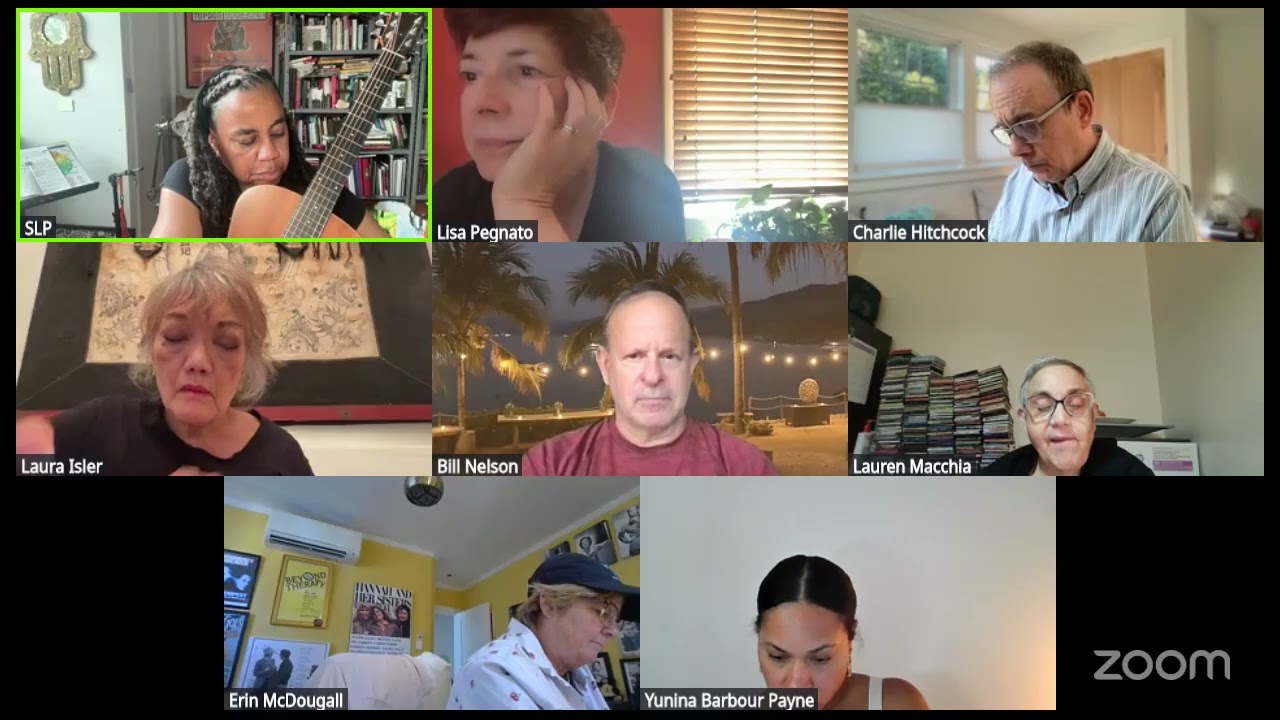
Suzan-Lori Parks's Watch Me Work - A Playwriting Masterclass
Watch on YouTubeVideo summary
In this episode of "Watch Me Work," playwright Suzan-Lori Parks (SLP) hosts a masterclass focused on navigating the creative process, specifically addressing challenges related to energy levels, conflict generation, and structural decisions. The session begins with a warm welcome from SLP and her colleague Zoe, who announces that Zoe will be moving on to new opportunities while introducing Amritha Ramen as her successor. A significant portion of the discussion revolves around managing low energy days, particularly when preparing to pitch work. SLP advises against forcing oneself into high-energy pitching scenarios on difficult days, suggesting instead that creators reframe their mindset by focusing on the joy and connection inherent in sharing their stories. She encourages writers to believe in the unique value of their specific narrative, noting that finding enthusiastic audiences can transform a daunting pitch into a genuine conversation rather than a sales presentation.
The conversation then shifts to practical techniques for generating conflict without feeling forced or artificial. A participant named Sarah shares her struggle with writing fun dialogue first but fearing she is "manufacturing" conflict later, a common issue when trying to adhere to traditional dramatic structures. SLP reassures her that there is no shame in prioritizing character joy and conversation before introducing tension. She suggests reframing conflict not as physical violence or hatred, but as simple differences in desire, such as characters wanting to go in different directions during a road trip. To make this process more manageable and less intimidating, SLP proposes treating the creation of conflict like a game where writers survey their characters' opinions; by giving imaginary friends distinct desires that may clash, the conflict emerges naturally from the characters' own motivations rather than being imposed by the author.
Another major topic addresses the dilemma of rewriting a finished play that feels flawed or deciding how to expand a short piece into a full-length work without making it feel artificial. SLP offers two distinct strategies for these scenarios. First, she recommends reading the longer version aloud and circling every moment that sounds fake or untrue to the characters, then digging deep to understand why those moments don't work and fixing them based on character logic. Second, if a writer loves their short piece but needs more length for touring, SLP suggests writing a prequel or sequel rather than artificially stretching the existing story. She uses the analogy of circling an airport before landing to describe this exploratory phase, emphasizing that writers should keep showing up consistently even if they are just "circling" the idea initially. This approach allows the writer to warm up their engine and eventually dive in with renewed clarity and confidence.
Finally, the masterclass touches on research practices and the balance between telling an audience what is important versus letting them discover it. When asked about the fear that research turns fiction into journalism, SLP clarifies that research should only be done on a "need-to-know" basis to get the creative engine running, not to create a history lesson. She warns against over-researching to the point where imagination is stifled, advocating for just enough information to make the world believable. Additionally, she discusses how to handle direct addresses to the audience or internal monologues that other characters cannot hear. SLP advises that these moments should carry urgency and deepen character development rather than simply lecturing the audience, effectively using them as a vertical axis of growth that complements the horizontal progression of the plot. The session concludes with an announcement of the next meeting date and heartfelt goodbyes to departing staff members.
Read the full video transcript
Hey everybody, it's five o'clock.
Welcome to another session of Watch Me
Work, where we talk with you about your
creative work and your creative process.
I'm SLP. We've been doing this show for
like 16 17 years now, for a long time.
Uh where we've been getting together
with folks to talk with you about your
work and your creative process. So what
we're going to do, what we always do is
we work together for 20 minutes and then
um we ask you ask questions about your
work and and we talk about your work. So
after that 20 minutes, Zoe in the new
work development department, please tell
us how to get in touch and ask.
>> Yeah. Hi everyone and welcome back to
watch me work. Happy last watch me work
of August and also this is my last watch
me work um that I'll be joining and
facilitating. So starting next meeting
you'll be getting um Amritha Ramen from
Newark development who is lovely. Um so
after the 20 minute work session if you
have a question you would like to ask
SLP please do so by click clicking the
react button at the bottom of your
screen and clicking raise hand. That way
we can have a nice queue going and I
will call on you to unmute and ask your
question.
>> Fabulous. Fabulous. Alrighty. Here we
go. Got my timer. Here we go.
All right. All right.
That was the work time and now here's
the talk time.
Anybody has any questions or thoughts or
concerns about their work and their
creative process? Come on. And Zoe, tell
us how to get in touch. Have you told us
how to get in touch already today?
>> Uh to ask a question or with me
personally?
>> No, to ask a question.
>> People ask that question at the end.
>> Um please uh to ask a question, click
the react button at the bottom of your
Zoom Zoom screen and click raise hand
and that way I can uh know who wants to
ask the question first.
>> Thank you. Since we're waiting for a
question now, so tell so you're going on
to bigger and better more beautiful
things after today. Um, congratulations.
I just want to say that in the front so
I don't so I don't uh forget to say it
at the end. But you're such a great
presence on Watch Me Work. We so
appreciate you. Just want to say that.
Thank you. Thank you. We love you. We
love you. And we will see you around
town.
Definitely. Definitely.
anything you want to tell us about your
uh your next adventure if you feel like
it. Do you feel
>> you don't have to?
>> Um it's gonna be fun. It's gonna be
amazing. It's going to be wonderful. How
about
>> Thank you. Thank you SP. Hi Lauren.
Please unmute and ask a question.
>> Hello.
>> Hi everybody.
>> Hey everybody. Um
>> I just wanted to give uh last week I I
found out I have shiggles.
>> Oh yeah.
And I would advise everybody to go as
soon as you can to get the vaccine if
you don't have it. It's not It's very
uncomfortable. It's uncomfortable.
But I mean, it's, you know, it's going
to get better, but it's not fun. It's
terrible.
It really is not fun.
>> Thank you. That you said the medication
was was working,
>> which I did not do, but I don't know why
I didn't do it. I got all the other
vaccines. I don't get
>> anyway.
And um here's a here's a question.
You you try to pitch your work, right?
And you're out there and it takes a lot
of energy, right?
>> What do you do if you don't have that
energy on a particular day to do that?
>> Oh, are you do you have to pitch every
day?
>> It seems it.
>> Oh, really? So you're having meeting you
having like pitch meetings or that's
what I call them. I mean that's like you
have pitch meetings or meetings with
people who
>> No, I'm just I'm just sort of
envisioning like like next year when I
when I have something ready to show
people,
>> right?
>> Hoping by the end of this year.
>> Right. So So okay. So you're imagine and
I'm I'm again I'm sorry you weren't
you're not feeling well and I'm glad the
medication is working and
>> Yeah. No, they were very good. They they
were they were very good. you know,
>> just to say that. But so you're imag So
I can understand why you might feel a
little low energy right now and not feel
because you're imagining, Lauren, you're
imagining going out to pitch your work
next year and you're imagining not
having energy. No, you didn't. That's
>> Yeah, because of that young.
>> Yeah. Right. Okay. So,
>> not that not that being old means you
don't have energy.
>> No, no, no. I I wasn't saying that. I
was I was saying maybe, you know, you
could
>> I don't want to say that. Yeah. Imagine
yourself going out to pitch when you
have to go out and pitch and imagining
that you go out and pitch on the days
where you have a lot of energy and that
thinking about your work and thinking
about talking about your work in front
of people gives you energy. It's like
it's the wind underneath your wings.
It's the result of all your hard work
and you've done all the work and you've
written it and rewritten it and you've
given it to friends and they've given
you notes and all those good things have
happened
>> and now you're going to go out there
with all that great energy behind you
>> and you're going to have a wonderful
time pitching so you can frame it
differently that might help you.
>> I'm sure that will help you actually.
>> Yeah. Right. believe in believe in in in
believe that this story is the is you
told it the only way it could be told.
It's your story.
>> Sure.
>> You figured it out and that's it's
special.
>> Yeah. Yeah. For you told it in the best
way you could. You've done the work. Um
you love it. Um it it makes you excited.
Um it's it has something to share. you
know, it it offers something to others,
all those good things, you know, like
Lou, you you were writing your book and
then you had to like pitch it. I mean,
what was that like? Just Yeah. What was
it like?
>> Hi. Um, it was very intense and I had to
take care of myself. I mean, it was a
long long process. Um, but when you find
somebody who is, you know, excited about
your work, it's easier to to to meet
them in the middle. So, I think that's
another thing I would say is I think
there's people out there who want your
work and that can kind of change the
dynamic too of pitching it if that makes
sense.
>> Oh, no. Go elaborate. What do you mean
that could change the dynamic of
pitching
>> because people meet people meet you with
enthusiasm like I'm sure Lauren's work,
you know, and and so it feels less like
pitching and more just like connecting.
>> Oh.
>> So, I just offer that if you ask about
>> Oh, that's great. Well, that's a
beautiful way to look at it.
>> Do you hear that, Lawrence? So it might
not, you know, you might meet plenty of
people who might not feel like pitching
at all. It just might feel like some
sharing of of, you know, a cool story,
>> you know.
>> That's a great way to think about it,
Lou. Thank you.
>> You're welcome. That's wonderful.
>> Thank you.
>> Thank you very much.
>> Thank you, Lauren. And I hope you feel
better even faster. Um, hi Sarah, please
unmute and ask your question.
>> Hi. Um,
>> just just a second pitch for uh or or
promo for shingles vaccines cuz
[laughter]
I also didn't get it in when I was the
right age and I've had them twice. So,
and I had I got the shingles vaccine
afterwards and get Shingris, not the
other kind, but it doesn't help once
you've had them. Anyway, um my question
uh is one I'm sort of shy and a little
ashamed to ask and it's about conflict.
>> I have a title I love that a friend came
up with. My friend uh Tracy Zurwig Ford.
>> Um I think I've mentioned it here
before. It's going to be called my next
fulllength play, Lesbian Pool Party.
What a fun name.
>> Yes. What a fun name.
>> Um so I've got a fun name. I've written
a bunch of interesting scene lits of
dialogue where everything there's always
water in the scene no matter what.
They're usually submerged in it but you
know not always. So I've had a bunch of
interesting conversations go on in
different parts of the character's life.
I have no idea. Like I I'm sure what I'm
ashamed of is I'm always having these
fun conversations and then stitching
them together and like and
manufacturing a conflict, which is
exactly what not to do.
>> I just can't I can never think in terms
of the conflict first and planning out
the outline and doing all that. I just I
really want to get at the conversations
and having fun writing. And it's never
fun to me to try to figure out a
conflict. So, do you have any advice on
not fearing writing about conflict or
figuring out how to do a conflict?
>> Sure. Sure. First of all, we could just
roll it back for a sec. I love the title
Lesbian Pool Party. Uh I think you have
mentioned it here before and it's like f
and it was between writing that and
something else. We were like write the
fun one. So, I'm glad I'm glad you're
writing the fun one. And um second um no
harm, no foul, no shame, no blame if you
don't, you know, like to write a certain
way. You know what I mean? Like some
people only like focus on the conflict
and they never focus on the fun and the
the dialogue or anything and they might
feel ashamed because they go straight
for the conflict. You know, it's like a
you know, a person maybe you you serve
them a plate of food and they only eat
the broccoli. They only ever eat the
broccoli. they never eat the whatever
else is on the plate, the potatoes or
whatever. Um, there's no shame in in in
loving the potatoes or the broccoli or
whatever. Um, so that aside and feeling
like, okay, I need uh, you know, all the
books say or all the all the people say,
you need conflict or you need change.
Drama is about change, right? You know,
that's what people say, spare change.
Um, you know, so you got to have these
characters like change. Um, and I I like
to think of it in terms of desire, like
what do my characters want,
>> you know, and and if they even like, you
know, want to be left alone, which is I
think someone Oh, maybe it was Heather.
Anyway, ages ago, you know, want to be
left alone. That's a want, you know,
especially when you're at a pool party,
you want to be left alone. So, why do
you want to be left alone? and all these
people aren't going to leave you alone
because they're your friends or
whatever. That's conflict. I mean, it's
not like conflict like, you know, like
we're gonna I'm gonna kick your ass
conflict or spank you, you know, and
hate you and pull your hair or whatever
people do. Um, I think there's
I think uh you can reframe the the the
concept of conflict into something
that's just like an everyday like
I want to go north. Do you want to go
west?
We both want to go on a whatever what do
you call a road trip, you know?
Simple things. Simple things like that.
[clears throat]
>> Um,
do you see what I mean? So, you can feel
okay about writing the way you like to
write because it's a fine way to write
to get interested in the characters and
their joyous conversations first. That's
a wonderful way to write. And then you
say, "Okay, so let me dig a little
deeper, maybe, you know, let me dig a
little deeper. What do these people
want?"
>> And is everybody, you can look at your
characters. Is everybody on board with
that? Everybody wants to go to Moscow?
No, you don't. Okay. Or whatever.
Everybody wants to know who killed the
king. Oh, you don't, Claudius. Oh,
right. Okay. You don't want to know. You
don't want that to be discussed, right?
You see what I mean?
>> So, you [clears throat] can take kind of
a survey. One of them is going to say,
"Actually, I I I am not really into this
idea." And then there's there's the
antagonist, you know? You know, it's
it's you can make a game out of it. It's
fun. It's called play.
>> Does that sound like fun? Does that
sound like a good time?
>> I liked the idea of surveying my
characters.
>> Yeah. Yeah. Yeah, they got opinions. So
idea. So Sarah, the thought is it's not
like all coming from you.
>> You're not alone.
You know, there's interdependence going
on. You got your people with you. You
know, your imaginary friends.
>> Yeah, I love that.
>> Yeah.
>> Thank you.
>> Sure, hun.
>> Thank you.
>> Great question. Can't wait to hear more
about the lesbian pool party. Is it a Is
it a pool? Like is it a like a natural
like is it like an above ground pool? Is
it in the ground pool? Is it a fancy
land? Like are they somewhere like where
are they?
>> It's really not like that's the uh that
is the title for it. And it's really
just going to be at least a lesbian in a
body of water in every scene.
>> Oh, that's really fun.
>> Okay.
>> Oh, that's fun. Oh, so someone could be
in their cups.
Uh, I don't even know what that
expression means.
>> It just means drinking.
>> Ah, thank you. Could be.
>> Drinking. Yeah. Anyway,
>> you never know.
>> Okay, that's really fun. Oh, see how
much fun it is. Oh, that's so great.
>> Yeah. Thank you, Sarah. Hi, Emmanuel.
Please unmute and ask your question.
Okay, got it. Um,
>> hi there.
>> Hi, Sop. Um,
>> it's very good to see you. I've been
trying to come back for a long time, so
super happy to come back to the
community. You
>> still live in the States?
>> Yes.
>> Oh my goodness. Look how brave you are.
>> So brave. I'm still waiting on my visa
renewal and it's been a year, but
>> we're here and we're making stuff.
>> Right on. Right on. Right on. Right on.
Great.
>> That's why I moved. So, um, thank you.
Um, I have a question about, so
it's kind of in two parts and you can
just like answer one or the other
>> if they don't come together.
>> But one is like uh how to if I've
written like a long if I've written a
draft like a full length
>> and then there are lots of holes and I
don't like some of the charact but like
I finished it so yay. But but it's not
what I like. I don't like it, you know,
like there are lots of things where I'm
like, I wouldn't want to watch this
story,
>> right?
>> And I need to like rewrite it and like
for a bunch of reasons.
>> Um, so how to do that [snorts] cuz I'm
not quite sure. I'm like I don't I don't
Anyway, so that and then the other one
is like having a shorter piece that has
everything but then trying to make it
longer. So I have like this one piece
that I've written like a longer version
and the short version is so good. Like
I'm so proud of it
>> and there's like a whole arc in this
short piece.
>> Yeah.
>> But then I've written it needs to be a
full length because I want to tour it.
So it needs to be at least 50 minutes.
>> But the extended version I've kind of
artificially,
you know, made some like devices, you
know, um like a murder mystery or like
whatever. Um but so it it kind of
diluted it and made it kind of grow a
few warts, [laughter] you know, along
the way.
>> Yeah.
>> Um
>> yeah. So there are two questions. So how
do you
is is one of the questions make sure I
heard you right. How how do you rewrite
>> and the second question is how do you
make a piece longer?
>> Yeah.
>> Without having it grow weird things on
it.
>> Tentacles. Yes.
>> Right. Well, I mean,
well, we'll do the second question
first, maybe because what's exciting is
you've written something and you're
really pleased with it and that's
exciting. That's that's super thrilling.
>> Um,
and
you tried you have tried to make it
longer.
>> Yes.
>> Already.
>> And it's it and it's it feels
artificial.
>> It's imperfect. There are some things
that are cool, but it's like and I just
don't know how to fix it. That's all.
>> Oh, that's tricky. Okay. Well, there a
couple ways. One, just just I mean, how
long has it h been since you finished
this fulllength play?
>> Like a year. I kind of left it alone and
then I went back to the shorter version
and did that a bunch.
>> Okay. Okay. Great. So, what you could a
couple of things you could and they're
very different. one, read the longer
version aloud and just circle everything
that doesn't sound
great to you and ask yourself, why
doesn't this sound great and improve it?
Because you can already write a really
great version of something. So, why
doesn't this sound great? Because it
sounds fake. Why does it sound fake?
Because Louise would never do that.
Well, why would Louise never do that?
Well, because, you know, she said she
wouldn't do it on page 10.
Well, maybe she lied and maybe that's
the story. You know what I mean? So,
really dig in. Ask your circle
everything,
you know, with a whatever your favorite
what's your favorite color highlighter?
>> Uh, yellow or pink?
>> Great. Or pink. Okay. So, you circle
everything with a pink or yellow
highlighter and just go, you know, why
doesn't this work? I don't like this.
Why don't you like it? You know, well,
okay. So, you can do that, which I think
would be good.
Um,
and or or and and or
I said that twice. I know. [snorts]
>> You could write either a prequel or a
sequel to the thing that you love very
much.
>> Oh,
>> which is very a very different approach.
M
>> but if you love it and it's like that
then you could go I'm going to write you
know and you could have two short plays
which would give you a full evening. I'm
just doing all these mark like things
here.
>> Anybody know Carol Churchill's play Far
Away? Not if you Okay. It's like you
walk in the theater and you just you
know taking your seat practically and
it's over. But boy it's And it's only
like less than an hour. It's it's like
it's nothing. It's like 30 minutes or
something. It's amazing. And you
wouldn't want it to be any longer and
it's incredible. So, [snorts] you know,
but that's Carol Churchill and the rest
of us, you know, walk around in the pat
patting the floor in the dark. Um, but
uh but you could write a sequel or a
prequel
or you could you could do both. You
could circle the thing. I I think you
should do I think you should at least do
the circle the thing one because you
need to practice rewriting.
>> Yes. So, you need to do the circle the
thing one. Circle where it doesn't work
and find it where it doesn't work and
fix where it doesn't work.
>> Yeah.
>> And you can also When's it due?
>> Um, it's it's long overdue.
>> Oh,
>> I have to make my own schedule.
>> Oh,
>> I I've been wanting to tour it for two
years now. So,
>> I'm like next summer it has to it has to
go out. This is impossible. I can't be
sitting on it. Yeah.
>> Okay. Do the circle thing first.
>> Yeah.
because you just just regardless, you
just need to practice rewriting anyway.
>> And that's good practice.
>> Okay.
>> And then maybe it'll be you'll be like,
"Oh, I can write the sequel really fast.
I can write the prequel."
>> Yep. It's a totally different tone as
well. Like the short version cuz it's so
quick. Like it means that like the
timing and the comedy is like very very
different because it goes through an
entire story in a very short amount of
time. So the style of writing is
>> quite particular. So as soon as it gets
longer, it's like it's a completely
different
>> beast almost.
>> Yeah.
>> Do do then do both.
>> I will. Okay.
>> Okay.
>> Thank you.
>> Great. Great questions.
>> Thank you so much. Hello Simone. Please
unmute and ask
>> question.
>> Hey.
>> Hello.
>> Hey. Let me lower my hand wherever it
is. Um,
>> hey SOP Zoe. Wishing you well on your
next chapter. Um, that's okay. I had the
joy of getting to see Sally and Tom the
other day because I live in Austin.
>> Oh, you do? Oh, thank you for going.
Thank you for going.
>> It was a great experience.
>> They're a great group. A great uh
ensemble.
>> Yeah, it was a really Yeah, you could
see that they really
>> Yeah. Fabulous direction by Dave Stley,
who's the producing artistic director of
Zack Scott.
>> Yeah. And I think that was the first
time I've ever seen actors stay and hang
out later to talk to each other and
process and stuff like that. So, it was
really sweet. Um,
>> yeah, they're really
>> Yeah. Well, the and the reason I bring
it up besides the fact that Yay, I loved
it. Um, it definitely brought up some um
some questions I had about thinking
about the process and I was wondering
things like how much um backstory do you
write into your play outside of the
dialogue for the actors like when you're
doing s like a a historical piece or
something that where you know who the
characters are is just as much as
important as you know some of the
dialogue and so I was wondering about
that.
>> Yeah. Yeah. Oh, sorry. Okay. Sorry.
>> No, I was gonna say and then the related
question was, you know, before and after
realizing there was a lot of contextual
stuff happening in the um in the lobby,
you know, um some images and things, you
So, I was wondering, yeah, how much is
that as you as the writer, not that
you're ever obligated to do that, but
I'm wondering how much is that um part
of the process as the writer versus how
much is I wrote the play and I'm going
to trust that the theater education, the
director, you know, that that that the
other people will do their magic and
bring something else into it. And so, it
just made me think about that process.
>> Sure. Sure.
The first question I mean the last
question first that's the fun of doing
you know theater film music dance you
know it's a collaborative art form right
so even even writing a novel you know
the fun thing is you have a team of
whatever the a team of folks who
practice their craft really strongly
right call them professionals or
whatever a team of folks who are great
at what they do, right? And so I rely on
a director who's great at what they do
and I rely on actors who are great at
what they do and I don't have to monitor
or worry or ring my hands, you know,
wondering what the productions like. I
just say go do your thing and it's it's
always wonderful because they're doing
their thing, you know. Um so the the
drama tur um was responsible for the the
the historical uh stuff in the lobby.
the director did the stage, you know,
that kind of thing. And the actors, of
course, brilliant.
>> But, um, this how much of a backstory do
you write in, you know, there's so much
of every play, I'm sure everybody or
every novel, right, that's cut, you
know. Um, so lots and lots as much as
you need um to to tell the story and
then as much as the story in its form
can bear. So, lots of backstory, but
then it's like we don't need to hear
about every single show. For example,
Good Company in this play, Good Company
did, we don't need to hear about every
single show. We don't need to hear all
the backstories of the deep backtories
of all the characters. Sometimes it's
just a little line or two and that's
because the show has a running time that
we and we want to respect how long we
go, you know,
>> there's a lot of cutting that goes on.
So,
>> so I think I was thinking more like
along the lines of not um
wanting to babysit and hold on to your
what you imagined the the the characters
are and and kind of letting the actors
bring
>> Oh, sure.
>> you know, bring you know, bring to life
or bring their bring something else into
it versus, you know, that balance of
like, no, but it's really important that
this character be this or or do you that
do you know that this character does
that or whatever?
>> Sure. Oh, it's well well some things are
some things are baked in. I I gotta say
some when when you do Hamlet, you know,
it's it's it's it's baked in that he
says or that Hamlet says it is I Hamlet
the DNE, right? But Hamlet the Dne
doesn't have to be a white man from you
know, you know, a Danish white man. You
see what I mean? It's Hamlet over time
has been played by lots and lots of
people. So that's but the line is baked
in the line should be said I think
because it's a great line right so I
think for example Sally Tom where the
character loose is a writer she's a
writer that's so she's not like not a
writer she's a writer that's her that's
her role and an actor stepping into that
will take on that and bring their own
stuff like a coat a role is like a coat
you put on the coat but you're wearing
the coat you know what I mean
>> [snorts]
>> um like says my antic disposition on
you. He's putting on something. Um, so
it's important.
I'm not one of those writers who follow
follows around their productions to make
sure they're done exactly as I initially
imagined.
Not at all. Um, but at the same time,
there's some things that that that
happen,
you know. You know.
>> Yeah.
>> So, so there's a it's it's a middle.
It's it's Yes. And, you know.
>> Thanks for that.
>> Thank you.
Thank you, Simone. Hello, Lou. Please
unmute and ask your question.
>> Hi. Hi again. Thank you.
>> Hi again.
>> Great to see you. Great to see
everybody. Um, one quick announcement. I
found out I'm part of a storytelling
night for this group called Generation
Women where one woman in her 20s, one in
30s, 40s, 50s. I'm representing the 50s
and it's at Joe's Pub uh two weeks from
tomorrow night. So, I'm very excited and
honored to be in the public loop in a
new way on stage.
>> Fun.
>> Yeah, I'm telling Thank you. I'm telling
a story about um turning to the internet
to become an influencer to try to sell
my first book, which I we talked about
some in here that process too. So,
>> because the theme is beginner beginners.
So, anyways, that's great. Yeah. So,
very cool.
>> Great. Yay.
>> Yeah, I'm really excited. Um and so I am
on the path for my new project
and it's really great because um my
other project has been in the world a
little almost three months coming on
three months
>> and um further to the selling and the
market like it's out there and people
are finding it and the right people are
finding it and I feel very zen zen and
I've gotten some wonderful response some
not wonderful respon and it's just like
that's it you know so so I'm really
excited to be like, "Okay, onwards." Um,
>> and that's cool. But the one the
question then is this other project that
I've been talking to you about for
coming on five or six years, six years
has was in motion for eight years. And
so this is my first time really starting
a brand new project for a long time and
and I'm having to get back in practice
of what it is to be so early in
something. And I'm finding myself
writing about what I want to write about
and having a real hesitation to dive in
to the writing of it. So I'm like this
character probably it's also it's
fiction. my first project was on. So,
it's a new world I'm imagining. And I've
had these characters and ideas for about
a year very sort of like sporadically,
but I'm now in earnest on it. And I
think it's my old like advertising head
like I'm trying to sell like why this
story is for now and like
>> why people like it's like it's like two
steps removed from being inside of it.
>> And then when I get inside of it, then
I'm like,
>> "Oh, I don't know. Is it first person?
Is is it am I doing this right? Like it
and then when I back out again, I'm
like, "Okay, yeah, I can see it. I can
see it." And then when I try to get
closer to it, I I'm having a hard time
be actually writing a project. And it's
like all I want to do is write around
it.
>> What?
>> I don't know if you have any thoughts on
that.
>> Um, how far along are you? because I um
like are you like one month in because I
I know you've been talking about it but
um I can't
>> I think in earn in earnest
I mean I had some material in February
that I generated very feverishly and I
put it I wrote it for two weeks and put
it on the shelf. So I'm revisiting that
uh for maybe like a month. So I'm really
back at it's really only like in earnest
like about a month but there's some
earlier notes and things that I've been
referring to. So some stuff
>> so okay. So, it's like it's like early
like I mean I'll use this analogy. I've
used it before dating, right?
>> Right.
>> It it's like you it's like you're still
new. You haven't like you haven't hit it
yet. You know what I mean? I mean, and
maybe maybe last time you did it really
early, you know, but this time you're
taking it slow. We're taking it slow,
you know? And I think I think there's
nothing wrong with that. I just think
consistency
is
um what you want to do. You know, you
want to make sure you keep showing up
for it.
>> Yeah.
>> Like and and and and whatever it is like
>> this morning or whenever you when do you
like to write? In the morning and
afternoon.
>> Yeah. The morning is my
>> Okay. So, this morning I'm just going
like blah blah blah blah blah blah blah
blah like that,
>> you know. But I'm showing up every
morning going blah blah blah blah blah
blah.
>> And then one day you'll maybe start to
say, "Okay, okay. I could you just
you're just um in German they call it uh
forgluen which means the drinking that
you do before you go out drinking
[laughter]
you know for or actually actually
literally it's warming up the engine I'm
sorry I I don't mean any disrespect to
our our our German friends it's the
warming up of the engine but it's it's
what it means is that so you you have a
bit of drink before you go out drinking
and that's a good thing
>> you know.
>> Yeah. Yeah. Right. Yeah. Yeah, because I
think I'm jud I'm judging the You hear
it, right? I'm like, I don't know. I'm
writing around it. D
>> judging. I hear you judging
>> the drink.
>> The drink before the drink, right? I got
to figure out the world. I have to
figure out the people.
>> Yeah. I mean I mean, have you ever been
on an airplane?
>> Yes, I have.
>> I know you've been to Japan, so I hope
you have.
>> But you know, when you come into the
airport, you don't just like dive in.
[laughter] Don't you circle?
We're cir We're okay everybody. We're
circling Tokyo. Okay, look. Here's
whatever this on this. You know what I'm
saying? You circle. You're just
circling.
>> Or a dog before it lies down. It's like
circles
>> or a dog before it poops outside. You
got to like [laughter]
check it out. Where do I want to, you
know, how's what's the best way to do
this? It's just it's it's all good. I
think the best thing to do is just keep
showing up for yourself and for the
work.
>> Yeah.
>> Whatever that looks like, great.
>> Yeah, that worked last time, right? So,
maybe just keep doing it.
>> In my experience, it works every time.
That's There are not many things I'm
sure of, but the keep showing up.
>> Yeah.
>> Work will show up for you. That seems to
be a wonderful constant.
>> Yeah. Yeah. I have a big feeling about
this project too and it kind of scares
me I think a little bit like the it
feels energetically like
and like big and it's very exciting but
I think I'm like I'm having to go around
it to kind of get a handle on it. Um
anyways if I keep showing up maybe it
will get easier to get to get at it a
little. So I'll keep doing
>> it'll definitely get easier. Keep us
posted.
>> I will. Thank you so much, SLP.
>> Thank you. Thank you.
>> Thank you, Lou. Hello, Hector. Please
ask your question.
>> Hey, man.
Oh, hello. Hey,
how are you?
Unute. There you go.
>> Yeah. Hi, Susan and everyone.
>> Hello. Hello.
>> Hello. Hello. Um, well, what we have six
minutes. So, uh, Susan, my question from
last time was, um, about research.
>> Yes. Uh yeah, I think it was Nadim
Gordimer uh who said yeah uh writers
don't research because the research then
becomes u journalism. It's no longer
writing is no longer uh fiction. It's
non-fiction.
Um so I'm of course you're the most
brilliant playwright of this generation.
So I want to know how you how do you see
it? Is it
>> I see nothing right now. No.
>> Oh you are. You are you are Susan.
Uh, so
like I'm putting together a cultural
piece. Um, but I also have my my my
sensitivity my sensitivities and um what
I want to bring into the piece. But and
then there always I I I did a play I
wrote a play a few years ago where um
somebody came up to me after the show
and said uh that's not how people with
synal dementia act. Uh so but that's how
my character with sen dementia was
acting uh and um so ever since then I
had the question is it important to
research or
>> guts into it and not the research. I
hear you, brother. And let me just say,
Cena, I mean, dementia there, you know,
it's like that's not how someone with
autism would act. You know, there's so
many there's a spectrum. There's so many
ways. It's hard to have feedback like
that after your play when what you wrote
came from a deep, beautiful place. Yes.
>> And someone said, "That's not my version
of reality."
>> Right.
>> That's very tricky. Okay. About Naen
Gord, who's a great writer and
everything. Perhaps for for them uh
research did get in the way of their
writing. Sounds like it did. Um I
believe in research.
>> I believe in research. I mean it's if
you weren't there, you know what I'm
saying? You got to do some little re I
don't believe in like getting all the f
because it's again it's fiction. So you
know just enough like when we talked
about eel doctor, you know, you wrote
rag time. I'm sure they did a little bit
of research to because they weren't
alive during that time. So they had to a
little bit they went to the library and
they read up on what uh this the city
was like during I think the 19 I can't
remember when rag time is set but you so
I think do do enough research again for
gluing right do enough research to get
the engine running and then stop
you know because it's not a history
lesson you're not going to be fact
checked do enough research to get the
engine running
>> and then stop and then do you know
research on a need to know basis if you
need to know a specific thing you know
you know okay do some research it's not
what you need to learn is to
keep do enough research uh to know a
little bit about whatever it is you're
writing about but not too much to like
blanket your imagination
>> yeah because
>> yeah I imagine that too much of it can
can uh hinder
the the creativity.
>> Yeah. Yeah. You don't want to hinder the
creativity, bro. You want to keep it
alive. You want to give yourself a like
a dancing partner. You know what I mean?
>> You know, so the research will provide
you
>> with all kinds of wonderful things.
>> I think the worst feeling it always is
where do I start now? You know, when you
have all this information in your head
because of the research, where do you
start now? Where do you go?
What do you do with all this?
>> Well, just start uh anywhere will do.
>> Yeah. Great.
>> Anywhere will do.
>> Yeah.
>> Thank you. Are we back here next week?
Are we back here next week or
>> I don't know. Let's talk to uh Eliza and
then because we got like two minutes.
We're gonna be really fast and then
we'll figure out what we're doing next
week. Uh
>> yeah, let's get Eliza in here. Two
minutes. Go. Go.
>> Okay. I'll be really fast. Um hi. It's
good to be back. Uh hope everyone's
doing well. Um I am currently I finished
a draft of a full-length play. So I like
have it all. Um and I am struggling a
little bit because this play has a lot
of layers and like stylistically and one
device I have is that characters can
speak directly to the audience and they
like switch between that and normal
dialogue without the other characters
hearing them. So, I have whenever
characters speak in bold italics,
they're saying something other people
can't hear and then they switch back
back and forth. And so, most of what's
important in the play is happening
within the character's minds. And so,
I'm struggling not to hit the audience
over the head with what's important
about this play because it's said
outright. So I guess my question is how
do you find a balance between like not
telling everything you want your
audience to hear but also conveying
these like emotions in your work.
>> Right. Right.
>> Yeah. I mean first of all what's great
Eliza is that this this thing you're
doing with the the characters speaking
to the audience and in a in a voice that
the other characters can't hear. That's
a great part of the reason why it's
great is because you're doing it. The
other reason is because it's something
that's been done for a long time like
the saliloquy you know to be or not to
be and then oh you're here blah
blah blah whatever nymph to thy or zones
be remembered whatever he says to her
right she didn't hear a saliloquy which
is cool but we heard it and that bears a
lot of important stuff right so it's got
to be
>> um
m you got to think of like uh it can't
be a lecture or a history lesson, you
know, let me tell you the backstory of
us. It's something that maybe can only
make sure that every time they speak to
the audience, it's a particular it's so
important that it's said
>> and there's maybe there's no one else
they can tell but the audience and the
story can't go forward without them
knowing this piece of information.
>> Maybe maybe ramp up the urgency maybe.
>> So it's not just blah blah blah. Of
course it's not. But I'm just I'm just
saying that, you know, it's oh my god,
that's what you're thinking in your
head. Wow. You know, it deepens our
understanding. So there's a there could
be a a vertical
development, you know, up on the
whatever that axis is. That axis that
goes like that. Y Thank you. The Y axis.
Thank you.
>> Thinking back to math classes.
>> Yeah. Right. So usually we have the
character development on the X axis, but
now we're going to have it on the Y
axis. And that those speeches develop
characters that way.
>> They go deeper
>> in a way that can't be said out loud,
>> right?
>> You know.
>> Okay.
>> Okay. So, so urgency I think it will
will win the day.
>> Awesome. Thank you.
>> Thank you. Thank you.
>> Thank you, Eliza.
>> We have one. Chess, do you have a really
quick question? Like really quick like
because we're out of time. in the in the
in the chat box. He said he'll ask next
time.
>> Oh, bless your heart. Okay. But but
you're holding your finger up, but
you're muted, so I can't Your lips move,
but I can't hear what you're saying.
>> Uh,
it's it's it's I'm going to ask
something based on my experience of
Edward Alb's Three Tall Women and how it
applies to story. But I'll wait till
next week because I'm very interested in
what you said about prequel, sequel, and
the difference in novel and play. But I
can hold on to it and work on it. Thank
you so much everybody. I learned a lot
today.
>> So did I. So did I. So, but one thing
we're going to learn is when are we back
next time? That's what we need to
>> Yes.
>> September 21st.
>> What? What is it?
>> September 21st.
>> September.
>> Yes. Because next week we have Labor Day
and then the week after that is the 14th
which is a a day when we aren't here.
[laughter]
>> Thank you.
>> The 21st. and Amtha will be here and Zoe
will be on to better things. We love you
Zoe. We so we celebrate you. [applause]
We cheer you on and you know if you have
a free Monday afternoon you want to come
out come over to hang out as one of the
hangout people please come visit us at
Watch Me. We so love and adore you. Best
writing and performing and all those
good things that you do.
>> Thank you. It's been an honor to be part
of this program.
>> Well, thank you. Okay, darling. Okay,
everybody. See you on the 21st.
Okay, bye.