Video summary
The cultural panel at the SURGE US-China Symposium 2022 explored how the Chinese government manages digital culture and censorship while shaping global relations and American perceptions of platforms like Weibo. Daria Berg opened the discussion by examining celebrity culture in post-socialist China, illustrating how figures navigate politics and markets through self-fashioning on both traditional and digital media. She highlighted that these "consumption celebrities" often hold dual ideological and economic roles, where avant-garde art frequently integrates into market logics despite potential political marginalization. Professor Mung followed with insights from her research on Chinese overseas students in the UK and US during the pandemic, noting how high information literacy allowed them to curate diverse news sources amidst conflicting narratives. This experience triggered a "personal is political" awakening among many students who felt compelled to take sides in polarized global discourses regarding racism, xenophobia, and nationalism.
Florian Schneider further addressed digital nationalism by contrasting Western examples of online tribalism with Chinese fandom dynamics, citing conflicts over fan fiction that led to government shutdowns and toxic backlash between fans. He emphasized how state officials actively engage in cultural disputes using strategies such as doxing, cyberbullying, the "water army," and the "50 cent party" to defend national narratives against perceived threats like pandemic-related memes or foreign controversies. The panelists collectively argued that technology design, algorithms, and state policies profoundly shape online discourse, reinforcing McLuhan's concept that the medium itself influences social dynamics as much as content does. In China, search engines normalize political narratives by presenting disputed territories as ordinary locations, while autocomplete functions reinforce nationalistic views, creating a false impression of widespread sentiment known as "viral villages."
These digital ecosystems generate recursive feedback loops where conformist phrases dominate and silence nuanced criticism due to fear of offending mainstream narratives, effectively silencing diverse voices. The state leverages this infrastructure for legitimacy through developmentalism but simultaneously creates exclusion via mandatory smartphone usage that marginalizes those unable or unwilling to participate digitally. Digital capitalism further fuels toxic environments by monetizing sensational content, including pornography mixed with political commentary on sensitive topics like Sino-Japanese relations, while the Communist Party monitors big data to guide public opinion and inform policy. This monitoring risks a feedback loop where perceived nationalist sentiment influences radical anti-Western policies despite the party's specific definition of patriotism, illustrating how nationalism emerges through an interplay of human psychology, technological design, commercial incentives, and state positioning rather than solely under direct control.
Ultimately, rapid digitization reinforces individualism while creating digital divides between urban elites and rural populations or marginalized groups, complicating the landscape of public opinion. While state media maintains official narratives on international issues like Russia-Ukraine to balance relations with both nations, social media hosts diverse and often contradictory views where disinformation spreads globally regardless of origin. Scholars caution against equating visible online shouts with actual public sentiment, noting that private feelings differ from front-stage performances and that non-representative viral content can still impact real-world politics, as seen in cases involving Taiwanese pop stars affecting election polls. The symposium concluded by underscoring the complex relationship between state control, market forces, and individual agency in shaping a digital culture where nationalism is continuously constructed through multiple overlapping influences rather than existing as a monolithic force.
Read the full video transcript
okay hello everybody
um and welcome to the cultural panel for
serge's 14th annual china u.s symposium
it's great to see all you here and i
hope you're excited to learn more about
from chinese digital media and its
interesting role in china-us relations
my name is megan starcis i'm a sophomore
here at tufts planning to major in
international relations and economics
and i am the panel lead for today's
socio cultural discussion i'm also
currently the marketing director for
tough search
hello everyone my name is jake
rubinstein and i'll be co-hosting with
megan today i'm currently a freshman um
here at tufts majoring in international
relations we're so excited to have you
all here today
hello everyone my name is caitlin wells
and i'll also be co-hosting this panel
with megan and jake i'm a first-year
student planning on majoring in
international relations and civic
studies it's a great honor to be able to
learn from the fantastic speakers we
have coming up we hope you enjoy the
panel
so with that i'm just going to give you
all some more context about what exactly
we will be discussing
so as china enters a new globalized era
in terms of communication and social
media
the question of how the chinese
government will manage and engage in its
evolving digital culture is a matter of
pressing concern its decisions to censor
and contain certain types of digital
content will not only affect those in
china but also the rest of the world
because china's cultural influence
continues to expand beyond the scope of
the sinosphere this panel will explore
the multifaceted capacities of chinese
digital media platforms like weibo and
the relevant cultural implications on
chinese society as well as the american
perceptions of that media however the
panelists here are free to discuss any
aspect of this topic that they find
particularly interesting
the first speaker we have today is daria
berg from the university of saint gallin
although she's not able to be here to
present virtually today we will be
presenting her pre-recorded lecture over
zoom
she has a philosophy doctorate in
chinese studies from university of
oxford and is chair professor of chinese
culture and society at the university of
saint galan in switzerland
she has published extensively on chinese
literature art popular culture and
cultural history including her monograph
carnival in china a reading of the
shinshur inuintron
some of her edited works include reading
china fiction history and the dynamics
of discourse
the quest for gentility in china and
transforming book culture in china
her monograph women in the literary
world in early modern china won the
international convention of asia
scholars book prize their 2015
specialist publication accolades
her current research explores urban
culture in contemporary china including
new digital media literate literature
art gender audio visual culture and
internet culture
the second speaker we have is being
from the london school of economics she
is a professor in the department for
media and communications where she
directs the masters of sciences double
degree program in global media and
communications with fudan university
she is also the co-director of the lse
furan global public policy research
center her research interests include
gender in the media the political
economy of media industries
communication governments governance and
comparative media studies she has
published widely on these topics in
leading academic journals from 2020 to
21 she served as a senior fellow of
global governance teachers 2035
organized by the global public policy
institute in berlin under the
sponsorship of the bosch foundation
her book the politics of chinese media
consensus and contestation was published
by paul grab in early 2018
she is currently working on another
monograph under contract with columbia
university press about ai industries in
china
our final speaker is florian schneider
from the university of leiden
he holds a phd from sheffield university
and is a senior university lecturer in
the politics of modern china at the
leiden university institute for area
studies he is the managing editor of age
escape digital asia and director of the
leiden asia center also the author of
three books
these include
staging china the politics of mass
spectacle china's digital nationalism
and visual political communication in
popular chinese television series in
2017 he was awarded the leiden
university teaching prize for his
innovative work as an educator his
research interests include the questions
of governance political communication
and digital media in china as well as
international relations in the east
asian region
wonderful so the way this panel will
work is after i'm done speaking each
panelist has about 10 to 15 minutes for
a presentation with a slideshow and
other visual tools they choose to use um
if you in the audience have any
questions that come up during any of the
presentations please feel free to leave
them in the chat and we'll address them
after everybody is done speaking um then
the panelists will have a chance to
address each other's remarks i'll ask
them a few guiding questions for
discussion and then the last 20 minutes
will be used as a q a
um so without further ado
we're going to allow professor berg to
present first so i will play her
recorded video
is everybody able to see this
oh
um
i have to reshare
yes story telling
hello and welcome to my presentation
on celebrity and post-socialist china is
transmedia storyline telling the authors
are daria berg uh from the university of
saint island in switzerland and judges
strafella from pallaki university in
olives
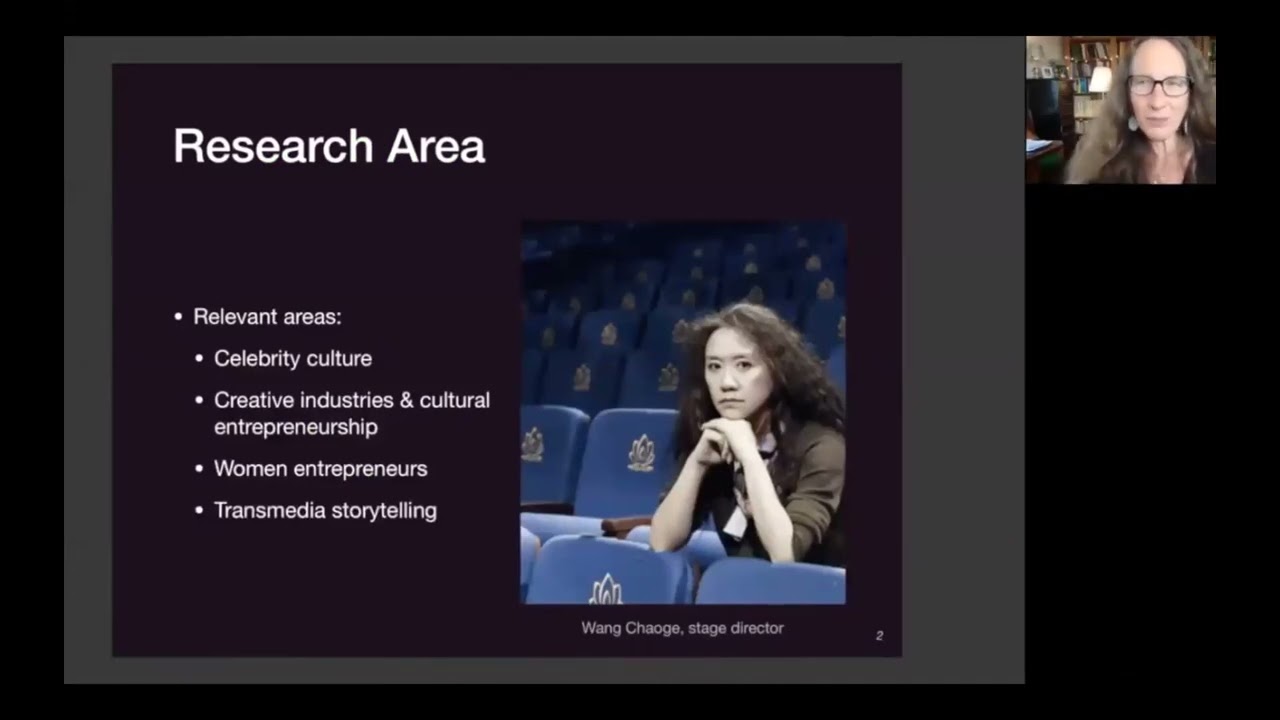
the research area
is connected to the areas of celebrity
culture creative industries and cultural
entrepreneurship women entrepreneurs and
trans media storytelling
the aim of this research is to
understand celebrity culture
and the cultural transformation in
post-socialist china's media sphere and
their social political implications
research questions include how do
china's celebrities use the different
media social traditional etc for
cultural production self-fashioning and
communication
the sources are printed media tv visual
arts etc web-based literature blogs and
micro blogs the best set is an analysis
of print and web-based sources and has
to do with both the contents and also
the frames to
draw connections to the commercial
context
market reforms and cultural commodities
play an important role here is there a
return to the republican era or even
early modern china
market principles pervade the cultural
sphere in the late 1980s and early 1990s
are there seats of a creative class
this is marginal to the system and
stigmatized by intellectuals the
eleven's five-year plan in 2006 said
that homegrown creativity appears as an
economic policy imperative
there's partial reform consumers and
cultural entrepreneurs
are between politics and the market
there are so-called social benefits
between has discovered the value of the
individual creative self-expression and
grassroots energy in transforming
chinese economy and society
jin wang
says
consumption celebrity is an important
concept in this context what fiction
prince fiction and non-fiction
about life in the culture of consumption
and are the texts that we are looking at
the author um
of the book the society of spectacle
guidebook
describes consumption celebrity
celebrity he says is a key element of
the panelization of the modern world
one example is only bobby the internet
writer
and whose real name is lydia she's the
best-selling novelist a blogger editor
and columnist a photographer and more
recently a buddhist recluse who now
writes no longer under the name anybody
or any baby but
which is a buddhist name modern on
traditional women writers and she also
writes similarly in this case as authors
who've also retreated into reclusion
the consum assumption celebrity finds
all of her persona linked with
consumption
hon han is another example of
consumption celebrity he's a high school
dropout who appears in the media as a
multi-personality he's a best-selling
teenage novelist a car racing champion
the world's number one blogger
a public intellectual
a singer and film director also named as
a playboy or a consumption celebrity all
his persona are linked with consumption
and he also ranks among china's top 10
best-paid writers
the propaganda department's honors
are something that we can look here and
in this slide out of 30 top
personalities the only two or four women
if you look at the years 2016 to 2019
for example the stage director wang
chaka
the tv producer akawa sun mei the dance
show produces um junction
the list of personalities are praised
for contribution to tourism the local
economies and the official media etc
are they marginal
above you see images of the video
blogger papi tiang on the left
tin sing a dancer and choreographer in
davos
at the intersection of culture and cash
that's where elizabeth's curry has
placed such celebrities
the creation and
conversationalization of cultural
products marketing business ventures and
self-promotion play important roles here
and the celebrity has both an
ideological and economic role
it is about exchanging cultural goods
while adding to the menus of beliefs
mindsets and cultural preferences from
which others choose here i am referring
to joel marcus research
as i mentioned
um is the pen name of lydia
she became famous
in on the literary website on the
internet um under the banyan tree and
she became one of the pioneers of online
literature in 1997 she published a short
story galbia
vivian
under the
pseudonym of any baby or anybody
she said she had no publishing
connections playing around mar an
important concept in the literature of
the reform era writing out of bought
them just for fun
around 2000 she actually changed from a
web writer or a hack uh esther shaw to a
more prestigious print author or
tortilla by publishing her books only in
print after um
that the year 2000. she has now about 15
books and is the member of the official
chinese writers association she's also
active as an editor translator colonist
and so on
on social media she is known for her
book promotion and self-fashioning as a
buddhism-inspired traveler
and i managed to get an interview with
her also she normally never gets
interviews so i was very happy to be
able to interview her she told me so
once i was able to get my writings
publishers books i just stopped my
online writings
not only was this a successful move from
online to the then more prestigious
print and rebranding
it also points to the dense and complex
connections between multiple traditional
and digital media in today's mature
media media sphere
another example is shooting lei the
actress film director and producer
writer editor and blogger
from my father and i um to go la lago
there's a range of diverse characters
that she impersonated and played that
hint at the real life shooting lane
transmediality as an all-around creative
promotional strategy has been and
character has been characterizing her
career it's not just products but
transmedia celebrity her trans media
celebrity persona that is important for
her marketing
and so fashioning
a shelter inside is a shooting lace
that is shooting lace individuality and
personal life in dominguez with her film
rose and together create the shooting
lay phenomenon
so sitting there can also be
investigated in the context of the
transmedia celebrities here i would like
to point to a better course distinction
between the empirical author the model
author and a character and
and
or as a narrator
with trump's media strategy and the
social media for example the illusion of
contact with the author there's a
flattening of the multi-layered
characters onto the identity of the
awesome both sides of the cultural
entrepreneur's identity
are the promotion of the product and the
promotion of the mindset or lifestyle
for example
a strong woman character more than an um
lifestyle exotic romance and so on
another example of a cultural
entrepreneur is
the woman artist sophie she's a
multimedia artist and international art
celebrity she won a chinese contemporary
art award as best young artist in 2006
and best artist award in 2016.
salvi's art reflects on china's social
cultural transformation from a detached
sometimes satirical standpoint
she wants to comment not criticize the
new york times reports
this points at globalization in internet
age for example her work on renminbi
city and one of the themes that she
discusses or hints at
is the alien nation
on social media or instagram she shapes
her artistic storytelling while
projecting an image of a successful
global artist
here is an example from her instagram
shining a light on chinese workers
room number one and number two
and normal art are works commissioned
and exhibited by gucci
sauerfe's other project was the bmw art
car number 18
called unmanned which was commissioned
by bmw
it augmented reality
uh in her art and she also um added a
short film on a car the w a bmw art car
number 18 which is based on the bmw m6
gt3 is inspired by the speed of racing
cars and the tremendous changes of
chinese society over the past decades
she says on her website
taofas
it's obvious case we can see how most
experimental of creative industries have
broken separation between the elite
serious culture and intense
commercialization and social media
promotion
most avant-garde cultural languages and
darkest commentary on modern society are
fully integrated in the market logics
of the creative industries
to conclude there's a relative
marginalization
the commercial limelight in which these
celebrities find themselves versus the
lack of political cooperation
there's a complex relation between
traditional and new media such as the
digital media with regard to symbolic
capital and creative activities
transmediality appears in cultural
creation or communication and the
shaping of the cultural entrepreneurs
public persona as a multimedia
personality
artistic experimentation appears as a
function of cultural entrepreneurship
thank you very much
great we are so grateful for professor
berg's participation in the seminar
given her very busy schedule
a fascinating
presentation as always so again thank
you to professor berg
now let's welcome professor mung who
will be presenting next
okay let me try to share screen first
is it okay for you guys now
oh good
all right well the nice thing about
doing a pre-recorded lecture is that you
can make sure that you don't go over
time um i i do have a tendency of
talking too long though so and jake
maybe you could remind me if i reach the
12 13 minutes point and then i will know
what time you need
when to wrap up um
so
my talk today is based on a project that
i recently
completed with two phd students about
the experience of chinese overseas
students during the pandemic
and when jake extended the invitation to
take part in this symposium i thought
it's related to the overall theme of the
panel
in two ways one is because the overall
theme of the symposium has to do with
final
us relation and engagement
and
what we did in this project is to
conduct in-depth interviews with
students who were studying
um either in the uk or the in in the u.s
during
the pandemic and a lot of the questions
have to do with how
their views
of the different political system and
also their personal experience with
xenophobia with anti-china
sort of shaped also their their value
during this this time so that that's one
connection there and secondly
we call this mediated
pandemic experience also because
in our interview there's a large chunk
of the the topic guide actually asked
about people's digital media usage
because in a way this current pandemic
compared with all the previous public
health crisis is intensely mediated in
an unprecedented way
and for overseas chinese students
because of the prevalence
of social media usage
they basically live in different
media environments so they get
the mainstream media from their host
country
but also they are closely monitoring and
also very intensely engaged
with
social media accounts
on wechat on weibo and constantly also
getting messages from their parents and
family back home
so it's in a way it's quite a unique
mediated experience for these um chinese
students
um
so that's that's why i think maybe it's
it's it will be relevant and interesting
to talk about this project although i i
do realize you know given the nature of
this symposium i'm not this is not
exactly a research conference so i'm
gonna skip some of the parts that have
um you know focus more on the the
methodology and the research design
um but first just to set the thing a
little bit and thinking about the
context um i think you know there are a
few things to note here
one is the outbreak of the kobe 19 takes
place at the high point of um
neoliberal globalization when both
global interconnection and the backlash
against it
on various fronts have reached an
unprecedented
level
um already you know before the pandemic
there was discussion about the so-called
decoupling of the us and china there was
a trade war there's also the
um the the talking about whether we are
witnessing um
[Music]
cold war 2.0
so it's uh you know really two sides of
the same coin we see in um unprecedented
interconnection but also there's very
strong backlash against it
and economically and geopolitically um
compared to the 2003 stars epic epidemic
china now also occupies a very different
position in the global capitalist orders
um and for the overseas chinese students
as they and and i you know this is also
partly the reason why i um started this
project i started this project really
because i was witnessing
um the kind of experience that my
chinese students were going through
especially around 2020
so in the early 2020s when china was the
epic center
and chinese students were experiencing
all the anxiety and they had to make the
difficult decision about where whether
they should wear masks coming to the
class because at that time it's not
happening you know it's not really
erupting in europe yet
um and they were also there was also a
very you know ugly
racist um
attack and racial abuse happening in the
uk in the at the beginning of 2020
because chinese students were somehow
considered being you know infectious
contagious or
simply because they were wearing musk
but then as the epic center shifted from
china as things were put under control
in china and then the epic center
shifted to europe and as uk went into
lockdown
they
then also experience also intense
anxiety about whether they should stay
here
um or um and especially after all the
teaching went online and whether they
should go back home and if they decide
to go back home is it possible to do
that some of them
bought multiple air tickets just to make
sure that they can finally make the trip
home
so this was really um you know
partly the project was really triggered
by what i witnessed as as the the the
struggle and the stress and anxiety that
my chinese students were going through
at that time
but putting this um you know in an
academic context the questions we are
asking
um in this project is what have been the
lived experience of chinese overseas
students during the kobe 19 pandemic
especially in relation to racism
xenophobia and nationalism
and what are the main discrepancies and
incongruences that chinese overseas
students have to negotiate
in their mediated understanding of the
crisis as i mentioned at the beginning
because you know they are getting
information from both media outlets in
their host country and also from their
their home country um and also because
of the the omnipresence of social media
um you know they were basically
if they choose to they can stay online
24 7. and i'm going to talk about later
how they
then learn to manage their own media
consumption
as a way also to manage anxiety and and
stress
um and then
have their assessment of the political
system in both china and their host
country in any way affected by the
pandemic and this of course is the
continuation of the the first research
question about how you know their
um they experience um racism xenophobia
and nationalism
and putting this in a bit of a
theoretical context so basically there
are two sort of theoretical threats here
one is
uric backs notion of risk society
and the extent to which the risk of
society should mobilize
a cosmopolitan
cooperation and also to
mobilize a cosmopolitan mindset
so his argument is that you know as the
the anticipation of global risk
could result in everybody
an everyday global awareness among
citizens of modern societies and give
rise to cosmopolitan in imperatives of
cooperation
um so this is you know of course you
know he
his notion of cosmopolitan imperative
has both a normative and analytical
dimension and what we want to ask is to
problemize this and ask the question to
what extent
or whether this has really you know the
current global crisis um has
contributed to um the rise of
cosmopolitan imperative and another sort
of um theoretical threat here is is
about diaspora and media consumption and
especially
at this day and age of
social media
pervasiveness
how have the diaspora population
negotiated their national identity and
political legions
with vocabularies and discursive
resources provided
by both you know media from their home
country and also media in the host
country
um
and you know so based on this um sort of
deriving from these two theoretical
threats uh we want to better understand
how is the current public health risk uh
makes it made sense of
by an elite group that epitomizes
mobility and connectivity and we do
recognize very much the the the very
strong elite band in our sample
uh because these are students um
studying
in um elite uk and u.s universities and
some of them even started their overseas
education from secondary school
so we are talking about a particular
group that used to take
mobility and connectivity for granted
and then suddenly during the pandemic
this mobility and connectivity
are
halted
and which also prompt
a lot of deliberation and
reconsideration
and how individuals navigate the young
incongruous and uncertainty by piecing
together
very diversity resources in an effort to
articulate a coherent
narrative
so i'm going to skip this um slides
about the researches with design and um
but just to note that basically the
topic guide has three
main components and and one of these
components is asking about their daily
media usage
um and i'll also skip this slide about
the sample but
generally we try to achieve
a balance in terms of gender
major and also the length of study
overseas but but as you can see here we
have quite a number of interviewees who
had more than five years of studying so
this would um
often include part of the secondary
education
and um you know this is this is a quote
from um this is with an article
published um
during the pandemic um so the um
colombia-based um
historian adam tooth and he was saying
uh that
back is the most important maybe
sociologists that could help us
understand the current crisis and in
this quote um in particular
um he talked about how back was talking
about you know in
contemporary risk a global risk society
there is this almost this demand for
individuals
to
acquire more knowledge acquire more
information and to become the so-called
private expert
on a very complicated issue
so partly um you know the
our interview question dealing with
media usage and media consumption
really highlights
um the cost of becoming the private
experts on the risk of modernization and
in this case
the pandemic
now generally speaking in terms of media
literacy and media usage across the
board because of the nature of the
demographic feature of this this group
we see a very
high level of information literacy and a
fairly sophisticated pattern of media
consumption
and often when we ask them where they
get their
news from
they
were able to make uh this distinction
between different types of
um english language news media and they
are critical of institutional media on
both sides on both the their home
country and the host country
but even more so
of the mainstream
news media in the u.s and the uk
and i think partly this has to do with
the fact that
it's a given that they understand that
media environment in china is heavily
censored
so but many of them said at least when
they
come to study in the uk or or in the us
they were expecting something different
but they were many of them were bitterly
disappointed during the pandemic
especially at the beginning of
the pandemic
because of the way that international
news media reported on the situation in
china
and in terms of social media usage also
they demonstrate very um
nuanced understanding of different types
of social media platforms in terms of
you know i go to this media platform for
this type of information but i don't go
there for such and such
so i go to xiaohungshui if i want some
everyday you know live daily life tips
but i would go to juhu if i want to find
more reliable
informational content
so they were able to to make these
distinctions
and this this very um you know because
of the the very high level of media
literacy and information literacy this
daily curation of media consumption is
often deployed as a protective mechanism
to shield themselves from negative
feelings such as anger distress or
anxiety
and
in reality these students experience
often an acute sense of fragmentation
confusion and contradiction while living
abroad during the pandemic
as much as
these feelings were psychologically
discomforting and emotionally draining
they also enabled um
opportunities of introspection and
reflection
which is um
sort of the the second part of our um
the result of our data analysis so we
call it the the personal is is political
so
you know in the meantime as they
experience anxiety trauma um and and and
all this um you know the the stress
there was also a sense of political
awakening
um and this happened of course not just
during the pandemic some of them said it
happened after they leave mainland china
um and one of the the interviews said
here um you know when i was in china i
was discouraged to to talk about
political issues but when i was studying
in hong kong i suddenly realized that i
am part of the political discussion of
other people so there's no way for me
even to escape this this discussion
um
they
also um
feeling there is also you know a sense
of feeling stuck in an increasingly
polarized world
in the sense that they feel that they
are constantly compelled
um or demanded to take sides um
and often they say you know the issue is
more complicated i don't always want
just what want to to take sides but i'm
you know called upon all the time to do
that
and
they
as a coping strategy they try to
separate the political from the personal
but of course this is not always
possible
and actually in the article
probably this is a very long quote you
won't be able to to read through it
given the limited time but in the
article we had
quite a few lengthy on original quotes
from interview transcripts is when our
interviewees
really open up and talk about their
personal experience
with um
with race with with class and sometimes
also this experience is also really um
closely connected with their
the intimate relationship that they went
through
so
you know partly as a
because we are talking again i'm talking
about an elite group
who have very high level of cognitive
capacity
so in the middle of this kind of
confusion um and the um you know the
stress
there is also a conscious effort
trying to articulate
a counter-harmonic discourse trying to
trying to make sense of all this and
trying to also make sense of the
discrepancy
and the
incongruence that they went through
after leaving china and after going
through the pandemic
um so we
were able to schematize um
what we call four types of counter-her
demonic discourses
um the first one is the you know at the
most surface level the criticism of the
political system in the u.s or the
uh the
the uk
and the um you know the also the
shifting boundary of multiple identities
and this is related to what i said
earlier about this discontent
with the imperative of taking sides in
the polarized world
and
um
the the four types of um counter
harmonic this courses we identified um
there's a there's a tiny slice among all
our um 45 interviews there was actually
one
vocal trump supporter um and he
was able to articulate a a
you know a reason for for for being that
um and he was also very much aware that
he said no i'm probably in the minority
and i don't always tell my friends that
i support um trump
um and there's also anoth a second type
which has is is also more or less in the
minority among our interviewees
but um it's of larger number than the
first one
that those are the people who
were able to
link
the racial
problem and racial tension in the u.s or
the uk with the class issue and
sometimes they say you know this is not
about race it's about class
and and they
were actually able to claim that i'll
actually now i'm rediscovering marx that
even though i was sort of indoctrinated
in my middle class politics
textbook back in china and i never liked
it and suddenly now i'm rediscovering
so so that's that's the second um type
of counter-hardmonic of course
and the third one is what we call the
status
developmentalism
people and this is probably i would say
more in the mature more or less in the
majority
and this is also the group that has the
strongest the nationalist
tendency
in the sense that the way they evaluate
different political systems is based on
economic growth
um and the ability to govern or the
efficiency to govern
so in that
you know regard when they compare
they um you know the the effort the
government-led effort against the
pandemic it's quite clear for them you
know which which side or which system is
is better
but there's also another i would say
probably
um also in the minority um an
articulation of or more of a social
democratic value those are the people
who were questioning this
developmentalism mindset um and um
some of them were even saying that i
don't understand how people in china
nowadays can evaluate everything based
on economic development that's just
insane
so so these are the people who are
questioning whether a good society
requires more than the efficiency of
governance and economic growth
but they are also very critical of
the new liberalism in that the witness
they witnessed in um us and the uk
um so in in conclusion i know i'm going
over time
um
we we would um conclude that leaving
china has been an enabling and
empowering experience but um returning
for many of them when they we asked
about their longer-term plan
um returning is an increasingly
desirable option for many
and the pandemic serves as a prism
through which overseas chinese students
reflect on a host of interesting
intersecting issues including race
national identity and ideological
affiliation
and the elite population has more
resources
undoubtedly including the capacity of
buying multiple tickets just to make
sure that they can eventually travel
back home and they are definitely
privileges
both that they have the both the
material and the intellectual privilege
in mitigating the global uh risk
um but they are also experiencing and
some of them were already able to
articulate the frustration with um
neoliberal globalization and their very
critical comments on
liberal democracy
so i think it remains an open question
if we think about you know these are the
people who are going to occupy
um you know important positions in the
future and think about
the sort of longer term
implication of of this experience i
think a lot of the issues remain
open-ended
depending on you know how
their trajectories develop
but um this is
the gist of our study
thank you for your time and attention
thank you so much professor hmong we
really appreciate it that was a
fantastic presentation our final speaker
will be professor schneider from the
university of leiden um you may go ahead
and share your screen all right well let
me go ahead and uh see if you can see
this my prezi here just gonna switch to
full screen
uh yeah so let me switch to a topic uh
that is slightly different from what
we've heard so far i think you're going
to notice a whole lot of connections in
the moment i'll try to stick to 15
minutes i myself work mostly on digital
nationalism but today i wanted to
reflect a little bit more broadly about
what happens when people come together
online what kind of community formations
we see coming together and what that has
to do with politics specifically uh in
the cases where the community sentiments
turn into a kind of tribalism the sort
of thing that you do indeed see in
nationalist movements so just to get us
started i wanted to create a little bit
of a connection
to politics more broadly and to give you
a brief rundown of why looking at
popular culture at uh subculture groups
might have something to do with politics
and i'm going to start us off with the
us so that you have that connection and
then you'll see in a moment uh what we
might uncover in the chinese instances
uh so uh this is just a brief
relationship diagram here from the 2014
uh infamous gamergate case
you know the age that you might know
this right so um
in 2014 there was this uh moment where
um
right-wing gamers were criticizing women
in gaming and gaming in the gaming
industry uh designers and journalists
under the guise of trying to criticize
game journalism and supposedly the
corruption happening in gaming
journalism there was really just a
misogynist rant against women in gaming
to the extent that a lot of women were
receiving death threats
you can see this here at the bottom
freight threats of rape uh was
absolutely horrific uh and it was um at
the time by a lot of gamers brushed away
as oh yes either boys being boys was
just it's just games
and a lot of people were if they weren't
in the gaming industry and and plugged
in with cultures and subcultures weren't
really paying a whole lot of attention
to this but they should because as uh
subsequent
research and especially investigative
journalism has shown a lot of the themes
that have come up in that 2014 movement
directly informed other right-wing
themes and connected with groups like
the so-called alt-right or the incel
movement if you're not familiar the
people who think the men who think that
their inability to find a sexual partner
is somehow involuntary and is caused by
evil women who are all inferior to men
so an absolutely misogynist group of
people um some even qualify them now as
a terrorist movement uh because they're
out to murder women
and then there's the maga movement which
has an interesting intersection with
some of these groups as well
and all of that
provides a foundation of right-wing
discourses and practices
and cultural themes that all provide the
feeding ground for what we've seen most
recently and that is not to say that the
gamergate people are the same people who
are here in this picture storming the
capital but just to say that they have
provided much of the foundation that
then later in terms of discourses
symbols uh practice and so on uh lived
on in these other more egregious
contexts or similarly egregious but now
very very political context now let's
turn to the chinese case
where fandom practices are uh in some
cases even more extreme than what you
see in europe or america i mean fan
groups are often
very emotional and engaged and
[Music]
often also very activists all around the
world but in china these dynamics often
take on a whole new dimension and a good
example is what happened in 2020 i don't
know if you're familiar uh with uh
xiaojian who's a famous uh actor soap
opera actor really uh he was in a tv
series called the untamed which had
hormone erotic undertones
and was a big hit and so a lot of his
fans started writing gay fan fiction
about him and about his character uh on
archive of our own which is a fan
fiction uh website and another group of
his fans got so upset with this because
they didn't want
their icon to have this gay label that
they petitioned the government and
agitated against archive of our own
until the ccp
shut down access from within china to
this
resource for cultural production and so
the archive of our own folks were
infuriated and there was a backlash
calling for a boycott of the actor um
and of the boycott of all the brands he
was associated with doing significant
amount of damage and was really just a
toxic uh slugfest between these two
groups of fans uh over who owned the
symbol of xiaojian and what it should
mean and there's so much to unpack i
don't have enough time to unwrap at all
in terms of the political economy in
china and how all of this
works but what i wanted to draw
attention to you here
is how
some of the practices that we see on
display here have been on display also
much earlier and
all across
cultural forums in china when fandoms
emerge and how that can be connected to
politics and for example also to
nationalism so my question here
i want to
discuss with you is how do digital media
interact with tribalism in china and
with these kind of community sentiments
and i myself as i said work a lot on
nationalism so you also see the
nationals and then spilling into the
streets for example when uh diaspora
students in this case in london uh
protest um this was uh on
hong kong and uh we've heard from
professor among the the complexities of
how people try to come to grips with
their chineseness in often quite hostile
environments but a lot of that is also
underscored by activities online and
here's another example this is a
satire i suppose rather tasteless one
that appeared in a danish broadsheet at
the start of the pandemic which casts
the prc's national flag as on these
viral particles
this did not go over well with a lot of
people
especially of course people from the prc
the
ambassador
to denmark the chinese ambassador even
wrote a
follow-up piece in which he was
attacking essentially the danish people
for having heard the chinese people's
feeling you have to always imagine the
scare quotes i'm putting in here uh so
that's already quite interesting that
state active state officials would get
involved and have opinions on this and
voice them but of course the cultural
sphere was very quickly ablaze with
retaliation with chinese uh
internet users creating memes and
mocking
the danes and using the danish flag in
various
more or less offensive ways to drive
home that point but then there was a
backlash to the backlash as well
especially among people from taiwan from
hong kong
people who are critical of the prc
who picked up the original symbolism of
the flag and the viral particles and
then reproduced it in all sorts of other
cultural products this is a video game
that was very briefly available in april
2020 on the steam platform a very simple
game really but um yeah offensive racist
really uh pretending or making you
pretend that you are murdering all the
evil chinese zombie folks who are trying
to leave the prc to spread the virus on
i don't know why how it fits that you
are playing the virus but yes that's
that was the premise and it got pulled
relatively quickly because it uh doesn't
meet the the platform criteria but i
have also looked at the discussions
around that game in the comment sections
while it was still available
and you very quickly see these
entrenched groups uh forming each
defending its own side not really having
any conversation with each other and you
know what does that remind us of
so overall these kind of fan practices
are important because they already
establish a set of uh of strategies of
tactics of how to behave online how to
agitate and how to achieve things that
includes doxing people so identifying
who is doing things online and
identifying where they are available in
the real world for retaliation bullying
people cyber bullying informing on
people in sensitive context so that
their employees that their employers
might punish them as employees
or drowning out opposition or sometimes
called the water army and we can talk a
little bit more also about the 50 cent
army the more official
people who are going online to defend
the prc but there's a lot of voluntary
defenders as well and they use a lot of
these strategies that people have
developed in fandom communities now i
want to say a thing to you about really
three factors that i think
drive how these kind of dynamics can
turn especially toxic how they congeal
into communities and what that might
mean not just in china but also for the
rest of us
both in terms of how maybe people in the
us
deal with
chinese online culture and interact with
it but also how we might deal with our
own internet cultures in various
different places so let me just uh so
three three points one is technology one
is political economy and one is the
state let me start with technology
and just point out to you that
communities are pretty much always
constructed right they're often imagined
uh when we see and know people face to
face that has a very specific dynamic
but as soon as we're talking about
people who you don't all know all
communities are imagine whether it's you
know all the all the students at tufts
university you don't know everyone right
that's an imagined community but so are
nations uh so our fan groups so they
already have something in common they
really exist because people are
circulating symbols and engaging in
rituals with each other that are
recognizable to others and that creates
this uh illusion really in people's
minds that they all have something in
common and that illusion can become real
because people are able to leverage it
and mobilize around it in certain
moments under certain conditions what's
important when people share
these discourses these symbols is that
they're using media and so the medium
matters as a delivery mechanism i'm
always reminded of marshall mcluhan's
famous victim that the medium is message
uh it matters that something happens uh
in social media rather than just in the
newspaper or on television the
technology
has its own affordances that it enables
so um this is another famous historian
of technology who said that technology
is neither good nor bad so we should be
careful with technological determinism
but it's also not mutual right design
matters we design things for certain
purposes and the way something is
designed like facebook the fact that you
can have a angry button or sad button
changes the dynamic of a conversation
compared to if you only had like buttons
for instance right and so that is true
for technology all around and certainly
also in the chinese context this is an
example for me studying uh sino-japanese
relations and how they played out
especially in 2012 when there was a
major dispute between the two countries
and i was looking at uh issues in the
east china sea as one of my cases the
diauria islands in china senkaku islands
and japan and if you put diarrhoea
islands into
baidu which is the chinese search engine
comparable in a way to google in terms
of certainly it's market share it's very
influential
if you put uh
dao into the search engine what comes up
among other things is a widget that
shows you the weather on these rocks
which doesn't make any sense because you
cannot go there it doesn't matter other
than to maybe some fishermen what the
weather there might be like and even the
fishermen might have trouble uh
going to those waters considering their
controversial nature and yet you get the
impression here that it's just a place
just like shanghai or beijing it goes
even a little bit further by the actual
website chinese weather whether
logging this as the dyawi islands china
if you speak chinese you can see here
that the autocomplete automatically adds
this as china
and it even registers the yawi islands
as a city district bizarrely
in fujian province which makes very
little sense uh but this tells you
already a little bit about how seemingly
banal uh little choices which are
informed by a combination of social
interaction and technological
interaction someone inputting something
algorithms doing the rest creates an
impression that people may not even
notice is quite political
here's another example a little bit
older one from 2010 but you see comments
like this on the internet of course on
all internets all the time
this is a
hate comment by someone commenting on
the
news paper article on the nanjing
massacre
and writing that you know anyone uh who
kills a japanese person will receive a
thousand rmb you know once this person
has some money and then just says kilco
kill
over and over so i'm not showing you
this to imply that everyone on china's
internet produces this kind of garbage
that's not the case uh this might just
be a quite exceptional comment in many
ways but when these kind of discourses
emerge they sometimes float to the top
of algorithmically governed
platforms as is the case here you can
see on the top right a red stamp and
even if you don't read chinese you can
see this must be important it means
particularly popular response to that
article and that comes up because people
have liked it and interacted with it
shared it and commented on this comment
enough for it to move to the front and
so you know of course these popularity
mechanisms that you also see on other
platforms like reddit and so on that
then also produce
the impression that some things that
might not even be worth of much
attention
are actually representative and
important a final example here
technologically
is billy billy this is a video sharing
and streaming platform which has this
special feature where you comment or can
comment on the video in the video itself
or sort of across the video which is
called the bullet commentary or bullet
curtain
and i did a study on bullet commentary
on videos that dealt with covet at the
beginning of the pandemic during the
wuhan lockdown and one of the things
that i found
was that these comments often
are almost like people just leaving the
note you know i've been here it's
asynchronous by the way so you leave a
comment and weeks later people will
still see that comment together with all
the other comments but they also then
sort of start merging into a conform
message where people start
commenting in the same manner because
they
presumably assume that this is expected
this is the correct way to write about
things so you can see in these videos
that people frequently use phrases like
uh go wuhan go china right jungkook yaya
or wuhanjay obviously that's a classic
comment at that time
and similar uh phrases recurring phrases
that mark them both as
all being part of a similar
community with a repertoire of signs and
language but also that signal to others
you know i know what i'm supposed to be
doing i'm getting active here uh even
though it's probably mostly clicktivism
as it's sometimes called but i'm
interacting with these materials in the
appropriate manner whereas other people
who might have criticism or
have more nuanced
views don't find necessarily the space
in this forum on this format to voice
them or they stay silent because they're
worried about not
offending the the mainstream in these
instances so i've called that viral
villages i refer to networks of social
technical engagement that generate
recursive feedback loops in which these
various kinds of people share their
community sentiment and it becomes
amplified and amplified through these
algorithmic mechanisms and i use the
word village viral village because i'm
again i like marshall mcluhan on what he
wrote about villages uh he used the term
global village and coined it but he
didn't mean what people often mean which
is of the cosmopolitan wonderful world
were all closer together he meant this
when people get close together they get
more and more savage impatient with each
other village people aren't that much in
love with each other and the global
village is a place of very arduous
interfaces and very abrasive situations
and so you can probably see why i have
this quote here this is from 1977 and i
think marshall mcluhan would have
recognized many of what we're much of
what we're going through in that context
now i'm pretty much out of time but i
just wanted to point out beyond the
technological level uh the state level
the way that uh nationalism and techno
nationalism on this chinese state side
and the communist party side is creating
a context in which national discourses
and that kind of tribalism that they
breed
are a logical response to politics and
to international affairs even though the
communist party has a very specific
understanding of what it thinks
patriotism means compared to what people
in china mean and then also many many
different nationalisms in china emerge
but there is already a infrastructure
that pushes a particular kind of
national and nationalist narrative and
perspective in china
and then there is the commodification
the political economy
that the digital capitalism really that
fuels these various platforms just one
image a trigger warning this is uh
pornography and some violence as well uh
these are images from a supposedly a
military history picture archive uh but
it's mostly porn snuff film um really
nasty stuff in many ways which sits
alongside political commentary and
discussion of sino-japanese relations
and that is because the people who run a
platform like this notice that people
click this stuff and so that's what
gives them money what makes the money
and the algorithm feeds back into it uh
signaling to the makers that this is
something that is lucrative and so they
produce more and more racy content and
it kind of spirals out of control
regardless of what the people who make
the content might think about it or what
even the viewers and people click on it
think about it we don't really know but
it creates a context in which discourse
becomes more and more toxic
so let me just conclude very briefly
here by uh telling you why any of this
matters matters because these guys think
it matters right so legitimacy concerns
are at the top of what the chinese
communist party has to worry about
domestically to assure social stability
um the uh party
monitors uh big data social media data
bizarrely it has sort of a dual track
goal on the one hand it's trying to
guide public opinion on social media at
the same time it is trying to measure
public opinion on uh weibo for instance
in order to inform politics uh create
five-year plans that are responsive to
the audience and so on uh but that means
that they're basically measuring
something of their own creation and that
also means that some of the problems
i've just outlined now might feed back
into policy making choices by convincing
politicians that the nationalists might
be more influential than they actually
are in making choices that are more
radically say anti-western anti-american
anti-anything else really and more
domestically oriented uh then might be
uh good from a more cosmopolitan
perspective
and so in the end we have a construction
of a sense of homeland as an existential
problem whether it's during political
crises whether it's during pandemics
that combine the human psychology of
what people do online with technological
design uh the state's position and
commercial rationales and that uh then
gets feet fed back through various other
groups as they challenge these
narratives and create more conflict i
could say more about the milk tea
alliance if we have time in the in the
section uh or in the q a in a moment but
essentially what emerges here is um
nationalism or various forms of
nationalism that are despite or attempts
uh to the contrary not under anyone's
control also not the ccps so i'm going
to conclude here looking forward to your
questions and comments uh and yeah thank
you for your attention
thank you so much professor schneider
that was really amazing um so now we'll
open up the
floor to anybody in the audience who
wants to ask a specific question
um or if the panelists themselves would
like to address each other's
presentations anything they find
interesting we can also do that um
so yeah
leave any and all questions in the chat
people are a little bit scared to ask a
question i do have one for professor
hmong in a moment but uh well maybe
we'll give our participants a chance
first right
um i'll give a general question to start
um professor schneider and hmong feel
free to
answer as you see fit um
china is is
very actively digitizing many aspects of
everyday life arguably at a greater pace
than the united states um what kind of
social consequences does this um
rapid development in technology and
government-sponsored
acceleration of these things
what sort of consequences and
implications does that have on the
public and the government's relation to
the public as well
being sure you want to get get started
sure um
well
i i guess um
i'll mention maybe two aspects um
one is that
um they
i think this kind of very
aggressive rolling out of digital
technology and digital infrastructure
is part and parcel of this state-led
development developmentalism
mentality
and i think it also
helps to reinforce that mentality and
and i see that also in some of my
interviews for that for that study
and it certainly also helps to because
it's all part of that discourse
it helps reinforcing
the legitimacy in the sense that
the legitimacy comes from development
come from technological superiority
and what we see is that increasingly now
when chinese people traveling overseas
they would initially be startled at the
backwardness of digital infrastructure i
think especially in europe
i think in the uk for example
um
so that firstly is part of this
developmentalism mentality that that
adds to the the legitimacy
um and it gives the sense of pride and
superiority but on the on the other on
the social side um what i see as a
very sort of
under discussed um negative consequence
of this is the kind of
exclusion this creates
and we see this very clearly during the
pandemic when the the qr code the qr
health code was rolling out
for the old folks who don't really know
how to use smartphone or who don't want
to use smartphone especially when they
are
you know going out
it becomes a real
issue
so as you
roll out this and and as you lay this
out as the daily informational
infrastructure
you are also basically setting up the
the digital barriers and barriers that
make it
um difficult
for the underprivileged for the more
marginalized group to enjoy the full
service um and this is of course you
know it's not something new we've been
talking about digital divide
but in china i think this become
particularly acute because
you know now your everyday life relies
on how much of your everyday activities
are is now you know being conducted on
wechat it's it's being taken for granted
but it's being taken for granted who
have the resource and the capacity to do
that but not for everyone so and and
then when at the moment like the
pandemic you do see the negative um
exclusive you know the negative
consequences of this
yeah i can only second that um
my my acquired note on what my colleague
here around the corner dutrett
university england hoff calls speed
leads so only very specific groups of
people are actually in the position to
make the most use of digital technology
and that's certainly the case in this at
this rapid pace in china
so you have urban audiences who are very
good at this not everyone of course in
urban centers but it's a very different
story in rural areas um and also the
the rollout of digital technology
interacts with uh capitalist ambitions
in a very interesting and often very
worrying way
pushing people uh to follow a highly
individualist life i find it quite
interesting how chinese students in the
uk are commenting on individualism in
the uk they're not wrong uh but there's
so much individualism in china as well
when it comes to elbows out and i have
to be on top um to the point where um
you see the the streamer culture video
streaming people trying to make money of
that uh only the the smallest amount of
people can ever live off that and
there's a long tale of people
uh my colleague jungkook has written on
this who are just in front of their
camera streaming their entire lives from
morning to evening and have zero views
or one view right uh and they're hoping
to at some point maybe make a buck of it
uh it's it's incredibly depressing so
you have an entire
large group of society that is switched
off and that's going to be a serious
problem
and you have dynamics uh in which it's
easy to make a big a quick buck uh by
exploiting people and by scamming them
and so that's something that a lot of
people outside of china don't always see
and i don't want to defend the communist
party's online regulation i have a lot
of problems with it but a lot of it is
not informed just by the attempt to keep
political oppositions quiet or shut down
the activists and so on it's often a
direct response by grant from for
grassroots
initiatives and grassroots pushes from
the public to say you know i as an urban
middle class person and not safe
shopping online i get scammed you have
to do something right or here's all
these celebrities
and these celebrities are cashing in in
weird ways or spreading body shaming
images and do something about it that is
these are concerns also the sort of
misinformation fake news concerns that
we all recognize uh across the globe and
that the communist party is also acting
on it just so happens that it then also
happens to be one of the biggest spread
of disinformation on the planet on top
of everything else right but there's so
this is a very complicated dynamic and i
think it reveals some of the
contradictions that you see emerging in
digital capitalism
great thank you so much for those
insights um we have a couple questions
in the chat so the first one comes from
michelle lynn and she says a question
for
dr schneider would you say china's
internet controls or interests are
threatening the liberal world order
ah that's a big question
um
i don't know uh i have my problems with
the threat stories um i like professor
mong's comments on ulrich beck and on
risk i think that's a much better way to
understand
how our world works and there are actors
in our world that create risks for
others
it's certainly the case that we see the
communist party rolling out a
campaign to influence public opinion
abroad and to become active for its own
gains
actually i think in many cases that's
not that different from what other
countries do necessarily
but it is often illegal so i can see how
liberals would be worried and we see for
example
this is documented uh chinese uh often
official
actors intervening in taiwan for
instance in order to undermine
democratic processes there or doing
similar things in hong kong also to shut
down discussion
so there is a concern but i'm also
concerned about that narrative about
threat which is so old and so tried uh i
think it creates a self-fulfilling
prophecy in which a lot of chinese
actors feel the need uh to step up the
more aggressive uh hawkish aspects of
their policies in response to what they
see as a antagonistic quote-unquote west
because china is not monolithic it's not
just one actor it's many many different
ministries and organizations that all
have different interests
and it's i think a question also for
people in europe or america who are we
empowering with our own responses who is
served by a trade war for instance or by
uh shutting down certain technology
companies uh abroad and so on uh and i'm
a bit worried that it steps on the
agenda of more liberal-minded potential
allies in china
and empowers the people who are maybe
closer to the pla or the domestic
ministries that mainly care about
domestic status development rather than
say for ministry people who are much
more liberal
so i i hesitate
as a good academic i would question the
question in that sense now to step on
michelle's uh indie very very good
question uh but just as a little bit of
a warning on how we frame these kind of
issues i hope that answers your question
um okay so we have um just one more
question um
this is
from oh we can do that two two more if
we have time if you just want to
quickly touch on these um one is from
artem
how has chinese state media and
censorship responded to the public's
interest in russian in the russian
invasion in ukraine
england you want to start us
um
yeah that's that's an interesting
question i i
i don't think i've
witnessed a lot of examples of censoring
in this particular case because if you
think about the timing of
the russian invasion of ukraine
that coincided with the covet situation
getting
out of control in shanghai
so i think it's fairly easy for you to
draw the conclusion which one gets much
more attention from
the sensor which is that it is deemed as
you know
um
much closer management and and
monitoring
um so i
you know at least i haven't really but
um witnesses um the the the the
censoring
of this case but i would also make two
observations one is that in terms of the
state media it has
been sticking to
the official you know foreign ministry
sort of a spokesperson official lying
saying that
we are against any war um
any invasion um we don't think um any
for any country in just for the sake of
securing their border they could wage a
war
and we stick to the you know we we are
we have concern
with people in ukraine and and but of
course you know as everyone know
what happened during the week before the
winter olympics sort of this special
sort of alliance being declared
um so so i think the official media has
been
walking a very tight line here trying to
not offend both either ukraine or russia
both are important partners to to china
but on the other hand i think
interestingly on social media though
the range of views is quite
diverse that we see people saying that
you know
calling for the separation cheer good
you know we need to we need to get clear
with russia we shouldn't maintain this
special um
relationship and that was by a quite a
high profile academic international
nation but then on the other hand of
course there are people saying that
um this war the the the it's because of
the expansion of nato it's because of
the u.s so russia was only responding to
that and and there was also a lot of
support and and there's also of course
as you can imagine
the energy between the situation in in
taiwan so i would say generally you know
the official media has been
sort of
controlling the narrative quite um
carefully but there's a diverse um view
on social media
yeah i mean if you're interested in this
um
i don't think it's published yet but uh
our colleague jennifer punn at stanford
university is uh doing research on this
with a team of people and she's been
tweeting about it so i can only repeat
what she said which is that there's
about about fifty percent of the way
board tweets that they've been analyzing
are pro-russian and produces kind of
misinformation that we're familiar with
also from russian television from rt
but the rest of the commentators fall
somewhere along all sorts of diverse
spectrums uh
including liberals and critics and so on
um so it is indeed
quite complicated also on the chinese
internet i am a little bit worried about
how much disinformation is circulating
though uh but that is not just the case
in china you also see this in europe i
think 40 percent of people in greece uh
are supporters of putin
i mean that is that shocking in the
netherlands is 15 i find that shocking
already but 40 so we don't have to point
to russia to say you know added to china
say 50
yeah it's not that different than other
places sometimes right
thank you
oh yeah go ahead
um
uh if professor mung and professor
schneider have time for one more
question um
there is one from
dr straffella who co-authored
the speech that daria berg gave today um
i know that we're over time it's about 2
50 p.m uh here in boston um would you
like to stay behind for one more
question
i'm happy to stay a moment yeah actually
no way
wonderful
so the question goes when researching
online culture in china or elsewhere how
do we deal with comments like the one
you mentioned which
is highlighted by the algorithm but not
otherwise representative in our analysis
of the culture as a whole
this is for dr schneider
um i
like goffman the sociologist
anthropologist right uh and the idea of
the front stage and the backstage i find
it very important to distinguish these
two things there's a public-facing
communication element that we can
analyze but we're really just analyzing
discourses we're analyzing the resources
the statements the symbols that are
available to people and that they reuse
in visible ways we're observing
something people do
we're never observing what people think
we don't have no idea what people think
um and we're also not observing what
people do in their private home you know
what do they take home
uh from these comments we don't know
who's behind this comment maybe they ate
something bad and posted it then you
know we don't know what the people
thought who were liking it or
interacting with it uh so i always make
sure to have additional caveats in place
uh to ensure that we're not um
insinuating that we're actually studying
public opinion like real public opinion
uh sadly i'm not so sure the chinese
government is always doing that because
i think there's people there who do
think they're studying public opinion by
looking at big data which is never the
whole story uh so in that sense it's i
think it's important because of the way
these
non-representative but very visible
shouts and screams that we see online
affect
the discussion how they can push
political decisions
we see this in cases with a xiaojian
example there were other cases with
a taiwanese pop star
where it was basically became an
international realm because she had a
taiwanese flag and a little video
and she got criticized extensively and
so you see these online debates and
suddenly the the polls for um saying
when in taiwan go up by a couple of
points because taiwanese people are so
angry that this pop star is forced to
make an apology so words have have
consequences right even if we don't know
who um who's making them but we should
be careful about what happens on the
backstage
um i'm always reminded of some very good
scholarship on the soviet union um right
before it fell all the russian experts
the vast majority of russian experts had
no idea uh that russians were
dissatisfied or at the degree to which
they were dissatisfied they thought uh
that the story everyone was telling on
the front end was the real story and
that's a mistake because uh that may not
be the case right so uh careful with
buying the propaganda or the hegemonic
discourse it might just be there because
it circulates the best not because
people actually buy it
um
great so i think that concludes our
culture panel um a special thanks to dr
schneider dr mong and of course uh dr
burke who was unable to be here synchro
synchronously today and of course dr
straffelo who um
co-wrote her speech
we're so appreciative of your
contributions thank you so much for
making this a wonderful experience
if anybody in the audience has any more
questions
i'm sure
all of our speakers would be happy to
talk to you through email and such and
we can provide you with those after
in an email but uh yeah i think that's
everything thank you guys so much um
bye
thanks for having me
thank you
bye have a great weekend