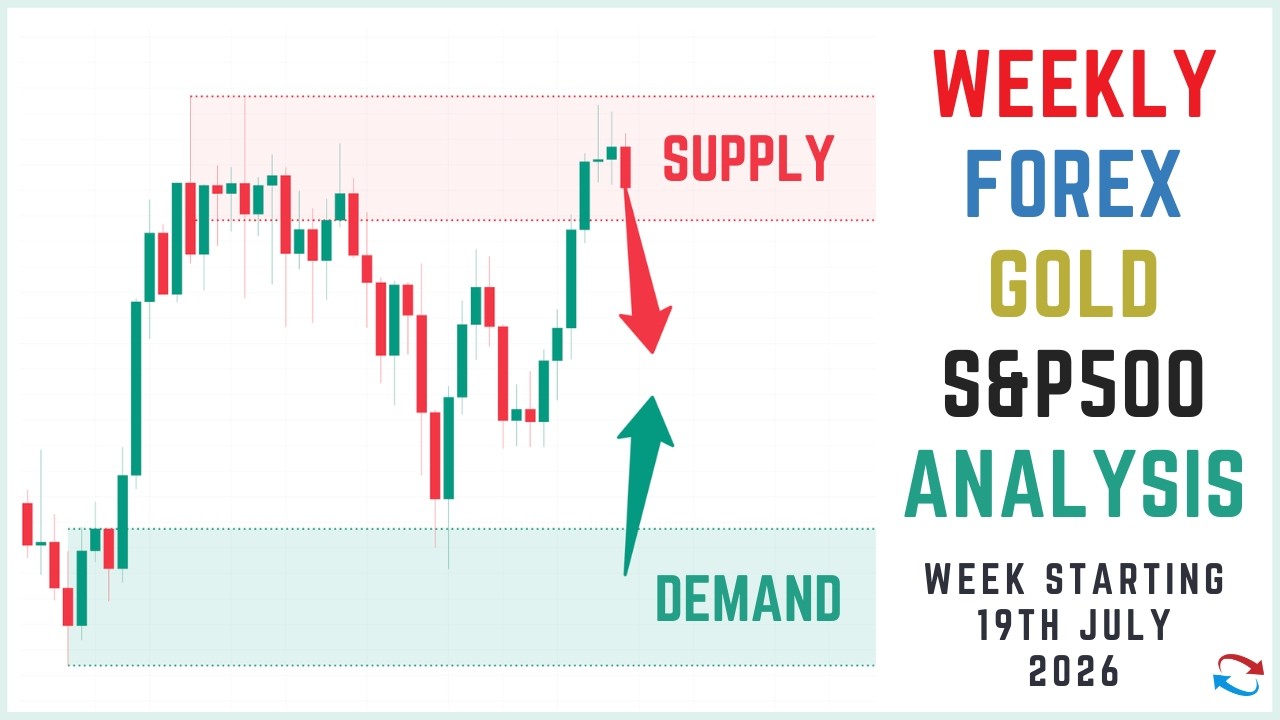
Video summary
The primary driver of this week's market analysis is the escalating geopolitical tension between the US and Iran, which has significantly impacted global risk sentiment and energy markets. Following a series of retaliatory attacks involving drones and missiles that resulted in casualties on both sides, investors have become increasingly concerned about disruptions to commercial shipping through the Strait of Hormuz. This conflict has created a supply shock for oil, driving prices up as hedge funds rapidly increase their bullish bets on Brent crude at the fastest pace seen in over a decade. Consequently, rising oil prices are feeding into inflation expectations, which complicates the outlook for central banks and keeps volatility elevated despite recent softness in US economic data that might otherwise suggest rate cuts.
In response to these high-yield environments driven by potential interest rates and inflation fears, gold has struggled to perform as a traditional safe-haven asset because it does not offer any yield or dividend income compared to Treasury bonds or the dollar. While risk-off sentiment typically favors non-correlated assets like precious metals, the current landscape of higher yields makes fixed-income instruments more attractive alternatives for investors seeking protection against inflation and currency devaluation. The US Federal Reserve remains hyper-focused on controlling inflation, with officials signaling that they will maintain a hawkish stance unless there is clear evidence that price pressures are subsiding due to the resolution of Middle East conflicts or other factors. This dynamic suggests that major central banks, including the ECB in Europe, may hold off on rate hikes for now but remain prepared to act aggressively if inflation proves sticky, particularly given Europe's heavy dependence on imported energy.
Currency markets reflect these fundamental shifts with a generally bullish bias toward the US dollar and bearish views on currencies from regions heavily reliant on energy imports like the Eurozone and the UK. The pound sterling has recently rallied due to political speculation surrounding Andy Burnham becoming Prime Minister, but this move is viewed as potentially unsustainable given underlying fiscal concerns and short-squeeze dynamics; traders are advised to wait for a pullback before considering long positions or look for selling opportunities if inflation data remains resilient. Conversely, the Japanese yen continues its downtrend against the dollar with room to weaken further toward intervention levels around 165 per dollar, although analysts believe there is still significant upside potential before officials step in to defend their currency. The Euro faces a similar challenge as it trades within support and resistance zones while awaiting a likely pause by the ECB until September, making it suitable for range-bound trading strategies rather than outright directional bets at current levels.
Looking ahead, specific trade setups are identified based on technical confluences with fundamental biases, particularly in pairs like GBP/USD where short positions may be taken after political-driven rallies exhaust themselves or EUR/GBP which offers attractive entry points near weekly demand zones offering an 80% discount to fair value. Gold and silver remain under pressure due to the strength of the dollar and high interest rates, with sellers encouraged to look for dips into specific price ranges around $4127 before attempting short trades rather than chasing upside moves that contradict current macroeconomic realities. The S&P 500 is expected to continue trading within a defined range as investors diversify away from equities toward higher-yielding assets until there is clarity on the Middle East situation or signs of dovishness from the Federal Reserve, at which point long-term bullish opportunities may re-emerge for equity markets.
Read the full video transcript
Hi, my name is Leon Ro, currency trader
and trading coach at trading180.com.
Welcome to this week's supply and
demand, Forex, gold, and S&P fundamental
and technical analysis for the week
ahead starting the 19th of July. Hope
you all had a great trading uh week last
week and uh getting into the week ahead.
And it says here and this is from
trading economics developments between
the US and Iran will remain in the
global spotlight after strikes escalated
impacting energy prices and interest
rate outlooks for central banks. A
softer week of US data will be hand
headlined sorry by leading indicators in
S&P PMIs CB leading index and results
from regional uh Fed surveys. Meanwhile,
the ECB will deliver a rate decision and
Europe will see a batch of sentiment
indicators while the UK will unveil
inflation rates and the employment rate
and retail sales. In Japan, the trade
balance and CPI are due. Elsewhere,
Canada will publish consumer inflation
data on the political front. Labor Party
leader Andy Bernham is due to become the
UK Prime Minister. said there's quite a
few market moving uh news macroeconomic
news events uh coming up this week. So
looking at risk sentiment overall and it
does look like volatility and risk risk
sentiment [clears throat] has increased
uh over the last couple of days trading
days from around Thursday to Friday and
we've also seen that being backed up by
you know the SM uh falling a little bit
right and that's really due to uh what's
going on in the Middle East and it says
here US and Iran trade more attacks
after two troops killed in Jordan. So,
the US and Iran engaged in another wave
of tit fortat attack attacks with US
forces hitting uh Quishim, I think
that's how you pronounce it, island and
uh southern cities in Iran and Iran's
army retaliating with drone strikes
targeting US forces in Kuwait. The US
strike sought to uh degrade Iran's
ability to threaten commercial shipping
and swiftly punish Islamic Revolutionary
Guard Corpse forces behind the Jordan
attack that killed two American service
members and Iranian Supreme Leader
I'm not going to uh Kamini uh warned uh
of unforgettable lessons uh for the US
saying US violations of the memorandum
have once again proven to everyone the
truth uh of how worthless and invalid
the signature of the US president is. So
um that's uh one of the uh the riskoff
narratives that is really driving uh
headlines and also as well we have here
that hedge funds add bullish oil bets at
fastest pace in a decade. Right. So
hedge funds increased their long only
positions on Brent oil by 75,96
to 357,154
in the week ending July the 14th.
biggest increase since December 2016.
The increase in bullish bets came as
fighting between Iran and the US ramped
up dampening investors expectation of a
uh sustained recovery in shipping
through the straight of horn moves. The
conflict has tightened the global supply
of fuels such as diesel and gasoline,
sending profit margins for refiners to
records and lifting long only NYX diesel
bets to the highest level since the
first days of the Iran war in March. So
the Iran conflict that's raging on is
causing, you know, a supply shock. um
therefore uh you're going to get uh
higher oil prices and therefore higher
oil prices feed into inflation, right?
And so um yeah, we've got really that
going on uh in terms of risk sentiment.
Gold not really being helped uh even
though we're in a riskoff environment.
Yes, gold is typically a risk uh off
[snorts] asset where traders will um go
into um gold to protect um a hedge
against inflation. But the issue is is
that gold doesn't pay an interest,
right? It doesn't pay a yield.
Therefore, um in a high yielding
environment, risk off environment, uh
gold doesn't do so well because there
are alternatives like the US dollar and
um treasury bonds, right, which pay uh a
yield.
So in a higher interest um rate or
higher yielding riskoff environment uh
gold doesn't necessarily typically uh do
that well right um and so gold
struggling um in this environment and
then we have the uh US uh 2-year
Treasury yield which is reflects uh you
know interest rates bonds thinking about
where interest rates are going inflation
is going um and also investor confidence
in government debt
Uh typically the rule of thumb is when
you have uh rising uh short-term yields
uh you or at least a stable short-term
yield where it's ranging uh the bond
market are assuming that the central
bank are likely to kind of hold rates
and the potential for high rates and I
think uh in the short term and this is
what's really being reflected where you
can see uh the uh 2-year yield over the
last month really just within this
range. kind of made new highs, but then
it's kind of pulled back a bit. So,
you're looking at this sideways
movement, but I mean, if you if you're,
you know, looking at to add, you know,
some trend lines, it is in a little bit
of a uh in a little bit of a channel as
well. But overall uh the potential for
uh rates being held in the US at least
for a little longer with the possibility
of hikes depending on the effect and how
long the conflict uh lasts in the Middle
East, right? Which will um uh is likely
to contribute to rising inflation and
therefore inflation rising would mean
the potential for uh rate hikes across
the board, not just with uh the Federal
Reserve but likely with uh other central
banks as well. And so we're looking at
the interest rate probabilities and we
have here that most central banks or all
central the major central banks anyway
that we're looking at in this video um
excluding really the RBN zed, but we
don't cover that uh in the uh YouTube
channel um are really on hold, right?
The next move is on hold. Next moves are
in pretty much late uh late later on
this month, late July. And uh the
probabilities of a hike for the Fed is
20 um 24% at the moment. So, low
probabilities of hikes for um for all of
the central banks. And in fact, it does
look like the it says here the Bank of
Japan might even end up cutting rates,
which would be very surprising
considering they um their inflation is
is rising as well. But ultimately um the
Fed I think still in the driving seat
and really when we're looking at the uh
the US dollar you know we have pulled
back a bit right down into this uh uh
support and resistance zone below it is
a bit of a demand zone. So let's see if
prices react to the support or
resistance or whether prices you know
move to the downside and then more to
the upside.
And uh uh really what's driving the
dollar um what drove the dollar this
week was that it says here US bonds
extend rally as soft inflation data dims
Fed hike bets. So treasuries rose for a
second day after um soft US inflation
readings reinforced optimism uh that US
inflation has peaked and may curb the
need for Federal Reserve to raise
interest rates. Traders paired back
their wages for a quarter point Fed rate
increase later this month, pricing in
about three basis points worth of
tightening this month. A roughly 10%
likelihood of a move. And the June produ
producer prices report showed a 0.3%
drop from May compared with a median
estimate of no change. And the
year-on-year rate slowed to 5.5%. So
inflation kind of came down this week
but as the market is quite forward
thinking again you know understanding
that there you know there's a pretty
much maybe a little bit of a lag when it
comes to inflation um and uh and oil and
the effect of oil prices on inflation
right um I think uh in the short term
that did have obviously an effect on uh
you know the dollar right to the
downside but as the war continues to u
potenti potentially continue. Um we
could see of course um inflation numbers
come in maybe a little bit higher or a
little bit more sticky. Therefore um the
short-term or the medium-term
inflation expectations are what are
likely to support the dollar as well as
of course the riskoff narrative as well.
The fact that there's war, right? Uh and
it says here as well, Walsh shows his
inner hawk as inflation debate heats up.
So, Federal Reserve uh Fed officials are
expected to leave interest rates
unchanged when they gather in Washington
on July the 28th, 29th, but a family
fight could come to a head in the
meetings that follow. Federal Reserve
Chairman Kevin Walsh has hammered home
the message that the US central bank is
on inflation watch. So, that's their
focus and has no tolerance for inflation
with some officials warning of an urgent
need to act. The central bank could
consider raising interest rates if
inflation doesn't call soon with vice
chair Phillip uh Jefferson and other
officials signaling a potential rate
hike although most analysts see a July
hike as a long shot. So the Federal
Reserve is you know hyperfocused on
inflation, hyperfocused on how long uh
these attacks will continue to happen
and along the straight or moose is
closed for. Um, and so again, if you
have a situation where hedge funds are
adding adding, you know, hugely bullish
bets as well, the fastest pace in a
decade, I would assume that they are um,
you know, pricing in uh, basically
higher oil prices for a for a bit
longer, right? And that um, you know,
that's the the the more higher
probability bet. Therefore, I think the
dollar should be a bit more supported in
this environment. Yes, it could continue
to move to the downside, but I think any
moves to the downside are likely um
buying opportunities until uh the risk
sentiment uh eases, the straight of horm
reopens and inflation uh potentially
continues to kind of trend to the uh to
the downside. But if you are looking for
a uh a dollar short,
then I would really kind of suggest um
waiting for a pullback, right? And this
is the dollar index, by the way. equally
weighted dollar index. Uh the dollar
equally weighted against currencies like
the euro, the pound, the yen, the CAD,
the Australian dollar, New Zealand
dollar, and the Swiss Frank, all the
major ch uh pairs and currencies that we
trade. And um and so I would uh uh wait
for the um dollar to be on the expensive
side, right, before looking to short the
dollar. If I'm if you're looking to buy
the dollar against any of these
currencies and you see a setup on your
pair, what you want to see is the dollar
on the cheap side and the pair uh and
you know the currency that you're you
know looking to sell against or buy
against either be on the opposite side.
So if you're buying the dollar then the
Swiss Frank would have to be on the
expensive side and vice versa. Right? If
you're if you're selling the dollar and
you're looking to, you know, then and
you want to trade against the New
Zealand dollar, then the um New Zealand
dollar would have to be on the bargain
uh end of things, right? So, that's
really where I am. Um I I think you can
probably look for more buys than sells
or more bullish um at this point in
time, at least for the next week until
proven otherwise. I'm more bullish on
the dollar
uh at the moment. Uh looking at the euro
and uh the euro did come down really to
the end the bottom end of this uh demand
zone with a little bit of uh um support
here proven support in the past.
We've had some resistance here, a bit of
support. Really hasn't acted as uh
anything until recently. And so um from
the Euro perspective, this week is also
a bit of a crucial week. And it says
here ECB set to wait for September to
hike one last time. poll shows. So,
economists predict the European Central
Bank will pause to assess inflation next
week before delivering a final interest
rate hike in September. Most respondents
in a Bloomberg survey anticipate a
quarter point increase in the deposit
rate to 2.5% in September when policy
makers will have new quarterly forecasts
and the ECB's decision will depend on
the situation in the Middle East. Right,
surprise surprise. and its impact on oil
prices and inflation with some
economists saying a September hike is
not a done deal. So again, the ECB just
like pretty much all other central banks
are looking at the Middle East situation
um oil prices and inflation as to
whether they will aggressively hike
rates
maybe high crate what once twice or
maybe even not at all. Right? So uh one
thing though in Europe is quite
susceptible unlike the US susceptible to
higher inflation in terms of the impact
of inflation on their economy because
they're heavily dependent on energy on
importing energy. Inflation um uh
affects them uh a lot more acutely than
it would in the US who are net energy
exporters. uh therefore uh high
inflation um does typically tend to or
can um end up hurting the economy as
well. So um in a high inflation
environment, the euro wouldn't
necessarily do well against uh a
currency like the uh US in a riskoff
environment. So um uh the euro I
wouldn't say even though they're
potentially looking to hike rates in
September um I don't know whether they
would be it would be really kind of
strong enough against the dollar against
some other currencies who are again in
the same boat maybe a little less um a
little less hawkish then the euro could
be a buy but in terms of looking for uh
buys against the US dollar I would
personally refrain against that but the
euro can be a buy or a sell a buy at
lows, a sell at highs. You can ether
look for a buy now, uh maybe a little
bit more of a pullback if you're looking
for a bit more of a discount or you're
looking at maybe sells if we get to uh
this supply zone around here. And even
around there, there looks to be a little
level of uh resistance on that daily as
well where you've got, you know, level
of support there, bit of support here,
resistance along here as well. So maybe
a bit more of a pullback if you're
looking for sells on that euro.
Looking at the yen and the yen again
been short had bit more of a short bias
over the last few weeks as well and that
has played out and we're at these lows
again. And the last time we were at
these lows, uh, we had intervention,
right? This was the intervention day,
30th of April, which, you know, the
central bank, Bank of Japan, ended up,
uh, uh, uh, intervening to try and
defend um, a weak uh, currency. They
don't want the currency too weak because
a weak currency means inflation goes
higher and they're not, the central
banks aren't able and the Bank of Japan
wouldn't be able to achieve its 2%
inflation target if it's overshooting,
right? So um is there intervention uh
now? Right? Is there likely to be
intervention now? And it says here that
yen options suggest a slide to 165 on
the dollar yen level before Japan
intervenes. So the yen has room to
weaken uh more before Japanese officials
step into support the currency. options
suggest uh a combination of global and
local factors are weighing on the
currency including the gap between the
US and Japanese interest rates. Traders
are comfortable pricing yen weakness all
the way to uh 165 per dollar uh which is
a drop from the current level already
near the weakest in four decades. Right?
So the yen overall,
you know, is weakened. Even if we do
zoom out and look at the uh all the data
that we do have, we have up in, you
know, back from until November 2026 and
we're even below that, right? So the yen
index is uh extremely um uh weak, right?
And so when we're looking at the um uh
the uh the yen, if you're looking at the
dollar yen, which we'll get to in a sec,
uh if it's looking at 165s, then and
we're maybe around the 163s. And let me
just double let me just check. We're at
162s 40. So, you've got at least another
um you know uh maybe about 250 pips uh
worth of upside potential which may mean
that this would likely break this level
before we even you know before we get to
uh a situation where the central bank
may intervene.
So overall bias would still look for
sells on the Japanese yen and the pound
the pound has had a great run right a
fantastic run. I have been bearish on
this. Um I've had a more of a bearish
bias and I think this this move to the
upside is really due to a number of
things but mainly due to short squeezes.
Um a couple of weeks ago um I went over
the fact that there was an article that
was saying that the um the market was
heavily bearish on the uh pound because
when you look at the pound fundamentally
it wasn't necessarily great at the time
but it has recovered right short
squeezing a lot of traders and then we
had this move on the Wednesday where we
had this outsized move on uh on
Wednesday and it was really uh more due
to the the political side of things and
the fiscal side. Then it says here,
"Pound hits one-year high as fiscal
fears ease and the bears retreats as
sterling hit its strongest level in a
year as speculation about incoming prime
minister Andy Bernham's chancellor of
the excheer pick accelerated a shift
away from bearish positions on the UK
[clears throat] sorry currency.
The uh Bloomberg British pound index
rose to its highest since July 2025 with
traders uh and analysts citing a mix of
politics, positioning, and technical
factors behind the move. Reports suggest
Burnham may uh name home secretary
Shabina Mahmud to lead the UK treasury
which is viewed as a market as a markets
friendly choice and has helped boost
sterling demand and turn traders bullish
on the pound. So
the pound uh becoming now uh a really a
a buy um in you know if you're looking
at the headlines uh I do think that the
uh the pound um isn't necessarily um an
an allout buy. I still in my private
members group um looking at more sells.
I do think that this is potentially a
stop hunt. There is data coming out this
week for the pound which if um uh if it
isn't necessarily great, we can uh we're
likely to kind of sell off. Plus, we
need a bit more of a pullback
technically as well. There's probably
some profit taking going on as well. I
think the short squeeze may be done a
little bit.
So, um so really what we're looking at,
I think if you are looking to buy
anyway, then you' look be looking to
maybe little bit more of a pullback
maybe down into this zone before looking
for a buy. But uh I'm actually short on
the pound. I've got in short on the
pound uh the pound dollar also as well
in the risk uh off environment and with
higher higher oil prices. The pound
doesn't typically do well. Again, just
like Europe, uh the UK uh import a lot
of their energy. Therefore, inflation um
higher inflation is a problem and it can
hurt the uh the economy. So um we could
see a bit more of a pullback. Although
I'm not totally against uh buying the
pound, maybe on a bit more of a pullback
in the short term. So if it does pull
back down to these areas and you're uh
and you're looking to buy the pound,
then fine. But again, as we get into
maybe uh the the budget, August,
September,
end of August into September, I think
the pound is likely to probably stall as
we get more uncertainty around uh Andy
Bernham's um uh labor and fiscal policy.
So the pound can be a buy at lows, sell
at highs. I'm still uh you know looking
for looking for sells at the moment, but
I'm not against buying the pound uh in
the short term if we get a decent
pullback and the environment supports
it. So overall, my uh my bias for the uh
for the dollar would be more buys,
right? I look for a buy on the dollar
and it's actually cheap at the moment or
considered cheap, an area where it's
pulled back. the euro. Um I am long on
the euro against the pound. I think um
the euro could have a bit of a pullback
this week and the pound a bit of a
sell-off. Um and I'll get into that
again in my new trades as you can see
down here. Uh the yen we've got still
sells. So I think my bias therefore if
you're looking for sells in fact you're
looking for really kind of um first area
[clears throat] to kind of look for a
sell would be somewhere around here
[snorts] where you've got level of
resistance right here. If it pulls back
up to this area or anywhere around these
highs I would definitely suggest looking
for sells unless of course there is some
sort of intervention. And with the pound
I think you can look for buys and sells.
short-term um sentiment I think is
definitely supportive for the pound. Uh
but in terms of the technical side of
things, I will look for a sell uh into
um I what I think would be a decent or
should be or maybe be a decent pullback
this week even if it pulls back around
here. Um and the and the uh um we should
see some downside uh to the pound
overall. So
looking at the pairs and the pairs this
week, uh we have the Euro dollar. Um I
do think that the euro uh could
rally a little bit if the European
Central Bank uh you know come out a
little bit more hawkish um this in their
in their meeting this week. Uh there is
a nice little stop hunt level around
here as well for those who knows how to
trade stop hunts. I wouldn't be
surprised if we saw a bit more of a
pullback. But in this current riskoff
environment, I would favor any downside.
So if prices do pull back this week and
stop hunt, that would be a decent trade.
If prices do pull back, even up to this
area here, I would still recommend, you
know, the pullback. As you can see, the
immediate trend, which is driven by the
fundamentals, is still really more to
the downside. I don't think there's
really a material change or structural
change in the in my bias.
Uh the dollar yen should continue to be
really more on the upside. Uh I would
probably draw if there's any kind of
demand it would be probably around here.
Uh got demand around here. So at the
maybe uh got a level as well probably
about here. Um
right. Yeah. So we got a level of bit
support there. Support there. So maybe a
pull back into the 161 120s and
somewhere within this zone, right?
Actually, probably the 160s would be
even better, right? But
remember, we've got at least uh 165
about 250 pips to the upside before uh
there's even a chance of an
intervention. I think any pullbacks into
this zone around here or below uh a
decent buying opportunities
uh the pound right the pound and I'll go
into um uh my trade setup and how I got
into this uh short I think should really
be on the uh on the short side. So
there it did actually touch this uh
supply zone right here. So, there was an
opportunity if you were looking to uh to
short in this uh supply zone. There was
an opportunity there. But I ended up
getting in on a stop hunt, which again
I'll go in a bit later. But if you are
looking for um sell, then maybe, you
know, the riskreward might not be worth
it right now. Maybe you'd have to wait
for a pullback back up into this level
before going short. If you're looking
for a long trade uh and looking to buy
the pound against the dollar, then down
here would be really where your nearest
demand zone is.
Uh Euro pound and the Euro pound. Again,
I end up getting long around here. There
are reasons for that um which I'll go
into when I uh go into my trade setup.
But um as it stands, it does look like
uh there is a demand zone from a daily
candle perspective. You've got a demand
zone here and you've got a demand zone
there. Now, many of you might be
wondering, well, how did you get into a
trade if uh there's no demand zone? And
there is uh an area um around here where
I um uh I'm able to get into a demand
zone. And it's really to do with uh
auctions and 80% of auctions to
discount. So basically it's just looking
at the high to the low from here to
here,
right? The overall and then looking at
around 80% of that zone as well, right?
So 80% discounts I don't mind buying at
if the top is that if that's 100% right,
you're paying premium prices, right? And
then this is fair value 50% discounts
and then we've got 80% discounts around
here. if prices kind of touch this area
of 80% then I I will look for a uh a buy
on that as well. So that's the reason
why I ended up getting involved in that
trade. So but I'll show you where uh
exactly where I got in on and where my
stop losses are on this trade. Um but if
you are looking for uh a sell, right, if
you're looking for a buy, you can either
do that or you can wait for prices to p
kind of pull back a little bit deeper
into this demand zone. If you are
looking for [snorts]
uh shorts, then you've got a level of
you got levels of supply just above here
where you can look to get involved. If
you feel that the pound is likely to be
um is likely to be um uh the continue to
move to the downside. Remember when I
bought here as well just to kind of give
you the uh the background as well.
Technically the euro right was seen as
cheap. Yeah. So remember it's pulled
back here and the pound is seen or was
seen as on the expensive side right and
so euro pound when we go to here that's
it. So that's really the uh the
confluence or one of the confluences
that I uh I use.
So you can go long there if you're
looking for a pullback, then maybe a
pullback, maybe a double bottom or maybe
even further down into this demand zone
before looking at going long or short if
you want to trade against my position.
Um Euroyen again, Euro Yen, I feel that
the euro um should continue to be uh the
stronger of the two. Um the chart
doesn't necessarily look great when it
comes to looking at demand zones. Not a
great chart, but we do have bit messy
but we do have an area of support and
resistance uh that you know you can look
towards here probably around here as
well. Probably around these lows. Yeah,
maybe that low there. So maybe here and
then looking for a low also as well. You
can go down into that lower time frame.
see where there's potential um zones in
terms of you know lows and try to trade
around uh those lows as well.
But on a monthly perspective, this being
a monthly high, monthly low, I would
look for anywhere around the 184s,
right? 184 round number, maybe just a
bit higher than that 18450s to then look
for potential uh upside as long as again
uh there's no intervention. There's no
threat of intervention uh on the uh for
the uh yen. And then we've got the pound
yen and uh again, no surprise we're
seeing the pound, you know, strengthen
against the yen, right? So I think any
pullbacks into a demand zone will be
nice. Nice confluence here as well.
You've got a level of support and
resistance. So if prices do pull back
into this area and again we don't have
any threat of any kind of intervention.
I think that would be nice for a buy. Um
again if if the environment does support
uh the pound
uh pound buys. So looking back here we
we've been uh this is actually uh
a decent area to look for some long
trades, right? Um so looking at the
metals and gold again, we were talking
about this uh gold's kind of um you know
pulling back a bit. Is there a chance
prices could move continue to move to
the downside? I think so. Gold was
always a long-term uh buy, but um in the
in the short term, it does look like
with inflation uh and and the Federal
Reserve maybe looking to potentially
hike rates, I think we could see more
downside potential for gold. As I said
uh earlier um gold is typically a hedge
against inflation but in a higher
interest rate environment
uh investors are really going to choose
uh you know a yield right a yielding
riskoff uh asset rather than a
non-yielding riskoff asset. So any
pullbacks into this zone should be um
should be I think a sell. If we're
looking at this over the last month,
then we can look at refining some of
these uh these areas here. Nice area
there where you can look for uh trades.
So somewhere around this one um this
4127
to 4122 area I would say looking for
shorts. And of course the better the
better the uh the price short the
better. Right? If you are looking for
longs, you can look for longs if you
feel that the dollar is going to get
weak. But um remember when you're
trading gold or silver, um if you're
looking to buy gold, then the dollar
really should be on the expensive side.
It really should be up in a supply zone
or a level of resistance. And we don't
see that at the moment. So
[clears throat] because of course, you
know, this is gold against the dollar,
right? So if you're buying gold, you
think gold should be cheap. that means
that the the the the dollar should be on
the expensive side and the dollar isn't
on the expensive side. Actually, got the
dollar is considered on the cheaper side
at the moment. So, um personally, I
wouldn't look to buy uh gold even though
gold may move to the upside, right? But
it wasn't necessarily the smarter move.
And the same thing with silver. Um
pretty much in the same boat as gold. Um
they move in tandem typically.
Therefore, you've got areas around
actually it's probably broken through
that zone.
So, the next area you're looking for
probably is somewhere around here,
right? Or you're probably looking at a
weekly zone where weekly discounts,
right? From that high to that low
probably where you got there and then
you've got yeah discount. So you can
actually start to look to trade actually
anywhere [clears throat] within this
zone if you're looking at that weekly uh
area there. But with what you'd want to
see within that zone, quite a wide zone
is areas of support and resistance which
actually come down to. So you got that
weekly level, weekly high, weekly high,
those wicks there and then prices have
actually come down to it and actually
are touching it. So that's if you do
want to be a buyer of uh of silver.
Technically it looks nice but
fundamentally I would not look to trade
that unless I was bearish on um on the
dollar and even then the dollar would
have to show me that it's on the
expensive side before I look to take any
kind of short trades. Uh looking at the
S&P. So, the S&P
um we have here uh S&P
uh kind of reacting off of this level of
resistance and supply. We kind of not
breaking through this alltime high. As a
rule of thumb, typically in a high
interest rate environment, the uh the
S&P um will I wouldn't say necessarily
won't do well, but may the upside may be
capped. um uh and this is due to just
investors having a bit more
diversification when it comes to um when
it comes to their investments, right?
Because although yes, the S&P uh has
moved uh moves moves to the moves to the
upside,
investors will also put their money into
higher other higher yielding um assets
like uh bonds, government bonds as well
as uh you know the US dollar and
emerging markets. So, uh, I do think
that the upside is capped for now. In a
riskoff environment where there's
volatility worries, inflation worries,
we could see a bit more of a pullback.
Overall though, the uh the S&P should
should be a buy if you're if you're more
of a longerterm investor. Uh, but any
pullbacks into these zones. Um and then
when the coast is clear when it comes to
bit of a resolution on the Middle East
or maybe even when the Fed starts to cut
rates, right, that would be a great
signal. If the if the Fed start to get a
bit more doubbish on rates, uh then I
think the S&P is going to be a really
really good buy.
But for now, I'd expect uh the S&P, as I
said a couple of weeks ago, the S&P to
likely uh remain within uh this range,
this auction of prices between that
high, the one, sorry, the 763s to the
723s
uh for a little while until um we get a
bit more clarity on risk sentiment and
maybe what the Federal Reserve is doing
with interest rates. uh looking at the
trade updates and uh last week I wasn't
around um but uh we did have some some
open trades and uh one of them was the
uh CAD Swiss uh took uh profit this
week. I was saying to the guys in the
group when we was in our group call I'm
going to take profit on that one. So
that was a nice trade that I only only
end up getting into one position. I took
80% off of that uh position when it
reached the 1:1 and then the rest of the
remaining 20% of that position ended up
taking off up here.
So I'm out of the uh CAD Swiss and then
the New Zealand Swiss. Uh remember we
entered here, entered into five
positions around here. Uh managed to get
in four positions at a one to one and
then one position I took off at uh 80%
of the what I've considered the uh the
auction right here. Uh but it continued
to move to the upside. Right. All right.
So, that trade actually could have been
somewhere around about a 5:1, but end up
only being about a 3:1, which is which
is fine,
which is all right. So, uh, profitable
trade nonetheless. As the old saying
goes, you can't go broke taking profits,
right? So, um, especially when you got
good riskrewards. So, um, so that was an
overall profitable trade idea trading
the New Zealand uh, dollar Swiss. So you
can go back to uh my previous videos to
look at, you know, my entries, uh my
stops and my targets and the new trades.
So this week I've got into the pound
dollar. So the pound dollar um this was
a stop hunt was the reason why I got
involved in this. This was the trade
setup. Um
uh so you got a nice level here. we got
a really you know large move uh again
based on the uh I think it was the
political side of things. It was here
fiscal uh fiscal fears ease um and it
was of of course you know the fact that
um Andy Bernham was was likely to um
name secretary Shabbina Mahmood to the
um to the chancellor role. Right.
Uh but then um I thought to myself, do
you know what? I'm still a bit bearish
on the pound. I don't I don't know
whether this move is, you know,
sustainable. So I'm looking at going
short. So uh my entry uh zooming down
into like the lower time frames, right?
When prices came back inside this level,
I decided to uh enter right here. Uh,
and then I've also got um some sell
pending orders above price. So, if
prices do pull back, then I'll be able
to get involved in several positions as
prices, you know, pull back and
hopefully it's a better better entries.
And all of the uh the positions there
the the stop loss is around here, which
is going to be the 1.357
uh 78 area.
So, let's see what happens with this
trade. And then we've got the Euro
pound. And again, I went over this a bit
earlier, um, where we had, zooming out,
we've got this area here, uh, 80% of the
weekly zone, uh, a discount and then
prices pulled back into that zone and
touched it.
Right, we had um my entry was around
here,
right there, right, with about a 15 pip
stop below the uh the absolute low. And
again, but this this trade though, I
haven't got into I haven't set as many
pending orders cuz I'm not necessarily
um too confident on the on the
fundamentals at the moment. So, I've got
maybe three positions. So, I've got one
uh two pending orders by pending orders
right here. So, um if prices do pull
back to the 50% and like the uh 95% then
I would get involved uh in that. And
what that again what that does is that
gives me a better riskreward right with
uh for the uh for my trades. And all
I've got to do really is kind of just
win um a couple of those trades, two of
those trades to be uh profitable.
>> [clears throat]
>> So
overall uh we should look to for more
upside. I think if the pound starts to
weaken um the pound is cheap or tra is
expensive the euro is on the cheap side.
And also as well there's a bank uh a
Japanese bank MUFG who are also in this
trade as well and they're
[clears throat] targeting 87 the 87s
right so that's a nice uh 4 to one. So,
if I can get in on two positions, I'll
take profit on one of those positions
and then I'll uh hopefully hold one
position up to 87. If it reaches there,
that would be a nice 4:1 trade. If not,
if I only manage to enter into one
position, then what I'll do is I'll get
to when I get to a one:one uh trade,
which would be somewhere around here,
right? The highs here, then I'll just
take around 80% off, maybe 75% off,
leave a quarter on or 20% on, and then
see if that can run up to, you know, the
87 round number. But let's see what
happens with those trades. Anyways, I
hope you found this analysis useful. Uh
hope you have a great trading week.
Don't forget to like, subscribe, and uh
share the video uh and my content with
your fellow trading colleagues if you
find it uh helpful. Take care. All the
best and speak