Video summary
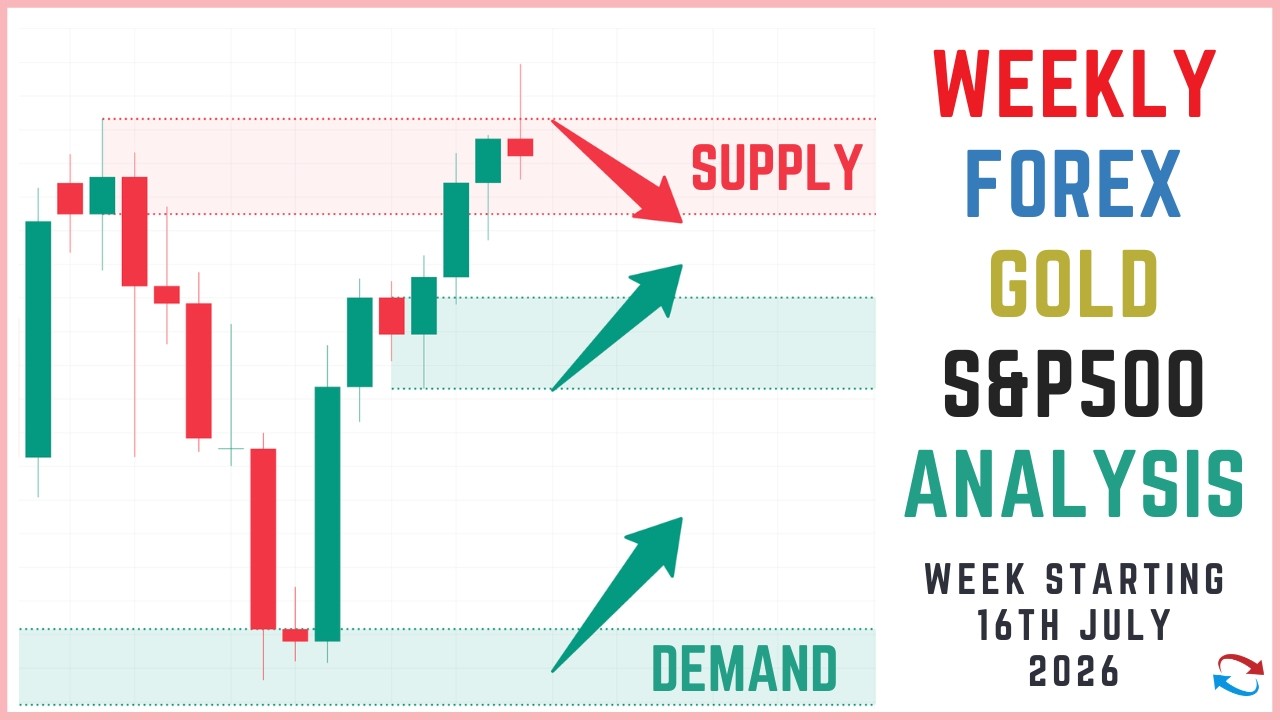
The video provides a comprehensive weekly forecast for Forex, Gold, and the S&P 500, anchored by a fundamental analysis of global risk sentiment which currently leans towards "risk on." The speaker notes that while geopolitical tensions regarding Iran and US economic pressure could theoretically drive volatility, markets have not yet fully priced in these events, resulting in a low-volatility environment where traders favor yield-return strategies like carry trades. Key economic data releases for the week include US flash PMIs, building permits, and inflation figures, alongside similar reports from the Eurozone, Japan, China, and the UK. The analysis suggests that with the Federal Reserve likely holding rates while the ECB and Bank of Japan consider hikes, the dollar is expected to weaken in the short term due to lower implied probability of rate increases, creating opportunities for selling USD pairs or buying assets like Gold which benefit from a weaker dollar.
In terms of specific currency pairs, the Euro is identified as a primary buy candidate, particularly if the dollar continues its downward trend, though traders must remain cautious of potential US-Japan intervention that could weigh on the Euro. The Pound Sterling presents a more nuanced outlook; while recent data showing economic boosts from the World Cup and sunny weather supports a bullish bias, upcoming unemployment and inflation data this week are pivotal. The speaker advises looking for buy opportunities on pullbacks to demand zones but acknowledges that disappointing data could trigger shorting strategies. Conversely, the Yen is expected to face continued downside pressure unless the Bank of Japan signals a more hawkish stance, with technical levels around 160-162 acting as potential support where intervention might occur, making it a long-term bullish play despite short-term grinding lower.
Gold and the S&P 500 are highlighted as assets that thrive in the current environment of expected rate holds and dollar weakness. Gold is projected to maintain its upward trajectory as long as inflation fears remain contained by stable oil prices around $90 per barrel, with technical supply zones identified for potential entries on pullbacks. Similarly, the S&P 500 is creating new highs driven by investor confidence in government debt and the likelihood of rate stability, although the speaker warns of a potential downside risk if an AI bubble deflates or if inflation data forces central banks to reconsider their stance. The technical analysis emphasizes waiting for pullbacks into established demand zones before entering long positions, rather than chasing prices at current highs.
The presenter concludes by reviewing recent trade executions, demonstrating a disciplined approach that involves taking substantial profits early—often around the one-to-one mark—and then trailing stops to protect gains while allowing trades to run. Successful examples include a Euro/Pound trade where 80% of profits were secured before a pullback, and multiple positions in the Pound/New Zealand pair that utilized stop hunts as entry points. The overall strategy for the week involves maintaining a bias towards buying the Euro and Pound on dips while keeping an eye on the Yen for long-term upside, all while monitoring key economic releases that could shift market sentiment from risk-on to risk-off.
Read the full video transcript
Hi, my name is Leon Rose, currency
trader and trading coach at
trading180.com. Welcome to this week's
supply and demand Forex, gold, and S&P
fundamental and technical analysis for
the week ahead starting the 16th of
August. Hope you're all doing well and
had a great trading week. So, getting
into the week ahead's news and data, and
this is from tradingeconomics.com, and
they say that the ongoing standstill
between Iran and the US should continue
to dictate energy prices and influence
global interest rates after the US
prolonged its economic pressure on Iran
instead of signaling efforts of
diplomacy. Rates will also take the
spotlight with minutes
from a divisive meeting from the Federal
Reserve, which included three dissents.
The ECB will also post-meeting accounts
data from the US will be headlined by
flash S&P PMIs,
building permits, trade terms, and
industrial production. PMIs will also be
published for the Eurozone, Japan,
Australia, and the UK. Meanwhile, both
the UK and Canada will release inflation
and retail sales.
The Eurozone and Germany will release
ZEW economic sentiment uh indices. Japan
will release its Q2 GDP, trade balance,
and inflation rate. In the meantime,
China will publish industrial
production, retail sales, housing price
prices, and join Australia, the UK, and
Canada in unveiling unemployment
figures. So,
lots going on this week. And uh looking
around the markets and just looking at
risk sentiment and kind of intermarket
analysis, and understanding really where
uh traders are likely to uh
place their money and really
more so um what kind of strategies
they're likely to use.
Uh we look at in terms of risk on and
risk off sentiment, looking at the VIX.
>> [clears throat]
>> We're in a low volatile environment and
in low volatile environment, traders
will typically, usually, look for
um, yield return strategies. So, rate
differentials and carry trades. And, um,
uh, risk sentiment at the moment is
looking more on than off, right? So, bit
optimistic when we're above the 20, uh,
zone, it's normally in a in a
bit more of a higher volatile
environment. Uh, it's normally seen as a
bit of a risk, uh, off environment where
traders will take their money off the
table, uh, in terms of, you know, uh,
they're more focused on safe haven and
protecting their assets and going into,
you know, assets like maybe gold and
and, uh, maybe government bonds and even
the US dollar, right? Depending on what
the risk, uh, event is. But, at the
moment, uh, definitely risk is more
optimistic, more on, uh, low volatile
environment.
And that is also backed up by, uh, the
S&P, right? So, in a risk on
environment, we typically, uh, have
money, uh, again, going into higher
yielding assets and the S&P is one of
those, right? So, we're creating new
highs, hitting those, uh, 7,820s, it
looks like on the on this broker. So,
um, so, yeah, that kind of confirms,
really, uh, more risk, uh, on sentiment.
Gold, although gold typically doesn't
necessarily rise in a risk on
environment,
um,
uh, the the gold is more rising as a,
um,
as a counter to really kind of gold, um,
sorry, the dollar kind of being on on
the weaker side, right? So, gold moving
higher over the last, let's say, for
example, let's look at the month. Yeah,
you can see here, we've got monthly
gold.
Uh,
date, you can see gold here. Uh, but
again, uh, gold really moving, um,
higher based on making these monthly
highs based on, um, dollar um, dollar
weakness. And we'll go over the dollar
weakness uh, in a little bit and then we
have the US Treasury yields which are,
uh, indications of really where, um,
interest rate expectations, inflation,
and GDP and uh, investor confidence in
government debt. And uh, you can see
here that the two-year Treasury on the
on the dollar has really kind of moved
to the downside over the last, uh, few
weeks. Right made this monthly high in
July, but now we're at these monthly
lows and uh, that's really the the bond
market pricing out, um, rate hikes. So,
the the rate hikes that were priced in
and expected, um, in late July. So,
that's, um,
uh, caused a bit of weakness for the,
uh, for the dollar.
And also, we have oil. So, oil is, uh,
you know, oil prices influence
inflation. So, higher oil prices
globally will, in, you know, influence,
um,
uh, higher inflation prices globally,
right? So,
and it's [clears throat] best to keep an
eye on oil and if oil maintains around
$90 a barrel, maybe even goes a little
higher, then inflation expectations are
likely to uh, increase. Therefore,
central banks around the world actually
may start to to try to get ahead of that
and look for, uh, uh,
rate hikes and look to implement rate
hikes. So, I think overall though, in
terms of risk sentiment and uh, also
looking at, you know, the front pages of
Bloomberg, um,
we don't really see much of the market
reacting to any kind of risk off
sentiment. And even though we do have a
story here, uh, which is kind of spoken
about earlier and, um,
uh, talks about what best since economic
isolation of Iran could look like. So,
this the US is switching tactics and
looking to, it says they're looking to
squeeze Iran with unprecedented economic
pressure despite the country already
being subject to naval blockade and
thousands of sanctions. Um, it doesn't
look like the market really is taking
that into account for now or even
pricing that in. Possibly in oil we
might we might see that first, but if
the market starts to care and a switch
to maybe a bit more of a risk on
environment so it's off environment and
a bit more volatility, we'll see it in
the VIX. But for now, it does look like
we are in a risk on environment.
Therefore, in Forex in Forex land we are
looking at really rate differentials and
really the carry trade should prevail
for now. That that kind of trade idea.
And so when we're looking at interest
rate probabilities for the major central
banks for major ones the Fed, the ECB,
the Bank of England and the Bank of
Bank of Japan. It does look like the ECB
and the Bank of Japan are looking at
hiking rates and the BOE and the Fed are
looking at holding rates. But
just because the Bank of Japan are
hiking rates doesn't mean that
automatically that they should it should
strengthen, right? There is something
called the carry trade where you're
looking at rate differentials. So even
though they you know the Bank of Japan
may hike 25 basis points to 1.25%
the question really to ask is that is it
is that enough to attract
you know investors out of a higher
yielding
currency like the Bank of England and
the the Fed into the into into into yen,
right? To get that return. And the
answer at the moment is probably not
especially in a low volatile
environment. So
yes, rate hikes typically usually
do strengthen a currency, but there are
nuances.
But I'll get into those in a little bit.
So
these are really the the probabilities
as well. Pretty much the ECB hike has
been kind of priced in and the Bank of
Japan although it's a higher probability
than a hold, Yeah, still some room to
the upside in terms of the rate hike
being priced in. And so um
looking at the the charts and looking at
the
equally weighted
dollar index. So the weekly
sorry the index dollar index right
looking at this probably have a demand
zone here.
And demand zone here technically. And
really what you're doing is you're
looking at
the index to get an understanding really
of
of what the dollar and other
currencies are doing against each other
right equally weighted. So this is the
dollar
dollar strength or weakness against the
euro the pound the yen the cad the
Australian dollar New Zealand dollar in
the in the in the Swiss franc
and seeing how the dollar is is doing
against those currencies right equally
weighted. So
fundamentally though the dollar
is not doing great in the short term. It
says here traders pair bets on fed rate
hikes on inflation outlook. So bond
traders stop fully pricing in a Federal
Reserve interest rate increase this year
amid a a retreat in oil prices that
reinforced positive sentiment on
inflation outlook. The Treasury
market rally trimmed yields across
maturities such as
by as much as six basis points with
those in the 30 year sector declining
less in the US government sold 25
billion of new bonds in auction. So the
market implied chance of a fed hike in
September ebbed to less than 40% and the
December contract priced in about 23
basis points of tightening indicated it
is still seen as likely highly likely
even if some doubts are seeping in that.
This was an article from the 13th but I
think since then, um,
uh, the the the odds really have kind of
come out and uh, you you see it here
that the in the short term, it does look
like the
the
the market really is more pricing in
holds
than hikes at the moment for the US
dollar and that is really the reason why
you're seeing the dollar
on
on the weakest side for now. So,
um, I think the dollar in the short term
is more of a sell than a buy. Um, and
so, looking at really where you can kind
of look for confluences on sells, I
would say if I don't know whether prices
would really kind of get up here, but
there is a little bit of a mini supply
zone, not the best supply zone in the
world. Um,
but if this starts to if the dollar
starts to break down a little bit past
this
demand zone, then that becomes a
stronger area of supply and then any
pullbacks into that zone,
I think should be looked at as a
confluence sells. So, if prices go into
a supply zone on the dollar index, then
what you're looking for is dollar shorts
on, you know, the pairs, for example,
like the
the euro dollar or the dollar yen or the
pound dollar, for example. So, this adds
confluence to really the trade and
that's how I use
the
the the indexes is to understand when
a currency is either cheaper or
expensive against,
you know, the number of currencies and
then I'm looking for either sells or
buys depending on my fundamental
direction. So, for now, although the
dollar isn't, you know, there are
supportive factors for the dollar, it
has got, you know, a nice carry in terms
of, you know, higher interest rates.
I do think at the moment though that the
dollar is likely
to be sold
rather than bought unless, of course,
there is some sort of inflation data
that shows and that proves, I guess,
that the
interest rates aren't necessarily
sufficient, right? So, they're being
held at the moment
and um
you need inflation evidence that they
should be really hiking rather than
holding.
So,
so yeah, the dollar, I think I'm leaning
on the sell side rather than the buy
side. Although, technically, you could
look for buys, but I'd rather wait for a
pullback to look for a sell.
Uh
the euro at the moment, zooming out a
bit, we can see here the euro, I think,
should be more on the buy side. Um
did look for buys. So, we've got some
demand there. And um
yeah, looking at this from a uh
from fundamental perspective, it says
here, "Resilient Europe turns into a
winning bet for money managers." And it
says here,
"Investors are flocking to Europe stocks
and bonds drawn by the best earning
season in nearly 4 years and economic
momentum is picking up, but remains cool
enough not to trouble rate setters that
the European
settlers at the European Central Bank."
And really, that's, you know, the maybe
the key to this. But, you know, we saw
that really the Fed Sorry, the ECB are
looking to
>> [clears throat]
>> to hike rates. And at the moment,
it does look like with
dollar weakness,
Europe is tends to benefit and the euro
does tend to benefit from any kind of
um
uh dollar weakness. So, if the dollar
continues to weaken, money typically
goes elsewhere. And really, first one of
the first uh currencies, major
currencies, would be the euro. So, if we
see more downside
uh to um
uh the dollar, then I would expect
really
Europe to continue moving higher, right?
So, wherever there's a pullback there,
I'd look for a buy. Prices go higher,
then pull back to a zone, maybe
somewhere around here, then I would look
for a buy trade again, right? So,
um for now, I think my bias is to the
upside. There is um
kind of a headwind though with the euro,
and it says here that the uh US selling
euros for yen spurs geopolitical risk,
BlackRock says. So, um we'll get onto
the yen in a minute, but it says here
that the US's decision to sell euros to
support Japan's currency without warning
euro policymakers is adding to
geopolitical risks and further dimming
the appeal of long-maturity government
bonds, according to BlackRock.
So, it says here while the yen
intervention is unlikely to hurt
European government bonds directly, the
surprise maneuver shows countries are
becoming uh a little less cooperative,
uh according to James Turner, head of
global fixed income EMEA at the um US
asset manager. Now, if the you know, the
sell pressure basically on the euro, if
there's another intervention in terms of
um
yen intervention to try to uh strengthen
the yen against uh you know, the uh the
market. And so, that will likely and
could likely weigh on uh the euro. So,
although I'm a buyer of euro of the
euro, you could see moves on on the euro
move to the downside um
if uh the uh there's any more uh US and
Japan-led
intervention, right? So, that's really
more of a headwind, but all things being
um all things being equal, I think the
euro should have um more upside
potential, even if it pulls back, you
know, I think there should be really
buying opportunities. Um
I'm looking at buying opportunities, the
pound. And the pound really has kind of
rallied. I've changed my tune on the on
the pound over recent weeks in terms of
in terms of buying and the data really
has supported that. And so we see here
we've got a bit of a demand zone.
Right?
And prices did pull back to this.
Not only we had demand but a level of
resistance turned potential support. So
the last week or so I was saying that
the pound could be actually a decent buy
and what we did see was some actually
some data come out and it says here
heatwave and World Cup hand UK economy a
surprise boost. So it says here the UK
economy expanded in June with GDP rising
0.3% over the month helped by sunny
weather and World Cup football. So
economists expect growth to moderate in
the coming months though as impact of
higher prices and borrowing costs filter
through to households and businesses.
But in the short term
I thought that the the pound was a
decent buy and
you'll see that really on the a couple
of trades that I took.
Well, actually I exited the the pound
CAD trade but I'll show you the the
pound New Zealand trade
and that actually worked out all right
and it's worked out so far. So
so the pound I think you can look for
both buys and sells. There are reasons
still reasons to sell but I think in the
short term the short term sentiment for
the pound I think is likely to be on the
buy side potentially on pullbacks.
Although this week will be pivotal for
the for the pound as there are several
data. I think they got unemployment data
coming out. I think they actually even
might have a
CPI coming out I think if I remember
correctly but there's some market moving
news for the pound. So
although I say yes the pound is likely
to be more of a buy than a sell. I think
there's actually an opportunity to
uh short the uh pound if the data comes
in disappointing this week.
So, technically, you know, you don't I
don't really want to, you know, buy at
highs or sell at lows. I want to buy at
lows and sell at highs. So,
at the moment, the uh
we can see that we're at highs. So, the
opportunity would be to sell, but that
would have to be um supported by
uh the fundamental data.
Although [clears throat] my overall bias
is to buy the pound um for now and uh
going uh into the week with the yen. And
the yen has been disappointing after
this, you know, massive uh move.
You know, with uh intervention, which
was supported by uh the US, we've pulled
back to pretty much uh you know,
halfway, right? Fair value and
continuing to uh to drop.
And um one of the uh the main reasons uh
for this, BlackRock uh Rider Wright
Reader says that the yen yen's rebound
hinges on
uh BOJ hawkishness. So, it says here,
"Supporting the yen will take more than
government intervention and will need
hawkish signals from the Bank of Japan,"
says Rick Reader. Um foreign exchange
intervention is not uh the most durable
path to a yen rebound, Reader says. And
Japan's benchmark rate compares with
Federal Reserve target range. And Reader
said he sees another increase in
September, though the central bank may
delay the decision to December. So,
really, unless the um the Bank of Japan
start to get hawkish again, we could see
some moves to the downside continue, you
know, grinding to the downside, right?
But what that would really do is just
that would cause and force maybe the uh
um
the um the US and the
uh and Japan to start to intervene
again, right? So, they're clearly going
to defend this level. They defended it,
you know, once already and then they let
it go to get a little bit cheaper and
they defended it here. So, you know,
anywhere around here with just a little
bit cheaper, they're likely to defend.
Also as well, 160, 162s are seen as a
bit of a level on the on the dollar yen.
So, if it does continue to grind lower,
we should see really more
more upside, but I'm going to I'm going
to still have a little bit of a
of a long bias on the yen.
I think
I don't know whether, you know, the yen
is going to There's no really no levels
to really kind of trade it off. If
you're looking at maybe support and
resistance, there might be
somewhere maybe around here where you've
got a level of support, resistance, bit
of support there, bit of support there.
We could see prices maybe go down to
around here, but if we get down to these
lows again, I would look for some more
buys on that
on [clears throat] that yen because uh
we already know that they're looking to
defend this level. So,
yeah, that's where I'm I think you can
look for buys or sells on the on the
yen, but even in the short term, even if
I wanted to be a seller of the yen, I
would still have to wait for prices to
move, you know, to the downside. So, I'm
going to lean more more on the on the
bullish side and take my chances to try
and look for buys on the yen with that
intervention threat.
Um
also,
yeah, so that's it basically. So, just a
bit of a recap. So, the dollar for me
should be more leaning more sells than
buys, the euro more buys, the pound more
buys. Although this week will be pivotal
for the pound depending on the data and
the yen, although I definitely
understand the weakness to the weaker
side, the carry trade uh is working
against the trade idea.
I [clears throat] think the uh uh
opportunity is more to the upside than
any uh downside technically.
And so, it makes it a lot easier to now
look at the pairs fundamentally. So, we
see and and establish really a
direction. And so, we've got
demand zone here. I would look for buys
on the euro dollar.
So, any pullbacks into a decent zone
around here should be a decent buy. Uh
So, we've got a level of support there,
bit of support there. It doesn't look
like support here. So, if you're looking
for a trade in the in the demand zone,
that should really be the uh
the area, the 115,
you know, around that round number
there.
Or just above it. So, that's what I'll
be looking for on the euro dollar yen. I
still think the move is to is more to
the downside, but in terms of an actual
setup, can't really see any setups for
now. There's uh supply all the way up
here.
Um and even if you're looking at this as
a as a bit of an a bit of a range,
right?
Meaning
uh bit of an auction where really
towards that fair value. So, this is
really where the expensive area is. It's
a cheap area, and then we're around fair
value. But for me, there's really no um
no setup on the daily time frame.
Uh the pound dollar again grinding
higher.
Grinding higher.
All right. So, any pullbacks, if I'm
looking to be a buyer of the uh
of the pound, then any pullbacks into
that zone, I think should be decent.
Now, there is an opportunity to look for
shorts on the on the pound, but
I do think that
if you're looking for a sell, you could
look to
>> [clears throat]
>> short this.
Right, but
I think there are better currencies to
to short the pound against. For example,
the euro, right? Or even the yen. So, if
the if the
if the data comes in this week, so we've
got this week we've got for the pound
we've got unemployment rate, we've got
inflation rate, and also got the
S&P Global. Yeah, so we've got a lot of
data. So, this will determine whether
the um
the pound continues to be a buy
fundamentally or whether upside is
capped and we see a bit more downside.
So, let's see
what we see this week.
But, as it stands, if that data does
come in positive, then I think the pound
uh should be a buy on pullbacks. Euro
pound at the moment, still in this
trade.
Got a very small position and I nearly
got stopped out. I think I trailed my
stop up to around here. So, um
But, yeah, the
the euro pound, I think really should be
um
it'll be a difficult trade. And again, I
think if the if we see any kind of pound
strength,
um then I think I'm going to definitely
exit this trade and just take this maybe
just let a trailing stop me out. But,
ultimately, um you've got two decent
currencies, I think. So, not really too
interesting. I wouldn't be interested in
taking any more trades, but the trade
that I'm already in would have to
move to the upside based on any kind of
pound weakness. But, if you are looking
for a trade, then I think really the uh
the two areas to look for a trade would
be
actually where it is now. So, that's uh
supply
and of course some demand here.
So, we're anticipating some pound
weakness.
In fact, you can look for uh a trade
this week. Right now, as you've come
down into this demand zone, so this
could actually be quite nice for uh some
more upside on the uh euro pound.
Um and the euro yen, again, the yen
pairs are a bit um
in terms of setups, not really much
setups going on on the yen pairs. Got to
be a bit patient
for a setup.
But, um
But, yeah, I think the um
the euro should really have it in terms
of uh in terms of being the stronger out
of the two as they are uh hiking rates
and they've got a higher interest rate.
But, again, it depends on whether
intervention comes in um and whether
that selling of the euros really does
affect the uh the euro. So, um yeah, I
think
again, not really a pair I'm really that
interested in, but if you are, then I
think there is probably
a level, maybe another demand zone right
here.
And then, you do have a level of support
and resistance around there. So, within
that level of demand, which made higher
highs, higher lows, price is if it pulls
back, you're looking for a sell trade
here. I'm sorry, buy trade here. If
you're looking for a sell trade, then I
think at the moment the only really sell
trades on on daily supply zones going to
be really up at this this area here. So,
we'll see what happens um
with the euro yen. And the same pretty
much same thing with the uh with the
pound. There's not really no kind of
setup on these uh on these yen pairs.
But, if you are a seller, then you have
to wait for prices to move up into here.
If you want to be a buyer,
then you're looking at
again one of these zones.
Probably around there is a decent area
to look for a buy trade.
Uh looking at gold and gold again
benefiting really from
dollar weakness. We have pulled back up
into this supply zone.
But if you are looking for continued
buys based off of dollar weakness,
then you're looking at these areas right
here. But the minute we get any kind of
dollar strength,
then I think um we're looking at a bit
of a sell. And actually technically this
level here I do
uh quite like it. Nice fresh area of
supply.
Um but a move to the to the upside would
be decent. And um
we see here actually it says here gold
needs $4,400
as traders weigh Fed interest rate path,
right? So it says gold edges towards
$4,400 an ounce as traders weigh the Fed
uh
interest rate path after the economy's
main engine showed signs of cooling. The
latest US data showed declines in both
consumer sentiment and retail sales
helping ease helping ease fears of an
imminent rate hike. And so um
and so again, as I said, the uh
uh gold is really moving based on uh
interest rate expectations. So um
a hold would likely mean
continued upside. Or even if there
starts to be cuts, but if inflation
starts to come in in terms of um you
know, oil, then actually this could be a
decent sell. So uh a decent setup
technically, but you'd need uh the
dollar to start to strengthen and
therefore gold starting to weaken. And
the S&P again making new highs
um on the uh Thursday, Friday. And again
this is more driven by the fact that um
the
Fed are looking to hold rates a little
longer.
Any kind of hikes
and money will typically flow really out
of
the
the S&P, but as we've seen
any any holds
um
the market will still or start to look
for more of a risk on and more of a
return on investment, right? So, any
pullbacks probably into that zone is
still a bit rich for me, but um
if you can get a decent pullback, then
that would be nice. So, um it seems like
as long as there's a weaker dollar and
the Fed are holding rates, we should
continue to see more highs. Um also as
well, just be careful of the of the AI
narrative, right? The AI bubble. If that
could
um
if that starts to pop a little bit
or deflate, then of course, we could see
a move to the downside, but ultimately,
I do think that we're probably likely to
see more upside than downside over the
medium term. Looking at trade updates,
so
again with uh
with the [clears throat] euro pound
in the last last video that I created, I
went over this trade,
took profit of 80% off around a one to
one, which is around here.
All right, and then basically trailed up
my stops, so my stop actually is around
here now.
And as I was saying previously, the uh
um
you know, nearly got stopped out on that
pullback, but overall, this is a
profitable trade because I've taken 80%
profit off. I've only got like a 20%
left. It's a very small position which
I'm trading up, which really I can't
really lose now anyway. So, if we get
some data out this week, which is
supportive for this trade, bearish for
the pound, then of course, uh this
should continue to move to the upside.
If not, and I get trading stopped out,
then that's fine. It's a profitable
trade. Uh the pound CAD, um I ended up
taking actually um
the profits off this cuz I thought that
the CAD was going to strengthen. I said
this uh again in the in the last video,
and um so I ended up taking profit
around uh
around here, around this area here. I
think it was like the uh as the market
opened, it was around these highs. Uh
ended up just taking that profit off.
Ended up getting in two positions,
right? Um took profit on one, and then
took the full profit on the other. So,
this ended up being a uh profitable
trade.
And then the new the new trades I've
taken is ones on the pound New Zealands,
and uh this was
uh in the in the in the group, right?
Where
discussion room,
where uh I posted this,
and it says here, I said, "Warning
everyone, I've gone long on the on the
pound New Zealand and short on the New
New Zealand CAD." The New Zealand had
some employment news that was
disappointing, and so the figure reduced
the need for immediate hiking.
Therefore, the market is likely to be
priced the New Zealand dollar in the
short term. The New Zealand dollar index
was expensive, so I expect a pullback.
So, uh this was really the trade. The
setup was a uh pound New Zealand uh was
a stop hunt, and we also saw a stop hunt
on the New Zealand CAD, right? So, I was
looking to uh to buy the uh the CAD.
So, um but in terms of this trade,
uh we ended up entering around here.
Again, hit a nice uh one-to-one trade,
but um I ended up getting in on three uh
positions. All right, so as prices
pulled back there was a buy there and
prices pulled back there was a buy
there. So, this trade here ended up
hitting a one-to-one. Uh, the next trade
ended up hitting a one-to-one. And then
the last position, which was around
here,
uh hit a one-to-one. I did take uh some
some uh some profits off again, another
80% off of that one and trailed up my
stop. I think my stop somewhere around
around here. So, um two positions and
then one uh I've taken profit off. Um,
and uh we'll see what happens this week.
Uh, also as well we've got the New
Zealand CAD.
And again, New Zealand CAD was a really
nice really a textbook stop hunt.
Right [clears throat] from this level
where you got a level there, level
there, nice stop hunt. And um
prices ended up, you know, dropping
unfortunately. I only ended up getting
into uh one uh position on this. So,
that was the entry was like there.
Prices didn't pull back to get me in
into multiple positions. So, this trade
ended up being again when it reached the
one-to-one, which was around here, ended
up getting uh taken off around 80%
profit on here and then um
just letting basic letting it run,
right? So, uh the rest of the smaller
position um I'm just letting run and I'm
trailing it down as well. For my to my
stop somewhere around here. So,
again, I've locked in profits and um
taken profits. So, this is
also [clears throat] another uh
profitable trade. So, uh that's it for
the week. I hope you found the analysis
useful. Don't forget to like, subscribe,
and share the videos with your fellow
trading colleagues. I hope you have a
great trading week. All the best and
take care.