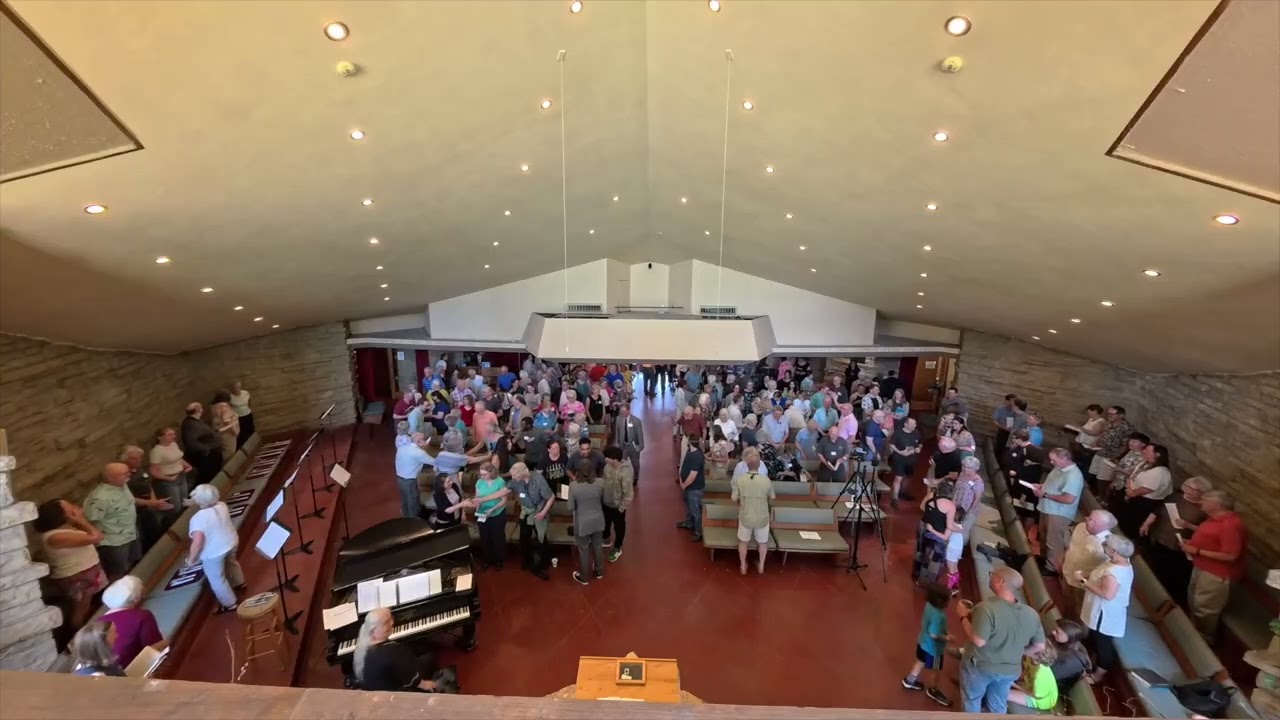
*Sunday, June 7, 2026 "Materials and Architects, Both" - Rev. Kelly Asprooth-Jackson
Watch on YouTubeVideo summary
The sermon delivered by Reverend Kelly Asprooth-Jackson at the First Unitarian Society of Madison centers on the dual identity of congregation members as both "materials" and "architects." Drawing inspiration from a 1976 radio address by Max Gatter, the speaker defines rootedness not merely as studying history but as possessing it to inform one's present existence. This concept is illustrated through various stories within the service, including a tale of a young boy who helps an elderly woman with dementia recover her memories using cherished objects like shells and puppets, demonstrating how past treasures sustain current life. Similarly, the congregation honors the anonymous volunteers from decades ago who wove curtains by hand to make their meeting space more flexible; while those specific items are no longer in use, the labor and spirit of that community remain vital parts of the building's living history.
The speaker further expands on this theme using Buddhist concepts of "interbeing" and African philosophy of Ubuntu to argue that individual existence is inextricably linked to others and the environment. Using Thich Nhat Hanh's metaphor, a sheet of paper cannot exist without clouds, rain, trees, or sunlight, illustrating how every element coexists with everything else. This interconnectedness mirrors the congregation itself, which functions as a vast network where diverse roles—from those who build facilities to those who bake cupcakes—are all necessary for the whole. The sermon highlights that true strength and health come from embracing differences rather than uniformity, much like elephant families in Eritrea sharing territory with baboons; each species contributes unique talents, such as digging water holes or spotting danger, allowing the entire group to thrive despite their distinct natures.
Ultimately, the message calls for a commitment to stewardship and continuity across generations. The speaker reflects on Wendell Berry's observation that humans must care for places they do not own because those places belong to everyone past and future. Just as ancestors passed down this building in good order so it could be used today, current members have a responsibility to maintain the community's integrity before passing it on. This duty is framed through an invitation to join children's religious exploration teams or contribute financially, emphasizing that no act of service is too small when done with kindness and curiosity. The sermon concludes by weaving these threads into a tapestry of hope, urging the audience to mend frayed edges in their lives and work together to create a house of peace where science, nature, humanity, and sorrow can coexist harmoniously for future generations.
Read the full video transcript
[music]
[applause]
>> Good morning and welcome to the First
Unitarian Society of Madison. Welcome
back to many of you. It is so good to
see your faces in this space. Welcome
back to the landmark meeting house on a
Sunday morning in the summer.
Did we forget how good this feels?
I know there's folks who are joining us.
I want to point out maybe it's the
obvious in congregations.
There are empty seats right up here in
the front row.
Please uh, feel free to come up here and
join us.
My name is Kelly Crocker and I'm one of
the ministers here. Today, I'm joined by
my colleague, the Reverend Kelly Aspers
Jackson, by the worship team of Linda
Orange, and Collins and Daniel Carnes.
Special thanks to Brian Rainey and the
members of the FUS Chime Choir for being
with us on this special morning.
>> [clears throat]
>> And many thanks to all those who are
volunteering. Our greeters are Aunt
Smiley and Elizabeth Barrett. Ushers are
March Schweizer and Cherry Langford.
Coffee is being made by Genie Hills and
Jen Gaber. Our lay minister is Lois
Evenson. Thank you all.
There There's still seats here in the
very front row.
And over here.
At First Unitarian Society, we question
boldly, listen humbly, grow spiritually,
act courageously, and love
unapologetically.
If you're visiting us today, welcome.
We're so very glad that you are with us.
If you'd like more information about the
congregation, please speak with one of
us here in coffee hour. Speaking of
coffee hour, today's will be held to
your left in the Loja. So, please join
us there.
And it is the first Sunday of the month.
So, members of our Board of Trustees
will be in the Commons after service to
answer any questions that you may have
about the board and their work.
Next Friday, June 12th at 5:00 p.m.,
there will be another family movie
night. This time showing the film My
Neighbor Totoro and including a potluck
There is more information and the link
for to RSVP are available on the flyer
at the RE check-in table, which it is
out in the lobby.
And tickets are now available for Sweet
Justice, our immigration justice
fundraiser, which will be held on the
evening of Friday, June 26th. Please see
the Red Floors on the FUS website for
more information and to get tickets.
We can't say that it slows down here in
the summer. It does not.
And now, I invite you to join together
in a moment of silence as we center
ourselves and bring ourselves fully into
this time, joining together once again
in community.
Here in this place of connection, may we
find life-giving community.
>> The central task of the religious
community is to unveil the bonds that
bind each to all, a relationship
discovered amid the particulars of our
own lives and the lives of others.
>> Here in this place of rest, let the
unrest of our hearts turn us toward
justice.
>> It is the church that assures us that we
are not struggling for justice on our
own, but as members of a larger
community.
>> Here in this place made sacred by
memories of connection, let us each feel
ourselves part of the new that grows
from the old in the spiraling unity of
years.
>> The religious community is essential,
for alone our vision is too narrow to
see all that must be seen, and our
strength too limited to do all that must
be done.
Together our vision widens and our
strength is renewed.
>> Here in this place of peace, may we find
hope.
And we invite you now to rise in all the
ways we do.
Joining in the words of affirmation
printed on your order of service.
>> We kindle this flame as a reminder of
the covenant between our congregation
and all other Unitarian Universalist
communities to dismantle racism and all
forms of systemic oppression.
Let us work to build and be diverse,
multicultural, beloved communities where
all thrive.
>> And before we join together in song, we
invite you to take a moment to turn and
greet those around you.
>> All right, how are you?
All right.
Yeah, awesome.
>> Good morning.
Let's remain standing as we sing our
opening hymn in the gray hymnnal number
354,
354.
We laugh, we cry.
>> [music]
>> We laugh,
we cry.
>> [music]
>> We live, we die.
We dance
and sing our song.
We need to feel that something
>> [music]
>> here
to which
we belong.
We need to feel the freedom,
>> [music]
[singing]
>> trust to last a while.
>> [music]
>> Our
lives are all we
need to share. We can
>> [music and singing]
>> grow our
love.
And we believe
>> [music]
>> in
>> [singing]
>> life
and we have found
>> [music]
>> a need
>> [singing]
>> We have our hearts to
>> [music]
>> give.
We have our hearts to
>> [music and singing]
>> receive. And we believe that
sharing
is the answer.
>> [music]
>> When a child is born of
>> [music]
>> love's own
we feel
a special bond.
We
>> [music]
>> see our
endless strength
as we watch
them grow.
>> [music and singing]
>> We thrill to hear
imagination
>> [music]
>> free.
We
>> [music]
>> dedicate our
minds to
the spirit of
And we believe
>> [music]
>> that we have the [music]
And we have found
>> [music]
>> to be together.
>> [music]
>> And with the
>> [singing]
>> we share the wonder
>> [music]
>> And we believe
>> [music]
>> that growing
is an answer.
Our lives
>> [music]
>> are full
Our time
>> [music]
>> No matter
what our
fills us
>> [music]
>> and free.
But as
>> [singing]
>> we live
so shall we
>> [music]
>> And when
our lives
No matter
>> [music]
>> what we
with friends
we believe
>> [music]
>> And we
believe in
>> [music]
>> And in
the light
And we
have found
>> [music and singing]
>> a place
to be together.
>> [singing]
>> We have
>> [music]
>> the right to grow.
We have
the gift
to believe.
And we
>> [music]
>> believe that
living is
an answer.
>> [music]
[music]
[singing]
[music]
[singing]
[music]
[singing]
[music]
[singing]
[music]
>> Friends,
I have a story for you today.
The name of this book is Wilfred Gordon
McDonald Partridge.
It is written by Mem Fox and illustrated
by Julie Vivas. I will do my best to
move about and give you some access to
the pictures, but owing to the fact that
there are a lot of us in this room right
now.
Uh you may not be able to see all of
them that well, but if you see me after
the service, I'll be happy to let you to
through the book.
So, here we go.
There was once a small boy named Wilfrid
Gordon MacDonald Partridge, and what's
more,
he wasn't very old, either.
His house was next door to an old
people's home, and he knew all the
people who lived there.
There he is showing off his belt.
He liked Mrs. Jordan, who played the
organ. He listened to Mr. Hosking, who
told him scary stories. He played with
Mr. Tippett, who was crazy about
cricket.
He ran errands for Miss Mitchell, who
walked with a wooden stick, and he
admired Mr. Drysdale, who had a voice
like a giant.
But his favorite person of all was Miss
Nancy Allison Delacourt.
Because she had four
Wait a second. Nancy Allison Delacourt
Cooper. There we go. Because she had
four names, just as he did.
He called her Miss Nancy, and he told
her all of his secrets. And here he is
spending time with Miss Nancy.
One day, Wilfrid Gordon heard his mother
and father talking about Miss Nancy.
"Poor old thing," said his mother.
"Why is she a poor old thing?" asked
Wilfrid Gordon.
"Because she's lost her memory," said
his father.
"It isn't surprising," said his mother.
"After all, she is 96."
"What's a memory?" asked Wilfrid Gordon.
He was always asking questions.
"It is something that you remember,"
said his father.
But Wilfrid Gordon wanted to know more,
so he called on Mrs. Jordan, who played
the organ. "What's a memory?" he asked.
Something warm, my child.
Something warm.
He called on Mr. Hosking, who told him
scary stories. What's a memory, he
asked. Something from long ago, my lad.
Something from long ago.
He called on Mr. Tibbit, who was crazy
about cricket, you remember the rhyme.
What's a memory, he asked. Something
that makes you cry, my darling.
Something that makes you cry.
He called on Miss Mitchell, who walked
with a wooden stick.
What's a memory, he asked.
Something that makes you laugh, my
darling.
Something that makes you laugh.
He called on Mr. Drysdale, with a voice
like a giant.
What's a memory, he asked.
Something as precious as gold, young
man. Something as precious
as gold.
So, Wilfred Gordon went home again to
look for memories for Miss Nancy,
because she had lost her own.
He looked for the shoe box of shells
that he found long ago last summer and
put them gently in a basket. He found a
puppet on springs, which always made
everyone laugh, and he put that in the
basket, too.
He remembered with sadness the medal
which his grandfather had given him, and
he placed it gently next to the shells.
Next, he found his football, which was
as precious as gold. And last of all, on
his way to Miss Nancy's, he went into
the hen house and he took a fresh, warm
egg from under a hen.
When Wilfred Gordon called on Miss Nancy
and gave her each thing one by one.
What a dear, strange child
to bring me all these wonderful things."
thought Miss Nancy.
And then,
she started to remember.
She held the worn egg and told Wilfred
Gordon about the tiny speckled blue eggs
that she had once found in a bird's nest
in her aunt's garden.
She put the shell to her ear, remembered
going to the beach by tram long ago, and
how hot she had felt in her button-up
boots. Here we see Miss Nancy
in days gone by.
She touched the metal and she talked
sadly of the big brother that she had
loved who had gone to the war
and had never returned.
She smiled at the puppet on the strings
and remembered the one that she had
shown to her sister and how she had
laughed with a mouthful of porridge.
She bounced the football to Wilfred
Gordon and remembered the day that she
had met him and all of the secrets that
they had told and the two of them smiled
and smiled because Miss Nancy's memory
had been found again
by a small boy
who wasn't very old
either.
Thank you for listening to my story.
>> Let's remain seated since these benches
are kind of hard to get out of.
Just sing our next hymn.
These are Frank Lloyd Wright-sized
benches.
He had no problem getting out of them
like that.
>> I'm just going to
>> Okay.
>> My apologies. I should have said, "And
now it's time for the children who are
going to summer fun to go to summer
fun."
Sorry.
>> Karen is right back there waving. You
can meet up with her and she will take
you where you need to go.
>> Uh
Linda, would you play this entire thing
one time through since it's been exactly
364 days since we've sung this one?
Number 65, Sweet June Days.
>> [music]
[music]
[singing]
[music]
>> Our inspiration today from the poet
Naomi Shihab Nye.
The river is famous to the fish.
The loud voice is famous silence, which
knew it would inherit the earth before
anybody said so.
The cat sleeping on the fence is famous
to the birds watching him from the
birdhouse.
The tear is famous briefly to the cheek.
The idea you carry close to your bosom
is famous to your bosom.
The boot is famous to the earth. More
famous than the dress shoe, which is
famous only to floors.
The bent photograph is famous to the one
who carries it and not at all famous to
the one who is pictured.
I want to be famous to shuffling men who
smile while crossing streets.
Sticky children in grocery lines. Famous
as the one who smiled back.
I want to be famous in the way of pulley
is famous or a buttonhole.
Not because it did anything spectacular,
but because it never forgot what it
could do.
>> This is the second of two sermons
memorializing the 75th anniversary of
this building.
And this weekend is our heritage week
featuring a number of special events and
tours.
My deep thanks to the friends of the
Meeting House, their board and guides
for all of their efforts in organizing
this and other activities to celebrate
the 75 years that this structure has
been our spiritual home.
After today's service, there will be a
special lecture right here by Charlie
Foulke,
who has been such a help to our
congregation over many years consulting
with us on the complex issues of
preserving this building.
He is going to speak to the specific
work that it has taken to maintain this
structure over the years.
At a much, much deeper level than I
could ever hope to.
Instead, I want to take up a theme that
I hope will resonate with his
and celebrate and appreciate
the people
who, by their contributions and
collective effort, made it possible for
this building and its congregation to
reach this current season.
Because of our 75th anniversary, as well
as the upcoming sesquicentennial of the
Declaration of Independence,
I have spent more time in our archives
in the last 6 months than I did in the
first 4 and 1/2 years after my arrival
as one of your ministers.
I've been looking for notes on the past
from the past that might have some
relevance to our present. And that is
how I came across a transcript of a
radio address that Max Gatler gave in
1976
on the subject of rootedness.
He explained that word as meaning
the recovery of the past, of the past
not simply as an object to be looked at
and studied, but as a possession that is
truly ours. Rootedness must rest upon an
awareness of the past as the source of
one's own present being.
He went on to say that
this is precisely the meaning of
religious community.
It is a community which, in Simone
Weil's words, preserves in living shape
certain particular treasures of the past
and certain particular expectations
of the future.
Those treasures include the remembered
heroisms of the saints and martyrs, the
moving words of forefathers spoken at
moments of crisis or triumph,
and the ritual acts which commemorate
those deeds and those words.
The particular expectations of the
future include patterns of response to
danger, to ethical challenge, to the
great moments of birth and death.
To belong to such a community
is to have ready at hand models of human
conduct to inspire and guide one. It is
to know in one's heart how one ought to
meet danger, what one's responsibility
to one's neighbor mean.
In short, it is the function of
religious community to link its members
with the deep and sustaining
continuities
of human hope and idealism
and devotion.
My hope this morning is to help to link
us with those continuities of hope and
idealism and devotion.
But, not by leaning heavily on the great
names in our history that most of you
probably already know.
Instead, by honoring the work which is
quieter
and less grandiose
and without which neither we nor this
edifice would be.
>> [clears throat]
>> Most of you probably know that there
used to be a curtain
that hung
along that line there towards the back
of the room where the low ceiling of the
heart room meets the vault of the
sanctuary.
Set on runners, it allowed for the
division of one room into two.
Made the space more flexible and more
accommodating for smaller meetings.
The story is that it was made by women
of the church, most or all of whom did
not know how to weave at the beginning
of the project.
They had to take lessons and there were
two looms borrowed from Taliesin, I am
told.
They were volunteers,
amateurs, figuring out what they had to
do to accomplish a task that simply
needed doing.
They created something
beautiful
and functional.
We still have much of their handiwork
today in sections. One of them is on
display in that hallway there.
But, it no longer hangs in its original
position
and no longer gets put to the use for
which it was made.
The congregation grew and found that it
had less and less reason to divide this
room into two.
Many hands and many hours and an unknown
amount of worry and wonder went into
that curtain.
But that was all to make something that
was changeable,
not eternal, not permanent because it is
a part of something alive.
Its very contribution helped that
something, that community, our
community, to live.
Catherine Jacobs appears to have been
their ringleader, but I do not have all
of the names of all of the weavers for
you this morning. I have only one
segment of their work to point to, close
in its clear case.
Yet,
their labor is a part of what has been
passed to us.
Their service to this building and to
this community was to make something
beautiful
and useful and changeable.
Each of those three qualities
being profoundly important.
And there is this only one in an
infinity of examples of the necessary
work from which our congregation has
continuously remained itself.
The Buddhist, anti-war activist and
teacher, Thich Nhat Hanh,
once used a piece of white paper
as an illustration of a critical concept
that he called interbeing.
There is a cloud floating
in this sheet of paper.
Without a cloud, there will be no rain.
Without rain, the trees cannot grow. And
without trees, we cannot make paper.
The cloud is essential for the paper to
exist. If the cloud is not here, the
sheet of paper cannot be here, either.
If we continue to look at the sheet of
paper, we can see the sunshine in it.
If the sunshine is not there, the forest
cannot grow.
Without the sunshine, nothing can grow,
not even us.
Looking more deeply,
we can see the logger who cut the tree
and brought it to the mill to be
transformed into paper.
We see also the wheat. We know that the
logger cannot exist without his daily
bread, so the wheat that became his
bread is also the sheet of paper.
Looking even more deeply, we can see
also in the paper everything.
Time, space, the earth, the rain, the
minerals in the soil, the sunshine, the
cloud, the river, the heat, even
consciousness
is in that sheet of paper.
Everything coexists with it.
To be is to interbe.
To interbe
is to be with,
because of, and in cause of each and
every other thing.
And while Thich Nhat Hanh was describing
a universal principle to be observed in
every dimension of life, our religious
community illustrates this principle
particularly well, I think.
A church is is simply a box in which
someone stands up and says something
profound for approximately 20 minutes
each week.
Nor is it just a venue for high-quality
music of classical and occasionally
other varieties.
It is a vast network of lives living in
relationship to each other and to other
lives now past
and to yet more lives which have yet to
begin.
And by this
creating something with a life of its
own.
Because of this, every contribution,
every act of service matters.
The people who give the money to build
the buildings and pay the employees, the
people who convince them to give that
money, the people who bake the cupcakes
for dessert at the dinner where the
second group of people talks to the
first.
Each of these is necessary.
Each of these is a vital part of the
larger whole.
Ubuntu, a word and concept in both the
Zulu and the Xhosa language of South
Africa
figures prominently in the social ethics
of that country
and other parts of Africa influenced by
it.
The Archbishop Desmond Tutu describing
Ubuntu said
"We believe that a person is a person
through other persons.
That my humanity is caught up, bound up
inextricably with yours.
When I dehumanize you, I inexorably
dehumanize myself.
The solitary human being
is a contradiction in terms.
Therefore,
you seek to work for the common good
because your humanity comes into its own
in community,
in belonging.
We come into our humanity in community,
and this is one of the places where we
have the opportunity to do just that.
So, I would be remiss if I did not
highlight at least one major opportunity
for you to do so.
Now is the time of year when our annual
efforts to recruit teachers for our
children's religious exploration program
are in full swing.
I'm told that there is still room on
teaching teams for a variety of ages and
at a variety of service times.
Please note
that that opportunity to be a part of
our faith formation work for and with
children and youth is not restricted to
parents.
You do not have to have school-age
children in your household currently.
You don't even have to have any
particular experience with children at
all.
Like the women who made that curtain,
neither deep confidence nor extensive
experience are required.
But the important work of helping our
young people to discover themselves
morally and spiritually
is available to you if you are willing
to practice kindness and curiosity
as a part of a teaching team.
If you are interested to know more, I
know that Karen Polnitz, our director of
religious exploration, would love to
talk with you after this service.
Although the timing of this weekend's
events and observances were set in part
because
it's his birthday tomorrow.
I did not want to linger long on the
memory of Frank Lloyd Wright in this
service.
But
I did find a few lines that I thought
were relevant for us today.
From one of his favorite poets
and mine.
Walt Whitman in his Song of the Rolling
Earth pronounces
"Say on, sayers. Sing on, singers.
Delve, mold, pile the words of the
Earth. Work on, age after age. Nothing
is to be lost.
It may have to wait long,
but it will certainly come in use.
When the materials are all prepared and
ready,
the architects shall appear."
We who are part
of a community of faith like this one
are materials
and architects both.
We envision what it is to be a
congregation, what it means, how it
ought to manifest in the world.
But we are also the stuff of which that
congregation is made.
It takes a great many of us to
continuously reconstitute this religious
society, just as it took a great many
more before us to carry it through from
its beginning until now.
As to build this building
and to hand it on to us
in good order.
Now, not exactly a story here, but a
small illustration.
In Eritrea, in Eastern Africa, much of
the countryside is very, very dry. The
animals that are native to that climate
have had to work out ways to find water
to live on without the benefit
of many rivers or lakes or streams.
The elephants that live there,
even though they are some of the largest
animals on Earth and need a lot of water
to survive,
actually have a special advantage. They
have these big, powerful trunks
and working together, they are able to
dig down into the soil and to find
ground water, essentially making their
own wells.
Now, elephants are an endangered species
and their population in Eritrea is
particularly small.
Hunting Hunting by humans and threats
from other animal predators are a
serious danger.
But people have observed that some of
the largest and most successful elephant
groups do not live alone.
Sometimes families of elephants and
families of baboons
share the same territory.
The elephants have the water holes that
they have dug and the baboons get to
drink from them.
The baboons have very good eyesight and
a habit of climbing trees and when they
see some danger approaching, they are
very, very loud.
So, the whole group benefits from having
members who are
different
rather than all being the same.
And that is also how it is with us.
Our community is made stronger,
healthier, more effective, and just
more alive
by the differences that we share and by
our coming together to share them.
Each one of us has some insight, some
talent, some gift that no one else here
has.
And it is only by working together that
we are able to draw up a longer of life
and to share it with one another.
Being different
together
sustains us.
The farmer poet
Wendell Berry
keen observer of the land
voice of lament for its desolation
and champion for
persistence
amidst life's painful struggles
wrote that
Because we have not made our lives to
fit our places
the forests are ruined
the fields eroded, the streams polluted,
the mountains overturned.
Hope then
to belong to your place
by your own knowledge of what it is
that no other place is.
And by your caring for it
as you care
for no other place.
This place that you belong to
though it is not yours
for it was from the beginning
and will be to the end.
This place
to which
we belong
is not ours.
It passed into our care only because of
the many before us who tended to it, who
made themselves belong to it even though
it was not theirs either.
In time, we too shall pass it on to the
next.
And though this place will not even be
theirs,
we will be.
We will be their ancestors
as they will be our descendants.
May we fulfill that calling of
ancestorship well
and appreciate how each of us
contributes to it in our own particular
and necessary way.
>> [music]
[bell]
[music]
[bell]
[music]
[bell]
[music]
[bell]
[music]
[bell]
[music]
[bell]
[music]
[bell]
>> Thank you.
I think that is its own particular kind
of magic.
How do you make that happen?
We invite you now into a time of giving
and receiving where we give freely and
generously to this offering which
supports the ongoing work of our
community.
There's multiple ways to share your
gifts. You'll see on the order of
service that you can donate directly
from our website, and you will see the
text to give information there as well,
and baskets will now be passed here in
the room. We thank you for your
generosity and your faith in this life
we create together.
>> Yes.
>> [music]
[bell]
[music]
[bell]
[music]
[bell]
[music]
[bell]
[music]
[bell]
[music]
[bell]
[music]
>> Yes.
>> [music]
[music]
[bell]
[music]
[bell]
>> Each week we gather together bringing
with us the joys and the losses of our
days. We share them here knowing they
are held in love.
Ann asked us to light a candle of
gratitude saying, "Thank you all, the
FUS community, for being my family.
You affirm and enrich me with
opportunities to embrace life."
And we light a candle for all that lives
in our hearts, the joys and the
celebrations mingled with the sorrows
and the loss.
May we know we are held in love.
If you'll join together now in a moment
of prayer and contemplation with these
words from Tess Bolinger,
What will they say of us?
That we lived upon this earth
or that we lived with this earth?
That we earned solely for ourselves
or that we worked for the well-being of
all?
That we wasted precious life on vanities
and empty diversions,
or that we each day claimed a meaningful
existence.
That we shut ourselves into rigid
individualism,
or that we nestled in the love of our
friends, families, and the whole
interweave of humanity.
What will they say of us?
What would you have them say?
Let us make each day not a beginning,
not an exorcism from the past, cutting
off the threads,
but rather let us take any frayed edges
and weave in new strengths, continuous
but discernable,
mending the harmed fabric, making it
whole once more,
creating the integral tapestry of life.
May we rest in the silence for a moment
together.
Blessed be,
and amen.
>> [music]
[music]
>> Our closing hymn today is in the teal
hymn book, known as number 154. It has a
special
history for us.
A hymn was written for the opening of
this building and this room and by the
minister at the time, Kenneth Patton.
Uh one of our UU bards, Jim Scott,
rewrote the hymn, updated it, and this
is it. Let this be a house of peace.
I'll sing the first verse and invite you
to join me after that. Please rise in
body and or in spirit so we can sing
together, "Let this be a house of
peace."
>> [music]
[music]
>> Let this be a
house of peace.
>> [music]
>> Of nature and humanity,
>> [singing]
>> of sorrow
and elation. [music]
Let this be our
house,
a haven [music]
[singing] for the
healing
>> [music]
>> and a open room for
prayer
and
>> [music]
>> our inspiration.
>> [music]
>> Let this be a
>> [singing]
>> house of peace.
>> [music]
>> Let this be a house of peace.
>> [singing]
>> Let this be a
house of peace.
>> [music]
>> Provided
we
>> [music]
>> are silent.
Let this be our
>> [music]
>> house, a
platform for our
free voice,
where
>> [music]
>> all
we shall not
Let this be our house of peace.
>> [music]
>> Let this be our house
>> [music]
>> where all our dreams are
>> [music]
>> Let science and
find a
>> [music]
>> Let this be our
house of our
>> [music]
>> Let this be
>> [music]
>> answer the great
>> [music]
>> Let this be
>> [music]
>> Let this be
house of
>> [music]
>> Let this
house of peace.
A vision
for our
We are
>> [music]
>> Let this be
>> [singing]
>> house of
>> [music]
[music]
>> vision and
and free
>> [music]
>> Let this be
Let this be
>> [music]
>> Let this be
Let this be
>> [music]
>> Let this be
Let this be
>> [music]
>> Let this
>> [music]
>> Our time in this place may have ended,
but our connection to each other in this
community remains.
Together may we walk the path of
justice, speak words of love, live the
selfless deed, trot gently upon the
earth, and fill the world with
compassion until we meet again.
Blessed be. Go in peace, and please be
seated for the postlude.
>> [music]
[music]
>> Woo!
>> [applause]
[applause]
>> Woo!
Woo!
>> Mhm.