Video summary
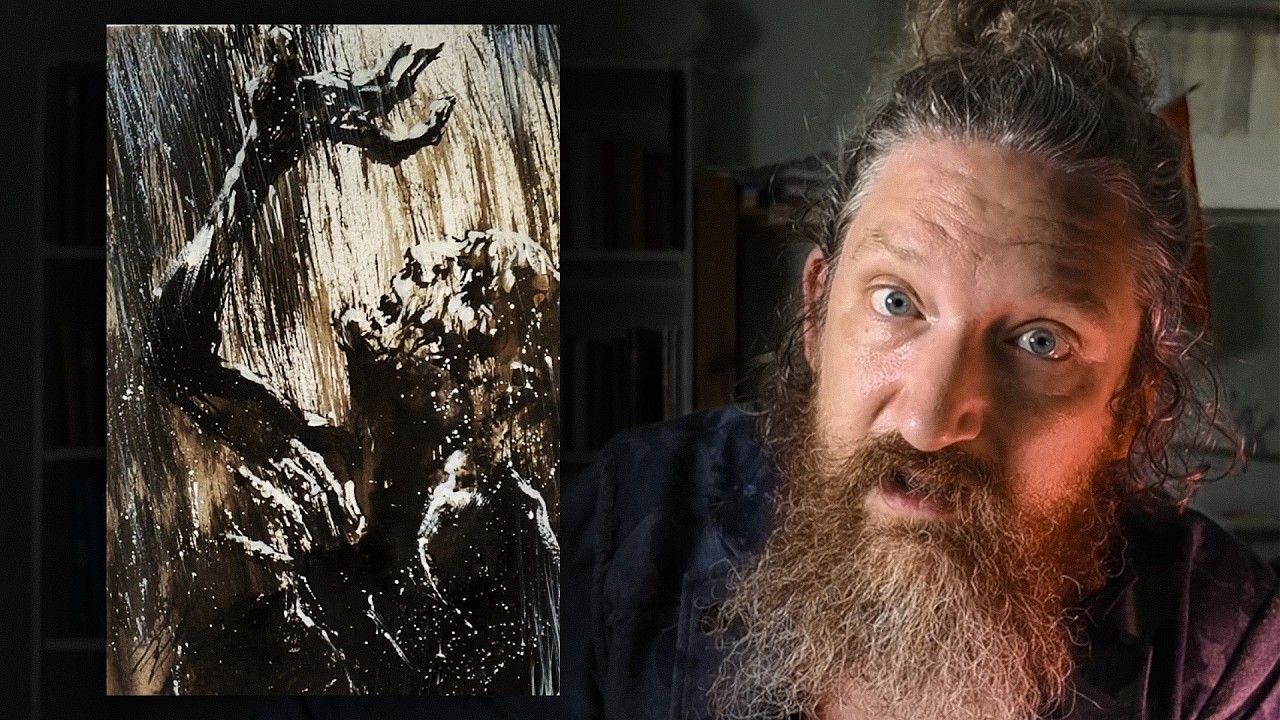
The artist begins this session with an open mind, intentionally avoiding any pre-conceived plan other than ensuring the composition is not centered around the middle of the page. By simply applying water and ink to observe what naturally emerges, he discovers a faint upward stretching form that captivates him despite his uncertainty about how difficult it will be to draw accurately. This spontaneous discovery leads him into a state where he feels he might lose control but enjoys the process, allowing himself to embrace imperfection as something positive rather than a failure. He acknowledges that while things often start with one appearance and then shift or grow rougher over time, this initial wrinkle on his face serves as a reminder of aging and experience, which he accepts as a blessing rather than taking for granted.
As the drawing progresses, the artist utilizes a deliberately broken brush to create thin lines alongside doubled strokes, using his own hand raised in an almost birthing gesture as both subject and guide without any external models or references. He admits that while the anatomy is becoming wonky and nearing a point where he dislikes it, he chooses not to tidy up the work because maintaining its raw quality is essential to his artistic intent. At times, dissatisfaction grows so strong that he considers tossing the artwork entirely, yet this constant self-criticism drives him to push beyond his current capabilities rather than settling for what feels safe or easy. He explains that this relentless urge to do something slightly better than he knows how creates a struggle where only occasionally does he succeed in transcending his limitations through pure stupidity and effort.
Ultimately, the artist finds satisfaction not because the piece matches an exact initial vision—which was nonexistent—but because it has evolved into something fresh and distinctively his own that feels like a success on its own terms. Although the final composition ended up being more centered than he originally aimed for, resulting in some groaning over missed goals, he still loves the result once removed from the tape to view with a frame. He reflects that this journey of stumbling toward unreachable things is deeply human and necessary, encouraging viewers to support real artists who fumble their way forward rather than those who only produce polished perfection. The piece concludes as "Stretching Towards," serving as an example for others interested in learning about drawing through negative space and embracing the messy, unpredictable nature of true artistic creation.
Read the full video transcript
What are we going to find in today's ink
plot?
So, what I want to do today is I have no
idea what I want to do, but I know that
I want
the composition to not be centered
around the middle. So, what I'm doing
now is just putting on some water
and
some ink
and just seeing
if something happens
and you so something always happens.
That's not the problem. What happens
that's the interesting part. So, I have
this plan that it I want a composition
that isn't grounded
around the middle,
but apart from that, nothing.
But already now,
I'm seeing something. It's something
that's getting me.
I don't know. It's getting me.
I wouldn't say that I'm so excited. I
just can't hide it.
But I might [sighs]
be about to lose control. And I think I
like it.
So, I'm seeing just a tiny bit of face
that is
sort of stretching upwards
and I liked that. [snorts]
Will I end up doing that? I don't know
because maybe
that will be
it's a hard thing to draw.
like this. And there's a lot of
potential for
getting things wrong.
But [snorts]
that was the first thing I saw. And
today I just want to focus on
Yeah, I need to I
focus on being present
and get back to the mindfulness exercise
of this of just being here
and saying that's that's all right.
That line was supposed to be there.
It might not look like it's supposed to
be there, but it was always
supposed to be there.
And maybe things
look one way
to start
and then shift
and maybe things grow
older and rougher and more rugged.
And
it goes from this
masculine face to this
more
wrinkled thing.
Shouldn't call him a thing.
Just got a few
wrinkles. We all have a few wrinkles
after a while.
Blessed be to be old enough to get a few
wrinkles. That's not something we can
take for granted.
So,
let's give him
a hand
like this.
And we can use our own hand as
the guide. And I'm working with this
brush that's it's all
messed up,
but that allows me to
just
use a few of the brush hairs
and try not to. It's a very interesting
way of working with a broken brush and
trying to
find
the nice thin lines
and not just the doubled
broken lines.
and then using the double lines when I
need to.
So there, that's some fingers raising up
almost like
he's almost being
birthed out of something.
And I think
I want
Shadow here.
Just his arm.
almost coming up.
This is the
type of thing that you should
probably
have some
a model for, some references
for or something like that.
But we don't. We're just working with
what we have,
our mind's eye,
and
finding
something.
This brush is getting more and more
impossible to work with, but I will keep
on working
with it.
That's one of
It's a thing that I love even though
it's really stupid.
This has got this wonky anatomy that I
kind of like, but it's almost over the
edge to
a point that I don't like. So I I need
to keep it without making it
tidy.
I still want to keep it
[sighs]
Now I'm thinking Okay.
Now I'm almost at the point where I I
want to toss this art
because it's not
coming together exactly how I wanted it
to, which is a stupid thing
to moan over
since there was no exact thing that I
wanted to. But I
will
find a way
and I'm starting to plan
part
two of this in the sense
Oh,
it's more interesting now.
And
what can be good
is
to first of all
dry out all this ink
batter
and just drag it down. We'll drag
everything down. That's okay.
And then
from the corpse of this drawing
find some
white gouache
and a brush
And then
start to
chisel out
back
some shapes
but
so that it breaks
and then
I can get a look that I might like
and it's
I know that that when I draw I often say
things like, "Oh, no, no, I don't like
I'm this close to tossing it." And for a
lot of people who are not artists or
who,
you know, are at another level
in
their art journey, they may say, "No,
no,
you shouldn't be so critical.
It's good. It It's better than anything
I can do. [snorts]
That's
That may be true. It may not be true.
But
the thing that that makes
for me
thing that makes me the artist that I am
Is
this
constant?
It's not constant self-criticism.
It's a constant drive
to work
above my capability.
I always want to do something
that's a little bit better
than what I know how to
do.
And that's hard. That doesn't work like
that.
A and
still
it works like that
for me.
[snorts]
I
by always
stretching
outside of my ability.
Maybe
one out of 10 times or one out of 20 or
one out of a 100 times
I manage
to strike
something
that's
beyond me.
That's the most beautiful feeling
to create these works that through
pure stupidity
transcend
what I was capable
of at
that exact time.
So
that is
part of the reason why I keep
that constant
self-criticism, the constant like, oh
no, no, no, no. This is going to hell.
This is, oh, no, no, no, no, no, no.
It's not just that I'm overly critical.
It's not just that I'm
uh wanting
attention and for people to say, "Oh,
no, it's really good." Although that's
both of those are
they might be a part of it.
And uh
I don't know.
It's so difficult to
know why or
how you're doing these
things
that you just do. It's just a part of
you. But I think
that is a decent explanation for why I
addicted to
being overly self-critical
and
[snorts]
being overly self-critical.
sometimes
gets you
to places
that you wouldn't have gotten to
otherwise.
And right now
I'm
starting to get very happy that I
was so dissatisfied because I think this
is
better than what it started as. I don't
know. Do you think it's better?
I'm not always the best judge, but this
is something I'm
This is something that that
for me
seems a bit
fresh for me,
just for my art, for my sensibility.
This has a slightly different feel to it
that feels
like me still.
So
that's a success in my book. I want to
Okay, maybe if I take this brush, dip it
in a lot of water. Dip it in a lot of
this
more water
and then
get this
soaked
feeling. Then we can
And just like that.
I think I
I think I like it.
I I don't know why it's finished now.
Wasn't finished a few seconds ago. But
let's [snorts] take off the
I almost said the guard rails, but take
off the off the
tape and see how it looks
with the frame
as I have a feeling this will look very
good.
Now in terms of a composition,
this came out very different from
anything I had thought. I
was aiming to do something that's much
more big shape here and maybe a little
shape there.
But this again maybe it became a
centered composition.
[groaning]
But
yeah, I like it.
What shall I call this?
I'm calling it
stretching
towards.
And if you liked this drawing and if you
want to learn more about drawing like
this then this is number 11,
random ink drawing 11. I am very close
to releasing my online course called
mastering ink through negative space.
Uh a and uh we have a waiting list so
you can sign up for that and get some
percentages off.
And uh yeah, support art, support real
artists, support people who
fumble and stretch towards things that
are out of reach.
Uh because that's a very human thing to
do and we need more humans
and we need more humanity.
I'll see you in the next random ink
drawing.