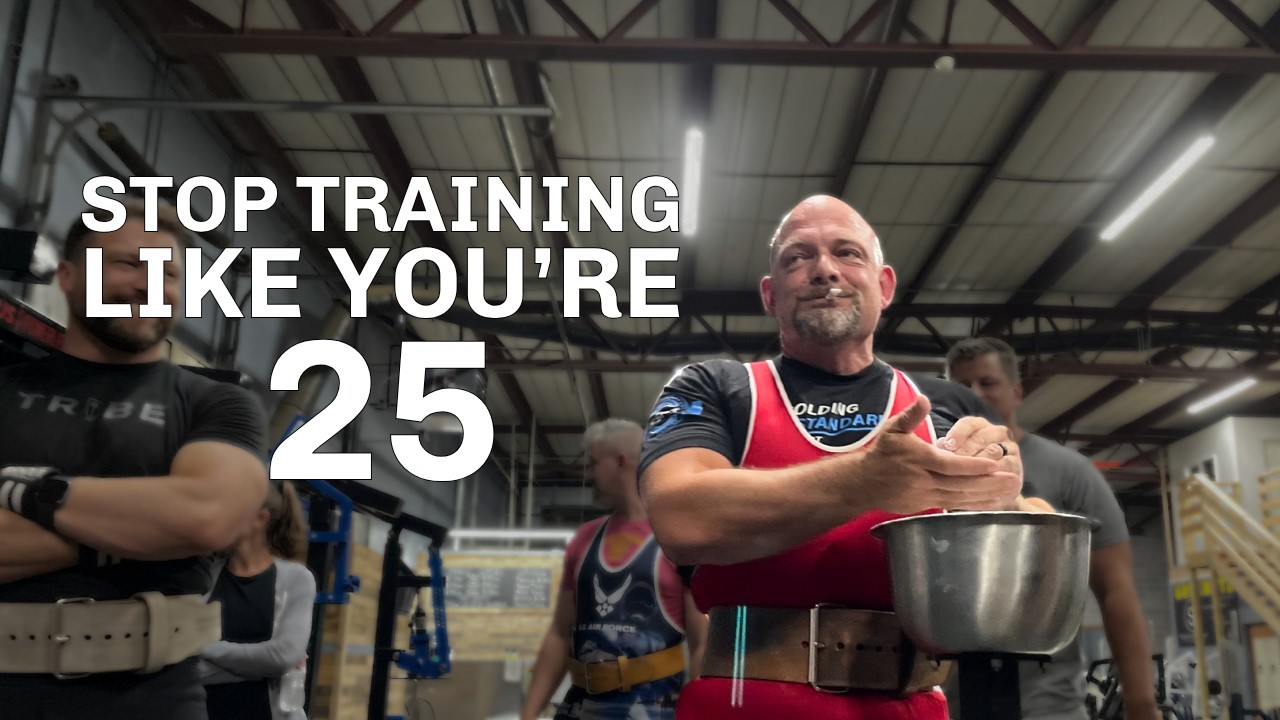
Video summary
The speaker outlines a practical strength training approach for individuals over forty that prioritizes heavy compound movements without sacrificing recovery or longevity. The core of the routine involves focusing on two primary lifts per session, such as variations of overhead presses and bench presses paired with squats and deadlifts on lower body days. To maintain efficiency while managing time constraints common in later life, the trainer utilizes accessory circuits consisting of three to four exercises performed for about three or four rounds. This method allows a workout to be completed in roughly nine to twelve minutes by moving quickly between sets rather than adhering strictly to timed intervals, ensuring that high-quality work is achieved without excessive duration.
As people age, their training context shifts due to increased responsibilities and the need for better recovery strategies, which become even more critical after forty. The speaker emphasizes that while bad habits may develop over time, older adults often have greater financial resources to invest in superior nutrition, professional coaching, and advanced home gym equipment like portable power units or high-quality food options. These investments are not merely luxuries but essential tools for maintaining strength and health when natural recovery slows down. Consequently, the advice is to leverage these available resources—such as hiring a coach if affordable—to optimize training programs and ensure that one can continue pushing limits safely without relying on suboptimal equipment found in second-hand markets.
Adaptability remains key to sustaining progress over forty, requiring individuals to listen closely to their bodies' signals regarding fatigue and joint health. When the body indicates it needs rest or a change of pace from heavy squatting twice weekly, the program should be modified by incorporating alternative movements like leg presses or trap bar deadlifts instead of forcing high-volume sessions that could lead to injury. The speaker notes that while they once disliked certain equipment, practical experience has shown that tools like safety bars, cambered bars, and trap bars are excellent alternatives when standard positions cause back pain or require too much recovery time. This flexibility allows trainees to maintain intensity and heavy loads without burning out their central nervous system or compromising form.
Ultimately, the philosophy behind training hard after forty is about balancing aggressive strength work with smart modifications that respect physical limitations while maximizing available resources. By combining heavy barbell lifts with strategic rest periods, quality sleep aids like CPAP machines or blackout shades, and sauna sessions for recovery, older athletes can extend their careers in fitness significantly longer than they might have otherwise. The conclusion encourages listeners to stop fearing the barbell but instead to embrace a mindset where volume and frequency are adjusted based on personal feedback rather than rigid adherence to past routines. This balanced approach ensures that strength gains continue throughout life without leading to burnout or injury, proving that it is entirely possible to train hard while staying healthy well into one's later years.
Read the full video transcript
is very similar the way I train today. I
like to go in and hit usually two lifts
and that's going to be a press and bench
press variation. Uh maybe a variant,
maybe an axle, maybe dumbbells even, um
or a squat and a deadlift on the lower
body day. And then I do accessory
circuits pretty fast and I I pick maybe
three exercises, four exercises. I do
those for about three rounds. I don't do
them every minute on the minute. I just
do a set and then I just move to the
next exercise and do a set. go for 10,
12, 15, and then go to the next set and
do the same thing. Um, and what you'll
find is if you have three exercises for
three rounds, it's going to take about
nine minutes. It pretty much is every
minute on the minute. Or if you do three
exercises for four rounds, it's going to
be 12. Or four exercises for three
rounds, it's going to be 12. And that's
usually in the ballpark of what I do. I
still get some of that um low oxidative
aerobic kind of work with the walks. And
I like the sauna for recovery. Who knows
if it actually helps. Uh, and then I'm
crazy about sleep. We've done podcasts
on that before, you know, with the CPAP
and the weighted blanket and the and the
eight sleep and the blackout shades and
all those things. I take that recovery
very seriously. So, those are the things
we have to do to stay strong and be
strong over 40. Lift heavy. Don't be
scared of the barbell. Squats,
deadlifts, bench press, press, and it
may be a variant for you. It might be,
you know, a squat. You might not be able
to get in a low bar position. So, you
might have to do a high bar or a safety
squat bar or a Mars bar or a cambered
bar or whatever the thing is. Buffalo
bar. so many things that we can use
today. I I love it. Um and those are
things we do. And then the other part of
this is like there's there's some life
context here that changes as we get
older. And that's that, you know, we
have we have more responsibilities and
fixed habits. We sometimes we have bad
habits that we have to figure out how to
work around or work through. Uh but we
also often have more resources, right?
So we can usually afford a coach and you
should have a coach if you're over 40
and can afford it. changes everything
about your training. We can afford
better food, uh, great home gym
equipment stuff, you know, instead of
going on, uh, Facebook Marketplace or
Craigslist, and some of us, there's
nothing wrong with that at all. But if
you can, man, if you could afford a a
Beyond Power Ultra, which takes up
almost no space, you can travel with.
actually heard the uh Brian Shaw
interviewed my good buddy Coupe at Home
Gym Con a last week and he Brian Shaw
travels everywhere with his Ultra
because he's basically got a makeshift
place he can work out and imagine being
Brian Shaw, World's Strongest Man four
time. He can't really go to a gym and
train because then everybody's going to
want to talk to you and he loves talking
to people. He's so nice but he can't get
his training in. So instead he can go to
his Airbnb and go he said he found a
telephone pole that they had in the
backyard or light pole or whatever and
he put the power vulture on and you know
that's a digital resistance cable
machine. You can get a lot of work done
on that and it's decently heavy. I mean
you can do belt squats and all kinds of
fun stuff with it. So his gym is all in
his training bag and he carries all of
that stuff and I think we can do those
things because we often can afford them
as we get a little bit older. So sure
certainly time is tighter and that
general health and longevity become
really important but I think it opens up
a lot of benefit for us. We're not, you
know, poor 19-year-old college kids for
the most part anymore, uh, who have to
live on on tuna cans and, you know,
whatever and bosmati giant bags of rice
from Sam's. And so we can afford better
food, higher quality food. We can afford
recovery tools. We can afford a little
better equipment u to be able to
continue to enjoy training and keep
pushing on the strength. So, I would
encourage you to keep doing the barbell
lifts. Uh, train heavy, just back off
your volume, uh, back off your frequency
a little bit if you need to. I can't
always squat twice a week every week.
And my body tells me I typically pro
program that uh some squat variation
twice twice a week. If I've done that
three, four, five workouts in a row, two
and a half weeks, three weeks in a row,
I often have to take a session where I
have to do something else. I'll have to
do leg press or some combination of leg
press, leg extension, leg curl, you
know, and uh deadlift, same thing. For
years, I used to just speak horribly
about a trap bar, but man, when my back
starts getting jacked up and just needs
some recovery, I'll just deadlift with a
trap bar. It's fine. I've got, you know,
one of the rep walkin trap bars. Works
great. And so those are the
modifications that we make. It's not
that I don't deadlift. I still deadlift.
I just back off the volume and back off
the frequency. But I keep it pretty
heavy. And when my body tells me I need
to change it, I change it. So there you
go. That is how we train over