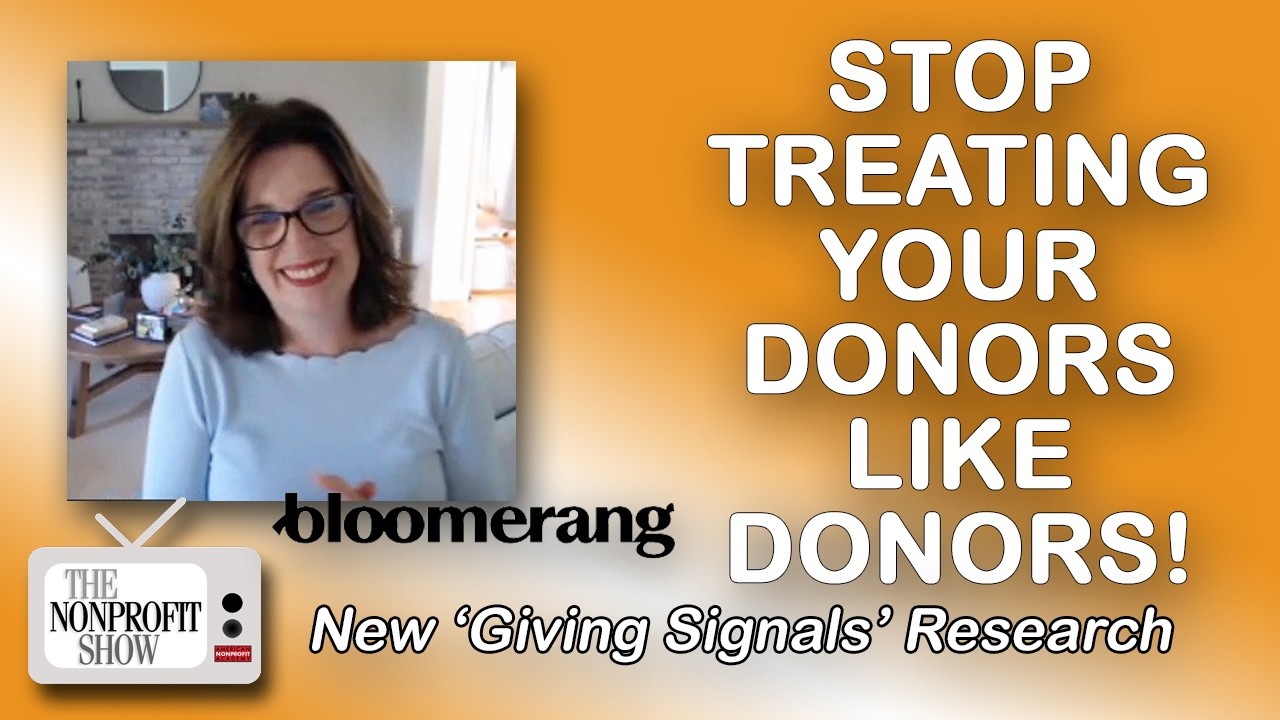
Video summary
The central thesis presented in this episode is that there is no such thing as a generic "donor," and treating all contributors to the same organization with identical messaging strategies significantly hampers fundraising effectiveness. Mary Krogan from Bloomerang explains how extensive research, including recent surveys conducted with the Harris Poll involving over a thousand donors, reveals distinct behavioral patterns based on geography, income levels, gender, and trust dynamics. The data indicates that organizations often fail because they apply a "one-size-fits-all" approach to appeals, which inadvertently narrows their focus by ignoring specific segments within their own database that might respond differently to tailored messages. By failing to recognize these nuances, nonprofits risk turning off opportunities for growth simply because they are not speaking the unique fundraising language of every segment in their audience.
Regional and demographic variations play a critical role in how donors perceive value and build trust with an organization. For instance, the data shows that Midwest donors respond better to concrete needs and specific outcomes rather than abstract concepts of community belonging or identity, which resonate more strongly on coasts like the West Coast and Northeast. Furthermore, income levels influence donor psychology; while higher-income households give more overall, they are driven by different motivators compared to lower-income groups who may be more emotionally responsive but also feel greater financial strain. Trust is identified as a foundational element that multiplies giving potential, yet it must be built differently across regions and demographics, with some areas requiring transparency about fund usage due to local trust deficits while others prioritize emotional connection or peer endorsements.
Gender differences further complicate the donor landscape, revealing that men and women arrive at decisions through different pathways regarding proof of impact and communication preferences. Women tend to place higher value on transparency, matching gifts, and detailed reporting on how their specific contributions made a difference, whereas men are more influenced by third-party ratings like Charity Navigator, professional endorsements from peers, and relevance-based messaging. Additionally, high-capacity donors who happen to be male often behave like skeptical buyers seeking evidence of ROI rather than being moved solely by storytelling. Consequently, successful fundraising strategies must build multiple roads into the donor journey, utilizing closed-loop reporting for female segments while leveraging ambassador programs and preferred communication channels for male counterparts, ensuring that both groups feel understood and valued in their decision-making process.
Ultimately, the conclusion drawn from this deep dive is that nonprofits must move away from a monolithic approach to fundraising cultivation and instead embrace segmentation based on these complex data insights. Organizations are encouraged to test different messaging strategies against specific donor profiles rather than assuming what works universally across an entire database. By understanding whether financial decisions in a household come from the wife or husband, recognizing regional trust issues, and adapting appeals to match income-driven motivations versus emotional drivers, nonprofits can significantly improve their conversion rates. The episode ends with a strong recommendation for organizations to download full reports like the Giving Signals Report to access these granular insights, proving that stepping back to analyze data before navigating forward is essential for sustainable growth in an increasingly diverse nonprofit sector.
Read the full video transcript
[music]
Hey, welcome back everybody. It's
another episode of the nonprofit show.
Interesting. Our guest today, Mary
Krogan's gonna say there's no such thing
as a donor and we're like shocked here
on the nonprofit show. We can't wait to
hear what Mary has to say. So, we're
delighted that you're joining us, Mary.
We get to have so such amazing guests
every day because we have great partners
and they include Bloomerang where Mary
joins us from, American Nonprofit
Academy, Staffing Boutique, your
part-time controller, Third Sector
Company, and JMT Consulting. I'm Julia
C. Patrick, CEO of the American
Nonprofit Academy. And I just want to
mention that we've been um running our
global edition of the nonprofit show now
for a couple months. really interesting
perspectives from people that do
nonprofit work and NGO work around the
world. We had a riveting guest on
earlier in the month from South Africa
who runs an organization that deals with
human trafficking. Uh fascinating stuff.
And so um if you're an organization
that's thinking about expanding or you
do work across borders, um check out our
Global Edition episodes. They're just
wonderful. Mary Krogan, hey, we loved
having you on so much for the first time
and then we were like, we got to get her
back on because you are fascinating and
uh you really were able to share with us
a lot of data and information that you
and your cohort have have been able to
put together and and lead. Talk to us
about that work, Mary.
>> Absolutely. Well, first of all, thanks
for having me back. I'm really excited
to join you again. Um, the team at
Bloomerang is constantly
uh engaging with the market and and
doing research so we can really
understand
um not only what makes and and motivates
donors, but also trying to uncover
opportunities for nonprofits. We've, you
know, we do big reports like the giving
signals report. We've got our
generational giving report, our mission
unstoppable reports, but we're also
doing monthly and quarterly pulse
surveys into our customer base um and
and the market as a whole and uncovering
some nuances and best practices that we
can bring to to the nonprofits that we
serve. So we we take that that um role
very seriously and and feel that it's
our job to uncover what's working and
what can be most effective fun from a
fundraising standpoint and share that
with uh with the nonprofit community.
>> You know, I want to call you out on two
things that I don't think a lot of
people realize is that um Bloomerang
always gives of gives this information
out to the community. It's not just
strictly for your clients. And that's
really huge because most organizations
that do in research because it's
expensive.
They don't want to share that out,
right? I mean, to the even to their
competitive set. Um, they want to be,
you know, holding that tight, that
information tight. And then the other
thing that I've really learned about you
all over the last couple years is that
how much you as an organization invest
in other organizations that are doing
research. Um everything from the
effectiveness um uh
>> oh the fundraising effectiveness project
>> fundraising I always get that first
[laughter]
>> um you know you're that you all are
investing in this and and I think that's
really it's really powerful and I just
want to say as somebody in the sector
thank you because um I know on the
nonprofit show we really look at this
information and it really it's it's just
amazing and and Um, so yeah, it's really
cool that you all do this. So without
further ado, you know, as we've been
talking about how great you are and what
you guys are doing, what the heck have
your are you learning here? Um, because
there's a lot. We only have 30 minutes,
but what's data saying about donors?
>> A lot actually. Um, you know, we
partnered with the Harris Poll back in
March and we surveyed just over a
thousand donors and uh several hundred
fundraisers and our goal was we really
wanted to understand what's actually
driving donor behavior now um and we
published the giving signals report um
at that time and we just recently did a
deeper um dive if you will into the data
set and we looked at donor response
responses based on some demographics
like region and household income and
gender instead of treating it all as one
group.
>> And there's a through line here and you
touched on it is there's no such thing
as the donor and and the data proves
that.
>> Yeah. It's so interesting and I I mean
when when you and I were talking um off
camerara last time you were on um you
did mention that you were going to be
really digging into some of this
information and I remember uh my
producer Kevin Pace and I when we got
off um the episode that day, we were
like, "Holy cow, this is going to shake
things up because of of digging down as
deeply as you did." And so really
interesting interesting stuff and I'm
just delighted that we could we could
have you back to talk about it. So first
off, what's up with the Midwest? Because
there's a comment in here that says the
Midwest speaks different fundraising
languages and we're always hearing about
the West Coast and the East Coast and
then they come together and what is it
that you saw or found, I should say?
Yeah, there's a couple of really
interesting um dimensions to this. Um
and we can start with reg. I'd love to
talk about income in a minute, too. But,
you know, the Midwest is definitely
speaking sort of a different fundraising
language, right? We found that donors in
the Midwest, they sit basically at the
bottom of nearly every sort of identity
or belonging motivator that we queried
about. They're the least likely to
expect to give more this year. They came
in at 45%. In comparison, the West came
in at 62%. And they're the least moved
by
being part of something or the sense of
belonging to something. And contrast,
good example, they came in at 28% on
those kind of statements. And my peers
here in the Northeast came in at 43%.
So, it's not that they're not giving
less, but this kind of coastal join a
community language
isn't landing with them. Um, and I think
what this points to is if you're
speaking to a Midwest audience, you need
to approach them with really concrete
need and demonstrate outcomes and not
lean so heavily into the identity or
belonging language. So, if you think
about it, you can think of this as
having a regional variation where for
the Midwest, you're leading with, you
know, $50 stocks um one weekend backpack
of food for a child that might otherwise
go hungry. Whereas, if you're talking to
someone here in Boston or on the West
Coast, focusing in on, hey, you're part
of a community that refuses to look
away, that kind of messaging would
resonate,
>> right? that join us and and be part of a
solution
versus this is what you your this is
what your action will do.
>> I find that fascinating. I mean like
that's like end of show right now.
That's really Mary. I have to really
think about that.
>> Yeah, it it we it caused us to stop and
think about it for a moment too. I was
just talking with Annne Felman, our CMO,
yesterday about the results and um you
know she's in Minneapolis and one of the
things that she pointed to is that you
know there's been a lot of um negative
press about nonprofit organizations and
um uh lack of trust and what have you in
those organizations in in that
geography. So it makes sense that
there's a more of a focus on okay be
transparent tell me what my money's
going to do. what how are the funds
being used versus talking to someone in
let's say Los Angeles or or here in in
New York that you know a message around
be part of something join like-minded
individuals in in making a change in
your community two different approaches
um that are equally effective
>> fascinating and um of all the things
that you could have said I wouldn't have
selected that as even an option right?
You know what I mean? And so that's why
I love that you all have you've looked
into this and that you're studying this
because we could be navigating through a
process that we think is what you need
to be doing and and in effect turning
off opportunities. Um, okay. So that was
like a barn burner and let's so let's go
on to this next issue that it has always
been there and you just talked about it
a moment ago and that's the issue of
trust
>> and and understanding how that and it
aligns with giving obviously that
they're on the same curve. What did you
find out about this? Yeah, 100%. And
that's something that I think all of us
in in the nonprofit space, we recognize
that relationship between trust and
giving. But it's really interesting when
you see it start to manifest an actual
research and data, right? Um we found
that the West
>> is is the most is both the most trusting
region. They came in at 86%
trust nonprofits to use funds
effectively versus the national um uh
number. And they're also the most
generous. They're expecting to give more
this year. 62% reported that. So there's
definitely a sense that trust is sitting
upstream of the ask and and it
multiplies everything that follows. And
you know, you can have a great appeal.
It can be beautifully written,
wellcrafted, well executed, but if
there's a low trust relationship there,
it's still not going to perform right.
So you need to treat uh treat
transparency as a fundraising activity,
not just a compliance moment. Like we've
talked a lot about that. And also, you
know, is how important it is to close
the loop on every gift and report on
what that last gift did and is frankly
the most persuasive input um you can
offer in order to generate that that
next gift. So we definitely saw some
differences from a geography perspective
there as well.
>> So when I hear you saying that um you
know that response to your get to gifts
and to your donors engagement um it
sounds to me like you're saying that
that helps build trust. It's not just a
oneanddone thing that as you're
navigating a relationship, whether it be
digital or in person, you still got to
be communicating these impacts.
>> 100%. 100%. And then, like I said,
there's some geographical variations
there in terms of just how important uh
that can be.
>> That's absolutely fascinating. I know I
know this is like an off-the-wall
question, but um do you can you tie this
this data point that says that they're
planning on giving more um to the
economics of the region? Yes. So, let's
talk about income because that was
probably for me one of the first things
we noted in our internal discussions
that I thought was um pretty
counterintuitive to what you might
expect. So, we looked at different
income bands and we saw the biggest
difference between households with less
than $50,000 a year annual income versus
uh those that have 150,000 plus. And you
would expect that, right? But here's
here's what is really interesting. That
lower end ban in terms of income, they
are more motivated
by emotional
>> outreach and messages. um uh statements
like people need more help now than ever
versus the higher household incomes.
There's a pretty significant difference
there even though it's that higher
income segment that's actually
increasing what they're they're giving.
Um so it was interesting because that
really strong emotional lever and those
those big wallets are actually kind of
pointing in opposite directions which we
really didn't expect. Um and it it
prompted a little bit of discussion
internally because you know there's a
there's there's an ethical edge here,
right? So you know this idea of using a
scarcity message with an audience who is
already financially stretched
>> even though the data is telling you it
works isn't something that you want to
enter into lightly. And if you're going
to pursue something like that, you
really want to pair um any sort of the
need is real appeal to that audience
with a truly genuine message that and
give what's right for you. And we talked
also about the fact that individuals in
those lower income um uh bands are
frankly feeling
feeling the pinch more so than anyone
right [laughter] now given our economy
is. and and they can relate to the needs
that others have and they they might
even be feeling some of that in their
own family and their own communities.
So, it really resonates deeply with
them. But you need to be careful and
intentional about how you make an ask
with that group.
>> And I think the the through line here
when you're looking at all these
different dimensions is truly that
there's no single the donor, right? I
mean, we're all individuals, but we
treat donors like a single entity a lot
of the time. And in doing so, we may
actually be hurting our our fundraising
efforts.
>> Um, we're talking about geography a
moment ago, too. We found that when we
look at all these different patterns and
stack them one on top of each other, um,
there's, you know, folks in the West
that are middle inome and female. Those
are the ones who
where identity and belonging and urgency
messaging it's calibrated to them
because that's what a lot of nonprofits
are leading with is calibrated to them
almost by accident but then in contrast
those messages are not converting as
well with like we talked about the
Midwest but also highcapacity donors and
men so there's a the key in all of this
I think is really understanding some of
these patterns
>> recognizing that you need to think about
how you engage with these segments
differently,
>> right? So, I think that's absolutely
fascinating because that is going to
upend a lot of people when they think
about their marketing and and how
they're achieving it. Talk a little bit
more about this high-capacity donor and
especially when they're male. um they're
not going to be moved by a story. And
storytelling has been, it seems to me,
at the center of marketing in the in the
nonprofit sector. It gets just hammered
into us all the time. Tell a good story.
Tell a good story.
>> Um so what does that look like? What did
your data, you know, help you uncover
when it comes to those those
highcapacity donors that frankly are
more male?
>> It was interesting. We looked at that
150k plus segment and it's clear that
they want proof, not just a moving
story, right? They're more moved by
things like third party ratings like
Charity Navigator, Charity Watch. They
came in at 41% look to those third party
ratings versus 29% for the average,
right? And they're notably
less less moved by those emotional
framings. even things like the
government isn't helping enough. That
was a huge spread um across the income
brand uh bands. So
those high those those individuals that
have the potential to be your high
capacity donors, they behave like a
skeptical evidence-driven buyer, right?
And they're they're not necessarily
emotional givers. So, you got to lead
your major gift cultivation efforts with
proof like ratings and audited outcomes
and measured ROI and impact statements.
That's what's really going to resonate
with them.
>> Wow. So, again, this is like off the
cuff cuff, but what would you um think
of a strategy for when you have um a
couple, one that maybe is female and
they're still in this high capacity
donor band. Um, it sounds to me like
what you're saying is that the female is
going to hear be more responsive to the
storytelling and the emotional part
where the male might not be. And yet
they're the two are going to have to
come together to agree on some sort of
gift.
>> Sure. I mean, when you think about your
the donor, a lot of times you are
talking about a household, which
>> Yeah.
>> Right.
>> So, um,
>> you really need to test into it. You
have to figure out well what resonates
with my audience with my donor base and
and and get a read on how they perform
or what's going to move them because you
don't know in a household. It could be
the the wife, it could be the husband,
it it who knows making the financial
decision when it comes to giving um and
who's an influencer. So, um, I think
it's really important to take these
insights and kind of look at them in the
context of what you're doing today and
your what you know about your donor base
and and start testing some things out to
see if you can move the needle when it
comes to your fundraising.
It's absolutely riveting because um you
know as we look at this great wealth
transfer and as we are working with more
dual income households these are real
questions that have to be answered.
>> Sure.
>> Right. You you can't just wait and and
hope that that uh kind of comes about.
Okay. So we've already started talking
about male versus female. What are some
of those other things especially when it
comes to trust? I am really interested
in this Mary.
>> So yeah, this was a we actually had a
good chuckle on this actually when we
started looking at the data like well of
course men and women are approaching
this stuff differently because we're
very different um uh individuals. Um and
I think trust is pro out of all the
dimensions we looked at the trust piece
was the one that kind of really stood
out is like okay this is where the two
are are diverging in sort of a
meaningful way. So what we found was
that trust matters to both but they get
there they arrive at a sense of trust
differently. So women, we're moved more
by proof of impact than our male
counterparts. Um, meaning for instance,
transparency.
For women, that came in at 74% as a
factor. 65% for male. Not that
transparency is not important to men,
but it's more important to women.
Matching gifts came in at 81%.
Males 74%.
interesting
>> and being told the impact of their gift
93% for women. So that's a big one when
it comes to building trust with your
female donor base.
>> Men when we looked at at what motivated
them and where the deltas were with
women, relevance and endorsement really
stood out. So,
>> men getting a recommendation from
someone in their personal or
professional network about a nonprofit
or um also what was important to them in
building trust was being contacted and
engaged through channels that they
prefer to communicate through more so
than women. So, those were two really
interesting insights that came out of
the data. And I think what it points to
is
you need to kind of build both roads
into your donor journey rather than
trying to optimize in favor of one
versus the other. You know, if you
create segments male versus female, with
females, closed loop reporting, matching
gift visibility is should be part of
that path, that journey as you nurture
those relationships. And with men, focus
on things like peer and ambassador type
programs and make sure you're targeting
them through channel preferences that
they've stated, through surveys that you
might have done, what whatever it might
be. Um, but yeah, really interesting
dynamic there.
>> So, um, the thing that's stands out to
me is that profession, I'm going to call
it professional endorsement or thought
leader, community leader. Um, could you
determine if any of that was from the
community versus digitally? Um, and
because I'm thinking of like the
influencer models that are being used um
throughout social media.
>> The way the question was stated, it was
less about digital and influencers and
more about their circle, their their
professional circle
>> or and their personal circle, their
friends.
>> Yeah, that is something I would not have
guessed. And if
>> yeah,
>> if that was something to measure, I
would have thought it was much more
female centric.
>> Interesting. Right.
>> Exactly.
>> Really, really interesting. So, I'm
thinking about does that mean, you know,
we need to be highlighting our boards
more and the people that that, you know,
our community leaders that support us
are doing that quote unquote
testimonial. This is why I support this
nonprofit. I mean, what does that look
like?
>> Yeah, that's a great tactic. That's a
great strategy right there. Um, bringing
your we talk about it in the forprofit
world as as bringing your customer voice
into your communication
>> and and having your customers talk about
why they work with your organization.
The same principle applies here. If you
have great relationships with your
donors, have them become part of your
voice, part of your story. first person
narratives around why they're choosing
to support your organization.
>> Yeah. Really interesting. You know, um
in my community, um our public, uh
television station does that. They they
they seem to get all different types of
people from our community, not just like
the, you know, the highly visible, but
you know, school teacher, a small
business owner that that stand up and
say, "This is why I support, you know,
um public public TV." Um, and I find it
very compelling.
>> It really is. And you think about that
Midwest segment we were talking about
earlier. um bringing that to bear in
your communication with folks in that
region if you're you know working
nationally or even if you're a local
nonprofit in the Midwest recognizing
that okay to build trust and restore
trust in the nonprofit community um I I
need to convey to folks that we are a
trustworthy organization and there's no
better way to do that than through their
peers.
So what I hear you saying is that if
there's a trust issue,
maybe not even in our own community, it
could be somewhere in our nation that's
impacting all of us. It's not just
specific to our nonprofit. Is that is
that fair to say? I
>> I I think it is. I think we're
definitely seeing um the trust and
concerns about trust with nonprofits
uh emerging in certain pockets in
certain geographies at least based on on
this data and and that was evident from
a from a Midwest perspective. There's
been other um research published
recently that talks about trust in
nonprofits and at a national level it's
it's incredibly strong and I believe
that to be true. But you know, you know
your community, you know your audience.
Um, and taking a pulse just like we've
done here with this survey on a national
level.
>> Great opportunity for nonprofit to
survey their donors um and get a sense
of where they're at on some of these um
uh profile points so they can tailor the
work that they're doing accordingly.
>> Yeah. Really interesting. you know, um,
you just said something that's riveting
because I don't think I've ever been
asked that.
>> Interesting. Yeah.
>> As a donor, right? I mean,
I I mean, going through all this and
decades and decades and decades of
supporting different groups in my
community, when we're when we get asked
about things, it doesn't seem like we
ever talk about that that.
>> Wow.
Yeah, that's very interesting. Well,
this is fascinating. I I've really
enjoyed having you on another episode of
the nonprofit show. Um, and yeah, thank
you. Thank you. Thank you to Bloomerang
for making these investments. These
things are expensive. Um, you don't
partner with Harris to get, you know, on
the cheap. These are these are really
expensive and they take a lot of time.
They take a lot of thought. Mary
Krogan's been with us. She's the vice
president in brand marketing at
Bloomerang. Mary, how would we get more
of this information and access to some
of this thought leadership that that you
all over at Bloomerang have been doing?
>> Sure. Um, before I give you the URL,
just one final point. I think the
takeaway here, just remember as a
nonprofit, one sizefits-all appeals
isn't wrong. It's just narrowing your
focus, right? and um you're likely
appealing to a profile that doesn't
represent your entire database. So, if
you do nothing else before your next
appeal, segment and test some different
messaging strategies based on these
insights and shape shape these into into
your program as as as appropriate. Um,
if you go to bloomerang.com,
you can search on giving signals report
and you'll then have access to our full
report as well as blog posts that we're
releasing as we do our incremental um,
deep dive. So, um, I hope everybody
takes the takes a moment to download the
report and uh, can glean some some great
insights from it. Yeah, I think it's
just brilliant. And I think it's um I
think a lot of times, Mary, I talk with
nonprofits and they get so frustr
frustrated because they work so hard to
put together a package and market and
they they really, you know, believe
they're doing the right thing and
strategic and it doesn't work and they
don't know why. And there's just nothing
more frustrating. So stepping back as
you said, looking at this first, looking
at this information first and then
navigating forward I think can make a
world of difference. So thank you for
sharing with us today.
>> Of course, happy to be here. Thank you.
>> Yeah, really interesting. Again,
bloomerang.com, go to their website,
you'll be able to find a lot about the
different research they're doing. As
Mary mentioned, I think what's really
interesting about this study that
they've done is that they're continuing
to dig down into what the data is
saying. And so those blog posts um can
really drill down into some of the
different points that um Mary and I have
been talking about today. I find it
riveting. Sometimes when you get a
report, it just is overwhelming because
it's so much. And that's what I like
your approach. how I like your approach
is that it's taken some of these
concepts and kind of broken them down a
little bit more. So, um I
>> yeah, I find the blog posts have been
really great for me to kind of get one
concept and really drill down into it.
Mary Krogan, you're welcome back
anytime.
>> I would love to come back. We're going
to do our third phase sort of drill down
uh here towards the end of October and
I'll let you know what we find.
>> Yeah, we need to hear this. Super super
cool information. Hey, you know,
Bloomerang's been with us since the
beginning last Friday. We separate we
separated we celebrated our 1,600th
episode 1,600 episodes of the nonprofit
show. Bloomerang's been with us since
the beginning as has uh uh American
Nonprofit Academy staffing boutique,
your part-time controller, third sector
company, JMT Consulting, and Inuit
QuickBooks. These are the folks that
stand behind us and uh really support us
so that we can have amazing people on
like Mary Krogan today. So I wanted to
make sure that we we touch base with you
on that. As we end each and every
episode of the nonprofit show, we leave
with this message and it goes like this.
To stay well so you can do well. We'll
see you again.
[music]