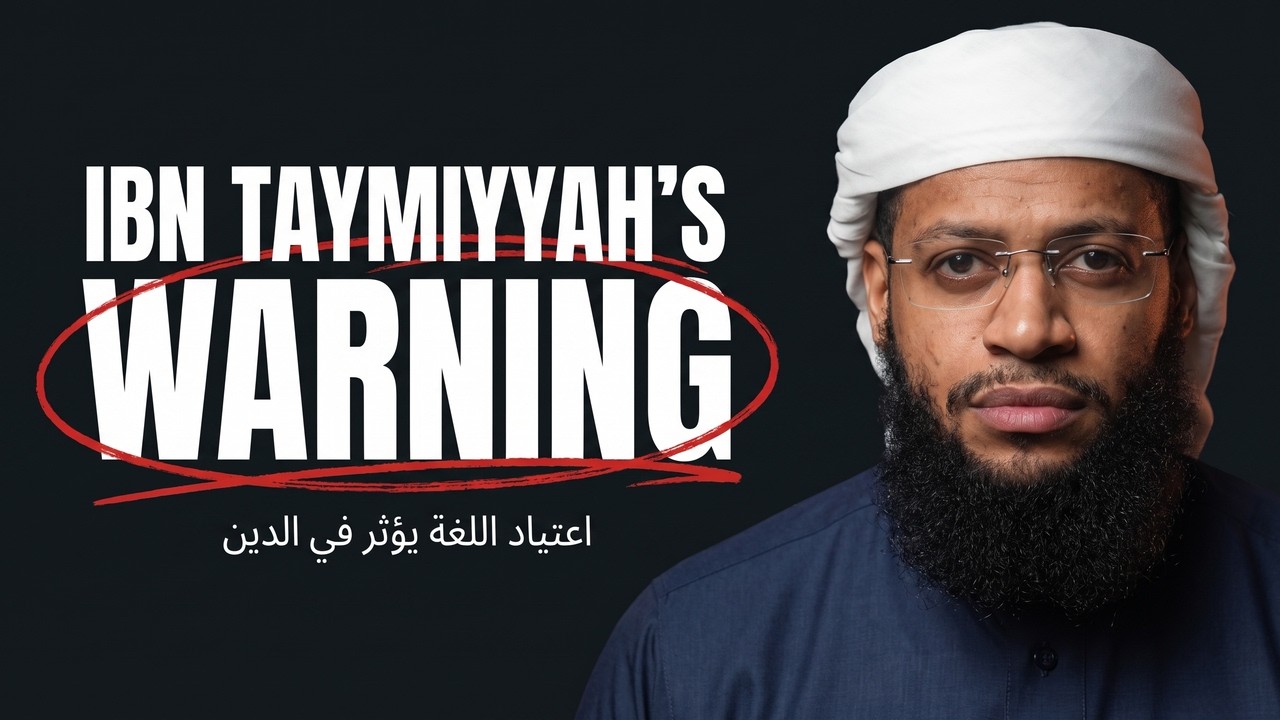
Video summary
The video argues that many contemporary Muslim students and teachers mistakenly focus solely on learning Arabic for the specific purpose of reading books, which contradicts the traditional approach advocated by scholars like Imam Malik. According to historical fatwas cited in the transcript, such as those from Fatawa volume 32, using any language other than Arabic within mosques or daily transactions was strongly discouraged unless absolutely necessary. The primary objective for a student of knowledge should be to master the spoken tongue to follow the Sunnah and live authentically, rather than treating the language merely as a tool for academic reading. This perspective is reinforced by the story in Sahih Muslim regarding Prophet Ismael learning Arabic from his people through immersion and social interaction, highlighting that the original method was oral transmission without formal grammar rules or written texts.
To achieve true fluency and understanding of how early Arabs comprehended the Quran, learners must prioritize listening comprehension and speaking over reading and writing skills. The transcript references a linguistic analysis indicating that listening is the hardest skill to fake, while speaking immediately reveals one's vocabulary, pronunciation, confidence, and ability to think in the target language. In contrast, grammar accuracy and large vocabularies are often overestimated as indicators of proficiency; one can possess perfect grammar yet struggle to communicate effectively if they do not speak or listen actively. The speaker emphasizes that all major languages derive their names from words for "tongue" or "speech," underscoring that the essence of a language lies in its spoken form, which was how it existed during the time of the Prophet Muhammad (peace be upon him).
Beyond linguistic proficiency, adopting Arabic as a daily conversational tool serves as a powerful defense against cultural erosion and colonial strategies aimed at dismantling Muslim identity. The speaker references historical accounts by Alexis de Tocqueville regarding French colonization in Algeria, where policies explicitly sought to replace indigenous identities with European values by forcing the adoption of foreign languages like English or French while suppressing local tongues. By refusing to speak Arabic only for reading but instead integrating it into family life and daily social interactions, Muslims can maintain a strong connection to their faith that is resistant to external ideological changes. This approach not only preserves cultural heritage but also fosters a resemblance to the early generations of companions, thereby positively influencing one's character, mind, and religious practice in ways that passive reading cannot achieve.
Read the full video transcript
Most Muslims nowadays, most student of
knowledge want to be and sadly enough a
lot of so-called teachers, they call
towards learning the Arabic language for
the sake of accessing books and that's
it for the sake of reading and that's
it. And that is not the way of the
celef. And in this video, I'm going to
tell you, he said in this book right
here, and it's actually way bigger than
this, but I couldn't pick all the books,
how he said that we should be towards
the Arabic language as Muslims,
especially as students of knowledge, as
those who carry the flag of knowledge
and sticking to the sunnah and living a
life that sticks to the sunnah.
He says,
he says in Fatawa volume 32, page 159,
the CF always disliked changing the
symbols of the Arabs even in
transactions.
which included speaking in non-Arabic
languages except when necessary. Malik
Malik he said whoever speaks in our
mosque with other than the Arabic
language should be removed from it. Your
goal as a student of knowledge should be
to learn the Arabic language to follow
the sunnah meaning speak with it which
is the main goal of a language. If you
go to Sah Muslim to hadith 3,346
is a long hadith the story of of Zam in
there in the hadith it explains how is
learned the Arabic language from it
doesn't take rocket science for somebody
to understand that in those times there
was no rules no grammar rules there was
no writing but rather it was a language
that was a spoken language is and is
the cause why the rest of the Arab
learned the Arabic language. So the way
how he learned was the tab way of
learning the Arabic language. The
prophet Muhammad sallall alaihi wasallam
is the most eloquent of the Arab and
anyone that spoke Arabic and the prophet
Muhammad wasallam he's Muhammadbah
Abdalib
the tribe of from the tribe of Quraysh
and from the and the from the from the
descendants of is so inahk in hadith
3,364
part of that long hadith he says is
the boy is
prophet Ismael grew up and learned
Arabic from them the tribe and they
admired him as he grew older when he
reached maturity they married him to a
woman from among them. So the goal of
the Arabic language and how you should
approach it is first of all to learn it
from its people, how they speak it. So I
did a quick uh search on Chachip right
now and I asked what which skill reveals
your level in a language the most. It
says number one listening comprehension.
This is the hardest skill to fake.
Number two speaking. Speaking
immediately exposes vocabulary, fluency,
pronunciation, confidence, and ability
to think in the language. And then
number three, reading, four, writing,
five, vocabulary, six, pronunciation,
seven, accuracy. Interestingly enough,
it says about number five, vocabulary
with four stars out of five. It says
someone with a large vocabulary sounds
advanced almost immediately. Limited
vocabulary is usually the biggest
bottleneck. Then we have number seven,
grammar accuracy with three stars out of
five. He says people often overestimate
grammar. You can have perfect grammar
and still struggle to communicate or you
can make grammar mistakes and still
function at a very high level. So
listening comprehension and speaking
with five stars, five stars out of five.
Reading with four stars out of five.
Writing with four stars out of five.
Vocabulary with four stars out of five.
pronunciation with three stars out of
five. Grammar with grammar accuracy with
three stars out of five. So when it
comes to a language, the thing that you
have to focus the most is these two
things. Listening comprehension. So you
can do number three, which is speaking.
That's the whole goal of a language. And
this is why language in English, langua
in Spanish, yenua in Catalan, long in
French, all these Latin languages and I
know five of them fluently. It alludes
to the language with or the tongue the
organ that that is used when speaking.
Likewise in Arabic we say
the tongue of Arab and the Arab in those
times they didn't write the language. So
this might attempt change the perception
of students of knowledge. Those who want
to eventually understand the Quran how
the Arabs understood it. You need to
look at acquiring the Arabic language as
trying to make it your main language,
your first language, not just a language
that you learn how to read books. So you
can take majawa
open it and read you know whatever
whatever text here and then translate it
into English when you're teaching or or
just basically using the Arabic language
just to read books. That is not how it
should be. You should try and be the
person in your family
that breaks this pattern of your
descendants and your ancestors not
speaking Arabic and try to speak with
your family Arabic. try to have children
be raised up in the language of the
prophet Muhammad wasallam even if it's a
dialect pick the closest dialect to to
the Arabic language that will help them
more than them just knowing English that
is the reason why when colonizers will
go to Arab countries the first thing
they would do is give them our values
i.e
Make them speak English, make them speak
Portuguese, make them speak Danish,
whatever it might be, and only allow
them to speak in these languages. Close
all Islamic schools, close all Arabic
schools. Don't allow them to speak with
this language because that is what had
Muslims connected to their book. And if
you're connected to your book, your
faith is strong. And when somebody has a
strong faith, you cannot change his
ideas. And that would go against what
the colonizers want to do. And there are
books where you can see these colonial
strategies like for example Alexis the
Tokville. He says in writings on empire
and slavery by Alexis the Toqueville. He
says, "We have made Muslim society much
more miserable, more disordered, more
ignorant and more barbarous than it was
before it knew us." And these the
writings on Algeria and the the whole
war that it happened in Algeria and how
French tried to to colonize Algeria.
Likewise in the policy of uh the French
which is called French assimilation
policy and mission mission civil in in
French it says that French language
equals civilization Arabic/Islamic
systems is backward indigenous identity
must be replaced gradually and the
resources for these is France Fenon the
wretchet of the earth Mei the colonizer
and the colonized Charles Robert Agiran
modern Algeria in Edward said or I guess
is Edward say culture and imperialism
and the quotes are countless but if you
think about it indigenous identity must
be replaced gradually that's what they
would do let's just have all these
Muslims countries colonized by other
countries and have them stop using the
language and Muslims in the West these
dummies, they are just going to learn
the language just to read the books and
then not speak it and not care enough.
And you don't realize how much speaking
the English language on a day-to-day
basis and social media and all these
propaganda and the culture that comes
the heavy culture that is given to you
through the English language or through
your mother tongue or whatever you might
be. Every language has a culture that
goes with it and your are heavily by the
language that you speak and your dean is
heavily impacted by the language that
you sleep that you speak. And this is
why he says that
He says that accustoming yourself to the
Arabic language affects the mind, the
character and the religion. A strong
clear effect. It also brings about
resemblance to the earliest generations
of this um the companions and the and
that resemblance increases one's mind,
religion and character. If you are
Muslim, please, especially if you
adhereare to the Sunnah and you claim to
be a student of knowledge, don't have
this mentality of I'm just going to
learn the Arabic language just to go
over books and then I'm going to speak
to the rest of the day and my family and
everything all in English. It will never
allow you as to the Arabic language to
the to the point where maybe becomes
your first language. Think about it. I'm
speaking in a language in English right
now which is not mine. how accurate I
am, how fluent I am. Do you think it's
impossible for you to get this fluent at
a language that is not yours? Would you
be fine being this fluent in Arabic as I
am fluent in in in English? At one
point, I didn't know English. So, is it
possible? Yes, it is. And you taking the
Arabic language as your day-to-day
language is going to have a clear effect
in your religion.