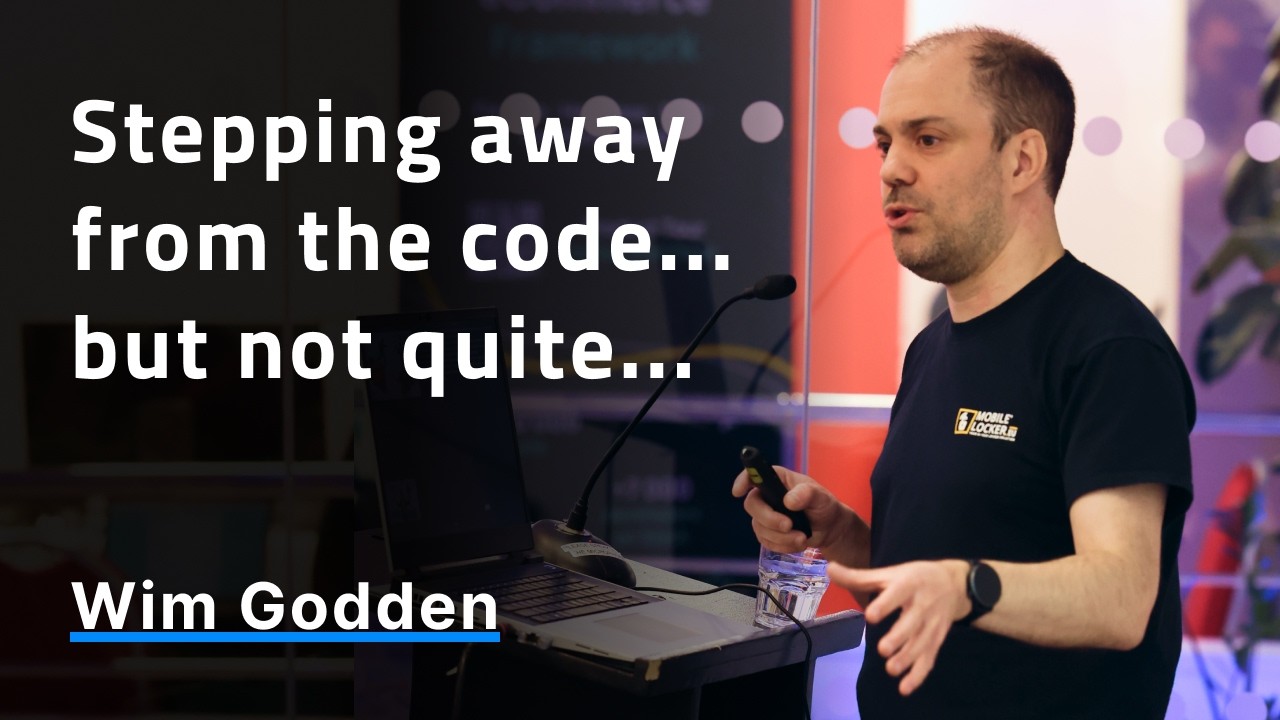
Video summary
Wim Godden begins by sharing his unique background as a Belgian developer who started coding at age seven and has since transitioned from building early internet tools like search engine submission systems to running a successful hardware and software company called Mobile Locker. He challenges the conventional view of a career as a linear ladder where one must constantly climb from junior to senior roles, arguing instead that professional growth is more akin to a landscape that flows in various directions. According to Godden, true seniority is not defined by years of experience or titles but by "reflexes"—the ability to instinctively understand complex systems and predict potential failures without needing to trace every line of code. These reflexes are perishable skills that can fade when one moves into management roles, but they can be replaced by new instincts related to architecture, risk analysis, and people management.
The core of his argument revolves around the dangers of detachment from technical realities when ascending to executive positions like CTO or CEO. Godden illustrates how communication gaps between sales, management, and development teams often lead to catastrophic failures, such as a platform collapse due to unrealistic user load projections that were never passed down the chain. He emphasizes that leaders must cultivate the courage to say "no" to features that are technically unfeasible or would cause system instability, even if those requests promise high revenue. This ability to push back early is crucial because it prevents technical debt and burnout, ensuring that the team remains sustainable and healthy. While moving away from daily coding creates distance, Godden warns that too much detachment blinds leaders to the actual state of the product, creating a delicate balance where one must stay close enough to understand the architecture but far enough to avoid micromanaging code details.
Ultimately, Godden redefines success by shifting the focus from climbing the corporate ladder to finding personal happiness and alignment with one's strengths. He asserts that there is no universal metric for a successful career; some individuals thrive on strategic decision-making and power, while others find fulfillment in deep technical craftsmanship, and neither path is superior. The most important advice he offers is to regularly re-evaluate one's role every few months to ensure that the current position brings joy and a sense of being "at home." If a professional feels unhappy after a reasonable period, it may be time to step back into coding or seek a different environment rather than forcing oneself into a role that causes misery. His message concludes that career satisfaction comes from solving problems that resonate with you and finding the place where you feel most alive, whether that means leading a team of twenty or diving back into writing code for a specific project.
Read the full video transcript
Please welcome Whim God.
>> Thanks. Um I'm surprised to see so many
people who want to step away from the
code.
Or maybe not quite. I mean um so hi. Um
let me uh yeah quickly uh tell you a
little bit more about myself. I'm from
Belgium. um best known for um Belgian
beer and chocolate and other tasty yummy
things. Um and this image may
look a bit like I have a split
personality but not not really. Um uh
it's just that I started as a developer
but I'm also well I run a business also.
Um but I I started coding at age seven
um which is a very long time ago. Um
nowadays coding at age seven is not that
exceptional anymore with all those tools
uh that are out there for for kids. Um
but in the 80s it was quite quite a bit
different. Um in the '90s I built uh
tools for uh bulletin board systems. If
I talk about bulletin board systems most
of you will think vulletin or PHPB.
No, I'm talking about bulletin board
systems. the thing you use a modem to
use a dialup connection to to connect to
and yeah use that kind of things. Um I
built um a thing called GNET back in the
'90s uh which was a search engine
submission system that was before the
days of Google when you still had to add
your website to a search engine. Um and
I built a Windows version even for it.
This was on PHP 3.0. Um, and I built a
Windows version that would interface
with it using a an API. APIs didn't
exist. So, yeah, you could imagine what
that looked like. And, uh, I actually
had well 50,000 57,000 members at some
point. So, I thought, well, maybe I can
make a business out of this. Um, in the
meantime, I was trying to make some
money running some ads. So, I ran a
project called PHP ads new for a while.
uh maintained that for a while which
turned into other names and it's now
called revive ad server and so I started
thinking okay I can make a business out
of this GNET thing maybe charge some
money for it and yeah make something
into it of course that all failed when
Google started and they started browsing
crawling the web themselves but anyway
in the meantime I started a company
called Cube which if you've seen me
given give give a talk before you
probably know that I worked for that
company until the end of last year when
I sold it to one of our customers uh
called Mobile Locker and that's who I
work for now as a CTO and we do mostly
locker installations, luggage lockers,
both fixed installations, train
stations, airports, music venues, things
like that, but also mobile installations
for music festivals uh and so on. Uh and
so we built software for yeah that runs
on there. We built the hardware and
everything else. Okay, that's enough
about me. Um, quick show of hands. Who
here is a developer?
Okay. Well, I see a lot I see some
people doing like sort of. Okay. Um, who
here considers themselves a senior? And
that does doesn't mean you have the
title senior, but who says, "Yeah, I'm
senior. I've I've been Okay. Uh uh who's
a lead developer or a team lead? Yeah.
Architect.
Yeah. Okay. Who's a project manager or
technical project manager?
Okay. Any CTOs or CEOs or CEOs or any
other seale?
Okay. Now I wonder what the few people
who were doing that were but anyway.
Okay. Um I'm I I just want to put this
image on the screen. Um because when I
asked you to raise your hands just now
um with one of those specific job roles
uh most people would match them with a
specific position here and usually on a
linear scale from like the junior
developer at the bottom all the way up
to the sea level at the top. That's what
most people would look at um would would
consider this as a career scale. Uh I'll
come back to this image later. I I'll
explain why. Um so most of us start our
careers as juniors and juniors well as
juniors we need to learn. We need to be
coached. We need to be instructed and
when we do our our abilities improve um
our understanding improves. Our the
quality of our code improves. We
visualize code structures better. We
spot mistakes more quickly and so on.
And the logic is to think that every
junior will become a meteor developer
and at some point a senior developer,
right?
First of all, that's not true. Um,
everybody has their limitations and for
each person that's different. Um, in
each skill like I will never play in the
NBA. I can play basketball, but I'm
never going to be able to do that. And
the same goes for coding. Some people
will never reach the stages state of
senior no matter how hard they try. Um
doesn't mean that they're not doing
their best but just everybody has their
limitations. Um so what makes a senior a
senior?
It's not the number of years. I mean
I've had people um applying for a job
literally coming to me and saying um
yeah I've I've done this job for 12
years. And I asked them, "What what did
you do?" Well, I wrote on a Zen
Framework one project for the last 12
years.
Okay. And you're applying for a senior
symfony developer position right now. Um
while actually you're basically apply
you're applying but you're a junior on
the symphony level. So number of years
doesn't make you a senior. So what does
make you a senior? Well, it's what I
call reflexes.
Um, and reflexes basically are grown by
doing many different things. Um, being
on many different projects and working
with many different technologies.
Um, it's basically illustrated here by
well the left person, the junior, he
will look at an error and say, "Huh, I
wonder why this is happening. I don't
understand this error. which file should
I open in my IDE, which which method is
actually calling this thing and where's
the data coming from and so on. Whereas
a senior will see the same error and
instinctively will be aware of where the
problem lies um and instead of browsing
through the entire code stack, they're
already opening the correct file and
already fixing the problem. Um, you
notice it in technical meetings where
the actually the actual most senior
person in the room regardless of whether
they received the title senior um will
say things like, "Wait, this solution
that you're proposing won't scale or
this thing here that we're building um
it's going to bite us in the ass later
on." They have often without realizing
it taught themselves how to predict the
future, predict what kind of problems
will come from this. That is seniority,
not the number of years that you've been
on the job doing a certain thing.
Now, to be clear, the reflex that I
talked about, um, the, you know, sensing
things,
those are skills that are perishable.
So, um, they need to be trained just
like any professional athlete needs to
train in order to be able to continue
winning at whatever they're good at. Um
so when you go beyond coding on a daily
basis when you spend less and less time
in in code when you become because you
move into you know an more architectural
role or more management role that's what
you also start to lose a little bit that
reflex.
But don't let that scare you. You might
lose a bit of the coding reflex but
chances are you'll pick up new reflexes.
reflexes that might have to do with
analyzing risk or systems architecture
and so on. Things that are more for the
job that you're doing at that moment. So
you don't lose really your seniority,
you just change the reflex that is being
trained.
Now you might think the hardest jump,
the biggest leap to take is from junior
developer to senior developer to lead to
architect. Now
usually that's the process that takes
the longest because you have the most to
learn over time. U but actually the
hardest one is being is going from let's
say an architect position or a lead
position to becoming a CTO, CEO, COO,
whatever. um seale management position
there is um it's where
you're not working in the code on a
daily basis anymore. You're not actually
looking at the virtual or the physical
server server infrastructure anymore. Um
you don't know how things are running
anymore because you're not involved on
it in it on a daily basis. um you're now
juggling a lot of things, but those
things are client meetings and budgets
and board meetings and much more without
having the day-to-day understanding of
how the product that your company sells
is built within. Um you might be
juggling a ticking time bomb if they
built it wrong. Who knows?
Now a lot of people think that um any
management level position
um they care about two things
um time and money.
Meaning by when can we build and ship
this thing on the one hand and how much
money will it cost and how much money
will it make? Those are things that PE
management uh thinks about most. But
that's leaving out a valuable
third variable,
people.
Um because behind the time and the
money, there are things like technical
debt, uh missing tests, um limits that
you hit in terms of scalability,
architectural decisions that are all
being made by people. And these seem
like purely technical problems at first.
Um things a CTO
doesn't need to be concerned about, but
they're actually not. And that's why
actually a CTO who doesn't come from a
technical background
usually that doesn't work out very well
because they don't understand the
technical things be behind it. And let
me illustrate that with a very simple
example that we saw at a customer
a couple of years ago. The sales team
sold a feature.
Okay. They sold the feature to a
customer and the thing was supposed to
go live on a Saturday evening at 8:00.
Yeah. Perfect timing.
That's when all the technical people of
course want to be online to check if
things are working. Yeah. Um so the new
feature is launched. Um the load on the
machine increases
and now there's 15 million people trying
to hit that application.
Nobody told technical people there were
going to be 15 million people. They
weren't even told they were going to be
15,000 people. So of course critical
limit reaches at some point the whole
platform collapses.
You could say this is a technical
failure because the system goes down,
but actually it's a communication
failure. Um, somewhere on along the
line, somebody didn't pass along the
information. And it it's similar to the
game you might have played as a kid
where you're in a circle and you tell a
story to the person sitting next to you
and they need to tell the story to the
next. What comes back after it's gone
through the entire circle is a
completely different story. It starts
with a story about dinosaurs and it ends
up being about, I don't know,
space or something. Um, it's basically
the customer telling the sales
department, "This is what we want." And
the sales department asking the CTO,
"Can we build this?" and the CTO
thinking, "Yeah, I built something like
that back when I was a developer. Yeah,
sure. We can build that."
Them going to the product owner, going
to the project manager and asking
eventually the developer, "Can you build
this?" Um, sure. But you see, there's a
bit of a gap between the CTO who said,
"Yeah, I'm sure we can build this," and
the developer who actually has to build
it. So that means there is a distance
between them but there's no direct
feedback loop and that's a very
dangerous thing. So as the CTO
there has to be a new reflex to push
back or at least to ask more questions
but in very in many cases to push back
early and it's actually not just the CTO
that needs to be able to push back.
Sometimes it is your job to say no. Um
as a CTO, as a product owner, as a
project manager, as an architect to
simply say no, no to oh this feature, we
want this extra button and when you
click it, a rocket has to launch. I
don't know, some kind of thing that
makes no sense because it is illogical
because it would overload systems and so
on.
uh you want to say no to oh we want 15
million people to be able to use this
tomorrow unlimited scaling no there
needs needs to be a certain amount of
constraints
uh unrealistic timelines I don't have to
tell any of you that if you're a
developer you know that that happens all
the time um so even if these things that
the sales team would like to sell would
make an enormous amount of money the
reality Reality is it would cause
things to fail, cause instability, which
leads to people burning out, people
leaving the company, which leads to more
people burning out because now there's
fewer people to handle it and so on. So
dare to say no, that's not a problem.
Um, does that mean that thinking about
that ladder that I showed before, the
higher you go up that ladder, the more
you become detached? Well, yes, on some
levels, absolutely. Um, you don't review
every line of code anymore. You're not
involved in that anymore. You don't
discuss the latest framework
functionality around the water cooler
with the the cool kids, the developers.
Um, but and here's the important thing.
Although you don't discuss the technical
details and you don't see the code
anymore, the goal must be to remain
involved in important architectural
decisions as a CTO or as an architect.
Obviously,
um you want to be close enough as a CTO
to understand what the project
architecture is like, how it is built
generally,
but at the same time, you want to stay
far enough away to let go, which is very
hard.
uh you want to be able to let go, not
dive into the code, not give comments on
certain things that might not look 100%.
That's not your job anymore. Um and you
want to let the people who know how to
code do exactly that. That's the tricky
balance. Um
that grows over Yeah. over a long time.
Let's go back to that ladder. I said I
was going to come back. Um, most people
think
they assume that going up the ladder
means success and going down the ladder
means failure.
I say that's a myth. Um, a career is not
a ladder. It's it's more like a
landscape. It flows. Um, sometimes it
goes up, sometimes it goes down. And
neither one is better than the other. So
you could be
going up and having a senior position
and maybe next time you take a technical
project management role and your next
job might be back as a senior developer
position and that is just fun.
Um, so when you go back from being one
of the higher on the ladder to one of
the lower on the ladder positions,
um, it's not a regression. It's it's
just aligning with what feels right to
you. And yes, you might have lost some
of those coding reflexes.
Reflexes come back. You might feel a bit
rusty at first, but
soon you'll feel sharp. Your instincts
will return. The hardest part about this
isn't technical. It's not about
um I cannot code anymore. That will come
back. The hardest part is basically ego.
It's saying, "Oh, I but I was a project
manager. I can't go back to being a
developer." Well, there's no reason why
you can't.
um brings me to
um another topic.
We try to optimize our career and the
company we work for and the products
that that company builds um everywhere
around the world. We build for
performance, for cost, for
competitiveness and so on. But there is
one thing that we do not optimize for.
It's happiness.
Um the real question is
not
how far can I climb the ladder. The
correct question is where do I feel the
most alive? Where do I feel the best in
place?
Some people thrive on things like
strategic decisions and money and power
and they will go up the ladder as far as
they can go because that's where they
thrive the best. Others feel on feel
better when they can dig deep into their
craft um where they can write the best
architectural things where they they
they thrive on things like precision and
so on. Neither one is superior to the
other. Um there is no there is no
dashboard that measures happiness.
You may reach the top of the ladder, but
if you hate the job, that's not success.
I would call that a bug.
You reach the top, yeah, you're a bug.
Um and this is something I can relate to
very much. Um I ran as I mentioned
before I ran cube for 25 years. In the
early days I ran products and services.
Um then I was a freelance consultant for
many years going from senior to leading
a team uh of 15 16 20 25
uh to being an architect and so on and
it all made sense and then at some point
I started hiring people
and then everything changes because when
you hire people
well you become responsible for them at
least when you do the job right like I
wanted to do. I felt responsible because
it's not just you have to pay their
salaries but you're responsible for
their well-being. But even for things
like there needs to be well there need
to be drinks in the fridge or the toilet
needs unclogging or
uh the door is stuck in winter when it
freezes um and so on. As a business
owner, if you do your job well, then
there is no rest.
It's a 24/7 job, so it's not for
everyone. Uh, for me personally, it was
great. It was fun, but it wasn't always
the happiest time.
So, that's a choice you make, which is
why, hence the title of the talk,
sometimes, you know, you go in the
direction of stepping out of the code,
sometimes you want to go back a little
bit.
So the more you move upwards on the
ladder, the more distance there will be
between you and the code. That distance
will give you a different perspective.
Too much distance will give you also a
little bit of a makes you blind on what
is going on which you don't want. So you
want to stay away from the code but you
want to stay aligned with the
architecture obviously.
So whichever mo direction you want to
decide to move in your career forward
back in a circle it's okay to step away
from the code. It's okay to move back
into the code as long as the place that
you're in makes you thrive and makes you
feel right at home. And sometimes you
want to re-evaluate after six months and
another six months. So forget about the
latter I showed. Find your place of
comfort and happiness and yeah, you'll
be just fine.
That's sort of my message.
really good talk. Thank you. I said to
Whim, this is the talk that I've been
looking forward to the most. You
shouldn't have favorites, but that was
one that I was definitely excited by.
So, thank you. Um, there aren't any
questions, but I kind of have a question
for you. Um the the coach that we have
at work uh was talking about kind of
finding your place within a company and
deciding should you go up the ladder,
should you like go down the ladder, so
to speak. Um but ultimately what his
advice was was that it kind of comes
down to figuring out what problems you
want to solve? What difference do you
want to make? And I thought that was a
really good way to distill essentially
that. But if you could summarize your
entire talk into one sentence as one
piece of advice, what would you say is
the most important bit?
>> Um, well,
find the thing that gives you the most
joy at the end of the day. You know, if
you're doing a job that
ultimately
you're looking forward to Friday
evening, you're not in the right place.
And and that's okay if if it's if it's
for a short time, if it's for a couple
of months. And that's why I said
re-evaluate every couple of months.
Don't don't if if if you're going
through a rough stretch, that's okay.
Sometimes you just got to bear down and
go for it. Um and and and work hard, and
that's okay. But if after 6 months you
still feel like that,
maybe re-evaluate if this is the right
place for you to be. Maybe it's
the position in the company, maybe it's
the company itself. Um, but I would say
if ultimately you're not happy at the
end of the day, at the end of the week,
you're not in the right place.
>> I would agree with that as well. Yeah.
Um, there are no other questions, but we
have five minutes if anyone wants to
shout one out because not everyone has
Slack.
I have a question.
>> Okay, good. That would have been all
good.
>> What was the best period professionally
for you since you started in the 90s?
>> Um, personally, so what was the best
period for me? Um, I think the time I
enjoyed most was when I was doing
um I worked for an ISP in Belgium called
Tilonet for about a year and a half. And
in that year and a half, I did about 25
to 30 different projects. And that was
incredible because the amount of
knowledge you absorb in such a short
moment and the reflexes you you breathe
basically you gain that was incredible.
Um so I think the diversity that that
that gave me and and and the amount of
knowledge that's that that was the most
fun part.
Thank you.
>> I made a noise. That was weird.
>> Thanks. Um I just wondered um uh what
kind of conversations have you had with
other people in the seauite that might
have caused push back on something you
were developing or pushing forward?
>> What were the conversations like? You
mean in saying no or
>> Yeah, you just mentioned like it's to be
ready to say no, but obviously in a
situation with senior leadership quite
often you've got maybe a minority in
that situation.
>> Yes. Um so well, as I mentioned, we
recently transitioned, but I I've been
saying no for to a number of things for
years, and they've been they've been
getting used to it. Um but
um
it takes time. The first time you say
no, they will not usually not take no
for an answer unless you can prove like
on paper I am right.
Um they will not take no for an answer
and they will learn from it because
things will go wrong.
And so usually it takes a bit of time
and then they will learn that what
you're saying is true and they will
learn to listen. But very often it takes
a crash. It takes something going down
in the weekend um before they realize.
Uh it's a matter of respect and trust
that you have to build up over time. Um
and that's that's yeah that's the way it
goes usually.
>> Don't say yes to everything.
Exactly.
>> All right, we've got time for one more
question if there is one.
>> No.
>> That's a good one.
>> I like it.
>> You're qualified.
>> All right. Thank you very much, Whim.
>> Thank you.