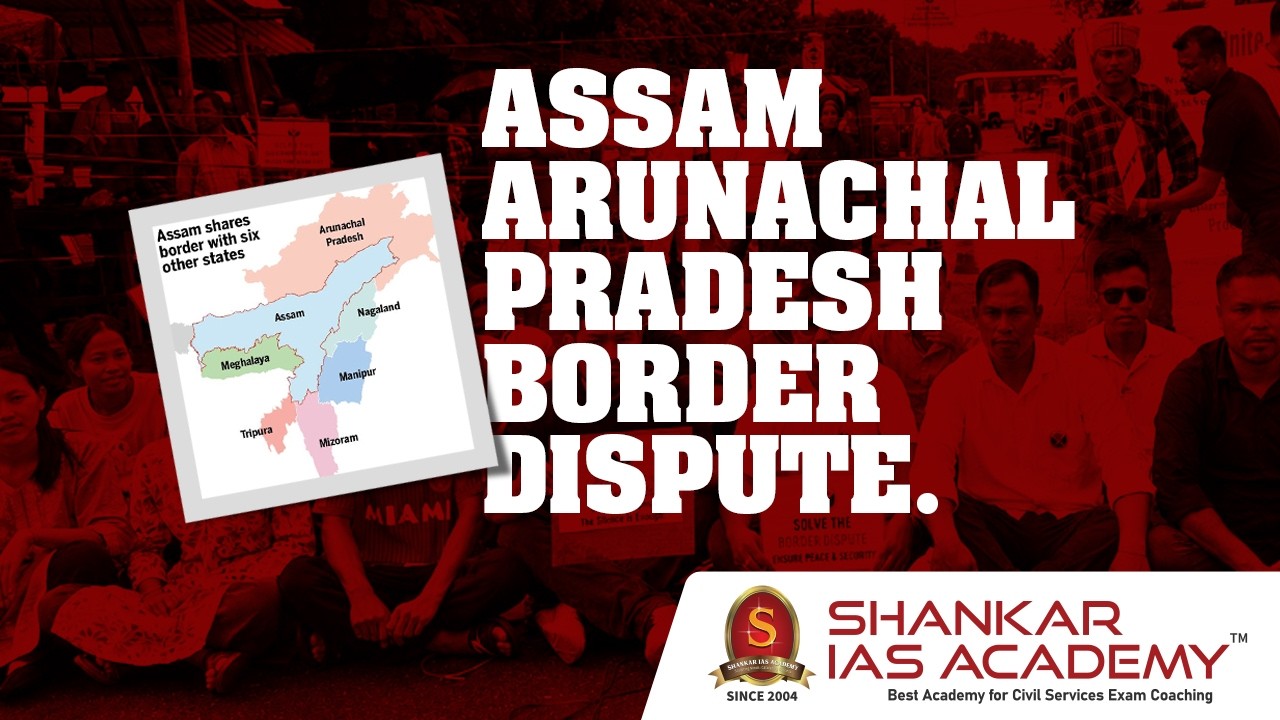
State of Affairs | Assam–Arunachal Pradesh Border Dispute | Shankar IAS Academy | UPSC | Mains 2026
Watch on YouTubeVideo summary
On August 10th, a violent clash erupted between villages in the border regions of Arunachal Pradesh and Assam, leaving nearly 18 people injured and four in critical condition. This incident has reignited the long-standing dispute over the boundary between these two states, which share approximately 800 kilometers of border. The conflict primarily centers on the Lower Siang district of Arunachal Pradesh and the Dhemaji district of Assam, where roughly 50 villages remain in a disputed status despite decades of diplomatic efforts. To understand the root of this issue, one must look back to the British era when the region was administered as the North-Eastern Frontier Agency (NEFA) until 1947, after which it came under the administration of India's Ministry of External Affairs until 1962. Following the Indo-China war in 1962, administrative control shifted to the Ministry of Home Affairs, with the Governor of Assam acting as the central government's representative for the region.
The historical friction intensified in the 1950s when the Assam Chief Minister, Gopinath Bordoloi, formed a committee known as the Bordoloi Committee to demarcate boundaries. Based on its recommendations, certain areas of the NEFA were transferred to Assam, a move that Arunachal Pradesh later contested once it gained Union Territory status in 1972 and full statehood in 1987. The state argued that these transfers were unilateral and violated its territorial integrity. Consequently, a tripartite committee was appointed in 1979, which managed to demarcate about 489 kilometers of the boundary between 1983 and 1984, leaving roughly 300 kilometers undemarcated due to a lack of cooperation. Although further negotiations led to the Namasai Declaration in 2022 and a Memorandum of Understanding in 2023, which reduced the number of disputed villages from 123 to just 49, significant portions of the border remain unresolved, keeping the Lower Siang-Dhemaji region as a flashpoint for tension.
To address such inter-state disputes, India employs a combination of constitutional, legal, and political mechanisms. Constitutionally, Article 131 grants the Supreme Court exclusive jurisdiction over disputes between states, while Article 263 establishes the Inter-State Council to facilitate dialogue between the center and states. Additionally, the State Reorganization Act of 1956 provides for Zonal Councils where administrative and boundary issues can be resolved. Beyond these legal frameworks, political solutions are often pursued through bilateral dialogues at the Chief Minister level, as seen in the successful talks that led to recent declarations. Other tools include appointing ad hoc boundary commissions with expert assistance and utilizing parliamentary legislation to create or reorganize states, as was done when Arunachal Pradesh was carved out of the NEFA. Despite these robust mechanisms, the persistence of the dispute highlights the necessity for sustained cooperation between the two states to achieve a lasting resolution.
Read the full video transcript
[music]
>> On 10th August,
the Arunachal Pradesh Assam border
villages witnessed a violent clash.
And in this incident, nearly 18 people
were injured and four of them were in
critical condition.
And followed by this violent clash, the
Arunachal Pradesh Assam
border dispute has once again become a
major topic of discussion in India. Hi.
Hello, everyone. Welcome to the street
of affairs 45 Shankar IAS Academy.
Today, we are going to talk about
Arunachal Pradesh Assam border dispute.
So, the actual incident took place
in the border villages of
Arunachal Pradesh and Assam. That is
exactly between the Lower Siang district
and the Dhemaji district of Assam. So,
the Lower Siang district, it is
Arunachal Pradesh and the Dhemaji
district is located in Assam. So, what
is the actual issue
between the Arunachal Pradesh and Assam?
To understand this, we have to go back
in time. So, you can see that this is a
map of northeast part of India, right?
And you can see Assam is the state that
shares nearly 800 km of boundary with
the the state of Arunachal Pradesh.
And before 1972,
before 1972, the Arunachal Pradesh all
these regions were known as
Northeast Frontier Agency. The Arunachal
Pradesh was later carved out from this
Northeast Frontier Agency. So, the
Northeast Frontier Agency was
established by the British government in
1914. And in 1972, Arunachal Pradesh got
the Union Territory status. And in 1987,
Arunachal Pradesh became a state.
So, note these dates. It is very
important to understand this issue. So,
the British established the
North-Eastern Frontier Agency in 1914,
and they were administering this region
until 1947, that is until the
independence.
And once we got independence, the
Ministry of External Affairs was
uh administering this North-Eastern
Frontier Agency until
1962. Until 1962, the Ministry of
External Affairs was responsible for
administering the North-Eastern Frontier
Agency. And what is the significance of
1962?
India-China war, right? So, after this
India-China war, the administration went
to the Ministry of Home Affairs. So, the
administration went to the Ministry of
Home Affairs. And the administrative
representative of the Ministry of Home
Affairs was the Governor of Assam. The
Governor of Assam was the administrative
uh representative of the Ministry of
Home Affairs. That means that the the
Governor of Assam will be representing
the central government regarding the
administration of the North-Eastern
Frontier Agency.
And we can see that in 1950,
before that,
in 1950s,
the Assam Chief Minister,
they formed a committee called Bordoloi
Committee. So, the the Bordoloi
Committee, the name comes the name comes
from the Assam Chief Minister name, that
is Gopinath Bordoloi. He was a former
Assam Chief Minister. So, under his
chairmanship, a committee was formed to
demarcate the boundary in this region.
To demarcate the boundary in this
region. And based on the Bordoloi
Committee's recommendation, certain
regions of
the North-Eastern Frontier Agency was
also included into the state of Assam.
And when the Arunachal Pradesh got the
Union Territory status in 1972,
Arunachal Pradesh raised this issue.
Arunachal Pradesh said that some of our
regions were transferred to the state of
Assam based on the unilateral
recommendations of the Bordoloi
Committee.
And we can see that uh in
the the dispute starts there and in 1979
a tripartite committee was appointed to
demarcate the boundary in this region.
And between 1983 and 1984, approximately
489 km of boundary out of total 800 km
was demarcated.
Remaining 300 km plus was not demarcated
because of the limited cooperation
between the Arunachal Pradesh and Assam.
And we can see that even today nearly 50
plus villages are in the disputed
region.
And we can see that between 1984 and
1989, that is exactly in 1987, the state
of Arunachal Pradesh was formed under
the Arunachal Pradesh Act. So under the
Arunachal Pradesh Act, the the statehood
was given to the Union Territory of
Arunachal Pradesh and now the Arunachal
Pradesh is a state. And Arunachal
Pradesh continued to raise this issue.
And we can see that in 1989, the
government of Assam went to the Supreme
Court seeking a solution to this
Arunachal Pradesh-Assam border dispute.
And in 2006, a local boundary commission
was appointed under the chairmanship of
a
retired Supreme Court judge. And we can
see that in 2014, the commission
submitted its report. And this
commission suggested possibility of
returning certain regions back to
Arunachal Pradesh and also called for a
stronger cooperation between Arunachal
Pradesh and Assam to sort out this
issue.
And in 2022,
Chief Minister level negotiations were
started between the Arunachal Pradesh
and Assam.
And until 2022,
we can see that nearly 123 villages were
in the disputed situation. And followed
by this followed by the CM level
negotiation, a declaration called
Namasai Declaration was signed between
Arunachal Pradesh and Assam. And the
dispute related to nearly 37 villages
were, I know,
settled and the number of the villages
in the disputed region got reduced to
86. And in the
in the April month of 2023, a memorandum
of understanding was signed between the
Arunachal Pradesh and Assam to further
to seeking to to resolve this issue. And
we we can see that you know the
currently the disputed villagers number
number once again go to reduce to 15
you know 49. So we can see that you know
now
the the number of villagers in the
disputed region got reduced, but even
today many villagers are remaining in
the disputed area and many regions are
still remaining undemarcated and this
Lower Siang Dhemaji region is one of
them.
And uh
So we can see this conflict is still
going on. It is still persisting. So and
at the same time without the cooperation
between the Arunachal Pradesh and Assam,
bringing a sustained solution for this
problem is not possible. But as of now,
let us see what are the mechanisms that
we have at present situation to deal
with the such a similar crisis. So we
can broadly divide the mechanism into
two. First is constitutional and legal
mechanism and second is political and
administrative mechanism. So under the
constitution, that is under the article
three sorry 131 of the Indian
constitution, the Supreme Court has
exclusive and original jurisdiction to
deal with the inter-state disputes. And
the next is we have the article 263
where we have the provision for the
inter-state council. So the inter-state
council is a I know it's a platform for
center-state dialogue and maybe the
states can approach this and through the
central government they can sort out
this issue. And next under the act that
is the State Reorganization Act of 1956,
we have the zonal council. So here the
inter-state disputes, administrative
problems, boundary issues, all these
issues can be resolved. So these are the
constitutional and legal mechanisms that
we have currently to resolve the inter
state dispute related to boundary or any
administration. And the next is the
political and administrative tools. So
here we can go for bilateral dialogue.
For example, the CM level talks that
have started in 2022. And we can see
that the CM level talks was more
effective because that led to, you know,
Namasai declaration and also a
memorandum of understanding in the
followed year. So see a bilateral
dialogue between the chief ministers or
ministers or higher authorities can sort
out this issue. And second is appointing
ad hoc committees or ad hoc boundary
commission to sort out this issue and
with the the support of the with the
assistance of experts.
And the next is parliamentary
legislation. So the parliament of India
can demarcate the the boundary, uh, you
know, for example, they granted the
statehood to the Arunachal Pradesh,
right? They created the state of
Arunachal Pradesh from the North Eastern
Frontier Agency. So such a similar
actions can be taken by the parliament
of India after detailed study through a
legislation. So these are the mechanisms
that we have in the present situation or
in the present system to deal with the
such a problem.
So I hope you understood this topic. And
if you like the video, hit the like
button, give your feedback as comments
and share this content with your
friends. And before leaving this
channel, don't forget to subscribe.
Thanks for watching. We will meet you in
another episode with another interesting
topic. Thanks again.
>> [music]