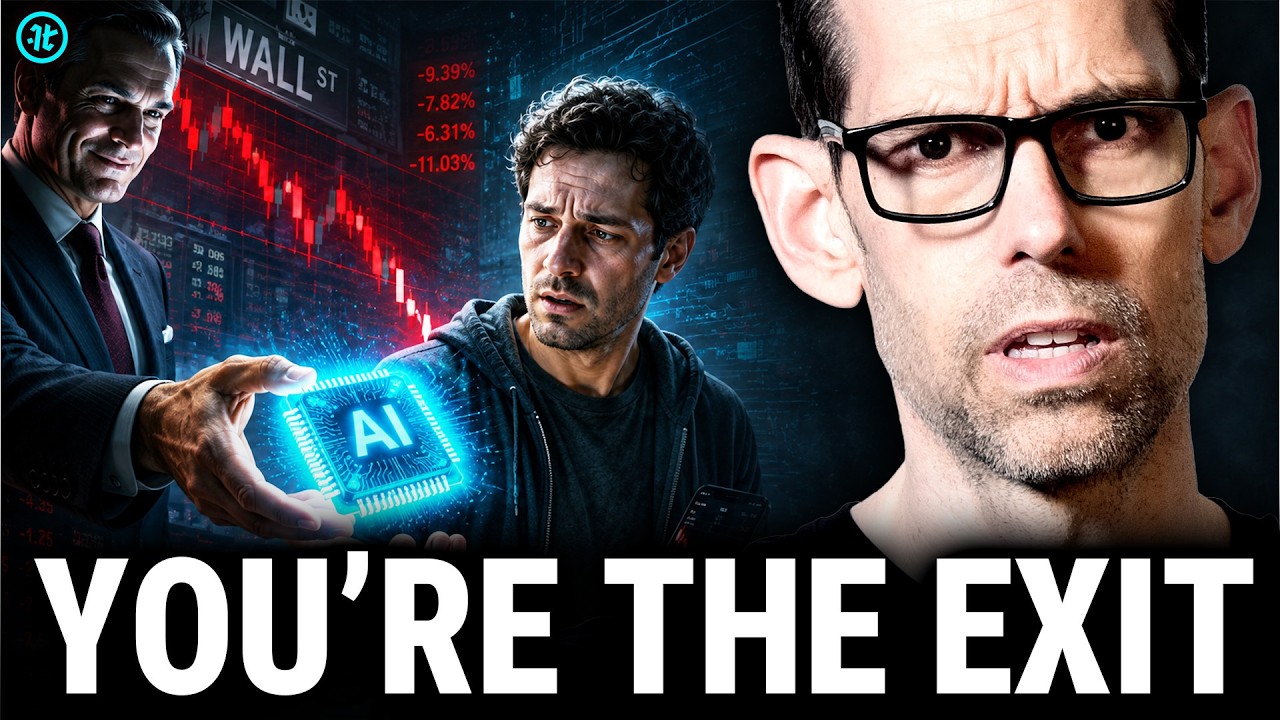
"Something Wicked This Way Comes" — Why The AI Bubble Isn't What You Think
Watch on YouTubeVideo summary
The podcast argues that while artificial intelligence represents a massive economic undertaking with $700 billion spent this year alone and projections reaching 6.7 trillion by decade's end, it is not merely another bubble but follows a distinct historical pattern of revolutionary technology adoption. Drawing parallels from the last 230 years, the speaker highlights four transformative infrastructure projects: UK canals in the late 18th century, British railways around 1850, American railroads by the 1890s, and fiber optic cables during the dot-com boom. In each instance, early investors faced catastrophic losses due to a timing mismatch between massive upfront capital outlays for infrastructure and the delayed arrival of revenue; however, these physical assets remained viable long-term foundations that eventually powered new economies once later waves of investors acquired them at distressed prices after initial bubbles burst. A critical distinction sets AI apart from previous technological revolutions: unlike passive infrastructure such as roads or cables which last decades with minimal maintenance costs relative to their durability, the most expensive component in an AI data center—the GPU—is highly transient and obsolete within three years. Historically, innovation occurred at the endpoints (cars or modems) while the underlying transport network remained stable; conversely, AI requires constant replacement of its own core infrastructure because the hardware itself is part of the technology stack that must be upgraded to maintain competitiveness. This creates a permanent tax on innovation where debt-funded projects rely entirely on future revenue streams that may not materialize quickly enough to service loans backed by rapidly depreciating assets, leading some analysts like Michael Burry to suggest chip lifespans are overstated from six years down to two or three. The speaker warns of a specific financial mechanism known as the "risk waterfall," which mirrors tactics used during the 2008 housing crisis where risks were hidden and passed on to retail investors through complex securities. In the current AI landscape, hyperscalers may be stretching depreciation schedules for chips that lose value quickly, while banks like JP Morgan Chase, Morgan Stanley, and SMBC reportedly seek to offload hundreds of billions in data center debt via synthetic securitizations (SRTs) into pension funds and private credit markets. Simultaneously, a historic wave of IPOs involving companies such as SpaceX, Anthropic, and OpenAI will allow insiders to exit by selling stock directly to the public, effectively transferring both equity risk and potential losses from early venture capitalists to retail investors who lack the ability to assess the true longevity of AI hardware assets or the speed at which profitability might be achieved. To navigate this precarious environment, the podcast concludes with four strategic imperatives for investors: avoid overextending using debt given the uncertainty of revenue timelines; maintain humility by betting on the sector rather than individual companies since early-stage winners are rarely obvious as they were in 1850 or during the internet boom; play a long-term game capable of surviving recessions and crashes that historically wiped out concentrated bets within short horizons but rewarded patient holders over two decades; and diversify across economic forces given global geopolitical fragility and US debt levels. Ultimately, while AI is viewed as potentially more transformative than the Industrial Revolution, getting the timing wrong on infrastructure decay versus revenue generation could result in significant losses for those caught between engineered confidence bursts and reality checks that leave ordinary investors holding the bag after risks have been systematically shifted away from institutional players.
Read the full video transcript
The biggest bet in the history of
capitalism is being placed right now.
$700 billion dollar this year alone. 6.7
trillion by the end of the decade. All
spent on AI. It is the most expensive
thing the human race has ever built. But
so far, most people only use it if it's
free. And the really scary part, if
you're thinking about getting in on any
of the upcoming AI related IPOs, is that
the industry is taking on massive
amounts of debt while only making a tiny
fraction of what it's spending. And all
the while, valuations just keep going
up. It does not take a genius to know
the current math does not work. But it
also does not take a genius to know that
AI could still have a lot of room to
grow. And that conundrum is exactly why
everybody's asking the same question. Is
AI a bubble? But what we're going to be
talking about today is that that is the
wrong question. The right question is
given that bubbles like this have formed
many times before. What secrets does
history hold that could tell us what
landmines lay ahead of us and what the
right way to invest is in a moment like
this? What you're about to see is that
history does indeed hold the key to
understanding what's happening in AI
right now. There's a very distinct
economic pattern that plays out with
revolutionary new technologies. And
every time a moment like this occurs,
some people get rich and others get
wiped out. My goal with this video is to
show you that pattern and help you end
up on the right side of that equation.
We're going to do it in three parts.
First, I'll break down the pattern, but
I also want to show you how there is a
trap that's been set just for you. And
in the end, I'll show you what the
historical winners have all had in
common. So, be sure to watch to the end.
All right, welcome to part one, the
historical pattern. four times in the
last 230 years. A world-changing
technology that has gone on to be
utterly transformational nonetheless
wiped out the first wave of investors
who funded the whole thing. The canals
in the UK that created much needed
interior waterways, the British railways
that connected the entire country, the
American railways that did the same
thing for the US but on a much larger
scale. and the fiber optic cable
buildout that made the modern internet
possible. Each one of these technologies
ended up making good on their promises
in the long run. But for the first wave
of investors, it was a catastrophe. It
starts in the 1790s. A single canal in
the UK had just cut the price of coal in
Manchester in half, [music] and Britain
lost its mind. Parliament approved 44
new canal companies in just 5 years.
Then all of a sudden, the bubble burst.
Share prices collapsed [music] and only
a handful of those canals would ever go
on to make their investors a dime. But
the canals themselves stayed in the
ground and they carried the coal and
iron that powered the entire industrial
revolution. The investors lost, but the
new economy they accidentally financed
[music]
roared on without them. 50 years later,
it happened again, this time bigger.
They called it railway mania. By 1850,
British families had poured close to
half of all of the investment in the
entire economy into just railway stocks,
much of it bought on credit. One man,
George Hudson, controlled a third of all
of the track in Britain and was woripped
as a financial genius. Until that is, it
came out he was paying old investors
with new investors money. It was a Ponzi
scheme, which I hope sounds familiar.
When it all unraveled, railway shares
were cut in half and a generation of
savings was wiped out. But the tracks
remained. 6,000 miles of them and they
ran the British economy for the next 100
years. [music]
Then America caught the fever twice. The
panic of 1873 bankrupted 89 railroads
and set off a depression that dragged on
for [music] years. Two decades later, it
happened all over again. By 1894, a
quarter of every railroad in the United
States was in the hands of a bankrupt
company. The people who funded that
track obviously got ruined. The track
itself, though, it never moved an inch
and it continued to carry the goods that
built the richest economy the world had
ever seen. And then in our own
lifetimes, fiber optic cable for the
[music] internet. During the dotcom
boom, telecom companies buried so much
fiber optic cable during the internet
euphoria that at the bottom of the
crash, roughly 90% of it just sat dark.
[music] It was paid for. It had all been
installed in the ground through a very
painful, laborious, and expensive
process. But it was all turned off. Not
because the internet was a failure.
Obviously, it would go on to become one
of the most important technologies in
human history. It failed at the time
because the infrastructure cost was so
expensive that the revenue just didn't
come fast enough to overcome the debt
burden. So companies like WorldCom,
Global Crossing, and a string of others
went bankrupt waiting for that revenue
to come in. WorldCom was the largest
corporate collapse in American history
up to that point. Hundreds of billions
in investor money was just gone. But
again, the cable stayed in the ground.
It remained an incredibly viable asset
and over the next 20 years that dark
fiber would finally get switched on and
it became the physical backbone of the
modern internet. Netflix, YouTube, the
entire cloud all runs on it still to
this day. The companies that scooped it
up for pennies after the crash,
companies like Google, used that
abandoned fiber to build some of the
most valuable businesses on Earth, only
made possible by those early investors
that ended up losing everything. But
putting the infrastructure in place and
that gap between the infrastructure and
when the revenue comes in is one of the
most important things to pay attention
to with artificial intelligence. That's
the hard reality we all have to contend
with right now. The buildout of
revolutionary new technologies almost
always requires a massive amount of
infrastructure. And that infrastructure
is insanely expensive. But some
technologies are so obviously powerful
and so obviously where we're headed as a
society that success starts to feel
guaranteed. And so despite the
incredible risk that there will end up
being a timing mismatch between the
capital outlay and the debt that has to
be taken on to develop the technology
and when the money actually starts
flowing in, investors still jump in with
both feet, often times using [music]
debt. Society benefits, but the
investors and their creditors get
hammered. But the pattern doesn't stop
there. It loops around to the next wave
of investors who come in and scoop up
the distressed assets for much much
cheaper and then reap the rewards of
that first wave of investors who
actually [music] paid for the
infrastructure. Okay, that's the full
takehome. The dark fiber might have been
a bad investment for the first wave, but
it was the competitive advantage that
allowed the second wave to win. The
initial investment was necessary. It had
to happen, but it paid out to the
benefit of humanity. and the second wave
of investors. Now, given that pattern,
it's up to all of us to try and figure
out where we are in the infrastructure
buildout and technological adoption
curve that signals that revenue is going
to come in as it relates to AI. If we're
too early, we're going to get clobbered.
But if we're too late, we die broke on
the sidelines. And most importantly, if
we misunderstand what's different about
AI than everything that came before it,
[music] we're going to learn the hard
way that AI is less like a bubble and
more like a time bomb for a very
specific reason. Now, to understand what
I mean, we have to analyze the economic
and structural realities of AI that make
it even more prone to the historical
pattern that we just walked through than
anything that came before it. So,
welcome to part two. One of these things
is not like the others. The strand of
fiber optic cable buried under your city
in the 1990s carries more than a
thousand times the data today than it
did the day that it first went into the
ground. The glass and the cable itself
is passive. So, nobody has to dig it up
to improve performance of the internet.
You just need to upgrade the cheap
electronics at the ends of the cable if
you want better performance. ultimately
will reach the limit of the glass which
only transmits a signal at about 67% the
speed of light but it's already carried
us for almost 30 years. You find a
similar dynamic with the railroads.
While railroad tracks do need to be
replaced occasionally, every major
component lasts years to centuries and a
well-maintained track will run for
roughly 30 to 50 years before being
completely replaced. With railroads and
fiber, cost and durability run in the
same direction. The most expensive
things, the route, the tunnels, the
bridges, the buried cable, they all last
the longest. The things that wear out or
become obsolete more quickly, the
ballast, ties, rail surfaces, modems,
routers, etc., they're the cheapest
parts, and in most cases, they still
last a pretty long time. AI, however,
inverts that financial relationship
completely. Now, do not get me wrong.
There are plenty of things that last
within a data center buildout. The
physical data center itself, the
plumbing for the cooling system, the
server racks, all of that. But the
single most expensive component, the
GPUs, is the fastest to die. We're
talking 3 years to obsolescence, give or
take, on the most expensive thing in the
entire infrastructure chain. No prior
technological infrastructure buildout
has ever had its most expensive asset
also be its most short-lived. And that's
an anomaly that is likely to have
massive repercussions for not only the
first wave of investors in AI, but every
investor thereafter. Historically,
infrastructure has been dumb. Roads,
track, cable, it's all designed to
transport something. Now that something
might be smart, but the road, the cable,
the track itself is not. Instead of the
road or the track needing to improve to
keep up with the competition, the cars
and the modems are the things to get
smarter. That distributes the cost of
the innovation contained to a smaller,
more manageable piece of the technology
pipeline. With AI, the infrastructure
itself is a huge part of the technology.
AI infrastructure is the brain. And
while the brain itself isn't the
intelligence in and of itself, the two
cannot yet be separated. A key part of
progressing AI technology is progressing
the GPUs themselves. And as of today,
they are almost comically expensive.
Because a dumb foundation goes out of
date only very slowly. You create far
less economic drag on progress and
revenues can more easily catch up with
the initial investments into the
infrastructure. The upfront cost may
kill the first wave of investors with a
distressing degree of predictability,
but the second wave can reliably
leverage everything that came before.
That's why the second wave of investors
have historically won. The asset the
first wave paid for was still sitting
there decades later, as good as new,
waiting for somebody smart enough to
build something profitable on top of it.
But what happens to the investment math
when a very substantial segment of the
infrastructure itself must constantly be
replaced? Right now, roughly a third of
all the money pouring into AI is being
spent on transient infrastructure,
meaning that cost is never going to go
away. It's a permanent tax on
innovation. Nvidia ships a brand new
generation of chips about every 12
months. Each one making the last look
slow. Therefore, every AI product is
built on a foundation of quicksand. To
stay competitive, companies must
eternally replace the most expensive
part of their buildout. The only light
at the end of the investment tunnel as
far as AI is concerned is the oncoming
train of the next generation of superior
chips.
We'll get right back to the show in a
second, but first let's talk about how
your brain actually works. Your brain
can run on two fuel sources, glucose and
ketones. Most people only ever give it
glucose. Think of it this way. You would
not put regular unled in [music] a
Ferrari. Your brain is like that. It is
the most complex machine on the planet
and most people are fueling it up with
the cheap stuff. And the Department of
Defense believed in this enough to spend
$6 million developing the technology
behind today's sponsor, [music]
Ketone IQ. Ketone IQ delivers pure
ketones directly to your brain. They
cross the bloodb brain barrier and fuel
your neurons at the cellular level.
There's no caffeine, no sugar, no crash,
no stimulants at all. For me, I use it
when I really need to be sharp. So, if
I'm about to do an interview or
something that I'm writing that really
takes a lot out of me, and it carries me
straight through. [music]
Ketone IQ contains no artificial
sweeteners or fillers and comes in
delicious flavors like peach, green
apple, and raspberry lemonade. If you're
ready to fuel your brain properly, visit
ketone.com/impact [music]
for 30% off your subscription order or
visit your local Target to get your
first shot for free. Let's talk about a
number that should concern [music] you.
Data breaches have increased 211%
[music] in a single year. And every
breach means more of your personal data,
your address, your phone number, your
social security [music] number. It ends
up on data broker sites where anyone can
buy it. The question isn't whether your
data is out there. It is the question is
whether you're doing anything about it.
That's where incogn. [music] They track
down your data across hundreds of sites
and remove it automatically. You
authorize them once, that's it. They
handle everything else. Plus, with
custom removals, you send [music] them
any link where your information shows up
and their team is going to take it down.
The threat is growing. Incogn is the
response that grows with it. Go [music]
to incogn.com/impact
and use code impact for 60% [music]
off an annual plan. Try it risk-free for
30 days. Now, let's get back to the
show.
And to make matters worse, in an effort
to raise more capital, today's biggest
AI companies may be lying about how long
the chips will last. If you look at the
accounting of the core AI companies
today, they're going to tell you that
their chips will last 5 to 6 years. But
if you ask savvy investors like Michael
Bur, the guy famous for calling the 2008
crash, he's going to tell you the real
number is closer to two or three. In
fact, he's gone on the record and
accused the biggest AI companies on
Earth of stretching that timeline on
purpose to try and hide what he calls a
176
billion dollars in losses. The companies
of course deny it [music] and in
fairness, nobody really knows the exact
number yet, but you don't have to settle
that fight to see the danger. Everyone
agrees the chips lose value fast. The
only argument is over just how fast. And
the people investors are trusting to
determine that [music] number have a
huge incentive to stretch things out
while they can. That's the difference
between this AI bubble and every bubble
before it. Bubbles are all about
confidence. When it pops, it will
because people will have lost
confidence. It doesn't require AI to
fail or not be the incredible technology
that I think all of us think it's going
to be for the bubble to burst. There
just needs to be a timing mismatch
between how long people can remain
confident in the future promise and when
enough revenue pours in for those
companies to remain solvent. And that
timeline gets real short when people are
using debt. And if the bubble does pop,
the real question is who's going to be
left holding the bag? Let's look at
that. Welcome to part three. Us retail
investors are called dumb money for a
reason. It's the fall of 2008. $16
[music]
trillion in American wealth evaporates
in an instant. Millions of families go
from euphoric homeowners with an
appreciating asset to dead broke and
homeless almost overnight. And the worst
part, and never forget this, the
disaster was engineered to make bankers
rich while hiding risk and passing it on
to homeowners and retail investors. And
despite that truth, only one person
[music] went to jail. The financial
system is rigged against the novice. And
there is a financial trick that has been
used multiple times in living memory to
make fortunes for a few off of man-made
economic disasters. It goes like this.
You take a risky asset and you find a
way to hide the risk. It could be by
slicing up and repackaging subprime
mortgage back securities, giving them a
new name and a top tier credit rating.
That's what they actually did. Or it
could be selling private debt with
mismatched loan terms and payment
schedules to unsuspecting retail
investors and pension funds. That's the
current suspected crisis [music]
happening in the private debt markets.
Or it could be what we're talking about
today. taking a legitimately thrilling
new technology with insane
infrastructure costs that never quite go
away and you do a little fancy
bookkeeping and voila, one extended
depreciation schedule later and the
stock price seems far more reasonable.
Then you IPO and use excited retail
investors as the dumb money exit
liquidity. If the bubble bursts, the
retail investors left holding the bag
and the government may even step in and
prop up the companies because the sector
is important for national security.
Remember, you heard it here first. Let's
call this trick the risk waterfall.
Comes in many flavors, but the outcome
is always the same. In 2008, that trick
was called mortgage back securities. The
banks building and selling those
products were at the very same time they
were selling them, actively betting
against them. They knew what the risks
were and they were counting on the fact
that the public did not. The ratings
agencies stamped subprime garbage as
AAA, which is the safest grade that
exists. And when it all detonated, and
[music]
erased $16 trillion of wealth, the
government stepped in, printed money,
saved the banks, [music] and hammered
the already suffering average American
with inflation. The risk was
manufactured at the top, repackaged, and
pushed downhill onto the people least
able to understand it or defend against
it. And that playbook has never stopped
being used. It's being used right now
today. I made an entire video on the
version running right now in private
credit, which you can watch right there.
And it's all too possible that something
similar is happening again with AI. If
the AI companies really are stretching
their depreciation schedules to disguise
how fast their chips decay in value, and
if this sudden stampede of trillion
dollar AI companies racing to go public
is even in part [music] about handing
the risk to retail investors before
people inevitably lose confidence in
AI's currently insane valuations based
on revenues, then to borrow from McBTH.
something wicked this way comes. Let's
walk through my rough swag of how this
could play out. Start with the debt. The
hyperscalers are borrowing hundreds of
billions of dollars to buy chips [music]
that have to be replaced in roughly 3
years. The banks making those loans
obviously don't want to be caught
holding paper that's backed by hardware
collateral that is rapidly declining in
value with each passing day. So they run
the 2008 playbook. They slice the debt
up. They repackage it. And they sell it
off into pension funds to insurers,
private credit, and increasingly into
retirement accounts. The Financial Times
reported on May 3rd of 2026 that large
banks including JP Morgan Chase, Morgan
Stanley, and SMBC are looking to offload
the risk tied to hundreds of billions in
AI data center debt because they're
hitting their own financing limits.
Their goal is to distribute portions of
the risk to a wider range of investors
through stake sales and risk transfers.
The Financial Times own headline was
that banks are trying to avoid choking
on the debt. Back in December, Bloomberg
also reported that Morgan Stanley was
specifically considering offloading data
center exposure via a significant risk
transfer. These are known as SRTs. An
SRT is a synthetic securitization where
the bank keeps the loan on its books but
buys protection on the first loss
trunch. So for regulatory purposes, the
risk is transferred and the buyer
collects 9 to 14% roughly yields and the
offbalance sheet version is also already
live. In October of 2025, Morgan Stanley
arranged over 27 billion in debt and
about $2.5 billion in equity for a
specialurpose vehicle tied to Meta's
Hyperion data center site in Louisiana.
The buyers are private credit funds,
hedge funds, insurers, and pension
funds. Now analysts expect insurers,
asset managers, and pension funds with
heavy private credit allocations to be
the buyers of these SRT structures and
discounted loan tunches. So that's
channel one. That's how they waterfall
that risk down. But they've got another
option, channel two. It's the stock. For
years, these companies have stayed
private, which meant only venture
capitalists, insiders, and the already
rich could own a slice. But the biggest
wave of IPOs in history is now forming.
[music]
SpaceX has filed, Anthropic has filed,
Open AI is preparing to file as well.
And together, those listings could push
close to $3 trillion
of fresh stock into the public market.
And an IPO is mechanically an exit for
the people that came before. The moment
the early money finally gets to sell,
sell to whom, you ask? you the public to
retail. Analyst Jill Lura of DAD
Davidson was quoted by Al Jazera as
saying the companies are in quote a race
to go public before capital runs out.
That sounds about right to me. Now let's
put those two channels together of how
risk is shuttled downstream. The debt
gets sold into your pension as a part of
a risk transfer. The stock gets sold
into your brokerage account as a risk-on
opportunity in the hottest part of the
market. And fair enough, it is. If the
revenue comes in fast enough, you are
loving life. But if it doesn't, you get
clobbered. So ask the four questions you
should ask of anything in finance. Who
created the risk that makes this
investment have a return? The
hyperscalers in Wall Street would be the
answer here. Who packaged it? The banks
who do not exactly have a great record?
Who's selling it? The banks and the
insiders who are cashing out through the
IPO. And who ends up holding it? Look at
your 401k. Roughly a third of the entire
S&P 500 right now is the same handful of
AI companies. If you or your portfolio
manager are chasing returns in the US
stock market, you are very likely to be
heavy into AI. Now that may be perfect,
but it may also be calamitous. It will
all depend on timing. Timing of the
dramatic revenue increases that are
needed to make AI profitable. And the
needed increases are dramatic. And it's
about the timing of investor confidence
in the sector. And it's the timing of
the depreciation rate of the GPUs
themselves and what that number ends up
being in reality. Now, I can't tell you
the timing of any of that. Nobody can.
It's going to have to play out. But the
technological revolutions that have come
before AI have ended up paying off only
in the long run. Before that, entire
crops of investors [music] have gotten
wiped out along the way. My belief is
that AI really is the single most
important technology ever invented.
[music]
My intuition, for what it's worth, is
that it will be much more transformative
than the industrial revolution. And if
I'm right, there are going to be so many
people that get wealthy off the back of
this. But getting the timing wrong is
the same as being wrong. If your time
horizon is short or you're using debt,
the future almost always surprises
everybody. And the markets have a way of
following the path of maximum pain.
Don't lose sight of that. But what I can
tell you is that the waterfall risk
structure is the same structure that
left normal people dealing with the
engineered catastrophe of 2008. Now, I'm
not predicting the AI is going to be
another implosion, but in my own life, I
am acting extremely paranoid. Now, my
goal here is to give you a fresh
perspective on what's happening beneath
the surface of this truly thrilling
technology. So what does that mean for
you? What should you do with this
knowledge? Every new revolutionary
technology demands an infrastructure
buildout. There's nothing weird about
that. The canals, the railways, the
fiber, but a dangerous combination of
enthusiasm and reckless investing tends
to wipe out early investors. They get
out over their skis with debt and fail
to understand how long it can take for
even the most incredible
transformational technologies to
actually generate enough revenue to
outpace the debt required for the tech
buildouts. If you guys aren't seeing the
push back that people are having to AI,
if you're not seeing how companies are
spending more than they expected and
getting less in return, this is all
going to take time. [music] And the odds
that it takes more time than anybody
who's invested wants borders on 100%. So
step one is to realize the tech can both
be the right thing and have timing that
may take way longer than expected to
become profitable. So don't overextend
yourself by making bets with debt.
Second, stay humble. I know the winners
seem obvious right now. It seems like
you can't miss with the big names, but
they're almost never as obvious in this
early stage as we expect them to be. So
don't bet on any one single horse.
Nobody in 1850 could have told you which
companies would survive and which would
go bust. The same is true with the
internet. And the same is true with AI.
Bet on the sector, not an individual
company. Third, play the long game. The
people who get destroyed when a crash
comes are those with concentrated bets.
Bets placed [music] using debt and bets
that require a fast payoff. If you need
your money back in a year or two, you
could get wiped out by a simple
recession. But if you don't need a
return for 20 years, [music]
history says you're going to win. Even
the Great Depression had people back to
positive yields within 20 years. You
have to be able to hold through the
storm to avoid locking in your losses.
And last, as always, diversify yourself
across economic forces. AI being in a
precarious state right now is not the
only thing to pay attention to. The US
is drowning in debt. We are politically
dysfunctional and the world is
geopolitically super fragile right now.
Assume the future is uncertain and
diversify accordingly. One last thing,
remember that the system is rigged to an
uncomfortable degree against the novice.
Unless investing is your full-time job,
assume they're out to get you, but
there's always a way to win. They cannot
stop you from playing the game well. But
it is a competition, so play wisely and
defensively. All right, if you want to
see me explore topics like this in real
time, be sure to hit that subscribe
button and join me Monday, Wednesday,
and Friday at 7:00 a.m. Pacific time.
[music] I hope to see you there. Till
next time, my friends, be legendary.
Take care. Peace. If you like this
conversation, check out this episode to
learn more. In 2008, a team of
neuroscientists in Berlin put people in
an fMRI machine and asked them to press
a button, left hand or right hand,
whatever they wanted. The researchers
then watched their brains and what