Video summary
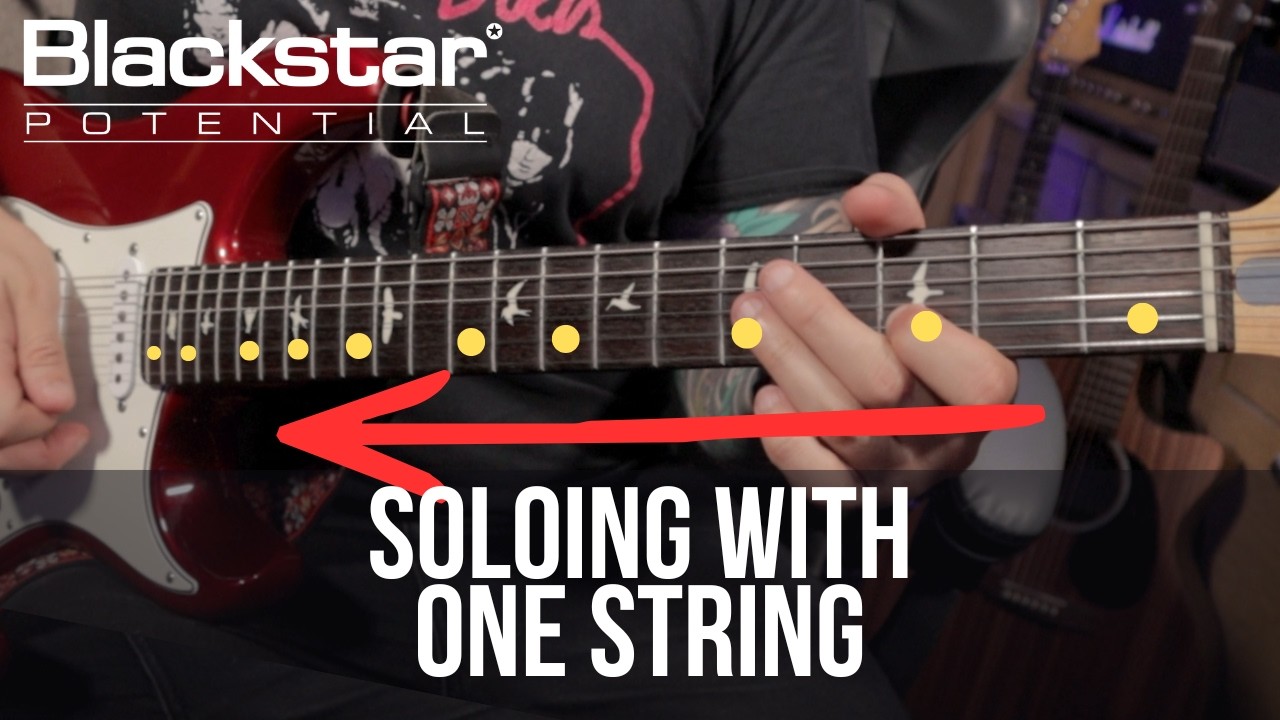
One effective method for enhancing guitar phrasing and escaping the limitations of traditional scale patterns is to map a scale entirely along a single string. This technique forces the player to abandon the habit of thinking in vertical shapes that move from low to high positions, instead encouraging a horizontal approach across the full length of the neck. By restricting movement to one string, musicians are compelled to make more deliberate creative decisions rather than simply running up and down strings as they often do during improvisation. This constraint naturally leads to interesting shifts in pitch registers, such as sliding from a lower section of the neck into a completely different octave range, which is particularly valuable for lead guitarists looking to think outside conventional boxes.
To demonstrate this concept, the lesson utilizes the A minor pentatonic scale laid out specifically on the B string. The notes are distributed across various frets, starting with the first and third frets, followed by the fifth and eighth, then the tenth and thirteenth, and continuing with a repeating pattern that includes the fifteenth, seventeenth, and twentieth frets before ending at the twenty-second. It is important to note that the note at the thirteenth fret represents an octave higher than the first fret, illustrating how the scale repeats its shape across the string while expanding the available tonal range. This specific arrangement allows players to visualize the entire scale as a linear path rather than a collection of disconnected boxes.
Once the scale is mapped out on this single string, the practice involves playing over a backing track using only those designated notes while employing a wide variety of techniques. The goal is to utilize slides, hammer-ons, pull-offs, vibratos, and string bends without ever leaving the confines of that one string. This exercise serves as a powerful tool for breaking free from rigid scale shapes and unlocking new creative avenues in musical expression. By trying this method in personal practice sessions, guitarists can discover fresh phrasing possibilities and develop a more fluid approach to soloing that relies on horizontal movement and dynamic technique rather than just positional shifts.
Read the full video transcript
[music]
>> A really great way to build up your
guitar phrasing and allow you to break
out of some of the creative boxes you
may get stuck in with scales is to
actually take a scale and lay it out
along a single string. This works a
little bit like the principle of only
playing a few notes at once. By limiting
yourself to a single string, you're
going to make yourself work in a
different creative landscapes. Instead
of thinking your scales up and down like
low to high shapes, we're now thinking
of our scales across the entire length
of the neck. And this is very very
useful because what this does is it
encourages you to make different
decisions. You can't just run up a scale
string to string like you may often do.
You could be playing in this part of the
neck and then all of a sudden you're
going to find yourself sliding up here
and going to a completely different
pitch register. So this is very
interesting from a lead guitar player
perspective cuz this really makes you
start to think outside of the box. So
I'm going to do this with the A minor
pentatonic scale. So the notes I'm going
to lay out across the fretboard are
these. So I'm going to do this on the B
string so it's going to be the first and
third frets on the B.
The fifth and eighth.
The 10th and 13th.
Now this note, the 13th fret is an
octave higher than the first fret. So
what we're now doing is just kind of
repeating the shape. So it's 13 and 15.
17 and 20.
And 22.
So all together.
So now that I've laid my scale out
across one string, what I'm going to do
is play over a backing track and I'm
going to show you how this works in
principle. So we're just going to play
only those notes along that one string
but I'm going to use all my techniques.
I'm going to use slides, hammer-ons,
pull-offs, vibratos, string bends,
whatever I want as long as I don't move
off that one string. Try this one out
for yourself in your own practice. This
is a great way to break out of the scale
shape and unlock some new creative
avenues with your music.
>> [music]
[music]