Video summary
The video explores various theoretical methods for reaching space beyond traditional rockets, focusing on the physical mechanisms required to escape Earth's gravity while ignoring bureaucratic hurdles like paperwork and training. The presenter explains that standard rockets function by expelling massive amounts of fuel and oxidizer at high speeds, a process complicated by the need to drop empty stages to maintain efficiency according to the rocket equation. While conventional rockets are proven technology, the talk introduces alternative concepts such as sea-based launch platforms like the 1962 "Seadragon" design, which aimed to float a steel rocket in the ocean before igniting it, though these were never fully realized due to the significant gap between theoretical designs and practical engineering.
Several unconventional propulsion systems are examined, including air-launch rockets carried by aircraft or balloons to reduce fuel consumption before ignition, and the ambitious Skylon spaceplane concept which attempted to use atmospheric air as fuel but failed due to cooling limitations and funding issues. The presentation also delves into more extreme ideas like nuclear pulse propulsion, which would have used a series of nuclear explosions to propel a ship to Mars in a month, only to be halted by the Nuclear Test Ban Treaty. Other concepts include space guns that fire payloads out of cannons or slingshots, which face immense challenges regarding payload survival and atmospheric re-entry heating, as well as spin launchers that subject equipment to crushing G-forces, making them unsuitable for humans or delicate satellites.
The discussion then shifts to infrastructure-based solutions like the space elevator, a cable extending from Earth to geostationary orbit that would allow gentle ascent without high-speed launches. While theoretically possible with materials stronger than current carbon composites, such as those potentially found on the Moon, building a 35,000 km cable strong enough to support its own weight remains beyond current capabilities. The video also covers "space fountains" and launch loops, which use centrifugal force from an orbital counterweight or a spinning loop to lift payloads, but these designs suffer from critical flaws such as catastrophic collapse if the system stops and the immense difficulty of deploying the necessary cables into orbit without them tangling around the planet.
In conclusion, the presenter emphasizes that despite the creativity and scientific interest in these alternative methods, most face insurmountable engineering hurdles or safety risks that make them impractical for immediate use. The talk highlights that while ideas like space fountains and launch loops offer interesting theoretical solutions to avoid ground-based tensile strength limits, they all share the common problem of being unable to handle failures gracefully or surviving catastrophic structural breaks. Ultimately, the video advises that if one truly wants to go to space today, the most reliable and proven method remains using a standard rocket, as other concepts often end in failure, excessive danger, or world-ending scenarios, leaving traditional rockets as the only viable option for now.
Read the full video transcript
Thank you. Hi, I'm Emily. Um, I'm
assuming you'd want to go to space as
you're here. Uh, this is not going to
worry about the bureaucracy, the
paperwork, the training you might have
to go through. This is how you
physically get from here to up there.
Um,
you know, not ignoring the decades of
planning and all of the rest of the
things that you would have to do if you
wanted to do this. Just, you know,
physically,
you know, just use a rocket. I know
they're big, loud, monumentally complex
fireworks, but they do work. We launched
32 Hang on, my Oh, my slides are over
there. Sorry, I've been looking behind
me. Um,
>> okay. Shall I start again?
>> So, you want to go to space? How are we
going to get there? Let's not worry
about paperwork. Let's not worry about
regulations and, you know, long training
periods of becoming a natural astronaut.
What are we going to use to get there?
How are we going to get from here all
the way up there?
So, just use a rocket if you actually
want to go to space today. Um, they're
big, they're loud, they're monumentally
complicated fireworks, but they do work.
Um, we humans launched 324 of them last
year. And yeah,
theoretically they're quite simple. You
throw an explosion out of one end and it
throw pushes you the other way.
Um, the engineering involved is a little
more complicated. That Saturn 5 is just
starting to burn through 2,000 tons of
fuel and oxidizer
um, in 2 and 12 minutes. It needs to
move 2,000 tons of liquid to do that,
which is difficult on its own. You know,
2,000 tons of liquid is a lot. Um,
doing it with fancy kerosene and
cryogenic liquid hy liquid oxygen is
very difficult. Moving it into an
explosion fast enough that the explosion
keeps exploding is the reason rocket
scientist is something of a meme.
Also, to make things more efficient,
you're going to want to drop bits of
your rocket as you go. Doing something
called staging, where
empty fuel tanks are not worth carrying
all the way to orbit. So once you've
emptied them, drop them. Um, and then
start a new explosion in the next bit
up.
If you want a reading to take away, go
and look up the rocket equation. It'll
explain kind of why that's important,
but it's complicated maths.
Okay, but that's kind of normal. Like
we didn't hear come here to talk about
normal rockets.
What if we don't have a launchpad?
This thing was a 1962
rocket that was planned called
Seadragon. The idea was well actually
the little bit on the front uh right
hand end is an Apollo capsule from what
they threw on a Saturn 5. Um
the the idea was you get a ship builder
to make this thing out of you know plate
steel rather than fancy aerospace grade
stuff and it's a lot cheaper. Um, then
you float this 150 m long thing out into
the ocean. You flood the ballast tanks
on the one on the other end. It starts
pointing towards space and then you
light it and hopefully it gets all the
way there. I never found out if the
astronauts were supposed to get in it
before they tilted it upright or not. I
kind of hope they were just because it
would be fun. Um, they never actually
built one of these things. They made a
few small scale test ones, but yeah, in
space travel there's a giant difference
between paper and space.
It's a diagram. Yes, this early in the
talk. Let's try something else.
What if we make the first stage not a
rocket? This missile looking thing on
the wing of the 747 is um
a rocket designed to go in theory go
into space not to the ground. Um
this one is called Virgin Orbit. They
try to launch one out of a spaceport in
Nuki in Cornwall. Uh it ended up in the
Atlantic. It's a bit of a sore subject.
Find me in the bar later. The basic idea
was you lift the rocket through the
worst of the atmosphere with the plane.
You know, we know how to use planes.
They're common as muck. Um, you get it
moving roughly the right direction and
outside of the thickest bits of the
atmosphere, so you need a lot less fuel.
Um, the problem is the rocket can only
be as big as your plane can carry, which
is why it's a fairly tiny little rocket.
Um, you know, planes can only get so
big, runways, building rags, etc.
What about something which needs less
fuel? We have the delightfully named
raccoon, which is a similar idea in
except similar idea except instead of a
jet aircraft, you use a balloon. Um,
gets you even higher out the atmosphere,
but it's basically impossible to aim the
thing where the balloons blow around in
the wind. That's kind of the point. Um,
and yeah, if you don't know where you're
launching from, you kind of have to
spend a whole bunch of fuel getting to
the right angles and directions. Um, as
you can probably tell from the black and
white photo, they've been trying this
for quite some time. And you can also
tell from the middle one that amateur
rocket people quite like this. Uh,
plastic tables and suburbia in the
background. Doesn't tend to happen on
normal or larger rocket launchers.
The limiting factor here is the carrying
capacity of the balloon again, which is
limited. Hence why there's a rocket
there that someone is managing to hold,
which is kind of cute.
Okay, what about not dropping bits as we
go?
Everyone loves the idea of the sort of
sci-fi space shuttle that you know you
get in your away team and they go down
to the planet and come back up again.
Um, this thing was a British concept
called Skylon. Uh the idea was that it
used
air from the atmosphere whilst it could.
Um
the problem is it's a liquid fueled
rocket and the air is not a liquid. So
you have to turn your air into a liquid
as it's traveling through the little
engine bits on the side and this thing
was supposed to get up to Mac 5 and a
half which is not much time to cool and
compress your air. So that was
difficult. Um, they did manage to get
the cooler working on the ground, but
then they ran out of money before they
actually managed to fire and things. So,
unfortunate, but fairly common story in
British aerospace history.
Okay, something more dangerous.
And more dangerous than 2,000 tons of
rocket fuel in 2 and a half minutes.
Thankfully, we're going back to
diagrams.
Nuclear pulse propulsion. What's more
energetic than rocket fuel? Um,
yeah, instead of throwing fire out the
back of your rocket, you drop a nuke and
ride the shock wave wherever you want to
go, uh, with some padding and shock
absorbers so you don't squish your crew,
hopefully. Uh, this thing was from the
part of the Cold War where they were
trying to figure out more constructive
uses for nuclear weapons, like mining
and drilling for oil. Um, the reference
design was apparently capable of getting
to Mars in a month and back. Um,
bear in mind that the Curiosity rover
took 8 and a half months to get there
one way and they were planning to launch
this thing from the Earth. So, you know,
whole bunch of nukes in the atmosphere
to get themselves out first. Um,
amazingly, the thing that stopped this
thing from being ever more than paper
thankfully was not that someone looked
at and went, "What the bleep are you
thinking?" It was uh the nuclear testban
treaty banned the use of nukes in outer
space.
So they gave up. Uh later analysis guest
estimated that they would uh have killed
10 people with the fallout from every
launch. Thankfully that never happened.
Um and also yes that is a nuclear shape
charge on the as fuel.
Mad.
Okay. something that's not a rocket.
Space guns.
All the way back to Newton and Jules
Vern, people have been trying thinking
of cannons and, you know, space guns.
The military really loved the idea
because BFG um
has some problems though. You still need
another rocket on your payload to turn
your orbit into a circle when you get
out of the atmosphere. Um, and whatever
you want to launch has to be able to be
survive being shot out of one of the
fastest cannons that's ever been made.
You're not going to make
um, sorry. Also, you can't really do
this with a conventional cannon. Like
conventional projectile propellants are
not fast enough. Rifle bullets don't cut
it here. Um, something more exotic like
gas guns, stage detonation systems. Uh,
yeah. things get weird. The
payload also has to be able to handle
rushing out of the atmosphere. The same
thing that makes meteors flame when they
come in happens if you just launch
something very quickly back upwards. Uh
the Americans managed a
Americans have managed a 16-in gas gun
that got a shell to 180 km. Um no one's
made it to orbit with one yet. some
engineers that in recent attempts oh
sorry some recent attempts have uh ended
in secret agents assassinating
engineers. So yeah
there was also spin launch which seems
to have pivoted to making communication
satellites as half the space sector has.
Um the idea was you stick your sling
stick your payload in a high-tech
slingshot which is the big circular
thing. Um spin it around really really
fast and then let it go so it goes
whizzing out the tube. The circular bits
under vacuum, so you can spin it very
quickly. Um, but it is spinning around
in a circle, which means there's
G-forces on it all the time that it's
spinning. And you have to build your
payload so they can survive 10,000g,
which will pancake basically everything.
Um, you're not launching any kind of
normal satellite on this or humans
obviously.
Uh, something with less g-forces would
be nice. We're going back to diagrams
though, unfortunately, because things
are about to get the theoretical.
The space elevator, another sci-fi
staple. You know, elevators go up. What
if we made one that kept going up? Um,
well, we run into tensile strength
issues pretty quickly. But if you can
make a cable strong enough that you can
hang it from orbit,
you can get there pretty easily and
pretty gently. Like you can just crawl
up the cable as slowly as you need to
and people aren't going to get squished
or crushed. It's kind of fine. Um, but
you have to be able to make a 35,000 km
long cable that can support its own
weight and the weight of your payload
and the climbing thing and everything
else and then survive like the wind and
stuff in the atmosphere. Um,
the
elevator has to go up to geostationary
orbit at least because otherwise the bit
on the ground is moving faster than the
bit in space and then bad things happen
and you know the cable wraps itself
around the earth or something. Um,
I think the people on the equator would
rather disagree with that one. Uh
yeah, we don't know how to make a cable
that strong yet. There's some hopes of
some magic carbon materials, but yeah,
no one's managed to get anywhere close
to what we need to make that work. Um
you can have two on the moon, though. We
have Kevlar is enough to make one on the
moon. Um you have to have it on the side
pointing towards the Earth or the other
way around because of the way the moon's
tidily locked to always face the same
way.
Um, but we have to get there first. And
I'll refer to the rest of this talk
rather than be recursive.
Okay. A space elevator without all the
tensile strength issues though would be
really nice. So this thing is a space
fountain.
Sorry, I really should have grabbed my
water before I came up here. Um,
the idea is you push a stream of
particles up a tube and the stream of
particles kind of supports itself as it
goes around and it supports the tube as
it goes up and then you can climb up
your tube which is great. Um, as you can
probably tell from the diagram, this one
never got particularly far off the
ground with the designs. Um, the problem
is if you ever turn it off, the entire
thing collapses. So, you can't push the
particles through it. You're in trouble.
Thank you.
Um, and then the entire thing collapses
and this is, you know, a few thousand
kilometers of cable. So that would be
bad for anyone living nearby
space fishing. If we didn't have a
space, we had a space elevator that we
didn't have to attach to the ground or
all the way up to geostationary orbit.
Um,
we're going to need to explain the
diagram because this is a very bad
napkin one. The idea is you have a very
heavy weight somewhere in orbit and a
long cable hanging from it that's
spinning around it. And as it spins
around, it comes down into the
atmosphere. And whilst it's down in the
atmosphere, you get someone to fly up to
it, grab onto it, and it goes all the
way into space. And then there they go.
And they are now in orbit. Um
the fun bit is how fast that cable will
be moving just from the fact that it's
other end of it is in orbit.
Um
the one of the proposals required
something that can get up to Mac 10 to
be able to catch up with the cable which
is a ridiculously fast thing. And also
if you can get that fast why are you
just not going to orbit in the first
place? Um,
yeah, not sure
the
Sorry, one moment.
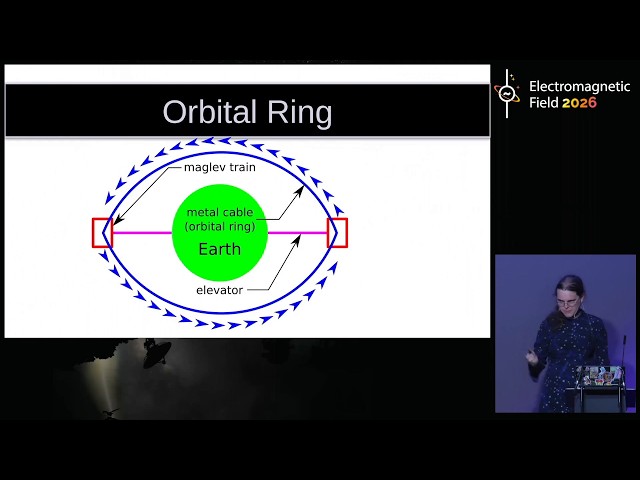
What if instead of extending our space
elevator cable all the way out to
geostationary orbit, we had something we
could attach it to? Obviously, we want
to avoid the cable wraps around the
Earth problem. Um,
so we
take a long cable and somehow get it
into space all the way around the world
and then you spin it and centrifugal
force means that the cable gets tight
and stretches itself at which point you
can use that to support the weight at
the end of your cable. And if you run a
train the other way around your cable,
fast enough that it stays in the same
space point over the earth as your cable
runs around underneath it, you can then
hang your elevator cable from it.
Um,
there several problems with this plan,
obviously. Um, first you've got to get
your cable into orbit. I'm not entirely
sure how you'd ever manage to do that
and get it to be a circle properly. Um,
you can't just like feed the cable out
the back of your spaceship as you orbit
because then it's not in the same orbit
as you because it's going slower. Um,
you also can't ever stop the train
because the cable then either rips out
the bottom or pulls the c other cable
into the ground. Um, yeah, this one in
theory works, but if how the hell do you
build it is the tricky bit. Um,
yeah.
And then we have the launch loop. It's
kind of a horizontal space fountain. So
instead of a stream of particles, you
have a moving belt that's kind of trying
to follow a ballistic path. Um, but you
put it in a tube that's magnetically
levitated from the belt itself.
And with some stays and cables and
things, you can kind of get this belt to
float in space. And then you can just,
you know, drive your payload up into
orbit or up to at the edge of space.
This thing was designed to be 80 km
high, so way outside of most of the
atmosphere
and you run along your cable, which is
2,000 km long, and get enough speed to
achieve orbit, which is nice. Again,
this is another one you can't turn off
because the cable falls out the sky. Um,
at least the proposal for this one did
suggest putting parachutes on the train
track so that if it does fall out the
sky, it's not falling out the sky
particularly fast.
Also,
also they did suggest putting it over
water so that you know it doesn't land
on people, which is nice of them for
once.
So, in conclusion, if you want to go to
space, good luck. try and come up with
something that's actually possible to
build, tolerant of failures, and doesn't
end the world. Or just use a rocket.
Thank you.
[applause]