SMU Physics Department Speaker Series - Prof. Pierre Ramond (University of Florida)
Watch on YouTubeVideo summary
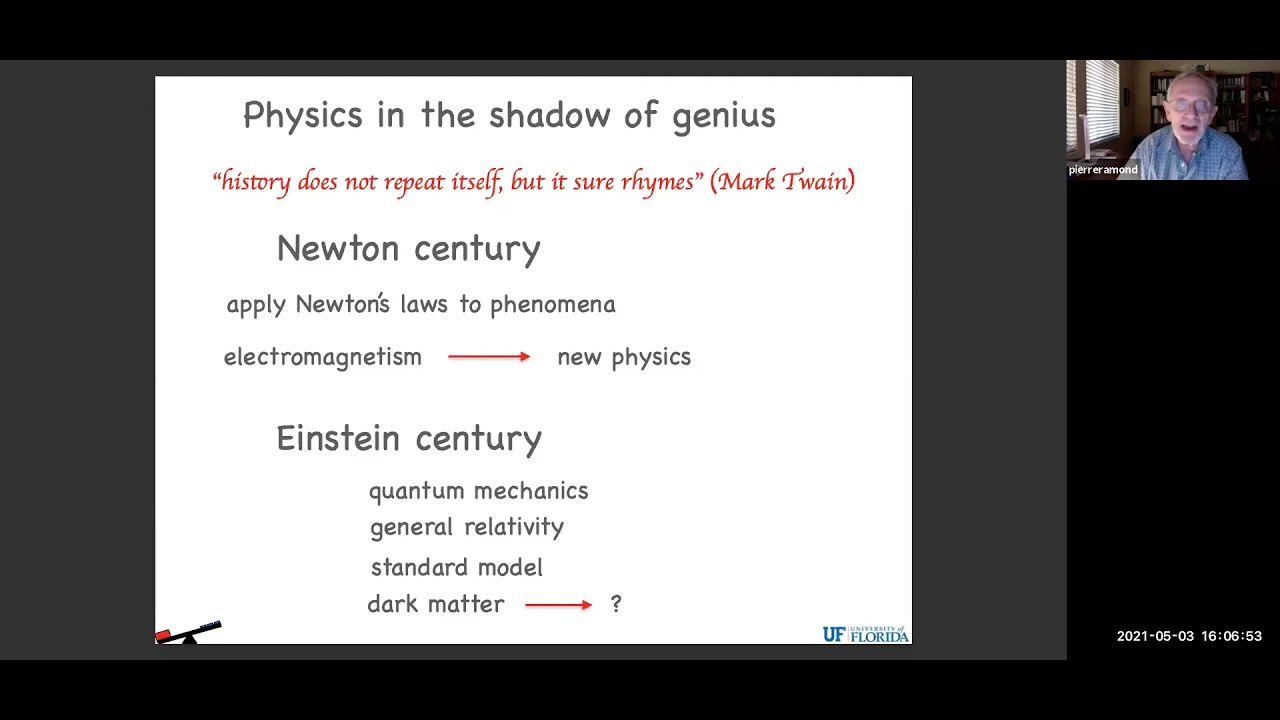
Professor Pierre Ramond delivered a compelling presentation titled "The Unfinished Standard Model," framing the discussion within a historical perspective that highlights how scientific breakthroughs often emerge after fundamental concepts like space-time and the vacuum were previously misunderstood. He identified three critical unresolved issues in current physics: the nature of the vacuum, dark matter, and neutrino masses. Regarding the vacuum, Ramond noted that while it has evolved from an empty void to a quantum field landscape, the Standard Model still struggles with the hierarchy problem caused by the unexpectedly light Higgs boson and contradicts theoretical predictions regarding the non-zero cosmological constant based on flat space-time phenomenology.
The speaker further elaborated on dark matter, explaining that although its existence is confirmed through gravitational effects rather than being inherent to the Standard Model's consistency, its identity remains unknown with potential candidates including axions or supersymmetric particles. Similarly, he addressed neutrino masses and mixing, contrasting the tiny masses of neutrinos—which require additions beyond the minimal model—with the small quark mixing angles observed in other fermions. Ramond discussed Pauli's historical proposal of the neutrino to save conservation laws, its eventual detection by Cowan and Reines, and subsequent discoveries of oscillations that suggest new physics at high energy scales around $10^{16}$ GeV.
To explain light neutrino masses, Ramond proposed the Seesaw Mechanism involving heavy right-handed states and Majorana mass terms, which links neutrino physics to potential proton decay near the Planck scale. He emphasized two "game-changing" experiments crucial for addressing global symmetries: proton decay searches at facilities like Hyper-Kamiokande and tests for neutrinoless double beta decay to determine if neutrinos are Majorana particles. While acknowledging anomalies such as the muon g-2 discrepancy, he stressed that indirect detection is less definitive than direct particle discovery and highlighted a primary weakness in Grand Unified Theories: the excessive number of parameters required to break symmetries between high-energy unification groups and the Standard Model.
In his conclusion, Ramond reflected on the difficulty of achieving new physics breakthroughs today compared to earlier eras, noting that while LIGO results confirmed General Relativity without revealing deviations from quantum gravity integration, future discoveries in dark matter or neutrino sectors may yet resolve current theoretical impasses. He clarified misconceptions regarding unitarity violation at the TeV scale and addressed whether Higgs mechanisms are strictly necessary for electroweak symmetry breaking, stating they are not required but that leptogenesis via Majorana masses is essential. The talk concluded with a Q&A session covering practical applications of neutrinos in solar chronology and further inquiries about discrete versus continuous time, underscoring the ongoing challenges and opportunities in fundamental physics research.
Read the full video transcript
[Music]
okay
so welcome back everybody to the smu
physics department speaker series for
spring 2021 and this
is the final event of our academic year
which is dubbed the spring colloquium
and in a moment i'm going to invite
professor dirdhana balaki shieva to
introduce today's distinguished
speaker professor pierre ramon but
before we get started i wanted to make
some of the usual reminders here so to
our audience on
zoom i just wanted to remind you that to
ask a question during
or after the talk you just need to type
the word speak in the chat window
we use that as a kind of speaker cue and
we'll get to you in the order in which
those those requests to speak arise
uh if you ask to speak uh during the
presentation we'll interrupt professor
ramon at the next slide change boundary
or thereabouts okay
um and you'll only be able to speak when
called upon by a moderator which i will
serve as the moderator so
donna doesn't have to worry about that
for the event um the other thing to know
is this event is being recorded on zoom
and it's being simultaneously live
streamed on youtube the youtube live
stream is non-interactive
but we have a number of participants on
the live stream today so to our
about half dozen participants on youtube
today welcome
without further ado i'm going to now
hand things over to professor durdanova
akushieva to introduce today's
distinguished speaker dardana
thank you very much it's my honor to
introduce dr pierroman
is a distinguished professor of physics
at the university of florida
and the director of the institute for
fundamental theory at university of
florida
he earned his phd from my alma mater
syracuse university and has held a
number of notable positions including as
a postdoctoral fellow at fermilab
he used to call be called national
accelerator laboratory
and a militant senior fellow at caltech
a member of institute of advanced study
at princeton university distinguished
simon's fellow
at kavli institute for theoretical
physics he is
extremely well known for initiating
super string theory
generalizing paul direct's work on
point-like particles into a context of
string theory
and he led to the discovery of the
two-dimensional supersymmetry and the
set of stage of fully
uh four-dimensional supersymmetric
formulation
he is the single author of three physics
textbooks i have them all
uh on quantum field theory physics
beyond the standard model
the group theory his research research
has won numerous prizes
um too many to you know mention old but
uh
mostly uh oscar clown metal light my
third prize
uh danny heimann prize and most recently
in 2010
direct model a direct medal that was
issued at icdp also
one of the schools i went to we are
honored
to host him um our dearest professor
ramon today
to speak on unfinished standard model
and
i underline unfinished standard model
okay very good well thank you thank you
very much now i have
now this distinguished professor has to
learn how to share his slides
the unfinished standard model yes
okay now so
so what the the the talk basically as i
said
was pandemically inspired because
it led me to i don't know to
some some you start to lend some
historical perspective
uh and then talk about the standard
model
talk about possible completions and in
particular
uh work in detail on the neutrino
strategy
for trying to understand more about the
standard model
which is the type of work
i'm interested in but i it will
basically tell you
more or less oops something okay
all right okay so this is what
so now i we
we are as i said earlier into physics
which still lives in a shadow of a
genius
and uh and then mark twain is said to
have said
he's supposed to have said this thing
history does not repeat itself
but it sure rhymes uh
and uh so maybe it was it's not such a
bad idea
to go back in a little bit in time and
see what
what um how well how
phil got to be where he is so in a
newton century
um the uh one once people understood
what newton had done
their application to newton's laws led
them to understand a whole host of
phenomena
no matter what they did they
applying newton's laws just worked
then historically towards the end of
that
century electromagnetism came up
namely with the invention of the voltaic
cell that you could store it
and you did not have to take your life
in your hands
to study it and uh that led to new
physics
in the new physics of course is embodied
by maxwell's equation etc
then a century later oops oh
okay so okay so now let's look about
i don't know i'm sorry look an einstein
century well last time century of course
there's quantum mechanics there's
general relativity
but for us particle physicists there is
the standard model
and then we are left here with something
we have no idea what it is
namely
what am i doing you know dark matter
does dark matter you know does it
what place does it have we have no idea
all we know so far
is that we we have things we do not
understand
we don't understand quantum mechanics we
know how to use it
we we don't understand general
relativity we know how to use it
we think we understand the standard
model we have
dark matter we don't know what it is so
it's a time full of full of questions
the question the only question is can
any of these questions be answered
within one's lifetime okay
so the one thing that is very important
is the ubiquity of the vacuum
the in a in in a century well
before when newton was was bought a
child descartes view of the vacuum
was a bunch of vortices the cart was the
big genius
of the time okay but the vacuum then
under newton basically was full of
nothing
there was okay and then with einstein we
know that
it's full of quantum okay
all right but now i would like to make a
pitch for history repeating itself
which is the brownian motion calculation
the brand in motion calculation of
einstein and smallskey
okay basically uh
linked a physical phenomenon namely
brownian motion
to uh a fundamental insight
using statistical mechanics basically
okay but the thing that happened that
was wonderful
avogadro's number came out
okay and avogadro's number was just the
purview of chemistry
and once this happened the whole that
was again a real game changer
because all the people who were doubting
the kinetic theory
and every and everything which were many
of them
suddenly understood that this this was
the real thing
okay and that is where i say that
perhaps
uh we have similar problems right now
facing us
first problem we have a standard model
vacuum
now the standard model vacuum we know
that in order to make a standard model
work
we have to get there's there's an order
parameter in it
and the uh there's something
and out with the soil parameter comes up
the higgs part comes the higgs particle
which is extremely light compared to
what its quantum expectations are
and the question is is that just a
uh the effect of the theory
of the namely we could add more like we
would add super symmetry we could do all
kinds of
addenda to the theory or maybe does it
tell us that there is something wrong
with
our view of space-time in terms of in
terms of the vacuum
that's an open question and then of
course
it is not too long ago cosmological
constant
which was obviously zero by from the
theoretical standpoint right
is there and i think it's it's fantastic
because the fact that it is there we
don't understand we
first of all we're not totally sure
whether or not it's called
it's a cosmological constant but it
looks like it
its equation of state looks a lot like
it
and i go back to this to to mark twain
why because when the next
genius when when when she solves
the cosmological constant she
gets the number of of the cosmological
constant the physical number
in terms of of the cookie theory of
space-time
we will know that that cookie theory of
space-time will actually
be probably has to be taken very
seriously
so there's something wrong with our
vision of the vacuum
we don't really know it we sometimes it
works sometimes it doesn't but somehow
the the standard mod the higgs
the lightness of the eggs is really a
problem that nobody understands and my
my field
has gone to a stand still as a result of
this
okay all right so let me tell you in
what ways the
the tell you a few details about the
standard model
okay so you know it's a theory of strong
weak electromagnetic force between carol
leptons and quarks
but it is a it's a beautiful quantum
field theory
but it is built on flat space time which
is something we don't really
know it's a you think of the flat space
time basically as a phenomenology
phenomenological description
okay but built on that it's like
building a fantastic
building on the swamp you know
okay and sometimes something doesn't
work out so we don't understand at all
what
what flat space time is in fact we don't
understand what space
space is now when i was a child
the standard model the the the thing for
a quantum field theory
was that it had to be renormalizable
and the renormalizability of a field
theory meant
that it yes it blew up at infinity and
in very short distances but if you put a
cut off and the cutoff was so far away
from the experiment
that you didn't really matter so if you
have a logarithmic cut off
and i was thought that basically quantum
electrodynamics was good because it was
normalizable
although people like dirac thought that
it was the wrong theory
okay and and nowadays the view
of this this model is exactly the
the direct view it's an effective theory
it's just an effective theory okay with
a neutral scalar particle
which happens to be much lighter than
the code of energy that's the thing we
don't understand
okay and the explanation of such a small
mass awaits
and the question again is is there super
super symmetry would actually alleviate
the problem somewhat
but uh could we does it really
necessitate a rethinking of what space
time is
and that is that is i say way way beyond
my my pay scale
but when when in the middle of the
pandemic i start thinking about stuff
big big stuff like this those are the
kind of questions that come up
however from the point of view of
working on things it works very well
i mean you can for most things you can
disregard these things
okay well let's see so now let's talk
about the local symmetries
my local symmetries of the standard
model is you three crosses so 2 cross u1
there are global symmetries they could
be which is variable number minus lepton
number
there is a there could be a peachy queen
symmetry we don't know
okay my i say that because my my
colleague that's here at um
in florida is pierci kivi who whose life
depends on me
on the axiom
and it has basically three chiral
families which survives 50 years of
experimental tests
okay and the model has such broad
shoulder that it accommodates
but does not explain neutrino masses
in other words you put an addendum okay
and you can explain but the important
thing about
the standard model it does not challenge
established principles okay there is no
direct challenges to the basic laws
as we know them so that makes it very
difficult because usually
fundamental progress comes up when there
is a paradox between
between something that works and
something
that that the fact that it works
implies that some cherished principle
has to be
dropped something has to be done
and that happens of course rarely and i
but i think this is only for the true
genius
you know who basically understand what
it is
now let's look at standard model and
general relativity
now the good news is that the
from the standard model's point of view
you ask yourself where's the cutoff
coming from
because it's an effective theory with
with the cut off
deep in your valley well general
relativity probably offers such a
cut off so in a certain sense from the
point of view of a particle physicist
general relativity
it just just gives it gives you a time
where you know that perhaps space time
will break down
and and uh something funny is going to
happen
but there is something quite spectacular
about the standard one which is not very
much
mentioned is that there's an absence of
of gravitational camera anomaly
the standard model has zero anomalies
uh connected with with the chirality
which is quite quite remarkable because
it could have could have been different
and and we don't understand so the the
universe which is what the standard
model
explains somehow is shielded from these
anomalies
even including the gravitational anomaly
and the most remarkable thing in order
to cancel the chiral anomaly you require
both
carol leptons and quarks in other words
they combine into this so this is really
the first time that that
leptons and quarks are unified in their
inner ability to car to
to basically get rid of a car analogy
that means that the standard model
is a shadow of something very deep
except we don't know what it is now what
about dark matter
well the sad thing about it right now is
that the standard model
there's not nothing in the standard wall
that requires dark matter for
consistency
so dark matter could be there it could
be an add-on but it doesn't challenge
any principle
okay all right but we do know that the
standard model interacts with dark
matter
why because gravity uh certainly is
susceptible to dark matter
okay and through and then
the standard model is susceptible to to
go to gravity
and therefore they're with their
amplitudes and therefore at some level
they will have to be interactions that's
quantum mechanics
coming in there is no choice except we
don't know
okay so we don't know yet what partic
what dark matter is
is it just a bunch of new particles like
the axion or
or some supersymmetric thing or is it a
game changer
is it something that truly changes
you know uh wait we don't know that yet
in other words some people there is it
on the left-hand side of the right-hand
side of
einstein's equation so to speak
now in comes a way now the gods
the gods come in so the dirac principle
of mathematical beauty
the iraq talks about the binomial the
bi-modal exploration of nature
one experiment in observation and from
the iraq's point of view
mathematical reasoning and he talks
about simplicity
and beauty and and simplicity
for him is newton's equation
okay the beauty for him is the special
relativity
okay and i should i i should tell you
something very interesting
that and from this point of view you
should always look for
for beautiful things which of course
is very weird for a physicist to say
that but then dirac was certainly a
weird physicist
okay and the and one one of the things
for example talking about a deep thought
talking about this is that newton's
equations are simple
and the question that the iraq asked
himself if they're so simple why is the
universe so complicated
and and then he says well it must be
quantum fluctuations
okay this this this remind in 1938
so this is this is the kind of little
remark that the gods leave behind
and and and now of course it's it's well
known people use this all the time
but that was that was the the the
complication came
came from the boundary conditions
basically which can vary
it's kind of remarkable now i think that
simplicity and beauty will will meet at
the standard model cutoff that will be
the
point where everything will go
unfortunately the standard model cutoff
is
is not within the reach of experiment
and right now i don't think anybody is
smart enough to understand what's going
on and we need experiment
okay now it's the
cruel thing about the standard model is
that it's weakly coupled
at this at a certain scale if you look
at
10 to the minus 15
g well if you look at
100 of the of the of the proton
of the extent of the proton for example
you find that
basically all the couplings in the
standard model are perturbative
and this is very cruel this is a very
cruel thing for theorists
because perturbative theorists can use
perturbation theory
and they can use their normalization so
they can use
so it gives a field of play to theorist
to extrapolate okay using the
equations to shorter distances
which is quite remarkable okay so you
look at the intersection
of gauging and newcomer couplings in
ultraviolet
you find that the in when you go in the
ultraviolet
there is a renormalization group
equation which which tells you that
the the the coupling of the higgs
potential
that makes it go up as a go up as a
function of field configuration
uh he decreases
through the radiative corrections unlike
the landau pole by the way which
increases
the the coupling and it can cause
instability and there's some sort of a
plant chimney that appears very very
bizarre thing
okay but this is one of the things that
people look at
so the bridge to show the distances
there it is we know there's a bridge we
know that theories can go there
we are looking for patterns
okay all right so
the grand unification so one way of
going through this bridge which people
following the beautiful work of patti
and salam
okay was basically that there was a
unification of the local symmetries
through asymptotic freedom
and that there was a convergence in your
autoviolet of the various couplings and
that led
people to take to look at the symmetries
of the standard model and extend
to su 5 so 10 e6
and other groups okay which had the
consequence of barrier number
violation okay because in a pati salon
way of looking at it
a lepton the electron was the fourth
flavor of quarks
with that that symmetry was broken so
there was
in preserve burying a minus lepton
number but basically lepton number was
but proton decay hasn't been seen
so that means that this introduces in
those
in those ways of doing things are cut
off in the ultraviolet
okay we could look at another way
the intersection of the big quark and
the tower left on mass
going in in the outer valley the mass of
the beak work
okay case described as half the mass of
the epsilon
bb bar compound and threshold
okay and experimentally the mass of the
big quark is about three times the mass
of the tau electron
now if you use the but the b quark mass
is renormalized
by the strong by by qcd to an extent
that is not met by the lepton and you
can define a new scale where m b equals
m tau because m b equals m tau
is a special scale for doing for the su5
theory
so the factor of three from the
renormization group sets another
ultraviolet scale okay which would mean
that new particles would be required
but then there's something because if
you use su5 you get proton decay
and i'll be much much too fast so again
we don't know what we do
now this is i want to make a simple
pitch before i turn to the neutrino
discovering proton decay well if we
discover proton
decay that's a direct bridge to planck
scale physics
so you don't have to increase the energy
yeah use avogadro's number make a lots
of like a hubble candle
the present lifetime of the proton um
which is in the
e plus by naught channel is 10 to the 35
years that super cameo conde has
now the near future next 10 years say
it will be increased to 10 to the 36
years with something called hyper k
that okay which is more of the same
in the meantime what do people like me
do
well we look now for a bridge to the
mystery of neutrino masses
okay why neutrinos are massive and why
are they so light
this is a very it's not a very stable
bridge yet
because we don't know what's going on so
so now
the rest of the talk will be to talk
about neutrinos
so first the first thing about a
neutrino it was
it was not born from experiment directly
it was born in the mind of a theorist
okay which may which means that he was
not believed by experimentalists for a
long time
okay it was the and coming from the
south and you guys are in the south too
it was the only elementary particle
detected south of the mason-dixon line
at the hanford reactor in the georgia
south
south carolina border okay and
it was those were the original particles
and and when they were followed in
retrospect they always
brought new physics with them in
particular
carol symmetry breaking so it has been a
rewarding research area
and now i wanted you to meet a few of
the
rewardees well no less than enrique
fermi
wolfgang paulie leon letterman mel
schwartz and jack steinberg who passed
away very recently
okay all right and but there were more
there was friend fred reiners ray davis
kochiba and now those two in college are
still alive
okay so congeeta and mcdonald
were the last two but there's another
thing about neutrinos
there's something i call the neutrino
hall of fame
these are people who basically made
fundamental contributions but somehow
died too soon or or were not understood
at the time
one of course is marijuana okay
the answer is the other one is bruno
pontecovo and it's
maurice goldhaber and if you teach a
course in experimental
physics gold harbors
measurement of the spin of the neutrino
is probably one of the great gems
of experimental physics through
resonance scattering i mean it's just
one of these incredible things
then we have sakata another great genius
but cole would die too soon lincoln
wolfenstein
those are also die too soon
although okay so let's go to the letter
and and i think this is interesting
because of sociology
so the famous letter of of um
of pauli and he says they're radioactive
ladies and gentlemen blah blah blah
and he take tells so you don't have to
read the whole thing you can read it
later
on you have a desperate remedy to save
the exchange theorem which was the panel
exclusion principle
and the the fact that
and then there was another problem the
energy theorem
okay and and he said they could exist in
a nuclei
electrically neutral particles we spin
one half
and do not travel with the speed of
light
i want you to know this because when you
look at the end of the
you know the summary of it all it's
supposed to be very clear
it was not and he said i do not feel
secure enough to publish
anything about this idea okay but
only those who wager can win and then he
says unfortunately i cannot appear
in tubingen because i'm indispensable
here on account of the ball
etc we've gone pali was a strange person
but you see what happened in his mind
the pub the idea of a new particle
okay which explains two things was
even that he did not write it down
because probably inventing a new
particle to explain phenomena
was just a not a macho thing to do
because the macho thing to do was to
explain everything with what you have
very different from today when whenever
you have something new
you invent an infinite numbers
that's true so paris two problems the
pali exclusion principle
which was the following 1930 there would
have been very good measurements of
raman scattering on the nitrogen nucleus
and and the nitrogen nucleus this is
before chadwick
was made up of we knew how much it
weighed so it had 14 protons
and seven electrons because it renewed
its chemistry at seven electrons
okay so somehow those they had to be
they had to be something different but
that that
you know that is that that is a bosa
as the line intensities are different
from from
from bosons and fermions okay
and then the second part so this was a
problem that people were worried about
the second part was the continued
channel continuous energy spectrum of
the beta decay electron
okay and those were the two problems
well
so he calls it x and therefore now we
have the so he looks at
at the e coli
little neutron by the way or
yeah a little neutron or neutron i think
he called it neutron by itself
a nitrogen nucleus 14 proton per seven
electron
plus x and then here the dx in here
and that was it now 1931
chadwick neutrons solve the nitrogen
problem because
basically the nitrogen nucleus the the
atomic weight
of 14 is actually seven protons and
seven neutrons so we know
it leads back to the way it is and the
little neutron remains
and in 1939 only 1939 says that pauli's
particle is not in a nucleus
it is created in an emitted during
battery emission
it took 26 years to find it
okay and that that was found by
[Music]
oh
okay all right so that was done by
clyde cowan and and fried rhinitis
longevity so first need about first
thing about neutrino physics you need to
live long
so you have to have a certain longevity
for neutrinos now the point the
pontikova brothers
next so bruno is the physicist guido
is the biologist and angelo is the
is the movie guy okay
he's the one who wrote the battle of
algiers
and and okay and 1945 bruno proposed a
ways to detect neutrinos
which you hit neutrinos with with
chlorine
you get argon and you get electron fermi
thought it was not practical
because every at that time everybody
went to fermi to double check
because fermi was the guru all the time
okay
but ponte cover never published and the
only time i met ponte covery
he regretted this very much and and he
had reprints made of his
of his chalk river preprint i mean
but ray davis uses it to count neutrinos
from the sun
at the home state gold mining lead south
dakota pronounced lee
which is now the site of dune the dune
detector
the sanford the detector
and what happened he assembled a bunch
of graduate students
and he took out the argon okay
because the argon that was produced was
radioactive
lived only about a month and therefore
if you did it quickly enough you could
count the argon and it
and if you are a certain number of argon
that would tell you how many neutrino
hits there were
okay you expect and davis finds one
third of expected rate there it is
the 97 comes in the supernova
and the underground proton detectors
that were being built
just become basically neutrino detectors
because a train
of neutrinos was found
okay then comes super k all right
and now super k is a lot of material
buried inside a mine except the money is
that
basically you drive to the mine
horizontally because the mine is under a
giant mountain and you drive into the
mountain
okay and those neutrinos come from
cosmic rays
and also from the sun okay
and there it is so the from cosmic rays
that's the
you you would find the dk products when
the cosmic rays hit
the atmosphere you you would find a
certain ratio
of neuron to electron neutrino
well you find more or less the same
and i end you have the number so you
have different type of things
you have neutrinos that come through the
earth onto the detectors from neutrinos
that come from above
and you you expected something you you
expect equal number
and you find okay and of course the
reason is that these guys were traveling
different distances therefore there was
different observation
and then there was a zenith eagle angle
of dependence
so they discovered two flavor of
simulation
in the tucson and the thing that was
remarkable was that the angle that
appeared
in that oscillation was about 45 degrees
in the process they they they confirmed
they confirmed their deficit of electron
neutrinos
that davis had formed and therefore
since they oscillate
the only that means oscillating from one
to the other that means you can
distinguish one to the other
so you have to give them a label and the
only label that was available
was basically their mass because you
know in quantum mechanics once you have
a label
the label is a dynamical thing
okay so next next come another guy the
snow detector
which is now this is under a mine
in in in canada and and you you look at
deuterium you look at dissociation by
neutrinos
all right and you look at neutrino
electron elastic scattering and sure
enough
electron neutrinos oscillate the
electron neutrino deficit is concerned
is confirmed the solar
electron neutrino flood is good is
confirmed
the the angle is not as large as the
other one for for this but it is the
salmon
and the count of the it counts neutrino
flavors and the late
john balco who basically did not live on
long enough to
to be rewarded for this
uh basically it was confirmed
okay and then the large the
the last mixing angle okay
was basically the so-called reactor
angle
between the three neutrinos
and it was first discovered uh into that
by by a reactor at the border between
france and belgium
and then but it was really with accuracy
it was the first chinese experiment
where basically
um he was he was uh he was a
it really measured the angle with a
great deal of accuracy
and then the the korean detector reno
found it as well and what it does is
that basically
uh these neutrinos produced in reactors
etc etc i mean
they are the question is that you get
react to mixing angles
you have an l over independence but in
that case the reactor angle is
is eight and a half degrees
okay so what you have is a remarkable
thing
that basically you have the three mixing
angle in a neutrino sector
one of them is of the you know it's kind
of reminiscent of the quark mixing
angles you know the
the quark mixing angles the largest one
is the cabin which is about 12 degrees
okay but the other two are very large so
something is happening
we don't know what
so a little bit of theory
and so the question is why are neutrinos
so light
well let's let me remind you a little
bit about the neutrinos i guess we're
running out of time so
the three neutrinos occur as as the
basically
uh doublets one for the electron one for
the muon what was
one for the towel they all have a third
component of this weak isospin under
which they are doubling
which is plus one half that's the upper
component
you could form for them a majorana mass
which is neutrino neutrino but this
has the weak isospin of because
this each neutrino has weak eyes a spin
one half and as everybody knows when you
put
two one half together you get either one
or zero
for the total but the statistics work
here that you get one
but if you give a lepton number to the
neutrinos you get two that would be one
kind of mass
but it gets more complicated because you
could add
a right-handed neutrinos like for
example
the electron there's a left-handed
neutrino you see the
the electron
that is in a doublet here that's a
left-handed electron
but there is a right-handed electron so
you can do you can add the right and the
neutrino which is
i which has wick is a spin equal to zero
just like the right-handed leg
has also has a spin equal to z and then
you could form what is known as the
dirac mass
but it has very different quantum
numbers it does not
violate an eptone number but it violates
the weak
by half a unit
and now come comes the magic of this
dirac and majorana unite
okay to to provide an explanation as to
why the neutrinos are so light
and and the basic thing is what murray
girl man call
called the stupid little matrix uh
basically what it is is that you if you
take
what happens you look at the myolar mass
and this is the
these these guys are dirac masses and
you don't put
the delta i which equals one so in other
words
okay you don't put any any majorana mass
in there
except for the for the very heavy for a
very heavy one for the right-hander
neutrinos
and this guy here has basically
a an eigenvalue m
which is you see these two two matrix
when you look at the trace of this
of this is m but the determinant is
small m squared
so that means that one mass belongs
is like capital m if m is much larger
and the smaller the other mass is
reduced
by m squared over m
so it's reduced by the scale of the
electroweak interaction
by this unknown scale and that is called
the cecil mechanism
okay where basically are the
by uniting all of this stuff you get a
you get very small separation mechanism
okay so that's that is probably very
important
and that the mass the mass ratio is just
the mass
so it's so basically i think what
happens
is that there is a suppression mechanism
that comes from the existence of a new
mass scale we know nothing about
okay that that is really the as they
will say nowadays the takeaway
okay all right so
uh if you took if you look at the if you
try to explain all of this stuff uh
this suppression in the most
sophisticated way
you there is a limit on the mass of the
neutrinos which is provided by the
planck survey
and this distance for milli electron
volts
okay and and that which corresponds and
it starts to about a scale of 10 to the
16 gev
now what is interesting is that that is
the scale at which
proton decay could become important
so there is a big there is a coincidence
that perhaps the scale that appears in a
neutrino physics
may actually have something to do with a
scale
close to planck scale and this is the
dream that particle physicists
are living with okay
now so now let us go back and look at
this neutrino mixing
the the name of the lepton mixing matrix
is called pmns
p is poltikovo machi nakagawa and sakata
three japanese ponte corvo with his with
his reactions it was more like
neutrino anti-neutrino oscillations
whereas
all of those that have been observed
today are neutrino one flavor of
neutrino
to another flavor of neutrino but m s
where
under the sakada sakada sakata basically
once they knew there were two types of
neutrinos they started talking about
mixing
but okay and the question is that this
object
upm and s which is measured where those
angles are mentioned measured
in terms of when you look from a theory
standpoint
it's made up of two parts two unitary
matrices
was nearly unitary one that comes from
new physics we know nothing about
and one that comes electroweak physics
okay the delta equals zero so it means
that
naively the experimental value of the
angles could be
basically a small component because
the angles you know in the quark mixing
angles
angle are all very small so the black
one will be small
and then there will be a new angle so in
this
in this in this view
the two large neutrino
mixing matrix would be a characteristic
of the new physics
and from my point of view again when i
was when i learned chemistry
large angles meant crystals
large angles meant crystal faces you
measured angles between crystal faces
etc
okay so perhaps there is some sort of
structure
there but nobody knows i mean i have i
have ideas of course but
i will not be believed rightfully so
because it's not it's not right
so let me let me show you
what the the present values are
it's like that okay and
okay so you see this guy here is small
these guys are you know this is what we
know
okay all right now
so the quark mixing matrix let me
i i was in two bridges okay so
the quark mixing matrix is a beautiful
matrix
which has been measured but it but it is
the mixing between up quarks and down
quarks
okay that is the one and so we know both
sides of the bridge here
okay all right the largest angle there
is basically uh the khabibo angle which
i say is about 12 degrees
now the laptop mixing matrix is that
stuff we don't know what the heck it is
on the other side
okay and so this ponte cover maki
nakagawa
okay yeah but by the way patrick over's
brother the guido
if any of you remember the movie the
battle of algiers
which was a very famous movie at some
point got an oscar
et cetera he's he's the he's the
director of that movie
and um yeah so he was a talented family
and the older brother
was a biologist well known actually
now so that is truly a bridge to the
unknown
so that is that goes again that is the
kind and
the good thing that happens okay
is that now since we have the no what
else can we do with it
well the first thing is that the large
angles allow for hope
to explain the variant of symmetry now
in a cosmology
okay the the the conventional
cosmologies that the universe started
being symmetric matter antimatter
symmetric
and that the asymmetry that we see today
has developed because of various
mechanisms
and one which basically
uh preven well some
were proposed but
so far nothing has really been
understood
one is that we know that in this case
there is a lepton number not that this
is the total lepton number
there is a phase which is which
experiments tell you is non-zero
this is this by the way is the
convention that the particle data group
uses
and then there are two majoranas cp
violating phases
which we don't know these two
experiments are going to be
um well dune and and hyper k
okay and and then this
neutrino less double beta decay
experiment which will be
uh maybe the graduate students will see
it but
i will not see them um
okay there will be so now the question
is theoretical challenge and this is the
last thing
now the the device the model that was
the greek people are playing with he's
saying that
the end we should think of the mixing
angles for the leptons
as being a beautiful dirac's view
exactly that that matrix actually was
actually proposed by
an experimentalist called perkins so
so then i'm defending myself because
it's an experimentalist
okay and then the noise the noise on
this
okay so you so you will you will have
the standard model side will not
contribute to that but it will it will
con it will contribute to filling this
zero
okay so there will be a majorana crystal
at the cut-off
so is it simple or beautiful we don't
know the answer
so okay so i think it's
i've i've filled your head so one way of
finishing a talk like this
is that you know i kind of pointed you
to to various directions
of this okay but all of them are
question marks
and the thing that is interesting which
i did not
mention too much is that some
experiments right now
uh are going to give us tell us
something about the amount of this angle
for example is going to be measured much
more carefully
right now i mean there is a by the
juvenile the japanese
and and perhaps do we'll see
okay so so the idea
the direct simple and beautiful maybe
there is
the neutrinos are trying to tell us
there's something fantastic
reading us because we don't know what it
is so
now let's turn to practical uses of
neutrinos
first use you don't need to build
temples to the sun
okay because we know where the sun is at
all times
you see in the old days people used to
build
these things to make sure that the sun
would rise again
because you know from the beginning you
know the sun disappears
and you never know so the the the
priesthood
became very very busy you know making
sure
that you know by building this the sun
would gain to reappear
but now i mean physics has taken the
magic out of this
the neutrinos are pure everywhere so
this this is kind of a useless thing but
nutri let me finish with neutrino
chronology
so the revelation of the neutrinos 1930
the detection 1956
which is two times 13 years later
oscillations with a degree of
of of certainty this was the the talk in
1998
okay is two two is four times ten to the
seven years later
okay and therefore as with
my my old uh habit as a string theorist
i look at the pattern and i say well
maybe i should generalize this
for the next big experiment the big
experiment i
see two to the first zero to the first
second and third
and then the next prime number is 19
therefore
that that will be revealed in 2052.
in the meantime enjoy the starry nights
okay thank you very much okay now thank
you very much pierre
and since zoom is so bad at applause
let's try to give you a little bit of
applause here at the end
thank you all right all right so we've
come to the time when we can
open up now for questions and i see we
already have one question from pavel
nadalski
so pavel let me go ahead and get you
unmuted okay you should be able to
unmute leave yourself unmuted until
you're satisfied with the answer okay
uh hi pierce thank you so much for the
wonderful yeah hi
so i wanted to ask you uh uh in your
opinion other
viable uh mechanisms of uh electrowick
symmetry breaking
that do not involve my iranian neutrinos
so in other words am i around engine is
necessary for
breaking electronic symmetry no
no i don't think so no i mean the
um the order parameter of the electro
weak symmetry is uh well it
it depends i mean for example if you
want to
you could forget about all this this
stuff and just look at the majorana mass
for a neutrino
then you you need an order parameter
that is transformed
iso triplet not an iso doublet i mean
the order parameter
of the standard model is an iso doublet
but if you put an iso triplet by hand
okay then you will you will you will
introduce
a myomas by by its coupling
okay but the problem now this would be a
heaven for experimentalist
because once you do this the the higgs
guys
that that that come in other words
you know the the guys that come
with the with the six triplet will one
of them will have a double electric
charge
okay so that that's a paradise for
experimentalists i mean because then i
mean
something with with charge two would be
a
would be thing but then you you have to
explain
basically why this why are is the mass
of a neutrino so slow
okay now now my rhino masses
are necessary to explain barium
asymmetry
through leptogenesis i i did not have
time to go into this
but it is really necessary as is proton
decay you know
sakharov's way of of talking about
proton decay
which is baryon number violation
well that's one but you see in a
standard model b
minus serum is
is left invariant so if s is broken
then b b is broken because b minus cell
is invariant
okay so that that is called leptogenesis
that comes from that direction
okay thank you
you're welcome okay great yeah no thank
you pavel um our next question comes
from
tom cohen and you should be able to
unmute tom again leave yourself unmuted
until you're satisfied with the answer
yeah i i um kind of
i have a kind of provocative question in
the um
in the run-up to the lhc i heard
infinite seminars where
the statement was made at one tev scale
unitarity is violated
new physics is guaranteed to pop up
what's wrong with that statement
well
what well there are new particles coming
in
and the and they did come in and we
there was a higgs there is you know all
these things are fine
the only problem that's not fine is that
the mass of the higgs is
is measured very accurately in fact you
know some people have done it
and but uh there is nothing oh it's a
quantum field theory so it's okay
unitarity is eventually violated but not
at that scale
yeah but who was surprised that the
higgs was found
but i okay i will tell you that
there used to be a time when the
department of energy
and the particle data group was actually
handing out one sheet
poster on the standard model okay
right if you look at that
there is no mention of the higgs
okay and the reason is because even
though people like steve weinberg and
others of course
thought the higgs was there and
certainly francois anglais and
okay and basically a lot of people
thought there would be some strong
coupling or something
that they you know etcetera etcetera
okay
that there was no there was no eggs they
would they would okay
but the higgs is there and so for some
reason
even in the in you know in the 1990s
there were posters
there were there were official reviews
where the higgs there was a whole
community of physicists who thought that
there was technicolor that you got
basically to to have strong coupling
more strong coupling stuff
and by golly i mean totally amazing
as we go deep now we learned that the
couplings are getting weaker
not stronger i mean that and that of
course is the magic of asymptotic
freedom
okay which which people did not think
about
been before so the existence of the eggs
is there it's perfectly okay
except why the heck is it that is it
that that must
and what people thought that if you
added super symmetry
supersymmetric particles within a given
mass range
you will explain why the eggs would be
light
well so the first the second part of the
argument is there
the higgs is relatively light okay but
the first part of the argument
there's no trace of supersymmetric
particles in that mass range
not to say it's not going to be there
but if they exist
it is not in that mass range the one
thing that is kind of
interesting about the value of the higgs
mass
is that if you look if you ex if you
look at the higgs potential
whose vacuum value gives you the higgs
mechanism
that potential the parameters of that
potential vary with scale
and if you go very deep in the
ultraviolet
there is a region with that value for
that value of the heax mass
where basically the lambda 5 4
coupling goes to zero which means that
you would have a potential without
retaining walls
which means it will not be bounded from
below so you have an unstable
situation and that is the mathematical
curiosity at the moment
but but maybe it's telling us something
very deep that's why i'm
okay that's about as far as i can go
and in the chat roberto vega commented
that presumably this statement about the
violating unitarity was under the
assumption that the higgs mass was
larger than one tev
yeah yeah right yeah so the statement
was either you discovered a higgs with
low mass or
new physics had to show in the form of
new resonances yeah
yeah and then uh pavel modelski noted
that in the run-up to the lhc the
concern was more about the naturalness
of the standard model radiative
contributions than about the unitary the
standard model
and he points out that that concern
about the naturalness of the standard
model nonetheless still remains to this
day yeah it still it still remains we
don't know
but you see what i'm beginning to to
think about except i have nothing
nothing
really clever to say is that whenever we
look at the vacuum
okay in the context of the standard
model
whatever it is this is something weird i
mean the cosmological constant
okay i mean to say the least right okay
the the question is that the it seems to
me that
you know supersymmetry offers a very
beautiful way
of triggering electroweak breaking okay
but it's still by some square
mass squared becomes negative
is driven in infrared or is being
being negated but it's still it's a it's
a conventional
potential view okay so you're using the
landau views of
things but the question is that it seems
that whenever the vacuum is involved
there's something we don't quite
understand
i mean the the vacuum there are lots of
vacuum expectation values everywhere
there's something there and and i don't
know i don't know what it is i mean that
that is
you know uh so probably experiment is
going to be
you know it's going to teach us
something but right now back to
the original the standard model right
now does not challenge in an obvious one
and obviously
any of the fundamentals in the field
all right tom did you have any more to
follow up on there i'll give other
people chance
okay uh richard you have a question go
ahead you should be able to unmute
well uh i have a silly question
thank you very much for the stimulating
talk
it's really brings
forward questions which are deep in in
my mind and one of them
is the question on time uh
the the physics theory tends to
push the energy scale beyond our ability
to measure
is there uh any reason to believe that
time will behave the same way
at very high energies as a variable
it's always factorized right in our yeah
yeah
well yeah there are other things right i
mean when you look at quantum mechanics
i mean as you said time is is completely
different it's just a parameter that you
put there
with the schrodinger equation yes i mean
in fact you don't even need the
schrodinger equation if you're doing
quantum information science you just
live in here with space and and upload
you know
you have fun with it uh but uh
yeah and yet there is special relativity
where with all of a sudden time becomes
space so space becomes time
they become linked okay so
uh i mean that again is beyond my
my my pay scale i mean right now i think
you just
you you know use it as a uh
i mean time by itself will not be impo
what is probably important is the
sequencing
of things the notion of before and after
but the question of of a continuous time
maybe that only occurs when you have a
continuous space coming up
but before before there was a continuous
time
between before there was a continuous
space maybe
there was still a sequence of events but
it was not necessarily continuous it
could have been discrete
okay but i don't know i mean you know
those are as i said those are things you
know
so before the pandemic such thoughts
you did it in the shower
okay while you were taking your shower
in the morning sometimes you thought
about such
such things with the pandemic you start
thinking about such things a lot more
often
okay so i i i plead
you know it's all the fault of the
pandemic
richard did you have anything you wanted
to follow up on there
oh it looks like you meet it again so
i'll assume not unless you say otherwise
all right any other questions for pierre
so pierre can i ask you a question while
we're waiting to see if there's any one
last question here
um so you you mentioned that
we still really on the neutrino side of
things we still need information
from experiments and so and but you also
kind of
wistfully noted that some of these
experience experiments are are likely
beyond
a single human time horizon at this
point
i guess if you could pick any one
experiment and say i want to know the
answer from that experiment right now
what would it be and what do you what
would you then do with that answer
well okay so
realistically okay the
we're at the mercy of um you know
well let's talk about the lhc
for example okay and uh so it could very
well be i mean this
this is not a very clean business but
it's it's looking for the new particles
okay and if basically with new
new detectors more computing powers
power etc they have the ability to
detect some anomalies
i mean there are always anomalies in the
data
but that's the nature of quantum
mechanics too
that basically you can get you can have
results all over the place and you don't
know
so but the question that becomes
interesting
if they detect some of these anomalies
are
linked to one another okay then of
course it becomes
interesting okay but
now but if it is there are two game
changing on things
okay in our future
one i think is is is you know
the detection of proton decay
now the as i mentioned in my one of my
slides
hyper k i didn't mention hyper k but
hyper k will increase the
the bound by an order of magnitude after
many years of running okay that is one
thing
and the second one the second experiment
which will
basically uh tell you whether there is a
majorana mass or not
right is a neutrinoless double metallic
tree
which i i hardly mention and the
neutrino s double beta decay tells you
that you know it looks like beta decay
except there are no there are no
neutrinos okay
and that was proposed in 1935
by well what's his name
anyway 1935 and and
you know nowadays we the experiments are
many orders of magnitude
away from possible detection mostly
because of the nuclear physics
it looks it looks like a very
complicated very rare
process but there is one day one expert
so
so those two experiments you know are
game changers in the sense that
they are attacking the last the global
symmetry of the standard model
b minor cell you know you can gonna be
able so it challenges that but the one
thing that is very
very interesting isn't the actual
measurement
of the cp violating phase the dirac
phase
okay and that that you know nowadays
there's just a hint for it
okay and the effect of this on the
overall
picture of of of leptogenesis
what it's called is just that the mixing
angles
in the pm and s matrix are large so if
even if you
if you have a relatively large angle
okay but you have to to to look at its
gauge invariant in fact you have to
multiply it by the
large angles and therefore it becomes
larger
so it has a chance of explaining the
you know the number of matter minus
antimatter per number of photons
right which is the the figure of merits
so but let let us be modest let's first
hope that this we measure the amount of
cp violation
accurately in in in the laptop mixing
and there's one more thing i did not
talk about which is the hierarchy
there are there are two competing
hierarchies right now
but that looks to me like it's a normal
hierarchy where you have two light
neutrinos and a little bit
one heavier one but anyway that's the
way it goes
so but other than that there must be
surprises
interaction with dark matter yeah
i mean you know the dark matter i mean
we
we you know it's there
yeah and there's still and there's now
there's seemingly larger
more open question about what the heck's
going on with the mu on g minus two for
example is that
well that that has a number of
explanations
yeah too many explanations on that one
yeah okay
because people have been studying that
for for
40 years
okay saying that this thing and what was
holding up was the contribution of the
strong interaction
to the process and now of course with
lattice simulation
it seems to be converging so this is
this would be maybe the
you know there's maybe there's a new
particle
as far as the lhcb i don't know it's
only three point
my my i don't know it doesn't fit very
well with anything i know
beta sll is that what you're referring
to no yeah
yeah yeah then it seems unfortunately
trying to put g minus two and b to sll
together gets conflicting
explanation no no no but they are
serious to do that of course
this is what theories do but you you
know
you just talk about
i don't know it's also 3.1 i mean these
people do the heroic work
going from 2.6 sigma to 3.1
yeah okay i mean that that is truly
heroic i mean
and and these guys the g minus 2
they could really really be on the
version of the discovery right
because they're the level of of four
yes before yeah and and uh and so
but you know it's nowhere to make a
business i mean to do a business the
real ways to find a particle for god's
sakes
for example yeah yeah for example
and so finding a particle indirectly
is nice but it's not the full thing
all right our last question will come
from durdana which i think is
beautifully symmetric so dardana why
don't you go ahead and ask that question
you put in the chat
because it is provocative yeah well
uh there were times with times when i
was very interested in grand unified
theory and i was always hoping that
there will be a new uh experimental
result that will allow us to figure out
what is exactly we're doing wrong
that we are struggling to actually
have reasonable uh and practical
theory that would unify all four
fundamental forces
and then we were sort of hoping that the
ligo results will give us some sort of
hint to what is going on
to be able to at least bring gravity
closer to the other three
we're still so far off on that
i'm not sure if things with lego
experiment made things
better worse so uh what do you think
is the weakest point of the grand
unified theory as it stands today
that we are uh in such a deep mess
when it comes to it well
the problem is the number of parameters
i mean
you see once once you have a bigger
group
you're increasing the rank right i mean
as you go you go beyond the electorate
and the and the patterns are
mathematically beautiful
okay and but
the question is that what whenever you
know the only
knowledge we have is the electroweak
model the standard model
so the path between the original when
unified group
and and and this and us is
that we have many many scales of
symmetry breaking
because we have okay so we just have
this
the electro weak symmetry breaking and
we don't even understand the mass of the
higgs
how it fits in this okay how come it is
immune from radiative corrections
okay so so now so you have to multiply
this by force for example if you take
su5 you you know su5 is the rank four
thing
okay so you have to get to it to su 3
causes you to cross you one so you have
to
you have to have in other words you have
to invent in land house language
new order parameters right to basically
break this more and more so you're
introducing more unknown
and the one thing that we have found
that we're not good at at all
is breaking symmetries we know how to
parameterize it
i mean andrea and brad showed us how to
do it
and higgs okay but the the question is
that we have
we just a parametrization and we
and so it's all coming down to the
vacuum
and i don't know uh so
you know i just taught statistical
mechanics right
so in statistical mechanics you you have
you have the thermodynamics stuff
and and you don't have to know
thermodynamics you just do statistical
mechanics and you get thermodynamic
quantities okay you know
etc etc but if you know
so the question i'm asking for example
this is fantastic okay
if i do a thermodynamics the one weird
thing about thermodynamics is entropy
the second law is weird okay and the
second hotel
tells you that the entropy can only
either stay constant or go one way
no not both ways and it's a little bit
like time
time seems to go only one way
so you ask i mean this is pandemic okay
but i mean it's crazy
the the question is that uh uh now
boltzmann and found the answer he said
it's there's an underlying thing with
avogadro numbers
of of stuff in it okay and then we can
use statistics to understand
the going one way in terms of yes it
happens but highly
the notion of highly unlikely
which is which is the statistical
interpretation
okay so right so
the naive thing is that space time
should be you know flat space time
there's something underneath there
we know that it's full of particle
anti-particle pairs
because we know when we calculate our
corrections
they work beautifully unless until we
get to the goddamn higgs mass
and this is where this is where i mean
i'm at the end of my career right so i
mean my i have tenure
i'm okay my tenure doesn't depend on
these things
but the fact is that it's going to be
very difficult
to to make a you know to make a physical
breakthrough
okay there are times in history where
it's very very hard
i remember uh germain telling me the
following
stuff he said nowadays it's very hard to
make a breakthrough this was the name
in the 90s okay and i said why
we said because written hasn't made a
breakthrough
he was talking about physics
whereas the people who were born in the
1900s
and were in their 20s in the 20s they
were there to make breakthroughs
because the breakthrough were happening
just like that
okay so it is a tremendous amount of
luck
and you know after all
you know spectral spectral lines
were there for a long long time people
lived with spectral lines for a long
time and then they got so used to it
they didn't think and it was anything
interesting
so i don't know yeah yeah it's a
difficult time it's a difficult time
you know keep thorn when he was asked um
about the ligo experiment he said he was
disappointed
and and the people ask him why he said
well because
it's consistent with general relativity
okay that's a real theory he's talking i
mean of course he was delighted
but the question is that the experiment
did not show any deviation
and that's the problem we live under the
shadow of
einstein
well i'm not sure if that's a i'm not
sure if that's hopeful or
hopeless but i don't know the
exploitation is good but i mean the fact
is usually these people clean up
you know yeah but but there are are
times so anyway
but yeah maybe we do live now in a new
era of
problems that seem that we're you know
taking for granted but we'll crack the
walnut as it were on what new physics
actually is between
dark matter neutrino mixing and mass i
mean i don't know perhaps we're living
in that
spectral lines error again yeah
no but oftentimes you know read
read
marty klein plane because
what what einstein was very good at
was to pick out some
something that he was unhappy with
like for example in his paper of the
electroweak effect
he's very unhappy with the fact that
there are there is
there's the way of life wave nature
which is
the whole 19th century way okay
and then and then matter on the other
hand because
einstein studied statistical mechanics
like mad
and he says it's all particles i mean
okay and yet you have waves and he puts
his finger on it and he and
by the correspondence of the time he
didn't think
necessarily that special relativity was
such a big deal
but he thought that putting together a
wave and particle
together yeah and i'm not sure
i mean if i did not exist
i i'm not i still would have under
the same reasoning because he never
mentioned planks in the paper
that's true it's very interesting anyway
so okay now it is oh my goodness
i think i owe it to myself i have a very
old
not very open 18 year old malt whiskey
and i think it's a good time to yeah i i
think there's no better reason than a
good malt whiskey so
here on behalf of the department and our
community i really want to thank you for
doing this so
thanks again one more time for this one
you're very my pleasure
emulating presentation yeah and yeah no
thank you pierre
and you have a wonderful evening and
we'll close out the event thanks
everybody and have a good evening okay
thank you all right
bye bye