Smart Buildings and Emergency Response: Current and Future. With Maria Marks of Siemens (April 2023)
Watch on YouTubeVideo summary
Smart buildings are defined not merely by high-speed internet access but through advanced data interoperability that connects disparate sensors to enable real-time analysis of occupant health, energy efficiency, and first responder support. This technological evolution is driven by a "triple bottom line" approach where social impact, financial profit, and environmental sustainability must converge, supported by innovations such as artificial intelligence, digital twins, blockchain, and quantum computing. However, these advancements bring significant challenges regarding privacy, ethical data protection, and the need to break down silos between architects, engineers, IT teams, and contractors throughout a building's lifecycle. The industry is currently shifting from reactive maintenance to predictive analysis using algorithms that anticipate equipment failures before they occur, addressing critical workforce shortages by fostering remote access capabilities and developing new skill sets for facility management.
Practical applications of these smart technologies span diverse sectors, offering tailored solutions that enhance safety and efficiency while reducing environmental impact. In office environments, microgrids with energy storage and hoteling desks managed via smartphones optimize space usage and lower cooling loads when areas are unoccupied, whereas healthcare facilities utilize wayfinding apps, smart room controls for surgical procedures, and integrated hygiene solutions to improve patient care. Airports leverage these systems for washroom monitoring during peak times, billing ground power units to prevent waste, and routing displaced passengers safely with multilingual emergency messaging, while laboratories benefit from real-time air quality feedback and demand-controlled ventilation. Educational campuses further serve as living laboratories where students engage in hands-on research involving renewable energy integration, demonstrating how smart buildings can function as dynamic tools for learning and sustainability rather than just static structures.
Despite these benefits, the widespread adoption of smart building technologies faces hurdles related to interoperability between proprietary systems and legacy fire alarm concepts that often limit two-way communication. Liability concerns regarding life safety systems remain a significant barrier until addressed by legal professionals, though insurance companies are increasingly engaging in risk analysis alongside industry bodies like the Continental Automated Buildings Association. Future developments will likely focus on standardized metadata frameworks, AI-driven data filtering to balance privacy with security, and multicriteria algorithms that incorporate multiple data sources for better decision-making. The path forward requires a phased approach involving early engagement of owners and operators to protect against value engineering, focusing heavily on lifecycle costs which often exceed initial construction expenses tenfold, while ensuring continuous maintenance through predictive analytics.
Ultimately, the future of smart buildings lies in their ability to evolve from static models into live operational feedback loops that actively contribute to global decarbonization goals through electrification, microgrids, and low-carbon materials like tallwood timber. As regulations tighten around cybersecurity and emergency communication standards such as NFPA 72 Chapter 11, the industry must prioritize occupant-centric design over mere construction costs to meet carbon-neutral challenges by 2030. By consolidating vendors for stability, implementing apprenticeship models to solve talent shortages, and designing systems that anticipate future needs rather than current ones, smart buildings will become essential tools for achieving a sustainable, safe, and resilient built environment where technology serves both human wellness and planetary health.
Read the full video transcript
good afternoon my name is Charles
Jennings I'm director of the Christian
reaghard Center for emergency response
studies here at John J College of
Criminal Justice and I'd like to welcome
you to this our second spring
2023 uh seminar uh on the subject of a
smart buildings and uh uh for those of
you who are new to the center uh the
reaghard center is a uh named for
Christian reaghard a probationary uh
FDNY firefighter who died on 911 uh and
we are focused on issues of first
responder response to large and Complex
events uh to include Technologies uh
command and control uh and policy issues
and uh for today's talk we're very
pleased to have Mariah Marx of Seamans
Seamans is a name known to most people
in the industry um uh Mariah is a uh
very active in life safety industry Fire
and Life Safety industry um she's been
in the industry for over 25 years she's
been an account executive for fire and
mass notification Solutions uh National
develop business development manager for
tier construction uh she's currently
Vice chair of the Nema uh B SSB fire
life safety security and emergency
communications section uh she's a member
of the SFP that's society of fire
protection Engineers editorial board and
vice chair of the SFP Foundation Board
of Governors she's a member of the board
of visitors of the University of
Maryland Department of fire protection
engineering uh she's the past president
of the DC um Maryland Virginia chapter
of the automatic fire alarm Association
and uh she's a graduate of Welsley
College she's also a certified Fire
Protection specialist and is a nice H
for so uh Maria is is very well placed
uh to discuss these topics today and um
uh and so we're delighted to have her uh
we've done work uh related to this
subject of uh uh smart buildings
automation sensors uh we have a working
paper on the subject and it certainly
complements our work on uh situation
awareness and so uh with that I will
turn it over to you Mariah and uh take
it
away thank you thank you for the
opportunity to present I would say a
couple of items to start this
presentation is AIA approved and usgbc
so if you do need credits please reach
out to Charles and let him
know uh the other one is I am working
remotely I do have a few four-legged
office assistant please ignore any
background noise they're fine and with
that I am going to turn my camera off
I've had some bandwidth issues today if
you have any questions please feel free
to ask I'd like this to be a little bit
of a
conversation so as we start looking at
smart
buildings we're going to take a look at
the how do you do this they are
transitioning from something that's nice
to something that we really need to have
it's a different approach when it comes
to how the building is designed
installed or built and then
maintained so we're going to take a look
at what the definition of a smart
building is and its role in occupant
health safety and Welfare gain a better
understanding of some of the current
challenges to design construction and
maintenance of these
buildings we'll take a look at how
technology is converging to play a
factor in this data interconnected
building system how it benefits not only
designers contractors facility managers
and occupants but also First
Responders and at the end we'll take a
look at some of the use cases and how
they are proving out what you can do
with these
buildings so with that you know
typically I ask how and what you think
is a smart
building and the reason I do that to get
people thinking about it is there's
really no one one
definition across all of the building
types and vertical markets so think
about the different
occupancies it used to be we said okay
it has broadband and that makes it a
smart
building but
today we are looking to leverage the
data you get from all the disparate
systems all the sensors that are out
there how can this data be used for
real-time analysis and
response you have interoperable systems
or whether they're
integrated via an
interface ultimately the smart building
delivers useful and consistent
experience in addition to providing
space and Energy
Efficiency it is a contributor to the
success of
stakeholders you can see that we're
expecting smart building Technologies to
grow over the next couple of
years and to reach two billion by
[Music]
2026 another way to look at the Smart
building might be the triple bottom line
we're used to the bottom line there's
always what is it going to cost me what
is it going to how do I gain well if you
think about a smart building you know I
said there are so many uses it impacts
the people
people so you have the impact on people
or the social aspect the impact on
profit which is your financial
aspect and now let's bring in green
sustainability or the environment they
need to have an increased value and
provide environmentally friendly design
that serves the users and the
community we expect our smart building
to establish all three of these int with
one
another so why you know everybody always
says what's the disruption what is
causing it Innovation tends to be
gradual you know it starts slowly and
then gathers Pace gradually working by
increments so early years we may be a
little disappointed by The Innovation
it's not going as fast as we want we
sometimes underestimate the impact of
innovation in the long run and
overestimate it in the short run so you
have to understand what some of the
technological innovations are that we
see these days from autonomous
devices augmented analytics now that we
have the data along with AI ai's been in
the news a lot recently how is it being
used how is it being
regulated on the digital side digital
twin we can create a digital
representation of your building that
allow you to run scenarios through it or
see how the building is
operated much less also an immersive
experience you know there's talk about
how can we use VR or augmented reality
to provide training to provide
data of course you need the technology
you need
how do I move it you know blockchain is
a distributed Ledger type of information
where you're tracking every single piece
of data you know who's changed it and
when which bring couple other things
that go across the bottom of all of
this Quantum Computing the speed of
computing is going up and the size of
chips are going down when you can find
them that
is privacy and ethics just because we
can should we and that's something to
keep in mind just because you can get
that information is it relevant to the
situation do we need to know it and how
are we protecting the
data so we'll look at a few things here
you know Mega Trends these are things
that are affecting all of us we're
impacted by
digitalization you know you know we
see data in
everything and in the next two years
they're
expecting 163 zabt of data will be
available
globally you know one zetabyte is a
stack of books from here to Pluto and
back that's how much data will be
available globally in the next two years
you know keep an eye on demographic
change as well the number of
people as well as average life
expectancy and where do these people
live how are they accessing systems
buildings we also have sustainability or
climate change concerns it's getting
hotter we're about to experience a
couple of 80 degree days here in the
Metro DC area this week so April that
seems a little early to me
but globalization is another one that
I'll touch on um it's
been a bit of an impact over the last
couple of years as we've looked at
Global Supply chains and what has
happened however
globalization is still a key aspect in
it you have you know World Trade
impacting your cost for energy and fuel
it it hits the logistic companies think
about your supply chain and where and
how we manufacture parts and pieces
components for all of the disperate
systems not just fire alarm but all of
our systems our economy is global and is
intertwined this isn't going
[Music]
away the other part that's a bit of a
reminder is we're starting to think
about the building again on how people
use it and what their experience
is so this goes back you know 100 years
form follows function the form of the
building follows the function of the
building how am I using the building
what do people expect we want our
buildings to be
healthy we want to make sure that our
staff is retained if it's an office
building space is
optimized how do we use it
so a designer can think about this you
know this is a good rule of thumb to
keep in
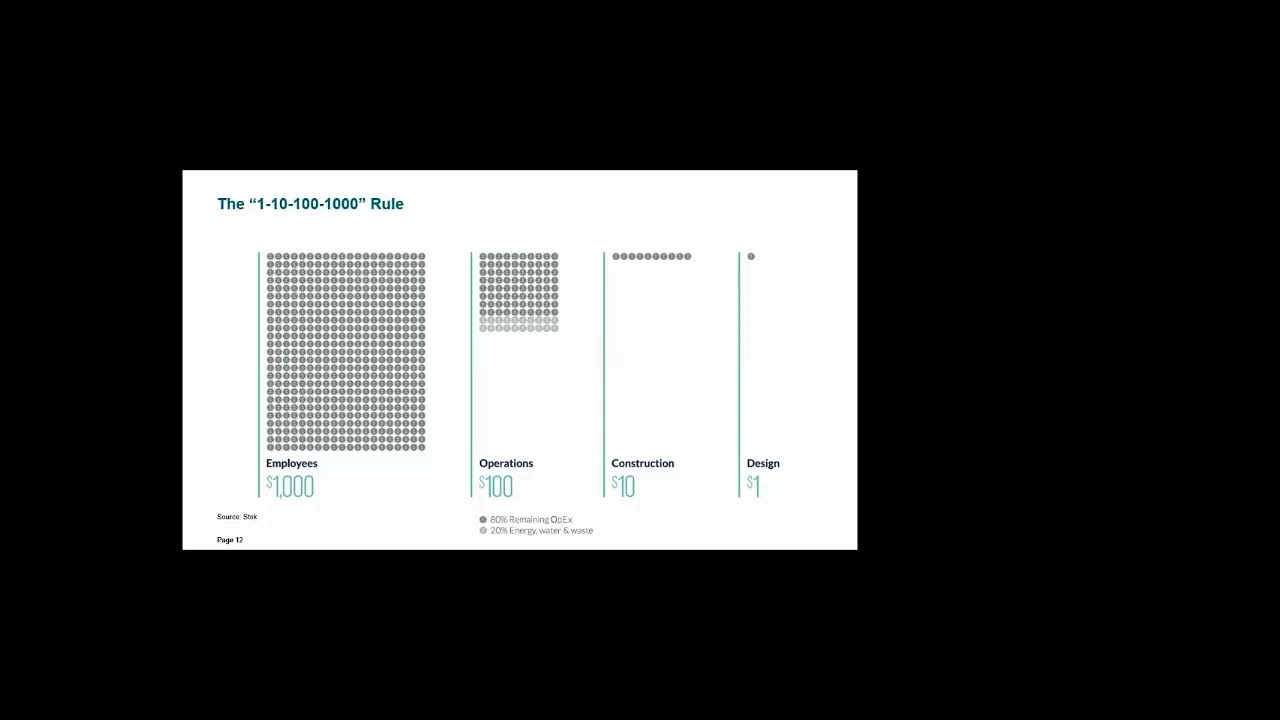
mind typical building expenditure
comparison across the entire life cycle
you look at design construction
operations and
employees if the cost of your employees
is $1,000 times the cost of Designing
the building or space that'll occupy and
100 times the amount of construction
cost
so if you
increase design and construction costs
by
10% to mitigate a 1% Improvement in
staff wellness and
retention it's
[Music]
justifiable think about how those
Balance out just because you're cutting
corners on the construction or the
design what are you doing on the back
end
the other thing that is
changing is uh how we access our systems
our facility management is
changing you know we've have a Personnel
shortage everybody is talking about it
every industry is facing
this uh there are estimates that'll be a
50% shortage in facility management by
2035 it's not not only that it's how we
access and how we use the systems you
know you start with our boiler Bob on
the left he was out in the field he was
using tools he was working on systems
and going off intuition blockchain Beth
on the other hand is looking at the
digital tools looking at the trends and
the data to make the
decisions there's also a convergence of
it and OT as well so she may not be as
deeply intertwined into all the
mechanical systems but she knows what
the results are supposed to be and what
to look for and where that's going to
direct
her so there's a shift in how we are
adapting to the
building there's a shift in how we are
receiving our
information I suspect you may have heard
the phrase there's an app for
that many of us are getting information
via apps or
notifications we can send notifications
for Mass notification or emergency
communication events we can provide what
we call Reno or remote notifications in
the Seaman world as to the status of the
systems there's also an app that allows
for remote access into the fire alarm
system which will let you test and
inspect it will let you
also troubleshoot and understand what's
going on that kind of data could be key
think about understanding or seeing that
information before you get to the site
now you know what's happening and how to
respond any questions up till now and
I'm sorry I don't see the chat so I'm
not sure if there are any in
there uh nothing in the chat yet uh but
please direct your questions in through
the chat and we'll get them
answered okay well I'm going to go ahead
and we're going to start breaking down
and talking about some of the people who
are involved with the building you know
we're going to start first from the
design phase and that's the architect
because the architect sets the scope
they set the
change there's a challenge that they're
facing right now with the 2030 challenge
that is given them an opportunity to
adopt whether it's specific energy
fossil fuel or emission targets for all
new building developments and major
renovations to be carbon neutral by
2030 huge Global participation in this
Challenge and this is really where smart
buildings tend to play a significant
role what there is
also is the complexity in
buildings that's caused by some of these
technology
advancements can add to a little bit
more of an increase in liability and
legal
aggression which means that sometimes
the architect hands it
off so they may not have that part of
the scope because they may say oh this
really isn't in my wheelhouse I need to
hand it off I need to hand it to an
expert and that expert may still be
siloed within their individual
division so that's something to be aware
of you need
to have that con conversation and keep
the design team talking across the
desperate
[Music]
silos one of the
other challenges that they face and this
is probably the biggest one when it
comes to Smart
buildings is the why
and think about the space
performance I've already alluded to the
form follows function
philosophy but the architect is
responsible for the overall
Vision based on input from the client so
they need to understand how the client
is going to use the
building and optimize the space based on
that use and on the
budget so there's that brings in a lot
of
flexibility as well as opportunity for
the
architect I mentioned silos you know we
have our mechanical
electrical fire protection technology
and plumbing
Engineers they're not always talking to
each
other so
understanding the interoperability is
key and especially as you
start merging or integrating systems
together or depending on data from
different systems you need to be able to
be talking to each
other you know a great example is smoke
control it's something we've been doing
for years but it's something that easily
gets
missed completely in specifications
or provided twice if you have a
mechanical and a fire protection
engineer that aren't talking or they may
have
gaps so you need to find a way to break
down those silos and
ensure that these Engineers are
coordinating across the
silos the other part is staying up with
technology how can you stay up with
technology how do you manage to leverage
current
technology while also dealing with code
adoption what are there design tools
that can help
you uh you know one of the simplest ones
is Bim or Revit and yet that tends to
stay 2in conduit or greater which means
you're looking at Major systems or major
risers you're not taking it out to the
floor which is where most of the Clash
occurs
collaboration Staffing all of this
is key for your mechanical and Fire
Protection
engineers and again they are also
worried about budget or cost along with
schedule and the scope that they've been
given by the
architect they may not have been given
the full scope if the architect doesn't
understand what Integrations are
necessary to meet the vision or even
possible that could meet the
vision so we had an architect that did
that and really did a great job your me
fire protection also did a great job
everything's
integrated your building has been
designed it's gone out for bid
everything is set to be a smart building
what we
want now we've got the construction
process so the general
contractor they still look at it as I'm
going to the mechanical I'm going to the
electrical I'm handling the building
envelope so it's understanding and
challenging the traditional project
procurement and delivery mechanisms so
this will be a huge part of it for them
you know keep in mind they are very
concerned they want to make sure that
their building is safe through
construction they want to be free of
liability or unusual liability so risk
and safety are big for your general
contractor
um constructibility is another one
that's big for them to pay attention to
they start looking at something that's
different than they've used before
you know many of the current
constructibility tools don't properly
address smart Building Technology so
they're going to have to think about
that and be involved as part of the
design
process we've got it built
now and now we are open your facility
operation takes
over for them with the
staff huge change approximately 55% of
Maintenance activity is
reactive they're fixing something when
it
breaks you know they're saying hey my
room is
cold that's what they're worried
about what if we have to change the
mindset so they start thinking
predictive algorithm and start thinking
about let's get to it before it breaks
I mean how many have you seen the
commercial where the elevator
dings as an elevator repair man is
talking to the facilities security guard
there at the building hi I'm here to fix
the elevator next thing you know people
are stepping out of the
elevator and they're looking like what's
going on well presumably what had
happened was the elevator knew that it
was using more energy running a
diagnostic check hey I haven't change
this belt
in how many runs of my elevator it's
good for X number of runs needs to be
changed let's send in a maintenance
request before it
breaks predictive analysis so we're
starting to see the capability for
things
like so start thinking about how you can
use
it there's a new player in the Fire and
Security in the fire World we're not as
used to working with
it or information
technology so this is brand
new if you're going to leverage
interoperability and
convergence you need to bring the IT
team into the
picture they need to be aware of it in
order to to be a part of the process and
not introduce further complexity
afterwards uh think of it from an
holistic perspective as well what are
some of the things that they can do
keeping in mind when you start looking
at OT you have to keep uptime and
business continuity in mind the fire
alarm system is still 100% uptime with
battery backup you're not taking it down
to run a patch
and this is also started you know
understanding and the authority having
jurisdiction understanding the benefits
of smart technology and why and how we
could use
this you know a great example would be
modular construction that's used a lot
within smart building projects we have
the capability of building sections
providing systems in there uh for
example a Zone control unit it gives and
we can do this beforehand and then get
it on
site so that you've minimized your
construction time frame while still
providing all of the information and the
in what you need for your automation
system
this is a fun one in the Life Safety
world we are very code
driven if it's a fire alarm system it
has to meet
NFPA and
your city
state has most likely adopted an
addition
of the iodes so which iode have you
adopted what are you running what is it
referencing keeping up with codes and
standards is one of the biggest
challenges we have technology is
changing so
fast you'll find that a lot of your
codes and standards are leaning towards
Frameworks or they have a common phrase
that states that nothing in the body of
the code is meant to prohibit
systems devices equipment of equal or
greater quality from being
used there are a couple of Standards out
there that are worth looking at when it
comes to Smart
buildings ashray 90.1 is an energy
standing for energy standard for
buildings that would be worth looking at
guideline 36 gives you your High
performances sequences of
operation um within the Vixie
World
07 is there information communication
technology design and implementation
practices for intelligent buildings and
premises Vixie is very much a wiring and
en cabling organization if you're not
familiar with them and this one does
break down and refers you back to the
appropriate ashray NFPA Ste standard
when you get the individual systems but
it talks about the
overall how do I integrate as part of
the
process NFPA has a standard for
integrated fire protection and life
safety system testing this is
effectively a recommissioning type of
standard and it's now required in the
2021 IBC IFC calls for NFPA 4
recommission in where you have smoke
control or high-rise buildings so think
about your smart buildings you have
tenant retrofits going on you really
need to do some of this to make sure
that the original sequences are still
working still
[Music]
operational so these are just a few of
them
um and we'll see more popping
up so just keeping an eye on on that how
they do this and what they're trying to
do so now we're getting into the smart
building the technology stack and this
is one of my favorite this is a great
way to show it it's one of my favorite
slides that we have um you know we start
from the bottom this is the part we know
about this is the device layer we have
all of our devices our inputs our output
our panels any kind of kiosk
Graphics our individual systems are
connected then we have the capability
for the
interconnectivity any of the gateways
you may
have uh this is your network
layer at the top in the application
layer you have your cloud
services yeah this is what we refer to
as part of the cloud and this is where
we are reviewing things we're looking at
it um how do we gather the
information you know it's kind of a
Northbound perspective they provide the
flexibility the adaptability and the
scalability this is where some of your
analytics your
visualization
occurs now I skipped over the middleware
layer
because that's this is really where we
are and what we're working on right now
when we get to the middleware
[Music]
layer you could also call it the
integration
engine this is where you're taking that
real
time
data and you're acting on it you have a
rules-based
middleware that applies rules from a
data set to to execute
logic across all Building
Systems syntax abstracted and applied to
all different languages or protocols is
another way to call these
languages so it can speak to all
Hardware some of your rules-based
middleware functions include basic
reporting documentation remote
[Music]
notification so the newer part of this
is your context
based you could also call it semantic
inoperability
and this is a little more
advanced you have an open- Source
communicate community that is looking at
the metad DAT inside the
data so this is let's how do I explain
this um take a cell phone you take a
picture of it if you haven't turned you
take a picture with your cell phone if
you haven't turned the gis off that
picture can give you exact geographical
location that geographical location is
the equivalent of
metadata that's within the data you're
saving from a
building so this is um a key challenge
that we are all facing right
now in the indust you know most device
data lacks meaning we pull alarms off
we're having a conversation over in Nema
about the term supervisory and trouble
they mean one thing for a fire alarm
system they mean something else for a
sprinkler system so at some point we
have to get the things
consistent and that's what's going on
with some of the data sets we're not
just talking fire alarm we're not just
talking sprinkler we're not just
talking automation system
system think if you were to respond to a
building a
hotel what if you wanted to know which
rooms were rented you don't need to know
who's in the rooms necessarily because
that gets into Data privacy but I need
to know that X number of guest rooms are
keyed that night because they use keyed
as a determination that it's
rented and then where they are
so you could be tying into a reservation
system you could be tying into a rental
system it all depends what you need for
a particular use
case and as part of the context base
we're talking about tagging and creating
a standardized method for describing and
contextualizing the metadata making it
more human and machine accessible to
analyze visualize and gain
revalue so these are
key of what we will see going
[Music]
forward any questions on
this right you don't have any questions
right now I've got a lot of stuff I'm
jotting down here okay uh but uh do you
want to go a little more into well I
think you're doing it but but drill down
because I think this is important for to
understand or an area that you know I
guess who who owns this this this uh
middleware layer is that vendor specific
is it is it a mix uh who's who's working
who are the people doing all this work
well you know the data comes with the
system this all goes back to who owns
the panels and
devices and you think about the software
that's in the system technically the
owner of the
building owns the building
system but what if I'm pulling data from
my cell
phone that's my data that maybe you're
pulling through Verizon or
AT&T or if you were responding to an
event and somehow you got
into um the health part
of a cell phone or a Fitbit or some kind
of Fitness tracker just to understand
where I have a heartbeat so where do I
have live people I need to go rescue
rather than okay that part of the
building is on fire I don't have any
live heartbeats over there I don't need
to send anyone into that SP face I do
need to fight the fire but I don't need
to send someone over there so in that
case think about it it's Blended because
the Fitbit data belongs or the Health
Data belongs to the person and yet
they're able to leverage it which is why
I made that difference when I said with
hotel reservation I don't need to know
who it is you have to separate out the
Privacy
aspects so it gets a little blurry at
this point
and we've got a question here how
regularly would these systems need to be
maintained I'm not quite sure which
systems but uh if you can take us swing
at that one um you know that's a good
question I can tell you that your basic
system maintenance requirements are not
changing so some of that is standards
driven uh I think most of our core
audience is familiar with the NFPA but
uh are there comparable uh you know time
intervals spelled out in the in the
other uh parts of the smart
Building
Technology
um so when we are talking about how we
do things we have to look at how it's
changed and we have
to understand how we are bringing a
project together it can't just be
throwing everything out for bid and
having
individual disciplines bid it without
coordinating uh what does that lead it
it leads us to something along the lines
of smart building a new version of
workflow so think about bringing in a
technology
partner your technology partner is the
one who's going to look at technology
and what needs to be integrated and how
we integrate
it and
when traditionally they're bring in
after the
bid it's a little too late because your
individual disciplines have not included
any integration in there so now you're
dealing with change orders to take
things out or add things in this is why
you need to bring your technology
partner in during the end of schematic
design so they can help with some of the
design development with some of the team
project definition they can also bring
to light some of the Integrations that
will be
used uh what it also can do is raise the
concept of
how you would need to do this and when
to buy
things
uh so just a thought on
that
another they uh well okay I see you're
going to expand on it uh Mariah but go
ahead you know somebody who works has
worked as a you know as an owner's R and
as a uh kind of an
enforcer you know that that this is this
is a big change from from kind of the
the way the industry has been set up for
the most part
right it's a huge change okay you know
it's it's looking at it very different
your technology partner or integrator
was typically a sub to your mechanical
or electrical if that much they need to
be
up equal with them they need to be
working with the GC from day
one uh you know this is kind of a
workflow process you're going to bring
them in on the strategy and
visioning for preconstruction so even
where the GC is coming in
through all of this think about it you
have them there for project Vision
meeting any site tours that you may have
there may be an NDA involved as they
start looking at specific use
cases and trying
to help create a spec which is what we
call technology co-creation because it's
not your normal spec it's geared towards
a specific use case yes you still have
to meet all of the standard health and
safety requirements so anything you had
from your NFPA 72 your fire alarm
requirements those aren't going away
your building still has to be
safe you still need to meet those
requirements but we're looking at how we
integrate the systems and it becomes
more of a use case which gets back to
how is the building being
used you're going to create your work
blocks you'll see those in the next
slide and
provide you know solution options which
leads to construction where now you
install you build this and commission
it you know it's great to turn it over
to the owner but once you have a smart
building you have to keep operations and
maintenance
involved you have to make sure that you
are maintaining your building in order
to keep meeting these
requirements you know think about
lead a lead building it's a green
building has to be
recertified think about maintenance now
as a recommissioning or a part of that
step and with
technology you may have to take a look
at do I have to update do I need to
replace is there a better way to do it
so this is a little bit of an eye
chart what we've done is we've taken a
um a little bit of a breakdown on each
of the segments starting with security
fire automation energy lighting your
network healthc care mobile apps
concierge management
Transportation all of these are part of
the work breakdown
structure and then we've given them a
key what value do we want them to bring
from
technology you know let's let's keep in
mind also what problems are we looking
to
solve just because I can connect
everything together is it the right
thing for that building for that use
case and yeah we can connect everything
together under the sun
but is it the right does it provide the
right value the most value with the
budget and time allotted for that
project so these are some things you
have to keep in mind as part of the
design process and that's where you have
to get everyone involved as part of that
the owner the architect the technology
consultant the
GC and even once it's awarded You' bring
in your vendors your partners as well
[Music]
it is a bit of a different structure
because we start looking at what we call
a division 25
framework one of the easiest ways to
look at this you know very simply is
it's integrated building management it's
an integration section of the
specification section it's going to
refer you back to various parts of the
specification but it's also going to
take into account
a section that tells you hi I need to
make sure I
consider IP signage for integrated Mass
notification I've got electrical power
monitoring I
have building management
systems so you should have a
construction team
Matrix and this is something that really
should be used as a way to
create that functional specification
this is the systems and data
architecture for a smart
building did that answer your
questions here's a I don't know if that
it did but there's a followup here on uh
if a building I think it's going
stepping back a little bit but if a
building's directed to a level of
initial acceptance testing uh and that
decision is identified early on in the
building design process has there been a
better experience with coordination
among the disciplines compared to when
systems are accepted or commissioned
individually I understand it if they are
letting you know early in the design
process what will be expected for the
commissioning system for the
commissioning process will that be a
better experience I would say yes
uh think about
um if you're designing for healthc care
Joint Commission if you know that you're
going to have certain requirements and
certain commissioning
requirements it's a lot better to know
that up
front Okay uh well continue and we'll
and we'll we'll probably go back back up
to the 10,000 foot level in a minute but
let's let's keep going uh digging in
here not a
problem which actually that was a great
question to ask because now that leads
you to commissioning and
warranting uh and this is something
that's coming through the last couple of
years have brought in the concept of
remote inspections in remote testing
there is a new standard in development
for NFPA 995 15 that is focused on
remote inspection and
testing it does
not describe any of the
actual tests that need to be done for
commissioning or inspection it
doesn't talk about the time frame it
leaves that to the appropriate system
whether it's 13 7270 whatever it
is NFPA 915 f focuses on the mechanism
for how do we do this
remotely how do we transmit the data how
do we protect the data and understand it
so that we can accept it you how do we
store it that's all it focuses on but
that's a great way to think about it are
we doing it via cellular are we doing it
video drone what um so this is some of
the stuff that is coming up we're
starting to see things I believe it's
another manufacturer that has self-
testing smoke
detectors uh someone else can turn their
notification appliances on so you're
going to start to see smart devices get
even smarter and how will these help um
little things to start thinking about
I would say the next step will be
something like a digital twin this could
even go back up to that 10,000 foot
level when we start talking about the
design process a digital twin is a
virtual data model of the real physical
building it the physical building
produces data that feeds back into the
virtual
module so the two are you know they are
always
representative
um digital twin has been around for a
while it's not something new it's what
was used to create the Mars rover so the
concept of creating this
digital object that will then become a
physical object and running all my
criteria through there I could run smoke
control calculations and see how the
smoke movement's going to move and how
my system's going to operate I could run
evacuation modeling how do I get people
out of the building or move them around
the building
now from a maintenance perspective I can
start to use this of okay why am I using
so much energy where is this breaking
down aha that's where it I need to look
at it this way so this is something to
think about as a next
step and how does it fit in well it's
really part of an
evolution starts with Bim and Bim does
design your static model becomes
enriched with live data and the Building
Systems because when you use Bim you're
putting in the actual the Bim models for
what is physically going into the
building think of it from an energy
perspective that building twin as a
feedback loop that continuously adjust
to the actual building conditions as
they evolve over
time it will graduate from your
construction
model with all of the asset data manuals
warranties Etc to a more
operationalized model that's using live
data from systems weather and people and
how they're
responding you mentioned SFP the
foundation has a study going on right
now on themm tools for the fire
protection engineer so that's bringing
it down past
the 2-in conduit out to the device world
is starting to think about that this is
coming so as we go into some of the
future
Trends and ongoing
challenges any other design and
construction questions
[Music]
okay I'm going to go into my design and
construction here or excuse me I'm going
to go into the future Trends and ongoing
challenges like anything new technology
new trends provide challenges there's
always something some oops we hadn't
thought about
you know now we need to take into
account the tenants the occupants along
with
manufacturer because everybody's
involved when it comes to the design
stage and this creates a increase or a
lack of representation and unified
Vision across the stakeholders during
that design stage so you've got to bring
them in in order to prevent adverse
impacts on the final
delivery cyber
security there are more devices than
there are people attackers are growing
in both numbers and
sophistication and with a convergence of
it and
OT you know how do we do
this how do we protect against
it if you're following NFPA you'll see
that in F PA 72 the 2022 Edition cyber
security has been added there's a new
chapter
11 starting to address that hey this has
to happen but it's not
just on the manufacturer side and making
the product it's not only the design and
the installation or construction you
have to take into account just because I
can connect various systems together is
there a reason to do
that or am I opening a door to something
I don't need to
do you know when I get into the
construction side of it oh I need an
extra cable here I need to connect into
the
network huh I can grab this network and
I get back there well is that the right
one or are you opening the door are you
what are you doing with that so it will
impact there we can do everything right
when we turn the building over
the owner still needs to maintain it
maintenance is going to be even more key
you have to make sure you're doing the
patches probably the
easiest protection for cyber
security password management changing
passwords or eliminating access if
employees
leave so keeping on top of it is going
to be
key
interoperability not just about avoiding
cost
it's also keeping in mind
value you know just because we can in be
interoperable between systems and we
think it's going to save costs it's not
what it's for why are you looking to
have those systems interoperable what's
the value what's the reason behind
it you know just because it's the latest
and greatest thing isn't always the best
reason you do need to start with the end
in mind when you look at smart
buildings in order to mitigate
unnecessary
complexity which will also equate to
significant cost all the complexity is
more
costly so these are a couple things to
keep in
mind you're not looking to make it
complex you're actually looking to
simplify and sometimes that's more
difficult we looked at the design and
the construction process
think about that as a procurement that's
rather
fragmented um you know we're looking at
single issues single vendors single
silos and not looking at an entire
ecosystem of what works well together
what systems need to be networked and
how do we integrate so that will cause
you to look at procurement a little bit
[Music]
differently it's really about
collaboration
and it's about skills and
training you
know we see a difference it's not white
collar or blue collar anymore it's that
new collar middle skills section of the
economy so we're looking to ensure that
students are learning marketable
skills finding design curriculum that
help
them there is a skill shortage so you
have a huge War for
talent and then you also have the aspect
of how does students get the job skills
how do they learn apprenticeship models
are one way on the job training
doing cohort type programs that allow
them to gain a college degree or the
educational that they need while working
in the process so that they're debt-free
and can take on these jobs
[Music]
living
Labs sometimes the buildings University
buildings themselves become part of the
lab so what's
next you know what do we expect in the
next 5 to 10
years well for one is
regulation regulation and adopted of
adoption of building codes and standards
credentialing embodies
changes that we'll see in that there's
an uptick in
Frameworks specifically towards smart
buildings uh I think we'll probably see
more of this because it becomes a case
of it
depends it's all about the use cases so
until we can get standard use cases that
mesh with the we look at occupants
you're going to see these Frameworks
appearing
uh you also have the prioritization of
experience you know people want to be
well how does the building help them
perform better heal learn all of
this emerging
Technologies you know where we see this
market adoption can be broken down into
five
phases so it starts as a trigger there's
a peak of inflated in
expectations a dip down because oh wait
it's not doing what I thought it
would then it starts gradually growing
back up as it's
adopted so we're going to see over the
next 5 to 10 years smart
buildings progress towards that Final
Phase of mainstream widespread
[Music]
adoption we talked a little bit about
metadata and data information
there needs to be some kind of
standardization on that metadata
otherwise it's going to be difficult to
implement smart buildings at
scale you know how will we develop data
interoperability standards that's
towards the meta data that we're talking
about uh you know I think we'll see some
of that coming through I is a big player
in that
one AI is going to play a Factor when it
comes to filtering some of the data
that's really where AI is going to help
us to help filter it because you will
have such sheer quantities we're going
to need machine learning and artificial
intelligence to bring it
together and then
consolidation you know there is an
increased merger and acquisition you
could think of that as a sign of
Industry
maturation and this will be good
for a lot of people because if once you
bring it together as
consolidation that also adds to the
trends of okay this is acceptable it's
not just a startup here a startup there
is it going to be around in five years
am I going to put something that is a
startup in my building physically in my
building that I expect to
survive these are just a few of the
trends I would argue some of the green
and the other data will play effect
Factor uh we're
seeing epr bills and there's a lot of
talk of e-labeling so many of the
booklets that you
have won't be there it'll all be
electronic use
cases we're going to start with uh hold
on uh we had a question that I've been
holding uh before before we get into
this could we talk about um in the big
picture how how smart buildings uh you
know the role they play in terms of
getting to uh reduction in carbon or
carbon
neutrality yeah it's a very good
question you know we talked about the
2030 challenge for the
architect think about the M materials
that are used for one you see a lot of
Tallwood Timber or Timber buildings
there is talk of low carbon
concrete um there is
electrification which is bringing in all
of your EV charging now you start using
micro grid can the building generate its
own energy solar EV charging can it
become carbon neutral in that sense or
energy
neutral so there are a lot of different
ways that it can do it and there's a lot
of different ways that we can bring in
decarbonization
to track it and that's where some of the
smart building May pay a factor the
design will definitely play a
factor the other thing to be aware of is
just because you're doing a micro grid
do you have energy storage
systems what are
your potential Hazard discs
not sure if I answered it think it was
kind of circular
there well I think the and then the the
play is is I guess being more energy
efficient and over the life of the
building uh as well right okay yes okay
I think we covered
it
okay so let's take a look at an office
building um think about it if you're
we're going to go back to we're still
going into the
building on you know wake up in the
morning you're driving in tells you the
fastest way to go so you're using your
cell phone based on where you want to go
you get to your building your parking
spot is
reserved and access is based on your
license
plate or a QR code you may have on your
badge tells you where to
park you've parked your car you're ready
to go into the building your access key
card is via your
smartphone potentially your building
uses hoteling so it tells you okay
you're at this office space or this desk
space today great by the way your
colleagues
are and you're in space 30 they're in 32
and 34 if you're looking for them so not
only does it tell you where you are but
where they
are you can use a room reservation
seamlessly goes into your calendar lets
other people know who may be on that
meeting and they can join
in okay think Health Wellness you want
to order lunch links right to the Lo the
restaurant there um you can link into
other things
so not only does it tell you your desk
or your office but perhaps it knows that
you prefer a cooler
workspace it's learned over the years
that okay you like the temperature at 68
not
70 and the lighting can go all the way
up or maybe I want it
dim so it'll set the workpace by the
time you get up
there you can use your phone to report
any
issues you know receive notifications
and then when you're ready to leave
here's the fastest route home you know
you're basically making the building
work for you as the
occupant by doing
this think about it the building isn't
trying to cool every office space down
to 68
and it doesn't need to keep your space
cooled until you get there so now I can
start saving energy I don't have to have
the lights on because you're not in the
building you know do that times
100 think about the energy you could
save by not having to have it
on 8:00 a.m. till 5:00 p.m.
healthc
care you know this
one big
thing big push for Health Care is to
prevent
hiis which
are Health Care um affection infections
Healthcare acquired infections excuse me
or Hospital in acquired infections
you're also looking to improve patient p
satisfication and to send them home as
fast as
possible so how do we do
this start with the patient how do you
find where you're
going
oh having spent a fair amount of
time in a hospital earlier this year
when my father had a heart attack trying
to find my way around an unfamiliar
hospital was very challenging the wayf
finding app was great it got me right to
the ICU where he was he's home by the
way no worries there uh we didn't have
to worry about virtual visits we were
able to attend personally you know the
smart room
controls setting it up for him perfect
to have what we've also learned with
those smart room
controls is we know through studies that
certain operations such as a transplant
the patient heals faster if the
temperature is kept cooler so you can
automatically set the room based on the
procedure again notice I'm not saying
the patient name I'm just saying
procedure transplant I set the
temperature for the room based on
transplant not based on Mr
Jones which leads me into the doctors
and nurses they're very worried about in
ction control what if I knew that the
room was unoccupied now I have an
opportunity to go in and do all the deep
cleaning I need
to Patient monitoring
devices you know fall alert other
sensors that you may have in
there care interaction
monitoring video
boards any of those things you could
have the uh remote that they use
Sonicare which is telephone as well as
call Button as well as TV remote could
also be a question how are you feeling
today what would you like to order for
lunch you know your choic is sandwich or
soup or spaghetti whatever it may be
push a b or c on the remote so now you
have the care interaction which also
leads you to presumably to improved p
Pati
satisfication from an administrative
perspector
perspective if I can turn the beds
faster presumably my patients are
healing relatively
quickly I am not keeping them in
there it's also a little bit of asset
management it's amazing that things like
crash carts and wheelchairs develop legs
and wander off now I can start tracking
those and see where those are it helps
me understand how to communicate with my
Personnel what information they need so
these are just a few of the things that
you can think
about uh just ways that you can start
linking it together you know think about
integrating purel hand sanitizer
stations with Wi-Fi for pre proactive
maintenance
uh think about a glass touch screen that
allows you to provide information at the
nurses station that can easily be
cleaned in case of hais those Hospital
acquired infections I
[Music]
mentioned air
travel we have a couple of uh different
sections on the air travel you've got
what's open to the public and then with
staff so we'll look at a couple of
challenges smart washroom monitoring how
do you maintain a level of comfort and
hygiene all airport facilities during
Peak and non-
Peak you can identify hot spots with
sensor technology and activate staff or
send them to those areas based on
traffic or frequency of
use uh you know washrooms are key
triggers for passenger satisfaction in
many airports
[Music]
so monitoring and billing for ground
power units gpus and preconditioned air
units your aircraft uses its own power
when parked which is wasted energy and a
negative environmental
impact PCU and gpus or pcas and gpus are
required to allow the aircraft to shut
down their auxiliary power units systems
are often Standalone and not monitor
Airlines will pay the same for a service
to the Airbus A320 and
a380s as the actual energy consumption
is not monitored but what if you could
monitor it and then you can actually pay
just what you use so now you're getting
into metering and you're using you're
paying just what you're using this may
lead to a little bit more energy cost
savings as well as a better experience
on the airline side
emergency communication and
messaging airports tend to have a very
diverse
population Dynamic and expansive
environment movement of
people all
directions and many different
stakeholders as well as many different
ahjs from facility management to TSA
border control
Customs so how do you solve
that leverage different modalities you
have paging you have gate sign boards
your advertising these days tend to be
digital and switching ads will put
messaging there think about it not all
of your visitors in an airport speak
English or understand English how can we
provide it in different languages in a
way they can find
that also understanding how you move
people if you have a flight from
overseas that has not gone through
customs you can't put them out on the
tarb back they can't exit the building
automatically in case of a fire because
this puts them against our border patrol
laws so where do we move people in case
of a fire having those Maps done and
routing set to send them
there just a couple of the things that
you might do asset tracking is Big here
think about missing lost equipment
looking for things wheelchairs aeds all
of these you can do it with
Bluetooth other Technologies as
[Music]
well
Laboratories here you've got Advanced
user hmis with their dashboards and
mobile apps labs are unique in many ways
real time feedback on air quality
critical you know think about your air
changes per hour smart buildings can
incorporate a multitude of Advanced
Mobile based web-based room level
visualization and alarms so these are
something to think about your Advanced
demand control ventilation can also
Leverage The interconnectivity and
intelligent indoor Environmental Quality
dat data analytics to respond anticipate
document and visualize
not only ieq but energy use flow data on
more you have room in lab level
integration this includes lighting
shading HVAC can help save energy give
you greater productivity gains and
increased
flexibility so think about a lab where
you may be in
there when you're running an
experiment it may be a 9 to5
you may be in there 24
hours allowing this to be used when
you're in the
space helps with that energy saving that
we talked
[Music]
about in addition real time location
service or rtls is also good that allows
you to keep an eye on where your
critical assets
are
and you know what do I need where did it
go
[Music]
hazards fire suppression systems and fum
hoods clean agent suppression you know
these can be very
challenging uh you have a unique risk
with critical room
pressurization and ensure that you have
the right data the right actuators
everything is still integrated in
operation
so just a couple of the things
there one last use case here smart
buildings for
learning think about you know the first
thing that comes to mind with a campus
is going to be unfortunately emergency
communications you need to be able to
reach faculty students staff anytime
anywhere you can have an automated
response that could be activated via
guey or single
log in with the appropriate
convential uh should
be could be integrated between mass
notification and room automation so that
your Shades and lights throughout the
facility could be turned off to provide
or on to provide visibility from the
outside for First
Responders you know how do you learn and
anticipate changes in demand based on
user
occupancy you're going to fill po a
large assembly or a gym quickly how do
you leverage that data so that you
start maintaining the comfortable
temperature humidity and ventilation
that's
needed but not 100% of the time that
room doesn't need to be ice cold when no
one's in it so how do I leverage a
sensor showing me that
data one of the biggest opportunities
for smart buildings in the the school
and campus environment is the living
learning laboratory concept where the
building becomes an immersive learning
tool and is using it's using this whole
co-creation
approach so what you allow the students
to do you may have dynamically
controlled systems such as rainwater
collection solar green rooftops Advanced
shading and lighting occupancy security
and
fire and you allow the students to
participate in Hands-On research and
development of emerging
technology uh we've had a couple of
universities that we've worked with that
have done this and allowed the students
the opportunity to do projects on their
own
building so these are all a few of them
that you
can do or some of the use cases that
we've
seen you know as we look at a
summary the biggest one is to start with
the
Y you need to focus on what the outcome
is how is this building going to be
used don't focus on the
features think about how you're going to
use the building I would recommend a
proof of concept pilot this is where you
scale it down it's a phased
approach that gives a chance to get
started to try it
[Music]
out advocate for an integrated team
approach everyone needs to be a part of
the team for this collaboration is
really the name of the
game and with that is develop a
technology road map just because it's
the latest greatest thing is that really
the right widget to use start building
technology is modular and extensible
think about building blocks
so it can be aligned with budgets and
construction timelines consider phasing
in technology over time consider
piloting some of the technology in
pieces or phases through test bed or
Innovation Center
approaches but if you do it with a road
map keeping that outcomes based why in
mind that allows you to understand how
you're using the technology which will
really mean that that road mapap is much
better the other change through all of
this that I hope you've picked up on is
design and build for
tomorrow not for today not for the
moment I turn it over and then I'm done
I'm off to the next one you know think
about how you're using that building
incorporate design and construction
features that enable Progressive
incorporation of Technology during not
not only through the design and
construction but throughout the
operation and
maintenance you may have additional
sensors
now but understand how and what you're
doing with
[Music]
them protect against value engineering
smart building features are
often misunderstood from a value
perspective and an outcome perspective
so frequently that integration is pulled
out when it comes into when it comes a
value engineering topic so you need to
understand what the implications are
when you start peac mealing building
technology through value
engineering get involved with a
technology partner early you know if
you're going to use div 25 you need a
technology partner early
on include the owner operat ahjs and
occupants when possible during the
planning um you know one thing we've
been saying is that a smart building is
an extension of its users
operators and the ahjs you know we hope
that you're not called to it other than
the initial commissioning but you need
to be involved so that you're aware of
it and your vision should be driving the
technology rather than the technology
driving us or
you design and Implement virtual
Facilities Management
plan you know look at how you're going
to do this there has to be continuous
maintenance you have to look at
predictive maintenance machine
learning make sure that everyone
involved with a project understands that
one of the core elements of a smart
building is its continuous maintenance
[Music]
qualify and
quantify the first cost of
non-traditional smart building
technology is
always you know by considering that
long-term value and
outcomes don't look at my upfront cost
for the life cycle value the operational
cost of a building during its life cycle
is Ty typically around 10 times the cost
of its design and construction so make
sure that you have everything considered
as part of
[Music]
this and as we said please take look at
the concept you the idea of a proof
concept approach you it's a great way to
leverage this and to try things out
you're starting with a w why sometimes
you need to test it out try a proof of
concept if that really is is what you
wanted to
do and with
that how are we on questions and answers
any more questions uh no I'm going to
put out another call here this our last
round of questions uh I do have a uh a
question here on
uh where do you see things going now you
mentioned AR augmented reality and
virtual reality early on in the talk is
any of that uh what at what phases is
that being integrated or is that still
kind of in
development you know I think it's where
I've seen it have been with things like
training to give people an opportunity
to do Hands-On when it comes to training
at least from a virtual perspective
rather than actually activating all of
the bells and whistles and evacuating
your colleagues uh
uh I see it in that sense I see it as
being a great part of the design aspect
this is a chance to walk through it and
see what it's going to look like from a
design
perspective put yourself in that space
now I see oh yeah this is what it looks
like and and when you talked about
interoperability right now each each uh
vendor uh in terms of they they
integrate systems within their within a
building or within a project and their
systems don't necessarily interoperate
with other other vendors or other
manufacturer systems
right uh there are two types of things I
would say most manufacturers can provide
a data stream or a network interface to
another manufacturer for a readon type
of situation
uh for
example I've done a network interface
for smoke control providing the readon
data to a jci automation system so they
could then activate the smoke control
dampers actuators everything that needed
to be done that's a one-way
communication um a two-way communication
I can do seens to
seens because it's our system it's
easier for us to get through UL listings
and have that two-way
Gateway some of the interoperability in
that sense if it's a one-way data stream
or overlay that's there right now and
that's not a challenge it's when you get
into proprietary
programming
that and UL compatibility where we have
some of the limitations in the fire
alarm side
[Music]
okay uh and then but we've always had
we've always had interoperable systems
okay all right thank you for that uh and
then with regard to the fire alarm um
you know the fire alarm is is as it
exists today pretty much a uh you know
kind of a a a 19th or early 20th century
Concept in terms of the technology and
the way that it's designed to work um
you know and that a device either goes
into alarm or is not an alarm and once
it's an alarm you know it locks into
alarm and then a responsible party has
to come and and uh reset the device um
where do you see kind of the the the
traditional fire alarm uh going in the
in the future uh in light of all the
advances that we have in in sensors and
uh and this
technology um I see our detection
sensors grow going
in I'm going to call them use cases it's
already it's already an existence and we
already have application
specific algorithms that tell us based
on what's in the space what burns so we
have multicriteria detectors that are
available on the market now I see more
multicriteria detection out there I see
detectors that are capable of providing
more information and data or picking up
or is fire alarm systems picking up data
from other sensors and other sources
that may be out there based on that
making a determination of what action to
take
um fire alarm because life safety is
involved and that's risk and liability
will always have some semblance of if
I'm an alarm I need to look into alarm
until it's
reviewed I don't know that that's going
to change in the short term until we
address the liability
aspect okay well those are those are all
uh I mean these are big big issues uh
what's your what's your feeling in terms
of the industry and really this is goes
Way Beyond you talk about you know
liability being a a a a big concern to
The Wider adoption of this uh or getting
it Beyond kind of the you know uh
getting into the life safety pieces
which are most interest to the first
responder Community um you know that
that implies you know uh you know
lawyers and and legal and risk people
which are traditionally not you know in
considered in the building architectural
engineering space um and are those are
those professional communities being
engaged in this or how is that
happening well insurance is definitely
involved so risk is definitely involved
think about it you have the fire
protection engineer involved part of
what they do with the design is based on
the hazard and the risk analysis for the
building and that really plays into the
design factor
uh so it's already there and already
engaged um you know I think my personal
two
cents this is me personally thinking I
think we're going to see some changes in
Building Systems and leveraging more
data and other systems the catch will be
we have to find a way to
balance data privacy and safety
and once we do that I think we will have
a lot more information at our hands
possibly more than we may know what to
do with so I would urge caution on just
jumping full force in if you saw the
amount of traffic think about the amount
of traffic that goes across a security
system card access especially in the
morning when folks are badging into a
building it could be very easy to miss a
crucial part so this is where we're
going to have to leverage machine
learning or artificial intelligence to
help filter out or to catch
key data
points okay uh so last call for
questions um and then if for people who
are interested uh in learning more
where's a a good place to go uh to send
people to to get some more details on
all the various things that are swept up
in this
topic
um let's see the Continental building
automated Building Association is a good
place to go uh I would say we could
always connect you to the Nema high
performance Building Council is another
one um
I'm gonna go ahead I'm going to I'm
going to preempt Maria and I'm gonna
because I can see people I can't write
it down I know they can't so I'm GNA I'm
gonna I'm gonna I'm gonna Strongarm you
for a a follow-up uh reading list or
organizations which I can then circulate
to the attendees which I think will be
really
great so last call on questions this is
your
chance you've got a real expert on the
line here somebody's got a really good
understanding of a of of such a big an
important area that we all are going to
be impacted by I'll give you a few
seconds here
uh for that any questions don't be
shy just real quickly in terms of the
education challenges uh let's talk
probably we we're most familiar with the
fire protection engineering community um
so what is that looking like now so this
has made its way into the enging
curricula and and people are coming
through uh kind of aware of these
Technologies and and working now in
design with uh with building information
models and digital Twins and all these
things all of those have come in they've
come in as separate systems in terms of
calling it a smart building that is
still
coming
uh you know as I said there's no one
definition I think I started everything
by saying that what we are looking at
doing is however how do we Define those
use cases how do we ensure that we are
providing the data when we need it how
we need it to who needs
it
um there is
a work group that is looking at a
proposal for the iodes
that will reference a couple of the
building
Frameworks wired score um well
buildings and Lead it's really looking
at it more from an energy saving
perspective of how you get
there you know I think in terms of
training there there's a lot out there
there's a lot of new technology a lot of
things shifting and
changing okay um all right well uh
Mariah I think uh the sign of any good
topic uh is that you leave them wanting
more and and this is such a big uh
subject area uh and there's so much here
I know uh you know because I try to to
stay up with this and we've done some
work
peripheral uh but I can assure you that
there's people here just like me are
kind of you know pushed back from the
screen and the the wheels are turning
trying to take this all in so I want to
thank you for for uh presenting for us
and for sharing the information and uh
you know we'll we'll certainly stay in
touch and uh we'll be uh looking forward
to the the followup and uh we may have
you back in a in a few years uh and we
look forward to to all the developments
is there anything we can be doing is is
professionals and sympathetic uh uh
consumers in the in the building safety
and Public Safety realm uh to help push
this effort
along I would
say keep a couple things in mind one
collaboration and two why it all comes
back to what are you trying to do and
why if you understand that then there's
a reason or a way to find a path
forward okay well I think that's a great
place to end it and so uh to all of our
attendees thank you very much and uh R
once again to our presenter uh thank you
and uh a reminder our our final
presentation for the semester will be on
May the 2nd we'll have Bob Henley the uh
journalist and uh writer uh to talk
about the politics of Public Safety in
New York City uh which should be a uh a
fun topic and uh certainly plenty to
discuss so thank you all very
much
byebye e