Video summary
Simon Fujiwara approaches his exhibition at Mudam Luxembourg by reimagining the museum not as a traditional gallery but as an immersive theme park inspired by the architectural layout of Disneyland. Following this concept, he transformed every element within the space—including colors, signage, and materials—into a cohesive universe designed to offer visitors a completely new experience rather than a simple survey of his work. The director encouraged him to structure the exhibition around distinct thematic worlds for different rooms, with the Grand Hall serving as the central hub akin to a castle in a theme park. This space introduces "Who the Bear," an invented cartoon character that acts as a mascot without specific identity, gender, race, or sexuality, symbolizing a search for self within a saturated world of images.
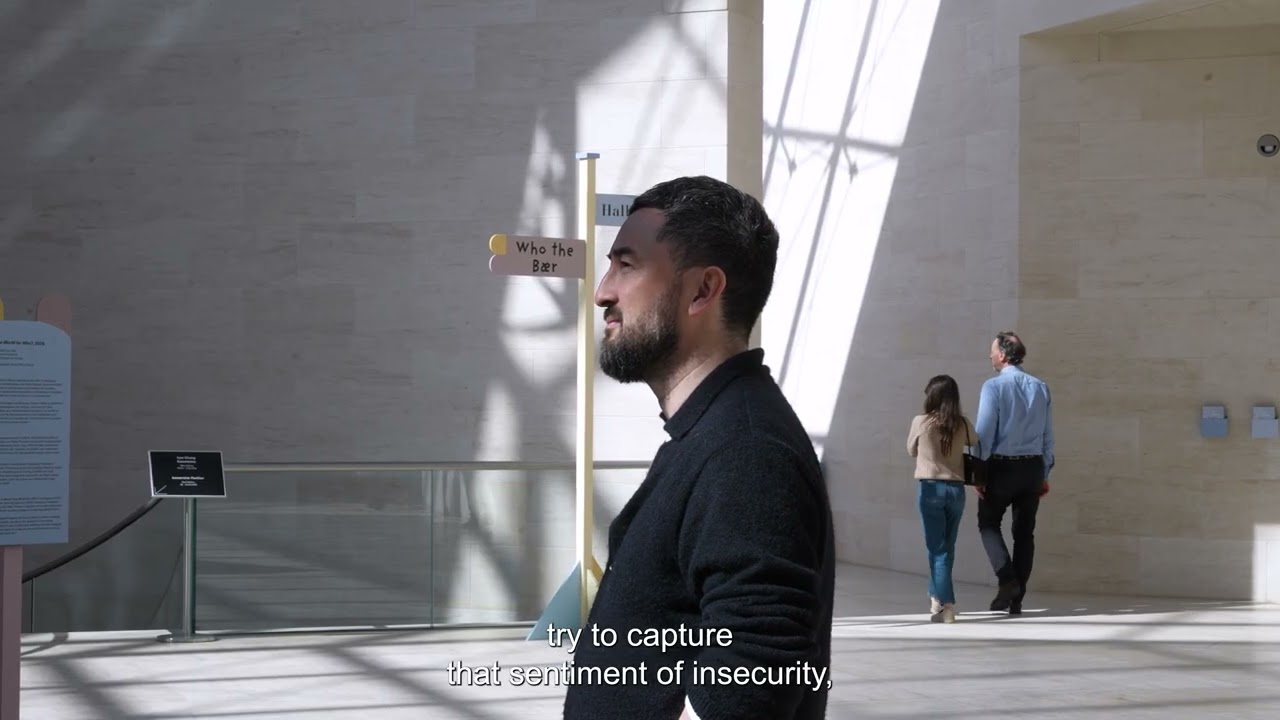
The exhibition delves deeply into how we process conflict and suffering through screens rather than direct physical experience, addressing the desensitization caused by image overload. Fujiwara presents his own interpretation of Picasso's *Guernica* to confront this issue directly; in his version, figures are not fighting but have collapsed into an exhausted pile clutching cell phones while a new sun rises in the background. This imagery captures the sentiment of insecurity and ambivalence regarding the future that characterizes our current anxious times. By creating such a large-scale work, Fujiwara aims to create an immersive environment where viewers physically cannot look away, forcing them to confront what happens after conflict rather than during it.
Beyond specific artworks, the exhibition explores the fundamental struggle artists face in defining their own identity and reality across different periods of life. Fujiwara explains that his personal journey involves constantly creating work that addresses various experiences he encounters, ranging from living online too much to visiting Holocaust memorials or dealing with health crises. He views these diverse subjects as vessels for exploring a central theatrical problem: how artifice can be used to convince everyone that cells are real. For him, the word "art" is derived from "artifice," highlighting that all creation involves staging reality through paint, light, and models. Ultimately, his work seeks to answer the age-old question of what reality truly is and whether it can be depicted or approached closely enough to understand our shared human condition in an era defined by digital saturation and uncertainty.
Read the full video transcript
When I first saw the architectural plan
of Mudam, it looked to me exactly like
the plan of Disneyland. And I had this
idea to turn the museum into a kind of
theme park.
I wanted people to come in and
experience
a completely new version of the museum
down to the colors, the signboards,
the materials to experience a kind of
total universe.
The director Bettina invited me to think
about the themes in my work, the kind of
underlying structures, and arranging my
work not as a survey, but as a series of
themed worlds.
I chose different themes for different
rooms in the museum. And the first space
that you come into, which is the Grand
Hall here, is kind of like the center of
Disneyland, where the castle is. And so,
it's for my cartoon character Who the
Bear. And this is a kind of theme park
mascot, you could say. It's a cartoon
that I invented in 2020. And it's a bear
that has no identity, no gender, no
race, no sexuality. And they're
searching for a self in a world of
images.
As part of the Who the Bear series, the
cartoon transforms into different
images. And a lot of them are art
historical images.
For a new commission for the museum, I
painted this large piece behind me,
which is Who the Bear depiction of the
Guernica by Picasso.
We're dealing today with so many images
of conflict and suffering. But those
images that we experience, if we're
lucky enough to not physically be in the
war,
are experienced through tiny images on
our screens.
And with that flood of images, there
comes a kind of desensitization
or detachment. I wanted to deal head-on
with the problem of what a picture can
do in this time of
overexposure to images, but also the
flood of images of violence and
suffering.
My version of the Guernica is not an
image in which all of the figures are
fighting, but have all collapsed into a
pile.
They're exhausted, some may be dead, and
they're clutching their cell phones.
It's an image of the day after the
battle. What happens after all of this
conflict? And in the background, the sun
is rising on a new day.
The question at the heart of this work
for me was
what is the future going to look like?
It's such a time of deep anxiety, and we
feel like we're leaping into the
unknown. And so, I wanted the first
image in the exhibition to really try to
capture that sentiment of insecurity, of
ambivalence about the future, and to be
an image that you can't look away from
physically. The scale of it is so large
that it immerses you.
A lot of my work has always come out of
a struggle with having a self, and it's
a created concept, and the notion of a
self was different in different times.
But I mean, on a personal basis, I'm
like everyone else. I wake up every day
and I go, "Who am I? What am I doing?
Why am I here?" The way I've managed to
sort of deal with that question is by
constantly making work that addresses
different times in my life when I'm
dealing with different questions. So, it
can be about being online too much. It
can be about visiting a
Holocaust Memorial or an Anne Frank
Museum. It can be about being in a theme
park or it can be having a contracted a
sexually transmitted disease. Like,
whatever I experience at that time is a
kind of vessel, I think, for something I
keep trying to explore, which is in the
theater we go through to try to convince
everyone that cells are real. And I love
that in the word artifice is the word
art. And all art is a creation. It's
different ways of staging the same
problem. And that problem is
the age-old question that every artist
has had is, what is reality?
Can you depict it? Can you get close to
it? And then the answer is with
artifice, yes, with paint and light and
curtains and models.