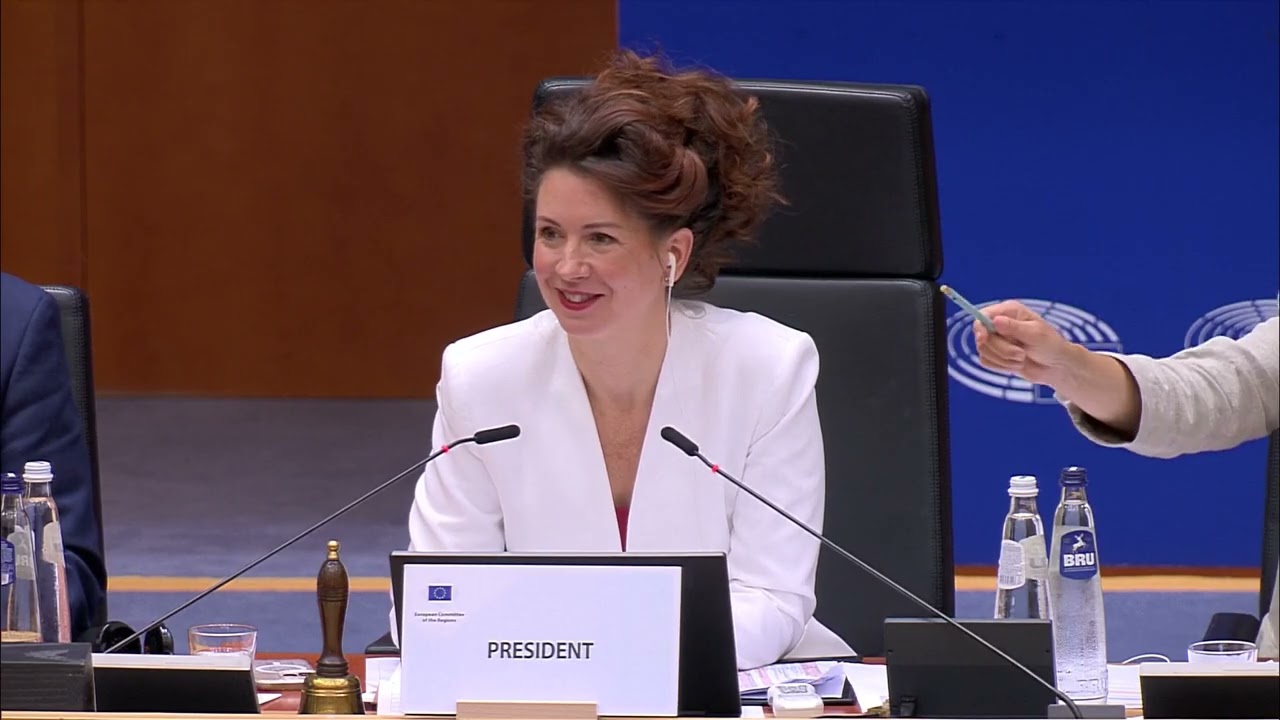
Signature of the Memorandum of Understanding with the Swiss Conference of Cantonal Governments
Watch on YouTubeVideo summary
The signing of the Memorandum of Understanding between the Committee of the Regions and the Swiss Conference of Cantonal Governments marks a significant step in institutionalizing cooperation, moving beyond abstract diplomatic relations to foster concrete political proximity through regular dialogue and thematic exchanges. This agreement is particularly important because it leverages the unique strengths of Switzerland's federal system, where twenty-six cantons often hold diverse opinions that necessitate extensive discussion, compromise, and a search for balance rather than simple convenience. By formalizing this partnership, both parties aim to create a pragmatic framework that strengthens mutual understanding among local administrators in border regions, ensuring that European integration remains grounded in the daily lives of citizens who work, study, commute, and live across shared borders with neighboring countries like Germany, France, Italy, Austria, and Liechtenstein.
The core argument presented by Swiss representatives is that federalism serves as a vital model for bringing institutions closer to people while maintaining strong regional roles, which directly impacts the lives of citizens in border areas where Europe begins just kilometers away or across a bridge. The cantons act as essential supporting pillars within the Swiss state, possessing extensive expertise in critical sectors such as education, health, economics, culture, and spatial planning that are heavily influenced by both federal and European political developments. Consequently, this memorandum is not merely about diplomatic negotiations but represents a recognition of how deeply intertwined these regions are through rail connections, cross-border economic value chains, university exchanges, and healthcare collaborations, making the relationship between Switzerland and the EU a matter of immediate relevance rather than an abstract concept for local populations.
European officials from France, Germany, Italy, and Belgium echoed this sentiment by highlighting that while bilateral agreements with specific border regions already exist, this new accord expands cooperation to include all Swiss cantons, thereby respecting their federal structure and subsidiarity principles. Speakers emphasized that the initiative demonstrates a broad consensus on constructing more solid relationships that benefit not only frontier communities but also businesses and local enterprises across the continent. By acknowledging Switzerland's distinct institutional peculiarities while celebrating its deep integration into Europe, this agreement aims to generate tangible benefits for all stakeholders, allowing European regions to learn from Swiss practices in multi-level governance and jointly address transnational challenges with renewed energy and a shared ambition for deeper territorial cooperation.
Read the full video transcript
We move on to point sorry 19 agenda
signature memorandum understanding swis
conference
govern
and welcome marusent
are
comm of the c and reg
andal
government
alsoing
reg
associations institutions can help this
cooperation to digest better what is
happening in the affs regs dig
instaled cooperation
cooperation
importants
because they keep the momentum going
especially when a lot of other things
are happening in the world
institutionalized cooperations
have significance in the long run when
it's
intervals.
Madam President,
esteemed members of the Committee of the
Regions, ladies and gentlemen,
in Switzerland it is sometimes said that
when 26 cantons sit at a table, there are usually at least
26
opinions. Anyone who knows Switzerland knows that
this is probably a rather
conservative estimate.
But therein also lies one of
our country's strengths. Federalism does
not always mean simplicity and
convenience.
Federalism means discussion,
the search for balance and
compromise, closeness to the people, and
ultimately viable solutions. And this
experience connects us with many
regions of Europe. It is therefore
a great honor for me today, as President of the
Conference of Cantonal Governments, to sign the
declaration of intent between the Committee of
the Regions and the Conference of
Cantonal Governments.
A letter of intent is initially just
a piece of paper. It only becomes politically important
when it is brought to life
through personal
encounters, growing trust,
and ultimately, concrete
cooperation. That's exactly what we're talking about
today. The Conference of
Cantonal Governments
is the political platform of the 26
cantonal governments of Switzerland
. It coordinates and
represents the common interests of the
cantons, especially where cantonal
responsibilities are affected by federal
and European political developments
. The cantons are the
supporting pillars of the Swiss
federal state. They possess
extensive expertise, such as
education, health, economics,
culture, taxes, spatial planning, or the
implementation of the law. And that is why
the relationship between Switzerland and
the EU is not an abstract question for us.
They have a very direct and effective impact on the lives
and politics of our citizens in the cantons,
border regions, and everyday life
. This was also exemplified by the
initiative statement launched by Matteo Bian
. Relations
between Switzerland and the
European Union do not only take
place between diplomats and lawyers in negotiating rooms. No, it
takes place primarily where people
work, where people study, where they conduct research
, where they commute, where they
invest, and where they live together.
And Switzerland is one of the
EU's closest partners, without being a member of
the EU itself. And yet,
Switzerland is right in the heart of Europe. Our
relationship is therefore characterized by
great closeness, mutual
dependence and at the same time respect
for the respective institutional
peculiarities. The Swiss cantons,
especially the 15 border cantons, live
this reality every day. Just as the EU
borders not only Switzerland but also cantons, Switzerland is
surrounded not only by states but also by regions. From Baden-Württemberg,
from Bavaria, from Vorarlberg and Tyrol, from
Lombardy, from South Tyrol, Biont, Ostal,
Grand Burg, Franconian and Roo, and Alps,
by the way, all economically very
strong regions in these border regions,
in these cross-border
economic and living spaces, Europe becomes
concrete in rail connections,
inter-projects
of health cooperation,
also university exchanges
and the economic
value chains in the daily
contacts between people. For the
cantons, Europe is therefore
not geographically far away. Europe often begins just a
few kilometers away, sometimes on
the other side of a bridge, a
train station, or a shared border.
With the declaration of intent that we are allowed to
sign, we also want to
strengthen political proximity through dialogue. We are creating a
pragmatic
political framework for regular
contacts, thematic exchanges, and
better mutual understanding.
And I thank you very much, Madam President,
and the Committee of the Regions,
for your openness and
willingness to deepen this cooperation with
us, with Kadek, with the cantons and
Switzerland.
Special thanks go to Matteo Bianke and
all the people who have supported this process with
great dedication. I look forward
to this new chapter in
the relations between the
European Committee of the Regions and
the Swiss cantons. Thank you very much.
Thank you.
Grace. Thank you, President.
Grazie signor Marcus D e grazie cari
colleghe, cari colleghi. I don't have to worry about the
fact that
the initial initiative is based on the part of
the
territorial dimension of the relationships between the
European Union and Switzerland, which also has an
important coronamento isituzionale and
desidero also ringraziare in the membri of the
Comitato Europeo delle regionali che Hanno took
all the initiative to propose the
rendering of the cooperation
with the Conference of the Swiss Cantonal Government
. Questo ampio consenso dimostra
che il tema non riguarda soltanto the
regioni di confine, ma al modo stesso in
cui intendediamo constructruire relazioni più
solid, più concrete, più vicine ai
cittadini. Ringrazio in particolare il
presidente Marcus Diet che il nostro
incontro nella phase of preparation of the
parere with già confermato una cosa
molto chiara, rafforzare il dialogueo with
i svizzeri cantoni e la direzione
giusta. The relatives have the power to determine the quantity for which they enter into the
part of the
volontà di approfondire la dimensione
territoriale delle relazioni Unione
Europea e Svizzera e questo memorandum è
a result of concreto di source ambizione
condivisa e un passo verso una
cooperazione più stretta. The
multi-level government model for the
concrete application of the
sussidiarietà attiva rappresenta un
riferimento importante perché chi crede
in istituzioni vicine ai cittadini e in
un forte ruolo dei territories. Sono
particolarmente liesto che attraverso
questa cooperazione un numero più ampio
di amministratori locali e regionali
europei potrà conoscerla da vicino,
also from the two territories, come
la Lombardia and the regioni di confine
collaborano già con la Svizzera.
Rispettare il federalismo Swiss e
riconoscere il ruolo dei cantoni
Swissvizzeri delle regionsi delle città
europee ci aiuterà certamente ad
affrontare sfide transfrontaliere comuni
e a generare benefici concreti per
cittadini, imprese e comunità locali.
Grace. Grazie
and give the floor to our members who
get
bonjour madame la president merci beaucoup
je me réjouis aujour'hui de la
signature de cet accord entre les
cantons Suisses et le CDR c'est vraiment
un moment très important et outre les
accords qui existent déjà avec les
régions frontalières comme l'Allemagne,
comme la France, je salue this
initiative. En effet, nous avons déjà
conclu des accords bilatéraux
franco-suisse with les cantons de balle bal ville bal
ville et campaignne. And I
remember that this
concrétization ait pu se faire
aujourd'hui. In effect, in the
Grand Est region, we have achieved great success
in partenariat with the Suisse
in the cadre du conseil rénant de la
conference dur supérieur et je me
félicite de this new énergie que va
donner cet accord que nous concluons aujourd'hui
. Bravo à vous tous qui avré merci
monsieur le rapporteur et longue
vie à ce new accord bilatéral merci thank
president geachte voorzitter
Marcus the collega's het doet me werkelijk veel plezier
dat the comité
van regional's vandaag deze memorandum of
understanding met onze collega's van de
Zwitsers cantons ondertekend. I already had
the country in the various cantons in Zwitserland, where the residents and the
public can organize vast positions in the country.
Zwitserland is a toonbeeld van
goedwerkend confederalisme, with a
great deal of respect for the subsidiariteit
waarbij strong cantons over
sleutelbevoegdheden beschikken and an
essential role play for the burgers and
ondernemingen. This must also be
formalized by the regional committee of the region. The relations between the
European Union and the Zwitser Confederatie
are always very different in the classic
international seed works of these
states. As long as you are in Zwitserland, you will
also have seeds in the
cantons and the local authorities. The
onze
burgers and ondernemingen legal trees were raked
. And I'll be able to get the same results from the seed plant for sale
. If both partners all
succeed toe. And how we know the word and come
from the European Union. Ik dank u.
Thank you.
Thank you vials for your statements and
also a very heartfelt thank you to
Matteo Bian who actually initiated the whole thing
together
with the KDK. I believe
we have a very good starting point here to
understand each other, to strengthen the regions,
and ultimately we always live in
our countries, but we
also live in our regions, and to identify these
strengths of cooperation in these
regions and
to strengthen these strengths even further
, gives us opportunities for
mutual understanding and
ultimately also for a better understanding of all
the questions that arise in
various topics and challenges
on our continent. And
Switzerland, I emphasize once again,
Switzerland is in the heart of Europe, not only
geographically, but we
also want to contribute, and that is why we are
here today to sign this.
Many thanks.
Thank you. invite you to
understand.