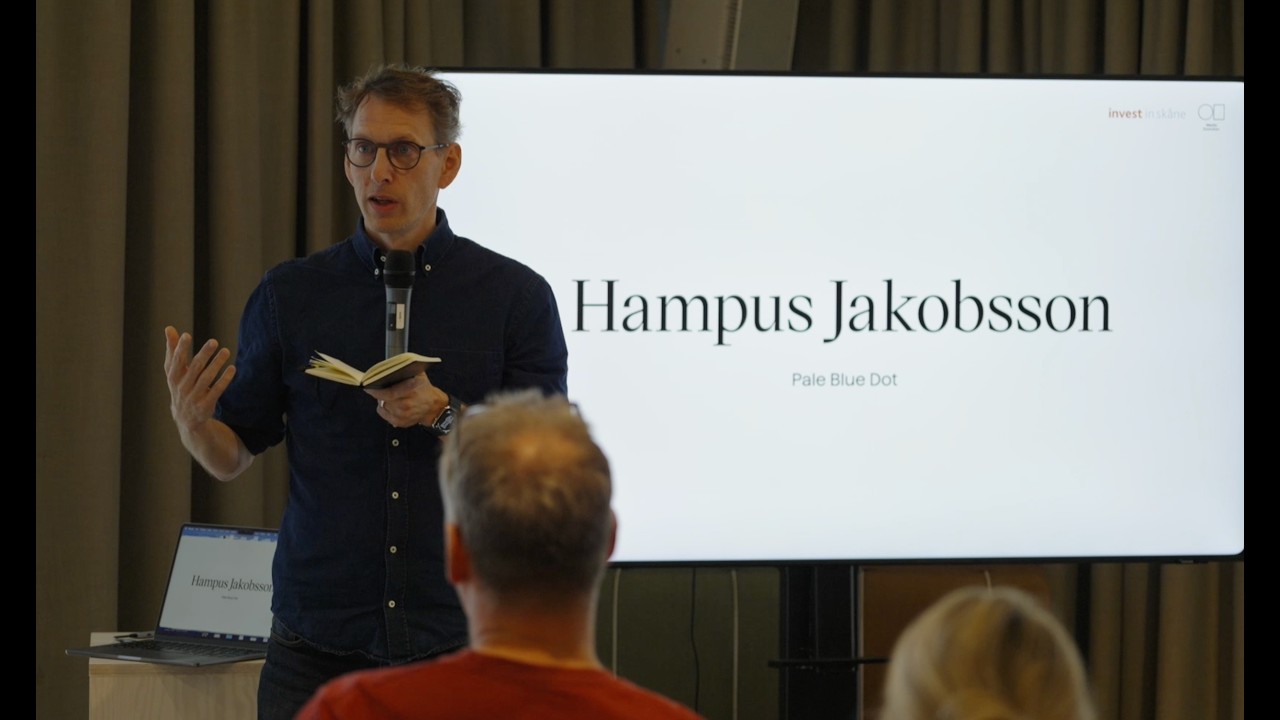
Video summary
Hampus Jakobsson begins his talk by challenging the audience to reflect on their ability to be fully present with someone in front of them for more than fifteen minutes, a feat he suggests is increasingly difficult due to our reliance on technology. He acknowledges that modern tools like smartphones and AI represent extraordinary superpowers that allow us to communicate globally or create complex digital content, yet these same advancements often weaken our capacity for genuine connection and satisfaction. While AI enables the solving of previously intractable problems by democratizing technical skills and allowing startups to address niche issues without massive resources, Jakobsson warns that this convenience comes at a significant cost to our human faculties. He illustrates this with a striking example from a medical study where doctors using AI to detect cancer initially improved their accuracy but subsequently declined in skill after six months of reliance on the tool, suggesting that overusing these technologies causes us to lose essential aspects of our humanity.
Jakobsson identifies three specific things that AI deprives us of if we are not careful: willpower, presence, and dreams. He argues that constant connectivity erodes our willpower, which he likens to a muscle that atrophies when we stop exercising it through acts of friction like running without headphones or turning off social media. The loss of presence is exemplified by the urge to photograph every moment rather than experiencing it directly, such as taking a picture of a cappuccino instead of enjoying its aroma and appearance. Furthermore, he contends that AI accelerates our tendency to live someone else's life, where we fulfill the expectations of parents, spouses, or society rather than pursuing our own unique aspirations. The ease with which AI allows us to produce more code, write more emails, and hold more meetings pushes us further away from introspection and personal goal-setting, causing us to drift into a state of perpetual busyness that suppresses our individual dreams.
Despite these concerns, Jakobsson maintains an optimistic view regarding the potential of AI to solve complex, fractal problems like climate change, which require deep understanding of intricate systems rather than simple workflows. He believes that AI will enable breakthroughs in areas previously deemed unworthy of investment by traditional venture capitalists, such as improving conditions for nurses or optimizing factory environments. However, his central message is a call to balance the adoption of these powerful tools with a conscious effort to reclaim our human strengths. He urges us to practice removing our digital "exoskeletons" and embracing vulnerability, arguing that it is precisely by acknowledging our weaknesses and resisting the constant push for efficiency that we remain strong and truly human. Ultimately, he concludes that while AI offers amazing capabilities, we must actively strive to preserve our willpower, presence, and dreams to ensure that technology serves us without diminishing what makes us special.
Read the full video transcript
[applause]
>> So, when Kalle's question was about how
many of you used AI this week, I'm going
to start by a different question.
This last week,
how many of you would honestly say that
you, for more than 15 minutes, have been
completely
and fully present with the person in
front of you?
Can you raise your hand?
15 minutes sounds like 15 minutes. It's
like That's like a lot like even 15
seconds is a long time. I'm going to get
back to that one. Because the thing is
I'm a technologist, I got to admit. And
the thing is
technology is an absolute extraordinary
magical superpower. If you would take
people from the 19th century, if you
take your your grandparents'
grandparents and explain most things
around you,
they're absolutely comic super novels.
If you think about it, right now you can
get into a plane and you can fly like
Superman. Right now, you can pick up
your phone and you can teleport yourself
on the other side of the world and have
a phone conference with somebody in
South Korea. It is complete magic and
extremely hard for us to actually
understand what superpowers we actually
do have all the time.
But the thing is
a lot of weaknesses for people
are actually a strength overused.
And the problem we have with these
things is we start to see the dark
sides.
I think most of us know if you go right
now over to a cafe anywhere in town,
you notice that mobile phones give us a
superpower to be present with somebody
on the other side of the world.
But they make it very hard for us to be
present with a person right in front of
us.
Social media makes it extraordinary easy
to get inspired by any subject super
easily.
But it's very hard to be satisfied with
what you have.
AI allows us to create things that we
just could not create before. Be it
code, be it images, be it novels or
texts. It's extraordinary.
The dark side with AI
is that it makes it very hard for us to
learn.
And I'm going to get more into that.
Before I do that, I have to say what's
good about AI.
So, I am a VC. I'm a venture capitalist.
I'm invested in startups. I've done that
for 15 years.
The thing is that previously it was very
hard for people to solve uncommon
problems.
The reason there are hundreds of dating
apps and other things is these are very,
very common problems.
The cool thing now is that now
somebody who has no technical background
or or or has technical background, but
they have an insight that other people
don't have, they can start solving a
problem that was just not {quote}
{unquote} worth it before. Because
previously you would have need 20
people, 5 years. It would just take too
long time. And if you were going to
solve a problem for, let's say, nurses,
is it worth it? Has anybody here ever
been at a hospital or met a nurse? Yes,
of course it's worth it. But it wasn't
worth it for 45-year-old men that are
venture capitalists before, sadly.
And I think that those kind of problems
are hopefully going to be solved way
better now.
The other thing is that if you go into
really gnarly complex problems that are
just not simple flows, you can also
start solving those.
I when I look around myself at a normal
workplace, if you go to a a factory or
something,
a factory might look simple from the
outside, but when you start
understanding inside, it's really
complex. And every time I meet a com-
company that does that, I get really
excited because I find that life is I'm
not allowed to use this word by my wife,
but I find life being fractal.
And what I mean with fractal, for all of
you who are not like math nerds, is that
it's insanely complex. It's like a
coastline with a lot of different small
cracks and niches. And the thing is that
previously when we could code software
the way we did before, we could only
solve very common problems, very solve
work for problems. That's why there are
101 different calendar booking apps or
whatever, because that's like a common
Everybody books meetings.
But right now, AI allows us both to
solve problems that weren't worthy
before, but it also allows us to take
these things that are in the brains of
the some of the people that work in a
factory or in a lab or in any other
complex environment and able to make
tools for them.
So, we will see enormous advancements in
really, really complex tasks.
And
as Keller said, I happen to work with a
lot with climate. Climate is a very
physical problem. It has a lot of atoms
and things, heating, food, buildings.
It's a very, very fractal and complex
problem. So, I think we're going to be
able to solve some of the ignored
problems and some of the hardest
problems thanks to AI. And that makes me
really positive.
So, why am I not only positive about AI?
Why did I start with that this topic
intro?
Lancet, the medical journal last year
published a really, really scary report.
So, um
they used AI to assist
endocrinologists, the people who are
trying to figure out if you've got
cancer or breast.
Um and that's like the great problem to
assist with AI. Not only because it's
worthy, but because it is also there's a
lot of pictures, a lot of images,
there's a lot of data. AI loves data, we
know that. So, you can really do a lot
of good stuff with AI to figure out is
this cancer is this higher risk of
cancer. And the endocrinologists
improved their skills a lot, like a lot.
It was really good. I think that all of
us would just be like, great, go on,
solve more complex problems.
After 6 months,
the skill of these endocrinologists
with AI
had decreased.
A bit strange though, cuz they used the
same tools and workflows. Why had they
gotten worse?
So, the study decided that they would
not now go back to doing what they did
before
and not use AI.
The detection rate for the
endocrinologists now after using AI
without AI
gone down 21%.
permanently.
They had lost something
with using AI.
And the question I'm asking you
and that I want you to think about is
what did they lose?
Like, if I'm using a computer, yeah,
yeah, yeah, sure, my handwriting gets
worse.
But I it's going to come back, right? If
I write write a lot. Or will it?
I think that AI removes something way
worse and way more insidious that we
don't really think about. Because those
are the things that make us human.
I think AI deprives us of three things
that we every day have to remind
ourselves that we have.
Deprives us of willpower.
It deprives us of presence.
And it deprives us of dreams.
And I think that's something we have to
constantly strive to do.
You have to have able to have the
willpower to say no to stuff. To turn
off social media.
To run 5K without headphones.
As it's called in Sweden, with my kids
around me, it's called Skavmxa. For you
those of you who don't have teenagers.
Um just being able to handle the
friction of normal everyday life.
That's hard. It requires immense
willpower. Here's the good news.
It is like a muscle.
It's been shown it's a part of the
brain.
If you constantly handle willpower
you actually get better at it.
And the bad news is, if you stop doing
it,
you get worse at it.
So, just keep powering through.
Keep telling yourself,
"Yes, I'm going to call my parents and
listen to my dad's worry about interest
rates and my large mortgage for 15
minutes, and then I'm going to ask him,
'How are you, Dad?'"
And I'm going to try to just power
through. It's worth it.
Presence, it's the same thing.
If you're sitting at a cafe waiting for
a friend, and you just got that amazing
sugar bowl cappuccino frappuccino thing
with the dots on top, don't take a
picture of it.
Just look at it. Just look at it for a
second.
I was buying strawberries yesterday, and
from the wonderful girl who sold
strawberries, I asked if they're good,
and they and she smiled and said, "But
they're pretty."
And I was like,
>> [laughter]
>> "Wait a second, what do you mean? I'm
not going to take pictures of the
strawberries. I'm going to have them."
And the third thing I think is that we
lose our dreams. And what makes us lose
our dreams is that I think many of us
are living someone else's life.
And what I mean by that is there are a
lot of us that live the life our parents
wanted,
our spouses wanted,
or or your boss wanted, or society
wanted.
And AI makes this just harder because
it's so much easier to send more emails,
to code more, to produce more, to have
more more meetings.
So, I think try to come back to what do
I want?
Because again, the cool thing with AI is
that now you can build it.
So, the message is AI gives you amazing
tools. That's great.
A weakness is a strength overused.
So, practice taking off that exoskeleton
and being weak cuz that is what keeps
you strong and human.
Thank you very much.