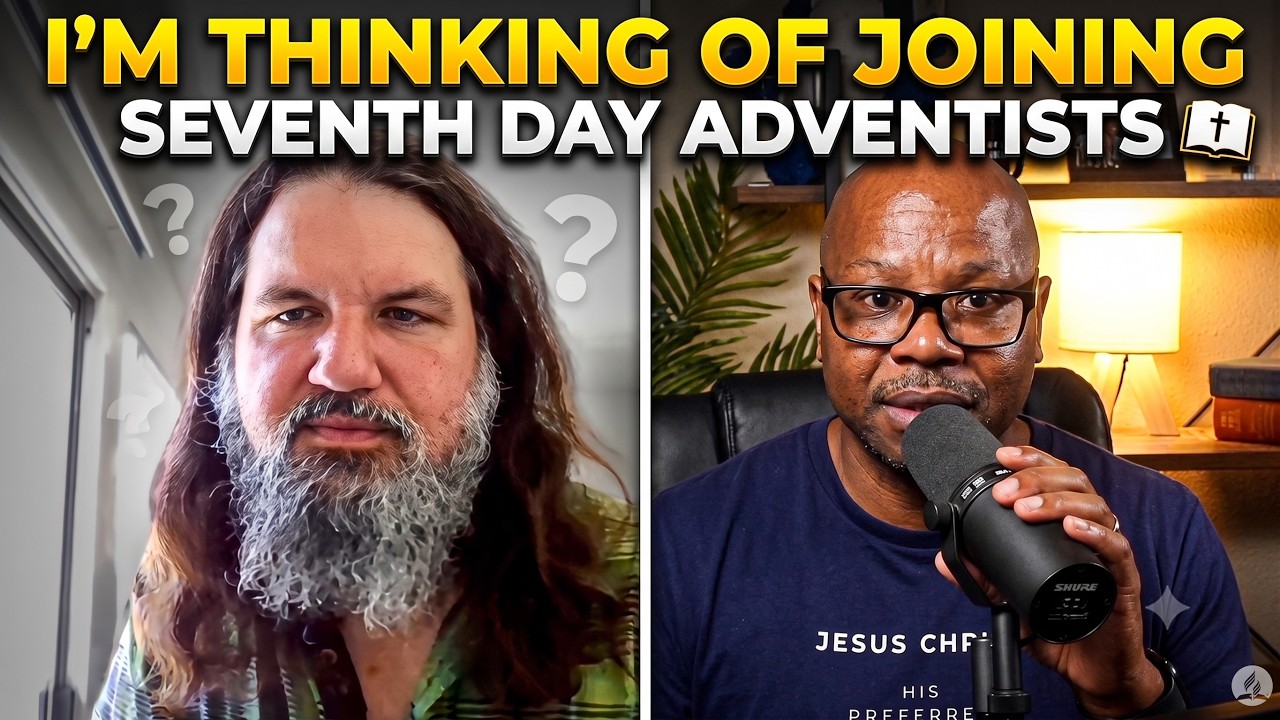
Video summary
The speaker explains that his initial interest in joining a Seventh-day Adventist church stemmed from personal struggles with depression and a search for meaning, which led him to volunteer at their food bank where he found purpose and fellowship among kind people. However, as time passed, he realized that while the community was welcoming, there were significant theological hurdles preventing full alignment with his convictions. He notes that on fundamental levels like the Nicene Creed, SDA beliefs resemble most Protestant churches, but a major point of contention arises from their unique interpretations of Leviticus and Exodus regarding the Sabbath, as well as their heavy reliance on the writings of Ellen White, whom some members elevate to a status nearly second only to Christ—a practice that deeply troubles him.
A central issue driving his hesitation is the SDA church's mandatory observance of Saturday as the Sabbath under penalty of being cut off from grace or facing severe consequences for non-compliance. The speaker argues that treating specific laws, such as the Sabbath commandment with its associated restrictions on fire and work, as a requirement for salvation contradicts Pauline theology which teaches that one cannot be justified by works of the law but only through faith in Christ's finished sacrifice. He emphasizes that attempting to achieve right standing before God by strictly adhering to portions of the Mosaic Law effectively severs a believer from their relationship with Jesus, turning worship into a legalistic checklist rather than an expression of love and gratitude.
Despite these doctrinal disagreements, particularly concerning Ellen White's authority and strict Sabbath laws, he acknowledges that many Adventists hold views closer to biblical scripture regarding baptism and other doctrines compared to what he perceives as the errors in typical Protestant churches where salvation is sometimes tied to water baptism or specific creeds not found directly in Scripture. He contrasts this with persecuted believers worldwide who worship simply based on hearing God's word without needing organizational structures, suggesting that true faith should be free from fluff and ultra-charismatic displays yet still grounded in a humble posture of repentance symbolized by sackcloth and ashes rather than rigid rule-keeping.
Ultimately, the speaker advises against immediately joining or pledging allegiance to any church group until one has thoroughly examined their teachings against Scripture without bias. He suggests continuing to attend services as an observer while taking notes on specific doctrines that cause discomfort, allowing God's Spirit to guide whether full membership is appropriate in light of those findings. His conclusion is a call for humility and careful discernment, urging listeners not to join simply because they like the people but only if there are solid theological reasons rooted entirely in biblical text rather than tradition or secondary authorities, ensuring that their faith remains centered on Christ alone without being subjugated under legalistic obligations.
Read the full video transcript
Um, so yeah, I um I have no idea what to
talk about because I was told like I
should call in. So call in for what?
>> I always did want to call in because I
enjoy discussing theology and like I
think
>> that it's a commendable thing. There
aren't there just really aren't a a
plethora of people out there who want to
try and teach and be like genuine about
it like forthright not come with you
know add whatever arguments and stuff
and I I love that you go to the text and
specifically like go into the
concordance I think that's a beautiful
testament to God's scripture is you know
the thing that has the ultimate answers
right
>> but yes I don't know what to talk about
because I brought you here.
>> I was just told by them to call in
because we were chatting about SDA and
it's like
>> Oh, are are are you the guy that that's
going to a 7th Day Adventist church?
>> Yes.
>> Okay.
>> Yes. That is the most accurate way to
put it. I am that guy that is going to a
7th Day Adventist church. And I guess
officially tomorrow will be a 7th Day
Adventist, but a heretic because I
refuse to hold to all of their 28
BaskinRobins flavors of
>> Well, then why?
>> Well, then why go?
>> Well, because it I can't find any church
that I agree to like every last bit of
their doctrine really.
>> Okay. So, what what attracts you to the
Seventh Day Adventist Church?
>> Okay. So, um, really ultimately it came
down to going there. My dad was trying
to help me get out of some depression.
Um, trying to find things that would
help me find meaning in life. And so, he
was like, [clears throat]
um, that one other place wasn't a good
lead, but how about these people? And
I'm like, okay, sure. And I'm like,
well, it's a 7th Day Adventist church.
That makes me think a little bit of
something. But I went there and I met
the people there and they were nice. And
then so I ended up just volunteering
there and it really did start to give
purpose to my life being able to work at
a food bank um to do something that you
know we we are commanded to by God to
correct injustice and you know if people
are hungry that's injustice to me. So
>> so um there are
>> I started meeting people there and it
was just a a natural organic outgrowth
of that. The people I met there were
mostly church attendees and then I was
like, well, I want to be around these
people more. I miss having fellowship.
>> Okay, so let me say this. There are
there are Muslim groups you could go to.
There are Buddhist groups do the same
thing. Nice people. There are nice
Muslims. There are nice Buddhists, nice
atheists, nice nice Protestants, nice
Catholics, nice nice Seventh Day
Adventists, nice Jehovah's Witnesses.
Right? So it shouldn't be just that. If
I'm going to go and attach myself to a
gathering, assembly, um, there should be
a doctrinal theological reason other
than just, hey, we we I like these
people, right?
>> So, and that's actually tough.
>> What is is there anything particularly
about their doctrine, their belief that
draws you there or is just the
camaraderie, just a just relationship?
Um,
I mean, in general, the 28, whatever
they call them, like in general, it's
it's essentially similar to the
what do you call that? The uh not the
Westminster, that one's way too long.
The Nyine Creed. Mhm.
>> Like
>> so I mean on on a basic level like the
fundamental beliefs are like the same as
most Protestant churches and then
there's that huge schism when it comes
to like how we interpret like Leviticus
and Exodus and stuff and well and Acts
and everything for that matter. Um, but
then my contention with it is all the
Ellen White stuff. Like I read I'm
starting to read her book and
like I've got this thing behind me and
like I just put a post-it note every
time I see something that gives me like
Wait. Yeah. Every time I see something
that gives me pause. So I make it like
this far and I'm already really
questioning like what she was saying and
teaching. And I've heard people there be
quite idolatrous of her. Like I've heard
a bunch of people say, "Well, you know,
Christ is like the one above all, but
Ellen White's the second." I'm like, "I
don't even know what to say to that, but
it hurts to hear it." [laughter]
>> It should hurt to hear it. Um now, and I
I do know that every that not all SDA
gatherings are alike, and some people
hold to the the the actual church
teachings, and some don't.
Um there are a lot of things that the
church holds to um formally that all
church members don't adhere to. But I do
know one of the things is that that by
um people who I think I think it's a
somebody some every time you say
something some SDA members is going to
come back and say that's not what we
believe and another SDA member is going
to say that is what we believe. But the
belief that that uh the mark of the
beast would be anyone that holds to a
Sunday a Sunday worship
>> uh the well then then what's the mark of
the beast and revelation that that can't
be it. So there are some teachings and
again remember there's no seventh advent
before the the mid late the mid to late
1800s. So it could not
>> they consider themselves like a revival
of tradition essentially right just like
the orthodox churches consider
themselves for better or for worse to be
a continuation of tradition.
>> Mhm. Here here's what's funny. Like with
the Orthodox Church, the Catholic Church
or the Protestant movement, there have
been people we don't give enough
attention to who have been outside of
the Orthodox Church. Outside the
Catholic Church, all believers were not
part of the Orthodox or the Catholic
Church. There are places that the
Catholic Church just didn't reach. And
so these folks, what does their worship
look like? Just like pretty much like
ours. And Jesus says that the gates of
hell is not going to prevail against
this this body. So, it's not as though
that we went 1,000 years or 1,800 years
or 1,500 years until we got it right.
No, folks have been getting it right.
And people have been striving for just
to hear the word. And I cuz the average
person when they hear the word, they
tend to have a similar uh set of
beliefs.
And most people who just hear the word
for example people who are in persecuted
places of the world like uh Indonesia or
North Korea parts of China
>> uh North Africa where we don't have time
for this for this following this
organized group or anything like that.
We just have the word we might die for
it. Do you know how they tend to
worship? Kind of like how we do. They're
not looking for any fluff. They're not
they're not ultra charismatic or
anything like that. They are just we
want the word. We love the word and we
want to spread the word because we know
that however long we're going to be
here, this isn't our home.
>> Well, and I mean ultimately the one
phrase that resonates with me throughout
the scripture is sackcloth and ashes.
Like that's that's the the posture that
you're supposed to have, the utter
repentance.
>> Mhm.
>> And like that's the truest form of
worship. Although I mean right I mean I
honestly feel like a lot of these these
um Protestant churches are are teaching
sort of against it but
>> okay now now what's going to happen is
this
>> that is also painting a wide a wide
brush like I mean people of every belief
in every denomination
>> here's what's going to happen Brian
because the Bible says so that people
are going to move away from sound
teaching they just are they're going to
fall away from it they're going to fall
away from the faith not from having
faith but from the faith, they'll start
believing things their fancy.
>> Yeah. And so it should come as no
surprise that you're going to see more
and more of it. As a matter of fact,
there going to come a point in time
where the majority of Christians,
professed Christians, won't look like
actual biblical Christians and they'll
look at us and call us Bible thumpers or
or what have you.
This is this is prophesied. Paul says
it's going to happen. And so we got to
get used to it. So, you're going to find
that there are a lot of churches out
there that I don't want to be at that
church. But that doesn't mean that there
won't be a lot of good churches. There
are. There are a lot of good churches,
people who love the Lord. And what we
have to do is this, cuz I know some
people, I got a buddy of mine who he's a
he's a nitpicky Christian. Meaning, he
goes to churches and he can't help but
see what's wrong with the church. I
don't like this. I don't like that. The
the air conditioning is too cold. I
don't like the color carpets. The music
too loud. Uh why do they preach like
this? All right, man. Okay, fine. So
>> preachers a little too bald. No, that's
bad.
>> Yeah. So so people there there's going
to be there's no perfect group of people
but like you said if per person has that
kind of humble way about themselves. I
understand that this church isn't
perfect which is why I'm here cuz I
ain't perfect but I don't want to put
myself in a position to where I'm doing
things that go counter to the text. This
is why this is one of the things that I
have against right
>> there. There are several things that I
have against the SDAs, but but two of
the things
>> is the m I don't I don't have a problem
with a person going to church on Sunday.
I mean on Saturday, I have no problem
with that at all.
>> Right?
>> If you mandate it as though it's part of
the law, it's part of the ten
commandments. Remember any part part of
the law, any portion of it that you
keep, Paul said, James says Paul says
you are required to keep the whole of
the law. [snorts] So, you can't just
pick and choose. Well, we're supposed to
go with the moral law, the Ten
Commandments. Well, first of all,
there's more than that. And by the way,
the Ten Commandments aren't just the
moral law, because the Sabbath itself is
a ceremonial portion of the law.
And so, and there are rules that go
along with the Sabbath. I mean, heck,
you can't have if if you live in a place
where there's a pilot light on your
stove or on your um um your hot water
heater, you can't have a fire. There's
certain things just because your whole
focus is to sit back and relax with God.
Now, I'm not trying to be too dogmatic
about it, but what I'm saying is if
someone else going to be dogmatic about
it and hold themselves accountable to
that,
>> you got to be held accountable to all of
that. And so, that means you also have
to stone someone like myself for not
keeping because the law requires if you
don't keep the Sabbath. I mean, if you
don't keep the Sabbath or someone else
doesn't, they must be stoned by who? By
the Sabbath keepers. And and I have
heard and I have heard that particular
like I have heard some particularly
strong views like that and I have also
heard I mean some much more subtle
views. It's like I don't know I I
suppose I don't see a whole lot of
concordance. I see that like in the
church that I'm going to in particular I
mean I see for the most part that
there's like a a lot of elders. the
church is like mostly elders but like
half of them are wellstudied and the
other half are are not at all
>> and um and I mean it's I don't know it's
it's slightly worrying like somebody was
pointing it out to me in chat earlier
like I should be concerned if the church
isn't really diving deep into doctrinal
discussion
>> um that often.
Um, so, so
>> but here's here's the one thing. Like I
haven't heard anybody I know personally
say say like they think that that that
they can fulfill the law basically like
that. I mean, I believe that anybody
who's honest when they're reading the
scripture is going to see that it's
Christ that fulfills the law. So it's
not like your works are going to result
in in your salvation. But at the same
time, when you read like James and when
you read a lot of what Paul writes, you
have to have a living faith. If there's
no fruit,
>> Oh, sure.
>> like then you can't really be assured of
anything. You you're just you could be a
Christian in name only, which is a real
worry. So, if you're a Christian, you're
not going you're not going to want to
lie. You might lie, but you're not going
to want to lie. If you're a Christian,
you're not going to want to be, you
know, bear false. You're not going to
want to commit adultery. You're not
going to want to kill.
>> If you're a Christian, well, by nature
of you being a Christian, you only have
one God. So, there are some things that
were stated previously that are going to
be reiterated also. And just by you
having the spirit of the Lord in you and
a brand new heart, you're going to want
to fulfill those things. But but if you
say and if you make yourself say I got
to do this I got to make sure this I got
to make sure that for example here's
something that you can dogmatically
religiously do that is let me keep this
portion of let me keep this portion of
the law the Sabbath it's a box to check
off because I have to now you have
subjugated yourself put yourself under
the law now if I just enjoy on my
Saturdays um just giving my time to the
Lord it's my day off I'm that's
different. I enjoy um not committing
adultery, right? I enjoy not murdering.
I enjoy not lying. Amen. I'm not
checking off boxes to make sure I'm
okay. Cuz Paul says this, remember this
issue comes up because the Jews wanted
these gentile believers to be like they
were, which they weren't even good Jews
themselves. So
Paul says, if you are trying, look what
he says.
He says um I test I testify again that
every man who receives circumcision
which is that that is the command if
you're going to keep the law that he is
under obligation to keep it. Look at
this word right here. He is under
command to keep the halom tan that is
the whole of the law. So when he says
the whole of the law all of it
>> all of it it's not you can't separate
that and say it's just this portion just
ten commandments. know the whole and I
think it's very similar text in it's
either Hebrews or Romans where it talks
about and if you still sin then you you
try to crucify Christ again something
like that
>> that is well okay so in in in uh Hebrews
6 he's talking to these Jews who all
they know is the law now they are
believers they're believing Jews and all
they know so they're they're they're I
mean it's all I know is the law so when
I mess up
>> I've got to repent in such a way I've
got to atone for my sin
And so his point is if you try to, it's
impossible because Christ, the sacrifice
that you had to bring you to him, that
ain't going to happen again. There's
nothing to put your faith in anymore
because Christ is not getting crucified
again. So, so the writer of Hebrews is
trying to comfort them by saying,
listen, you have a new command. You have
a new covenant that is not fulfilled by
your workings, but it's fulfilled by
your faith.
And so Paul says, that's why he says,
"Are are you
>> well, can I say it feels like the new
covenant is worded like it's it's not a
spirit of condemnation, whereas the law
is is a bunch of things, but one of them
is condemnation for those that fall
under it." Right?
>> It is soon when you mess up. Oh man, I
got to which is the problem that they
were having in the book of Hebrews. I
done messed up. Now what am I going to
do? Now I'm lost. So Paul makes this
statement and and it's a scary statement
he makes here in in
>> he was was it to Timothy
>> to where
>> because I think he I'm trying to
remember what he was tell was he not
telling Timothy that he should get
circumcised as as like a matter of
making witnessing easier or something.
>> Yeah. Yeah. He wasn't doing it because
he has to because remember Paul is now
fighting Galatians saying that you don't
have to get
>> circumcision but it gives them less of a
chance to like argue with him about
something. And they're like, "Well,
you're not acting like a Jew." But he
says, "Well, I got circumcised, so it's
that's not about it, right?"
>> Yes. So,
>> I guess I'm bringing it up because it's
it's like pointing out that like there's
certain things that, you know, it falls
under the law, but it's not Judaizing
like he's doing it for a specific
reason. Likewise, I guess my thesis is,
you know, if you treat God's laws as
just generically good, that like wanting
to have the Sabbath, the the day of rest
that he proclaimed for for for man is a
matter of like respect for God. It's a
matter of worship. It's not a matter of
like believing that that one particular
well I think for some people in the
church I think they do believe that that
one particular thing is so much more
important and of course it's not like
>> they do and so if that if that puts you
in right standing with the Lord this is
what Paul says he says you have been
severed from Christ you've been cut off
from Christ who who has you who those
whoever it is who is seeking to be
justified by the law even Even if it's
one portion of the law, he says, "You've
been cut off. You have fallen from grace
because your goal is to be seen either
by yourself or the world in right
standing because you keep this vestage
of the law. You keep this portion of the
law." And so, because you're trying to
do so, you've been cut off from Christ.
Now, if you're doing it because let's
say if if I want to give a tithe, I'm
allowed to give a tithe. I should not
obligate myself to give a tithe. If I
say, "You know what? I think I just I
just want to make myself give 10% just
cuz I I love the Lord that much. I want
to just honor him that way. But if I say
I have to give 10%. Or I'm breaking
God's law. I'm I'm sinning. Now we got a
problem. So like you said, whenever you
mess up now, what what who are you
accountable to when you mess up? The
law. Because you're following the law.
It's like if you have a job and I would
personally much rather be be accountable
to the Passover than than the law. So,
so here's the question though.
Listening to what you're saying, why
then are you going to a 7th Day
Adventist church?
>> It it ultimately it ultimately to me
feels like like overall get their
doctrine a little bit more right than
like your average Protestant church. But
ultimately,
>> which doctrine would you say they get
more right than the average Protestant?
Um, like there's a good amount of of
like I see people proclaiming that you
have to be water baptized or like you're
definitely unsaved.
>> Like, well, there's a there's a split
between Protestants. The majority of
Protestants don't believe that, though.
The majority of Protestants don't
believe you have to be water baptized.
We just believe that.
>> Well, I I just happened to have gone to
a church like most recently before this
one that that's what they held to, for
example.
>> Yeah. Don't don't judge the don't judge
all of it by some of it
clearly because there are some people in
the world who cannot get water baptized.
There's just and but you know how it is.
All we know is what we know here in
America.
>> They would drown if they Yeah. Right.
>> There are some people who who are on a
sick bed, some people who are in prison,
some people who are in a persecuted part
where they cannot if I'm in a prison in
North Korea and I place my faith in
Christ, do you think that they're gonna
let me get baptized? No.
So,
so I don't know what So, what what other
doctrine are you are you referring to?
Maybe you just you just had bad
experiences with some churches that
really aren't Christian.
>> Well, I I mean I don't really want to
get into certain like heresies real per
se. Like I just want to like to
summarize it as overall the people that
I met there, what they tell me they
believe lines up more with what I read
from scripture than like than like a
typical church. But ultimately, I I
really do have a problem with most
typical churches because when I read
like the Aanasian creed and the Nyine
creed, I'm like, you know, I can get
behind a lot of this, but like some very
specific wording that you've got here,
I'm not really like I I don't see that
in the scripture.
>> So, let me let me
>> to me it's such a serious matter. Like
if a church is to make me like swear an
oath essentially like I want to know
that it's 100% true to God's word.
>> So let me give you this advice. I I've
got to go ahead and run. But let me give
you this advice.
>> Yeah.
>> Hold off on joining. Go ahead and keep
attending. And then as your as your as
your notebook fills up with different
things that you're not you're not
comfortable with, it makes it a lot
easier to to to be led away by the Lord
if you're not if you haven't aligned
yourself or pledged allegiance so to
speak. Bad bad way of putting it
probably to them. I I do actually I
would do that and and not swearing an
oath but I do promise like I'm I'm not
going to like um to like repeat the set
of 28 principles or whatever like
whatever happens like in the church is
going to be like spiritled and not you
know repeating anything at all.
>> Mhm. All right brother. Well listen keep
keep us update. Keep us updated. Keep
coming back. Uh, and and anytime you got
a question, you want to have conver.
>> Huh? Say it again.
>> I said it was good to talk to you for
the first time. Hey, man. Good talk to
you, too. Good talk to you as well,
brother. Take care.