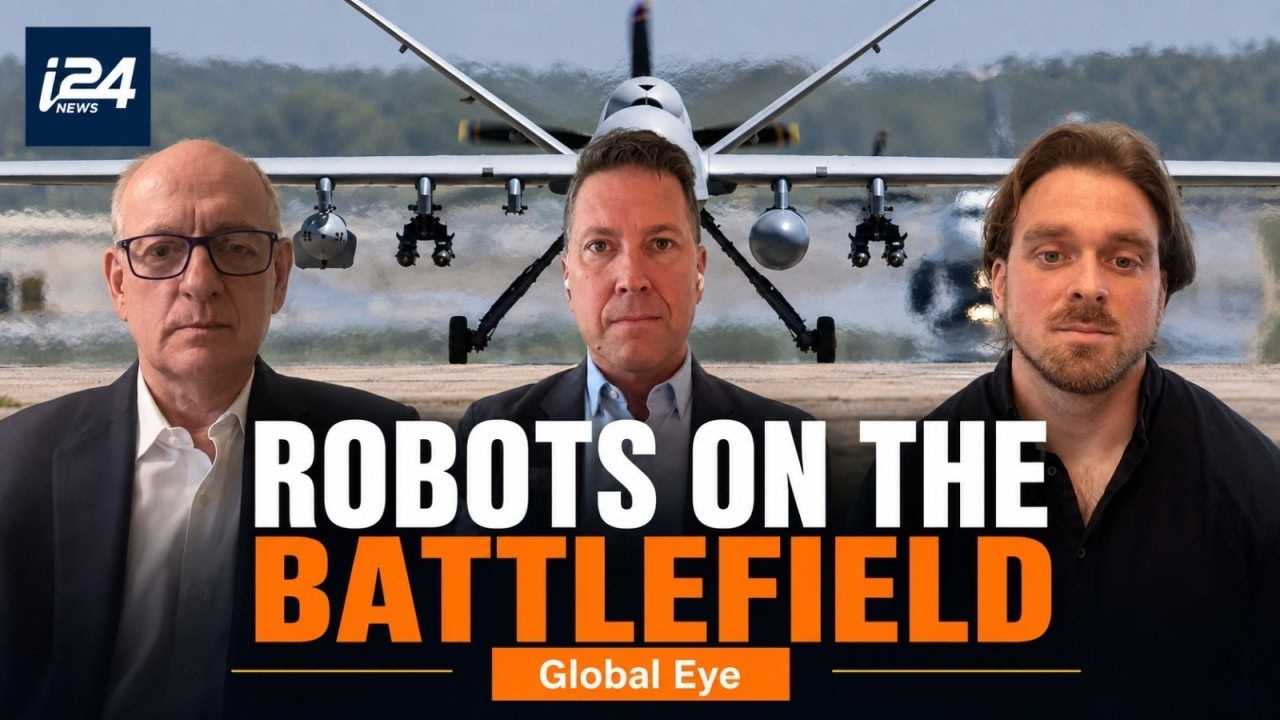
Should autonomous drones, known as 'killer robots,' be banned in warfare?
Watch on YouTubeVideo summary
The debate centers on whether autonomous drones, often termed "killer robots," should be banned from warfare due to the rapid advancement of artificial intelligence outpacing international regulations. While organizations like the UN and the Red Cross urge governments to establish clear limits to prevent machines from making life-or-death decisions without human oversight, there is significant disagreement among experts. Some argue that a total ban is necessary because these weapons could be mass-produced cheaply and proliferate easily, potentially making the world unlivable, similar to how nuclear weapons were once feared but are now strictly controlled. Others contend that definitions of autonomy are too vague and that a blanket prohibition is impractical, especially given the open-source nature of much AI software which makes enforcement nearly impossible.
The panelists present contrasting views on the feasibility and ethics of such restrictions. Professor Stuart Russell argues strongly for a ban on small anti-personnel weapons launched by a single operator, comparing the danger of mass-producing these systems to selling nuclear weapons in supermarkets. In contrast, Professor Jesse Kurpatre suggests that autonomy is a broad category where some applications could improve precision and save lives, provided there are strict governance measures like robust testing, legal reviews, and human accountability. Jake Steckler supports this nuanced approach, noting that while the risk of bad actors using these technologies is real, enforcing a ban on software-based systems is incredibly difficult because they can be easily copied or modified, unlike chemical weapons which have strict manufacturing controls.
Furthermore, the discussion highlights the dangers of relying on technology to keep soldiers out of harm's way, citing the conflict in Ukraine where remotely piloted weapons have led to enormous death rates rather than reducing them. Experts warn that assuming one side will use these weapons responsibly while opponents do not is a fallacy; if both sides possess autonomous systems, they will inevitably be used to kill each other, potentially creating stalemates or widening kill zones. Additionally, there are concerns about the technology falling into the hands of terrorists who could use open-source AI models to build bombs or deploy drones without the specialized resources required for biological weapons, posing a unique threat that current arms control frameworks may struggle to police effectively.
Ultimately, the consensus leans toward targeted restrictions rather than an absolute ban, acknowledging that while stopping development is impossible, safeguards must be implemented to prevent mass casualty scenarios. The panelists agree that moral stigma alone may not be enough and that practical steps, such as restricting hardware reprogramming and requiring human operators for large numbers of weapons, are necessary. However, they also recognize the strategic disadvantage a ban would place compliant nations against non-compliant rivals like China or Russia, who might exploit the lack of lethal autonomous systems to gain a competitive edge. The conclusion is that while the technology poses significant risks to humanity and requires immediate international attention, the solution lies in rigorous testing, legal frameworks, and hardware-level restrictions rather than a simple prohibition that may not be enforceable in a world where such weapons are as common as Kalashnikov rifles.
Read the full video transcript
With technology advancing at light
speed, we are seeing it before our very
eyes. But with the rise of AI, there is
a great fear over the use of killer
robots, autonomous weapons used in the
battlefield. But do the pros outweigh
the cons? Well, we are going to have a
debate tonight. First, we're going to
introduce our panelists for this topic.
We have Stuart Russell, computer science
professor at the University of
California, Berkeley. also the president
of the International Association for
Safe and Ethical AI. He is in Paris. And
in Washington, Professor Jesse Kurpatre,
the director of the Mason Autonomy and
Robotics Center at George Mason
University. Also in Washington, Jake
Steckler, research scholar at Govai.
But before we get started, here is some
background into the topic of killer
robots.
Technology is moving rapidly [music] and
international bodies are playing
catch-up. The UN and the Red Cross have
jointly pressed governments to set clear
international limits on autonomous
weapons, warning that the technology is
moving [music] faster than the rules.
They say the dangers have grown since
their last appeal 3 years ago, even
though they have not confirmed these
systems being used in combat. Rather
than demanding a total ban, they're
[music] calling for targeted
restrictions on how such weapons can be
developed and deployed. Advocates
[music] back the push because they fear
machines could soon decide who lives or
dies without meaningful human oversight,
while some states and defense sectors
oppose tight rules, arguing they could
hamper military innovation and weaken
strategic options. But is it humane
[music] to use killer robots with little
human oversight? Or is all fair in love
and war? Does it help preserve life or
is it a threat to it? Should autonomous
drones be used in warfare?
>> All right. And now we are officially
ready to begin. We're going to start
with the first question. You each have
30 seconds to answer. We're going to go
in order of how we introduced you.
Starting with Professor um Russell. The
first question is, should autonomous
drones be used in warfare? Go for it.
>> I think the answer is essentially no.
Um, we have to ban particularly small
anti-personnel weapons that can be
launched in the thousands or even
millions by a single person pushing a
button. Those are weapons of mass
destruction. They are much cheaper,
easier to use, easier to proliferate
than nuclear weapons, and they could
make the world completely unlivable for
everybody.
>> Wow, that's a scary thought. Okay,
Professor Kurpatre, what are your
thoughts?
>> Yeah, I mean, I really think the answer
is it depends, right? Autonomy is a
really broad category. The way that it's
been cast with the kind of killer robots
camp has been way too broad. Some
applications may in fact uh improve
precision, saving civilians and soldiers
alike. But what we should do is that we
should strictly govern autonomous weapon
systems. We need robust test and
assurance,
legal review, human control, and
accountability.
>> All right, Jake, your take.
>> Yeah, I think efforts to ban autonomous
weapons are generally misguided for a
few different reasons. The first was hit
on by the previous guest is that the
definitions are a little unclear. We
have autonomous weapons today that don't
pose the sort of risks that we're
talking about here. And as a weapon
systems have gotten more advanced over
time, they have reduced civilian
casualties. And last, I'm a little
skeptical of the feasibility of
enforcing a ban and don't think it's
directly analogous to uh different types
of arms control. So my basic position is
that these things are inevitable and
it's a matter of the accountability and
safeguards that we put in place.
>> Right. And clearly there's no stopping
the development of these. So whether
it's ethical or not, it's you look at
where where we're going and how fast AI
uh is developing. But would you say it's
uh morally acceptable, I mean to
delegate a a lifealtering decision? I
imagine mistakes could also happen.
And we'll start. Oh, sorry. We're going
to go to uh Stuart again first.
>> Well, so notice that I did not make a
moral argument in my opening statement.
Uh it's just common sense, right? We
don't sell nuclear weapons in
supermarkets and it's not for moral
reasons. It's because it's just not
sensible to do that. So if we're going
to allow people to buy millions of
anti-personnel weapons that they can
launch and kill millions of people, we
might as well sell nuclear weapons in
supermarkets. That's the situation that
we're heading towards. So that's not a
moral question. I would say however that
moral stigma is a very important
component for example of our attitudes
towards chemical and biological weapons.
We used to have very large very advanced
development programs to create those
weapons and now we would I think almost
everywhere in the world feel that it was
morally unacceptable [clears throat]
to do so and I think the same would help
uh in controlling autonomous weapons.
And what do you have to say, Professor
Kurpatre?
>> Yeah, I take a somewhat different
approach. I mean, I don't think that
there is anything special morally about
a human pulling the trigger. Um, and in
fact, much of the kind of
decision-making authority that we see in
life and death decisions and warfare
are in fact very much made upstream and
the human is primarily pressing a
button. So I don't think that there is
some sort of magical thing about a
machine killing versus a human.
>> Right.
>> I will say on the
>> go ahead.
>> I will say on the top I thank you. I
will say on the topic of chemical and
biological weapons I think that those
are very different. Right. I think that
we ban those weapons when when the
objectionable characteristic is
intrinsic to the weapon. Right? So we
can think of bio is disease, chemical
weapons produce poison. Autonomy
produces autonomy, right? It's how
they're used, how they're how they're
deployed, how they're developed, that is
really the meaningful point here,
whether it's legally, morally,
strategically.
>> And uh Jake, from your from your
perspective, uh what do you say?
>> Yeah, I think I think I generally agree
with Professor Kurpatre here. Um I think
that uh one thing to add is that
enforcing arms control on these things
would be incredibly difficult and it is
different from these other use cases
basically because what we're talking
about is is software uh and a lot of it
is open- source software and and there
are all these AI models from China for
example which are all open weight which
means that anyone can basically pull
them uh off of the internet. Uh so the
ability to enforce a sort of ban would
be much more difficult and even just
detecting that someone has used an
autonomous weapon is is also something
that's very difficult to prove uh
because it doesn't leave any sort of
residue behind to show that it was
operated by a person versus uh operated
autonomously.
>> Well, I mean we can see just from
>> Can I push back against this? So So
obviously it's not software, right?
Software doesn't kill people. Uh
hardware kills people. Um and so uh what
we need to do is to ban the production
of autonomous weapons. Uh the software
is is a almost completely irrelevant
issue. We can put in restrictions on
human operated weapons so that they
can't easily be converted to fully
autonomous operation. Um and uh we can
for example
uh fix the onboard
um computing in
uh you know these kinds of weapons so
that they can't be reprogrammed. We can
we can require that they only operate
with special purpose application
circuits. Um so there's a number of
steps that can be taken to distinguish
between autonomous and human operated
weapons. We can also require that, you
know, if you have uh a million weapons
that you claim are human operated, then
you have to have a million human
operators, right? Um so what we're
trying to do is avoid the situation
where one person can push a button and
kill a million people. If you want to be
in that world, be my guest. It's not a
world that I want to live in.
>> So with that said, I mean, we know AI
could make mistakes. Even just using it
for a basic search, AI could make
mistakes. So how could we even uh you
know trust that these that this
technology especially if many people are
developing it I imagine some technology
would be better from one country to
another. I mean it seems like a very
scary thought from my standpoint. What
do you think?
>> I mean one way if I can jump in is that
is that we can test and assure the way
that we have with other weapon systems.
Right. I mean, we have a pretty robust
regime here in the United States, and I
can't speak of other countries that I'm
less familiar with of testing and
validating systems so that we're assured
that they work and they work properly.
Now, I will say that I share many of
Stuart's concerns. I'm worried about
proliferation, right? I'm worried about
bad actors. Um, I'm worried about making
war easier. I'm worried about um
enabling terrorism. I think that where
we where we're far apart is that I have
a different kind of cure for what I
think are the symptoms, right? And I I
>> Well, I think that the the symptoms are
the sort of worst case scenario where we
have a world in which weapons are widely
available, that they've been
proliferated, that they are used without
knowing the the ways in which they work
well and where they fail, right? That
they're used by bad actors. I mean,
there are lots and lots of scenarios in
which autonomous weapons can cause
concern, right? I I I'm not San Gwen
about this, but I also think that a a
full ban is neither practical nor
desirable.
>> Well, and also, I mean, when you're in
war, you can't not have soldiers. So,
how could AI
try potentially replace that at some
point when we are having world conflicts
and could it get even worse because of
it?
Well, so I think this was one of the
myths that was put about by proponents
of autonomous weapons that uh and the
phrase they usually use is it it keeps
our soldiers out of harm's way. You
know, would you rather send a robot or
your son to war? Um but what we've seen
in Ukraine is that uh the remotely
piloted weapons are extremely effective
and the death rates for human beings are
enormous. There's a there's a fallacy
which says, well, we of course are going
to use these weapons in the right way
and our opponents are not going to have
these weapons at all. Obviously, that's
a fallacy. If both sides have these
weapons, they will use them to kill each
other. And that's exactly what's
happening in Ukraine,
>> right? Yeah. And another thing I want to
add, I mean, look, we are seeing so many
mass shootings. We just saw something
happen uh that we're going to talk about
in in in Switzerland. But let's talk
about that idea of terrorism. People can
find on AI how to build bombs and to do
all of these things that no one had
access to. Is the same uh can be said
when it comes to these types of uh
devices? And is there a real threat of
random people learning how and causing
major catastrophes unpoliced?
>> I mean, I think the answer is yes.
Wait here.
>> Oh, yeah. I'll let I'll let uh Professor
Kpatrick go. You haven't gone in a
while.
>> I mean, I think the answer is yes. I
want to go back to the the previous
question, though, very very very
quickly, which is um Stuart's right, but
you know, I think the the idea that um
that robots are going to be fighting and
doing all the dull and dangerous work
and humans aren't. Um is a is a fiction,
right? that what we know is that um
robots are or you know autonomous
systems can be very good at at um
finding targets potentially selecting
them and engaging them but can't hold
territory they can't hold ground or at
least not yet right
>> and they don't have point
>> well yeah they don't have intuition
that's right but I think the second
point is this is that uh to to your
question is that yeah I mean whether
whether autonomous weapons are banned or
not Right. It is a major concern that
any type of new technology, including
autonomy and lethal autonomy, is going
to get into the hands of bad actors. I
mean, that's a that's a major concern,
and I can see that fully.
>> Well, especially as gun laws and people
clearly, it's such a huge um trigger
point uh in the US with so many
different mass shootings and and gun
laws and all that. Is it going to have
the bad guys try to find alternative
ways to have weapons?
Jake,
>> I think it depends on whether you
whether you allow them. Just Oh, sorry.
Very quick. Go ahead. Depends on it
depends on whether you allow them to be
manufactured in vast quantities or not.
So, chemical weapons, for example, uh
I'm sure that many terrorists would love
to get their hands on them. In fact, we
know that they are trying to use AI
systems to develop their own chemical
weapons. Um but the manufacturers of the
of the most dangerous chemicals are
required by the chemical weapons
convention not to sell them to
unauthorized entities. Uh and so that
means that they are large the the risk
is largely contained and we haven't had
any major terrorist chemical attacks.
But with these kinds of weapons, they
will presumably be as available as
Kalashnikov
militarygrade automatic weapons. And
there are 100 million Kalashnikovs in
private hands. So that's the scale of
risk that we're looking at if we allow
these systems to be manufactured in
large numbers.
What do you think when we are in real
war uh situations clearly as we're
seeing with Russia and Ukraine and and
what's happened here um locally in the
Middle East? How how could having these
weapons in more numbers? I mean, could
it really lower the amount of casualties
or limiting the number of soldiers that
may have to go in into a territory like
replacing the need for certain units
that maybe would be on the ground say in
uh southern Lebanon or Gaza for example?
I think that uh something that you're
seeing in Ukraine is that you're not
seeing a reduced number of soldiers in
total. I think that there are uh many
operators and people behind the scenes
working with any of these systems that
even do have some autonomy in them. But
you are seeing uh a situation where it's
created a sort of stalemate uh in this
this very large and wide kill zone uh
which has basically become a place where
no one can move in and and in some ways
uh that that could be a way that uh
could deter war uh to some extent or
even reduce casualties because of the
understanding that anything beyond some
point is is at such a great risk. Um and
you're starting to see in Ukraine uh
using uh machines for doing things like
um evacuating soldiers uh for delivering
goods. So it it does it really depends
on the use case, but there are
absolutely use cases where you could
reduce the the uh potential people that
you're putting in harm's way.
>> I can tell uh Professor Kpatrick, you
want to say something? Looks like you
want to say something.
>> Yeah. I mean the the goal is right is
that no military um wants to get into a
fair fight, right? That they want a
strategic advantage against their
against their enemy. And what we see in
the United States is a lot of
assumptions about the type of wars that
the United States is going to be
fighting wrong. Right? The United States
has operated under the assumption that
wars are going to be short, sharp, and
quick and that we would have major
technological dominance. And that's just
not the case, right? We have nearpeer
competitors and and I know that lots of
folks want to say, you know, well, we
could get a comprehensive ban, but there
are actors who are not going to comply
with the governance regime that is going
to be laid out. Who do I mean? probably
China, certainly Russia and you know so
a ban is going to give those folks the
sort of competitive edge that um that
we've seen. So you can imagine the whole
world imagine the whole world agrees
that they're not going to be lethal
autonomous weapon systems just open the
door for China to invade Taiwan or for
Russia to take Ukraine and hold it
without any answer to that question.
>> Well and also if it becomes the wild
wild west how could it even be policed?
I mean, nothing's stopping anybody from
sending a autonomous drone over circling
over the White House. I mean, it's not
like here where we know we have the
laser in the Iron Dome and we're ready
for that stuff. I imagine uh that is a
concern. How do you
>> police it? Who wants to go first?
>> I think I think essentially you can't.
Um there's really no way to stop someone
who has a few hundred drones uh in a
city from uh basically pointing them at
any target they want. And uh you you
can't have every single building with
anti- drone laser whatnotss
um on it. Uh you can see the cities now
in Ukraine have covered themselves in
netting. uh every road between cities,
all the the major thorough affairs and
cities uh have tall poles with netting
um so that people can drive without
drones uh blowing them up as as they
move around the country.
>> So is this the future that we want? Um
and I want to push back against this
idea that well we can't have any arms
control agreements
>> because someone might cheat. Well, if if
that was a valid argument, we would
never have any arms control agreements
at all. Um, obviously the United States
thought that its development of
biological weapons in the 1960s would
give it a significant technological
dominance advantage. Uh, the US was
actually trying to develop weapons that
would specifically kill people of Slavic
descent. Um, and I'm sure the Russians
were working on something similar. Um
but they decided uh that this was a
direction that would lead to the
widescale proliferation of weapons of
mass destruction that would be very
cheap and would be used against the
United States. Um so it wasn't revulsion
that led to the biological weapons
convention. It was common sense. And so
uh I think we're in a very similar
situation with respect to anti-personnel
autonomous weapons.
All right, any uh we have to go to
break. Anyone have a final thoughts?
I just think biological weapons are
different than these types of systems
because autonomous drones today can be
produced using commercial off-the-shelf
technologies without the type of
expertise or resources that are needed
for something like biological weapons.