Video summary
The video discusses the decomposition of Richardson varieties, which are geometric objects used to construct the coset polytope. The core concept introduced is that these varieties can be broken down into smaller pieces that are isomorphic to products of affine spaces, specifically of the form $\mathbb{C}^A \times \mathbb{C}^* B$. This decomposition allows for the calculation of the finite field point count as a summation over these distinct pieces. Each piece is labeled by what is known as a "distinguished subword," which is determined by a specific algorithmic process involving reduced words and simple reflections. The speaker illustrates this with an example using the permutation 31, showing how choices are made sequentially to either include or exclude reflections based on whether they decrease the length of the product, thereby defining the unique distinguished subwords for each component.
The presentation then extends this classical decomposition to a "tilted" setting, introducing tilted Richardson varieties and a corresponding notion of tilted distinguished subwords. In this generalized framework, the speaker explains that while the basic logic of choosing reflections remains similar, there are additional rules involving three different colors or states when selecting simple reflections. For instance, in the case of the permutation 24653, four distinct tilted distinguished subwords are identified. The speaker notes that if a standard reduced word $u$ is less than or equal to $v$ in the strong order, the tilted structures reduce to their classical counterparts, ensuring consistency with previous results while allowing for more complex geometric configurations where the varieties can be parameterized explicitly using products of matrices.
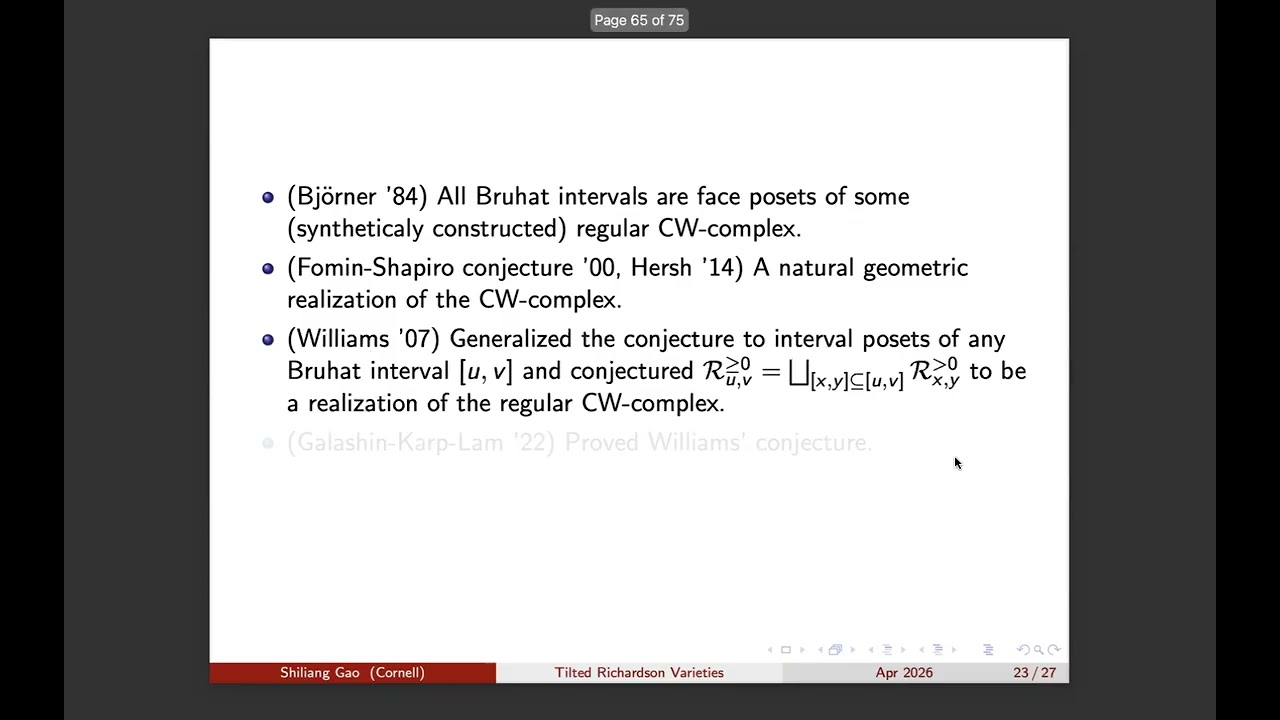
A significant application of this generalized decomposition is proving the irreducibility of certain posets associated with totally non-negative parts of flag varieties. The speaker connects this work to the broader context of total positivity and the realization of CW complexes, referencing historical conjectures by Billera, Shapiro, Hersh, and Williams regarding Bruhat intervals. By intersecting tilted Richardson varieties with a modified "tilted totally non-negative" part of the flag variety, the resulting pieces live inside a single tilted cell. This leads to a conjecture that this intersection provides a geometric realization of a regular CW complex, analogous to how classical Richardson varieties relate to the Coxeter complex, effectively bridging combinatorial poset structures with explicit geometric realizations.
Finally, the talk addresses the "component matters problem," a long-standing conjecture stating that the point count polynomial of open Richardson varieties depends only on the poset structure of the underlying interval. The speaker presents a tilted generalization of this result, demonstrating that the point count for tilted Richardson cells also relies solely on the poset structure of the corresponding tilted interval. This connection is further explored through the lens of the Hecke algebra, where these polynomials can be expressed as traces of products of reduced words. The video concludes by highlighting recent research linking open Richardson varieties to not-invariants and suggesting that similar combinatorial properties likely hold in this new tilted direction, opening avenues for future investigation into the relationships between these geometric objects and their algebraic invariants.
Read the full video transcript
Diodar's de composition
is to u study uh the uh cousin lucic r
me or really cousin lucic m uh so the
customic rule can be defined as the uh
finite field point count of a uh uh
richerson cell or open Richardson
variety
and they are the uh uh pieces that's
used to construct the uh cosmos poly
Um so uh to understand these rinomials
uh um they are introduce a really a
decomposition uh of the uh uh open
regression variety uh into uh pieces uh
that uh are isomorphic that are of the
form you know uh C to the A plus C star
to the B. And so uh we can then uh
express uh this uh finite field point
count as uh summation u uh over um over
all these pieces q to the a * q - 1 to
the b.
Okay. Um and uh these uh pieces uh are
labeled by something called uh
distinguish subword. Uh so if we fix a
reduced word uh of v whatever reduced
word that is um a uh distinguished
subword is one where um you know if uh
where we uh uh sequentially decide if uh
each of the si if we want to include
each of the sis uh if including that si
will uh decrease uh the length of the uh
product that we have so then we have to
use it. That's the red SAK. And if not,
so if the lens will increase, we can
either we can choose to use it or or
not.
Uh so as an example, if you know we set
V to be the permutation 3 to one and we
take the reduced word S1, S2, S1, uh
there will be two distinguished subword
for uh UB identity. Um so I can uh
choose you know um I can simply not
choose uh any of the uh simple
refractions. So uh you could be 111
or um so if I say I choose the first S1
uh I do not choose the second S2. And
now we're looking at the uh the uh the
the third uh uh you know the last S1 uh
we see that if we multiply it the lens
will go down and we'll have to include
it. And this is the uh red S1 uh towards
the end. Uh and these two are the two uh
distinguish uh subword uh for you.
And um yeah so uh the uh riches itself
can be uh decomposed uh into uh the odor
itself uh where the uh where we're
taking this union o over uh over the uh
distinguished subwords and uh each uh
the cell will be isomeorphic to c star
to the number of ones you distinguish
subword cross to the number of uh red
SIS
and uh the and we even have a uh
explicit primarization
uh well using you know all these uh C
stars and C's u of the DAR cell uh we
can think of them really as a uh product
of uh some very simple matrices.
So again we use the uh example uh the S1
S2 S1 example. Um so here we have two
distinguished subwords and uh the first
one has three ones. So uh the first
piece will be isomeorphic to C star uh
to the uh cubed and the second one has a
one and a red S1. So it's isomeorphic to
C star cross C
and we can actually
>> just sort of interrupt what what is the
difference between the result and the
mass reads
>> right? Um so I think market reach uh
give this uh explicit parameterization
in terms of uh these m product matrices.
>> Yeah but it it looks a lot like the old
house but maybe there's a difference. Ah
um so yeah so in their case uh they're
also thinking about uh uh the uh totally
non- negative part uh uh of uh the
uh of the riches themselves and um uh
we'll see uh later that um all of them
actually lies in a single uh guild cell.
Um,
>> you just this this theorem you're you're
stating
>> it looked like the last result from 85.
So
>> yeah, so I should probably only mention
the uh uh
>> Okay.
>> in the parenthesis. Yeah, that's right.
Yeah, thank you.
>> All right. Um
yeah. So um so one can um uh explicitly
priameterize uh the deal cell by uh
taking uh products of uh uh of uh
matrices. Uh really it's you know uh we
have uh some uh 2x two uh small matrices
that we embed uh inside uh this uh 3x3
larger matrix here. This is the um 2x
two uh matrix one p11
p21 and 10 p3 we take the product
uh and similarly uh similar for the
other case.
Okay. So um yeah so uh uh so for us we
uh uh we generalized uh the de
composition
uh to our uh uh into our tilted setting.
Uh so if we fix a uh what we call the
tilted reduce work I won't tell you uh
the precise definition it's a little bit
complicated and there's too much details
involved.
um
uh we can uh we define the notion of uh
tilted distinguish subwork where it's
still the case that uh you know at each
uh si
j uh we're deciding or s we're deciding
if we want to uh choose this um uh
simple reflection or not. But then um uh
there are uh some rules where uh you
know we want to uh we have uh three uh
different colors for when we choose the
case.
Um you know as an example you know uh so
for for V uh permutation 2465.3 we have
this uh tilt reduce word whatever that
means and there are four uh t
distinguish subwords
uh uh for the permutation uh u uh equals
512 3 4 six
and what we proved is that the open
tilted Uh the tilted riches cell uh is
can be decomposed into again uh small
pieces. U each piece uh label by a uh
tilted distinguished subord
isomeorphic to um C star to some power
plus C to some power.
And yeah and in fact if uh if u is less
than or equals to v in strong order uh
the tilted reduced word are just uh your
regular reduced word and tilted
distinguished subwords are just your uh
distinguished subwords.
Yeah. and um uh okay so what can we do
with uh this uh tilted uh generalization
of uh dar de composition uh oh first of
all as I hinted earlier uh we can prove
irreducibility of puv um so for any
totally reduced word v that we choose
there's a uh unique uh distinguished
subword that uh doesn't use sik
uh uh well the red sik
and the corresponding tilted the order
cell will be the unique cell of maximum
dimension. Remember the um
the
uh yeah so it will be uh a cell of the
form C star to some uh to the power of
uh LUV where LUV is the uh really the
dimension of uh our totes right or in
other words the length of the shortest
path from U to B uh in quantum
And all the other cells will have
dimension uh uh at least one less
and so um um yeah so from there we know
that uh TUV is irreducible and uh this
uh specific uh uh tilted dealar cell uh
will be dense uh inside the tilted
regress.
Okay. So that's uh application one.
application two uh um well uh this is uh
total positivity.
So in uh so very old term uh like Boner
uh states that if a uh postand is thin
and you know shallowable then the post
set itself is the face post of some uh
regular cable complex
and
um it is proved by uh brandy for posting
that uh the ta interval every interval
uh is thin and e shallow.
So uh the motivating question for us uh
is that you know can can one find a
natural realization of such uh CW
complex
and the problem here really has a uh
rich uh history. Uh so back in 84 Buer
showed that uh you know all bur
intervals are uh phase post set of some
regular C complex. uh he uh constructed
uh these um uh regular C complexes uh by
uh you know um inductively uh
recursively gluing uh you know a bunch
of uh all the pieces together. This is
what they called uh you know
syntactically uh constructed.
Uh so Bian Shapiro uh back in 2000 uh
gave a contractual description of uh a
uh a natural uh geometric realization of
the CW complex um uh using uh the uh
using a notion of total positivity and
forming shaper constructure was proved
by uh Patricia Hersh uh back in 2014.
So in 2007 uh Lauren Williams
generalized the conjecture to uh to the
interval pets of any brha interval. So
now uh instead of looking at a brha
interval as a post set and think of it
as the face pet of some CW complex uh we
consider the p set of all brha intervals
where the partial order is given by
containment. So now we have a post set
whose you know elements are these high
intervals and um
uh an order given by uh uh bas yeah
order given by campaign
and uh uh yeah so here you have to throw
in a zero which is you know smallest uh
as a smallest element and she conjecture
that if we look at the um uh the
Richardson variety uh and we intersect
that with the totally non- negative part
of the flat variety uh it has a uh
decomposition uh uh into uh a bunch of
these smaller pieces uh where um where
each piece is labeled by a uh sub
interval of UV.
Uh uh so the conjecture is that this is
a uh uh a geometric realization of uh
the regular Cable complex that is uh uh
uh yeah this is a realization of the
regular uh of the regular Cable complex
uh and building really building on work
of Richard Williams uh Gian Carpon Lamb
proved uh proved this contraction.
So for us you know uh we we uh we've
mentioned all these uh nice properties
that Richardson variety has and we can
we are able to generalize them to uh
tilt richerson varieties. uh why not uh
think about uh uh why not try to
generalize one more
okay so uh to do that well um now we
have uh all these uh rotations going on
we uh doesn't quite make sense to
intersect terson with uh just a totally
non- negative part of the flag
um so we um modify the definition just a
little
Um so if we fix a sequence a1 n minus
one we define the uh tilted totally non
negative flag variety tn a uh to be the
set of all flags such that the poker
coordinate uh delta i1 k is uh non
negative where here uh we ask that uh i1
uh is less than i2 you less than all the
way to ik under this uh rotated uh order
ak. Uh so we think of ak as the smallest
and ak minus one as the largest.
Uh so for example um if let's say a is
sequence 432
um then uh the flags uh in this tilted
totally non- negative flag variety well
we'll have uh delta 1 delta 2 delta 3
delta four all non- negative
and um
we'll have so for two element sets now
we're thinking of three as the smallest
uh so the the non- negative plers are 3
4 3 1 32 4 4 1 42 and then one two.
Uh so uh if we just take let's say the
determinant of the 2x two matrix with uh
uh row index 2 and three uh that's uh
negative delta 32
and similarly for the uh three subsets.
And now uh we can define what the uh
totally non- negative part of uh tilted
richerson uh so it's just the
intersection of uh the tress cell or to
variety with uh this totally the tilted
totally non- negative part of uh flag
and
um it is
uh
yeah And um we uh yeah so here we
actually know that uh the uh
intersection of the
um
uh
yeah so the intersection of uh
tilted riches and cell with uh this TNNA
uh will all lives inside a um will all
live inside one tilted deodorar cell and
uh uh we have a uh explicit uh
parameterization uh of uh of this
uh and so yeah so we conjecture that uh
this intersection will give us the uh a
uh regular cable complex uh uh just like
uh in the Richardson case um uh proof by
gian carbon
What does regular mean again?
>> Uh this is about uh the uh uh the the
attaching map are uh homeomorphisms. Uh
just uh some uh this is uh adjective to
the C complex. It's about how you glue
the pieces together.
>> Okay. Thanks.
>> Yeah. So um
yeah so uh uh application three or
really this is uh more uh more of a
conjecture. Um so we can define uh this
tilted generalization of our polomials
as point counts of uh uh of the uh open
tilted riches themselves.
Um so there's this uh long-lasting
conjecture component matters problem
that says uh that conjecture uh the our
polinomial depends only on the poset
structure uh of the uh strong uh
interval.
Um and we conjecture that uh the uh
tilted R polomial so the point count of
tilted rich cells also only depends on
the poset structure uh of tilted
interval
uh I seem to have two minutes so let me
just say
little more about this um but there's a
way to think of uh uh to think of uh the
r polomial as um uh in terms of not and
uh taking trace in the hiker algebra. Uh
so you I think you take any reduced word
of u uh you take any reduced word of v
and you do something like t u uh times
dv inverse uh inside the hacker algebra
and you take the trace that gives you
the uh the r polomial.
uh we proved a uh tilted generalization
uh of that uh where you take a tilted
reduced word of u to take a tilted
reduced word of v you still do tuv
inverse you take the trace that gives
you the uh tilted rumal to the point cut
uh in this case
and
uh there are some uh more recent papers
by uh Kashian lamb studying um uh that
the relation
with uh between uh really coordinating
of open um riches and uh riches and
cells. uh and they're uh and the they
connected to uh some uh uh not
invariants and uh so there are
definitely also um
uh
things we can do in that direction
and uh thank you all for listening. I'll
stop here.
>> Thank you very much. Thank you for a
beautiful talk.