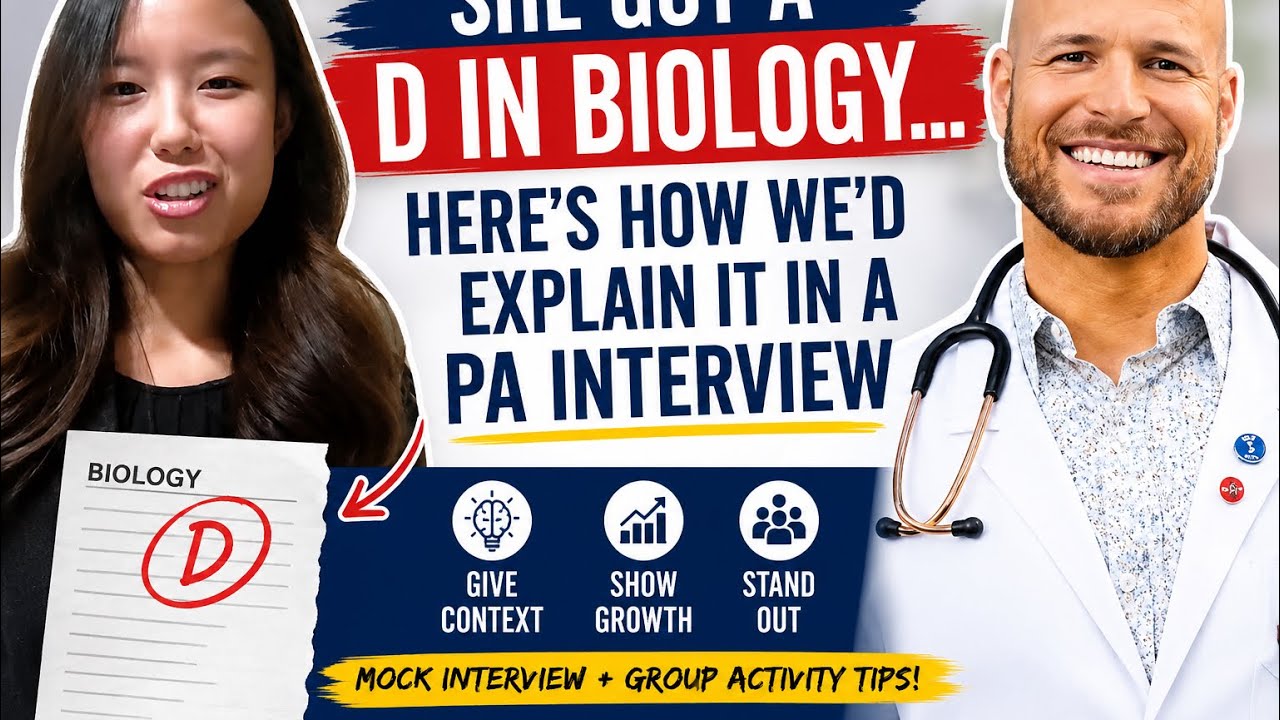
She Got a D in Biology… Here’s How We’d Explain It in a PA Interview 👀
Watch on YouTubeVideo summary
In this mock interview review, Brenda addresses a significant academic challenge by explaining how she earned a 'D' in introductory biology during her first quarter and later received a 'B-' in anatomy lab due to family emergencies that forced her to commute two hours away from campus, limiting her attendance at open lab sessions. She demonstrates resilience by detailing how she improved her grades through adapted study habits, consistent use of office hours, and collaboration with classmates via Zoom, noting that while a 'B-' might trigger academic probation in Physician Assistant programs, her developed support system and time management skills ensure she can succeed. When discussing her career path, Brenda explains that although she considered becoming a doctor or nurse practitioner, she chose the PA profession for its shorter training duration, ability to address primary care shortages quickly, and lateral mobility between specialties, inspired by PAs who provided compassionate care to her father and herself regardless of a patient's background.
The conversation also touches on critical healthcare issues, where Brenda identifies a lack of culturally competent providers as a major challenge, drawing from her personal experience with immigrant parents who faced delays in care due to language barriers. During the "dinner party" question, she lists her late father, Taylor Swift, and her late grandfather in Vietnam, but receives constructive feedback that these answers lack sufficient context and personal detail because interviewers do not know specifics from her application. The reviewer emphasizes the importance of providing concrete examples for claims, such as explaining specific steps taken to resolve difficult patient interactions with agitated non-English-speaking individuals by utilizing interpreters, rather than making unsupported assertions about professor support or simply stating intentions to avoid academic setbacks without outlining contingency plans like requesting a leave of absence.
Further guidance focuses on balancing detail with empathy, particularly when addressing interpersonal conflicts or difficult situations, where candidates should lead with empathy, provide brief context, and then explain their responsible actions instead of spending excessive time on situational details. Brenda is encouraged to expand on her unique personal backgrounds and perspectives to better connect them to the PA role, as well as to consolidate examples that make similar points, such as compassion shown by different PAs, while adding greater depth to her personal interests and motivations. The feedback also highlights the need for better pacing, noting that she spoke too quickly toward the end due to nervousness or preparation anxiety, and advises her to intentionally slow down her speech when feeling anxious to maintain clarity and composure throughout the interview.
Ultimately, the session concludes with praise for Brenda's friendly and approachable demeanor while identifying key areas for improvement in structuring responses to conflict and ensuring all members are heard during group scenario questions by acting as an anchor who organizes discussions and collaboratively builds on others' ideas. The interviewer reinforces that candidates should avoid overly open-ended questions in favor of more specific inquiries and must explain how they would handle potential academic setbacks with concrete plans rather than vague promises. By incorporating these strategies—providing supporting context, slowing down when anxious, and offering detailed examples of problem-solving—Brenda can effectively demonstrate her readiness to overcome challenges and thrive in a demanding medical education environment.
Read the full video transcript
All righty. Ready?
>> Yes.
>> Let's go. Professional face on. Okay. Uh
Brenda, it's great to meet you. We're
very excited to learn more about you as
an applicant.
>> It's really nice to meet you. I just
wanted to take this opportunity and say
thank you so much for taking the time to
have me interview your program. Really
excited to be here.
>> Absolutely. Happy to have you here,
especially as another UC Davis alum. Uh
so first question I have for you is does
your academic record contain any
challenges?
>> I definitely think I had some challenges
when I first started college. So I know
that on my transcript there was a class
where I did receive a DN. That was my
first uh quarter in college. And I think
the reason why that happened was because
I brought in study skills with me from
high school that I thought would be
applicable to my courses uh in college.
And I soon found out that the way I was
studying in high school was not the way
that I should be studying in college.
And I ultimately failed that class. But
from filling my class and continuing on
to taking other courses in college, I
was able to figure out kind of the best
way for me to study for my courses. And
it came with a lot of just figuring out
what resources were available to me at
college. As a first generation student,
I didn't know about all the resources
such as um office hours where I could go
and talk to my professors and get help
from them if I needed. So that was a big
thing for me, just learning to go to my
professors when I needed any help with
courses. figuring out that there were
different ways of studying such as uh
for some courses, especially when it
comes to things that I need to recall,
it's always so much easier to come back
from those lectures and writing down
notes immediately after or reviewing
those lecture slides immediately after
because that really kind of helps me
retain the information. And another big
thing for me uh was that I from
transitioning actually from in-person
classes to Zoom, I was able to figure
out another way of studying that really
worked for me, which was consulting with
my classmates, meeting over Zoom, and
going over some of the lecture materials
and content and just studying together
and bouncing ideas off each other. So,
all of those really helped me um
do better in the uh my college courses
going forward. And so after retaking
that uh class, I was able to do a little
better and I did end up getting a um
better grade in that course. So I think
for me it's a lot of it was just
figuring out what study habits worked
best for me and being able to utilize
that depending on which classes required
which type of study methods.
>> Yeah, I see what you're talking about.
Uh freshman year looks like there was a
D in basic bio.
>> Yeah. Uh and then another thing just on
review of the transcript is you
definitely did better. You're right. Uh
but there was a B minus in anatomy lab
senior year. What happened there?
>> Yeah. So at the um so anatomy is
notorious notoriously one of the most
difficult courses at UC Davis and
everyone is like really scared of that
course. So I remember I had to to um
take it alone. So it was a lecture
component and a lab component. And for
the lecture, I felt like the way I was
studying was really good. Again, like I
mentioned, what I did was after every
lecture, it was a lot of information. So
I would go home and re uh re rerun
through all the lectures, re-watch the
lecture videos, and take as many notes
as I can. So for me, that active recall,
making flashcards was useful for the
class itself. But the lab portion it was
very hands-on identifying the muscles,
tendons, you know, we were working with
cadaavvers and we only had a a few hours
in lab during the week and on the
weekends we would have open lab where
the lab would be open the entire day and
I'd be able to go in there and get more
practice with identifying the muscles
and whatnot on the cadaavvers. But
during that last um quarter, I had a lot
of stuff going on at home in my personal
life. And because I was really close to
Davis, I was about two hours away. I
would just basically in two places at
once going from home to back to school,
home, back to school. So I honestly
didn't get a lot of practice or a lot of
time in open lab with the cadaavvers.
And so when finals came around and when
midterms came around, I did have some
difficulties with identifying just the
um parts on the cadaabver because I
didn't get a lot of practice with that.
So for the anatomy course itself, I was
able to study that on my own, but
because I wasn't in person for a lot of
the um cadabra lab portion, I didn't
didn't do well in the lab itself. And I
know it's not a reflection of how I am
as a student. I know that if I was fully
present in that course, I definitely
would have done better. But
unfortunately, during that time, I did
have some family emergencies going on at
home. So, I just had to be in two places
at once, and I wasn't able to fully be
present for the lab portion.
>> Okay. Uh, and so I'm sure you're aware,
I'm actually not sure about Davis's
exact rules, but every PA school has a
minimum grade and minimum GPA that you
have to maintain during [clears throat]
dactic year. In my program, it was a B
and a 3.0. So, a B minus would have
either put you on academic probation,
made you remediate something, and or
just kicked out of the program. How can
you assure me that you won't have a B
minus again in PA school, you know,
barring any family emergency or anything
else that might happen?
>> Yeah. So, I know PA school is going to
be really rigorous. It's intensive and
there are moments where I feel like I
would have to give up a lot because
becoming a PA is my dream. It's
something that I've been working towards
for such a long time. And I know that
with PA school, the studying is going to
be intense. I am going to have to give
up the things that I like to do some for
um some [clears throat] time. But I feel
like I've developed a really good study
habits from my undergrad, which I'm sure
I will have to tweak again going into PA
school because classes are going to be
different. I'm going to have to come up
with different ways to study. Um, I do
have a really good support system at
home with my friends and family as well.
Um, they're just a phone call away or I
can go visit them whenever I need the
support. I've developed really good time
management skills where I'm able to get
everything done efficiently. Setting
aside time for what really matters,
which is school, and setting aside time
to just decompress and de-stress, which
I've also found really good ways to just
decompress and de-stress from just
rigors of school and stressors in life
in general.
So, I think all of that combined,
I without a doubt, I'm sure I will be
able to succeed in PA school and be able
to do well in my classes because
becoming a PA has always been a dream of
mine and it's something that um I am
willing to put things aside for.
>> Okay. And have you ever considered a
career that is not physician assistance?
I
definitely have. I growing up I never
really knew well I knew that I wanted to
work in healthcare but I never really
knew what I wanted to do exactly. I've
weighed the option of becoming a doctor
becoming a nurse practitioner. I'm
always someone who has wanted to be a
part of a patient's care team where I'm
able to help diagnose, treat or evaluate
them from start to finish. And um so
I've always considered um the many
options outside of a PA program and
being a becoming a physician assistant,
but
>> [clears throat]
>> um the one thing that really drew me to
the PA profession was when I actually
met uh a PA who was working on my dad's
care team. She honest he was staying at
the nursing home for quite a few years
and I spent a lot of time getting to
know her and she was always the person
on his care team who answered all of the
questions that my mom and I had. She
took the most time out of all his
providers to clearly address all of our
needs. And I was pretty young at the
time when I met her. I was I was um
probably starting high school, middle of
high school. And she took the most time
to explain to me my dad's conditions and
to address any of the concerns that I
needed because and that was so important
to me because I felt like I was so young
at the time and I didn't feel like a lot
of my dad's other providers were able to
give me that um kind of attention.
So that was so special to my mom and I
and that's when I knew that I wanted to
be a PA, someone like her who is able to
make other patients feel even and their
family members feel safe, heard and
seen, especially at any age. So that's
when I really started to research into
the PA profession and there was a lot of
things that really stood out to me. So
the first is the length of training. So,
from my time working as a medical
assistant, I really enjoyed the hands-on
aspect working with patients. I know
that there is currently a shortage in
primary care providers in California.
And my one of my goals is actually to
work in primary care as a physician
assistant. And being able to get out
there and just work as soon as possible
after graduating from a PA program,
getting my pants and a license to work
in the state of California. I think that
is something that's really appealing to
me. And that's kind of also why I don't
want to become a doctor because again
the length of training would be a bit
too long for me. And I've considered
nurse practitioner but I currently do
hold a degree of um a bachelor's in
psychology. So looking into the nurse
practitioner route I would have to go
back and get my nursing degree and then
work as a nurse for a few years and go
back to NP school. And that length of
training was also a bit too long for me
as well. So I knew that uh the PA
profession was perfect for me and even
after shadowing a PA. Another thing that
I really enjoyed about the PA profession
was the lateral mobility aspect of it.
So when I was shadowing a PA, her name
was Karen. She was working in allergy
and immunology, sleep medicine as well.
And when I was shadowing her, there was
a patient that came in and she wanted a
consult on a certain material metal type
that she was getting for a knee
replacement surgery.
and uh Karen discussed the allergy with
her, but I was really surprised when
Karen was also able to kind of touch
base on the surgery part of um the knee
replacement and I found out that Karen
actually worked as an orthopedic PA
before becoming an allergen in imanology
PA. So that versatility was really
impressive to me and that's also
something that um [clears throat] I
think I would enjoy because I am someone
who has always had so many interests
growing up. So just having that option
open was really important. And so
I think I've really been inspired by all
of the PAs in my life. And there is also
a PA worked that worked with me where I
was her patient and she was a
dermatology PA. And she was also really
inspiring to me because I felt like
every time I went to her office, I all
of my needs were addressed and she took
really took the time to understand my
concerns. And every time I left her
office for the past two years that I've
seen her seen her, I always thought to
myself, "Wow, I want to be the same
provider that she is because she really
made me feel so confident in the care
that she was giving me." So again, like
I've just been so inspired by all of the
PAs in my life, and I just know that the
PA profession is the perfect profession
for me, um, academically,
professionally, and personally.
>> All right. And switching gears a little
bit, uh, what do you think is the most
important healthc care issue facing
America today?
I think
one of the most important issues facing
healthcare today would be
>> [clears throat]
>> um the I I I would say it's
a
that's a really good question.
I think the biggest issue facing America
today is the lack of providers who kind
of um [clears throat] understand
uh
patients backgrounds. I think it's so
important that every provider is able to
um identify [clears throat]
any barriers to care in every patient
that they meet. being able to advocate
for patients regardless of their
background, regardless of their um
culture, regardless of language. And um
I think it's so important that patients
are kind of met where they're at. And I
think and in my own life as well growing
up with immigrant parents, there's there
has been so many instances where there
was a delay in care for my mom or dad
because they didn't speak English and we
have to wait so long on the phone when
they're calling insurance or so long um
when they're in the emergency room
because they had to find a translator.
So, I think that's really it's so
important that providers are educated to
be able to advocate for their patients
and kind of just meet their patients
where they're at.
>> Okay. And next question is, if you could
invite
three people
to dinner, past, present, living, not
living, doesn't matter, who would they
be and why?
I think the
first person that comes to mind would
probably be my dad. So he passed away in
um [clears throat] 2020 was during pe p
uh covid season and
>> yeah thank you. Um yeah so I would
definitely invite my dad. I miss him
every day. Um I think about him a lot.
He's also One of the main reasons why
I'm sitting here today, it's because he
gave me the opportunity to meet that PA
that was working with him and kind of
guide me into this career path. So, I'm
so thankful for that. I would love to
have dinner with my dad. Um, the second
person would be
Taylor Swift. I love her music. She
I love her music. I love her new album.
It's so good. She's been one of my
favorite artists um growing up. She was
probably the first artist that I
listened to uh shortly after moving to
the United States. I really liked her
music, though I didn't understand it at
the time, but I would definitely love to
have dinner with her. And lastly, it
would
and lastly, it would be my maternal
grandpa. So, growing up, we have always
been super close. I remember being super
close to him before moving to the United
States. But since moving, I haven't
gotten the chance to uh go back to
Vietnam to see him before he passed
away. So, I miss him every day as well.
So, it would be really nice to be able
to have dinner with my grandpa as well.
>> All right. And so it looks like the
majority of your medical experience,
your patient care experience is in a
actually hold on let's cut it for a
second because there is definitely a
little bit of feedback.
>> Uh how do you feel so far? We've done
what? Four questions, five questions.
One, two, three, four with some follow
on. How do you feel so far?
>> I think I ramble a lot.
>> Okay.
>> Not at all.
>> Okay. And sometimes I feel like I talk
too much and then I forget what I'm
talking about and then I forget the
question and then like what did he ask
or
>> so sometimes I that happens to me. But
so far so good. I I was really stuck on
the question about what issues um in
healthcare does America face today. I
think there are a lot of issues but it
was really hard for me to pinpoint in my
head exactly which one I want to talk
about.
>> Sure.
>> And I was kind of questioning whether
what I said was like appropriate. I
>> I think it was appropriate. Uh that's
yeah when I prepare people like I I have
a whole you know interview prep
worksheet and everything. One thing that
I honestly feel like is missing from
there is to have at least one like
modern issue to be ready to talk about.
>> You know even if this question doesn't
come up it's a good thing to kind of
segue into
>> right like you're talking about an
example talking about a question and
then be like I'm super passionate about
you know this.
>> So it would be good to prepare an answer
to that one and just be ready to kind of
you know present it because that's
definely a good one. Uh but overall, so
first things first, good things. Uh you
don't talk too fast, which is great.
You're talking in like a very kind of
like pleasant, professional, friendly
tone. Like I would feel comfortable
seeing you as a provider.
>> Comforting. Very, very good. Probably
just like that provider that inspired
you, right?
>> Yeah. Yeah.
>> I think I kind of like because of like
how she spoke to me and like honestly
all the peas I've met so far in my life
have always been like very like what can
I help you with? just very comforting. I
think that's kind of where I adopted
like the that
>> that's the vibe I'm getting. So, that's
good.
>> So, those are all very good things. Uh
there's a few times where you kind of
like froze for a second, but you
recovered quickly and you were honest.
So, fine. Not a big deal at all. No
stuttering. Everything's good. Uh so,
those things are good. Uh overall, your
answers are decent. Couple of things I
would definitely do, like we'll we'll
talk more about specifics, but a couple
things I would definitely start changing
right away. If you're giving context
from something that's already in your
essay, like your father's situation,
anything else, don't assume the
interviewers read your essay. Don't
assume they even saw your application.
>> Okay?
>> Because a few things just because I read
it, I know are from your essay and you
kind of like referenced it assuming that
I knew and I might not,
>> you know, like for instance, uh let's
see here. One sec. I wrote down notes
already.
I'm just asking you to be more specific.
One second. Yeah, here it is. So, you
were talking about what drew me to the
PA profession was meeting a PA during my
dad's care on his care team. Uh, she
took time to address all of my needs.
So, if I didn't read your essay, I have
no idea why your dad even had a care
team.
>> Okay. So, you're just talking about
about the background a little bit.
>> Anything you bring up,
>> okay,
>> give the necessary context. you know, uh
because again, if I didn't read your
essay, I would not have known anything
about that.
>> If they did read your essay, fine. It's
a nice little refresher. It's okay.
[clears throat] But if they didn't, you
could say, you know, my father had X, Y,
and Z. He was in the hospital a lot.
This one time I met this PA named Brandy
who and then just go into all that.
>> Okay. [clears throat]
>> A little bit. It'll take five seconds.
>> Okay.
>> But then at least I know what you're
talking about.
>> Uh let's see. I always had interest
growing up. Okay. Another thing is
whenever you make a statement,
especially like a personal share, you
want to give it a little bit of context
too. You want to give some examples or
at least talk about it. So like in the
same answer you said this was super
important because this is YPA. You said
you know PAS have the lateral mobility
aspect. They can change specialties. Uh
which is good for me because I had a lot
of interest growing up. So related to
switching specialties. So, I basically
wrote down what interests and how does
that relate to switching specialties,
>> right? You just said I had interests
growing up. Uh, and then I saw a PA who
inspired me in dermatology. So, it would
have been good to say like I was always
interested in sports and music and I
loved splitting my time between those
things so I wouldn't get bored and I'd
feel motivated and I just think learning
different things kind of inspires you
to, you know, enjoy life more. Uh, so I
would love to spend more time in
different specialties, learn all of them
thoroughly during school and then apply
knowledge that I learned maybe on a
dermatology rotation to working in
ortho. You know, I know we're here to
see somebody for their knee replacement,
but hey, there's a rash and by the way,
I can also help you with that.
>> Yeah,
>> that kind of a thing. Like be more
specific, right?
>> Got it.
>> And also just getting to know you. Like
what interests?
>> Okay.
>> Violin. I played botchi ball. I don't
know. Whatever it is.
>> Okay. So more specific. Cool. Uh that
that's one thing I like to say lately is
less topics more deeply about each
topic.
>> Okay.
>> Rather we bring up two topics and really
explore them than five topics and not
really say much about any of them.
>> Uh let's see. Healthcare issue. Yeah,
that was a very short answer. I would
have definitely talked more about that.
>> Uh yeah, don't be afraid to to expand
more because your answer to YPA was
really good length. It was a good like
three, four, five minutes. Very
detailed. Could have used more detail,
but it was long. But then the healthc
care issue and then the three people at
the dinner were super short.
>> Like you can talk more about it,
>> right? Um like your dad you said uh he's
one of the reasons I'm sitting here. I
met a PA that got me into the career
path and then that was it, right? Like I
would have said more about it. She was
super friendly. She was super helpful. I
just inspired me to be just like her,
right? Uh but either way, yes, my dad, I
would want to talk to him. He died when
I was
16. Uh, you know, I I think we would
have his favorite meal. I think we'd
probably talk about whatever sports he
liked. You know, just more just just
more. Just give me more. Okay.
>> Uh, same with Taylor Swift. I like her
music. The end. Like, what would you
talk about?
>> Okay.
>> Why Taylor Swift? Like, the question
itself doesn't really matter. No one
really cares who you want to have dinner
with, but we do care about like what
characteristics about yourself you're
trying to bring up. M okay.
>> Does that make sense? Like you're not
Don't treat it like a test where you're
just answering the question correctly.
[clears throat]
>> Use it to say things about you.
>> I like Taylor because she's an
inspiration to a lot of girls.
>> Yeah. That's how I want to be, you know,
once I'm in this like position of
authority. Want to go to schools. I want
to go to colleges and like inspire girls
to be like me.
>> That kind of thing. You see what I'm
saying?
>> Yeah.
>> Just give me more.
>> All right. Uh, and I think yeah, we have
plenty more questions to go, but that's
the main thing is give context where
necessary and just feel free to express
more, share more about yourself, just
more.
>> Okay. Yeah,
>> you're not talking too long. I promise.
Not even close. Uh, any questions or you
want to do a few more?
>> Um, I'm I could do a few more.
>> Your feedback makes sense?
>> Yes.
>> All right, let's go. All right,
professional faces on. All right, so
next question. Your name is Okay,
Brenda. That's right. Brenda, next
question is going to be uh so it looks
like all of your patient care experience
comes from two different medical
assistant roles. One for about 2,000
hours, one volunteer for 500. Looks like
a very good experience. Uh from that
experience, can you tell me what kinds
of patients are particularly difficult
for you to work with?
Yeah. So
I think from working as a medical
assistant in two very different clinical
settings though they were both in
primary care. One was where I was
working primarily with the undership
community and the other one I was
working with um a different group of
patients. I think the one the patients
that are kind of difficult for me to
work with are just the ones that kind of
get
a bit angry and agitated easier than
others. And the reason why I say this is
um during my time working as a medical
assistant, we had a patient come in who
was upset because he couldn't reach our
office to confirm an appointment that he
had. And the day before it was actually
Memorial Day, so we were closed. But he
said he kept trying to call and he
didn't understand why we didn't pick up
the phone. He left messages. But when he
came in screaming at us the next day, it
was when we first opened. So it was
around 9:00 and there were already a few
patients sitting in the lobby and he
just came in screaming at us asking why
we didn't pick up the phone, why he left
so many messages, why didn't we get back
to him? And at the moment I will admit
that I was a little bit takenback by
what was happening. and the patients uh
there were kids in the lobby as well so
they also looked a bit scared. So what I
did was I brought him back into one of
our patient rooms and I sat him down and
asked him around what time did he leave
the messages just trying to get more
information out of him just so that I
can kind of address the situation at
hand and he said to me that he left a
message uh yesterday Memorial Day I
explained to him that we were closed. He
didn't really understand the concept
because he was actually uh he just moved
here from China. So, it was there. He
said that he expected everything to be
like uh responded back to in a timely
manner. And I I did reassure him that
typically we do get back to patients
pretty quickly, but because we were
closed on Memorial Day and we just
opened this morning, we didn't have
enough time to get back to all the
patients, but we did we do always
guarantee about a 24 to 40 hours for
returning voicemails. And he was still
really frustrated and he was talking
about how his legs really hurt. He's
been waiting so long for this
appointment and he was really
disappointed that he couldn't uh reach
us to confirm the appointment slot and I
was also having a hard time kind of
communicating with him as well as he was
getting really frustrated. So um and
obviously I didn't speak the language so
I felt like there was a kind of a
barrier in my communication with him as
well. So what I did was I went outside
and asked one of our nurses who spoke
Mandarin to come in and help me
translate the conversation and I felt
that time while I was able to explain to
him what has happened and I really am
sorry that we weren't able to get back
to him. Uh she translated that
conversation and he seemed to kind of
calm down and kind of apologize for
coming in and creating such commotion.
But at the end of the day, I think there
are going to be difficult patients that
I would have to work with. And I think
it all really stems down to these
patients be being really
anxious and scared about seeing a
doctor, seeing a provider because I
mean, we've we've all been there where I
I get so anxious waiting for a doctor to
come into the room or I get really
anxious to know what my diagnosis is. I
get anxious all the time.
>> [clears throat]
>> um when I have like a certain condition,
I just wanted to get solved. So, I
really understood where he was coming
from. End of the day, we're all human.
We all have these needs that we would
like to be addressed. So, I think it's
so important that um we're able to work
with these difficult patients and just
kind of um giving them the care that
they need, but making sure that at the
end of the day that we're also um
hearing them out and kind of addressing
their concerns as well.
All right, next question is, what
qualities do you possess that set you
apart from other PA school candidates?
>> I think I bring quite a unique
perspective to um the PA profession and
to the PA PA programs in general. And
what I mean by that is as someone who
does come from a low-income background
with immigrant parents and having
experience volunteering at a primary
care clinic where we did primarily work
with the underserved community, I have
witnessed firsthand the effects of
socioeconomic factors such as a lack of
providers, a lack of uh providers who
spoke a certain language or even a lack
of resources and other social or
cultural impacts on healthcare. And
as APA,
I
would like to and I'm really passionate
about working with the underserved
community and being able to identify
barriers, address those barriers to make
sure that every single patient has the
most optimal form of healthcare and to
to PA programs. I hope to bring my
knowledge um and my experiences to have
conversations with other students about
the socioeconomic effect uh impacts on
healthcare. That's why I'm so passionate
about attending UC Davis because UC
Davis is really big on cultural ability
and and equitable healthcare and there
are courses on social and behavioral
[clears throat]
cultural determinance of health and I'm
really excited to be able to bring my
experiences and my voice to those
conversations and UCS also has rotations
um required rotations in some rural
areas as well. So I'm really excited to
be able to work in that aspect as well.
And another thing about me is I feel
like I am pretty optimistic. So I have
really never been discouraged by any
setback, my life motto has always been
it'll all work out in the end. So that's
been a really big motiv motivator for me
and I know that going into the PA
profession and healthcare in general
there there will be hard days there
there will be days where things will get
difficult but just having that mindset
will really help me get me through those
hard days. And I know that PA school is
so rigorous and I hope to bring that
optimism and positive mindset into a PA
cohort and being able to lift up the
spirits of my classmates. Whether it be
just sending cute messages through our
group chats to lift up everybody's
spirits or preparing little goodie bags
when it comes to exams. Those things
really make me happy and I would also
like to bring that into um APA
[clears throat] program as well.
And you touched on this a little bit in
your previous response, but why are you
choosing this program to apply to?
>> Yeah. So, like I mentioned, I believe I
well, first of all, UC Davis is
definitely my top choice and I feel like
I closely align with the program's
mission and focus on cultural and
equitable healthcare. Coming from a
low-inccome background, like I
mentioned, um I do truly understand the
effects of socioeconomic factors on
healthcare. And as someone who speaks a
second language, Vietnamese, I hope to
be able to bring my
skill as a Vietnamese speaker to the
table. And from my experience working as
a medical assistant, it's been so
rewarding to be able to translate for
these pat a handful of patients who
didn't speak language. It felt so
rewarding for me when they called into
the clinic and asked for me specifically
by name because they knew that, you
know, there's this girl working on my
clinic who I'm able to speak to, address
all of my concerns and not be afraid
that my um concerns or my needs would be
lost in translation when, you know,
speaking to the doctor. So, I think
that's so rewarding and attending a
school like UC Davis where there is a
big focus on cultural humility will give
me that um expertise and that training
as a PA to bring back to my community in
San Jose where there is such a big
population of underserved community and
Vietnamese immigrants and just being
able to bridge any gaps in healthcare
and language there. And another thing is
I really appreciate UC Davis's studentr
run clinic. So UC Davis gives students
opportunity to on their first year
volunteer at these student run clinics
where it's um it's for the community.
There are a few from my undergrad
experience I know there are a few
student run clinics that um we were able
to participate in as students and as PA
students were able to volunteer and that
it's really exciting for me because I
love working hands-on with patients. I
just love getting out there and give and
not having to wait the full two years to
work with patient is something that's
really appealing to me. So, that's
another reason why I'm really excited
about the UCSPA program. And lastly,
I've been able to research a lot into
the program and I was able to meet with
uh alumni and speak with current
students. And everybody seemed to rave
about the faculty support, the amazing
faculty support that they had received
from UC Davis. And that's so important
to me because during my undergrad, I
knew the big thing was being able to go
to my professors, my TAs to get the
support that I need, whether it be
emotionally or academically. And UCIS
had such an amazing wellness center. And
they I know that you guys also provide
um first year students with online
learning assistance, which I believe are
alumni from the program just to help
tutor the students. And I'm sure that
speaks on why UC Davis has such a high
graduation rate and high enhanced pass
rate as well. So, I have no doubt that I
would be able to succeed in a program
like UC Davis's PA program. And it's
just it just really aligns with my
personal goals and my academic goals as
a PA student.
>> All right. And then this is me as the
interviewer, not me as myself. Uh, do
you have any questions for us?
>> Yeah. So the first question I would like
to ask is
do you feel like in the past few years
your cohorts have been more competitive
or collaborative?
And my second question would be what is
something that you're most proud of
about the program? And if they're a
professor I would proudly ask what made
you choose to come to UCI and to teach
here.
>> All right. And we're definitely running
a little short on time. Did you want to
do a uh scenario question, too?
>> Yes. So, I know for so from what I've
seen on um Reddit and the forums, I know
that it's like a group discussion where
uh they would put students into like a
room and we'd discuss like a topic that
they give us. So, more so I think advice
on that.
>> Yeah. I'm not quite sure what the
contents would actually be.
>> How about we do this? Um, just in the
interest of time, so I'm not explaining
all this to you, I'll just copy a little
paragraph for you.
>> Uh, just one sec. I'm literally get to a
different Google doc here. I'm literally
writing a book on interviewing
>> and I'll just copy over the entire
portion on groups.
>> Okay, got it.
>> So, that'll save us some time and give
you all the guidance you need so we can
spend the rest of our time doing
feedback.
>> But it's it's quite simple
uh to do the group thing here. Just one
sec. So, it's in chapter seven. Nope.
Chapter two, types of interviews.
Sorry, one sec. I just want to make sure
I give this to you.
>> Yeah, no rush.
>> Cool.
Uh, let's see. Group
>> group interview. Perfect. There we go.
Uh, so this is going to be a group
activity,
right?
>> Yeah, it's the activity. Yeah.
>> Okay. So, let's see here.
Good. All right. So, I'm literally just
copying over my entire portion of the
chapter on group activities. Uh, and
I'll put it at the very front of your
document that I'm sharing with you.
>> Okay.
>> Say regarding group interviews,
activities,
misspelled activities, which is okay.
>> It happens.
>> It does. Uh, here, let me share my
screen with you just so you can see
that.
Okay, let's full screen this bad boy.
All right, so I'm going to share this
document with you real quick or Brenda.
Okay, so this document has all the
questions I just asked you. A few more
questions to practice with.
>> Yeah.
>> And at the Oh man, I really screwed up
the spelling. Activities.
There we go. Uh, so at the very front of
the document, I'm just putting a whole
blurb about what to do with group
activities and group interviews.
>> Okay, [clears throat] thank you.
>> You got it. Okay. And then next is just
some notes I took down about your
application. Just things I wanted to ask
you, stuff that stuck out to me. And
then here's your questions. All the
questions I asked you, and then a few
more to practice with. [clears throat]
Okay. All right. So, let's see if
there's any that I really had some
feedback on. Uh, is there anything that
you felt you could have done better or
anything that you want to do for
feedback before I give you any of mine?
>> I think
not. I don't have anything that I I'm
pretty sure there are things that I
struggle with and I could have done
better. I
don't really know how to identify those.
So, if you could help me.
>> Yeah. So, I think you took my feedback
in stride. You definitely gave more
examples. I think you that was really
good. Uh let's just go question by
question because instead of like writing
down comments at the very end trying to
remember them, I just as soon as
something came up, I typed it down.
>> These little stars. That's the real time
feedback I gave you.
>> So for this one, academic challenges. I
mean, this was obvious a D in intro to
bio and then the B minus. So here I told
you be more specific, right? You said
study skills from high school. What kind
of study skills did you do in high
school? Right?
>> I figured out resources. You were just a
little too general here, right?
[clears throat]
>> And then you didn't mention this,
>> which concerning
>> So, I would have definitely talked about
this, too. Like, I had a rough start. I
got better. Here's how. And then, you
know, I had another unfortunate grade
senior year. Here's what happened.
Right.
>> Yeah.
>> Just explain that.
>> Was that explanation? Um, okay. I that's
exactly what happened. But I
>> I honestly I don't think so. I don't
think it was sufficient because you
basically just said I had a lot going on
and I couldn't be two places at once.
>> But I mean that explanation is not going
to fly in PA school. If you get that B
minus in the class, you're either
decelerated or possibly even released,
right?
>> That so that's not going to work. It
needs to be a better explanation.
>> Like not necessarily a better
explanation for what happened, better
[clears throat] explanation for how in
PA school you won't let it happen.
basically just said like I had a
personal difficulty. I live two hours
away. I couldn't be in the lab. I mean,
you you kind of had to be,
>> you know. Um not sure if you feel
comfortable talking about what actually
happened.
>> Mhm. during that time. Uh
but at least like explore some other
options like if it was something you
absolutely couldn't miss,
>> consider maybe taking a leave of absence
or something in that course to not to
fail it. [clears throat]
>> You know, something because like failing
it or even a B minus is really not an
option in PA school. [clears throat]
>> Got it.
>> So that's why I said, you know, convince
me that won't happen again.
>> And you said, well, basically it's
important to me so it won't.
I need a little more than that.
[clears throat]
>> You know,
uh for instance, like if I realized that
I had such a family emergency that I
actually could not be there, I would
communicate with my professor, here's
what's going on. Uh can I make this up
somehow? Can I take this week to be with
my family or this next two weeks? And
then make this up on the back end, maybe
make it up a little bit later or just
even something like a leave of absence
pass fail or, you know, a withdraw from
it even beyond the deadline. and here's
what happened. You know, like that kind
of thing. Just some options, right?
>> So, just um talking about how like if
this were to happen again, what would I
do
>> if this happens in PA school?
>> Okay,
>> definitely need to include
if this happened in PA school, family
emergency,
illness, anything keeping you from
succeeding
in school?
What would what I would do
such as communicating with the professor
early, considering a leave of absence or
making up the class work tests in one to
two weeks, etc. Right? [clears throat]
>> Let's communicate. So that's what I
would have done. And then here you said
something about decompressing. It would
have been good to like say I like going
for a jog. I like reading. I like doing
whatever. I prioritize half an hour of
this before bed. Like something, right?
>> Specifics. But this this is a big one
right here. You really need to make sure
that we just feel good about you not
doing this in PA school.
>> Um Okay. Don't want to beat a dead
horse, but that is super important.
>> Okay.
>> This is basically this was very good.
You went into YPA. I told you like why
not PA? And you were like YPA. So this
is good.
>> This is a really good response.
Uh the things that I added here. Yeah,
we talked about this already, right?
Like,
>> yeah, [clears throat] context.
>> Add the context. We talked about that.
Uh, specifics like what interest did you
have?
>> Yeah. And this last one where you had
the dermatology guy example essentially
was the same point as the one who took
care of your dad. So, I probably could
have done without that one.
>> Okay.
>> Like, if you're making a different point
with him as an example, cool. But you're
making the same point. He was
>> kind and compassionate, right? Like that
was it.
>> So, I probably could have done without
that and spent more time here. Got it.
Okay. So, probably just taking that last
part out if there's nothing uh like
different
>> remove the part about the germ PA since
it's making the same point
of the previous one or use that example
to make a different point for a
different reason why you want to be a
what did I do? My hands are too big for
this laptop to be a PA. So, like you
want to be kind and compassionate.
Listen, that's definitely true. You want
to do lateral mobility, shorter course
of training. Um
I don't know, he's able to work
part-time, he's able to moonlight in
different clinics,
>> you know, whatever it may be. Uh or just
remove that.
>> Okay,
>> cool. Uh this one. Okay, definitely
prepare a longer, more detailed, more
personal response to this one.
>> Yeah.
>> Yeah, definitely think about it a little
bit more. I know that this is important
to you, so you can certainly bring up
some more examples.
>> Okay.
>> Like here,
>> would that be just a good foundation for
like an issue that I think is important?
>> Very.
>> Okay.
>> Yeah, absolutely. And again, like even
if they don't ask you specifically this,
>> even if it's part of like why PA or part
of like motivates you to be a PA or what
value do you bring to a program, you
could use that for any of those.
>> Okay?
>> Right. So like here definitely a good
question or a good example here like mom
and dad didn't speak English. There were
delays in care. We waited forever on
insurance. a little bit more like
>> you know mom ended up with pneumonia
because she couldn't explain that her
cough had been going on for a long time
and she was getting worse like something
you know [clears throat]
>> more of a more personal
>> just see how short this is compared to
like this one
>> cool
>> yeah I kind of didn't know really what
to say wasn't something that I thought
about a lot but
>> but now you will
>> yeah now I will for sure
>> yeah this is a really good length just
for reference like your answer to this
one was a very good length. It was very
detailed,
>> you know, more details of course, but
like this is good. This is kind of
quick. This is also super quick.
>> Um, yeah, I like that. Like when it was
a fun question, you kind of like smiled
and laughed like that was good. Like he
didn't seem nervous. He seemed
personable. Uh, so I'm going to say
expand much more on about this.
not about answering a question but
rather using the questions to share
important information things about you
>> would for each of these would I would
you recommend that I tie it back to like
YPA or just expand about myself in
general
>> no this isn't so much YPA this is more
of like a tell me about yourself kind of
question
>> like my dad was important to me because
this this and that he taught me these
values And family is super important.
Like that's the point you're making.
>> Yeah.
>> Taylor Swift, you know, I want to be a
mentor. I want to be a role model.
That's probably the point you're making.
>> Uh who else was there? There was
grandpa, which is kind of the same point
as dad.
>> Uh maybe cultural. You can bring in the
cultural thing with grandpa.
>> Anything.
But yeah.
All right. What kind of patients are
particularly difficult?
Uh let's see. So when you said the guy
got angry and agitated easier than
others, I probably would have said that
a little bit differently,
>> you know, uh, and I would have also led
with empathy, but we'll talk about that
in a second. Also, okay, so here I said
way too many details. So you're
explaining the situation
>> for this much time and then even
actually more. You're explaining the
situation for
this much time
>> and here's how much empathy you showed.
Mhm. [clears throat]
>> I Well, I guess here's so much empathy.
I would have liked you to flip these and
not necessarily order, but to spend
about this much time talking about the
details
>> and then that much time being empathetic
to the person [clears throat]
>> and then that much time, you know, like
being responsible. So, I have a whole
little prepared response for that one
because it's a very common one I like to
train people on. And that is
conflict.
One second. Interperson Oh, personal
statement. Crap. One second. It needs to
be um One sec. Copy and paste.
There we go. So, anytime there's
interpersonal conflict conflict,
like whenever there's tension, someone's
being an a-hole, it's a comment or it's
a question that's like, you know, who
can you not work with? Who's stressful
for you to work with? When did you feel
judged? When did you feel, you know,
unfair? Anything like with people,
tension with people.
>> Lead with empathy. Always empathy first.
Right? Very brief context. Here the
situation then but of course I
understand I'm putting myself in their
shoes.
>> That's first then I either this is what
I did to make the situation better which
is what you told me or this is what I
could have done better or something
>> you know so a little bit of context
super empathy super responsibility.
That's what you want
>> you know whereas you saw you see here
it's way more details and then a little
bit of empathy.
>> Cool.
>> Yeah.
>> All right. It's like imagine, you know,
someone's talking about a friend or a
family member of yours in the hospital.
Uh, you know, you over hear the nurses
talking and they're talking about like
how they were yelling and how the kids
in the lobby were scared and how, you
know, he said in China he guaranteed a
phone call and he didn't understand what
Memorial Day was and like there was all
these details.
>> Yeah.
>> About how angry he was instead of like,
you know, this guy got a little
frustrated with us, but of course I
understand he's, you know, there's a
language barrier. He doesn't understand
what's going on. There's a cultural
barrier. you didn't understand that we
were closed or why, you know, totally
understandable. I'd be really pissed
off, too, if I was in that much pain and
I couldn't get the help I needed from
the people I'm supposed to trust.
>> If you heard someone talking that way,
you'd be like, "Okay, cool. I like them
taking care of my family member."
>> If they were just complaining for that
long, you'd be like, "I don't like
this."
>> Yeah. Good example. Yeah.
>> Yeah. So, that's kind of the the
context. Any tension, you want to be
super empathetic.
>> Uh qualities do you possess? This is
kind of good.
See, come from Yeah. your your unique
background. Good.
Seen firsthand. Good. Uh so I would have
loved for you to explain more here.
Would have been great to expand much
more on your background, what you saw,
how it gave you perspective,
right? Before talking about as a PA what
you want to do.
>> Yeah.
>> Like more on this. This is definitely
good to talk about. Um, discouraged
that. Good, good, good, good. Hope to
bring positive mindset. I love this.
Love the positive mindset part. Love
positive mindset part. Goodie bags is
cute. Uh, group chats.
That's all excellent.
Could have expanded more on your unique
perspective
things you saw.
and how that will translate to being a
PA and student
like you just kind of said it will but I
would have loved to see how
a little bit more but otherwise this was
really really good. I like this a lot.
>> Uh why this program? This was great. Uh
I said would have been more good to do
more details about what um in oh in
undergrad how you uh got support from
professors emotionally and
professionally. Mhm.
>> What does that look like?
>> You know,
like when I was freaking out over a
test, even though I was ready, my
professor, Dr. Smith, sat me down and
said, "Look, you just got to focus on
one question at a time and breathe and
blah blah blah." And that just made me
feel better, whatever it was.
>> Yeah.
>> You know,
>> and more on what I told you otherwise.
Excellent.
Very good answer. Otherwise, uh, this is
okay. These questions are pretty common.
They're they're good questions, but
they're a little common.
>> Uh, let's see. Collaborative or
competitive? Uh, I mean, you could add
that. I feel like everybody asks that.
Um, I don't know if it was on like a
TikTok or something, but lately
everyone's been asking that one.
>> And it's almost always collaborative, so
I don't really see the point in asking
it. [clears throat]
>> Um,
yeah. I don't know. That's just it's
been asked so many times. Uh, what are
you most proud of about the program?
It's kind of open-ended in general. It's
a good question. I would have, if you
want to ask this, I'd probably make it
more specific,
>> like the class that just graduated.
Um, you know, what are you most proud of
them for? Or what specialties do you
find, has anyone who just graduated, you
know, in 2025, um, do you know of anyone
who got a really unique specialty or
most people kind of going into primary
care, emergency medicine?
>> That's a good one. Are most people
staying around the area like I would
like to or are a lot of people kind of
jetting off to different areas of
California?
>> You know, more specific. These are kind
of general.
>> These questions are good, though. Pretty
general
and very common.
Being more specific would be helpful.
Um, making the question less open-ended
and easier to answer
would be good.
All right. And then there's scenarios.
>> Uh,
how do I get this out of here? Okay.
Questions?
>> I think just overall,
so I really appreciate all the feedback.
I think it's really good. It's
definitely things that I have to tweak
and incorporate, but overall I think I'm
really glad I did this because it really
gives me kind of insight into what like
a real interview would look like and
what they're really looking for.
>> Okay.
>> So, I don't think I have like any
questions, but if you have any like just
general feedback or general advice in
general.
>> Yeah, I mean general feedback, I think I
told you the the vibe is very good. Uh,
you know, you seem pretty confident.
You're very friendly, very approachable.
That's good. Uh I did notice you started
talking really quick towards the end. I
think maybe because it was like material
that you had already presented, like
you'd already prepared.
>> I think when we were talking about like
maybe underserved kind of stuff, you
started like going really quick as if
you already already like memorized it.
>> So I So those questions I definitely
practice like the you know the big
questions about like why our program,
why um PA, why you know tell me about
yourself. I've definitely practiced
those. I I don't want to come off as
like rehearsed.
>> The like I do have points that I want to
address and I think I I think I'm just
someone who like speaks pretty fast in
general and if I get nervous I speak
pretty fast but but from honestly yes
those questions I have prepared
beforehand.
>> Well the YPA one you weren't like that.
You were good. But it was just like the
last two questions you started talking
really quick and I didn't understand why
>> because you hadn't before.
>> Yeah. I'm not quite sure. I wasn't aware
that I was like
>> Yeah. You never are. It's like because
you get nervous and you naturally start
talking faster.
>> I think so. Yeah. Or if like Yeah. I
think when I get nervous I speak super
fast.
>> Why did you get nervous at the end and
not at the beginning?
I think at the end Oh, I I think it's
because I prepared a question for why UC
Davis, but I didn't expect myself for
you to ask a previous question. Uh I
forget what the question was, but I also
had to talk about like a part of like
why UC Davis Oh, why would be a good um
why would I stand out from other
>> Yeah.
>> Yeah. So, I'm like, "Oh, no." Oh, like I
have to like kind of separate these two
answers and make it work for this
question and like also have enough for
that the next question that you asked.
>> I think that's where I got like pretty
like tripped up and nervous.
>> Okay. Yeah. Did you feel that you were a
little nervous?
>> Definitely. Yes, I did feel nervous.
>> Okay.
>> About that. Yeah.
>> So, it's like the hardest thing in the
world to do, but when you do feel
nervous, like you know what it feels
like,
>> focus on slowing way down. Mhm.
>> Like focus on talking uncomfortably
slow.
>> Okay.
>> My one friend calls it the stoner vibe.
>> Like like But the thing is when you're
nervous, when you do stoner vibe, it
turns into just being normal.
>> When you're not nervous and you're just
doing it on purpose, then it turns into
being painfully slow.
>> Truly.
>> Yeah.
>> So either way, just focus on, especially
when you're nervous, just focus on
slowing down more than you even want to.
[clears throat]
>> Okay. because that was like you just
started really really speed talking. I
was like what the heck? She hasn't done
this like the whole time. Why?
>> But I didn't notice. Yeah.
>> Yeah, that makes sense. When you watch
it back, you'll see up.
>> Uh so that's the first general feedback.
Just try to focus on slowing down when
you're nervous.
>> Two, uh trying to give context for
everything. Either an example or at
least like if you make a statement, back
it up. Don't just make another statement
after that. You know, like the
professors were there for me
professionally and emotionally. Okay,
before you move on, what do you mean?
>> Just like imagine me being there and
going like, what do you mean?
>> You mean [clears throat] follow on
question, right?
>> Uh, so you'll see that. Uh, and then
definitely practice the low grades one.
That's a big one.
>> And the interpersonal conflict one, just
leading with empathy.
>> Otherwise, I think you got it. I mean,
overall quite good. You know, if you did
this without my feedback whatsoever, I
think you'd still be okay. But, you
know, you're paying me for feedback. I'm
going to find something.
>> Yeah. This is great. Yeah.
>> Right. There's going to be something
that everyone can improve, right?
>> Yeah.
>> And I think those are just the things
you can improve. But overall, quite
good.
>> That's good to hear.
>> Uh, any other questions? Anything else
you need to talk about or you're okay?
>> I think I should be good. Um I know that
so I watched one of your videos on like
just group interviews and scenarios.
>> I know you said that just like
identifying the what role I need to take
on in
>> interviews. So
>> yeah I I think for me would would you
have any other general advice on that or
is it all in the doc that you
>> uh but the basic feedback there was one
did you see any of my videos on the
four-step method for scenario questions?
>> Yes. um just kind of repeating this what
the scenario was, thinking out loud,
identifying the um possibilities or like
what I could do and then picking one and
then further elaborating on that.
>> Yeah. Uh step two is going to be uh
getting more information.
>> So like that you probably can't really
get more information, but you can make
assumptions or you could at least voice
what you would want to know.
>> You know, like scenario is X, Y, and Z.
Okay, before making a decision, I would
really want to know this.
>> If it's this, I would go this way. If
it's this, I'd go that way. Right?
>> So, those four steps, just have those
constantly in your head and just try to
think during the group discussion like,
all right, what's been covered? What's
missing? What can I do?
>> And always, you know, include the other
group members. Uh, someone's quiet,
include them. Try to talk first. If not
first, then certainly make sure you're
heard.
>> Uh, always try to organize them. If like
two or three people have talked and
you're nowhere near the prompt, organize
everyone. be like, "Okay, hold on." So,
step one here, this is what we were
asked to do. Uh, Jamie, I heard what you
said. Alex, I heard what you said.
Here's what I think. By the way, step
three, here's what I do.
>> You know what I'm saying? Just like
constantly be like the anchor. Be the
organizer because everyone's going to be
like all over the place.
>> Yeah.
>> So, if you're the one who's steady and
organizing everyone, that's the
provider's job.
>> You know, the front desk is saying
people are calling her and yelling. The
security guard is saying someone's
trying to like, I don't know, fight him.
the patients are coming out of room
saying, "How long is it going to be?"
Uh, your medical assistants are telling
you about three different patients.
You're the one keeping it all together.
>> Yeah.
>> So, be that person in the interview.
Just like constantly like redirect
everyone, get everyone organized.
>> You know, that would be good. Or if
someone's already doing that, just piggy
back off them. Oh, Jamie, great job.
Like, uh, I'm really glad that you
brought us back to that. Uh, I totally
agree. By the way, here's what I would
do.
>> Cool.
>> And it's always okay. Is it okay to like
say, "Oh, that's a really good idea."
Like just other people's ideas. Or
>> of course, why not?
>> Okay.
>> Yeah. You're not competing. I mean, you
are, but
>> on the surface, you're not.
[clears throat]
>> Yeah.
>> Collaborative.
>> Yeah.
>> Yeah. Absolutely. [clears throat]
>> Yeah. They're doing those things. I
mean, you're going to stand out for most
people.
>> Okay.
>> And also that Yeah. It's all in the
dock, but that's that's the chest.
>> Okay. Yeah. Thank you. Thank you so much
for taking the time to help me out.