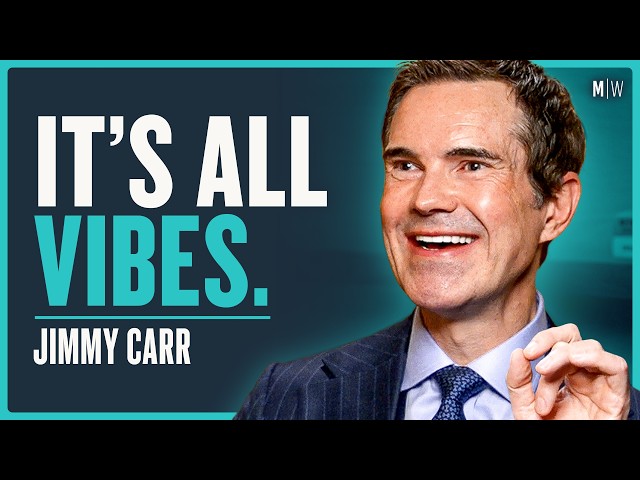
Video summary
In this high-energy conversation, Jimmy Carr expresses his deep admiration for *Modern Wisdom*, describing it as an essential resource that cuts through the noise of modern media to offer genuine value and breadth in subject matter. He highlights how listening to the podcast has influenced his own information diet, noting that while many people focus on physical health like exercise and processed foods, they often neglect their mental intake by consuming low-quality content such as *Love Island*. Carr praises Joe Rogan for consistently aiming high with well-intentioned guests who strive to make listeners' lives better. He shares a humorous anecdote about his "Mount Rushmore" of podcasters—Naval Ravikant, Jordan Peterson, Sam Harris, Andrew Huberman, and Alex Blumberg—and the relief he felt after finally securing Naval's appearance, joking that it completed his collection like Thanos gathering Infinity Stones. The discussion also touches on Carr's anxiety regarding whether he has fulfilled his purpose as a comedian once he achieves major milestones, such as selling out stadiums or landing big deals with Amazon Prime Video. Carr delves into the philosophy of success and disposition, arguing that one's internal state is far more important than external position in life. He suggests that gratitude should be viewed not just as an emotion but as "celebration in action," a way to reframe reality positively even when facing boredom or privilege issues like constant travel. This mindset connects deeply with his views on creativity, which he believes often emerges from silence and unappreciated serenity rather than overstimulation. He contrasts the structured nature of some podcasts, like Morgan Housel's *Almanack*, with others that meander, noting that while comedy requires a service-oriented approach to make audiences feel good, it also demands immense bravery in taking risks without filters. Carr emphasizes that jokes are fair game if they can be funny enough to transcend offense, citing Peter McGraw's theory of benign violation and the idea that creativity is refined through process rather than solely bestowed from above. The dialogue shifts significantly when discussing fatherhood as a mechanism for overcoming death anxiety. Having lost his Catholic faith in his mid-twenties, Carr describes life without an afterlife as terrifying until he realized parenthood offers a form of immortality through the continuation of DNA and genes—a concept he finds deeply comforting. He admits to having children late because he was waiting to feel like a "man," only to realize that fatherhood reveals one's true self rather than changing it fundamentally. This revelation helps assuage his existential angst, shifting his focus from seeking recognition in a shallow world to embracing the messy reality of raising a family. Carr also touches on the concept of deferred happiness syndrome, warning against viewing current life as merely a prelude to some future ideal state; instead, he advocates for finding fulfillment in the present moment and accepting that problems are features of life rather than bugs to be eliminated. Throughout the interview, Carr reflects on his work ethic, describing himself as one of the hardest-working comedians who maintains a rigorous schedule despite facing personal challenges like gastric band surgery. He contrasts this with the idea of using busyness as a coping mechanism for emotional pain, noting that when such distractions are removed, individuals must face their issues directly. This leads to a discussion on essentialism and the power of saying "no" to opportunities that do not align with one's values or trajectory. Carr references Dave Chappelle's advice that an artist's only real power in show business is refusal, illustrating how maintaining high standards prevents dilution of quality. He also addresses the nature of fame as a byproduct of creativity rather than its goal, using Will Smith's experience to highlight how wealth and status do not automatically fill inner voids unless they are earned through authentic effort. Finally, Carr explores the relationship between reputation, character, and self-perception, advocating for an internal metric where one should be someone they would happily buy a beer with themselves. He discusses the importance of managing the inner critic by treating it as a specific coach rather than a vague source of discontent, suggesting that confidence without competence is delusion while healthy criticism drives iteration and improvement. The conversation concludes with reflections on trajectory over position; being on an upward slope matters more than current standing because success derived from authentic alignment feels meaningful, whereas hollow achievements do not bring lasting happiness. Carr reiterates his belief in the value of earnestness—taking emotions seriously without losing one's sense of humor—and expresses gratitude for the camaraderie found within comedy and among friends who share a genuine desire to understand how the world works.
Read the full video transcript
This is a big deal for me. Uh because I
listen to the show so much. I absolutely
love it. I slightly could fanboy about
the whole thing. I really I I I love
what you do. I love this show. I'm
nervous about it because I kind of go,
"Well, normally it's an expert with
something to say and I'm like, "Oh, I've
got dick jokes if you need them.
Well, that do." Why are you such a fan
of it? I don't know. I think the breadth
of the subject matter and I think that
thing of going it's in a there's a lot
of it's that signal and noise. There's a
lot of noise out there and I love the
idea that I listen to this show and even
stuff that I well maybe I wouldn't read
that book but I'm interested in
listening to them for an hour and a half
or two hours and then often times is
something where someone says something
you go wow that's brilliant I've got to
go and look at their channel or I'm
going to go and find something. So, I'm
using it almost kind of as a your
research as a resource for me. And I
think a lot of people talk about diet
and exercise and they talk about um how
it makes them feel and they're eating
right and they're staying away from
processed foods and they look fantastic.
And then you ask them what they're
watching and they go, "Yeah, I'm
watching Love Island, but like the old
series and I'm smashing through it." And
I don't know if you're aware of Love
Island, but it's it's for it's for it's
for terrible people doing terrible
things. I mean, the idea that you go
that information diet is such an
important thing of like I think you said
it here where you're sort of a uh if you
tell someone the last five podcasts I
listen to, it's a pretty good read on
who they are and what they want to do.
And I love the other thing I love about
this show is I think it's got it's
aiming up.
Everything seems to be like the way that
you conduct interviews and the way that
you engage with people. It seems to be
you're trying to bring the best out of
them, which which I I like anyway. It's
very positive to listen to, but it's
also like everyone you have on is trying
to make your life better. It's it's very
well-intentioned as a as a show. Um I I
think it's it's terrific. And the the
the transformation in you, I think, has
been sort of sort of extraordinary. the
journey um to this is is just kind of
amazing when I see you I mean I I
genuinely got quite emotional with the
Naval Racadant uh thing of because I
knew what that meant to you and as
someone who's a big fan of podcasts and
a big fan of I suppose modern wisdom in
in the broader sense as well but someone
like Naval who's done maybe five or six
podcasts ever and one incredible burst
of wisdom on Twitter
you go, it's slim pickings if you're a
fan. He's the JD Salinger of the podcast
world and then you get him on the show
and it's like I felt like that was the
Is that your Mount Rushmore completed?
One more Rogan. So, it was a Mount
Rushmore, but then I realized there was
five. So, it's more like Thanos's glove
with the different Infinity Stones. So,
it was before I started uh Rogan, Jordan
Peterson, Sam Harris, Alander Boton, and
Naval Ravicant. That was before I
started the show. Those are the five I
wanted and I've got four. And after the
last episode with Rogan, I woke up the
next day as you have today with still
the anxiety of well, you know, I didn't
put my foot in my mouth too many times
and so on and so forth. And uh he texted
me and was like, "Love the show
yesterday, man. Like always a pleasure
to sit down. By the way, we still need
to get a book a date in to bring me on
the show." Him on. So he's selfinvited.
So I was like, Joe, you can give over,
you know, I've got so many other people
to speak to. Um, but yeah, there's a
there's definitely a little bit of a
sense of like gold medalist syndrome,
uh, where I think, [ __ ] like, what do
you do when you've completed the things
that you said that you were here to do?
And I imagine that that must be the same
in your industry as well. you know, when
when I can start selling out theaters,
when I can start selling out arenas,
when I can start selling out stadium,
when I get the Amazon Prime deal, when I
Well, we've got to run it back for
season 2. I've got to ensure that it
wasn't a fluke. I've got to do it twice.
That's the problem. Is it not Morgan Hel
uh the the the genius that is Morgan Hel
that said it's that like success is not
moving the goalposts? It's that thing if
you constantly like that that uh uh
hydonic treadmill of like as soon as
something good happens you go yeah but
but what about the the next thing and
yeah I said it was that amount of money
but now it's this amount of money and I
think the um most ambitions should be um
internal they should be you should be
heading for a feeling and if it's
process driven cuz kind of success is a
is a is a moment you know even if you
get the the big thing whatever it is and
there's lots of those markers along the
way and I've kind of um I'm trying to
think about celebration in a different
way. I'm trying to think about like
celebrating those moments like the
equivalent of Nal Ravank comes on your
podcast. Um you do a co-headliner with
Dave Chappelle and show what whatever
the thing is that you go oh that's cool.
M um celebrating that as being like
celebration is gratitude in action and
that thing of like gratitude being the
mother of all virtues because if you if
you kind of track it back to that my
kind of fundamental belief is that um
disposition is more important than
position. So where you are in the world
you could be you could be miserable or
you could be you know in entirely at
ease and it's it's kind of dependent on
your disposition. Are you looking at the
donut or the hole? because you could
always look at what you don't have. You
could always look at what what's missing
or who's doing better or the other
thing. But, you know, kind of being
grateful in the moment. And the thing
that seems to shift that is is kind of
uh is gratitude and celebration as a
form of gratitude. Like trying to trying
to reframe a lot of stuff in my life in
a positive light. So that thing of like
I travel constantly which is incredible
sort of privilege but also incredibly
boring a lot of the time.
It is right. Travel is boring, but um
but going places is fun and you're
seeing new things and it's this idea of
like boredom
as unappreciated serenity.
There's guys up mountains in Tibet for
30 years trying to get to where I get to
in Denver airport of like
h and slightly like not being
overstimulated like like allowing
yourself to be bored seems to be the
that's kind of where creativity bubbles
up. Mhm. Right. You kind of allow
yourself to be bored and you allow
yourself to kind of just have have that
kind of um space. I think it's very
difficult to white knuckle creativity.
I'm aware that you as someone who has
quite a sort of uh structured creative
process, but I would imagine that if you
look at the absolute big winners that
you've come up with, they've probably
kind of been bestowed from above in a oh
[ __ ] that's it. It's that thing.
It's sort of almost divine inspiration
that then gets refined in the process.
Yeah. I think there's something about
Yeah. I don't know about the refining
really. I mean often it's that thing of
like you're writing on stage because
you're in a flow state. So I started
doing a thing a couple of years ago
where actually what it was I mean
jealousy really. I was looking at Andrew
Schultz and I was looking at Matt Refe
selling out arenas across America and I
was how are they what's going on here?
And then and I know those guys a little
bit and I like him a lot and what's
happening and putting out crowd work.
See why I do a lot of crowd work but but
what oh I should do that. Oh, dummy.
Every day is a school day. So, I kind of
watched it and started putting out these
crowdwork videos and it has grown. I
mean, and it's also that weird thing of
like going I hadn't realized how much
improv I was doing in a show. It's like
20 minutes a show of stuff we can put
out that's unique to that show and
doesn't kill the sad doesn't doesn't
touch the written material. And it's a
lovely thing where as a comedian you
want to kind
of I I think I'm in the service
industry, right? and I I'm going to be
fine because I I make something people
want. I make them happy. No one
remembers what I say, but they remember
how I made them feel. And I tell jokes
and I want to turn up suited and booted
because it's a proxy for respect, right?
You I respect you. You've paid money.
You've come out. You've given me your
time and attention. There's not there's
nothing else. All that we have in life
is time and attention. And they've given
me that. So, I want to prepare a show
and make sure there's like 150
incredible banging lines that are like
and they've been filtered from a
thousand lines that were okay but not
didn't quite make the cut. And then it's
that thing where you go and also I need
to hold that space where okay perform
those jokes and
then okay what do we got? Shout out
anyone got anything? Join in. And it's
like I suppose the analogy was would be
it's like doing that kind of improv.
It's like watching a magician do real
magic because you're doing the thing in
real time and it's freestyle rapping.
Yeah. And it's the I wonder how much of
Chappelle said this thing a while ago
and it really struck with me of like he
was talking about a bad gig that he had
and Dave does not have many bad gigs but
he was talking about Evil Conval. He
said evil conval wasn't paid for the
jump, he's paid for the
attempt. And I was thinking that's a
brilliant way of looking at it because
actually how much of what we do as
comedians is bravery. How much of it is
being paid to Yeah, there's freedom of
speech, but it isn't freedom of
consequence. And this [ __ ] lunatic is
saying anything. This guy's I'm taking
all the filters away. And if you think
about what friendship is for me, it's
the person you have the least filter
with. Again, another thing I got from
Modern Wisdom, but it's the least the
least filter. I was going to ask this. I
was like, this is like a best of episode
of Modern Wisdom. I know. It's really
lovely to hear you on other shows and I
wonder how many other people pick up on
it. I'm not to say that I'm your
intellectual daddy or that the people on
the show are, but it's so nice to hear
your interpretation of ideas that really
mean a lot to me that have maybe the
inspiration consciously or
subconsciously has percolated through.
So I'm like, [ __ ] that sounds familiar.
[ __ ] that's like that's like a that's a
that's a work on a homosy quote from
2000 2023 that I and I try and give you
prompts. Oh, you do all the time because
Yeah, but it is that thing where you go
it's your your your friendship group and
your the the things that you're taking
in. I think also like for a lot of
people, right, I'm in a very privileged
position. I'm fully aware of that. I get
to know you. We get to be friends as
well. If there's a question you want to
bring up, we can WhatsApp each other and
we get to be friends with George Mack.
There's there's a cery of people that,
you know, we know each other and there's
a lot of mutual respect there and I feel
that and it's it's lovely. But I think
really the sweet source of this show is
I think most people that listen to this
show have that relationship with you as
well. It's just they they didn't get to
go for a steak last night, but they kind
of go you, you know, they're I think
it's the same thing of going I think
probably most people listening to the
show are like lowle a bit concerned
about your health at the moment like
because you you sort of you don't really
talk about yourself that much. I think
the other thing about the show is it's
it's very much about it's kind of it's
very dense compared to other podcasts. I
wanted to that was the point I was about
to make with regards to your set and I
saw you in Wembley at the second of a
matinea I think on that evening. I think
you'd done two in. Oh yeah. One at 7,
one at 9:30. One for me, one for the tax
man. That's how that's how I operate my
touring system. Two shows a night. Very
good. Um and it your set is incredibly
lean. there is very little wasted time,
including in the warm-up, which doesn't
exist. And uh I realized that if you
were to have when I first started the
show and still now, just because of my
disposition, if you were to have Rogan
at one end, which is uh information
dense but can meander because he likes
to vamp and and chat [ __ ] and then if
you were to have Tim Ferrris at the
other end, which is, you know, very sort
of structured, it's almost like a
Blinkist sort of cut down. Well, well,
I'd even go further. I' I'd say to to
the to the other absolute extreme,
Morgan Hel has a 15minute podcast that
you listen to and go I All right. I need
I need half an hour to process that.
Yeah. Cuz it's so dense. Yeah. It's the
Almanac of Naval Ravoc podcast. Yes, he
did. He did one the other day which was
like, oh, just like 15 things I've been
thinking about and after each one you
had to kind of pause it and go, need a
day. Right. Okay. Yeah. Wow. Yeah. I
mean, he's he's [ __ ] brilliant. So,
and I think that I sit, you know, I'm a
bit more Ferris Pilled than Rogan
Pilled, but I like I like people feeling
like, huh, that I really got a lot out
of that. I feel like it's I I think it's
really true of comedians, and I think
it's increasingly true in the in this in
this world, the podcast world of like
you leak. You don't say a lot about
yourself on the podcast, but you leak
like that. Like who you are sort of Oh,
okay. There's like clues. Yeah, there's
there's little clues and it's you can't
hide who you are in this kind of long
form for long, you know, there's no
pretense. It's really it's great. Uh
just on your idea around uh boredom
being an uh insight uh creator, this
beautiful work on uh the magic you are
looking for is in the work you're
avoiding. It's a twist on that. The
answers you are looking for is in the
silence you're avoiding.
Yeah, I [ __ ] love that. The answers
you're looking for is in the silence
you're avoiding. You need fewer inputs,
not more.
I' I'd agree with that. Yeah, that's
really uh it's very it's it's
interesting that thing of like cuz it's
two British guys, so we feel like we
should apologize for saying anything
deep. There's there's like there's a
natural uh don't get ahead of yourself.
George Mack had a great line yesterday.
I went for a walk with George and he was
talking about, you know, Britain's very
cynical. Uh America's full of [ __ ]
which yeah, such a great kind of It is.
Yeah. In in in England, you need to be
aware of the cynics and avoid them. And
in America, you need to be aware of the
[ __ ] artists and avoid them. And
both of them are applauded. The cynics
are praised by most of British culture.
And the [ __ ] artists are praised by
most of American culture. But yeah, I uh
I think I've realized the sort of people
that I like and I think it's why me and
you have become friends. I think it's
why George is friends. Mosy, Brian
Callen, you know, like this little
whatever we want to call it, squad of
degenerate people trying to work out how
the world works. I like earnest people.
Like people that are earnest, and my
working definition of earnest is the
bravery to take your emotions
seriously. Yeah. I think you can be I
think there's a there's a sweet spot
between being very uh sincere, but you
don't need to be serious.
you could you you kind of you're real
but it's not you know and it's very I I
always think that thing of like it's
very easy live as well to to switch um
you know because there's slightly a code
switch thing going on where you go well
on stage I'm there to do a job we're in
a theater this is the space you're there
to be funny but occasionally now and
I'll allow myself put it out on social
media as well if something comes up
that's heartfelt or or or beautiful
sometimes you answer a question
seriously sometimes you just go so or
someone needs it uh and seen a few of
those. There's a couple of those moments
like in a show where and I feel like I
need to earn it. I feel like yeah, if I
do 20 minutes of fast balls, then I can
there could be one nice moment where you
make a point. But I but no one wants
that. No one wants to come to a comedy
show and have someone uh wag a finger at
them and talk about, you know, being
progressive. It's it's that thing where
you go, "Okay, I'll be super funny." And
then I feel like my audience will go,
"Okay, he's he's made a good point
there." and nothing overly
controversial, you know, it's not like
uh but it's like that thing. It's really
interesting that thing of
um I don't know whether it's an age
thing, but feeling like I can do that a
little bit more now. Yeah, there's
certainly an extra kind of credibility
that comes with age that I'm I'm feeling
too.
Uh you look at Peterson and he's got
this sort of patriarch persona, right?
He's got sort of the gray hair. He's got
the wized fingers that look like a
[ __ ] druid and you think, "Yeah, he's
able to, you know, talk to you about the
deeper meaning of life and stuff like
that." But if you wear your cap
backwards and walk in in Crocs, really,
you've capped your upper bound on how
much of this you can be taken seriously
when you talk about, you know what I
mean? So, I think I don't know because I
think it's much more um it's much more
relatable. What will people listen to?
Like it's always that thing of like I
wrote a book a couple of years ago u
which kind of a biography self-help and
it was like it's that thing of going
it's um echartle for for dummies. It's
it's because there's a lot of people
that love that kind of stuff or would
love that kind of stuff but they're not
going to read that kind of stuff. It's
like there's no going to find time in
their day sufficiently accessible. Yeah.
And it is it's tough. It's tough to kind
of uh to get through because that stuff
is actually it's um
it's sincere and it's very serious and I
think actually you sometimes do need to
sugar that pill. I think comedy does
that. I mean Peter McGro I think you've
had have you on the show Peter McGro? Um
so he's got the theory of benign
violation. I was chatting to Joe about
this yesterday. the idea of like um uh
violations being uh anything that um
messes with the norm, what you were
expectations of life, patent
interruption. So something terrible
happens in the world and you make it
benign by making a joke about it. And so
this idea that jokes cannot be offensive
because there's a um there's a by making
it a joke, you're putting it in this
kind of sacred space. It's like kind of
like alchemy. Yeah. your your your
process. Well, I often think like if
someone's offended by a joke. I I I I
[ __ ] up my I didn't use strong enough
juju. Not enough magic on that. That
wasn't funny enough to make it
worthwhile for them to go to that place.
I asked Schultz the same question. I
said, "Are there any jokes that
shouldn't be told?" Like, is there can
you think of a joke that shouldn't be
told? So, saying something is too
serious to joke about is like saying,
"Oh, that that disease is actually too
serious to treat." or saying to a
journalist, "Oh, we can't report on this
story. It's horrible." Like, you'd never
dream of saying that and you go, "Well,
I feel sort of the same way about
comedy. It's all sort of fair game."
It's a question of how funny could you
be. Well, that was how how skilled could
you be in in doing that. Andrew's
response was when I said, "Is there
anything is there a joke so abhorentt
that you shouldn't make it?" And his
immediate response was, "Is it funny?"
Yeah. He's like, "If it's funny, you can
get away with whatever you want." Yeah.
I think so. I think it's not even
getting away with it though. The the
idea of I don't buy into the get away
with Yeah. And the p the punching up,
punching down. I don't buy into that
because you in order to buy into that
you have to buy into um the Frankfurt
school and uh Fukco and Derida and
Leotard and all of that and the idea
that power dynamics and that cultural
any cultural uh work is a demonstration
of power and I I frankly I don't I mean
I was I was kind of brought up in that.
That's when I was at university that was
all um postmodernism was was thriving.
the first time around. Yeah. And it was
well it was it was very very interesting
and valuable in the lab and very much
like co it escaped the lab. Great in
theory horrible in practice and has had
horrific effects. It's ah it's out of
the lab. It's the not number keeps on
rising. It's uh 28 days later, but with
but with a meme, but with an idea. And I
don't I don't buy into that punching
out, punching down, because it's a in
order to be punching down, you'll be
looking down on someone. I'm not looking
down on anyone. Traveling should be
about the journey, not the chaos of
packing, which is why I am such a huge
fan of Nomatic. This backpack has
genuinely made the process of traveling
so much more enjoyable. They've got
compartments for everything, your
laptop, your shoes, your sunglasses. so
well organized that even your toothbrush
will feel important. It's the Marie
Condo of luggage. Everything's got its
place. And if you're on the fence, their
products will last you literally a
lifetime with a lifetime guarantee. So,
this is the final backpack that you'll
ever need to buy. Plus, you can return
or exchange any product within 30 days
for any reason. So, you can buy your new
bag, try it for a month, and if you do
not like it, they will give you your
money back. Plus, they ship
internationally. Right now, you can get
a 20% discount and see everything I use
and recommend by going to the link in
the description below or heading to
nomatic.com/modernwisdom. That's
nomatic.com/modern
wisdom. I heard a quote of yours, if
you're going to have an interesting
life, you can't have all of the other
interesting lives you would have had.
What's that mean to you? Well, I suppose
it's that thing of like it's incredible
the things you won't do.
Like when you think about like the
potential that we all have like we've
all we're all privileged in a sense
right because we all get one life and
then we get given you know different
gifts right so there's no there can be
no equality because we're all born
different right so it's that thing of
going and it's not better worse or the
same it's just different everyone's kind
of different and I think that for me
that the the idea of going Um, you can
you can't have an easy life and a great
character. You can't you've got to kind
of go out there and and decide what you
want. That's the first great adventure.
And then getting it is the second great
adventure. So, it sort of speaks to that
thing of like wishing wells
work, but they don't work when it's not
the magic. The magic is you going, "Oh,
what do I wish for? What do I want?"
Being the fundamental goal. Like if you
know what you want, that's incredibly
powerful. Most people don't. Mo most
desires are mimemetic desires. And you
get into Renie Gerard and the idea of
going, "Well, I want that watch cuz he's
got that watch and I want that car cuz
he's got that car and I'd love that
girlfriend." It's like, how many guys
are dating girls incredibly hot? They
look amazing, very impressive. They
don't even like the guy. It's like it's
a
weird flex. Yeah. They're they're in
love with what other people think about
them for having that. It's that Will
Store thing, that status game book,
which is again I mean it's just he's
such a genius writer. Uh I love him.
He's got a new substack by the way all
about storytelling. Wonder book. He
comes out this week on the show that uh
a story is a deal. Yeah. He's he's he's
an outstanding outstanding human. But
that idea of like you choose what status
game you play, you know? So, so what
steady this game came and and again
another thing from modern wisdom that
idea of going well there's there's [ __ ]
you money and there's [ __ ] you freedom
and there's [ __ ] you family. I really I
mean that really I took to heart as
going oh that's very interesting and the
idea of going what are the things that
you're not going to do because we live
in a world that rewards specialization
and it strikes me that our whole school
system is like geared wrong to get you
to do all the different things you know
and
and really you know young kids are like
what are you going to get from being
okay you're terrible at maths but we're
going to get you up to a C grade yeah
because what the world needs is someone
who's right at maths. No, competent at
maths. No, but but you're brilliant at
English. Well, [ __ ] lean into that.
Spend all your time doing that, you
know, specialized, especially as as the
world changes. I think leaning into, you
know, what it's that you often get, I
don't know what it is about age or my
position in life, but I often get asked
like, oh, you know, what you think I
should do? And it's that thing of like,
what do you think about all the time?
That's the best indicator. There's a at
Georgie's birthday this year in Austin,
Dicky, one of the guys, came up with a
[ __ ] wonderful, I haven't written
about it yet, but it'll be in a
newsletter soon. It's great idea. He
calls them shower thoughts. And the
shower being one of the very few places
reliably that people don't have some
sort of external input going on, right?
And he said, you can tell what you care
about by what you think about in the
shower.
Tell what you care about by what you
think about in the shower. When there's
no other inputs going on and you're in
this liinal space between being unclean
and then drying yourself off with a
towel, what do you think about? Where
does your mind go? It's like that's what
you care about. Yeah. I think expanding
that space to uh 20 minutes, an hour,
the answers you're looking for in the
silence you're avoiding. That kind being
alone with your thoughts is a that's a
that's a lovely thing. How do you think
about that? cuz you're spending all of
this time on the road,
airports, could watch a video, can
listen to a podcast, can do the whatever
thing. How do you try and purposefully
uh create that space when you're busy
all the time? I suppose that thing of
like going if I do eight shows a week or
be more than that on the American tour,
but it's normally eight shows a week.
So, it's that thing of like going well,
I want to try new jokes at every show.
Uh it's quite sort of stoic really. I
mean, it's just like that thing of like
going, well, there's I always think how
hard you work is important, but what you
work on is essential. Like that's the
key thing. You can work so hard on
[ __ ] and distract yourself with it.
And like my job's quite easy because
it's easy to analyze and to to pinpoint
what's the thing that makes a
difference. And it's for me it's jokes.
It's the love language. It's the the
model. And the more that I spend time
with them, you sort of go, it's sort of
like time in the gym, I suppose. So,
when you're uh thinking about nothing
and letting your mind wander, that's the
that's when it comes up. Or you're
listening to something and it's outside
of your purview. You're not listening to
comedy. You're listening to someone talk
about uh economics or politics or
philosophy. And you're then thinking,
what could I make a joke of that? So
everything's within you're seeing it
through that the lens of be very careful
if if you are the average of the five
podcasts you listen to the most you got
to be careful because that's going to
shape your you listen to too much Gary
Stevenson you're going to be talking
about Marxist economics and stuff like
that be very careful what sort of
algorithm holes you fall down in in
particular yeah good right good be
careful how do people know what they
should be doing with their lives people
coming up to you and asking you for
earnest you know sincere life advice how
do you work out what someone should be
doing with their life I don't I mean,
it's
uh it's very odd uh to be like I I'm I'm
quite uh taken with simulation theory.
Mhm. Um because I don't think it's true.
I don't think we are in a matrix and
this is a video game. But if we are,
I've definitely got a cheat code, right?
Where I get to be a a touring
international comedian with a, you know,
some lovely kids and a great life and
great friends. Like that's an incredibly
sort of privileged position. I think
thinking about the world as as if
simulation theory is real and this is
all a simulation is very interesting
because if you imagine life as a game,
what are you solving for? What's what
are your metrics? And I think when you
really kind of analyze it and went,
well, if if this was going to be a
scoreboard at the end and you're only
really competing with yourself, there's
nothing in being better than anyone
else. there's only um honor in being
better than yourself last year. So the
idea of going well what would be the
important things what would be the you
know it's and it's that thing of you go
it's not the
um the the achievement so much as the uh
process enjoying the process seems to be
it. So that thing of like I you know
what what should people be doing? It's
not for me to say it's all life is self
assignment. It's that thing of like what
are you happy doing? What where's the
where's the flow state for you? What's
the thing that brings you joy? It's not
even like the 10,000 hours I slightly
think misses a trick because although I
buy Yeah, you got to work really hard
and really long to get good at anything
to get competent at anything is hard.
But what could you stand to do for that
long? Because if it's I mean it's Naval
if it's play to you and work to them
you're going to win 100% of the time.
Yeah. much better question to build on
that what looks like play to you but
looks like work to everybody else is
what pain do you want in your life this
is Mark Manson's twist on it he says any
pursuit no matter how existentially
aligned will regularly come with a huge
side order of pain like it doesn't
matter how much you love doing comedy if
you want to be a comedian that means you
need to spend an awfully long time
writing jokes that never see the light
of day apart from one set where no one
laughs you go Yeah. [ __ ] I spent ages
on that. No. No. Forget that. You can't
enjoy Taxi Rides to the Apple. Correct.
You have to enjoy the whole thing.
Correct. Correct. And And as soon as you
go, "Oh, no. No. I just like the bit
where I'm on stage." Well, no. It's not
That's not how life is. You have to take
the whole package. Mhm. Yeah. James
James Clear has a [ __ ] unbelievable
take where he talks about if you want
the life but not the lifestyle, you
guarantee disappointment. Like if you're
going to pursue this outcome, but you're
not prepared to do what it takes to get
it. Okay, you want to be a touring
musician. Sounds fantastic. You need to
spend probably between five and 10 years
just learning the instrument. This is
before you get to perform. You don't
really get to perform on stage for that
long. And then when you start doing
that, the first
10 tours that you do are maybe going to
be in someone's borrowed van in the back
of a van. You're not going to have
enough money for hotels. You're going to
be playing to 100 people. No one's going
to care about you. You're not going to
have any money. You're not going to know
if it's going to work. You have no
promise of glory on the other side.
You're going to be racked with
self-doubt, constantly uncertain. The
whole experience is going to be
tarnished in this
like weird liinal like discontent about
whether this is actually the right path
to be on. And then maybe you reach a
tiny bit of escape velocity and perhaps
get
toward micro notoriety. Okay. And then
we maybe get a tour manager and then we
start to get looked after. That is the
process of becoming remotely great at
anything. Yeah. I always think that
thing of like with young comics, it's
quite easy because you go if you're
going out 300 nights a year to do open
mics, it's kind of the same life as
playing arenas. It's not vastly
different. You going out and telling
jokes, you go out and do a show like
where you go to and how whether it's an
audience of 50 people or 15,000, it
really is a very
similar process. M so it's if you enjoy
that, if you love it, then great. Uh
good question on um what should I be
doing with my life? You said before, uh
if people were making a movie about your
life, what would the key scenes be?
Well, it's a weird thing actually where
like the cancellation episode, I was
thinking like whenever you get cancelled
or not cancelled, dragged, whenever you
get like a tough time, it's like if my
life was a movie, this would be the best
episode. Mhm. If my if my life was a
like a 10 part on HBO, they they
dedicate an entire episode to that. You
saw the episode where he said the
terrible thing and people got very
upset. I mean, I always think you've got
to right size it with with uh you know,
there's different types of cancellation.
Like often times it's I told a joke and
some people didn't like it. Wow. Okay.
Yeah. It's like who cares? There's a um
the patron saint of comedy is St.
Lawrence and St.
your industry has a patron saint. Yeah.
And he's a 3rd century martyr and he was
a early Christian obviously and uh St.
Lawrence was uh condemned to death and
they burnt him alive. Uh so they put him
on like a a metal kind of I don't know
like I don't know what you would call
it. A [ __ ] skillet. Yeah. Like a big
skillet. Skilleted. And they and they
they cooked him. Okay.
And he said after 10 minutes of being
burnt alive, uh, turn me over. This
side's
done. And that
level of bravery and [ __ ] you is very
inspirational. It's like that thing of
like going, it's almost like stoicism to
the extreme. Like the what we we h we
can't control the world. We can have a
strong influence, but we can't control
anything. And [ __ ] is going to happen to
you and how you react to that is life.
Was Plato the guy that was forced to be
killed by the government? Was that him?
What drank poison? I think that was
Socrates, wasn't it? Socrates. Thank
you. Um,
there's a great story about
him apparently. Very like big [ __ ] you
energy. I think I need to channel my
inner Socrates a little bit more.
And the way that it worked when they
condemned him during the trial, he was
saying, "You think that you're punishing
me like it was a a jury of like 150
people. This is how much." And typically
what you're supposed to do is be grling.
Socrates is supposed to come up and, you
know, bring the crying wife, bring the
crying children, do he didn't do any of
that. Yeah. And he started chastising
the jury and he said, "You all think
that you're punishing me, but you know
that I'm an innocent man. So really,
you're punishing yourselves. There's
nothing that you can do to me because I
know that I haven't done the things you
whatever it was disturbing the youth."
You know, this sort of frivolous claim
that accusation and he gets sentenced to
death and he's supposed to drink
hemmlock.
Hemlock. and he's back at the cell and
all of his family's around him and his
friends are around him. And the way that
it worked, there was not really a time
limit on when you had to drink the
hemlock. His friends said to him, you
know, you don't need to you don't need
to drink this. You can spend some more
time around your friends and your
family. You can you stay you like play
the system and drag this out and he just
drank it in front of them immediately. I
just love how much of a [ __ ] you it was.
Like you all think that you're
condemning me, but really you're
condemning yourselves. You'd think
you're punishing me, but you're actually
punishing yourselves. There's nothing
that you can do to me. A quick aside,
you've probably heard me talk about
Element before, and that's because I'm
frankly dependent on it. For the last 3
years, I've started my morning every
single day with Element. Element is a
tasty electrolyte drink mixed with
everything that you need and nothing
that you don't. Each grab-and-go stick
pack contains a sciencebacked
electrolyte ratio of sodium, potassium,
and magnesium with no sugar, no
coloring, no artificial ingredients, or
any other junk. It plays a critical role
in reducing muscle cramps and fatigue
while optimizing your brain health,
regulating appetite, and curbing
cravings. It's basically a magic elixir,
and this orange flavor in a cold glass
of water is how I've started every
single day for over 3 years. And I can
genuinely feel a difference when I take
it versus when I don't. Best of all,
they've got a no questions asked refund
policy with an unlimited duration. So,
you can buy it and try it for as long as
you want. And if you don't like it for
any reason, they give you your money
back, and you don't even need to return
the box. Plus, they offer free shipping
within the US. Right now, you can get a
free sample pack of all eight flavors
with your first purchase by going to the
link in the description below or heading
to
drinklnt.com/modernwisdom. That's
drinklnt.com/modern wisdom. Do people
want more time or do people want more
unique experiences?
I would argue that like the great gift
of being a comedian is you see stuff.
You see it when you've got kids, right?
Kids are seeing stuff for the first time
and they're excited. And what I think a
lot of people are doing past a certain
age, I don't know what the age is, but
let's say 40. You're remembering stuff.
You've made that drive before. You've
seen sunsets before. You're kind of
remembering stuff. So then your mind is
kind of filling it in and you're not in
wonder. And I think a lot of what comedy
is certainly that kind of the
observational element of it is whether
it's linguistic or or uh observation
more generally is you're you're really
recognizing stuff. You're really seeing
things in a in a in a way that that uh
an artist would. You're trying to see it
for what it is. If I'd never observed
this before, what would I notice? Yeah.
Yeah. And also that unique experience of
like touring around seeing different
places. It's like literally, you know,
when you I've
done 20 shows in my life. 20 30 shows in
my life. I remember a bunch of different
scenarios. There was a 9-year-old girl
sat in the fourth row of the show that
we did in Sydney and she asked this
amazing question and James had been
dropping the sea bomb throughout all of
his warm-up act. And my mine was a
little bit, you know, this fingering
jokes and stuff like that. And I I was
like, "Parents, I'm so sorry for like
what's happened to your nine-year-old
daughter." She's like, "It's all right.
She's Australian." And everyone broke
out laughing. I'm like, "I'm I can't
until Parkinson's comes and rips my
[ __ ] like consciousness out of my
head. I'm not going to forget that." So,
you have You're right. The two ways that
human memory works is novelty and
intensity. If it's something that's new
or if it's something that's really
emotionally salient, which you could
just look at as another form of novelty,
right? The intensity thing. So, uh,
someone will make a drive to work.
They've been at this job for four years.
You're like, you've made that drive
there a thousand times and back a
thousand times. No memory. But it's been
condensed down into one journey. So
apart from that time when it was icy and
the guy next to you skidded and oh
nearly that's novelty and intensity and
you go [ __ ] I remember that one and I
remember the first day I went to work.
Yes. And I remember when the road was
closed and I got in late and I did
whatever. Unless you purposefully inject
novelty. And this is one of the sort of
ruthless double-edged swords to routine,
which is a lot of the gains in life are
to be made through being being
structured and routinized. What's
interesting is finding that balance of
going like cuz is that thing of like you
could go somewhere different on vacation
every year or you go back to the same
place cuz what are you solving for? Are
you making new memories or do you want
relaxation? You know what what's the
what's the what are you trying to get
out of this? What do you want? You're
back to that fundamental question. I
think this is one of the reasons why uh
as people get older, their openness to
experience goes down because the
assumption is I've been on loads of
holidays. I know where's good and I know
where's bad. And the likelihood as
somebody that's been on lots of holidays
of beating the best one or even getting
into the top 10% is way tougher in my
sixth decade than it is in my reversing
like that thing of like trying to go
against the grain of what normally
happens. So serotonin and dopamine,
right? Both very important. And we
normally get our uh serotonin from old
music. People listen to old music. They
listen to the stuff they like when they
were in their teens and 20s and they
listen to and they watch new movies,
dopamine, new new stories. Where's this
going? What's going to happen? I kind of
changed it around. I listen to that
Quinton Tarantino book, those cinem
speculation. And when I haven't seen any
of these 70s movies or maybe I saw them
when I was a kid, but I haven't seen
them for years or whatever. I'm going to
watch 70s movies and listen to new
music. And it's a really it's really
fun. It's a really fun way to kind of
change. Thank you. Well, I think that
thing of like going being slightly out
of your like new music is really
interesting because it's it's such a
pleasurable thing to listen to new stuff
and old movies I think the 70s was the
high point for movies. I I don't think
movies got because it was like there was
an industry there but it wasn't fully I
don't know it like the it wasn't
blockbusters yet like experimental.
Yeah, there was there was alters and the
the suits were giving the best directors
the money to go and do the thing. Go and
do because we don't have a established
process of how this should be done so we
can allow you to have a few more degrees
of freedom. Yeah, it was it was I don't
know. It's just a a wonderful time. I
kind of feel like it's very analogous to
how comedy is now. Comedy's really uh
having a moment culturally um that's
very very special. And I don't know what
that is. Maybe it's uh uh authenticity
or there there's something about um uh
people wanting to be part of a tribe. I
I I sort of think right so in our
culture there was a fire and we gathered
around the fire and we did this spoke
right and then there was the radio and
we gathered around the radio and we
listened to it and chatted and then
there was a TV. We gather around, we
watch the shows and talked about the
next day and then suddenly it was the
phone and I'm over there and you're in
your room and it's we're kind of
isolated and I think that thing about
coming out to comedy or going out to
festivals or going in seeing stuff is
it's my I
suppose play. We are playing creatures.
Someone wrote a book about this in the I
think it was the late 30s about human
beings as a playing animal. Like play
being upstream of cooperation and
cooperation being the secret source of
humanity. And the idea of like think
about what people are interested in,
anyone you know, anyone you speak to,
like what you excited about? Oh, well,
I'm watching the game on Saturday.
You're watching people play. Oh, I'm
going to go and see the the the concert.
The Killers are playing live. Oh, I'm
going to go and see them play. Oh, I'm
going to go and see that comedian. Okay,
it's just a guy playing on stage. I'm
going to go and see uh a musical. I
mean, whatever you're into, you you want
to see people playing and what is this
conversation? It's it's kind of play,
right? It's curiosity and it's you with
sort of sorting out ideas and picking
little things and strands and it's
playful and it's you sort of it's it's
incredibly important that I love that um
George Bernard Shaw line uh that we
don't stop playing because we grow old.
We grow old because we stop playing. And
there's a wonderful thing in um my
privileged life as a comedian where I'm
a grown man, but I also get to be in
that mind space where I'm playing all
the time. And the audience come out and
they they bought a ticket and just I
mean it's very self- selecting the
audience like you you'd have a tough
time having a tough gig cuz a thousand
people bought a ticket to see you. They
want to see you win came to play. No.
Well, there's an illusion, isn't there?
The illusion is um and that your ego
could get taken away. Oh, I'm on stage.
It's me. I'm performing. And you don't
see the audience. The audience are
performing. I saw it last year. I went
see Taylor Swift live in Wembley last
year and it was transcendent. And she
was amazing, right? Great songwriter,
incredible musician, wonderful
performer. She was great. The audience
were next level. Like it was girls and
their moms and their best friends. Like
it was quite a lot of this action. They
knew every word to every song they were.
Cuz I was watching it and I was also
kind of watching the crowd and watching
that it was performative. Mhm. And then
you saw I was kind of watching it and
going, "Oh yeah, well in my audience
people don't they wouldn't laugh if they
saw the clip on their phone on the bus,
you know, or with you know sometimes
people will post under an Instagram, you
know, you put out some heckle video I'm
not funny. Yeah, but you watched it with
the sound off and the subtitles. I saw a
clip of Taylor Swift live and I didn't
sing along." Yeah. Well, you're not
singing along when you see the clip, but
but when you're there, it's permission.
It's the the I suppose that thing with
like I don't know you see Bruce
Springsteen live. How you doing? Yeah.
You someone in Starbucks says it you
sound psychotic. Mhm. It's it's great.
You allow yourself permission to be in
that space where you can perform. It's
wonderful. Collective effvescence is a
wonderful way to get out of your own
head. And yeah, I think to fly the flag
for my old industry, the demise of
nightclubs that don't require quite as
much effort, that aren't as rare, that
allow you to sort of be in that space
and see a DJ. There's just, you know,
some local DJ that plays great songs and
every songs that everybody knows, and
you get to dance together, you think
like, [ __ ] like, how increasingly rare
is it that you're in a room with a bunch
of people who you both do and don't
know, all feeling a kind of vibe that's
together. And yeah, maybe the the the
resurgence that you're seeing with with
comedy, with live stuff, even the sort
of things that I do or, you know, like
more like a Petersonian style lecture,
come whatever with a few fingering
jokes. Um, there's there's something
going on there. Well, I wonder what
people are looking for when they uh our
mutual friend uh Alan Debot uh you know,
he's got the school of life, which is
ultimately they were running services on
a Sunday. I think they still do run
services on a Sunday which is sort of
church for people that can't they can't
sort of believe in uh a deity but they
still want to go and because you know
church works but but church works not
because God is happy but because people
are coming together and you know they're
kind of there you you'll have heard me
talk about this Latin mass thing which
is kicking off at the moment. People
going to Latin mass. Well, I've often
said Vatican 2 was the the biggest
mistake in in the church's history
because what they did was they they
translated it goes back to Ian
McGillchrist. You have you read that the
master in mystery the left brain right
brain thing. So the incredible thing
about the left brain is it it it orders
things and makes them uh makes lists and
it's very uh we live in a leftrain world
procedural and the only thing more
impressive than that is the right brain.
the idea that it can see the gestto, it
can see the whole thing. And you go, the
problem with Vatican 2 is they took
religion and they they made it they
translated into your local language and
you could just go, oh yeah, doesn't make
sense. That can't happen. Can't come
back from the dead. It's crazy. But
before that, when it was all in Latin
and there was a lot of incense, it was
you were just in awe. So I had the same
effect of like standing in nature. Did
it just Do you know what it is? I I
[ __ ] wish it wasn't this, but the
more that I think about what it is
people want to take away from life, it's
all just vibes. It all just comes back
to vibes. So, what's the vibe? What was
the vibe of his show? Do you remember
any of the one line? I think he did a
think he did a joke about about
roadkill. Can't Yeah. No, can't remember
anything. And he did he definitely did
he gave this really nice answer. He gave
this earnest answer to this guy about
this something something something. And
uh but I remember the vibe vibe was it
was so relaxed. It was like intense
actually. It's kind of quick. Um, and is
it my Angelou that people don't remember
what you say, but they remember how you
feel. How you make them feel. I got to I
got to round out that that movie thing.
You mentioned movies before and uh two
questions about uh people ask what
should I be doing with my life? Um, if
your life was a movie, what would the
key scenes be? I think that's important
when you're looking backward. But a much
better one. If your life was a movie and
people were watching up to this point,
what would the audience be screaming at
the screen telling you to do with your
life?
What would they be? Just it's [ __ ]
obvious. Leave the job. Leave the you
mean get like it's your brother. It's
the you know the the [ __ ] killers
hiding in the cupboard. Whatever it
might be. What would the audience
watching the movie of your life be
screaming at the screen telling you to
do? And I think
it's a
very orthogonal way to look at
h I already know the answer of what I
should be doing. I'm just scared of
making the commitment and having the
conversation. Yeah. I I I I waited a
long time. I didn't uh I had kids very
late in life and it was because I was
waiting to feel like a man. And
obviously I had it just backwards. It's
a it's cuz it's a it's not a noun. It's
a verb. So you have kids and then
suddenly you feel hold the kid and you
feel [ __ ] manly. This is [ __ ]
great. And then you don't know who
you're going to be as a as a dad. How's
fatherhood changed you? Um I I don't
know. I think it's
um I don't know about change. I think
it's like you sort of
um you know that thing of like uh uh
power
corrupts. I think it does. I think power
reveals and I would say sort of the same
about sort of parenthood like you don't
you don't change. It just reveals who
you who you are at a kind of a deeper
level. It just like the the there's a
there's a side of you that was always
kind of waiting. Uh, and you you come
out and you don't get it's almost like
the kids come out with their factory
settings, right? Like how much of what
they have is heritable and they just
come out and they are who they are and
you watch these little creatures and
they and they you kind of go sort of got
a personality. I don't know where that
happened. And then the other one's got a
totally different personality. Oh, cuz I
think everyone with one kid is
nurture. Oh, we we gave them this so
they've done that. And we were always we
read books like that. So they did this
and did because you haven't got to run
the experiment a second time. Yeah. And
then as soon as you get the second one
you go I don't know I don't know. Yeah.
They just she likes that. So what are
you going to do? Yeah. It's it's it's
lovely. Um and I think it's the same
with parenting. I think you don't know
who you're going to be as a parent. And
it's a it's a revealing thing. It's it's
you you kind of go, "Oh, I'm Oh, I'm
that kind of. Okay, that's fun. Great."
Did it teach you much about yourself?
Um, I don't know. I I I I don't know
what the I suppose it's that thing of
like it's a uh it's a feeling that's
very difficult to put into words without
you know it's a sort of cliched thing
but it does feel like it's
um I suppose it's it's closed off
uh an
existential angst that I always had of
like since losing my rel I lost my
religion my mid20s quite sort of eight.
Uh I was a a Catholic and I I lost my
faith and was uh an atheist and not
having a an afterlife is it's a rush of
blood to the head, right? So I've got to
do something with this life. I've got to
take opportunities and risks and have
fun now because um a random collection
of atoms coalesed into a form that can
contemplate its own consciousness for
4,000 weeks and then disappears again.
That's it. We're in this brief shaft of
light between two oceans of darkness.
And then suddenly you have kids and you
go, "Oh, there is there is an ex life.
It's them. It's the It's the DNA. It's
Dawkins was right. It's the the gene.
I'm just the I'm the vessel. And that's
I I found that very I found that
incredibly comforting. Oh, so you're
saying that uh the denial of death and
the death anxiety can be assuaged at
least in part by making more of you.
Yeah. I think the the the death anxiety
the death is the uh um uh it's the
certainty.
It's, you know, it's coming coming for
all of us. I think the more that we uh
talk about it and acknowledge it and the
better that idea around I I will become
a dad when I become a man. Uh I I will
um that's clearly like the movie of your
life, the guys listening to the podcast,
the girls listening to the podcast, the
whole I mean we're all screaming at the
podcast. go
and like use the genes. Use them. We
sort of want you to be happy. Yeah.
Yeah. Yeah. Well, I can't wait. I, you
know, I keep on saying it. I I I really
really do look forward to becoming a
dad. Like, I think it's going to be uh I
hope that becoming a father makes all of
the things that I've done up to now feel
like shallow, vapid attempts to get
recognition from the world. Sure.
club promoter, Love Island. Shallow and
vapid. Yeah, I know. Shallow, vapid. How
dare you? What can I say? It's a
wonderful industry. Very insight, very
insightful, incisive. You know, my
prediction is you should uh not my
prediction, my my uh dream for you is
that you have uh a big family because I
think there's a um there's an only
child. That sounds terrifying, but
there's a there's a theme in the the
only child thing comes up a lot for you.
Mhm. Like it's a it's a recurring theme.
And I think what you need is a really
loud messy house. Let's go back to
Plato, right? So my issue with Plato
obviously, you know, the the the birth
of the, you know, it's Plato to NATO.
That's Western civilization, right?
Incredibly important figure. But I got
issues with Plato if he was here. And
I'd say I'd tell him it's Plato and the
Zarathustrans. And they both
independently came up with the idea of
perfection. So the zarathusans were the
first religion I believe to come up with
the idea of heaven perfection and the
platonic ideals of Plato and I think in
our heads we think of perfection
as an ideal uh obviously a lot and I
think it gets in our heads like well if
it can't be perfect I don't want to I
want to get to the bottom of my list I
want to cross everything off I want to
deal with all these problems and then
move on. You can go. Well, problems
are all a problem is is is something
that needs your
attention. That's great. And there's no
such thing as no problems. There's just
different problems. High higher order
problems. If it helps, call it a puzzle,
not a problem. Like just it's there
there's going to be problems. It's going
to be messy. Like nature had this great
line which that embrace the chaos. like
it's quite chaotic life and it's it's
not terribly orderly and it's never
going to be orderly. And I think there
something about having kids kind of let
you just kind of lean into that a little
bit. It's the illusion of control really
disappears. You've got influence but
very little control. Before we continue,
if you haven't been feeling as sharp or
energized as you'd like, getting your
blood work done is the best place to
start. which is why I partnered with
Function because they run lab tests
twice a year that monitor over 100
biomarkers. They've got a team of expert
physicians that take the data, put it in
a simple dashboard, and give you
actionable insights and recommendations
to improve your health and lifespan.
They track everything from your heart
health to your hormone levels, your
thyroid function and nutrient
deficiencies. They even screen for 50
types of cancer at stage one, which is
five times more data than you get from
an annual physical. Getting your blood
work drawn and analyzed like this would
usually cost thousands. But with
Function, it is only $500. And right
now, the first thousand people can get
an additional $100 off, meaning it's
only 400 bucks to get the exact same
blood panel that I use, just go to the
link in the description below or head to
functionhealth.com/modernwisdom. That's
functionhealth.com/modern wisdom. That's
interesting. I learned this idea called
uh deferred happiness syndrome from
Gwinder Bogle. The common feeling that
your life has not begun, that your
present reality is a mere prelude to
some idilic future. This idol is a
mirage that'll fade as you approach,
revealing that the prelude you rush
through is in fact the one to your
death. It's this strange Is that not
John Lennon? Life is what happens while
we're making other plans.
Like it's it's Yeah, it's brilliant
piece of it's a brilliant observation.
Oh, once I've got this done, once I get
my degree, then life will begin. Once
I've I've just got to pass these exams
and get to that thing and buy that house
and then I've just got to pay this off
and then I've got to and then we can
start. It's a very instrumental view of
life that everything is done in order to
achieve the next thing. So at no point
do you actually arrive? It's a great
question. Okay. When are you going to
arrive? Tell me. Tell me when you're
going to arrive at life. When are you
going to feel like you've actually got
there? Well, it's we're going to end up
being Buddhists, aren't we? because it's
like I I do slightly disagree with the
over pathizing life but depression and
anxiety which I I would rather call
sadness and worry but you know it's very
serious for some people right and
depression is always about the past and
anxiety is about the future and in the
the more you can just be in the moment
you're kind of you're sort of all right
you're sort of okay you know today
enjoying that thing of like enjoying
this bit of the process. Mhm. But it it
is that thing of like it's very it's
kind of
easy. It's easy to say. I mean, I love
that thing as as well. I'm such a fanboy
of the show, but they the um 2D and 3D
lessons. Oh god. But it's it's so true
in terms of like you can't say to a
young person like the material
possessions they're not going to bring
you happiness because actually they kind
of will. Mhm. But
not having the watch won't make you
happy. Getting the watch. Getting it is
fun. Having stuff is getting stuff is
fun. The journey is is so fun. like that
that thing of like and it's partly the
dopamine of like it's it's the uh the
the thrill of uh the acquisition but the
stuff that gives you pleasure long term
it's like it's it's um it's feelings.
Yeah. Having things isn't fun. Getting
things is fun. That's Andrew Tate by the
way. But you have this is it? Yeah,
that's Andrew Tate. Yeah. Like you
weren't expecting that. Well, a stopped
clock is right twice a day. That's true.
Um, but you had the you had the inverse
of this when it comes to work rate,
which I think probably classes as one of
the best insights over the last few
years. Everyone is jealous of what
you've got. No one is jealous of how you
got it. Yeah. I think that thing of like
but it is that thing where you go when
people
say I want to be famous and but they
don't have a thing they like I don't
know what for but it's the but fame and
fortune is the a secular heaven
for for fame read heaven it's the land
of milk and honey everything's going to
be okay and then when you it's kind of
annoying when famous people complain
about stuff because you go but you got
No, you just got different problems.
It's again, it's problems as a as a a
feature, not a bug. The issue you have,
the issue that I think a lot of famous
people have is I am certain that my
inner void will be filled when I and the
benefit that people who are not yet as
rich or as famous as they want to be is
that they still have the potential
panacea for them to get to. was that
great Will Smith line. I'm not the
biggest Will Smith fan in the world.
Yeah. But the idea that he he went, "I
was I was poor and miserable and it was
okay because I thought, well, I just get
some money and then I'll be all right."
And then I was rich and miserable. It
was like, "Oh, fuck." Yeah. Oh, no.
Yeah. That's Mark Manson's uh nothing
else to do. Yeah. Yeah. Um originally
that was going to be a two-part series.
Mark was going to write cuz the first
book's called Will. He wrote that with
with Will Smith. And the second book was
going to be called Power. And should
have been called I Am. How would it be?
Uh, very good. A copyright issue. Which
which way around does it work?
Interesting. When it comes to trademark,
I'm going to get this the wrong way
around, but Europe and the US have
different laws when it comes to how
words can be trademarked. My my mind is
stuck on a
joke. Okay. So, when the Will Smith and
Chris Rock thing happened, okay,
obviously it's Chris Rock is like for me
a godlike figure. I've met him a couple
of times and I just I I'm so in awe of
his skill and and touch our profit.
Okay. Work ethic. And like I was so
annoyed. So I I I was uh chatting about
chatting about it a couple of weeks ago
with a friend and uh and said, "Oh, uh
uh somehow it came up and I said, "Oh,
Chris Rock, he was uh he was at the
Oscars. Yeah, he was really
starruck. Like 3 years too late. I
thought of that on the day." I was
really genuinely annoyed with myself
like, "Oh, come on. Come on, brain.
Think about it on the day. No use now.
But there is there is this sense
of what happens if you achieve the
things that you say that you want. What
happens if you get there? Just imagine
for a second the perennial insecure
overachiever optimizer people. What
happens if you get there and you still
have the same
problems? Then what do you do? That's a
difficult question. Yeah. But I think
it's I think it's answered by
um you know there's there's there's
other people on the same road and it can
feel sometimes quite sort of I don't
know you sort of you're out there
battling trying to trying to achieve
whatever you're trying to achieve and
you you kind of do it and look around
and you go well there's other people I
think having friends in other fields is
really helpful and you because that
thing of like if if it's too close to
your industry it can sometimes be a
little bit kind of frenemies Um, but I
think that thing of like, well, comedy
is really good for that because it's
kind of we're out for ourselves but in
it together. There's a lovely thing
about sense of camaraderie. Yeah. And
it's not like we're actors. It's not
like we're, you know, it was there's
only one role for the next Marvel movie.
There's only one James Bond, and I'm
afraid you didn't get the part, but he
did ah, his life's amazing, yours is
[ __ ] whatever that thing is. Um, with
comedy, it seems to be that there's a
there's a a camaraderie and a it's also
comes back to that thing of like don't
be the best, be the only. Like if you're
a nonfgeable human and someone goes,
well, no one else is doing what he does.
Other people are in the same uh
industry. It's like Iron Maiden had a
great line about this. the the Iron
Maiden was like they I think they did an
interview with the um their their
manager and he went well we're not in
the music
industry. We're in the Iron Maiden
industry.
That's a [ __ ] slammer. And and they
went he went I don't care what's
happening in that field. We can only
plow this field and like it's just you
go. Yeah. I mean they had so many great
lines actually. I think Bruce Dings was
sort of saying fame is um it's it's a a
byproduct of what we do. It's the it's
the uh it's the excrement uh fame is the
excrement of creativity.
[Music]
[Laughter]
Like something that you need to deal
with but sometimes can be enjoyable.
Well, it's like okay. Well, it's
interesting when people pursue fame for
fame sake. I want to be famous. That No,
sorry. You You were on Love Island when
Sorry, that's true. Hey, look, I'm
allowed to talk I'm allowed to talk
about this because I went up the
mountain and came back down. Well, I
think it is that thing of like the I
don't think that story's been told
properly. We chatted about this last
night at dinner bar. I think to tell
that story fully, I think is very
inspirational
because you go it's the you've worked on
something that is a
uh like like any other muscle, you know,
we going into Love Island and Okay, you
got great forearms. Wonderful. Good
luck. God bless. And then you've worked
on that for how many years now? Six,
seven. This is year eight. Yeah. Seven
and a half now. Yeah. Okay. Wow.
The results. Mhm. Like the the like
you're you're an advert for it's not
even work ethic. It's just it's it's
it's not like ambition. It's systems.
It's like three shows a week, every
week. I know what a tough year you've
had. And the idea that you just keep on
showing up. Come on. Come on. To to
mutually fate each other. You
are by a margin the hardest working
comedian on the planet. I I don't think
that funny I had a bit more talent. Take
a weekend off.
I I'm blown away by the schedule that
you have. Um I did actually want to read
you an essay of mine um based on people
that work very hard. The gastric band
surgery of being busy. After undergoing
gastric band surgery, people's risk of
suicide goes up. That's perhaps
unsurprising. Gastric band surgery is a
big deal and can sometimes have
complications, infections, and painful
outcomes. But one of the unseen reasons
for the increased suicide risk is
actually due to the surgery going right,
not it going wrong. Many patients used
food as a way to deal with issues in
their lives, emotional challenges,
loneliness, anxiety. After having their
stomach shrunk, the ability to use food
as a comforting crutch has been removed,
but the emotional challenges still
remain. So, the coping mechanism has
been taken away, forcing patients to
face their issues without a release
valve. I think there is an equivalent
dynamic happening when you try to
elevate your life to take your sense of
selfworth from things other than your
work and your level of busyness. Let's
say that in the past you used busyiness
as a chaos and as a way to distract
yourself from feeling unwanted emotions.
It meant that you didn't need to reflect
on your decisions or sit in discomfort.
That you're moving so quickly that you
never fully connect with the things that
are happening in your life. Lost
relationships, disconnected friends,
poor decisions, and accumulated negative
character traits are all swept away so
quickly that you didn't even have time
to consider them by manic work rate.
Eventually, you realize that chaotic
busyness is not your highest calling in
life. Maybe you value different things
now. Maybe you've outgrown that phase of
your life. Maybe you realize that
busyiness for busyness's sake is
detaching you from connecting to your
existence. So what happens when this
coping mechanism gets taken away? You're
forced to face your issues without the
highly distracting release valve that
you're used to. The busyiness anesthetic
that you've used to previously rely on
has now been removed, leaving you with
two choices. Number one, ignore the
lesson that chaos is not fulfillment and
go back down this road that you just
escaped from by force-feeding your way
through this figurative gastric band.
Number two, actually learn to handle
emotional discomfort without distracting
yourself with
work. Yeah, that's beautiful. It really
reminds me of that um Milan Kundra wrote
this short book called slowness and kind
of the the nub of the book the message
is that memory and speed are inversely
proportionate. So the idea like the best
example I can think of is when COVID hit
and the world slowed
you kind of took stock and remembered
stuff and sort
of had time to contemplate like in that
boredom I guess of not being busy not
being chaotic there was a real oh can I
look around
I don't know I um didn't you have a
chairman Mao quote that was similar to
What was the chairman mail? I don't
know. You can't smell the roses from a
galloping horse. Yeah. Yeah. Yeah.
That's a good That's male.
What? Who do you chairman? Look, we can
take good [ __ ] We can take good [ __ ]
from Andrew T and chairman M. As long as
it's headline, cuz that's really who you
need to be associated with right now to
help rehabilitate your your public
image. Sure. Sure. Sure.
Yeah. But it's that the uh it's it's
true like slowing down once in a while
is uh is is very good for you and and
finding that balance in life, but I
think um I don't know. I think working
hard is not it's also like I know people
that really work hard. Like I work it
hard in showbiz like are the hardest
working man in comedy. Yeah. It's like
being the best looking guy in the Burns
unit. Mhm. Right. It's not It's not
really a flex because even if I do two
shows a night, oh my god, sometimes I
have to work for four hours.
I'm not sure I'm going to be okay. Like,
what do you It's It's nothing. But
there's people with real jobs that work
really hard. And there's people actually
that don't love their job that they they
work in order to facilitate a life that
they love. Well, great. Good on them.
There's a there's a there's a there's an
honor and there's a worth in that. I
think we've slightly lost that in our
society, if I'm honest with you. like
the hero of the working man that
provides for his family puts food on the
table and a roof over their head. I
think it's a that's a good point that um
we've sort of pedestalized passion so
much that we assume the only reason that
anybody does a job is because they want
to do it and there is a an additional
type of nobility that comes along with
drudgery. You think well not only do you
do this thing which is maybe hard but
you don't want to do it but you do it
anyway. Yeah. I know being being a
provider um taking care of I mean
yourself and the people that you love
just doing that and working hard it's
not like something shifted in our
culture where that isn't um those those
people are seen as being chumps or you
know a mark oh they they haven't got a
they're by the man. Yeah. They haven't
got a side hustle and a grift. You go,
"No, that's some people work like that
and they work really hard and they
provide for their families and they they
are doing great and they're taking
pleasure from their hobbies and their
interests." And actually a friend of
mine was talking about this cuz his
father had quite a boring job but he was
so passionate about his hobbies and it
was really it was really interesting
that he was like he didn't like the term
hobbies even because he was going that's
what brought him joy in life.
That was the thing for him. Great. In
other news, this episode is brought to
you by Momentous. If your workouts feel
flat, your recovery is slow, or you've
just been feeling off, it might not be
your training plan or diet, might be
something a bit more boring like your
testosterone. So, if you're not
performing in the gym or the bedroom the
way that you want, or you just want to
naturally improve your testosterone,
tonatali is a fantastic researchback
place to start. And when this is stacked
with zinc, it can make a huge
improvement in testosterone production,
strength, recovery, and energy. Which is
why I'm such a huge fan of Momento's
zinc. It supports testosterone, boosts
vitality, and helps keep everything
running like it should. And if you're
still unsure, Momentus offers a 30-day
money back guarantee, so you can buy it
and try it for 29 days. If you don't
love it, they'll give you your money
back. Plus, they ship internationally.
Right now, you can get 35% off your
first subscription and that 30-day money
back guarantee by going to the link in
the description below or heading to live
momentous.com/modern wisdom and using
the code modernwisdom at checkout.
That's
lim
n
li.com/modwisdom and modern wisdom at
checkout. There's a line from Visakan
Verasi. He says, "I have not yet grown
wise enough to deeply enjoy simple
things." And this is an idea I've been
thinking about recently.
The there is a kind of embarrassment in
the modern world at taking pleasure from
ordinary pursuits. this sort of sense
that
my the things that I feel particularly
proud about and that I take a sense of
selfworth from and fulfillment, they
should be grand because how feeble, how
shallow, how unimpressive a life it is
that lying in a hammock for a couple of
hours can be one of the greatest sources
of joy. No, no, no. are supposed to be
base jumping from the the edge of a
skyscraper, you know, just off the back
end of some VIP trip to Athera to go and
watch, you know, it's supposed to be
this grand thing. And that line, I have
not yet grown wise enough to deeply
enjoy simple things. I think is a
pathology of the modern world. Should we
quote Naval? I mean, he's the best of
us. If you're not happy having a coffee
with a friend, you won't be happy on a
yacht.
Yeah, I did have coffee with a friend on
a yacht recently and went, "This is I've
done this good. I'm enjoying all of it.
This is great. It is better. It's a big
boat." Yeah. But no, there's an
interesting um there's an interesting
challenge there, I think, for people
that are perennial overthinkers because
a lot of them will feel things more
deeply than they should do, including
the shame of feeling things more deeply
than they should do. It's this odd sort
of recursive loop. Yeah.
Are you en are are you allowing yourself
enjoy anything at the moment? I'm trying
to as much as I can. I mean, look, some
of the things that I've learned this the
celebration thing is gratitude and
action, I think, is a a beautiful way to
summarize something that I've kind of
been floating around. I'm trying to get
I'm trying to build a studio in an
office here in Austin because I
basically took the working from home
pill during COVID and then never
realized that CO had finished. Just I'm
just going to, you know, soloreneur
degenerate loan ranger. my way through
this thing. But we hit a million subs
and I got to ring Dean. We hit 2 million
subs and I think I broke off from work
for a little while. I hit 3 million subs
on a plane and I just didn't, you know,
it's just another thing that happens
despite it being something that we
worked toward for a long time. And you
might go, well, you're not doing it for
the subscriber count. Okay, so at what
point are you going to allow yourself to
arrive? When are you actually going to
celebrate this sort of a thing? Well,
it's interesting. I you know that thing
of like when it gets to a certain number
of subscribers, you do a Q&A. Mhm. I
think the Q&A should just be a regular
thing because I think it's like it's a
bit like the newsletter. It's like just
it's sort of almost allowing people
check in with you on a regular basis.
And I I think you don't allow yourself
do that because like if your whole
interviewing style is about the guest,
yeah, you're very much in service of the
of the guest. And my goal is to make you
or whoever sat in front of me look as
good as possible, not to make it about
me. Okay. Well, when's that going to
shift? When's it going to shift? Because
how many books do you need to read? How
many people do you need to sit with and
talk to and add value to? How many
quotes do you need before you go, I'm
enough. I've arrived. I can just talk. I
can I can
just talk about life and what I think
and it's I'm enough. It's a good It's a
It's a good question. Um, there is
definitely still a a kind of imposter
syndrome. not around what I do, but
around stepping into the more sort of
guru side of this stuff. And I think
that in some ways that's healthy because
there's certainly a lot of people who
completely bypass the learning thing and
go straight into the proletizing thing
without having done any of the work to
get up there. I mean, I'm a big fan of
imposter syndrome. I sort of think if
you're not feeling it every 18 months,
you're not pushing yourself. Mhm. So
that thing of like doing things that
you're not quite comfortable
with on a regular basis is it's it's a
pretty good sign you're moving. You're
making some progress. Is that difficult
for you given that kind of all of the
things that you sort of can do now? Like
what? Yeah. Yeah. No, I I like I put
arenas in in the UK. So I'm playing
arenas at the end of the year. No way.
And it's like that's a that's a like I'm
used to playing theaters and I do arenas
in different markets in the world. Like
in Australia and New Zealand, I'm
playing arenas next year. But in the UK,
I kind of haven't done like 10 cities
around the UK. And then I, you know, in
Australia and New Zealand, what?
Everywhere. Yeah. Do you know what dates
you're doing in the UK? When is uh I'm
doing like it's uh November and
December. Uh and it's but I'm playing in
the round. Um because it's that thing
where I I just I did a gig I was in I
was in Melbourne. um had one night off
in the tour and Chappelle was in town
and he called and said, "You know what's
popping?" And I said, "Oh, you're doing
a show." "Oh, I'll come down and play."
And he played it in the round and it was
like being a boxer and you sort of
realized there was like 14,000 people in
there, but no one had a bad seat. Wow.
Cuz there screens above. Mhm. And you're
just kind of gently rotating and
delivering to You're like the the lazy
Susan of the Commonwealth. Yeah. It But
it was literally It was so exciting. and
they're walking on and it was that thing
and it was outside and I loved how
nervous I was walking on. Oh, so you did
a little warm up boy for him. Oh yeah,
like a half hour or whatever. Um, only a
half hour for it. But it was so fun and
then I kind of
thought sick. I love I love being
friends with you. I think it's so cool
to watch you do this stuff. But pushing
yourself and getting to that space is is
it's really exciting. and then playing
America like playing sort of traveling
across America and really trying to I
suppose it's that thing of the it's the
same as the Beatles you know you're
you're taking something that is standup
is an American medium really if you
think about what America's given the
world culturally it's the western jazz
music and standup comedy
but I mean this is a George take where
he says Britain has some of the funniest
people some of the funniest comedians
but so few of the world's biggest
comedians what do you think's going on
there why is it that the UK is able to
reliably produce a Jimmy Carr, Ricky
Jves, but most of the big names come out
of the states. Um, I think that might
change over time. I think the club
culture here has is very very healthy.
If you think about the comedy seller and
the comedy store in LA and the
communities that they've engendered and
then later the mothership in Austin uh
that Joe set up and you know you know
Yellow Springs is is uh is Dave
Chappelle's new thing as well which is
an amazing space. Um I I I think that
thing of like you can't beat your
environment and the being around other
people and coming up like it's it's it's
scenes it's groups of comedians that
come up sort of together. So if you
think about um uh Jerry Seinfeld and
then
um you know beat Chris Rock beat Louis
CK all out of the same kind of comedy
seller crew and they're all around each
other all the time. I think that really
helps to be part of that that group. I
wonder whether uh the classic British
aversion to aiming too high or doing
something too different is causing that
scene to just stutter a little bit as it
grows. Cuz when I look at the best for
me, when I look at the best scene in the
UK for comedy right now, I'm thinking
about guys like Adam Row, Finn Taylor,
uh Vtorio, um uh uh the screen rock
guys, Jacob and Jake. like this is kind
of the equivalent of the DGEN podcast
bro circuit from the US over in the UK.
I wonder with the with the UK as well.
It's it's it is a great comedy market
like the UK there's a lot you could busy
yourself very happily for 2 years
touring the UK and not have to drive far
and not and and be home in your own bed
every night and then write a new show
and go again. So the the the wonder loss
that I have to go out to 47 countries on
tour is maybe slightly unusual but I
think I think as the comedy's gone
global relatively recently right was
Netflix decided to and obviously Netflix
is based in America so it's going to
lead with the American comics and then I
think it will gradually go out around
the world and well I'm hoping that it
just becomes a bigger and bigger thing
because going to be such a a a broad
church it's It's kind of wonderful. I
mean, I kind of get annoyed when if ever
I see a comic slag off another comic,
I'm always
like that narcissism of small
differences. We sort
really doing exactly the same job, doing
the same thing. This is different
stylistically. What do you Yeah. Yeah. I
love that. I love that Iron Maiden line.
Uh, you know, don't try to be the best,
try to be the only. Um, I suppose that
really only works if you're actually
good at what you do. Because if you're
if you're not good at what you do,
you're like, "Yeah, I mean, it's awesome
that you've created your own unique
brand of World of Warcraft stand-up
comedy. Uh, it's a shame that nobody
except for you is into it." So, but I,
you know, I do think that thing of like
there's a with comedy, you find your
your audience. You can joke about
anything, but not with anyone. And that
kind of goes both ways. It's like you
you go your audience is kind of is cool
with this stuff and maybe other people
wouldn't be but it's they you attract
your crowd and you get the audience you
deserve ultimately. I mean if if you
look out and you don't like your
audience you [ __ ] up. Yeah. I mean
that is one of the most fortunate things
I think about doing doing work that is
interesting to you is that you will
accumulate an audience of people that
you would happily hang out with. I look
out at the audience at any of the live
shows, the one we did in London last
year. Uh sold out the event in Apollo,
which was [ __ ] mind-blowing. I'm
like, there's 7,000 eyes looking at me
and I would happily go for a coffee with
like any person in this. That is such a
weird way to think of three and a half
thousand people. 7,000 eyes. Yes. Well,
you see them in No one is No one thinks
like that. That's a bizarre way to think
about It's a good way to artificially
inflate numbers, though. Jimmy, you're
you're talking to a club promoter who
used to inflate numbers for a very very
long time, turning 3,500 people into
7,000 eyes. It's packed in there, mate.
It's packed in 400 eyes. Yeah. Uh but um
yeah, and I would happily go for a
coffee with any one of them. And I know
for a fact that there are [ __ ] tons
of people in my industry that couldn't
say the same. Yes, I think that
definition of a grifter is is really
powerful. Somebody who is selling a
product they wouldn't use themselves.
That's it. So I and we've had a
conversing conversation about this. I
have an issue because I think it's kind
of like the racism concept creep of the
online course bro and influencer world
that if grifter and shill means
everything, it means nothing. And it's
just a
uh insult that gets thrown around to
anybody that seems to be kind of
commercializing. It's like if you're
selling anything at all that isn't just
yourself or Patreon access, this is some
sort of a grift. And what they basically
mean is you're monetizing in a manner
that I'm uncomfortable with. I think
it's I think it's very different for
different people. Like I did uh Kill
Tony the other night, Tony Hitchcliff,
and they got a ton of merch. It's like a
merch table out the front and I saw lots
of people buying it and they're big fans
of the show and they love it. And I sell
books at the tour shows and that's it.
Mhm. And I don't sell t-shirts. I don't
sell pens. I don't sell mugs because I
wouldn't buy it.
It's that's not to say that other comics
can't do that because for them they'd
go, "Yeah, no, 100%. I would wear that.
I would wear that hoodie. I would wear
that
t-shirt. What What am I going to do?"
That's why you've got shares in men's
wear company in Savo. Sure. So, yeah.
Go. I'm going to sell Tom Sweeney suits.
I'm going to have Taylor on standby in
the lobby. Yeah. Uh, but I asked on
Twitter. I was like, for the people who
use the word grifter or a shill, give me
your best working definition of what
that actually means. Like, what is a
grifter or a shill? And I was kind of,
it was a little bit of a a red herring
question cuz I just assumed that nobody
would be able to come up with a good
definition. That's a great definition,
isn't it? The you would sell something
you wouldn't buy yourself is so kind of
QVC from the 80s. It slices, it dices.
You're going to have one of these in
your life. Well, I just think, okay,
that's cool. But in that case, if you
have this functional definition, it's
pretty easy to work out whether somebody
Thank you. You have a neutronic
neutronic. Jimmy, there's no R in it.
All right. I came here with a I came
here with a [ __ ]
uh what's the make of the bag you put me
on? Nomatic. The nomadic like the Yeah,
you are fully wisdom pilled. Yeah. Oh
man. Uh, but I did think sometimes you
have a LMT uh in the in the morning in
the cold plunge. I got the I got the new
brass monkey cold plunge. Jesus wept. So
it's the one it's the lie down one and
it has ice that you break through at the
top so you feel like it will throw up
ice in the morning. So no, it's just it
just feels better. I mean I can't do as
long in there obviously cuz it's it's
really cold but it's so good. I love how
we've slowly sort of rebroaded you there
as somebody that sort of turns up in the
three-piece suit and all the rest of it,
but behind the scenes, it's Crocs and
socks and cold and element and nomatic
and [ __ ] pneonic. I tell you my uh my
uh let me tell you the story. So, I was
in I now stay in hotels based on sauna
cold plunge, right? If they've got a
sauna and cold plunge, I'll stay in that
one, okay? Because I I like to do it
every day. I find it very energizing.
I'm not great with meditation, but I
think there's a lot of people like me
that aren't great with meditation, but I
mean, I love Sam Harris's out waking up.
Fantastic. I do my best. I I'm better at
listening to talks about it than I am at
doing it. Okay, that's fine. But then I
find I can sauna and cold plunge and
that's sort of the same thing, right?
It's the same vibe of like just take
some time. So staying in these places
and I'm staying in this place in
Austria. They've got an amazing sauna
cold plunge, right? So I go into the
sauna. like beautiful facility, huge,
like 95° in there, properly hot. So, I'm
in there and the guy
goes, I don't speak German,
but
shorts, shorts, and like I weren't
supposed to be dressed. Oh, you can't.
Okay, well, I take my shorts off and
fine. There's like three guys in the
sauna. Everyone's naked. Fine. We got
towels. Great. Then I do the cold
plunge and I come out of the cold plunge
and I don't know if you've done you know
it's like 5 minutes in six°ree water and
there's some baby dick going on right
there's some baby dick and then another
guy comes into the sauna as I get out of
the cold plunge. He has no evidence I've
been in the cold plunge. I'm just
walking around and I'm like
I need a disclaimer. Could you come into
the sauna with me for a couple of
minutes until this and then what? Ah,
so Sky that you've just met, uh, very
odd. We went to his bachelor party in
Houston and he likes Asian things, which
is why the office looks like that next
door. This is not not great for him at
the moment. If he's listening out there
and I've just said, "Baby Dick," and
you've gone, "Oh, I've got a story about
Sky. I've got a story about Sky." Yeah.
Um, he made us go to I think it's called
the Golden Temple or something. It's the
biggest Asian spa in Texas. And this
thing has five nine different sauna
rooms and a a [ __ ] snow room and this
weird hut thing that you've got to
clamber into and the floor's heated and
it's insanely hot. Uh and through the
back of the gents kind of classic Asian
spa approach is load of uh unisex cold
plunges and sauners, but you've got to
everyone's dick out. Uh so first off, I
was the only person in there with a
foreskin. That was interesting. But I
walked in to see Sky laid down on a bed
with this small Asian man and a loofah
and he just had a a towel covering his
junk. And this guy, you know, like how
people plain the top of varnished uh
tables where like we're going to get the
we're going to get the varnish off the
top of this table. I'm going to retreat
it. Then we're going to revarnish it
again. This guy had a loofah and I was
watching him like scrub very
aggressively.
Like I get that this might be a cultural
thing. Everyone in here is naked. The
guys getting out of the sauna per you
sort of hands are open. I've got no
problem with my manhood. Everybody
getting out of the cold plunge was a
little bit more sheepish about the way
that they walked around. Oh yeah. This
is I tell you you've come a long way for
Is it Middlesbrough you're from?
Stockton. Yeah. The [ __ ] of
Middlesbrough. Yeah. Stockton. Stockton
aunties. And that's your idea of a stag
do now? That was sky. Shame on you. I
know. Shame on you. You should have been
in benadorm. You should now have some
kind of antibiotic resistant STI.
You went to a sauna.
Not even that kind of sauna. You had a
Jeffersonian dinner that that weekend as
well. Uh and followed Shabbat at the
same time. Yeah. No, I My friends are
unbelievably weird. I have the I have
some of the strangest friends in the
world. I mean, you've been you were at
dinner with us last night. He rocked up
to dinner and we've got Craig Jones,
second best grappler in the world, maybe
the best troll on the planet. Seth
Balilele, who is his handler, I suppose.
Uh, George Mack, your soon to be one of
the best writers on the planet. Zack
Telander, signed to Conor McGregor's
record label, but an ex weightlifter.
Your videographer, me, ex [ __ ]
reality TV turned podcaster person.
Brian Ken and you. And I'm like, this is
the shittiest version of the Avengers
that I've ever seen. But what an
eclectic mix. Yeah. I don't know what
crime we were planning, but it it wasn't
gonna go well. Yeah. [ __ ] Um I don't
know, man. I I really
like I've liked breaking out of
whatever format the
UK or whatever life it was that I was
supposed to lead. I think cuz I don't
think I was supposed to lead this one. I
I feel like this was kind of You talk
about self- authoring an agency. I I
think this was something that kind of
wasn't written in the stars all that
much. I don't know whether you feel that
way. You started your I think you made
you made a very big move like a physical
move. Mhm. But I think you could have
done this in the UK. I think it's the um
it's not so much the physical location.
It's the it's where you chose to go. I
think you you know you made the move
seven years ago. You made the move seven
years ago to sit in your bedroom and to
go well I'm going to talk to interesting
people about interesting stuff. That's
what happened. Like everything, the fact
now that it's on a grander scale,
neither here nor there. Process-wise,
it's the same thing. You're as
inquisitive as you were early on.
Unfortunately, even more, actually. I
think. Yeah. I don't know. Look, I It's
one of the things I I have two tensions,
right? I have I have a tension between
two different polls. One
is I don't like to get too big for my
boots. I know that it is a bit of a
turnoff to people to see someone who
seems to be too full of himself,
especially someone that like presents in
the way that I do, especially someone
that's doing it through an art form that
on the surface anybody can do and lots
of people do do. It's slightly different
if you see somebody that plays an
instrument cuz you think, well, as much
as I might not like the fact that
they're successful at the saxophone, I
can't [ __ ] play the saxophone, right?
So, there is a kind of hurdle that you
need to get over. So, the narcissism of
small differences, I think that the
differences are much smaller when it
comes to the art form of podcasting
because let's, you know, it's having a
chat. It's just having a chat. Well,
hopefully when you do it effectively, I
don't
think anyone thinks that. I mean, I
think you'd have to be insane to think
that. It's, you know, if I look at the
work that goes into it, if I give it
just a the briefest thought, cursory
glance, a cursory glance at like the
questions you asked, the reading that
you've done, the research, the amount of
books you have to get through, the the
the way that you you need to kind of go,
okay, so they've written a book, it's
whether it's really good or really bad,
you you kind of have to get them to
present their whole thing. It's like the
presentation. It's it's a phenomenal
skill set. I I appreciate that. So that
that's on but but sorry your perception
is that you shouldn't appear too
successful because not only appear too
successful, just appear too full of
yourself. It's like ah you're not that
special. Again, it's that British
working-class mindset that I'm trying to
rid myself of. It's why being around
people like like George, like Zach, like
Brian, like yourself, people who've got
big dreams and sort of blue sky vision,
it I I I refer to myself as a criticism
hyperresponder. I overindex on uh the
criticism of others. Uh and but so
that's one end, right? That is one end.
But the other end
is if somebody that comes from the most
backwater working class [ __ ] town,
three people living on one person's wage
in the northeast of the UK, goes to a
school where your entire 200 person
group has maybe one other person that
goes to university out of it. Everybody
is born, lives, and dies within a 20
mile radius for the most part is able to
kind of rip some [ __ ] project off the
launchpad and get themselves out to
escape velocity in orbit. Yeah, that
should be a really relatable story for
most people because it's
this pretty accessible combination
of
effort, curiosity, and stubbornness to
not stop. I think
it's I think you're very workingass in
the best possible way and you don't
waste anyone's time. remember like
seeing the you know that kind of inside
the actor studio thing the masterclass
there's a masterclass thing and Michael
Kane did it lots of actors have done it
and most actors do it and they tell
their life story and I did this and then
I did this and then I did this and
Michael Kaine did it and Michael Kane's
workingass and Michael Kane goes when
you look in the camera I can't do a
Michael Kane but when you look in the
camera have one eye look look at the
someone in the eye but look at their
look at their left eye and cheat it and
then look the other side. So you just
look at one of their eyes and the in the
camera it'll look as if you're looking
directly down the lens but also looking
at them and it's like a practical tip.
He's not wasting anyone's time. It's
very spitting and sawdust. He's a
working class guy. He's telling you how
to do the functional thing. Weirdly I'm
I'm more workingass than you think
because I'm from slow and from the farm
road in slow next to the Mars factory. I
grew up on the the biggest education and
the current thing of like you go I'm
very aware of like there's there's
reputation and there's character there's
how you are perceived very important to
know how you're perceived you're very
aware of how you perceived there's also
there's character there's who you know
you are that thing within you and like
where you've come from and the idea of
like I think people assume I went to
private school people just go well yeah
probably No, of course not. But I kind
of know that. But you go, you can't
change how people people just have that
perception. Yeah. But it's okay to lean
into that. I think as long as you know,
um, yeah, reputation management is an
interesting one that people have. I
think so many people are concerned about
what other people think of them, not who
they are. I had Dry Creek Dwayne. Did
you watch that one? The guy with the the
the uh Wrangler horse dude with the big
beard. Oh, yeah. Yeah. And um he just
had this [ __ ] lovely line where he
said, "I like me. I'd buy me a beer." I
thought, "What a [ __ ] beautiful self
assessment. I like me. I'd buy me a
beer." But he hadn't arrived there
overnight. It took him a long time to
become the sort of person that he liked.
And I guess some people start further
off. Maybe some people are more
scrutinizing around who it is that they
feel they need to become before they
would buy them a beer.
But I thought that was a
lovely internal metric of a place that
we should all want to get to. I want to
like me. I want to be the sort of person
that I'd buy a beer.
Yeah, I'd buy you a beer. This has been
great. I want to know what relationship
people should have with their inner
critic.
Um, I think it's I don't know. I I think
it's very healthy, isn't it? It's very
healthy to have um an inner critic, but
it's also it's the there's the golden
rule and then there's the there's the
platinum rule, right? There's the treat
others as you want to be treated. Mhm.
And then there's the treat yourself as
you treat others.
Most people are very kind. Like you're
nicer to me than you are to yourself.
Mhm. Mhm. Like I if you said the [ __ ]
you say to yourself to me, we wouldn't
be friends. Um and I think that thing of
like the the inner critic has to be it's
um as long as it's process driven. I
think it's it's very very healthy. It's
like imposter syndrome. Yeah. Okay. Feel
like an imposter for a while as long as
it gives you as long as you can get that
to a granular level where it gives you
something to work on. Like the inner
critic can't just be it can't just be
like that's bad. It's got to be oh that
that didn't work so we need to change it
or that one's that one's not going to
work so we're going to write something
new. It it's got to be something that's
like uh you're working towards something
you're aiming up and I think criticism
is very important. I mean, Walt Disney
used to do this thing where he had like
the he had three rooms. You know this
thing of like one for creativity
uh one for sort of um management like
how would you do the idea and then it
was only in the third room that you were
allowed to be critical. It's kind of fun
idea of like going to sort of comp
compartmentalize. Well, I do think that
thing of like never refuse the muse. If
you're working in anything creative,
just write it down. something comes to
you, you just one, right? Inspiration is
perishable. Act on it immediately. Yeah.
Yeah. There's a Tim Ferris says, "The
world rewards the specific ask and
punishes the vague wish." And I think
that sort of inner critic voice can
expand out into I don't feel good about
the thing I did. Okay. Well, that's
probably the first place everybody gets.
I'm not not really too sure about why,
but there's some
sense of discontent about something that
just happened or something that I'm
about to do. Probably very normal. You
don't know where it's coming from and
you don't know what it's about and you
don't know what to do to fix it. Okay.
So, how about we get away from the vague
critic and we move toward the specific
coach with regards to this. Okay. So,
what precisely is it that you're
concerned about? Well, I don't feel
fully prepared for the presentation I've
got to give tomorrow. Okay. Is that
fair? Do you know that it's true? Do you
think that you haven't prepared enough?
Well, actually, I have prepared quite a
lot to be honest. I think this is
probably just my fear trying to be
sneaky and sort of turn itself into a
way that I'm going to believe it. All
right. Well, what are you going to do
about it? Well, I'll just check my notes
a few more times. And actually, huh, it
seems like I do know this pretty well.
the the yeah you know the inner critic
it's not often
wrong just you can say it in a nice way
you know it's it it's sometimes it's
right sometimes you [ __ ] up sometimes
it's not it's not it wasn't good enough
and that's okay it's like it's the um
it's the idea of like going um it's not
repetition it's iteration it's like lots
of different you know doing the same
thing again and again doesn't make you
better but like tweaking it and knowing
what to tweak is that you have to listen
to an inner critic. I think the the um
uh is it Hoszi? Uh it's Hosi is so good
for quotes, but it's I think it was um
uh self-confidence without evidence is
delusion. Mhm. Some version of that.
Confidence. Confidence without
competence is delusion. Yeah. It's it's
so true. And you do meet people along
the way that have that incredible
confidence or they they they sort of
exude that and then they they don't have
the the confidence to back it up and you
go well no you need to you need to be
able. So finding that I think it's very
I think without that inner critic I
think we would all be kind of delusional
wandering around going yeah you know.
Yeah. George says uh does someone with
half your talent but five times yourself
believe making 10 times the money?
Yes. And that that's true for for every
British person. And there's an American.
Exactly. Well, I mean, look, I I think
for
the perennial
overthinkers, reframing
this very welltrodden landscape of inner
criticism. A lot of the way that you can
look at that is I'm fragile. You know,
my my self-belief exists on a knife
edge. It feels like I'm tightroppe
walking confidence. Perhaps I think a
better way to look at it is you're not
fragile. you're just finely
tuned. And in the same way as a Ferrari
can go really, really fast, especially
around a track. But if you don't treat
it very well, it's probably going to
break down quite a lot actually. And if
you treat it really well, it's still
going to have a couple of hiccups and
days where it doesn't fully operate
rightly. But yeah, you're not fragile.
You're finally tuned. Is a nice reframe.
It's so easy to be kind to other people
and sometimes so difficult to be kind to
yourself. It's like you wouldn't let
someone else speak to a friend like
that. You just wouldn't stand for it.
Mhm. And yet your inner critic, you're
just like, "Yeah, yeah." Say terrible
things to me. Just accept it as it
comes. Yeah. I uh that idea on you had
uh position and disposition. This has
happened a couple of times. I
misremember things that guests uh tell
me and then I write about the thing that
I misremembered and what you realize is
that you've actually built on something
that they didn't mean. And I think I
told you about this before, but I'm
gonna I'm going to tell you about it
again. So, uh, this is after our first
episode, 18 months ago, something like
that. My chat with Jimmy Carr a few
weeks ago inspired an idea. I've been
reflecting on how your trajectory is way
more important than your position. If
you're number two in the world, but last
year you were number one, that is way
worse than sitting at number 150, but
being on a huge upward slope from 300 12
months ago. There's a few reasons for
this. Recency bias. If your value is
increasing right now, that means you
have to be popular at the moment. By
looking at recent trajectory, you are
selecting for only the few people who
are trendy right now, which is really
all that we can remember. We can also
romanticize where someone will be in
future if they're currently hot stuff.
How high might they climb? Who knows,
maybe to the top, maybe even beyond the
top. Humans struggle to realize that
everything is temporary, including
growth and decline. Instead, it's easier
to label people as heroes and losers
based on what we know of them right now,
so we don't have to predict a messy
future. There's an old saying saying
that there's three types of people on
the ladder. One at the bottom, one at
the middle, and one at the top. Which
one is the best to be? The one that's
still climbing.
Yeah. No, I think I think it's
fantastic. It's very well put. Um, yeah,
I think that especially in show
business, trajectory really seems to be
such an important metric and it's like
you could be half the size of some other
comic, but they've been around 20 years
and they always sell out the arena so
who cares. It's like it's novelty,
dopamine, this is new recency buyers.
Yeah. I think there's a there's a thing
this year where um Oasis are playing uh
and it's a big deal. People are very
excited about it. And I think Coldplay
are doing I think it's 10 or 11 nights
at Wembley Stadium.
Everyone's like Chris Martin bored of
you. Been around for ages. Yeah. Well,
of course you are. Yeah. You're a big
band. But it's like but it's not like uh
an event culturally in the same way that
Oasis coming together is. There's a
there's a narrative to that and a
trajectory of kind of where they are
that's and Coldplay have just been
steadily
listen and if Taylor Swift does 15
nights next year, it'll be a Yeah. Yeah,
of course. Of course. Accepted. Yeah.
So, that thing of like other people
getting excited about it and I think I
don't know what it feels like to be uh
you know in Coldplay at the moment and
maybe people aren't making as much fuss.
I hope they're celebrating. I hope there
I hope they're taking time to go this is
fantastic. It's a question again of what
what happens when you arrive. Let's say
that the things that you want to have
happen
happen. What then? Like, okay, I I will
be happy when I get to do Wembley. Ah,
but no, I need to run it back because I
need to prove that it wasn't a fluke. I
It's got to be two nights at Wembley
because, you know, the gold it that's
the reason the gold medal didn't feel
right because it could have been a
fluke. So, I need to I need to do it
twice to prove that the first one wasn't
a fluke and Oh, I Well, because the
three cuz or is it a process thing?
Well, they just go, "Yeah, keep doing
what you're doing. Keep doing what
you're doing. keep, you know, if it's,
you know, however you want to frame it,
you know, if you're hard charging, if
you're like, if you're working hard
because you go, well, this is this is an
opportunity. It's what I like to do.
Yeah. I, you know, as I've reached
whatever level
of microniche, degenerate, fame, success
thing that I have done, the I think it's
okay not to do the throat clearing on
that. The British the British person in
me has as I've reached this level of
success, it's okay to say that. Thank
you. as I've reached this level of
success. Yeah.
Uh the thing that I've realized
is if
you create all of the external
accolades that are associated with
success, but the thing that you have
done to get there is not fully
aligned. The success feels unbelievably
hollow. And this is not something that
I've done with the show, but you see it
in micro wobbles when episodes that are
I'm really passionate about. It's
someone that I wake up on the morning,
I'm like, I cannot wait to speak to this
person. This is going to be so [ __ ]
cool. Today was one of those days. And
then there's other ones where I go,
"Yeah, it's like I'm going to be I'm
going to be interested in talking to
this person, but I'm not like super
fired up." Even if the other episode
that I wasn't super fired up about does
10 times the place or 100 times the
place, it's number one on Spotify and it
does all of this stuff like it was okay,
I guess. Like it was
fineish, but it doesn't feel the same as
something that's 1% as successful but
much more existentially aligned. And
again, this is another unteachable
lesson that success derived from
something that isn't authentic doesn't
feel like
success. Well, it's it's slightly that
thing of like what's the you know money
money won't give you happiness unless
you earned
it. Like a lottery win doesn't mean
anything. It tends not to bring people
happiness because they didn't earn it.
But if you earn it then it's it's got a
meaning. It's like there there's no
benefit. I'm sure I could get some kind
of helicopter to fly me to the top of
Everest and have a look around. No one
does that because there's nothing in it.
The view isn't I'm sure the view is
great. But it's the climb is the thing
and the idea of going the episodes that
really resonate with you and are
important to you and you go well that's
just that's giving you direction. That's
the gift of going oh more guests like
that less guests like that. Mhm. And
then you're not looking and the metric
that you're using is the feeling,
fulfillment, vibe. So it's the vibe and
it's you're not looking at the figures
and going, "Well, that went through the
roof, but it's not I didn't want to talk
to that person. I want resonate in the
same sort of Yeah. And I think actually
for your listeners as well, I think it's
actually very important to have the
balance. I think it's what you don't
want to do is is um it's not audience
capture, but it's it's
um you you're feeling a certain way at
the moment and you go right well I want
to talk to these people and you could be
siloed into just okay well I'll just
talk to these guys and it could just be
health and fitness and then someone
comes on and talks about economics so
you go well this is boring I'm not
really interested in in money in that
way so whatever but the audience might
be and then it might awake something in
you and you'll ask more interesting
questions of that person than they would
have got somewhere else. So it is that
thing of like going actually
the for me certainly the idea of this
show is that it's quite a broad church
and if you don't keep on split testing
guests that are well yeah know maybe
I'll chat to them that might be that
might be something you're not
necessarily the best judge of what
you're going to enjoy right it's I I
kind of think and maybe this is the same
when it comes to the comedy stuff too to
avoid being too stagnant I think there's
been a bunch of specials that I've seen
recently
Some of which have been, "Wow, that's
like that's really really good." Others
where you go kind of feel like this guy
did this thing before
and maybe this is a bit repetitive.
Well, there's a there's a balance, isn't
it, of like it's it's growth uh but also
in service. So, you go I always think,
you know, comedy specials um you go,
"Yeah, it's
it's all my comedy specials are exactly
the same and totally different. It's me
and it's 200 jokes in a row. And that's
the thing and like you know how much
crowd work you put in there and you know
what kind of jokes it's as funny as I
can
be. And I think if I released one and it
was a a heartfelt story about love
people go well that's not no I didn't
too much of a departure. You could Yeah.
Yeah. And you can do a little bit of
that. You can do a little bit of talking
about stuff that is meaningful to you
within that but you've you've got to
serve as well. So, it's not all it's not
all for you. It's for the audience.
Yeah, it's an interesting one. I I I
certainly think that if you feel
existentially aligned with stuff, the
more that you do that, the less you're
going to feel like the more uh you're
going to feel connected to the successes
that come along with it. I just think
that there is that thing of like the
success in whatever term that is whether
it's
um a financial lifestyle feeling
whatever it's it's um it's a lagging
indicator of good decisions you made a
long time ago 7 years ago oh I'll do
three shows a week I don't know when you
made that decision co yeah it's insane
it's an insane work ethic and that's me
saying this it's like it's a lot of prep
to have to do it's a lot of work to put
in. It's a lot of reps, but my god, it's
paying off.
Yeah. Stubbornness is uh and
consistency. Stubbornness or consistency
is a a hell of a performance enhancer.
Just it's the
one the one way, and you've spoken about
this, too. How are you presuming that
you're going to be able to beat somebody
who does one thing if you're doing two
things? At the very least, you need to
be twice as good. Yeah. in order to be
able to keep up just with where they're
at. In order to be able to beat them,
you need to be like two and a half times
as good. Yeah. It's, you know, you and
you see people that are spreading
themselves incredibly thinly and they're
taking I suppose it's that thing of like
the things you won't do. Coming back to
that, the opportunities that are
presented to you in show business, the
things that you could be distracted by,
the invites you get, the stuff you could
go to and you go, "Yeah, but I've got to
go to work." This is another one of
those insights that I think people early
in the journey need to be aware of.
Essentialism by Greg Mchuan was a huge
influence on me. Okay. Doing less but
better. You know, the highest point of
contribution. Uh what is that? And get,
you know, very very offensively get rid
of all of the rest of the things.
But if person watching this who is
trying to get more clients than they
have now as a personal trainer or a
person that's writing on the internet
and wants to get more opportunities to
go and do live speaking or whatever it
is that your goal is, as you continue to
get better and better and better at the
thing that you do, more opportunities
are going to come along, which means
that your nose need to be more
discerning, not less. So you have this
weird inversion where as more
opportunities come along that are better
that only 18 months ago you would have
begged to have had the opportunity to be
in the room to have pitched to have been
able to say yes to, you now need to be
able to say no. Dave Chappelle had a
great line on this like I think someone
told him very early on your only power
in show business is
no. He did a thing on uh series two of
the Chipotle. I'm not sure if this is a
known thing. I'm sure I can talk about
this. Um, on the second series of the
Chappelle Show, they were in
negotiations and he said,
"Um, make me an offer and if I don't
like your opening offer, I'm
walking." It's great. Someone gave me
that advice years ago, like when I had a
proper job. They said, uh, if you get
offered a, you know, an amount of money
for a job, whatever it is, don't even
look at it. Just write back and go, "I'm
a little bit
disappointed." Don't even look at what
the offer is. Just go, "I'm a little bit
disappointed." Doesn't matter what the
number. It It helps if you don't look
because you think I can't say I'm a
little bit disappointed, but kind of
works. Jimmy Carl, ladies and gentlemen,
Jimmy, you're awesome, man. I love you.
And uh thank you for coming to see me.
Thank you for staying for an extra day.
So, I know you've got somewhere to go
to. That's great. I think I think I
think you know I like the show.
Proud to be a small part of it. I
appreciate you, man. Until next time.
Lovely. Take care. Congratulations. You
made it to the end of the episode. And
if you want more, well, why don't you
press right
here? Come on.