Sharing Collaborative Approaches and Community Insights on ETD Management in Canada. USETDA 2025.
Watch on YouTubeVideo summary
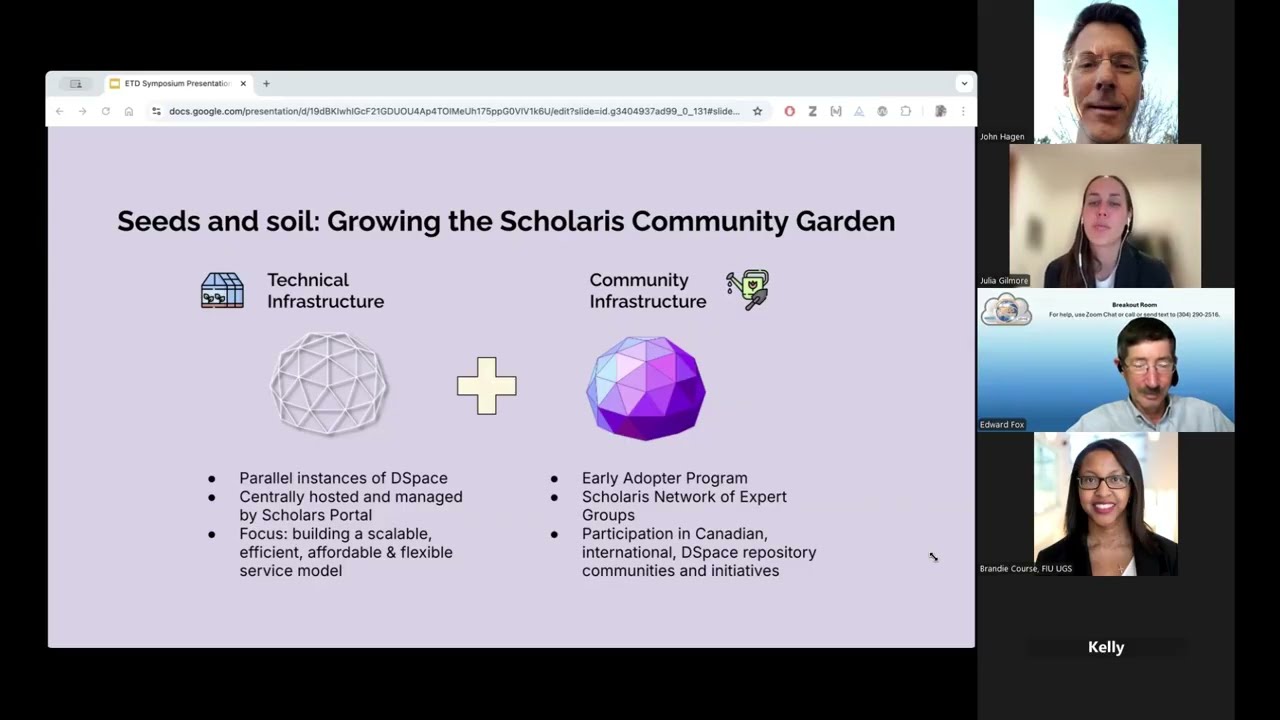
Julia Gilmore from Scholars Portal introduced Solaris, Canada's new national opt-in shared repository for electronic theses and dissertations (ETDs), which was developed in collaboration with CARL and OAL. Built on DSpace software hosted at the University of Toronto, this service utilizes a parallel instance model where each subscribing institution maintains its own branded sites managed through GitLab and Chef to ensure automated updates. While Solaris currently provides robust technical infrastructure and community support rather than acting as a centralized discovery layer, it fosters significant collaboration through expert groups coordinated by CARL, most notably the ETD Expert Group (SEG). This group was instrumental in conducting a comprehensive needs assessment survey that gathered insights from 41 Canadian institutions using various platforms to better understand the current landscape of ETD management.
The findings from this survey highlighted substantial variability in existing workflows, particularly concerning embargo management and file format restrictions within DSpace when compared to systems like ProQuest or Virio. Respondents expressed a strong desire for improved automated tracking of embargoes, enhanced capabilities for handling non-traditional theses such as audio and video files, better discovery features, and standardized submission forms. The assessment also revealed critical challenges in balancing copyright with open access policies, managing multiple stakeholders across graduate studies offices and libraries, and addressing staffing limitations required for mediated deposits. In response to these insights, the SEG is actively developing recommendations to address non-traditional thesis requirements, improve harvesting compliance for Thesis Canada, and streamline overall workflows while prioritizing feature requests based on collective feedback.
To support these goals, Solaris has adapted its service delivery by offering specialized training sessions on embargo management in DSpace and hosting community calls with experts from Library and Archives Canada and other organizations like Aerodyne. The initiative aims to advocate for improvements within the broader DSpace community to ensure scalable, affordable, and flexible support for Canadian institutional repositories. Technical plans include contributing an ETDMS crosswalk and namespace to DSpace following expert group recommendations, updating metadata standards created by NDLTD for upstream discovery, and developing documentation on recommended workflows using packaging tools like Staff Builder and Staff Creator. Furthermore, the Metadata and Discovery Group will review standard submission forms during their second term to align with all expert group recommendations, while institutional onboarding processes now include graduate studies staff in migration teams and repository communities of practice.
The session concluded by acknowledging key contributors, such as Pascal Kolarco from the University of Windsor who co-developed a survey for the SE Tech Group, and inviting further contact via info@scolaris.ca. An audience member noted that Canada's thesis system is enviable compared to the United States despite the diversity of platforms used, while Julia cited the Texas Digital Library as an inspiration for their documentation and community approach. Looking ahead, there are plans to contribute more resources once clarity is achieved on specific service details, with future directions including a closing ceremony involving ED leadership awards that will take place in another room or main Zoom space.
Read the full video transcript
Hello and welcome to session 16. We're
going to be talking about sharing
collaborative approaches and community
insights on ETD management in Canada.
Sharing this information with you is
Julia Gilmore from the scholars portal.
My name is John Hagen and I'll be your
moderator for the next 50 minutes. We
will reserve 5 to 10 minutes at the end
of the session for discussion. And a
quick reminder before we begin, um, uh,
please, uh, mute your audio, uh, and
feel free to use the Zoom chat tab to
ask questions which will be addressed
during the discussion segment. Thank you
all for joining us, and I'll turn it
over to Julia.
>> Great. Thanks, John. I'm just going to
share my screen if I see the right bar.
showing up. Okay, one second.
Okay, so hopefully that looks all right.
Perfect. I see a thumbs up from John.
Thanks. Okay, well, thank you so much
for for sticking around. It's the
evening here. Uh I'm I'm joining from uh
Toronto in Canada. Uh so, thanks for for
joining uh one of the last sessions of
the symposium. It's been a really
wonderful uh wonderful time over the
last two days. So, I'm grateful to to
get to join you today and to tell you a
little bit about a new shared repository
service in Canada that we're developing
called Solaris and also sharing some
reflections on developing the community
building blocks for the service.
So, my name is Julia Gilmore as as John
uh introduced me. I'm the digital
projects librarian at Scholarsportal
which is a department at the University
of Toronto Libraries uh and al also the
technical service provider for the
Ontario University Library Consoria
which is called OAL.
Perhaps more pertinent to tonight's uh
presentation, I am the librarian service
lead for the Solaris service which I'm
really thrilled to get to tell you a
little bit more about tonight.
Okay. So I'll start with a a brief
overview of Solaris. It is a new
national opt-in shared repository
service that aims to support open
discovery management, sharing and
preservation of Canadian scholarship.
So the ground was planted for Scalaris.
uh many years ago uh there were some
investigations happening both at the
regional and national uh level in Canada
exploring the feasibility of shared
institutional repository infrastructure
uh with members of the repository
community. So these various assessments
and feasibility studies confirmed that
there was strong interest and
opportunities for a shared model that
could provide a number of benefits to
repository uh staff and institutional
libraries including economies of scale,
centralized technical support and
collective resource development that
would also help address some of the pain
points in repository management uh that
were identified through the surveys and
also ensure that Canadian IRS remain
viable and attractive options for
stewarding Canadian scholars. ship. So
all of this kind of came to a head in
the fall of 2023. So I guess two two
years ago at this point uh when an
agreement was signed between the
Canadian Association of Research
Libraries uh which is called CARL the
University of Toronto and the Ontario
Council of University Libraries OAL to
develop this shared repository service.
Our role at Scholars Portal is as the
technical service provider uh for
Scolaris. We're building the
infrastructure, hosting the platform,
and managing the service uh using the
DSpace software. We're also running an
early adopter program uh over a two-year
period. The early adopter program I'll
I'll talk a little bit about um on one
of the next slides. And the goal of that
program is really to inform the
development of the service.
Complementing these efforts, Carl, which
is the Canadian Association for Research
Libraries, are leading the development
of the governance and financial model
for the service through an advisory
committee uh the shared shared
repository infrastructure advisory
committee and they're also coordinating
the Skeeris network of expert groups who
are offering key uh key guidance on
specific areas of repository management.
one of those expert groups, the ETD
expert group uh is what I'll be focusing
the second half of the presentation on.
Okay. So, as uh expected uh the
technical infrastructure is really a
fundamental component of the service. We
look at Solaris as having two pillars
technical and community infrastructure.
So, from the technical side, the service
model consists of hosting and managing
parallel DSpace instances using a
software as a service model. Each
subscribing institution receives their
own branded uh DSpace instance and that
consists of both a development site and
a production site and those are all
hosted on dedicated virtual machines on
scholars portal services uh at the
University of Toronto.
I won't go too far into the technical uh
weeds but uh I'll just share a little
bit about the model uh that may be of
interest. Uh so we keep the code in uh
gitlab and then we use an open source
version of chef which is a configuration
manager to automate the management of
the code to the various institutions uh
the various dspace instances and that's
how we roll out uh updates and upgrades
and sort of manage all of the the code
across the instances.
institutions have front-end access to
their own instances and backend access.
So, server command line access is all
restricted to the Solaris technical
team.
Any local customizations that the
institutions request and we know there's
lots of different customizations that
you can have on the institutional
repository, these get applied to that
centralized codebase and then they're
deployed to the various instances that
have made those requests using the
configuration management system. So,
this is a centralized service model.
It's very similar to how we deliver
other digital publishing services. At
Scholars Portal, we host a number of uh
of different services. We have a data
repository called Borealis. We have a uh
digital preservation service uh called
perafrost. We also host uh scholars
portal books and scholars portal
journals uh as well as a geo scholar geo
portal which is also a a geospatial
repository. So we have quite a bit of
experience although DSpace was was new
for us when we got uh into developing
Scolaris a few years ago. As the
technical service provider a primary
area focus for us is building
infrastructure that is scalable,
efficient, affordable and flexible
designed to meet and respond to diverse
repository scenarios and shared needs of
Canadian institutions.
And of course, Scolaris is more than
just the the technical pieces. Building
the strong uh building a strong
community infrastructure is just as
important. And this really continues to
be a significant focus so that we can
build a collaborative and dynamic
service that's really attuned to the
needs of our repository community here
in Canada and also uh aligned with
repository best practices, developments,
and initiatives um as well as
international sta uh standards and
that's happening on a broader global
scale.
engaging with our repository community
here in Canada as well as with the
DSpace community and the broader
repository community uh which we would
include folks on the on the call here
today. Um really getting to engage with
this broader community helps us better
understand uh what we can do from a a
service perspective and then also uh
what we can offer to Canadian
institutional repositories and also to
learn a bit about uh what those
repository teams want from a shared
service of this nature.
So I mentioned that DSpace is sort of
newer ground for us here at Scholars
Portal. Um and we know that we're
already stepping into an a thriving
repository landscape. It's a very
vibrant community and so our aim as we
as we join this community is to look for
ways where we can contribute to and
leverage the really great uh work that's
already happening within these networks
and ideally we can make some
contributions to those networks as well.
So thinking about some new approaches or
avenues that we can offer for knowledge
sharing support and collaborative
feature development.
So this is a very uh simplified diagram
of the Solaris service model uh in terms
of hosting multiple instances. Uh DSpace
doesn't have a multi-tenency model. So
uh we're hosting parallel instances uh
parallel instances of DSpace for each
institution.
So each institution here we have five
different institutions. uh they have
their own dedicated instance which we uh
kind of colloially refer to as being
powered by Solaris powered by the
Solaris infrastructure.
Scolaris provides technical and
community infrastructure and support uh
as we're hosting and managing each
instance.
It's uh maybe a kind of crucial point of
distinction is that Solaris is a
repository service but it's not a single
or a centralized repository platform or
a discovery layer. Although we are
participating in conversations about
what this could look like at the
national level, this is something that's
already uh also been identified in those
feasibility studies I mentioned earlier
that there is interest in having uh some
centralized layer or hub where uh there
can be an easy way to discover Canadian
research. Uh so while we're not that
discovery layer, we're participating in
conversations about what that could look
like and also looking at ways that we
could leverage uh leverage existing
cataloges or discovery services.
The feasibility studies I mentioned
earlier confirmed the need for a shared
repository solution that would be
scalable and responsive. And so the
Solaris model really aims to offer
flexibility for repository teams to
tailor their instance to their own uh
repository scenario and to meet the
needs of their scholarly community.
While we host and manage these parallel
instances, local repository teams still
maintain a great deal of autonomy and
control over their particular instance.
So we support uh many of the
customizations and integrations that
DSpace uh provides and we work with
institutions to add the various ones
that they want. Uh often that's things
like including institutional branding,
uh configuring DOI registration using
the data site API, adding external
authentication methods for login and
making uh various customizations to
submission forms depending on uh the
requests from the institution.
We don't make core code changes in the
service model, but we document those
requests and then we bring them to the
broader uh DSpace community. Sometimes
we'll make a ticket for it on GitHub or
we'll participate in DSpace uh
conversations that are happening,
whether that's the DSpace community
advisory team or the monthly developer
meetings
as we see more common needs emerge. Uh
and I'll talk about an ETD needs
assessment survey that we uh completed
with the ETD expert group a little bit
later because that definitely identified
a number of common needs and and sort of
pain points that we can look at. Um our
goal as we uh go through the program is
to uh dedicate more time to contributing
code upstream so that more institutions
not just ones that are scalar
subscribers can also benefit from these
improvements. Local repository teams
maintain responsibility for overseeing
the day-to-day operations of their own
repositories and they continue to be the
point of contact for their students,
faculty and other researchers, providing
uh local support and then administering
their own policies and procedures.
So we like to kind of describe Solaris
as helping repository teams support
their uh scholarly communities and
recognizing the really valuable and
crucial role that these local teams
continue to play. Um this is really
something that we uh we want to continue
to provide support to those repository
teams so that they can continue to do
this really fantastic work.
Okay, so I mentioned the early adopter
program uh a little earlier. This is
really one of the ways that we're
starting to put together those technical
and community pieces for Scolaris. So,
it's a two-year cohort-based program.
It's open to Canadian academic
institutions of all sizes representing a
wide range of repository use cases and
migration scenarios.
We're at the well, we're just over the
halfway mark now and we currently have
over 20 institutions that are
participating in the program in phased
migrations. The majority of these
schools that we've onboarded are also
live on their scalaris instance which is
really uh exciting. It's been a very
busy year. Lots of migrations from many
platforms not just e-space but errare
uh bress as well. So there's been a a a
lot of learning that's happening and
certainly we've had a really fantastic
time working with all of the
institutions who have joined us as we
develop this service together.
So some of the goals that are on the
slide here are to uh migrate
participating institutions to DSpace as
I mentioned uh and through that process
really understand what's needed to
support Canadian IRS from a service
perspective. Some of the expected
outputs of the program are to establish
efficient workflows for migration and
ongoing service delivery. Clarifying
what the Solaris offering includes. So
sort of what's the outofbox Solaris
offering versus what are uh available
customizations or optional uh support
identifying uh the required resources
and responsibilities uh for um not just
migration tasks but also ongoing uh
service and then determining the pricing
structure needed to operate this service
on a cost recovery basis. By the end of
the program next spring, we anticipate
that Scolaris will be fully operational
and ready to support broader adoption
from more institutional repositories in
Canada.
And there are a number of ways that we
engage with the community through this
program. We host monthly community calls
for early adopters. Uh we have working
hours and special interest sessions. And
all of these are designed as uh places
for dialogue between schools and our
Solaris service team as well as
functioning as an avenue for schools to
talk to each other to share feedback and
help uh not just shape the development
of the service but to also uh support
each other and share best practices,
workflows and resources.
And we're really thrilled that that on
these calls and and in these discussion
channels, participants uh frequently
share practical insights and local
resources for man managing their own
repositories.
This generosity and support that's
extended to fellow early adopters is
really a shining example of the
opportunities that exist for sharing
resources and knowledge within a
collaborative communitydriven service
model uh that we're hoping to build uh
with Solaris.
We've also set up a number of
communication channels to continue these
conversations, provide service updates,
and then also uh offer support as well.
In addition to the early adopter
program, the Canadian Association
of Research Libraries, there's the
acronym CARL, uh has convened three
expert groups to provide recommendations
and guidance on key areas of repository
management. So these are the expert
groups that I hinted at in uh a little
earlier on in the presentation.
These groups are vital in identifying
common use cases, developing practical
strategies, prioritizing
uh requirements for the service
development and a whole lot more. They
are very active. We are so impressed
with their outputs.
The opportunity for the Solaris team to
collaborate with the expert groups has
really brought critical perspective and
expertise to our initiative,
strengthening its direction and impact.
These groups are coordinated by a
visiting program officer for Carl uh the
visiting program officer at Carl for
Solaris and it's a a wonderful woman
named Gabriella Marcia from the
University of Calgary. She is fantastic.
Uh so I wanted to give a little shout
out uh shout out to Gabriella and the
expert groups all also include
representation from the scalaris team
who serve as ex officio members on each
of the groups. So on the side we have a
little bit of information about each of
the groups and then we'll talk more
specifically about the ETD group and
some of the work that they've done over
the [clears throat] last year. So the
first group is the Solaris metadata and
discovery expert group. This group is
focused on developing metadata
strategies and recommendations to
enhance the discoverability of
repository content. This includes
guidance on minimum viable metadata,
multilingual metadata, metadata cleaning
activities, uh pre and post migration,
uh some information on persistent
identifiers as well as taking a look at
configurable entities which is a new
feature introduced into the general
dspace in version 7.
They've been very busy. they have made a
number of recommendations and published
those. Uh you can find links to all of
the outputs that have been published
from the expert groups. Uh and maybe we
can put a link in the chat again uh to I
can probably drop it in here
uh if you wanted to see a little bit
more about uh some of the
recommendations that uh I've mentioned
from the metadata group and then also
from the ET ET group. So that is the
second group. The ETD group or SEG works
on the migration and integration of
electronic thesis and dissertations into
the shared infrastructure as well as
providing guidance, recommendations and
advice on requirements and
considerations related to ETBs.
The last group is the Solaris Digital
Preservation Expert Group or SDP. Uh it
was established a little later on uh
than the first two groups. uh and it was
established to provide the Solera
service team and community with
guidance, recommendations and advice
related to digital preservation planning
requirements and pathways that would uh
both support the longevity of Solaris as
a service and ensure that the
preservation offerings uh within the
service reflect the preservation needs,
priorities and capacity of member
institutions.
So the first two groups began uh in
March of last year and the digital
preservation group started last August.
Each group consists of about 8 to 10
members from the Canadian Repository
community who have generously
contributed their time, expertise, and
insights to the development of the
service.
These groups have made a significant
impact in a pretty short time in just
over a year. Uh and they've already
released a number of recommendations uh
which you can find. Uh there's a
scolaris collection uh well and it makes
sense at the University of Toronto's
institutional repository which is called
Tespace. So you'll find all of the
published recommendations there as well
as some information from our service
team uh including a migration guide.
But really our focus today is to share
share uh to shine a light on some of the
impressive work and findings from the ET
ETD group or SEG. While the group's
outputs are attuned to the scalaris
context uh and designed to support
subscribing institutions, we really hope
that the guidance and insights shared by
the group have broader relevance uh and
will prove useful to the wider
repository community.
Okay. So, uh on this slide I'm just
highlighting a few of the areas of focus
based on the uh deliverables for the
group. uh they've really been uh working
through all of the many complexities
that surround uh ETDs uh and some of the
deliverables and areas of focus or
conducting a needs assessment survey to
learn more about the ETV lands uh
management landscape in Canada uh to
prepare uh some recommendations on uh
requirements for harvesting ETDs into
thesis Canada which is a uh thesis and
dissertation harvesting program that's
operated by the National Library and
Archive here in Canada.
Preparing recommendations specifically
around non-traditional or non-extual
thesis
reviewing standards adherence and making
recommendations.
Summarizing uh ETD review workflows uh
both in and outside of DSpace and then
identifying best practices and relevant
resources related to ETD management and
migration of ETDs into the Scaleris
service.
So as the group uh started their work
together, they determined uh they had
all of these deliverables, but they uh
kind of stepped back a little bit to uh
determine that they really needed a
deeper understanding of the current ETD
landscape in Canadian institutional
repositories in order to make meaningful
recommendations that were grounded in
practical realities.
So the information gathering uh stage
was was uh was really the first part of
their work and one of the big ways that
they did this was through a needs
assessment survey. So the rest of this
presentation will share uh the approach
uh that the group took in preparing the
survey and some of the key takeaways
from these efforts.
The aim of the survey was to ask members
of the repository community in Canadian
academic libraries about current
perspectives and approaches taken for
ETDs in their own IR. Responses from the
survey informed other recommendations
made by the group and assisted the
service team in understanding the
functional requirements for ETDs and the
identified needs of the repository
community related to these materials. So
you can see some of the goals of the
survey were to provide a snapshot of ETD
management in Canadian IRS, identify
some of the opportunities and perhaps
pain points related to managing ETDs,
identify functional requirements, what
are some uh popular or desired features
that would make ETD management a little
more uh streamlined, and then identify
areas for greater alignment across the
repository community. and with that also
identify areas of focus for the Solaris
service team and and inform some of the
other recommendations.
So that survey was doing a lot of work
as you can see from the goals here and
we were really pleased with the
responses that we uh that we got. So I
will uh kick things off with a short
introduction uh a short overview of how
the survey was uh put together.
So the survey was created in Google
forms and then it was distributed
through several channels. So we use
various list serves. Uh we have a blog
with this valeris service. Uh there is a
scholarly communications mattermost
channel uh or mattermost platform I
guess uh which is an open source version
of slack that uh is used quite a lot by
the repository community here in Canada.
And then we had some various other uh
channels here at scholars portal that we
used to send the survey out. So the
survey was open for three weeks. Uh it
ran from the end of October to mid
November last year. Uh and we received
41 responses. So uh roughly
threequarters were responses from
English institutions and then the other
uh quarter were from French institutions
which was really nice to see uh that
there was a good number of responses
from French language institutions as
well as they identified some of the
multilingual uh needs in areas where
there could be better support for uh
managing ETDs and and other areas where
there could be more multilingual support
within the DSpace platform.
We were also really pleased with the
representation of responses across
repository uh platforms. Uh the
responses were sort of evenly split
between uh institutions that were
already part of the Scolaris early
adopter program or planning to join and
then also from non-scaleris
institutions. And so it does uh track
that we would see some representation
from other repository platforms, not
just DSpace. We had responses from uh
repository teams that were uh on island
errints bress fig share san and uh a few
custom uh repository solutions. So this
was really helpful as it gave us
valuable points of comparison uh
especially thinking about some of the
ETD functionality that was in place for
nondespace platforms particularly as
some institutions are going to be
joining the service from those
platforms. It gives us a sense of what
they might expect when they come over to
DSpace and and maybe where DSpace might
have certain features uh that their uh
current platform may not have or uh or
vice versa. Uh so really this also
helped us uh identify and highlight what
institutions like or don't like about
their current systems and how DSpace
compares to those platforms. also have a
a small uh graph here showing that the
responses were spread across uh CRKNB
band. So the Canadian research knowledge
network uh has a banding system that's
used here in Canada to group member
institutions for comparison and vendor
pricing and it's based on uh a three
different parameters. So looking at
sponsored research, student enrollment
or FTEES and then full-time faculty.
So from the the graph uh we can take a
look and see that we had uh most of the
responses uh coming from mid to largesiz
institutions but we still had a good
number of responses from some of the uh
smaller institutions as well. And this
was one of the things that we also uh
wanted uh when we developed the early
adopter program was to work with
institutions of various uh size,
capacity, uh small and large repository
teams is that gives us a kind of good
overview of all of the different
repository needs and we know that they
vary depending on how much staff you
have and and sort of what the
involvement might be like from the grad
studies office and the library team. So,
we're really grateful to all of the uh
members of the Canadian Repository who
provided really thoughtful and detailed
answers. There were about 20 questions
to go through and there was an amazing
amount of of feedback that we received
with the survey. The input from uh from
respondents gave us a a great deal of
information to discuss and really
directly inform the recommendations that
we were able to make. So, here are some
key takeaways from the survey.
Something that really uh came across was
that there is just so much variety in
how institutions are managing ETBs uh
particularly managing embargos. This
came up quite a bit and we asked a
number of questions particularly aimed
at learning more about embargo
management for ETBs.
There isn't really a one-sizefits-all
approach for how ETDs are managed uh in
institutional repositories. And uh for
folks that are joining the session, that
may not be a surprise to you. wasn't
necessarily a surprise to us, but it was
really helpful to to see that laid out
and sort of borne out from all of the
different responses.
The survey also revealed that that
repository teams are using lots of
different tools and processes to manage
their ETVs and that this management is
not just happening within the repository
platform. So, some schools are using uh
spreadsheets. They're using Excel.
They're using uh forms that they've
created. Some have developed uh have
locally developed software or
administrator tools. Some are using uh
an ETD management software platform like
ProQuest ETD admin or Virio. And then
there are varying levels of integration
of how those custom tools are custom
tools or platforms then integrate with
the repository. uh for example, ETD
admin and DRA both integrate via sword.
Uh but something like the spreadsheets
or the forms, all of that is sort of
happening outside the repository and
there isn't necessarily a a sort of
streamlined way to communicate the
information on those spreadsheets and
have that uh be reflected within the
repository platform.
And uh more than just the tools, there
are often many different stakeholders
that are involved in the ETD workflow at
various stages. Some work happens within
the graduate studies offices, some
within the library and in some cases
central uh central IT is also involved.
Uh so there are a lot of actors involved
in ETD management, maybe a lot of cooks
in the ETD kitchen. Um and the role that
each group play uh plays tended to vary
across uh cross respondents uh to the
survey. So for example, some repository
repository teams are doing significant
metadata curation or remediation for
ETVs while at other institutions most of
this activity is happening in the
graduate studies office and the ETVS are
then uh coming to the coming to the
library staff and the repository team in
batches that are then just uh ingested
into the IR.
We also saw that there was great variety
in levels of complexity regarding
embargos and how they are applied and
where they are applied. Sometimes this
was happening outside of the repository.
Uh so in some cases ETDs are just kept
ETDs that have an embargo applied to
them are kept elsewhere. They're not
even put into the repository until the
uh lift date passes and then they go
through uh the process to be uh
deposited. [snorts]
Whereas other uh other respondents
indicated that they are using the
embargo functionality of their uh
respective repository software. The
level at which embargos are applied also
varied. Uh some uh repository teams
apply embargos just to the files
themselves while others prefer to
restrict the entire item. With that
level of complexity and granularity, it
makes sense that uh there was a strong
desire for better embargo functionality
uh within repository software. Uh this
came through a number of times in the
survey and that uh included requests to
make it easier to manage different types
of embargo requests. Um in DSpace you
have to do that with resource policies
instead of um adding embargo in the
metadata. You can add embargo
information in the metadata, but it
won't convert into a resource policy
unless you've uh you've explicitly
assigned a policy. Uh and speaking on
behalf of uh the Scalera service team
and managing a number of migrations from
non-despace platforms, that sort of
separation between embargo information
and metadata and embargo information in
something called resource policies in
DSpace terminology uh can take a little
bit of time to kind of wrap wrap your
head around. It's not always easy to
know how to apply a a resource policy.
There are a lot of different files that
might be attached to a single item. And
so it's also uh can be sort of uh
challenging to understand how DSpace
manages embargos and how to also then
show others on the library team how to
do that uh management.
Some of the other uh requests were to
make it easier to identify which items
have embargos and when those embargos
are going to lift, making that
information available not just to
repository staff but making it visible
uh visible in the interface as well for
end users and then finding ways as well
to automate embargo processes and
tracking. So respondents uh also asked
for custom date ranges for example
automatically lifting embargos after a
set period say after one year or after
two year instead of a specific date. Uh
many of these feature uh requests were
uh coming from institutions that either
were migrating to DSpace or were already
on DSpace and we know that there are
some pain points around embargo
management with that platform. Uh we
also know there's some improvements
coming in future releases uh like adding
the embargo date on the simple item
page. Uh so this feedback was really
helpful uh to get a sense of what to
prioritize in terms of uh in terms of uh
upgrades and also uh what we could uh
present to the DSpace community in terms
of uh more improvements that uh would be
beneficial to a greater number of
institutions.
Lastly, another uh key takeaway here on
the slide was the uh was the sort of
balance or tension between uh making
recommendations or or requirements
around format restrictions. About half
of the schools require certain formats
uh for ETPs uh or restrict what types of
formats can be deposited while the other
half make recommendations or indicate
preferences but they do not limit with
which formats are accepted.
It can also be a challenge to be be that
restrictive around file formats when the
platform itself does not impose those
restrictions. Uh so we heard from some
uh respondents that their software
allowed them to restrict what types of
formats could be deposited. But in
DSpace you really can deposit any file
format even if it's known by the system
or not. The only limitation is often
through the interface the file size.
Some respondents spoke to this uh in
their in their survey responses saying
that even with their best efforts, some
unknown or inaccessible uh files will
sneak through and get deposited. So, it
requires a little bit more uh content
curation on the repository team when you
can't make a restriction around
requiring just PDF or PDFA for example.
So I I talked about uh some of the uh
information we learned about embargos.
This is a very uh cursory uh chart here
to show uh what kind of emerged from the
survey. Uh when uh when repository teams
were managing embargos within their
repository, file level embargos tended
to be the most common, but there were
also significant group of teams that
also applied embargos at the item level.
In some cases, the application of a file
or item level embargo will depend on the
type of item or the collection. In
DSpace, you can uh apply a file uh you
can apply an embargo on any of the files
or at the item level. Uh but for other
repository software, you may not have
that level of granularity.
We also asked in the survey where ETDs
from Canadian IRS were being harvested.
So where they were uh uh where
institutions were focused on making
their ETVs discoverable. Library and
Archives Canada which operates the
thesis Canada harvesting program was the
over overwhelming uh top answer from our
uh survey respondents with some
repository team saying that they uh
already had their ETDs harvested there
while others were planning to set this
up uh and potentially this was part of
what they were looking to do when they
migrated to Solaris.
Thesis Canada is a collaborative program
between uh Library and Archives Canada
and Canadian universities. And the
program strives to acquire, preserve,
and provide access to thesis and
dissertations published at Canadian
universities by harvesting ETDs using
the OI PMH protocol. After LAC
harvesting, ProQuest, Open Air, uh and a
various number of library cataloges were
also mentioned uh by respondents. uh and
most of those again are using the OI PMH
protocol.
We also asked uh what are some of the
biggest challenges related to ETDs in
IRS? Uh and there are a number of them
on the on the uh slide here. Uh some
folks uh mentioned uh challenges with
balancing rights around copyright CC
licenses with institutional policies
that require open access to ETDs. Uh we
heard some of the challenges with uh
managing and providing guidance on
various uh formats as well as uh not
just file formats uh not just file
format uh recommendations but also
looking at uh providing access to
formats that were suitable for
preservation as well as how to uh sort
of uh approach non-extual ETDs uh and
perhaps their supplementary files as
well and to think about uh how you would
enter a non-extual ET ETD and all of
these other uh elements that uh how to
structure an item for a non-extual ETD.
We heard a little bit about some of the
challenges with managing uh restrictions
and permissions. Uh some challenges with
discovery. So how to surface
relationships between uh various files.
This was something that came up with the
non-extual ETDs in particular. Uh also
supporting discovery for those types of
materials.
looking at some challenges related to
accessibility or non-compliance with
accessibility standards. Managing
disperate requirements for metadata that
may be coming from grad studies or the
or the library cataloging team. Uh
issues with managing multiple
authorship. Establishing and maintaining
stable links to supplemental data that
might be stored externally, say a data
set in a data repository, as well as
managing persistent identifiers.
response uh respondents also indicated
that staffing capacity to provide
mediated deposit or support for self
self- deposits uh was often a challenge.
Even ensuring that all of the ETDs were
deposited into the repository meant that
there was uh some considerable work uh
in terms of uh management from the grad
studies office as well as the library
team.
There were uh there were also some
challenges related to the lack of
standardizer best practices for metadata
and then also keeping up to date with uh
various open access trends and IR best
practices and managing interdep
departmental workflows when there are
these various uh uh various stakeholders
involved in management of ETDs.
There are some desired features that
came out of the survey as well. So, uh,
being able to set up review workflows
for content. Uh, DSpace already has this
functionality as well as batch editing
and uploading options, which are really
popular and and have helped, uh, quite a
bit with ETD management, particularly
during busy convocation periods. The
ability to automatically register DOIs
which DSpace has via the use of the data
site API was also a popular feature and
we started working with a number of
schools who are starting to assign DOIs
uh for their ETDs which is an added
benefit for students uh and also makes a
good deal of sense because this type of
content is often unique to the
institutional repository and so that
articles or thesis is unlikely to
receive a DOI elsewhere say from a
publisher.
We also heard some opportunities for
ETDs uh and sort of more broadly within
the community that there were uh some
really exciting opportunities
particularly around developing a shared
service to collaborate more on sharing
best practices and have conversations
about how we could collectively improve
discovery of ETDs, adopt metadata
standards, uh look at uh standardized
submission forms for ETDs across
repositories again supporting uh
interoperability and discovery of those
ETDs downstream.
and then looking at uh some best
practices for deposit workflows and
standard uh sort of standard methods of
uh depositing ETDs into the repository.
There's a clear need uh from respondents
to that there was interest in seeing
what other institutions are doing and
what's working best for them. So the ETD
uh group really uh found a lot of value
from the survey responses and and that
really helped inform uh a number of uh
the deliverables that I mentioned
earlier. So uh recommendations uh
metadata recommendations for compliance
uh with ETDs being harvested in the
thesis Canada program recommendations
specifically looking at non-traditional
or non-extual ETDs. uh that includes
describing some of the challenges that
came through in the survey,
[clears throat] flagging some
limitations related to non-traditional
thesis and then outlining some
preservation considerations and special
requirements. Uh and this group, this
subgroup is also making recommendations
to the broader repository community as
well as the Solaris service team. So
those uh recommendations are about to go
out to the community for feedback and I
think uh they will be very uh very much
appreciated uh based on what we heard
from the survey.
The group is also uh using responses
from the survey to identify different
workflows. We asked for workflow
diagrams and we received a few of them
from uh some of the institutions. So
that's helping us sort of map out some
ways to bring content uh into the
repository.
And then building off of the success of
the ETD survey and the high response
rate, the digital preservation group
also undertook their own survey that
went out earlier this spring, which uh
built off of some of the responses uh
from the needs assessment survey that
the ETD group did uh but dug into some
of the questions in more detail. So the
goal with the preservation survey was to
look uh similarly to the ETD one uh
provide a snapshot of digital
preservation in the Canadian repository
content uh surface where repository
teams need guidance and support and then
identify some areas of work for the
group. Uh and we know that uh
preservation is also very much connected
to uh long-term access to ETDs. So it's
nice to see that these uh these groups
are also building off of uh off of the
work that they are doing within their
group and then uh collaborating
together.
The responses have also uh have also
informed a number of uh work items for
our service team. We've learned a great
deal from the ETD survey. Uh this
feedback really helped us prioritize how
we can provide support to institutions.
So for example uh now during the
migration and onboarding of of
repository teams we offer a separate
session to specifically go through how
to manage workflows in DSpace and how to
assign embargos within the interface.
We've also hosted community calls on ETD
related topics that came up most in the
survey. So we had guests from LAC as
well as another uh harvesting program in
Canada called uh Aerody. And then next
month we're welcoming folks uh that uh
developed the VIO ETD management
software. So it's really nice to to get
to uh respond to what we heard from the
survey and and to uh tailor our service
our service delivery to meet those
needs.
We also uh identified some platform
improvements that came out from the
survey. So, we've kind of kept a running
wish list of feature requests that have
come up uh either through the survey uh
or through our our regular check-in
calls with subscribers and early
adopters. And this survey really helped
give us a wider base of representation
so that we can advocate for improvements
to the DSpace community and and we're
not just saying there's one institution
that was interested in this. we can now
kind of have even more of a of a
collective pitch to say that we've heard
from 40% of respondents in the survey
that this is a feature that they'd like
to see. We have over 20 schools that
would would love if it was easier to
manage embargos than the DSpace
platform.
So looking ahead uh we know that ETDs
and ETD management and IRS is not
static. There is a lot uh of ongoing
work that is happening not just in the
Canadian repository community. This
symposium is a great example of all the
really fantastic work that that everyone
in the community is doing to make ETDs
more discoverable and usable. So I
highlighted some areas that we're
looking to focus on here. Um,
one of the one of uh maybe I'll
highlight one of uh these here as we're
coming to time is that uh we we are
going to be contributing the ETDMS
crosswalk and namespace to DSpace. We've
assigned oursel this ticket here at
scholars portal. This was a
recommendation that that has come from
the ETD expert group as well as the
metadata group. uh it's currently not a
default registry in DSpace and so you
need to add the thesis namespace or
ETDMS namespace manually on a per
instance basis. We've also committed to
update the crosswalk so that thesis
specific metadata can be pulled in and
discoverable upstream. both
recommendations or sorry both
improvements that will make it easier to
take the recommended approach of using
the ETDMS standard which is created by
our lovely conference host NDLTD or
Noodle TD maybe Ed was um using so we're
really uh we're really looking forward
to be able to contribute that to the
DSpace community uh we're looking at uh
the standard ETD submission form so the
metadata and discovery group is going to
be looking at this in their second uh
year of their term. We're also looking
at uh some opportunities to put
documentation together on recommended
workflows. So, putting some
documentation together on how to use uh
different packaging tools uh like staff
builder and staff creator to bundle ETDs
and bring them into the repository uh as
well as uh also uh using consistent
metadata. So all of the expert groups
are looking at metadata in some capacity
and so uh looking for areas to align
those recommendations uh in the
submission form is one way that we can
uh help standardize metadata for greater
discovery of ETDs.
We also are uh recommending that there's
uh when we do when we uh onboard
institutions, we're also sort of um
recommending involvement of grad uh
graduate studies staff uh both uh in
migration teams and in uh the repository
community of practice. So we started
recommending their participation when we
on board institutions and then we also
have representation from uh some grad
studies uh
uh some uh grad uh studies staff on the
ETD expert group for the second year. So
it's great to have that perspective as
well.
So we're quite busy. There's always lots
to talk about. I feel like these
presentations go by very fast. Um, but
before we go, I wanted to highlight and
thank the members of the SE tech group,
which are uh who are all listed on this
slide. We really couldn't do this work
without these really lovely, incredible
folks who've contributed their time and
expertise to build a bright future for
showcasing Canadian scholarship,
including ETDs. Uh, and to provide the
benefits of their insights not only to
Scaler subscribers, but to the broader
repository community and their
researcher publiclix. I would
particularly like to thank Pascal
Kolarco from the University of Windsor
uh who is my fellow needs assessment
subgroup member who co-developed the
survey and analyzed the responses.
If you have any questions about Solaris
or you'd like to learn more about the uh
fantastic work of the SEG group, we
would love to hear from you either
during the symposium. We have a few
minutes for chat maybe. Um, but if uh
it's not during uh during this session,
we encourage you to get in touch by
emailing info@scolaris.ca.
>> Well, thank you so much, Julia. That was
very enlightening. And I will tell you,
having been in this business for almost
30 years, well, yeah, pretty much 30
years now, um the Canadian thesis
ethesis system has always been the envy
of myself and our my colleagues in the
United States. I think [clears throat]
maybe we'd never get there in the United
States. You'd be like hurting cats. But
looking at the endeavor of you having to
deal with so many different
institutions, doing so many different
platforms, and then integrating that
into your national repository on a
DSpace environment is truly amazing.
Thank you so much for for sharing all
that information.
So I'd like to ask the audience if we
have another minute or so, two minutes.
Um yeah, somebody says, "Cats on
catnip." I understand. Um, so any
comments, questions or concerns for u
Julia?
Please raise your hand or uh type
something in the chat.
We'll give folks a moment here to gather
their thoughts. Dr. Fox, did you have
anything to offer?
Um just a question whether Julia knows
of other groups that have taken a
similar approach and are serving a
community of of practice in some other
region elsewhere.
>> Well, we are always inspired by the
folks from the Texas Digital Library. Uh
I know that they have they had done a a
survey to their members on I think
embargo policies. They did had a poster
at open repositories this summer and
they they are always sort of our
inspiration in terms of the
documentation and the community that
they have developed. They've been around
probably 20 years I would say. So we're
just getting started but it is really
nice. uh they've always been very uh
warm and welcoming in in sharing their
documentation. And um as we kind of go
through and and um have more clarity on
on what is all involved in the in the
service and and our documentation, we
definitely want to contribute more of
that uh more of that back as well.
>> Great. Thank you, Julia. Um anyone else
for the good of the order? We are at the
witching hour here.
So I would encourage you to stay in
touch with Julia. Julia stay in touch
with us is a wonderful enlightening
presentation. Um thank you so much. Um
I'm going to usher us into the final
segment of the day and of the
conference. Um we're going to have a um
a closing session involving our ED
leadership award uh ceremony and um the
future directions. We have an official
announcements to make. So, um, we're
going to shut down this room momentarily
and, uh, so if you're here, you'll get
sent over to the other room or just join
me and navigate over to the main Zoom
room. Thank you so much, Julia. And
please, everyone, help me to thank
Julia.