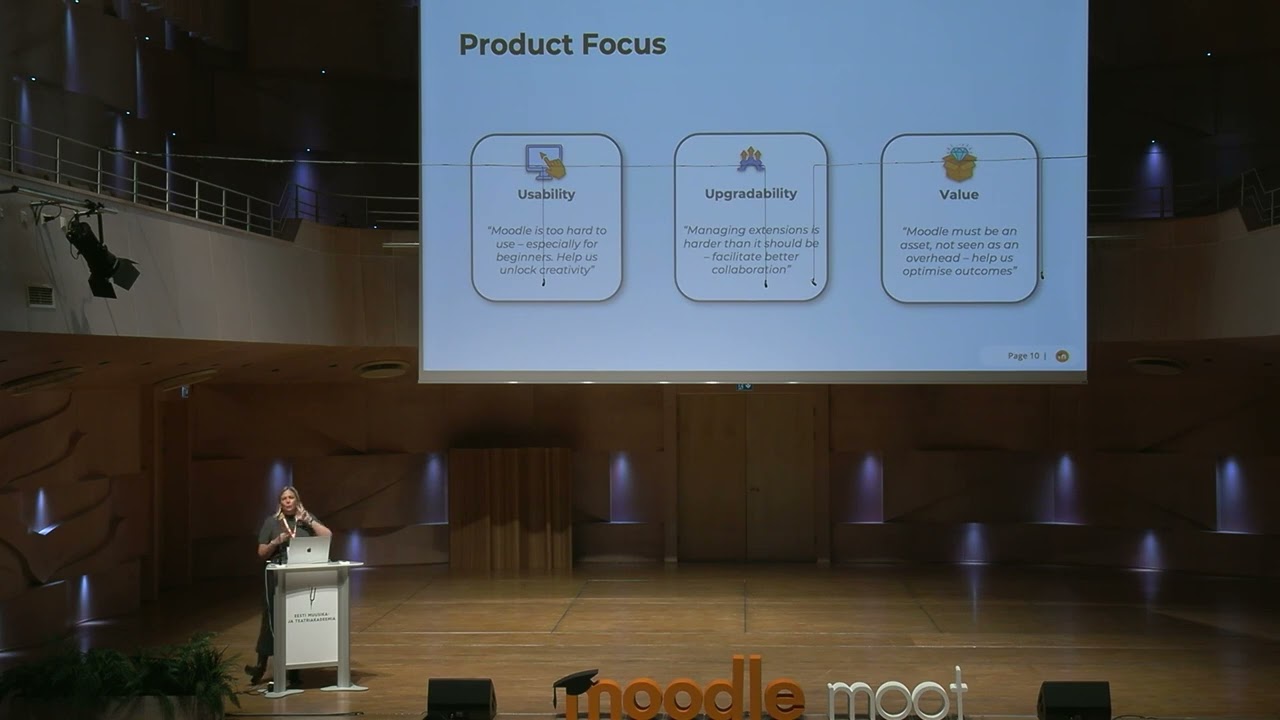
Video summary
At Moodlemoot Estonia 2026, Marie Ashure, Chief Product Officer at Moodle HQ, outlined a strategic vision for the platform that honors its twenty-four-year foundation in social constructivism while embracing modern technological demands. The presentation emphasized an approach where artificial intelligence serves as an optional enhancement rather than a mandatory requirement, allowing institutions to select their own Large Language Models and maintain strict data privacy standards through the new "AI your way" subsystem. This strategy is particularly relevant for major organizations like NASA, which rely on Moodle's accessibility-focused architecture instead of proprietary AI services that may compromise user control or security.
To support this evolving ecosystem, Moodle is undergoing significant technical transformations aimed at simplifying upgrades and modernizing the user experience through a new Design System and Composer-based codebase management. The roadmap includes distinct product lines: the core LMS will continue its six-month release cycle with features like improved activity pickers and bulk actions in versions 5.1 and 5.2, while version 5.3 introduces multi-tenancy support to better serve large institutions managing multiple campuses or programs. A new Moodle Workplace solution is also being developed specifically for complex organizational needs, offering advanced automations for course enrollment, credentialing, and AI-driven skills development tools that can be migrated from standard LMS implementations.
Beyond the core platform updates, significant investments are directed toward learner engagement through a revamped mobile app focused on specific student needs and a new Marketplace launching in late June or early July to replace the legacy plugin directory with stronger governance and security reviews. A key functional innovation highlighted is the proposed "Programs and Catalogues" feature, which will allow educators to organize multiple courses into cohesive sequences leading to accreditations directly within the platform. This capability addresses a current gap by enabling learners to track their entire educational journey without needing external tools to manage program progression or certification pathways.
The session concluded with insights from internal initiatives designed to foster community growth and technical stability, including a dedicated Community Contributions Team to guide external developers and ongoing efforts to streamline deployments. The Q&A segment further clarified the benefits of migrating between LMS and Workplace environments, reinforcing how these updates collectively aim to optimize learning outcomes through demonstrated return on investment while preserving the platform's core educational values. Ultimately, Moodle is positioning itself as a flexible, secure, and future-ready environment that empowers institutions to shape their own digital education strategies without being forced into rigid technological constraints.
Read the full video transcript
Hello everyone. Um, it is wonderful to
be here with you all in this beautiful
country. It is my very first time in
Estonia and the visit has been wonderful
so far. Uh, for those of you who don't
know me, my name is Marie Ashure and I
am the chief product officer at Moodle
HQ. Um before I start with the
presentation that's going to be focused
on telling you a little bit about what
we've been doing in the products team um
a bit of a showcase on our AI strategy
and what's coming up next for uh the
Moodle product suite. I wanted to say a
a very thank you to professor for your
wonderful opening. I think you expressed
the relevance of Moodle in today's world
better than I ever could. So that was
wonderful. Thank you so much. Um, thank
you to Lucy and Polio for that beautiful
introduction. Um, and especially thank
you for all of the work the Vexter team
has put in, but also the community has
put into making this event happen. Thank
you to Taltech for hosting us in in what
is one of the most beautiful rooms I've
ever had the honor of speaking in and we
really appreciate it. And thank you to
all of you for being here um for being
part of the Moodle community by
attending a moot. you are an official
member of the Moodle community. Even if
it's this this is the only thing you
ever do, uh you have ticked the box on
the Moodle community. Um and this Moodle
community has been in existence really
now for 24 years. Uh Moodle has been
what I think the best Moodle the best
LMS uh builder in the market for all of
these years. And um from the very
beginning Moodle was created um with the
philosophy of social constru con oh gosh
social social construct where I can't
ever say that word that and pedagogy
which is a real problem in my career um
but social construct which is the
concept of bringing people together to
learn that the the idea that people
learn better when they can exchange
ideas, see how each other learn and have
collaborative work that helps them
elevate their learning. Um, we've been
doing this for 24 years and I have been
in my role for four and a half and I
just thought I'd double check to see how
does that compare to the journeys of the
people who are in this room. So, anybody
is this are you brand new to Moodle?
Anybody here brand new to Moodle or have
not really started using it yet? Let's
see if anybody puts their hand up. This
is very rare. Yes, I'm not surprised.
Less than a year or a year. About a
year's worth of Moodle experience. Oh,
one, two, three. Okay, getting there.
About five years. Who's in the room that
recognizes five?
That's okay. That's a good average.
Usually this is the highest number.
About 10 years.
Yeah. And then we'll go to the 15 20
years. Anybody in 15 20 years? Oh my
goodness.
That is way more than normal. Usually
it's 10 that gets the most number of
years. You are dedicated moodlers. I'm
not going to teach you anything today.
I'm very sorry. You might as well go and
have some more coffee.
Fantastic. Um, but I'll I'll still I'll
start with a bit of a journey about
Moodle because I do think it's important
to kind of put the context of, you know,
why we're all here and and what is this
big thing called Moodle? Um, and one of
the things that makes Moodle Moodle is
the fact that we pioneered a lot of the
features that today in LMS's feel like
they're normal. Like you you don't have
an LMS without question banks or forms.
Um, but those things didn't exist until
Moodle and its community created those
and and included those in an LMS. And
it's why from the very beginning
institutions that were serious about
teaching and learning chose Moodle as
their digital learning platform and it's
why they still do it today. And you can
see that in the reflection of our
customer base. Um I've put some logos on
on on the screen there, but these are
some of our the biggest institutions,
biggest universities and biggest
government departments in the world. And
they all choose Moodle to teach and
learn. And that's because they trust us
to look after their interests better
than most. There is one logo that is on
this um slide that I really want to
highlight.
It's that one called NASA and con like
if we consider what's happened recently
uh in in the universe. Yes, Moodle helps
people put put people on the moon.
Absolutely. It's really exciting. It's
my favorite logo. Um, and whenever I
think about it and when I was watching
the the astronauts on Artemis doing what
they did, I felt this little special
pride in the work that we do at Moodle
more than normal. I'm always very proud,
but that was a very special moment for
me. Um, our customers, the big
institutions are not the only people who
love Moodle. One of the biggest things
about Moodle is our community. Um,
question for the audience again. How
many of you, if you know, know if your
Moodle site is a registered Moodle site?
Thank you. Well done. Everybody else,
you need to register your site.
If you register your site, you are
counted as one of these 154,000 Moodle
sites in the world. Um, we have over
half a billion registered users that use
Moodle platforms. And that's only the
registered numbers. There are a number
of Moodle sites that are not registered.
And there's an argument to make that
there's potentially almost a billion
people who have accounts on Moodle
platforms around the world. Um, even at
just 500 million, that's about 6% of the
whole population. It's massive, right?
And you know, it's because of Moodle's
gravitas and and and the fact that we've
pioneered true learning and teaching
within our platform for so long that we
have this space. It's very very
important. Okay, that's where we've come
from. Now, I'm going to talk a little
bit about where we're going. Our product
vision. So, as I said, um I'm the chief
product officer for Moodle HQ. And what
does that mean? Well, I have the
absolute pleasure and honor of leading
the team of about a hundred or so people
who together with our community design,
build and maintain all of Moodle's
product suite, which which includes
Moodle LMS, which is the famous one, but
also Moodle workplace, our Moodle mobile
apps, our Moodle cloud proposition, and
your home for learning anything you need
to know about Moodle, which is Moodle
Academy.
Um, we do our jobs following a few
different things and one of them is some
key principles that I like to call
non-negotiables about how we think about
development in the Moodle platform. uh
which is to say that when we are doing
new work um we will not release that new
work or that new functionality if we
can't assure ourselves uh that we have
made it as secure as respectful of data
privacy and as accessible as we possibly
can. Now I won't say that we always get
this right. Uh it is impossible not to
uh you know f have pockets of things
that we don't get right. But it is a key
priority in all of our development um
all of our development philosophy. Um
and I think this the aspect of data
privacy in particular and importantly da
d d d d d d d d d d d d d d d d d d d d
d d d d d d d d d d d d d d d d d d d da
soy uh at this time in the world is is
more relevant than ever and it is a
responsibility that we to take
incredibly seriously at Moodle HQ. Um
the other thing that focuses our work in
product development is our product focus
areas. So the product principles are the
non-negotiables and the product focus
areas uh have been chosen based on
feedback from our users and effectively
a couple of years ago we did a huge
piece of research and we we asked tell
us tell us how we can make Moodle better
for you and there were three key themes
there are thousands and thousands of
comments and feedback but if you boil
that down there's three big things that
people asked us to do firstly mood's a
bit too hard to use um it is so rich in
function functionality that that
richness has an offset that makes it a
little harder than it should be once in
a while. So in any way that you can,
please modernize and please make the
learning and teaching experience that
people have with Moodle more
userfriendly and more intuitive. That
was problem number one that people asked
us to tackle. Number two, people's
Moodle's a little bit too hard to
upgrade. Um you want to keep up to date
with the most recent versions of Moodle,
but doing so takes a long takes a lot of
work and it's not as easy as it should
be. figure out ways that you can make
that easier for us so that we can stay
updated, have a secure system and
benefit from the latest features that
are issued by the the Moodle product
suite. Uh and so that's the second big
thing that we're focusing on. And the
third one is is an allencompassing one,
but in a world where LMS's are no longer
optional for learning institutions or
large organizations,
you have to be able to demonstrate real
value. You want to demonstrate an return
on investment in terms of the value that
the platform provides to the learning,
teaching, educating, training
experience. And what we need is to be
able to optimize learning outcomes and
training outcomes. And so create a
platform that really allows us to do
that. That was the feedback that people
gave us. And these are the big focus
areas that we then leverage um to think
about what we prioritize, the the effort
that we put into creating the platform
and the things that we um choose to do
versus those things that we choose not
to do because that is always a very
important trade-off when you're building
software with a a fairly small team.
And then the other big thing that's
impacting or affecting our vision right
now is AI. uh and it can't not of course
it is the biggest shift in tech in the
tech landscape since we started um
Moodle was started in a world where the
internet was new uh that was what kind
of gave Martin our founder the first
kind of thinking that says oh we could
potentially do something with this
internet business um and the second big
thing that happened is AI and so we now
have a similar shift to that of the
advent of the internet it's probably
probably more significant actually um
but it is changing how we are thinking
about what we do every day and the role
of LMS's in the world
um and our primary response to AI is the
Moodle AI subsystem now I'll talk a
little bit more about what that might
mean for each of our products week but I
I do want to particularly talk about AI
in the world of Moodle LMS now we are
here in a country where access to the
internet is not a question mark. But
Moodle has an impact mandate. Uh we want
to bring learning and education to the
many, not just the few. We want to bring
learning and education to those who
cannot access it any other way. Um we
believe that learning and growing is a
right. It's not a privilege. uh and
having a a technical solution that
depends on AI to operate and be
effective
is not an option for Moodle LMS
because that means that there are too
many places in the world where Moodle
LMS could not be used effectively for
learning. Access to AI and and the speed
of internet that you have to be able to
to access have to access it or even the
cost of it is actually a privilege. We
are all very privileged but there are a
lot of lot of places in the world where
that's not possible. So our philosophy
for Moodle LMS is to enable AI for those
of you who do have that access and want
to be able to unlock it but not make LMS
core functionality dependent on it. So
you will see Moodle MS have what we call
an AI integration strategy where you can
use it without AI but you will have a
world of opportunities to bring AI in
via integration of the platform and
that's the role of the Moodle AI
subsystem. That's what it actually does.
It's built for developers uh that are
there to help bring and it's a tool that
helps bring AI capability within the
platform. uh and it is also built on the
concept of choice. Uh the founding
principle is AI your way. You get to
choose how you bring AI in what LLM you
use to you you choose to connect Moodle
to and you know we've got more and more
choices of that that are built into the
platform and you we have a very focused
interest on maintaining that first
principle that I was talking about one
of those non-negotiables about data
privacy. So if you want to embed AI
within your Moodle platform, you don't
actually have to connect to one of the
big American LLMs if you don't want to,
there are options that are built into
the Moodle AI subsystem that allows you
to do that. So that's the the grounding
philosophy and ethic that sits at the
heart of the Moodle AI strategy. But
when I say that, I always worry that
people might think, oh, well, that means
we can't do as much with AI. It's
actually the opposite. This gives you
more optionality and more choice and
allows us to unlock the innovation that
is coming from our community in all
things AI. And we're going to hear a lot
about that throughout this conference.
So I'm not going to talk about all the
different examples that are out there.
But there is so much innovation
happening outside of the core Moodle
development and our AI subsystem allows
you allows you to bring that innovation
into your Moodle core platform.
What it means our AI direction across
all of the products. Um firstly we will
as I said we will unlock the power of AI
in Moodle. We'll just do it in a very
measured and integrated way. Um but we
believe that there's some really
important opportunities to leverage the
power of AI in three different ways.
Enhancing administration of your site
using AI tooling. Um so that there's
less manual effort that you have to put
into administrating your your your um
Moodle platform. um enhancing the
learning experience, providing learning
assistance, meeting the learners where
they are through the use of AI
capability and then further educator
support. Um we did this kind of
longitudinal study um over a number of
months following actually day day in the
life type of activity uh with educators
around the world. Last year we had 12
educators who kindly recorded how they
spend their time in everyday life. Um
what they do at their work and how
Moodle plays a role for that with for us
and they did so for a number of months.
And the number one thing that came out
from them was that educators have no
time. Uh and so whenever we think about
how we can add AI to the Moodle
solution, what we're thinking about is
how do we save educator time? How do we
save them time so that they can focus
much more on actually engaging with
their learners rather than having to do
all of the admin processes that they
have to go through day in and day out
and and and makes their jobs a lot
harder than it should be.
Um AI also plays a role in how we're
going to be building Moodle. Um we are
our our team members are are deep in uh
the the the AI tooling. It's helping us
code Moodle. It's helping us design
Moodle. It's helping us research Moodle.
Um, and we are doing all sorts of things
to elevate the skill sets of the people
who work at Moodle HQ, but also we're
engaging with the community to try and
drive the community to to to generate
innovations in AI. And and we have some
activities that we do to do that. I
invite you if you're interested in
participating in the conversation, uh,
scan the QR code. It will take you to a
course on moodle.org, which is our
Moodle research AI course. um where you
can see a lot of the dialogue, some of
the activities. We have fortnightly
meetings uh where people share uh ideas
and exchange thoughts. Um I see a few
people in this room who have a tendency
to attend those meetings on a fairly
regular basis. Um and it's a really
vibrant chat group really. We have a
matrix chat where we we talk about these
things and the idea is just just to see
what's what's out there, what are people
doing with AI and explore because
everybody is learning in this domain and
we are not done learning in this domain.
So, we're trying to encourage that
learning and do that learning together
with you in our community. A and let's
talk about the Moodle community. Um, I
like to talk about our Moodle community
as our unfair advantage. And the reality
is that Moodle is not built by Moodle HQ
or one one company or one team. It is
built by the world. Um, this is an
example of the community impact in
numbers. Uh, these are statistics from
the 5.0 release. I choose it because
it's a particularly good community
release. Uh, but the numbers are pretty
much directionally the same. And I'm
sorry about the formatting. Sometimes
when you move from one laptop to the
other, it was a little funny. So, I'll
read what it says under the world
testing. But, um, effectively, this is
the kind of impact that the community
has on the Moodle platform. So, in the
5.0 release,
302
um features
were added to Moodle. Of those, 69 were
from community improvements. That's a a
really big number of features if you
compare it as a percentage. Sorry.
And then those were contributed by 111
different developers from 18 different
countries. So, it just goes to show how
many different people participate in
creating the Moodle that you guys all
use. Um, an incredible impact from our
community and we could not do what we do
with without it. Um, and and we do
really love you all for it. So, thank
you for all the work that you do.
Now, let's get into the specifics. So,
that's kind of the big vision. Let's get
into the specifics of of what we're
really doing with the Moodle product
suite.
So, Moodle LMS their platform. Oh, is
that water?
I love the Taltech team.
This is what happens when you spend 24
hours on planes to get to places. So
Moodle LMS I don't have to tell you you
know it is unmatched in uh the
opportunity to pre provide people choice
and flexibility uh when you are using a
a learning management solution um and it
is our flagship product. So we invest
more than anything in making Moodle LMS
better and it will continue to evolve
and get better at every new release. We
release a new version of Moodle LMS and
Moodle workplace, but Moodle LMS in this
case every single six months. If you are
not up to date with your Moodle
versions, you are missing out. And I
always think I know upgrades aren't as
easy as they should be, but that doesn't
mean you shouldn't do them. And I like
to do this test. Uh maybe you guys don't
know, but do you know if you are on a
version of Moodle that starts with a
three three something version?
Well done. I I am in some rooms where
there's way more hands that go up. Do
you know if you're on a version of
Moodle that starts with a four 4 point
something version? Okay, we could do
better. We could do better.
Those versions of Moodle are no longer
supported officially uh by by Moodle HQ.
Of course, they work really well, but
you know, we could and we are we have
just released uh Moodle version 5.2 two
actually on the um April 20th was when
that when that new version um was
released and I'm showing here a few of
the highlights of some of the new
features and functionalities that have
come out in 5.1 and 5.2. Uh it's worth
mentioning that our next release which
comes out in October which is 5.3 is a
long-term support version. Uh we find
that many institutions choose to hop
from LTS to LTS long-term support LTS.
Um, and so I think that 5.3 is going to
be a very popular new version of Moodle,
but in the meantime, we have 5.1 and
5.2. And just to highlight some of the
things, I've got to put my glasses on or
else I can't read them. Um, we have made
choosing activities much easier and and
the flow of the activity picker uh much
more intuitive, helping educators choose
the right activities for their needs as
they are creating their courses. Uh
we're we've made course creation easier
in a number of different ways through uh
like bulk actions and and different ways
that you can organize your course um
that you can't do in today. The theme
layouts have been updated. Um, we've
updated the the the the login page and
the dashboard in in Moodle so that the
experience that people have when they
first land into a Moodle instance and I
know that many of you have been doing
Moodle forever, but it's easy to forget
that we have students and and teachers
who who haven't um and so the first time
that they log into Moodle having that a
beautiful easy intuitive experience is
really important. So, we've been working
on making that better. Um, from an
upgradability perspective, we're doing a
lot of things in the in the back end in
we we I'll talk about it a little bit
more, but we've got a project that is is
making a lot of things simpler in the
long run um to upgrade Moodle. Um, but
we there's always improvements that we
push in that are dedicated to the
administrators of moodles to make their
lives easier. Um, and we've got a a
really um beautiful story to tell uh in
the 5.2 to release which is the multiple
markers for assignment uh project. So
this is a multi-phase project that will
see us bring double blind marking to
Moodle. Uh in in 5.2 the first phase is
introduced and that first p phase allows
multiple markers to mark different
assignments and we know that right now a
lot of institutions are doing that
separately in spreadsheet and bringing
their results back into Moodle. So we
want to bring that capability and embed
it in Moodle and it is one of those
community initiatives that's worth
talking about. Uh it is being developed
by the teams in Catalyst UK and Catalyst
Australia but is being funded by an
international consortium of um
universities from Melbourne and Mache
universities and the UK. So UCL King's
College and a fourth one which I always
forget. And so it's this really great
group of universities contributing,
funding the work, doing that work and
bringing this new capability. So phase
one is in 5.2 with multiple markers and
the goal is that by the phase four which
is the end of the project I believe it's
four we will have double blind marking
in Moodle. So I hope that for any of you
who work in the education space that is
something that you will be looking
forward to because we we hear that is a
very high demand need.
Um just to give you a little sneak peek,
this is what some the new login page and
the new dashboard looks like. Um you can
see the changes here. We've made it so
that when a user lands on the the the
first page of Moodle, they see their
courses first. They don't have to click
to a different location to see their
courses. We've moved the calendar so
it's not straight in your face. Um and I
know that a lot of you have versions of
Moodles that have been customized. So
these login page and these dashboards,
you don't get to see them exactly, but
um we also have a lot of people who are
trying out Moodle for the first time.
It's a little surprising because you
wonder how many new people can discover
Moodle, but it happens quite a lot. And
so for those people, they get a much
nicer experience when they start their
journey with Moodle.
And then what's happening beyond 5.2? uh
we continue to focus uh everything that
we do in Moodle LMS to be about making
mood the most educator focused LMS in
the world. So we think about the
educator as that one person we want to
ser serve and really that separate
concept of saving them time and letting
them really engage with their learners.
So we're continuing to optimize the
dashboard experience. Mood's going to
start looking better than it ever has
before. We have a lot of UI improvements
being done. Continuing to make activity
choice uh and actually this supported by
AI um better and and more informed and
actually using AI to help educators
create sounder courses and more
effective courseware um bringing our
talent to that world. Um marketing
workflows I've talked about um and more
teacher control. We a long long-term
project in in enhancing the capability
of LTI tools in Moodle allowing teachers
and administrative
control because I know that's always a
big thing uh to embed more LTI tools on
their own in different ways within the
Moodle platform.
Moodle workplace is our next big product
and and in Moodle workplace some of that
impact mandate that I talked to you
about with Moodle LMS doesn't exist. So
we don't necessarily have to be more
measured in our use of AI within Moodle
workplace and so you will see more AI
native features come out in Moodle
workplace whereas in LMS they will be
available by integration. Um but Moodle
workplaces has a really important agenda
ahead of it. Um just checking how many
people work use workplace do we know?
Okay a good good few number of people
that's nice. Uh for those of you who
don't know it, one of the big advantages
of using a workplace solution and and
workplace, by the way, is called
workplace, but it's used by universities
all over the world. Uh workplace is a a
product that's made for more complex and
larger institutions that have different
um needs in terms of how they set up
their Moodle platforms or more evolved
needs and how they set up their uh
Moodle platforms, which is actually
makes it really ideal for larger scale
university or teaching institutions. Um
but workplace one of the big advantages
that you do get with the workplace
solution is the concept of cataloges uh
and programs. So programs of learning
that you can build within the platform.
Uh cataloges that allow you to advertise
your learning in a different way. And we
are evolving the functionality being
made available in both a catalog um and
through programs bringing full program
usage within the catalog which is
released which was is going to be
released in workplace 5.2 which is
coming out in just a couple of weeks.
And then from 5.3 onwards um a very
heavily requested feature which users in
multiple tenants. Um,
right now if you are a user in one
tenant of Moodle, it's very difficult to
transition to another tenant under
Moodle workplace. Multi-tenency is one
of the very important features of Moodle
workplace. Uh, and we are building a
functionality in future that allows you
to move a tenant from one to the other
and that's coming out in 5.3. Um, and
then
all of the AIdriven skills development.
So we have solutions that will help
learners, managers, PNC managers, L & D
teams and leaders leverage AI in
different ways to drive benefits within
the platform. I will not read them all
because there is a lot coming out. Um,
and you if you pay attention to Moodle
releases, the workplace 5.3 release, I
highly recommend you keep an eye out for
what's coming out because the list of
things that we've got on plan is growing
every day and the team are really
excited about that upcoming release in
that that will be in early November um
in the year to come. So, just continue
to pay attention to that.
We continue to look after our mobile
app. If you do not currently have uh the
app functionality as part of your Moodle
strategy, I encourage you to really
think about it. It brings a whole new
dimension of to Moodle for your users.
Um we continue to improve its
functionality. There is something that
we do at Moodle that is called a branded
mobile application solution. It allows
you to basically have a Moodle version,
a an a version of the app that is
completely branded to your needs. It
looks like your's
app if you wanted to. Um, and if if
that's something that is of interest, I
highly encourage you to to to reach out
to to someone and find out about it
because it does provide this visual
identity that you just can't get um via
the other uh mobile application
functionality. But the uh our investment
in the app continues to evolve and we're
always bringing new features um to the
mobile app. And I think one thing to say
that's really important is the mobile
app's primary customer unlike Moodle LMS
where we look after the educator the
mobile app its primary customer is the
student or the learner. So you'll see
that the functionality that you have in
the app is adapted to really look after
that learner.
And then we've got something new coming.
Um I'm sorry there's so much going on
this I there is so much going on that we
have a long list of things but I really
want to make sure that I speak properly
about this one which is Moodle
marketplace. So Moodle marketplace will
be replacing our plug-in directory but
do not panic. I know that the plug-in
directory is an incredibly important
part of the Moodle ecosystem. I know a
lot of people absolutely love it. Uh we
are not going to make anything go away.
Um, but we are enhancing and improving
the plug-in directory uh and replacing
it with what we call Moodle marketplace.
So really this is about making
discovering plugins that can add value
to your Moodle ecosystem a lot easier
than it is today. It means enabling you
to evaluate whether a plug-in is going
to meet your needs uh and is going to
continue to meet your needs in a
sustainable way uh to a lot easier as
well. and should the case be enable you
to purchase paid plugins um directly
from a Moodle own system. So there are a
ton of free plugins, there will continue
to be a ton of free plugins in the
future world, but there are also a lot
of paid Moodle extensions and solutions
that exist in the world. And right now
there is no way to actually
access those solutions through a a
Moodle governance space. um they're all
over the the place. They're difficult to
find. Um and there's not that kind of
self that assurance that the the Moodle
system knows that this is a a good
plugin. We have our certified
integration plugins which are red
speaker is is here um and they're
absolutely beautiful integration
partner, but integrations and plugins
are a little different. Um, but there
are all sorts of plugins out there in
the world that get sold to people
without the Moodle HQ oversight and and
that's not great um for for some
reasons, quality being one of them. Uh,
and by bringing all of that to the
Moodle marketplace, it can provide
people that assurance that the plugins
that are being sold on on that
marketplace have been reviewed by Moodle
HQ. Um, and the same with the free
plugins that are there. uh just that
extra visibility on
the fact that the plug-in has been
maintained, that it's been upgraded,
that the security is there. The
marketplace contract construct is going
to make that a lot easier for everyone.
And and we know that that's something
that people worry about before you put
in a plugin into your Moodle ecosystem,
you want to know that it's going to be
around in five years. And right now,
that's a little iffy. So, we're hoping
that the marketplace will help with
that. Um, it's coming very very soon,
the new marketplace. If you are a
developer of plugins and you want to
list a paid plugin on the marketplace,
you can do so right now. Scan that QR
code. Um, that QR code will take you to
the marketplace provisional page, which
is there right now just to accept
submissions of paid plugins. Um then
we're going to transfer all the existing
free plugins in or not all but most of
the existing free plugins in the
directory onto the marketplace and in
late June we will be launching the new
marketplace site. So we are incredibly
excited about that. Um and it's going to
look really nice. So we've got a brand
new color purple is coming to the Moodle
world on top of the orange and the blues
that we already have. Um, and so we're
we're really looking forward to
launching that to the world at the end
of June, maybe early July. Um, and then
much more to come uh in the marketplace
world. Uh, uh, more options to provide
things like having reviews and feedback
within the marketplace on on plugins,
which will make it easier for people to
know whether or not this is a good
plug-in. um more transparency on how
plugins are maintained and continued
improvements in helping you choose the
right plugins for your environment,
including things like recommendations.
So, that's all of the product stuff
that's going on, but there's a little
engine that could that sits underneath
all of that development that I kind of
wanted to share with you as well. We're
also inv advancing a number of what we
might call more internal initiatives,
but they have an impact on everybody who
builds on Moodle. uh and so I thought it
would be really important to share that
with you as well.
Firstly, one of the new things that
we've done recently and and that's
happened in October last year, sorry,
is we've dedicated a team of people to
look after anyone who wants to
contribute to Moodle LMS. Uh we call
them our community contributions team.
Um and they have a series of really
important goal which is really about
engaging meaningfully with the
community, strengthen the community
connections and encourage and support
people as they want to contribute to the
Moodle platform. Um, we have a lot of
people who want to contribute ideas, but
sometimes those ideas depending on how
they've been shaped or the philosophy
behind them, they they might not fit
nicely within the platform or even
architecturally the way that they've
been built doesn't meet our
technological needs. Um, and that's
really kind of sad because we have all
these people who want to do great
things. Sometimes they put a lot of big
work into building new things and then
they give it to us and we're like, I'm
sorry, we can't take it. uh and we
wanted to try and make sure that that
happened less and less often. So with a
community contribution scheme, you have
a point of contact that people can
contact and say, "Hey, I'm thinking
about doing this thing. Is it going to
work? Will you accept it? Can you give
me guidance from a design perspective,
from an architecture perspective?" And
in the past, it was hard for us to say
yes to that. We just didn't have the
people to do that. We now do the
community contribution team. And the QR
code that is on this slide will take you
to a presentation that was given at the
Moodle Global last year in Edinburgh. Uh
Mick Hawkins, who is our um engineering
or product manager who looks after the
team, kind of articulates in his own
words all of the benefits of the
community contributions team. So if this
is something that is of interest to you,
I highly recommend that you watch Mick's
presentation. He does a much better job
than I do at explaining what it's all
about. Um the other thing that we have
just launched and we're very excited
about it is the Moodle design system and
it is a system that is designed to
empower both internal but also external
Moodle developers at a accelerating
their development effort but also
providing a more consistent user
experience to people as they are using
the Moodle platform. Um as you know uh
Moodle's been contributed to by so many
thousands of people around the world and
everybody kind of has a little different
idea as to what a save button should
look like or where it should sit on a
page or all of those kinds of things.
And so it you you know because you use
Moodle more than I do, sometimes those
things aren't quite consistent within
the Moodle platform. Like different
activities have different look and feels
and all that kind of things. And that
comes from 20 years of people just
putting in things to the platform and
we've got to try and clean that up. And
the design system is going to help us do
that. It will set a series of baseline
expectations as to what buttons look
need to look like, what spacing look
needs to look like, what what font types
and those kinds of things should look
like, the different colors. And this is
on standard Moodle. And I know a lot of
people customize their Moodle, but you
should be able to do that less and less
if we can try and make that a more
consistent and cleaner experience. And
particularly if you're building plugins
or external applications that you want
to connect into core and you you want to
make sure that the user is having what
seems like a seamless experience. Um am
I in core or am I in your plug-in
because they look the same they feel the
same. You can use the design system to
apply that consistency. It also means
you don't have to code all these things
from scratch. The code's all pre-built
and and done for you. And should we
choose to update the warning red from a
very bright red to a not so bright red,
it will change it across the system
automatically. The design system will
drive that for you. So, we're really
excited about it. It just launched. Uh
this is the introduction page. There's
all sorts of documentation. Uh even if
all you do is love to look at pretty
things, scan the QR code and go visit
design.moodle.com.
My favorite is the colors page. It's
just beautifully laid out. It's
beautiful to look at. Uh and so even if
if you're not a Moodle developer, um
just it's quite pretty. It's worth a
look, that's for sure. So, and wonderful
initiative that we're doing internally.
And then the other one, and this is a
big initiative, and it's long long
overdue, and I I know I'm probably going
over, but I'm gonna keep talking as fast
as I possibly can. Um the we are working
very very hard at reimagining the Moodle
architecture through our text
transformation. Um Moodle has been
around as I said for 24 years. There is
some modernization needed in the ways
that we develop our solution and the
team are working um at delivering a
series of enhancements that are designed
to make that better and easier for
people. Um we are doing so following
some really important principles and the
number one is that this has to be a
journey or a technical transformation
that is a journey that our community can
come with us on. We can't change too
fast. We can't break things. We know
that there are mill literally millions
of people who rely on our solutions but
they still do need to evolve so that
they will be here in 20 years or 24 more
years to come.
Um, we have a number of outcomes from
the tech transformation, including
making things like building plugins
easier. We've got to clean up our
codebase. It needs a bit of a tidy. We
want to make Moodle deployments and
upgrades easier. So, that third that
second kind of problem, a lot of the
fixes are coming through the technical
transformation. And you would have seen
already in Moodle 5.2 to some new ways
that you can install and upgrade Moodle
with the advent of of composer that has
been brought into the Moodle platform.
So if you are a technical person, we
really um invite you to follow along on
the tech transformation journey. Uh I
think there is oh no there was a QR
code. Nope, I'll have to send it around.
Um I can tell you if you go to
moodle.org or and look for tech
transformation. Just do a search. Um you
can join the tech transformation product
advisory group. So if you are um
somebody who builds on Moodle or more of
a a technical administrator of Moodle,
we highly encourage you to join the
product advisory group for tech
transformation and follow along with all
of the things that we are doing in that
space.
So that's us. Lots to talk about, so
many things going on in in the Moodle
world. Um there is so much going on. I
could have spoken for four hours quite
frankly. I I do sometimes. Um people
have to stop me. Um but ultimately I
hope that I've given you enough a little
snapshot a quick peak at all of the
things that are happening across the
Moodle ecosystem um to excite you about
the future of Moodle. I know I am very
excited about the future of Moodle and
and I hope that you continue to be part
of our journey. Thank you very much. Do
we have time for questions? Did I speak
fast enough?
Thank you very Mary for a very
interesting presentation. Do we have any
questions? Please raise a hand and
colleagues will bring the mic.
>> I hope so because this Q&A is my
favorite part.
>> Okay. Till someone is uh waiting or
thinking about your question. One
question from me. Uh now you introduce
it to Moodle platforms I think and for
some of educational sector which is not
using already the Moodle workplace.
>> Yeah.
>> Maybe you can share some uh top three uh
functionalities why maybe university
need to migrate because you not
mentioned that model can be migrated to
model workplace.
>> Yeah, excellent question. Thank you
Boris. Um so a bit of context for for
those nonworkplace knowowers. Um, so
Moodle workplace is effectively a series
of additions to Moodle LMS. So if you
have a Moodle LMS implementation today,
super easy to migrate from LMS to
workplace. It's built to do that. And
when you do, uh, you will receive
functionality that is not available in
Moodle LMS and kind of can't be for many
many reasons. Um, there's a number of
things that are really important. The
first one is multi-tenency. A
multi-tenency means that you can run
different instances of Moodle. So for
instance, let's say you have a c a
university campus in Estonia and one in
Latvia, but it's the same university
that runs both campuses. The Estonian
campus could have its own URL look and
feel implementation. The Latvian campus
could have its own URL look and feel
implementation, but it would be governed
by one common platform. So sharing
policy contexts etc according to the the
different tenants. So that's a very big
advantage particularly in a higher ed
context when I was saying when you have
a more complex middle implementation um
when you have bigger universities that
functionality is really really useful
there that's probably feature number one
that's different about workplace.
Feature number two uh that larger again
institutions absolutely love is the
automations um that are available in
Moodle workplace. Uh you can do all
sorts of tasks without having to do them
manually. Course enrollments,
credential awarding,
all sorts of things that take a lot of
manual effort in a Moodle LMS platform
um is available in Moodle workplace. So
that kind of time-saving effort from an
administrative perspective again really
really interested interesting for more
complex higher education institutions
needs. And then probably the third big
one is I kind of touched on it a little
bit. Um
and this is what it looks like so I'm
just going to show it to you. Um the
programs and cataloges. So the ability
to have a preset course path. So it's
not just one course that somebody goes
and access. It's a program of courses
and all of the courses that people need
to take to get to a specific
accredititation or certification level
can be grouped together into a program
um and guided and the user or the
learner is guided through the completion
of that program um within the the
platform construct so that you don't
have to do that outside of the platform
construct which which has to happen in
Moodle LMS because the program feature
does not exist.