Video summary
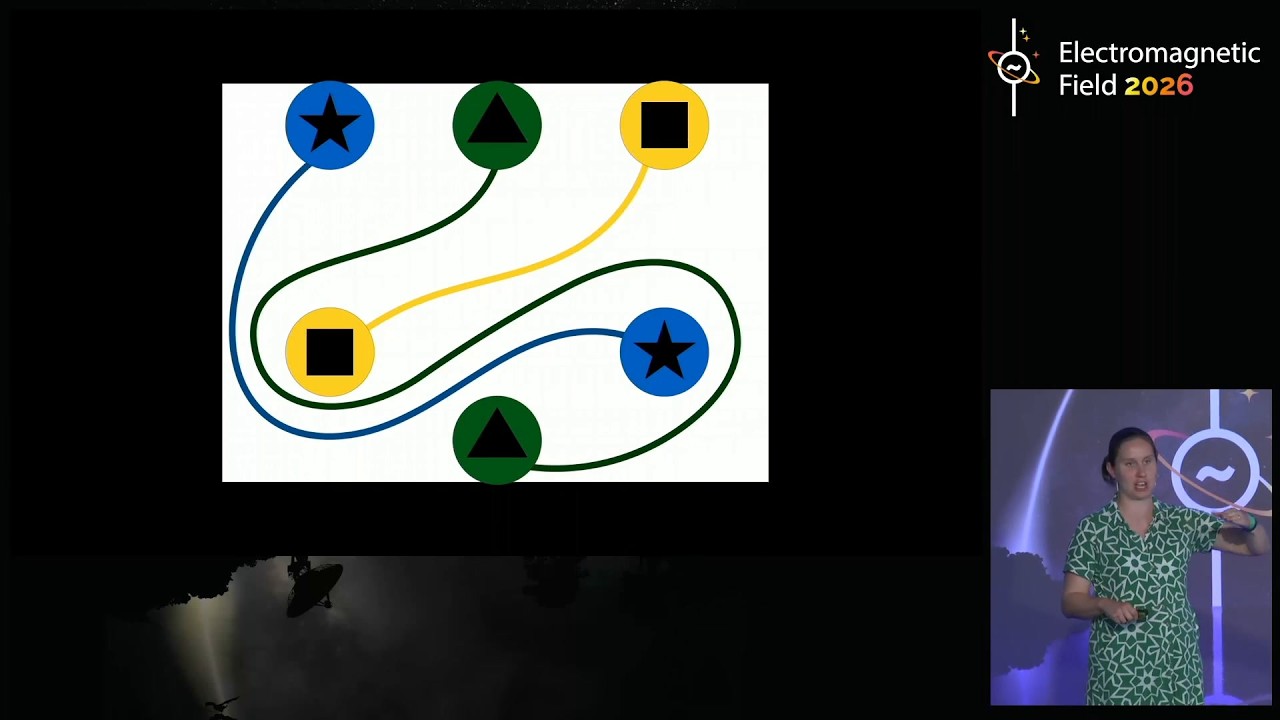
In this engaging presentation from EMF 2026, mathematician and Numberphile host explores the fascinating world of topology through interactive puzzles and real-world demonstrations. He begins by challenging the audience with a problem involving connecting identical symbols without crossing lines or leaving a box, revealing that what seems impossible is actually solvable when viewed through the lens of topology, which studies properties unchanged by stretching or deforming shapes. To further illustrate how connectivity remains constant regardless of movement, he performs a captivating magic trick where an arm moves from one position to another without rotating the wrist, explaining this phenomenon using spherical geometry. By tracing the path of fingertips on an imaginary sphere, he shows that the resulting triangle has three 90-degree angles totaling 270 degrees, proving that geometric rules differ significantly on curved surfaces compared to flat ones, where these curved paths are known as geodesics representing the shortest distance between points.
The discussion then shifts to one of his favorite shapes, the Möbius loop, a strip with a single half-twist that possesses only one continuous side. He demonstrates its unique properties by showing that cutting it down the middle produces a single large loop rather than two separate ones, and further illustrates how cutting two perpendicular loops yields different results depending on their twist: standard loops form a square, while two twisted Möbius loops interlock to create two hearts. Building on these concepts of shape and connectivity, he introduces his ultimate favorite shape, the torus or donut, which he brings to life using smoke rings generated by a machine. These rings are described as stable "toroidal vortices" where internal pressure pushes outward to maintain their form for an extended period, contrasting them with destructive linear vortices like tornadoes while noting natural examples such as Mount Etna blowing smoke rings and dolphins creating air rings for play.
The presentation concludes by addressing the inherent limitations of representing three-dimensional reality on two-dimensional surfaces through map projections. The speaker explains that all flat maps inevitably distort reality, citing the common misconception that Greenland appears larger than Africa due to these projection methods. He wraps up the session by expressing hope that someone will demonstrate something at the Q&A tent within a few minutes and thanks the audience for their attention, ending with applause after sharing resources on his website for those interested in exploring these mathematical topics further.
Read the full video transcript
Uh right. Good uh good afternoon
everybody. Um I am I tell you what I'm
going to do is I'm going to introduce
myself quite slowly uh so that we can
allow a few more people to come in.
There's a few more people sort of on the
way I think. Um and so I think probably
yes probably before I tell you anything
about shapes and smoke rings which is
what we'll be uh be doing this
afternoon. Um, I'm going to tell you a
little bit uh more about myself.
Probably the easiest way of
understanding who I am is to say I'm a
mathematician. Uh, which means um that I
studied math at school. Um, and then I
went to university and I studied maths
there. And then I've done some things
with math since. Um, and now I spend a
lot of my time um actually uh I spend
quite a lot of time in schools and at
various other places, science festivals,
this kind of thing. Um, just showing
people the bits of maths um that I think
is most fun and exciting, which is is
really great fun. So, it's really lovely
to be here um on this. I'm I'm so glad
it's slightly cooler uh now than it has
been. It's just perfect weather. It's
brilliant. So, it's very exciting to be
here. Um, so uh so that's me. I've done
a little bit on number file is a YouTube
channel all about maths. Um, and very
occasionally uh on uh BBC Radio 4. I
imagine none of you are listening. Thus,
is fine. Uh, and shapes and smoke rings
is actually I still don't think I'm
going to tell you too much about it
until we've warmed our brains up a bit.
Actually, warm that's not the right
phrase, is it? Warmed up. We are already
warm. Uh, we've woken our brains up a
little bit with a puzzle. So, I'm going
to give you a puzzle. Um, and your job
is to your job is to wait for me to put
my clicker on. There we go. Your job is
to see if you can join up um identical
symbols on the screen um with a line.
However, there are some rules. The rules
are that those lines, they cannot cross
each other. Um, and they also cannot
leave the box. So, you can see that that
green one is right down against the edge
of a box. Uh, it's there for a reason.
You can't go around it. You also you
can't go over the shapes as well. Um,
and actually the question I've got for
you is do you think this puzzle is
possible? Um, or do you I don't want to
know now. [laughter] Um, rule one, hands
up. No, we're not in school. It's fine.
Um, so the question, you're going to
have a minute to think about it and talk
to person next to you. Um, is do you
think this puzzle is possible? Would you
think it is not possible? I'm going to
give you a minute to think about it. You
don't have to draw it. You can just do
this kind of thing if you want to. Um, a
minute or two while we wait for more
people to come in. Have a go. What do
you think? Possible? Not possible? Have
a chat. That's fine. Chat to the person
next to you.
Even if you don't know them.
Okay, come in. Welcome.
Don't worry, you're not late. It's fine.
Just find yourself seat. And I'm It
might make sense. There's not many of
you. It might make sense to sit around
here. Um you can hide at the back if you
want to,
but yeah, probably makes sense to be
there. Oh, you've got a an ice lolly. is
exactly what I need. Oh my gosh, I'm
jealous now. Right, we've got people
thinking. So, the puzzle that people are
thinking about, people who've just come
in, um, is they are trying to to work
out or decide whether they think this
puzzle is possible or not possible. So,
we're linking up identical pairs um
without lines crossing and the lines
can't leave the box. So, we think it's
possible, not possible. Um, I think what
we will do, you've got a you've got kind
of 10 seconds to make a decision, you
three. Uh we're going to do a hands up
vote and I I can literally count you
all. So no one's getting out of voting,
right? I know if you're voting or not.
Um so everybody's got to vote for either
possible or not possible uh for this
puzzle. We'll see what you think. So
grown-ups too. Uh you do also have to
vote. Uh so hand up if you think that
this is impossible. If you think this
puzzle is impossible. [sighs] I've got
two hands from over there. This person
is extra sure. But it's not everybody, I
don't think. Hand up if you think it's
possible. If you think this puzzle is
possible, there are about three or four
who think it is possible. Um and so I
would say that's sort of 20% versus 80%.
80% impossible. And you know when I
asked people this question that's what
people normally say. They normally say
to me yeah I don't think this is
possible. And when I first saw this as
an adult right and a mathematician not
very long ago um I thought it was not
possible. But in fact as some of you
might have spotted there is indeed a
solution. There is a way of doing it
which is quite nice quite satisfying
isn't it? Yeah it's quite surprising.
And there's a reason there's a reason
that I start this talk uh with this
puzzle. And in order to explain that
reason, I am going to show you a much
easier puzzle. Now, so it's exactly the
same rules as last time, but it's much
much easier. And this time, you don't
need to say anything. I just want you to
put your hand up when you see a
solution. So, as soon as you see a
solution, you can uh you can have a
stretch and put your hand up again. Even
even adults, thank you very much,
grown-ups as well. Brilliant. Really
good stuff. Yeah, this is really easy,
isn't it? You're probably thinking, why
is why is she giving us something so
easy? Um, and there is there's a reason
for that. So, I am going to move this
blue one a bit. You don't you don't have
to do anything now. I'm going to move
it. And I think you'd still tell me
that's fine, wouldn't you? You clearly
just have to bend the lines a bit. And
even if we move it down here, it's it
it's the same thing, right? I think
mathematically it's the same puzzle.
We've just had to stretch things a bit.
The way it is connected is is the same.
And actually, if we move it down here,
that's the same thing. This is also even
the same thing. It's It's totally
doable. So is that and so is that. Oh,
what's that one? Somebody younger than
18. What's that one? Is that the really
tricky one? That's a really tricky one
we saw at the start, isn't it? Um, and
the point that I'm trying to make is
that the really easy one and the really
difficult one, uh, they are essentially
they're the same puzzle, right?
Mathematicians will say they're the
same. Um, we've just had to stretch
things a bit. And there's an area of
maths called topology, which some of you
will know about. um and and some of some
of maybe the ones of you that are a bit
younger, maybe if you go to university
and study maths um you will meet it. And
it's essentially it's all about shape.
Uh and it's all about um what kind of
what stays the same when we stretch and
we deform shapes. Um and really
topologists, they're really interested
in how things are connected. Not really
where they are, right? So not really
where they are in space, not really what
they look like, but how things are
connected. Um, and we're going to do
we're going to kind of dip our toes into
a little bit of topology and and some
other fun stuff um in in this talk. Um,
and uh and we're essentially it's it's
kind of an excuse for me um to show you
my top three shapes. Right. So, I've got
I mean I've got a top 10 shapes, but
we've not got all day, right? So, we're
just just going to go top three shapes,
third favorite, work our way up towards
uh my ultimate favorite shape. Uh it is
more exciting than I'm making it sound.
Uh we and in each case we're going to
look at the properties of the shape a
bit like a a topologist. Um and actually
but before I do that before I conclude
this when as soon as I put this puzzle
up even before I asked the question uh
some people went oh it's impossible and
and and they were very certain. There
was even somebody with two hands up
which was uh extra certain. Um yeah
you're over there. Um and do you know
why I think that is? I think that's
because you might be confusing it with a
very famous puzzle. There's a very
famous puzzle which is a bit different
um which asks a slightly different
question. It says instead of can you
join each identical symbol. It says can
you join say the top blue one can it be
joined with all three at the bottom and
can the top green one be joined with all
three at the bottom and the same for the
yellow one. Um without lines crossing
like for example this is the blue one
would have to go with with all of those
ones at the bottom and then all the
green and and the yellow. Um and that is
not possible without lines crossing.
That is not possible um on a flat
surface. Although you might be looking
at it now and not recognizing it because
usually it's it's kind of uh it's kind
of shown to us in a slightly different
form. So usually it's shown to us like
this as the utilities puzzle. Um the
idea is can you join each house with the
three utilities um that it needs. Uh not
possible on a flat surface. However,
here we go. Possible on the surface of a
mug. Um and so if you want to uh
children, you need permission from your
parents, but if you want to get a mug
from your cupboard at home and a dry
white pen, you could draw the little
symbols on. you could see if you can
work out how you can uh do the puzzle
without lines crossing. Um it's also
possible on the surface of a donut. They
are to topologists they are this the
same shape because I said what they care
about is how things are connected,
right? And these two shapes they are
they're connected in the same way. Um if
you took the cup and you kind of but
imagine it's play-doh, imagine it's
plasterine. Imagine you remold it. You
you don't have to cut it. You don't have
to um you don't have to do any cutting
or sticking and you can remold it into
uh into the donut. So, it's connected in
the same way. Topologists say um they
are the same shape. Should we do that
again? I quite like that. Oh, lovely.
It's going back again. That's nice. I
find that very satisfying. Anyway, so do
go and do that as an extra challenge.
Mas gear, you can buy them online. I
don't work for mascara. I'm just uh I'm
just showing you that because you might
be interested. Um or you could just draw
it on yourself. That would be equally
fine. However, we are going to crack on
with my three favorite shapes. It's my
third favorite, working our way up
towards my ultimate favorite. Um, and
actually the f third favorite allows us
to do a particular magic trick. Right.
So, I am going to describe the trick.
Um, then you can all have a go at the
trick. Um, oh, that should not it's No,
that's fine. We're all good. Um, and
then I'll explain what it's got to do
with maths. And if you think you've seen
this trick before, then just kind of
keep very still
like that like a statue while I'm
describing it. Once I finish describing
it, you can you can all have a go. Go
wild. That's fine. Um, right. So, your
job is to try and get your arm from this
position to that position. Um, without
just turning it over. That's very easy.
Uh, that's not a trick. Uh, you have to
kind of pretend that your arm is like in
a cast. Okay? So, it's broken. You can't
rotate your wrist. That's not okay. You
are welcome to rotate your elbow. That's
completely fine. You don't need to do
backstroke. Anything that looks like a
swimming stroke, this is not a solution.
You don't need to get out your seat.
Don't do anything we've not risk
assessed. Uh, right. See if you can do
it. So, from this position to that
position without turning it over. Off
you go. One minute. Talk to person next
to you. See if they can do it. Everyone
can have a go. Everyone have a go while
I drink some water.
It feels like you're all waving at me in
a kind of mathematical way, which is
nice.
This is bizarre. [laughter]
>> H got some solutions in the room. And
you know, we've got some people really
trying hard to work out the solution,
which is nice. Um, we've got even some
grown-ups who are really unsure what to
do. [laughter]
Okay. Um, let's see if I've got anyone
who's done it. I think I saw someone
over here who might have done it before.
Saw how to do it. Can I see anybody? I
can see some people I recognize who
might know how to do this. Uh, which is
nice. And some people I don't recognize.
What we all will do is Hey, what? Should
we do it all together, right? Do you
want Should we just I think there's at
least one or two people who've worked
out how to do this. Um, let's do it all
nice and slow together. Um, we'll do our
palm out p arm out, palm face up like
this. And we'll start um by doing a 90
degree bend at our elbow. So, our
fingertips are pointing upwards like
this. Lovely. It's so nice. You're my my
maths robots. It's lovely watching a
room full of people doing the same
thing. Lovely. Then we're going to do
another 90° bend. So, our fingertips are
pointing across our bodies like that.
Yeah, that's going to hurt. Don't do
that. That way. And then you're going to
do another 90 degree bend at your elbow.
So your fingertips are pointing this
way. And then lots of you have worked
out what to do. Just the same thing
again. Yeah. Up to the top. Over to the
side. Round to the front. There you go.
Do you want to have a little practice?
Yeah. Super fun. Up to the top. Over to
the side. You could do both arms. Can
anyone try both arms
same time? This is your If any of you
are going to be dancing later on, this
is the dance to be doing. I'm going to
be looking out for it on the dance
floor. Yeah, we've got someone doing two
arms there. I love it. Excellent stuff.
Right. So, this is this is good fun. Uh
but somebody is probably thinking um I
thought this is about maths. Where's the
maths in this? So, we'll have a little
think. Um so, essentially when I'm doing
this trick, the shape that I'm thinking
of is a sphere, right? A spherical
shape. Um a sphere because um when
you're doing this trick, you can imagine
that your elbow is the center of the
sphere. You can imagine that your
fingertips are always on the surface,
always on the very surface um of the
sphere. Um, it's it's like your
fingertips are tracing out a path on the
surface of the sphere. And the distance,
of course, from your elbow to your
fingertips, it doesn't change, right,
when you do the trick, unless you break
your arm or something, that's always the
same. And and of course, that's the same
for a sphere, right? So, a ball shape
for people a bit younger. Um, and uh, so
the distance from the center of the
sphere um to the surface of the sphere
is always the same, right? It's always
the same distance. I mean, that's the
definition of a sphere, really, isn't
it? Um, so that's that's what's going
on. Um, and so I say yes, it's a sphere
whilst showing a picture of not a sphere
on the screen because as you might know
the earth, not a sphere. Um, but not far
off. Not far off. And it makes some nice
images for what we're going to do. So
we're going to pretend, if that's okay
with everybody, we're going to pretend
that the Earth is a sphere. And we're
going to imagine that you've dipped your
fingertips in some pink paint and they
start here kind of on the equator um off
the uh off the west coast of a Africa
there. Um, and let's just see what this
path looks like that we've just done
with our fingertips. So, we're going to
go up towards uh the North Pole. So, it
looks something like this. And then
we're going to go 90° over towards the
east. So, it's going to go over there.
Uh then we're going to do another 90°
bend. So, we're joining up that pink
triangle. Um and then we just went over
that pink triangle again. Job done. Um
now, one or two of you might have been
listening really carefully. Um and you
might have heard me say, uh 90° bend,
90° bend, 90°. In other words, right,
those three the three angles in that
pink triangle, they are all 90°. Uh, now
I am sure that there are lots of you who
a very long time ago uh learned
something at school about triangles and
angles uh inside and there are some of
you maybe who maybe I don't know how old
you you maybe maybe haven't maybe you
teachers may have told you by now who
knows but if they haven't they will do
soon. Um, and this thing about 180
degrees. So, you go to school and they
say, "Right, the angles inside a
triangle add up to 180 degrees." And
then you see this and you're like, "Hang
on, three times 90, that's 270." Uh,
what's going on? Um, and essentially, as
lots of us probably know, if you take,
uh, the, uh, a triangle and you draw it
on something that is curved, um,
spherical like that, is not a flat
surface, um, then you'll get more than
180 degrees. Essentially, the rules of
geometry, uh, just completely change.
So, if you're not on a flat surface,
everything goes a little bit wacky,
right? There's some fun stuff about
parallel lines. I'll be a fond of two of
you will be reminding you of like maths
degrees I imagine now. Um but anyway,
geometry of a flat surface, very
different from the geometry of um
something that is curved. Um and so we
we draw a triangle and we get more than
180°. Um and so the 180 degrees only
works for a flat surface. And actually
if we drew a triangle on something that
curves the other way like that, um then
uh we're going to get we're going to get
less than 180°. Um and that's kind of
why I like I like the sphere because it
allows us to do this trick. This is what
you're doing with your fingertips when
you're doing this trick is you are
effectively you're you're drawing a
triangle with more than uh 180 degrees
in it. Um and occasionally one or two
people have seen this trick and it
frustrates me. And do you know do you
know why they've seen it? They've seen
it on Tik Tok or some other social
media. Occasionally young people I show
this to oh yeah I've seen that and do
you know just so it went viral on Tik
Tok a couple of years ago. Um and they
didn't do the math. So all these people
around the country doing this trick
having no idea that what they were doing
was uh drawing a triangle with uh three
90° angles in it, more than 180 degrees.
So I thought we've got to do the maths.
We've got to do the maths of the viral
trick in the talk. So that that's why I
like the sphere really. Um we are
however um we're going I say we're going
to move on to my second favorite shape.
say that. But actually, just before we
do that, I'm going to address uh the the
elephant in the room, the question in
the room, because there will be one or
two people who are thinking, "But that's
not a triangle." Because and it's
probably you with your hand up because
those those lines are not straight,
right? They look kind of curvy. I've
been told a triangle's got straight
lines. Um this one in particular, people
people are not happy uh with that. Um so
the definition of a straight line is is
the shortest distance between two
points. Um, and if you wanted to go
from, is it just north of Australia?
Yeah, whatever. If you want to go from
there to the North Pole, um, I mean, you
would just go due north, right? That
would be the, as the crow flies, the
shortest way to do it. You just go due
north. So, that is the shortest. I mean,
I advise you don't. A lot of sea in the
way. Um, it would take a really long
time, but but that that is what you
would do. So, that is the shortest
route. Um, it just doesn't look like
what we're used to straight lines
looking like, but it is a straight line.
It's something called a geodics. If
you're interested in kind of like, you
know, why do airplanes not fly what
looks like a straight line? Why do they
fly up towards the poles? Um there's all
sorts of interesting stuff in that. It's
all connected. So this is a a straight
line um on the surface of a sphere. So
they are straight lines. It is a
triangle. Um it does have 270 degrees.
Um but we are going to move on swiftly
on to my second favorite shape. Here we
go. Which is not this. This is a
rectangle. Some of you have seen that
before, I imagine. Um, [laughter] but if
I take my rectangular strip of paper,
um, and I I'll do I'll do this under the
camera so you can see what I'm doing.
Um, so I take my rectangular strip of
paper and I get some sticky tape or some
glue, some cellar tape. Um, and I do
this kind of thing and I stick my cellar
tape there. Um, then I get a loop. Maybe
I'll call it a loop. I think some of you
might call it a cylinder without without
ends. That's fine. Um, and that's kind
of nice, but actually also still not my
second favorite shape. Um, but if just
before we sell tape it, if we take one
end and we turn that end over and then
we sell tape it, then we get my second
favorite shape, uh, which is the mobius
loop. So, it's like a loop with a little
twist in it. Um, it's called the mobius
loop. There we go. Um, and here's one.
Here's one I made earlier in true blue
style. There we go. Um, and actually to
think about the Mobius loop, um, and
find out what's interesting, we're going
to really quickly whiz back to the
normal loop, right? the standard loop.
And I want you in your head to just
imagine.
You can just keep it in your head. Um,
not that you're being rowdy in any way,
but don't shout out. I'm joking. All
right. So, take a pair of scissors and
we can cut. Imagine I'm cutting a line
down the middle all the way round. Just
in your head, imagine what you would
get. Can you nod at me if you are
imagining two loops that are half the
width of the Thank you. The two people
nodding. Three people. We've got We've
got more people nodding. some grown
really gentle nods from the grown-ups
over there. Thank you very much.
Excellent. Um, so that's what we'd
expect, right? So that's what we imagine
to happen for the normal loop. So we are
going to do that, but we're going to do
it for the twisty loop, the mobious uh
loop. Um, because there is something
interesting you can do with the two
loops that you end up with, the two
halves that you get. Um, and [snorts] if
you do this at home, young people or
even older people, um, what I advise you
do is you make a little fold like that.
Um, you do a little cut into your fold.
Um, and then you get your scissors in
there because I have seen people even
even adults going kind of wild and it
all just goes wrong. So, be real care
really careful. Um, and you just got to
start cutting down the middle. It's a
little bit fiddly. You might have to
turn it over. You've got quite a lot of
cellar tape uh to go through. Oh, there
we go. My scissors have got stuck
already. There we go. And I've got super
scissors. Uh, keep cutting on this side
all the way around. And we'll get our
two loops. Um, and we'll see what we can
do with it. So, I'm cutting it all the
way down the middle. We'll get our two
loop.
Oh,
what
did I not just Did I not just cut that
down? Did I cut that down the middle?
People at the front, were you watching?
Did I have I dropped a bit? Is there a
bit on the floor? No. I don't know
what's going on. That's weird, isn't it?
It's kind of fun, isn't it? Um I imagine
for some of you, this is not the first
time you've seen that, but we could
pretend that it is, right? And the time
the first time that you see this, um
it's you know, it just blew my mind the
first time I saw this. This that is as
far as my acting skills go. Um, this is
what happens when you cut the Mobius
loop uh down the middle. You just get
this one big loopy thing. Um, so I guess
it's the shape you can't cut in half if
you uh if you cut it down the middle.
Now, if uh the penny has not dropped as
to why that happens, the thing to do
when you go home is before you cut your
I'll just show you how to do it again.
Actually, if you want to see. So, just
before you sell tape it, take one end,
turn it over, and then sell a tape. And
just before you cut it down the middle,
the thing to do is to take your pen and
start drawing the scissor line on and
start drawing on one side and keep going
all the way around until you get back to
where you started. And you will notice
that without trying to, you will have
ended up drawing on both sides of the
piece of paper. Now, I've not done all
of it. I've only done a bit of it, but
there we go. Um, so without trying to,
you've drawn on both sides of the piece
of paper. Now, imagine if you did that
for the normal loop, right? The standard
one. there's no way that you're going to
draw on the inside unless you
deliberately go over the edge. Um, and
uh, that that's kind of why this
happens. So, I think if you draw the
scissor line on, this kind of being on
both sides at the same time thing is
really important. So, draw the scissor
line on, notice you're on both sides at
the same time. Uh, and actually what
topologists say is they say the moious
loop has only got one side, right? That
that's its special property. Um, this
being on both sides at the same time,
it's only got one side. Um, so you draw
the line on very slowly cuts and the
penny might drop. You might begin to see
why. Um, we just ended up with the one
uh big loop. Um, so I I do like the
mobus loop very much. Um, it's my it's
my second favorite shape. Um, but it
does get a little bit better than this,
right? So we can do some slightly more
fun stuff with it. Um, and in order to
explain the really fun thing, I'm going
to have to very quickly whiz back to the
normal loops. Can you see here? So we've
got two normal loops and they are
cellotap uh two loops. I shouldn't call
them normal. It's two loops and they are
cellar taped at right angles um at 90°.
You can see there's like a right angle
gap there and there and that kind of
thing going on. And what I am going to
do is I'm going to cut this one down the
middle all the way around. And I'm going
to cut this one down the middle all the
way around. Um and we will end up with
one thing. So just like last time, it'll
be one big connected thing. Um and it is
your job with the person next to you to
decide what shape you think it will be.
Uh and you've got the time it takes me
to cut this up. So off you go. I will
cut this one up. Uh, what shape will we
get? You may you may speak
to each other. Right. So, do this one
first.
Oh, it's frozen. It's not happy. I'm
doing things, but the camera is not
telling me I'm doing things. There we
go. That's better. Um, so I'm cutting
down the middle. I'm just doing the
first one all the way around down the
middle.
We go. We are halfway. We're at the
halfway point here. There you go. Just
about. Um, and I tell you what, shall I
take a guess? I'm going to take guesses
from anyone under 18. Uh, and it's like
the reverse of a pub. Um, so if you're
under 18, you don't have to show ID. If
you want to have a guess at what you
what shape you think we will get when I
cut this second one down the middle. So,
I'm going to cut this second one down
the middle. Um, what shape do you think
we might end up with? Do you want to
have a go? Front line. You don't have
to. So, we've got Mobius loop. I'm going
to take three different guesses. Maybe
two cuz there are only two people under
18. We'll go for two different guesses.
What's your what do you guess?
>> Maybe like
>> maybe a circle. So we've got Mobius
loop. We've got the guess of circle.
We've probably got some other guesses in
our heads. Um we will see. We will see
what we end up with. Um and I'll tell
you what's interesting is this is the
last one I've got to do. So this is
going to be a line of symmetry. Um and
that's so that's going to be a line of
symmetry, isn't it? We saw some right
angles at the start. So that might give
us a little bit of a clue. So I'm going
to cut. So, when you do this at home,
you take two uh normal standard loops
and you cut them down the middle all the
way around. I should probably do it that
way. Um then you get
two normal loops, cellar tapes at right
angles. Cut down the middle all the way
around. You get you get a square. There
we go. That's quite nice, isn't it? It's
quite lovely. It's I find that very
satisfying. It's a square. It's lovely.
And actually, did you see when it was
all cellar taped together, it looked
like a cross shape, didn't it? And we
saw we saw four right angle gaps. And
[snorts] you can Can you see where
they've gone? One, two, three, four.
Boom. Nice. So, it kind of makes sense.
But it does get I've got to be honest,
it does get a little bit better than
this. It gets a little bit more
exciting. And because if instead of
having two normal loops and cellaraping
those at right angles, if we take two
mobious loops, that's the twisty ones,
and we sell tape those at right angles.
And this is really important. You have
to twist one of them clockwise and the
other one anticlockwise. Right? Can you
remember that? So twist one of them
clockwise, one of them anticlockwise. If
we take those two mobius loops and we
sell tape those at right angles and we
cut both of those down the middle uh
then we get uh what is quite possibly
the most romantic shape uh in maths
which is nice. Uh it's two hearts that
are in celinka which is lovely and
actually you can see can you see the
right angles at the bottom of the heart
um and the right angles in the kind of
iny bit at the top. There's probably a
technical term but I don't know. Um,
that's your four right angles and
actually they're pointing in different
directions because of the twists um that
we put into the Mobius loops. The
interlinking bit I'll just I'll let you
I'll let you go and think about that's
tricky. Um but anyway, so really lovely.
So I would love it if some of you go
home and try that. And actually what
I've done um for the adults in here who
get easily confused, I've made a
worksheet, right? So I've made an
instruction sheet. I'm going to give you
a link at the end. So if any of you
families or anyone else wants to
teachers maybe in the room, I don't
know, want to go home and do this with
somebody um please do. I'd love it if
you did. Um, you've got I mean we forgot
how long have we got now? Seven months
to practice for Valentine's Day. That's
all you have to do, right? Pair of
Mobius loops and a pair of scissors. Job
done. Very easy. Um, right. So, that's
the moious loop. We're going to move on.
It's not my favorite shape. My favorite
shape
um is something to do with this. It's
not this. This is a cylinder. We've seen
that already. Um, but if I stretch out
my cylinder and I join up the ends, what
do I You can just say out loud if you
want. What do I get if I join? Anyone at
all. Anyone can say what do I get for
stretch it out and try and join these
ends up.
>> Donut. Taurus. We've got all sorts of
words. You want to go for it? Yeah. A
circle. Some really nice guesses. The
circle is a really nice guess because
what you've done in your head is you've
imagined you've imagined exactly the
right shape. You probably imagined um
the circle shape, but because it's
three-dimensional rather than flat,
we're going to give it a different name.
Um somebody said donut, which I mean you
are nothing if not predictable. That's
fine. Um so I'm joking. If you said
donut or you thought donut, your brain
did the right thing. Well done. Uh, but
we don't call it a donut. We call it a
Taurus. Thank you, whoever that was. Um,
so Taurus is the name of it. Um, and a
Taurus is my favorite shape. And the
reason it's my favorite shape is there
are some mathematical and scientific
properties. Um, that means that if
hypothetically speaking, I were to fire
a Taurus of smoke across the room, um,
it would hold its form, uh, for a really
long time. Um, it's a very, very stable,
that's the word we're going to use, a
very, very stable shape. if it was kind
of a different shape, it would have
different properties. Um, and so we're
going to see that. So that's what we're
going to do. Um, and essentially, um,
your job will just be to enjoy it, which
is it's a nice and easy job. Um, and in
order I'm sure none of you will I mean,
I'm going to do the rules anyway because
I just always do, but I'm sure it won't
be an issue. Um, but in order to allow
other people to enjoy it, just make sure
you don't put your hands up. Um, don't
disrupt it. And we'll see how far we can
get this Taurus of smoke to go. If we
can get it to It's quite warm in here,
which I'm a bit worried it might up. Um,
but if we can get it to kind of the the
big um metal things in the [laughter]
middle, there's probably a better word
for that as well, but the big thing in
the middle. Um, that is that's great.
That's like round of applause worthy. If
we can get it beyond that, that's
incredible. If we can get it towards the
camera, I don't think I'll get it right.
I might get it to the back. I'm not
sure. If we can get it towards the
camera, that is just go wild. That would
be incredible. Um, so that's the idea.
That's what we're doing. Um, and just
um, so you know, so we're calling it
smoke. That's the easiest word to say.
Um, but it's inert. So it's not really
smoke. It's kind of it's like a sugary
solution um, and a heating element and
it kind of breaks down to make it look
look a bit it's like a smoke effect. Um,
so it's inert. It doesn't affect anybody
with asthma and we should be all good.
Um, I think we are almost ready to go.
Um, and we will see it float across the
room. We'll see it hold its shape. And
after we've had a go at this, then we
will think about the reasons um why it
is so stable and why it holds its form
um really really well. And I'm just
going to identify. We've got a camera
there. We've got a camera there. I
wonder if I can get one to that camera
and one to that camera. That would be
brilliant. Right, off we go. Um so let's
get these smoke tauruses to vortexes
in action.
Okie dokie. Right. We ready? So, let's
go for the middle.
Three, two, one.
Oo. Oh, it's gone down, not up.
Interesting. [applause]
There we go. Nice.
[cheering]
Okay, let's try and have another one.
Let's see if I can go a little bit
further this time. Let's go this way.
Right, ready? Three, two, one.
I don't know why it's going down.
Oh, it's still going. [laughter] It's
almost getting there. It's not too bad.
Let's go across the room. Oh, lovely.
[applause]
Let's go across the room. Let's try and
go this way. Right. Ready?
Three, two, one. Oh, that was less good.
We'll try that one. Oh, no. It's still
kind of there. It's kind of there, isn't
it? Floating around.
We'll do another one in a little bit.
It's having a The smoke machine's having
a little break and then we will try and
we'll try and do a couple more in a
second. Um, so we have seen Did it get
to the back? The one when everyone went
whoop. Did it actually kind of almost
not It's not bad. It's a big room. I
think we did very well. It's a big room.
Um, right. So, what you've seen is
you've seen my smoke cannon. That's this
thing. It's a garbage waste basket in
case anyone is interested to make your
own. um garbage weights basket and I uh
this hole is covered with tarpolin um
the hole that's in the the basket and
this hole I cut in because you need a
little bit of uh like a margin
essentially. So I cut that hole in. So
if you want to make one yourself that's
what you do. Um and this tarpool in has
to have enough give so you can give it a
good old whack and it will um it will
create the smoke ring. And actually
what's happening is you saw me punch the
back of the smoke ring. Um, and what I
was doing was I was pushing the smoke,
that orange stuff, um, towards um, the
hole at the front. Um, and essentially
the smoke that is in the center um, of
the circle is a higher pressure than the
smoke around the outside. And what that
does is it means that it pushes the
other smoke out the way. Kind of like
this. So if my arm could carry on, I'd
make a little circle um, like that. So
what we've got is kind of at every angle
around the circle, we've got a little
little circles being formed. Um, so the
smoke particles are basically making a
circle. Um, there you go. That's that
circle of circles. Um, but we are going
to try and give it one more go to see it
in real life. Let's see if we can do it
again. That last one I was I was not
happy with that last one. We're going to
we're going to do that one again. See
See how far we can get it to go.
Let's try and do another one. Let's try
again. Right. Three, two, one. Oh,
that's a bit better, isn't it? Oh,
lovely.
It's going to land on someone.
>> Yay. [applause]
Okay, probably the last one. We'll see.
Let's go to the other side of the room.
Let's go this way. Uh, three, two, one.
Oh, I'm sorry.
I wasn't aiming at you. Never mind.
These things happen. Try one more. We'll
try one more. It's going to let me do
one more.
All right. Three. Let's go that way.
Three, two, one. Oh, no. Not not happy
that time.
No, I've not got enough in that. That is
That is the end of that. We'll do a
round of applause. Thank you very much.
>> [applause]
>> Okay, my smoke machine says no. My smoke
machine had enough. But um that's that's
fine because what I've got uh is even
better smoke rings for you uh from Mount
Etnner. So this is a couple of years ago
um in Sicily um Italy. Uh Mount Etnner
was blowing smoke rings um and some
tourists took some videos of it. This is
footage from the BBC. They are just they
blow my mind. They're just huge. Much
more impressive than my smoke rings.
Really very cool. It's lovely, isn't it?
That's the right noise. You can come to
all my talks, whoever that is.
That is nice, isn't it?
There we go. Um, so they're out there in
the real world. Uh, not just happening
here. This is what I say to young people
sometimes. not just happening in your
school or in your classroom, but they're
out there in the real world. Um, and so,
so volcanoes blowing smoke rings for the
same idea. You've got like a force
that's pushing smoke up towards the
eruption obviously um towards an
aperture at the top which which makes um
the smoke ring. Um, apparently dolphins
can blow smoke um not smoke rings,
sorry, air rings. Dolphins can blow air
rings. Um, and apparently they don't do
it for any reason. There's no biological
reason. They just do it for fun. Uh,
which I just think means dolphins are
amazing. They must be the most
intelligent mathematical animals. They
just play with them. There are videos on
YouTube you can go and find um divers
for the same reason divers can blow air
rings as well um when they go down into
the water blowing air through their
mouth which is the hole. Um, so there's
there's lots of other places that you
can see this. Um, it is it's a type of
vortex, right? So you might have heard
the word vortex before. So any any
fluid, so any gas or liquid that has
circular motion um is a is a vortex. Um,
and this is the toidal, if you want the
fancy name, tooidal vortex, taurus
shaped one. Um, different type of
vortex, tornado, very different. Um,
circular motion, but circles on top of
each other, I guess. Circles around a
line, right? That kind of thing. Um, a
linear vortex. That's it. That's its
name. Um, and it's a very different
shape. Not circles around a circle, but
circles around a line. Different shape.
So, different behavior. Behaves very
differently. Um, it's, you know, it's
it's very destructive. It's not stable
at all. Um, and, uh, and, um, you can do
that in a water bottle as well. So, you
can whiz your water bottle around and
you can get, you can see the kind of
tornado shape. Um, I am hoping we've got
I've actually, this is unbelievable, but
I'm I've finished with about four
minutes to spare, which just is, you
know, this doesn't happen, right? we can
uh we can get excited about that. Um so
what I'll do actually I'll use some of
my time to show you a link. So I'm going
to show you this link which you can go
to um to find more out about this. So at
this link ww.think-maths
um that's my website.co.uk/smoke.
Um that's quite easy to remember, isn't
it? Think-maths.co.uk.
Um then at that link there's lots of
other bits that you can look at. So
there's some videos um from numberfile
from somebody else talking um about the
maths of maps. Um and we talked a little
bit briefly about um how the geometry of
a flat surface is very different um from
the geometry um of of the sphere. Um and
uh so kind of linked to that is is the
idea that every flat map that you ever
see is wrong. Right? So every flat map
you ever look at will have some sort of
distortion. Um and so it's
mathematically been been proven we can't
perfectly make a flat map because of the
difference of the geometry between flat
flat surface and surface of the globe.
Um and so for example, the Maka map,
that's probably the one you most
commonly see in a geography classroom or
so on. Um is probably the most famous
one. Um its distortion is its directions
are correct, right? Things are in the
right direction. Um but the sizes of
land masses are distorted and it distort
it makes the the land masses towards the
poles look much bigger than they should
be, which makes Greenland look much
bigger than it should. Um if it was the
real size, I wonder if Trump would take
less interest in it. I don't know. Um,
and it makes Africa look smaller than it
should because it's at the equator. Um,
so that's probably the most famous map,
but there's loads of other types of maps
that have have different distortions.
And the maths of maps is just I
absolutely love it. It's so interesting.
So, there's some really interesting
videos um you can go and look at if that
interests you. Um, there's also there's
the worksheet instruction sheet kind of
thing um for Mobius loops, for the ones
I've shown you, and other things that
you can do with the Mobius loop if you
want to go and try that with somebody.
Um, that's on that link as well. And
some maybe utilities. there's some
utilities puzzles um as well that you
can download and have a go at. Um so do
go to that link if you would like. I
think otherwise all I have to say is I'm
hoping that you have enjoyed this
session. Thank you so much for coming.
Um it's lovely to be here um and I will
go to I don't know where the Q&A tent
is. I'm going to hope someone someone
will show me and I know I will be at the
Q&A tent um in in a couple of minutes.
Um so thank you very much for listening.
Hopefully I'll see you there. Um thank
you very much.
[applause]