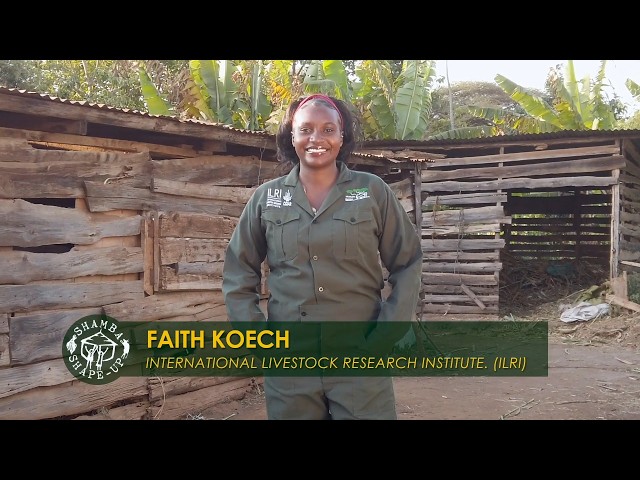
Shamba Shape-Up Season 16 - Episode 23 - Farm 17 ILRI (English)
Watch on YouTubeVideo summary
Low milk production, poor quality, and compromised animal health create significant stress for dairy farmers, making prevention crucial for sustainability. In this episode of Shamba Shape-Up, the focus shifts to mastitis, a bacterial infection of the udder that severely impacts yield and animal welfare. The host interviews Faith Kweiga from ILRI, who explains that mastitis arises in two primary forms: contagious types spread by the milker or other cows, and environmental types caused by dirty bedding or manure accumulation in the cowshed. Faith emphasizes that maintaining a clean, dry environment with well-structured housing is the first line of defense, as unhygienic conditions provide the ideal breeding ground for bacteria that can infect animals and reduce milk output.
To detect this condition early, the video introduces the California Mastitis Test (CMT), which is essential for identifying subclinical or hidden mastitis that cannot be seen during regular milking. The process involves milking a small amount of milk from each quarter into a paddle containing a liquid reagent; if the mixture thickens into a gel upon spinning, it indicates a positive result for infection. During their inspection, Faith and the host discovered stress gelling in four quarters, confirming the presence of hidden mastitis. This testing method allows farmers to manage infected animals separately and adjust milking routines to prevent further spread within the herd before visible symptoms appear.
Preventing mastitis requires strict adherence to hygiene protocols throughout the entire milking process, starting with thorough hand washing using soap and water before touching any animal. Farmers are advised to use individual cloths for each cow and follow a specific disinfection routine involving pre-dip solutions, typically iodine-based, which are submerged into the teats for about 30 seconds to kill bacteria. After stripping milk to check for clots, the actual milking occurs, followed by a post-dip application to ensure the teat end closes properly within thirty minutes. Crucially, infected animals should always be milked last, and healthy quarters must be processed before affected ones to avoid cross-contamination between cows or even between different parts of the same udder.
The episode concludes with a clear call to action for farmers to implement five key strategies: keeping housing and bedding clean, practicing good milking hygiene, ensuring proper teat disinfection before and after milking, regularly testing for mastitis using the CMT, and maintaining overall good milking practices. Faith shares her personal journey of rebuilding her livestock after a devastating loss, highlighting that even after facing severe setbacks, resilience and knowledge can lead to recovery. The host expresses satisfaction at finally learning how to perform these tests, underscoring the importance of education in empowering farmers to take control of their herd's health and boost milk production through simple yet effective management techniques.
Read the full video transcript
Low milk production, low quality milk,
and poor animal health can be very, very
stressful to a dairy milk farmer.
A farmer needs to know how to prevent
this.
>> We have invited Faith Kweiga from ILRI
who will tell us all about mastitis and
how to prevent it.
>> I can see a very beautiful I call it
beautiful because indeed it is.
>> Sure.
>> Who who who who is she?
>> She's Carol.
>> Ah,
it had to be Carol.
>> [laughter]
>> All right. So, Faith, we were here a few
years back. There were cows here.
So, I don't know what what happened,
Sankale.
>> I just had a tremendous loss of all my
livestock. So, I had to start over.
>> And we're just so glad that even after
going down, you still had the strength
to rise up.
>> Indeed.
>> Yes, and that's what we're championing
today.
>> Sure.
>> What challenges are you facing with your
cows?
>> In our region here, there are very few
vets. So, when
a cow falls sick, it is difficult to
find a veterinary.
>> All right.
>> Yeah.
>> Ah, Faith, I know you've done your
inspection as usual. The cowshed is very
organized and the animal has clean
beddings. It's clean and dry. So, this
will not have a bacteria. We also
examined the animal. The udder was well
placed above the ground and it was also
very clean. Our farmer, Sankale, wants
to have more milk. Isn't that so?
>> Indeed.
>> First thing is to provide clean water
and nutritious feed for your animal and
get a well-structured cowshed. And then
now we can look at the milking hygiene
practices which are meant to improve on
your dairy milk production. If your
cowshed is unhygienic, this will provide
suitable environment for a bacteria and
that will infect your animal. So, you
may experience something that is called
mastitis and this will lead to a
reduction of your milk production.
>> What is mastitis?
>> Mastitis is an inflammation of the udder
and it is caused by bacteria. So, the
bacteria may occur in two forms. We have
the contagious type and the
environmental type. So, the
environmental type comes from the
environment of the animal, as we've
said, and also when you have
accumulation of dirt or manure in the
animal's sleeping area, this harbors
bacteria. And also, we have the
contagious type of mastitis, which comes
now from the milker. The milker may
spread this if you do not observe
hygienic practices.
>> Mhm.
>> We have screened cattle for mastitis. We
use the California mastitis test.
>> There are two types of mastitis,
clinical or visible mastitis, and
subclinical or hidden mastitis. Visible
mastitis is where the disease can be
seen during milking. Hidden mastitis
[music]
will require a test to tell if it's
there. The California mastitis test,
CMT, is used to test for subclinical or
hidden mastitis. [music] This is done
using a paddle and liquid reagent.
>> You hold the paddle facing the head of
the animal, and then you milk your
animal into the four quarters
represented in the paddle.
>> Milk 2 to 5 ml on each quarter, and then
pour the same volume of reagent.
Now, gently spin the paddle. If the
solution thickens from liquid to gel,
then your cow is positive for the hidden
mastitis. If the solution doesn't
thicken at all, then the cow is okay.
>> And so, what did you exactly see?
>> We found stress gelling. There was a bit
of gelling in the four quarters, and
that showed stresses of subclinical
mastitis.
>> Mhm.
>> So, what can I do in order to prevent
mastitis?
>> When you find your animals to be
positive for mastitis, you need to
separate them from your herd. You need
to make sure that you milk the infected
animals last. So, you start with the
healthy animals, and then finish with
infected animals. And in case not all
quarters are affected, you need to milk
the healthy quarters first, and then
finish with the infected quarters.
>> Can mastitis be transmitted from one
livestock to another?
>> Yes, you can transmit the contagious
type of mastitis from one cow to
another. Before you milk, you need to
properly wash your hands with soap and
clean water.
You thoroughly wash in between your
fingers and also up to your wrist. And
then you make sure that you have
individual cloths for all your milking
cattle. So first of all, you will use a
pre-dip solution.
>> What is a pre-dip solution?
>> So a pre-dip solution is an iodine
solution that you can get it
commercially from any local agrovets.
You will use the teat dip to dip all the
four quarters. You completely submerge
them in the teat dip and then you leave
it to stay there for about 30 seconds
and then you will wipe it off. So once
you wiped it off, you will use a strip
cup and you will strip all the quarters
into the strip cup because it has a
sieve and a black background, you will
observe for any clots that may be in the
milk.
So after that, you can proceed to milk
your animal and then finish up with a
post-dip using the same solution that
you began with. And then you need to
make sure that you leave the animal to
stand for about 30 minutes to ensure
that the teat end completely closes. And
then before moving on to the next
animal, you also need to wash your hands
again and repeat the same process.
>> Farmers, remember there's so much you
can do on the farm to prevent mastitis.
One, keep your housing and bedding
clean. Two, good milking hygiene. Three,
proper teat disinfection before [music]
and after milking. Four, test for
mastitis using the CMT test regularly.
Five, good milking practices.
>> Have you ever done a mastitis test?
>> Never. Yes.
>> Even with your other
>> This is the first one.
>> Mhm.
>> And I am happy
>> Mhm.
>> to know how it is done.