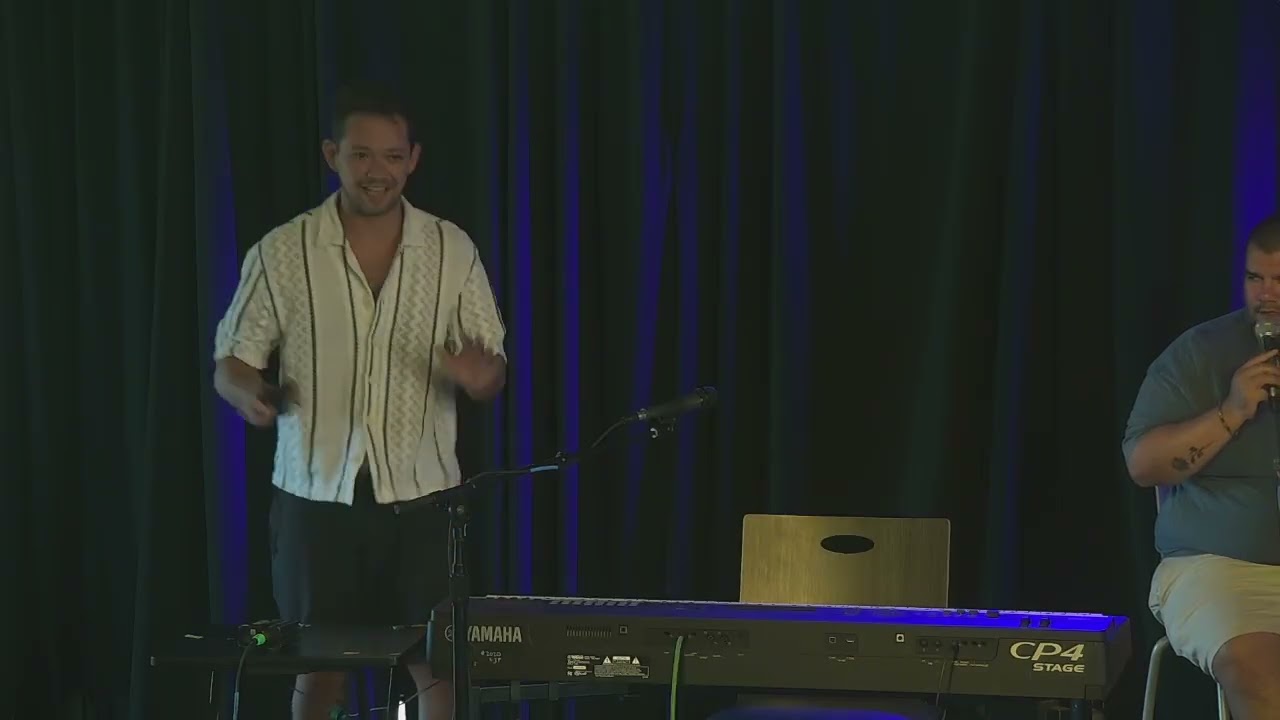
Session #2: Composers Menea: 2026 Latinx Theatre Commons Carnaval of New Latinx Musicals
Watch on YouTubeVideo summary
Session #2 of the 2026 Latinx Theatre Commons Carnaval brings together a diverse group of composers to explore their unique creative processes and the stories behind their new musicals. The session features artists working on projects ranging from *Little Dende*, which reimagines the historical "Dance of the 41" in Mexico City, to *Eore City*, an immersive piece set in 1918 Tampa about labor strikes and racial divisions. Other highlighted works include *Cafe Leche*, a nostalgic exploration of a Chilean mother's struggle with her gay daughter; *Daydreamer*, an anime-inspired fantasy about sisters seeking the sun; and *Fruition*, a live-looped performance honoring female fighters from the Mexican Revolution. Through these varied examples, the composers illustrate how their workflows differ, whether starting with film-score-inspired orchestration, developing music and lyrics simultaneously at the piano, or beginning with historical research on gender expression before finding a musical groove.
The discussion extends to deeply personal and ancestral connections within the art form, exemplified by composer Candela's work on *Bayano*, an epic about a 16th-century Panamanian warrior king who led a mutiny against Spanish enslavement. Candela describes the project as an ancestral journey, revealing that his own great-grandfather belonged to the same Palenke community Bayano protected, thereby grounding the narrative in family history. This emotional depth is mirrored in the session's broader conversation about musical influences, where artists cite a wide spectrum of inspiration from global icons like Nina Simone and Taylor Swift to specific Latin legends such as Rubén Blades and Violeta Parra. The composers emphasize that while they learn from established rules, their primary goal is "vision revision"—pushing art forward to serve the story's needs rather than adhering strictly to tradition.
Beyond individual technique, the session underscores the critical importance of collaboration, communication, and technical adaptability in modern musical theatre. Composers advocate for an "unprecious" attitude where ego is set aside for the best idea, relying on trusted collaborators who can provide clear feedback to refine melodies and subtext. Technical skills are also highlighted as essential, particularly for those using live-looping technology, where understanding sound design allows artists to handle failures gracefully during performance. The dialogue reveals a shared commitment to playfulness and community building, whether through blending Panamanian tamborito call-and-response with classical saxophone arrangements or exchanging voice memos to refine syllable counts in fantasy narratives.
Ultimately, the session serves as both an educational showcase and a networking opportunity, encouraging attendees to engage directly with these visionary artists. By sharing demos, discussing their specific workflows, and answering questions about balancing historical accuracy with creative freedom, the composers demonstrate how diverse influences can coalesce into powerful storytelling. The event concludes with a strong message of solidarity and growth, urging participants to build their own networks of trusted collaborators who can support their artistic journeys. Through these interactions, the Latinx Theatre Commons fosters an environment where new voices are heard, technical challenges are met with innovation, and the rich tapestry of Latinx musical theatre continues to expand and evolve.
Read the full video transcript
Wow.
>> Good morning everybody. How's it going?
Um I just want to say u when we're
talking, make sure you talk in here so
the people on the live stream can hear.
>> Oh
>> yeah, yeah, yeah, yeah. Um good morning.
Thank you for being here. Uh and thank
you for everybody who showed up
yesterday and and sent the love. I can't
wait for all the other shows to come
out. Um basically today is is I I want
to be able to talk to all these amazing
artists and their process. And I think
it's just so valuable to understand um
at the end of this thing that there is
no one way and and everybody is
different to get to how you create a
song, how you work with a collaborator,
do you start with lyrics, you start with
music, all these questions that we
always have. So I thought well we have
amazing amazing composers. So we should
pick their brains and say hey in this 1
hour time what what do you do? What do
you do 90 minutes? Uh what do you do?
three hours. No, just kidding. Um, so I
I think we'll start by just kind of
going down the line and just introducing
ourselves um and pronouns if you're
comfortable and uh what show you are
here with representing. So Jesse J
Sanchez, Swenos, he him,
>> Daryl Alejandro Hol
uh he and I'm here with Bayano and
Afropanameanian Masquerade.
>> Um Eliza Vidar here with Daydreamer.
Oh,
>> I'm Dan Ferman. Sorry. I'm Dan Ferman.
I'm here with Eore City.
>> Hi, I'm Robbie Well, I'm Robbie Hager.
Uh, he him pronouns and I'm here with
Little Dwende.
>> And I'm Satia Chavez. I use all
pronouns. And I am here with Fruition.
Um, so I think what we're going to start
with is um each per each person up here
is going to play something and kind of
give a little blurb about their show and
kind of what that is and then once we
kind of hear the song then we could
start talking process and then if there
are any questions but we'll keep it as
short as possible of course um so
everybody has a chance uh and then
that's where we'll go. Cool. Who would
like to go first
>> to talk about
>> to talk about their show
>> and play and then play your song?
>> Okay,
>> sure. I'll go first. Robbie, let's go.
>> I I think I I have my tap shoes back
here somewhere. So, let me No, I'm
kidding. I don't know. Um uh so I I'm
here with little Dende, but I actually
wanted to share something else. I'm uh
developing another show that I'm going
to share a track today. Uh, I'm really
excited about this one because it's
about my culture and me as a gay Mexican
man. And it's uh the story is about this
rumor that it happened in Mexico City in
1901. And uh it's called the dance of
the 41. And uh there was a raid, a
police raid that happened in 1901 in
November in the city in Mexico City. And
uh 42 men were uh caught or arrested.
And it so happens that half of them were
dressed in tuxedos and they're having
this ball and the other half were
dressed in dresses, wigs, makeup. So it
was a queer private ball that was
happening. So that um but the
interesting thing is that uh it so
happens that they only arrested 41 out
of the 42 because one of the 42nd person
was the son-in-law of the president of
Mexico Ignasio de la to this is during
the pfir era which is a very intense uh
era and uh so in order to keep it in the
you know quiet as much as possible they
did try not to do too much uh say too
much to the public. However, a lot of
the news did get out. Did cartoons and
perodicos uh which is in English is
newspapers.
Um and uh so there's all the so this
rumor existed that he was the 42nd. Also
there were so many of those people that
were in the high ranking officials in
the government. So it was really very
much a moment of like oh okay this is
like we this is interesting right? Uh,
the other thing that was really that
really caught my eye with this story is
the fact that Emiliano Sapata was taking
care of his horses in his in Mexico City
of Ignasios. Uh, and there's rumors of
them having a sort of relationship. And
that also just to me was like, wow, the
idea of masculinity in Mexico comes from
Sapat Subigote
>> and how how that completely challenges
so much of the queerness in Mexico City
for us. And then 2016 there was uh the
Pride Parade. I think it was 2016
reclaimed the number 41 as ours as our
queer anthem because for so long there's
no 41st floor in Mexico there. You don't
celebrate your 41st birthday. If you
want to call somebody uh a derogatory
name, you call them the 41. So there was
so many things that this number uh uh
caused for us. So I kind of then
realized I think there's there's a story
here. Uh, so yeah, so I've been
developing this this musical. There's
also a movie that came out like this is
about two two years after I started
developing this this movie that's
amazing on Netflix. You should go see.
Uh, it's a beautiful interpretation.
It's it there's there's uh it's not
fully accurate because he didn't have a
lover necessarily that he like that is
in this um in this movie. But uh it
doesn't get into the Emiliano Sapata
part. That's something that I want to
add. Uh anyways, so I want to share a
little uh song. I I'm not going to sing
it. I I have a demo track. And in this
song, I'm going to stand now.
>> In this song, it's it's a moment that I
imagine where uh Ignasio de la uh bumps
into this man and uh at at work and then
when he goes home with his wife and he's
at his study and he's imag he's finding
these feelings like he's imagining what
it would be like to be with this man to
in a place that he can't do that in and
just be with him. and it gets a little
like in intense and so I'm imagining
it's some sort of like big uh movement
piece dancing kind of thing but we
always remain with him just alone having
to deal with this on his own and uh not
being able to express himself as a gay
man. So I'm going to plug in
>> all
the volume all the way up on my phone.
Yeah.
>> Okay.
>> Okay. Bring that up. Can we bring the
Okay.
>> Okay.
>> Life theater.
Oh,
see you make
Oh Lord.
Spenc
Oh, God.
All
in
love.
I come
to
Don't
I love it.
Yeah.
can't see anything like that.
Yay.
>> Thank you. Thank you.
>> So, I think the next part just quickly,
uh, Robbie, how what was the process to
to start that song? Did you start with
music? You start with lyrics? Are you
working with a collaborator? And what
does that look like?
>> Uh, great question. Yeah, I I always
start with music first. I think a lot of
my inspiration comes from film scores.
uh because that's the where I get the
most feeling and I'm a very visual
person. So like most feeling for me has
always been a film score and like okay
let me find that and I how what lyrics
pop up. Sometimes my first lyrics for
this were like terrible just like words
and I'm like I'll I'll get to it later
but I know that the feeling is correct.
Uh there are some chord progressions
that just pop out. I'm like this feels
like it's the right one but let me just
go with it and then it is the right one.
Uh I orchestrate also from the
beginning. I just go and orchestrate
everything and then uh and then a melody
pops up. Then I then I put a melody on
top of that and then I put words after
that.
>> Yeah. So I kind of get so I can like
listen to it and like be immersed in
like what is the music? What is it doing
for me emotionally? Uh so yeah, for this
one it's just currently it's just me. Uh
and uh yeah, and I'm currently just
trying to break this whole outline of
it.
>> Yeah. And and just to clarify for those
of you what orchestration is, a lot of
composers love to write either with
piano or at the guitar and it's usually
a single instrument and then the
orchestration you typically comes later.
There are a lot of people who love to
orchestrate as well and and put music uh
instruments to it. So we have like sound
libraries or we have friends that we ask
uh to to play things for us and pay them
out of pocket and that kind of thing. Um
because it it I said this yesterday, but
it it it becomes harder and harder to
actually understand the thing because of
the the euroentric piano and what that
means. It's a different thing. It
doesn't have the same heartbeat. Like if
we heard that on piano, it's just a
different story than hearing the strings
and all the different kinds of things.
So it's just really it's really
beautiful. So thank you for sharing
that.
>> No, thank you. Thank you.
>> Great. Who wants to go next?
>> Don't be shy,
>> Dan. All right,
>> let's go Dan.
>> Let's go, Dan. I'm gonna start assigning
this.
>> Right. Talk into the microphone.
>> Okay. So, I've had a little trouble with
my voice. I was planning to sing today,
but for your for your sake, I'm not
going to.
Um, Eore City. So, I started Hold on a
second.
>> I don't know. I'm kind of digging the
voice.
>> Yeah.
>> Okay.
Um, Anita and I started writing this
quite a while ago. Um, and Eore City is
very appropriate for today in a couple
ways.
One is it's it's uh
this is going to be immersive,
right? It's uh it's the temperature
outside and the sun. It's going to be
like you're in city experiencing the
show at 1:30. So,
we've got umbrellas, right?
Okay. So, number two
is uh it's a story about
um Eore City in 1918 around that time
period. Well, it actually Eore City
started in the late in the late 1800s
when Mr. Eore came over from uh Cuba. I
think he was he had cigar factories in
Key West, too. and uh he started out a
factories in Eore City
and uh Ebore City became the cigar
capital of the world. Immigrants from
from Cuba, from Spain, from Italy, from
other places as well came. So, we had a
whole melting pot of cultures including
the uh the Caribbean cultures and the
African-Americans who were in in the
area, too.
So, that's what the show is about is
we uh
Anita and I met and we talked about it
and we decided there was going to be a
strike at at one of the Eore City plants
and uh uh
there were uh and the the way Anita
conceived the show there was a division
between because she's got history in the
area. there was a division between the
more uh the darker Kubanos and and
Latinos uh who were living mostly in
West Tampa and the lighterkinned Cubans
who were work living in Eore City. Uh
and they were working at the factory
some of them um and then the the
opportunity for the bosses was to
recruit other people to come in once
they went on strike. So there's this
community division that happens
and it has to do with immigrants and
they're trying to use the divisions to
divide us and stop us from uniting and
fighting back. And if that doesn't sound
like today, what does right? So it's a
very good musical for today. It's always
been a over the last since we've been
writing it, it's always been very
appropo, but it's even more so today I
would say.
So, just to quickly introduce this song,
one of the leads is Pedro. He's an
Afrouban worker at the factory
and his wife Arena is a washer woman and
she doesn't have uh the conditions are
not so good for the washer women and
they've discussed whether or not they
could someday get jobs at the plants.
Well, then the strike happens and
Alejandro the foreman offers them jobs
at the plant to come in and help break
the strike
and there's a lot of racism also on the
side of some of the Eore City workers
towards not all but some towards the the
darkerkinned Cubans.
So, is this going to happen or not? So,
at this particular instance, not to give
away any of the the way the show ends,
uh, but in this moment, Arena's been
very frustrated,
Pedro has, when they said they're
considering going in, he became very
upset and he left the night before and
he went out and he comes back and he
realizes that Arena is the the most
important thing to him. and he sings her
this song.
>> Not going to play the whole song.
>> It's on
the second half of the song. So, first
>> it's the other one on the
sings a verse.
Arena sings a verse. We're going to
start where is
And here we go.
Everyone
stories of going up north to start a
new.
Maybe the days of washing clothes and
sweeping floors were through.
The day that we stepped upon the shore,
we thought our dreams had come true.
We were young and stupid.
>> There's things that I regret.
>> Things I wish I could forget. We quarrel
and we fight.
>> Still I see somehow
we got something right.
For I see you,
the flower I made mine.
No diamond can match the way that your
eyes can shine.
The blackeyed Susan I picked forever
more.
You were the moment I struggled.
The flower I found, the warm I got to
hold.
Come walk with me. I'll walk with you.
Whatever lies in
us.
Come walk with me. I'll walk with you
through whatever lies in
>> Pedro.
You can say it again.
Beautiful.
>> That's so beautiful. That's so
beautiful. Same same question for you,
Dan. So, talk us through how did you
when you're when you're approaching the
songs. Uh you did book you did music and
lyrics. Is that right? So, when you're
kind of starting to think about crafting
a song for it, does the song for you and
your team, did you start with the
lyrics, the music?
Um,
>> the reprise.
>> Yes.
>> Sorry about that.
>> It's okay. Yeah. What what is what does
what does your process look like to to
write this song? Did you start with
music, start with the lyrics? What was
your early conversations? How did you
decide this is where the song goes? That
kind of stuff.
>> Our process kind of developed as we went
along. Uh, at the beginning, uh, Anita
would write scenes. Sometimes she would
write in songs and then I would write
something different.
uh
>> in in this case uh I think
>> I'm not sure I remember how this one
happened. It's it's hard to keep track
but a lot of the times I would take a
scene and I would say okay there's going
to be a song here or we would talk about
there being a song here and then we we
then I'd write it. Um later on we've
also evolved so that like uh there's a
new song in the show that Anita wrote
the words to totally and put them in the
script a week ago and and that's the new
song. So I just sent her words in that
case.
>> Most of the words I wrote
>> and as far as um the process of writing
uh I tend to write music and lyrics at
the same time.
>> Wow. So it means you don't get very far
add words in a various and then I figure
out where the melody will go and then I
add some words and then I think oh it
needs to say this.
>> Yeah.
>> Yeah. And so so when you say that can
you just give us a little visual just a
a snapshot into you're sitting at your
desk or what does that look like when
you say you were right? Are you at the
piano and you're like oh this is where
the thing goes or what does that look
like? I sometimes I write at the piano.
Yeah.
>> Sometimes I take a walk and wander
around and write in my head kind of and
then come back and figure it out more on
the piano.
>> Yeah.
>> Um and then sometimes
>> once I get the song going then I then I
sit at the piano and write words.
>> Gotcha. Cool. Well, thank you for
sharing. Beautiful. Beautiful.
>> Thank you.
>> All right. Next.
>> I'll go next. Hi everyone. Good morning.
I'm Viral. I'm the writer of Kof Leche.
Uh, I'm was
Eliza and I were talking last night and
crashing out about what to present this
morning. Um, because I had something
else in mind, but this is for composers.
And so I was like, maybe I will share
what a demo looks like in its rawest
form. Um, cafe leche is arranged and
orchestrated by Philipe Segoa
uh who is my main collaborator both as
when I do just lyrics and book. He's my
composer and then when I'm the composer
he he and I share you know a musical
vision. I always uh I'm a big proponent
of understanding musical theater as a
pop form like popular music because
that's how it was born and that means
that a lot of the composers acted like
pop musicians and then worked with a
range of orchestrators like music like
producers you know who produce a record
you know Taylor Swift Jack Antonoff uh
the Beatles George Martin you know what
I mean like that kind of relationship
where the music is actually composed by
one team but then the vision becomes
something that you share with another
musical mind.
>> Um, but for this I really wanted to
showcase kind of my process as a
composer. And so the song that I'm going
to be sharing today is called Unau
uh a good mother. And uh there are no
Chilean characters in musical theater.
This is my big reason why I'm writing
it. Um because I'm Chilean. So Chile
sachi. And uh I think a lot of uh of
what that means though as a composer is
that I get the gift to and the real
privilege of adding musical traditions
that aren't part of the cannon into it.
>> And so when I was thinking about how I
wanted to write the mother character um
in this part of the show uh spoiler
spoiler spoiler for the show, produce my
show if you want to see the whole thing.
Um,
uh, at this point, Alejandra, who is,
uh, the lead of my musical, has decided
that she doesn't want to hide her true
self anymore, and she would rather be
kicked out of her house, um, than
pretend not to be in love with who she
is anymore. Uh, shout out, the gay
agenda. So, um, but I was very strongly
a proponent that that that means that I
want to show a way for parents and
children to have a conversation. And how
do I do that? By not villainizing
parents who um are trying to do the
right thing in their eyes, right? It's
not the right thing, but it's the right
thing in their eyes. And so when I sat
down to write the song, I thought, okay,
how can I showcase a very particular
aspect of Chileanad and that this
character has to be Chilean for this
reason, right? It's not going to sound
like any other Latino character. This is
the thing that I'm adding. And so, uh,
Vita Par is a huge inspiration for me.
She wrote Graciasa.
Yeah, thank you. Thank uh, so I wrote it
in this style of Vleta Par, this very
nostalgic classical Novaagion from the
70s. And even though the musical is set
in the future, we Chilean people still
carry that folkloric tradition with us.
Um, and so when I sat down to compose
this, I actually wrote it on the guitar
to give that viol. So I'm going to plug
in now. Eliza, say something cool.
Let's go carnival.
That was so cool.
>> Take take the mic away. No, just
kidding.
Oh yeah. So, are we ready?
>> Yeah.
>> Ready? Let's go.
>> Gives up her entire life.
Stops being a woman, a lover, a wife. So
she can out work, out build, out smile.
heart
outrun
every longing
in her own heart.
Is that not what I've done?
loves her na as best she can.
keeps her on a perfect lifelong plan so
she can outgrow,
outlive,
outlast,
out run
her family's
sinful past.
Is that not what I've done?
And I
die.
Did I make
the wrong call? Did I ruin it all?
Did I force her to hide from me? Cuz I
wouldn't see past my dreams
my way.
Are these the last words we'll ever say?
The sting of her cheek on my palm.
When did I turn
into my mind
die?
Is that not what I am?
Is that not what I've done?
Am I even more
if my Alejandra
is
gone?
That's amazing.
>> Oh my god.
>> It's beautiful. Very beautiful.
>> Totally.
>> The train adds to the vibe, you know.
>> Yes, it does. Yes, it does. It was 3:00
a.m. The demo was due. Um,
>> okay. So, the the ne the same similar
question, what what is the process?
Also, I I also am curious about um you
know, we this is something we haven't
really touched on, but the form of the
song, right? Like what how does that
inform the storytelling? Are you
choosing an A section or B se you know
what what is all that? So, talk us
through. So I am a playwright who
magical realism approach is musical
theater and that's how I view the way
that I write when I'm a solo writer. So
as book music and lyrics I'm writing the
play first. Um and then I'm mining
myself for the lyric. Um when I compose
I feel like the music can take me
anywhere. And so I have to build
infrastructure to make sure that the
music is serving the function of
subtext. Um because that is the the
function of music in my approach. um
right so like she can't say what she
actually feels so the music has to do
that labor and the way that I do that is
by making sure that my infrastructure
and playwriting is there and so when I
approached the song I was like okay the
vleta par form is typical ABA um but I
want to do an extension because um there
are words she can't say and that's where
the la is born right she can't she can't
speak and Rosa always has something to
say right and this is at the part of the
show this her final song um before she
decides that she's actually going to go
back to Chile and deal with her mother
and and and also learn to break the
cycle, right? And I and I think that
that's how kind of how I approached it.
I always do lyric first, but then I'm a
mean composer and I I'm like, damn, my
god, why did you write me the
lyric? Um now I have to set this. Um,
and so then I'm doing rewrites on the
fly because then the music is guiding me
because I think like lyricists tend to
rhyme, but what people don't realize as
composers is that composers rhyme as
well. And sometimes those phrases have
to match. And and I think that when
you're composing, sometimes you're like,
"Oh, this thing is going to not end on
the ba, it's going to be ba." And so
then that means you have to change the
word to match what that melodic line is.
That's right.
>> And um, so yeah. Yeah, I definitely
consider myself to be like in the prop
tradition. So, the most important thing
to me is melody.
>> Um, and uh, making sure that even
something like this, right, is like that
la will hopefully haunt you. You know
what I mean? Like um, I really that is
my main focus as a composer, right? I
want to write the bombass melody as
possible.
>> Yeah, that's great. Yeah. And and you
know like one of the one of the things
that I always find that's interesting
about this is you know somebody who
writes book music and lyrics they're
already a little bit easier to have that
one singular voice right cuz you you
hear musicals sometimes you're like oh
you can tell who wrote the book who
wrote the lyrics who wrote the music and
then you get to that next level where
it's all cohesive. And so I think that's
interesting and I'm curious to hear from
other people who who have other
collaborators like how do we find that
voice so it's cohesive so it doesn't
sound like three people writing or two
people writing it sounds like one story.
Um and so I yeah this is this is
beautiful. So good work.
>> Thank you so much.
>> Um great amazing. Yeah.
>> Okay. Uh because Eliza's using my phone.
>> We'll go Eliza.
>> Okay. Thanks.
>> Set you up.
>> Oh thank you. Um, so Daydreamer is this
epic fantasy musical that I wrote with
Mario Vega. Um, about these two sisters
who go on a journey into a scary world.
Um, we wanted to create this fantastical
world of like mythical beings that are
like descend from the stars. So, it was
our attempt at writing a myth to explain
the world and then how we move in it.
And so one day the sun is taken from the
sky and these two sisters who have like
harnessed the power of fire through
generations, it's all very anime.
Um, thank you. No. Yeah. Set out on this
journey to try to find it back. Um, and
so,
uh, the song that I'm going to be
sharing today, it's these sisters find
themselves in this mythical forest of
mirrors where they, um, something we
explore in the show a lot is this idea
of who you are and like how can you
forge your image of yourself? Um, the
thing that because the sun's gone, there
is never a morning. And so, what we love
about the sun is that a day brings new
opportunities to show who you can
become. And so the song is called Change
My Reflection. And it's this idea of I
want to be someone. I want to do this or
that. But it's like how can you get
there? How can you honor everyone that
came before you and this ancestral uh
history that like come from cosmic and
mythic circumstance?
Um yeah. Oh, you have a
>> in the stars. They'll watch you.
They'll guide you. And if the night's
too dark to see the stars
and you can find them
right inside you. When I look inside of
me,
I can't feel their protection.
I see weak and scared.
When I see my reflection,
my ancestors carried and passed out
flame. I carry their fire. I carame.
Do they hang in the stars hanging their
heads in shame? Cuz they were so strong
and I'm far from the same.
Can I change
my
dream?
Be the waror
I was born to be. Can I change myself to
save everyone? Can I change the moon and
back into the sun? Can I change
my reflection?
>> And then we go through like three key
changes.
like Beyonce.
>> I love it. I love it. I said three key
three key changes like Beyonce, you
know,
>> keep change. Yeah. Um great. That's
amazing. Um same same question. Similar
question. Talk to us about your process.
How do you and Mario work together to
really identify where a song goes? You
know, did are you music and lyrics or
you know, like what what do we start
with? Um, so typically Mari and I, we
map out all of the songs for whatever
draft of the show we are doing and those
become kind of our tent poles for like
those are our guide polls throughout the
whole process. And then we really like
break down what each moment is and then
sometimes I'll come up with melodies
first and send voice memos to Mario and
then vice versa. Sometimes he'll send me
just like Google docs of lyrics and
that's kind of how we that's just how we
work. Uh, I'm actually gonna go piano.
>> Yeah.
>> Hell yeah.
>> Let's go piano.
>> Yeah.
>> So, specifically for this song, um, this
song we did lyrics first, I think, cuz
you were in grad school and I was
freelancing.
And so, um, he sent me this long list of
lyrics. I was like, "Okay, what is this
moment?" It's like mystical mirrors. And
so, I like trying to find a color
palette that's like that's mystical. And
then this kind of
to give like the feel of it of just like
wandering through like a mystical forest
and then kind of in like the musical
theater tradition whenever there's a
shift it's finding like the doubt of
everything and these like progressions
Mario and I I mean my comics cousins
were both Catholic
and so there's like I I grew up learning
progressions like this that's just like
really present in it too and so That's
And so it's just like ways to like score
every beat in the moment of the song to
like track each of these changes
emotionally where the character is
going. and then um going back down to
this moment of doubt
and then you think it's going to go
somewhere else, but it's just like this
idea of still being stuck and wanting to
change my
there's something about that rising
quarter progression that to me it just
like really sported just like the
aspirational part of what you want to be
when like the morning comes and that you
just can't reach like this heroic like
like because you want to go
like like you want to hear that arrival
but there's something about just like
this that it's like still in the vein of
night time that I think Mario's lyrics
are so poetic and so visceral that it's
just like I I find that it's so fun
working with him because it just like
there's such clear like musical textures
to get from the lyrics and then our
biggest fights are always like I need
another syllable or like I
or like we need to change this line
because it now does not fit in the
framework we've set. And so that's like
it's a constant back and forth of can
this fit here or what is like going to
support this the strongest. And so
that's kind of our process.
>> That's great. Thank you. Yeah. Yeah. I I
think it's so it's so fascinating,
right? Because um music is the is the
the emotional heartbeat of the whole
thing, right? And so like it's it's its
own character when we're writing
musicals. It's it's really like what
this character is set in this thing and
what are we trying to tell and how do
how for me I always love to just think
about like how what would they be
listening to on the radio? Like what is
the papa going to be like listening to
and and how can he truly uh connect and
and these heightened moments, right?
Because that's what music is in a
musical is you can't do anything but
sing about the moment. Um so all the you
guys are all fantastic. Oh my gosh. Uh,
next we got two more.
>> Up to you. I'll do
>> It's your choice.
>> All right. All right. All right.
>> All right.
>> Let's go.
>> Uh,
>> Satia,
>> I will show and tell. I'll do this. I'll
do this.
>> Great. Yeah.
>> And I will sit here.
>> Yeah. Yeah. Yeah.
>> Well, while Satia is setting up, I also
just want to say it's just so it's so
awesome to have so many of you here
because writing music and talking about
it, it it's different. You have to use
your ears. It's the one of the only
things, right? You you go to a costume
presentation or a set and you can see
things, but this you have to like close
your eyes and listen and and that is I
think that's what's beautiful about
something like this. So, thank you for
being here.
>> Uh mic check 1212. Um so, I am the uh
composer lyricist of Fruition.
>> Thank you. Um, but and while Fruition is
indeed a looping musical, um, or play
that comes out as a musical, uh, I
decided to share something a little bit
different that is also a looping
musical. You're so funny. My best friend
Lily is filming me right now.
Put that away, you silly goose.
Um, so I think what is uh exciting to me
about composition and musicals and
storytelling and integrating that with
looping is the dramaturical work and um
the dramaturical purpose of looping in a
show. I think um what you can't see and
maybe I can show you a little bit. Um
let's see if that's an easy turnaround.
This fun device. Yeah, all the buttons
light up in a way that really fuels
dopamine levels.
Um, and like for example, for example,
and then like you know stop those bad
boys but anyways. Yeah. Yeah. Um okay
and that's my presentation. Thank you.
No, no. Uh, so I think something that
is, um, really exciting about the
concept of looping in musicals is that
it's both like very entertaining to
watch and it also brings process to the
performance. Um, so I feel like what I'm
about to do is showcase the process in
performance. Uh, the piece I'm want to
share with you is from a brand new thing
that I've just started writing maybe a
month ago called Adelitas. Um, hell
yeah. Maybe you've heard of it. Maybe
you've heard of them. Um, and it is uh
it is a story about I'm pitching it as u
uh Mulan meets Hamilton in Mexican
Spanish
>> and uh it is a story about the women who
fought in the Mexican Revolution that we
know as the Adelitas. So the thing about
the Mexican Revolution is that there
were actually thousands of Mulans
um and it's and I will tell you a little
bit about it now but please kiki with me
about it later because I am obsessed
with this topic. Um, so the drama turds
out there like, "Let's dig. Let's dig."
Um, yeah. Yeah. Come and talk. Come and
talk to me. Um, and so, uh, so, so this
what I've learned. I I did a a workshop
recently with New York Theater Workshop
and my co-creator, um, Florencia Quanka.
Um, yeah. Hell yeah. Right. Work. Yes.
Big fans. I'll let her know that you
applauded. Um,
>> yeah. Oh, yeah. Hopefully, she's
watching. Where's the camera? Hey. Hi,
mom. Um, so we did a New York theater
workshop recently in which we spent uh
the majority of the week just digging
into the history of the Mexican
Revolution. And so my process is very
different depending on the project I'm
working on. And for this one, it started
in research and it started in the
history of the Mexican Revolution. Um,
and it started with because uh I think
the the north star for us on this play
is exploring queerness in the Mexican
Revolution and queerness within the
adelitas. Um, we can dig in later about
like all of the myriad ways in which uh
women joined the Mexican Revolution. uh
not it wasn't always altruistic and at
at a at a for a lot of it it it was
women trying to preserve themselves and
their safety um because your options
were really you know you you marry a man
and you feed and take care of him during
the Mexican Revolution or you get
kidnapped and assaulted and forced into
servitude during the Mexican Revolution.
Um, and then we can get into the history
of um, Emiliano Sapata and uh, Panchovia
and thank you Roi because I feel like
you set me up for the Portfillio era.
Um, and uh, and and anyway, so these
these guys were like some of them were
altruistic, some of them were
egoomaniacs. Um, and some of them were
uh, violent against women and uh, and so
this is an exploration of that. It's an
exploration of queerness. um the
genderbending nature of uh a lot of the
women who fought uh both to preserve
again their safety, their anatomy. Um
some women even uh dressed as men
um and were so convincing as men that
all of the men in the revolution
respected them as men and they continued
to be men for the rest of their lives.
Um, and so this opens up this new can of
worms about what is gender expression in
that time period. They don't under do we
understand gender the way that we
understand it now. It's different,
right? Did transness exist? Um, that's
something that this play chooses to
explore. Um, but what this piece that I
want to share with you, uh, it's a it's
I'm calling it de la revol. Um, but it
is uh I think I think this play follows
a band of women who who fight together
and they all have different skills and
one's like an explosive expert and the
other is a medic or a kunandera and
another is um uh well you know like
goridos are intended to be music that
educates us about what happened over
there and what happened over here and
now I'm going to bring this information
to you and it was a way to exchange
information and so one of our characters
is the like the news anchor. Uh, and
this play starts with a history lesson
in which she catches you up on what
happened on last week's episode of Glee.
So, uh, so here's a little bit about my
process. I love starting with a groove
and a hook and finding the thing that
wants to be, um, the part that we all
walk away singing, the earworm, the
loop, the ear loop. Uh so in this case
um
can I actually can I record all of us
first? Yeah. Yeah. Yeah. Yeah. Yeah.
Yeah. Okay. Cool. Cool. Cool. Um so I
think uh a battlecry of this show is the
gerito. Um and I think I feel like I'm
in really good company.
Uh so on the count of three I want a
GOOD
one two three and
Okay, cool. I didn't count us in, right?
I'm gonna go one, two, three, and and
then we're gonna go.
>> Yeah. Yeah. Yeah. Yeah. Yeah. Yeah.
Yeah. Yeah. Yeah. Yeah. Yeah. I'm not
I'm not the music director. My music
director's in the audience.
Shout out Alan.
Okay. So, that's going to be one, two,
three, and Okay. Okay. One, two, three,
and
Excellent. Excellent. Let me see if
that's Let me see if that's workable.
I'm It stays. It stays. It stays. It
stays. Okay. Okay. Amazing. Amazing.
All right. So, we're going to start with
a groove here.
Oh Doing that again.
>> Process.
I'm going to do it one more time just
because I feel like we can groove it
better.
So we start with amigos
friends, Romans, countrymen.
Okay, now you hear how there's like a
little bit of a glitch. Yeah, that's not
good for us. So, we're going to rebuild.
We're going to rebuild. And the thing
about life looping is if you make a
mistake, it lives in the loop forever.
And if you catch it early enough, you
can maybe write the wrong.
So, hey, ready? And
hey.
Hey.
There she is.
Yeah. Yeah. Yeah. Yeah. So, listen to
this. Clean
right on the down beat. That shit's
clean as Totally. Totally.
Totally. Totally. Then we had a little
Oh,
God has been. So this chick sat on the
throne too long. to modernize a nation
backed by foreign and you guessed it US
corporations.
Portion
took railways from zero to 100. More
like 15,000. Economy was open. You think
that'd be good money for the Mexicans.
But the rich they rich poor got poor.
Over 30 years of order
American mining companies, British oil
on the ground while campos felt the
fences closing it all around. They took
the fields in Moros and Sonor took the
flames. Yaki supported to the south
forced to work in chains. 30 years of
peace, they said. But peace for home.
Exactly. When one man's feast depends
upon another family's tragedy.
People getting sick of it. It's giving
eat the rich. It's giving land back.
It's giving at 80. You should be
retired. We want our country back.
You're fired.
S for
to Chihuahua. From the deserts to the
farms, men and women gathered, carried
rifles in their arms. Panchchovia and
Sapata Oreonaransa
put their differences aside to join the
fight. determined to reclaim their human
rights. And while city after city fell,
but
the
was forced to say farewell
>> the dictator boarded ship. The people
tasted victory, but ending one man's
reign is not the same as being free.
My little my
little
My m
a new president
stood for nothing and said pave the way
stood for nothing. Call it
stood for nothing. So everybody said
adios and by adios I mean little
assassination
last not this year that you've been
waiting for. But the worst of us, the
ones who choose to kill for power, make
deals with US ambassadors, knowing their
people will be devoured, left a trail of
carnage, call him El Chakal, with a
devil's greed to get rich. Victoria Wera
Werta sees the government claimed the
nation in his name. But every spark he
tried to burst into a larger flame. The
under and overeducated all came
together. Cuz what unites the people
like an evil superpower? Soaransa to
saparta from the south to the north. Men
did the thing that they do best and
insisted on war. But enough about all
the little men who paved the way. This
plays about the women who to this day
remain unnamed. The backbone of any
revolution big or small are all the
sadas who helped to tell it all. Amigas
friends, Romans, country women.
in your
day.
You've been waiting for.
Hell yeah.
Hell yeah. Hell yeah.
>> If
if you want to know about process, that
was the process right there.
>> Incredible. Um
um I guess I just quickly because I want
to make sure we get to Darl. Um uh we
know about the process. We just saw a
lot of it. But I guess the question is I
guess the question
>> Yes. The qu but the question is with
this as the as a newer kind of
introduction into the theater world,
what are the resources and what are the
things the time, right? It's probably
looks different than like let's show up
and just do a 29 hour and do the thing.
You need something different. Is that
right? Maybe. I'm assuming what does
that look like with a collaborator?
>> Yeah, I mean I think uh in in developing
a musical that incorporates looping, it
either requires like uh having access to
people who understand this technology
and who understand um something that
Eliza and I Eliza and I have in common.
Uh we're both sound designers and so
there's a little bit of um an
engineering aspect to that that becomes
really helpful. So I think uh depending
on you know the scope of what the
presentation wants to be I think there
is nothing more useful than having a
sound designer present for a process
like this because the thing about live
looping musicals is tech starts the
first day you introduce the technology
and that is day one of rehearsal when
you're looping um so having access to
I'm I'm going to
>> 30 second soap box about a dream of mine
that I have that I've learned over the
process of I've been looping in I've
been looping in theater for about 10
years now. Um, I think there are a lot
of people that have the capacity to do
this. It's just another instrument. And
if you already play instruments,
composers and whatnot, then you already
have the skills that you need that would
make you super qualified to do this.
It's actually a much simpler crossover
than we think. And so I think starting a
process early with people who understand
or are willing to learn and eager to
learn this technology early on in the
development process, then you build that
army and that foundation and that
comfort because half of the the
theatrics and half of the challenge and
half of the um the the skill that is to
loop is to learn how to fail in front of
people and to be comfortable failing. I
mean, we witnessed it.
>> Yeah. And things happen, right? And
sometimes it's your fault and sometimes
it's technology and sometimes it's
Bluetooth signal and sometimes it's all
there's all kinds of things. So I think
like
>> having a community of people that are
eager to get on the ground floor and
then you build that vocabulary. So then
the next 29 hour workshop you've already
got three under your belt with this core
group.
>> Um and I think each play has the
capacity to build a new foundational
>> u group of Avengers. You know what I'm
saying?
>> Totally. Um,
>> yeah, I think that I think that's great
because, you know, there's a lot of
decision makers here on Zoom and a lot
of uh producers and different kinds of
people and every time as somebody who
works at the Oregon Shakespeare
Festival, we kind of put things in the
same box and we have to remember that
each project is different, requires
different resources and is not the same,
right? So, I think that is great to
really be like, hey, you know, this is a
musical, but I don't need just a piano
player. I need a sound person in there
because that is the kind of art that
we're trying to create and we want to
create and feel supportive. So, I just
want to say, you know, throw this out
there. Not everything is the same,
right? So, when you go do your budgets,
think of talk to people, right? And and
do the thing. So,
>> beautiful. Thank you.
>> Thanks, team.
>> Great. So, our uh final composer is uh
somebody who I'm super excited about.
Um, and I just want to say too that uh
after this is done, I I don't think
we're going to get to a Q&A. Um, please
find everybody. Uh, we we might, but
please find everybody and talk to them
and continue to get to know their work.
I am a huge fan of all these people up
here. And I I aspire to be like them so
much. They're so amazing. Um, so thank
you for coming out and supporting.
Daryl,
in. in, Jesse. You tell me.
Um, well, first of all, I just want to
say
>> Candela,
>> Candela.
>> I just feel so proud of all of the
Candela fellows in this room. Um, I'm so
inspired by each and every one of you. I
see you. I see you. So, um, I run the
Candela Fellowship, which is a
week-long, um, intensive in July for
musical theater. And, um,
Yeah. And playwriting and other things.
Uh, so I just wanted to shout out to
everybody, but I'm not here to talk
about that.
>> I'm here to It's my comfort zone, but
it's great.
>> I'm here to talk about Bayano, which is
my musical. And um, I will say that for
me, it's a dream come true to be able to
develop this show. Bayano is a
historical figure. He is I'd like to say
that he is the Panameanian Harriet
Tubman. So he was a warrior king in the
16th century that was captured by the
Spanish and in taken to Panama and led a
mutiny on the ship. So by the time they
arrived they were already freed. So I
like to say Bayona was actually never
enslaved.
>> And then he built an army in Panama um
that and then fought the Spanish for 20
years. And he built that army by
attacking more slave ships which meant
that he was able to free hundreds of
people at a time. And by the time he
died, he had freed over a thousand
people.
>> Yes.
So when in 2018, I had a conversation
with Jonathan McCory, the artistic
director of National Black Theater, and
he was inviting me to submit an
application for a play commission to
become a playwright and residence there.
And I remember um saying to him, you
know, the first
figure from black history that any
Panameanian learns about is Bayano. And
uh I would love to develop this, but
it's going to be epic and it's going to
be a long process. And are you with me?
And he's like, well, the program's only
a year, but you know. Anyway, um but
thanks to his support, thanks to the
support of a lot of other folks, I was
able to um actually get some research
grants and I traveled to Panama. I also
travel to Spain where there are all of
the archives from the Spanish colonial
period. And because he um was such an
important figure,
the work that he did alongside other
simarones in Panama actually ended the
Spanish using Panama as a port during
the slave trade because he caused what
is considered to be about $20 million in
damage.
>> Yeah.
>> To their trade. So they black
Panameanians, we were just too
rebellious,
you know. they had to cut us out of the
picture. So,
um I'm really grateful and for me it's
been an ancestral journey because um the
majority of my family really identifies
an aspherant which is West Indian and a
lot of West Indians came from the
Caribbean to build the Panama Canal in
the early 20th century and West Indian
culture in Panama really dominates a lot
of the um black culture in Panama.
However, I learned through the making of
this that I'm actually related to the
paleenke that Biano built.
>> So, and you know how parents are
sometimes
you know
they're lucky.
>> Yeah. Cuz cuz I was like I was like,
"Oh, I'm obsessed with this history and
I don't know why, you know." Um, and my
dad was like, "Well, it's your people."
And I was like, "What are you talking
about?" And I had been working on the
play for several years by that point.
And then he told me that my
grandmother's father is actually from
that. So, my great-grandfather is
actually from that Palinka community.
Um, but I was like, "Why didn't you tell
me?" And he was like, "Everybody knows
that."
So for me it's been a opportunity to
reconnect with ancestors as well um and
to share the story with with the with
the community. So
>> beautiful.
>> Yeah.
>> Amazing. Amazing. So I'm going to play a
song for you that is from earlier in the
play and in the musical. And I'll say
that this actually started as a play,
but it was a play with music. And um
this is one of the first songs that I
ended up writing for the play, which
eventually became a musical. And uh I
call this the middle passage song. It
takes place right when Bayiano is
captured. So um it's when they begin the
middle passage before he leads the
mutiny on the ship.
So Daryl's amazing. Um, if you have
money and funds, support his work. Also
support his mission with Candela. Um,
which has created such a wonderful area
for many of us writers who did not have
community. Um, the first time I ever saw
Latino people who wrote musical theater
that wasn't just me, um, was in Candela
last year and it was a life-changing
thing and I would not be here if it was
not for Daryl. And there are many of us
here because of the work that him and
Dafany do. So give him money.
Dur. foreign
the
empire
for
Beautiful.
Wow.
So, wow. Sorry, I'm so blown away by it.
It's just so beautiful. Um sim same
question talk process how did you get
there music lyrics all
>> that song is in the style of a
panameanian tambborito
>> and uh but it's definitely my version
because tambburitos are um they're
either mid-tempo or they're fast and uh
you'll hear a lot of fast songs from the
show later in the finalist slam which I
hope folks check out. Um, but I wanted a
song that really um communicated some of
the sorrow and this the loss that the
characters were experiencing. So, I had
to um slow down the tempo and um I
really wanted to get the hypnotic
um vibe of the tambborito of the call-in
response because there's something
hypnotic about it. And the more I
studied Panameanian Congo to Tambburito
which is similar actually to what's also
in Colombia because before these
countries had borders right they had
just the communities and the paleenes in
Colombia are like the paleenes in Panama
and there actually used to be a lot of
exchange between them. So they exchange
culture as well and so they have dumbito
music as well. And um the more I
connected with this community um some of
whom are actually uh in pit orchestras
on Broadway
>> cuz panameanians are everywhere even
though you don't know.
Um yeah, so they uh really helped me
understand that um in order to bring the
spirit to life, you have to create room
for improvisation
>> and you also have to create room for
reflection and memory because the device
of having the Cantales sing a line and
then having the chorus either repeat the
same line or something similar
It's hypnotic, yes, but it's also a way
of kind of memorializing. It's also a
way of building archive, right? It's a
way of um building community. It's a way
of collaborating and uh to make sure
that that was always present and alive
on the track.
>> And then I'm classically trained as a
saxoponist. So I try to stick saxophone
and everything. That's not saxophone on
this song. But it did also create an
opportunity for me to start featuring
other woodwinds, other horns, etc. Um,
and then I um for the in the earlier
demos, I had this early early scratch
demo that was sung by Nicole Venessa
Ortiz, uh, Daya Esperansa, and Katherine
George.
>> Yes.
um and with drums provided by Jesse J.
Sanchez.
And with each with each iteration, with
each collaboration, I learned more about
the song, but more about um the
characters, their journey, and my
connection to it. And so, you know, I
have the the fortune of being connected
to a lot of professionals in the in the
music industry, particularly in like
hip-hop and reatong.
>> And uh I've had this whole journey where
I've been talking to them about uh
programming and producing my work. Um
that still allows there to be um
that space for improvisation because
that is where so much of the
spirituality lives.
And uh Bayano is on a spiritual journey
because we um the story starts actually
with him in the bottom of the Atlantic
when Yamaya comes to him to talk to him
about coming back to continue to fight,
you know, against slavery in both Panama
and actually in West Africa as well.
Yeah. So, uh it's a spiritual journey
and so um you'll hear the dance. the
pops are coming later tonight, you know,
but the musical actually starts with a
with a prayer to Allegua.
>> Oh,
>> yes. And then um this song is soon after
that. So, we sort of really ease into
the spiritual world of the Black
Atlantic in particular.
>> Beautiful.
Keep going. 10 minutes.
>> Yeah. Yeah. So, I think what we're going
to do is we're going to just quickly do
a a quick Q&A. Uh 10 minutes and Lisa
would like to ask the first question.
>> Yeah.
>> And we're going to need to try to get
the mics out to you guys some way or
you'll just need to come up if you have
a question. Okay. Because we're on the
live stream.
>> Oh, there's a mic. Thank you, Sparrow.
>> I just wanted to be on stage.
>> Um is this on?
>> It should be.
>> Hello. Hello. I'll turn on
this one. um just I just you know
there's been so many traditions on stage
you know Chilean Panamanian many many
different um uh kind of roots and I
think one of the things that's important
for folks to understand is that when you
know in outside of this room there's a
lot of people that think Latin music is
like one thing
>> you know what I mean and I think one of
the beautiful things about this carnival
is featuring the full diversity of what
Latinad is and I just wanted to ask a
question about like what are
What are your ancestors? Who are your
influences? Who are your musical
influences? Um, who are the people that
you kind of think of when you're
imagining your music?
>> Yeah.
>> Whoever would like to go ahead and
answer
>> maybe just down the line quickly. Uh,
can you use your mic?
>> Totally.
>> Thank you.
>> I just got scared by that.
>> Um, uh, I I I grew up uh my I grew up in
world music. I grew up with Mottown.
When I grew up, uh, Herardo Chavez, uh,
loved a good Bamo presents album.
Shout out. Um, and so I think my
influences, um, range from bands like
Mariachi Vargas to, uh, Nina Simone to
obviously the Jackson Five.
um to like present day Amber Mark uh and
uh like uh people that do like um neo
soul and folk influence um really yeah
it's a it's a gambit but that's me
>> I think I'll just there's so many that I
get influence from but I'll name four
that are so different from each other
that I think I try to combine uh
Gabrielle of course
>> anything that he wrote is just magical
um Gustava Santolaya who I don't know if
you know but he's an amazing Argentinian
guitarist who did like the Brook
Brokeback Mountain score and so many
beautiful scorers just like yeah he's
amazing
um then Rufus Waynewright is one of my
top top songwriters and Selen Dion
>> well let's see I started as a
excuse me I started as a when I was a
kid as a piano player So they teach you
classical and I started with that but um
really I've become a jazz pianist
and uh so all the jazz people um plus um
when I was in college sorry when I was
in college I really it was not until
then so I came across Musa Latina
>> and the the album that blew my mind was
uh Salio Cruz and Johnny Pacheo
>> and that that started me off on the
journey.
>> Um, that's a really hard question, but I
will just narrow it down and say like
the singer songwriter tradition is one
that is solved differently by each
country. And so I'm just going to name
my favorite singer songwriters at the
top of my head right now includ
um Taylor Swift. I know. I know. My me
one gringita that makes it onto my
podium. Um,
you know, and then like Stephen Sonheim,
right? Like the rigor of the of of
pushing theater forward. And I think
that like that's my tradition.
>> Oh my gosh. Um, very much the same
thing, musical theater tradition. I I
actually started as a jazz pianist first
before I learned how to play classical
music. So that is also very present.
Love world folk music. Like minored in
ethnomusicology in undergrad. Like I'm
all about world folk music. It's so so
good. It's so real. Um also I mean video
game music like Yokoshi Amura, Legend of
Zelda,
um whatever whatever Latin music Mario's
playing in my car.
Uh and those are kind of like my biggest
musical influences.
>> Yeah. For this project, I would say that
um Selia Cruz is huge for me, enormous.
and I did a deep dive into uh her
spiritual songs which just happened to
be released on Spotify. They were kind
of uncovered um while I was writing
bayano. Uh so that was great. And then
um Ismael Ria and um uh Joe Aoyo that
song Rebellion um I would listen to it
almost every single day when I was
writing the music for the show uh as
well. And um
there's this uh African singer named um
I think she's Afrouban. Dome Rosen.
>> She's great. Yeah.
Um and um uh Yama Watt is also fantastic
if you're looking for like Afro
>> Yeah.
>> Cuban stuff.
>> What about yours, Jesse?
>> Oh, um uh anything Chico, of course. Uh,
no. But I I I
my credit my grandma actually growing
up. She she always would be like, "Mho,
you got to listen to Harry Kik Jr. Miho,
you got to listen to Salia Cruz. Miho,
you got to listen to Shopan. Miho, you
got to do all these things." And she had
stacks and stacks and stacks of records.
And I remember just sitting there as a
kid being like, "Oh my god, the Chicago
Christmas album is amazing. Oh my god,
you know, it was like the most eclectic
thing. Oh my god, why do we have this
opera thing? Oh, that's weird." But I
love it. Um, so I listen to really a lot
of things and also I listen to a lot of
my peers here. Um, and their music
because I'm always looking for like, oh,
what is the what is their inspirations?
Um, but yeah, just a just a whole
mixtape of everything, which you do hear
in my musical. It's just a mixtape of
sounds because that's that's what I grew
up. And then shout out Tower Power.
That's it.
>> Can I can I just say one thing? I'm I'm
gonna get angry texts from Panamines if
I don't say Reuben Blades of course as
an influence. Blades, not Blades,
actually. Blades. Yes, it's Blades.
Yeah.
>> Uh, any questions? Let's go start.
>> Oh, there we go.
>> Hi. Um, as we've been kind of talking
about the way that we get feedback about
musical theater, how it's different for
like us and community and what we've
been shown. Um, where do you find the
balance of learning the rules to break
them and forging your own path?
>> One person answer it. We'll be here all
day.
>> Well, whoever wants whoever wants to.
Yeah. Anybody wants to start?
>> Um, I I think that vision revision is a
great model, right? So, um, there we we
all stand on the shoulders of our
ancestors. No one creates in a vacuum,
right? There's nothing new under the
sun. But how can you take that vision
that you that you're inheriting by
sitting at that instrument by sitting
with paper and pen and then how can you
revise it to make it your own right
every time that you make it your own you
are pushing it forward because you can
never actually replicate what came
before you so I just take uh vision
revision to be the north star.
>> Yeah.
>> Yeah. And and I also add too that you
know I think you have to you have to
have those trusted people in your ear
right you can't just hear everybody and
all the things you have to really
because you get to a certain point with
your work where everybody starts having
an opinion right and I always think
about is it is it serving the story and
is it a want or a need right is this
something that somebody wants or is this
something that is needed for the clarity
of the story and so I always think about
that whenever I get notes or whenever I
feedback. It's like, okay, are they
trying to tell me how to write a musical
or like what they want to do is go write
your own musical or is it really it's
not not clear? So, just thinking about
those kinds of things, too. Yeah.
>> Hi.
>> Um I is this one?
>> Yeah.
>> Okay. So, Chile, I forgot your name.
>> Oh,
like Oh my god. So I'm just wondering
about I want to shout out what I think
I'm not a musician
>> per se. The 68 time signature that is so
famous for the konosur of South America
literally and that is such a signature
>> rhythm for and that kind of singer
songwriter. I'm just wondering now in
general are there time signatures and I
know that goes with genre but there was
someone else in a 68 time signature that
you know is not doing the same thing but
are there time signatures that you find
you use to create a certain mood or is
it more the form of that particular
genre for that particular song? I think
because I consider myself to be a
playwright lyricist first. I am a type
of lyricist that can write in the rhythm
of my song. So when I sat down to write
the lyrics, I knew that I wanted to do
ya par and so I wrote the lyrics in 68.
So if you read my scansion of my lyric,
you could write a 68 song because it's
the only way that I wrote the lyrical
scans. You couldn't set it in 44 and get
the feel for the song. You'd need to
extend the phrase. Um when I there was a
song in cafe leche that did not make the
cut. It's been in development for five
years or rather I've been writing it for
five years and I wanted to do a qua
which is a very native right like I
dance qua professionally as a kid so
it's very native in my body so I was
able to write a qua for it but I found
that the rhythm of the qua which is also
in this 68 78 it can really move it has
like a 68 and then like a 78 bar um
actually distorts the pace at which the
rhythm of the story needed to go it
created that one extra beat which slowed
down the rate at which the information
needed to go and so I had to decide what
is more important, right? Like the story
or adding qua to the musical theater
cannon. And I decided at that point,
okay, I'm just going to write a
different musical where I explore quas
and their dramatic function. But for
this musical, which is, you know, it's
cafe leche is like uh what if in the
heights? This is my elevator pitch. What
if in the heights with a waitress score
but gay and in LA? Um but the
architecture is very guys and dolls. Um
and that thing moves fast. That is a
90-minute show, right? So there can be
no fat. That thing's got to be a lean
mean machine. And when you are doing
Latin rhythms, sometimes the rhythms are
slower or they demand more care. They
demand more architecture as a lyricist.
And so when you are because I'm a
playrate first, right? I'm serving my
god of dramaty. And that's where I had
to like as a composer kind of step back
and be like, okay, I wanted to add Quai
to the musical theater cannon. I'm going
to have to write a second show. You know
what I mean? Like but that's also like
the gift,
>> right? Because like what I liked about
musical theater was that I could be like
Sonheim and all these old white guys
whom I love um and write forever, right?
I don't have to be 20 and write. I can
write till I'm 70 and I actually get
better with age. And I think that that
leaves a lot of room for that.
>> We're going to take one more question
right here.
>> Okay, since I know this we're out of
time. Um what is like one word of a
green flag for a collaborator? You're
all composers. So, what is one thing
that you are looking for in someone as a
bookw writer or co-ist or lyricist?
>> I'll start on this end quickly and we
can just quickly go. I'll say um willing
to um uh kill their babies.
>> Willing,
>> one word,
>> kill hyphen babies.
>> Uh responsiveness. You want a good
communicator. They can be very talented.
If they're a poor communicator, they're
not a good collaborator.
playful, down to try things.
>> Good hang. If you're talented and you
can't take a joke, we're not working
together.
>> Uh heart.
>> Oh.
>> Uh friendship.
>> Oh.
>> Um I would say unprecious.
Like I think there's something that's
equal parts important about being super
precious about the work and super
unprecious and allowing to uh I think
this is in conversation with uh let let
go of things. Um, whatever. So, best
best idea wins, you know.
>> Yeah.
>> Always
>> best idea.
>> What an incredible group of composers.
>> Don't forget to check out their work.
>> What an inspiring morning. I hope you
all feel inspired and excited and want
to collaborate with everybody here on
stage. Find them.