Sensing Our World: From Your Badge to the Future of Robotics - EMF 2026
Watch on YouTubeVideo summary
The presentation introduces Micro-Electro-Mechanical Systems (MEMS) as tiny silicon devices capable of measuring physical phenomena such as acceleration, rotation, magnetic fields, and pressure. These systems consist of a moving mechanical part on one chip and an electronic interface on another that converts analog measurements into digital data for microcontrollers. Originally developed in the automotive industry to replace bulky and expensive sensors for safety features like Electronic Stability Programs, MEMS technology has become ubiquitous in consumer electronics. Today, they are found in smartphones for step counting and screen rotation, gaming controllers, robotic vacuum cleaners for indoor navigation, and even in hearing aids for detecting head movements.
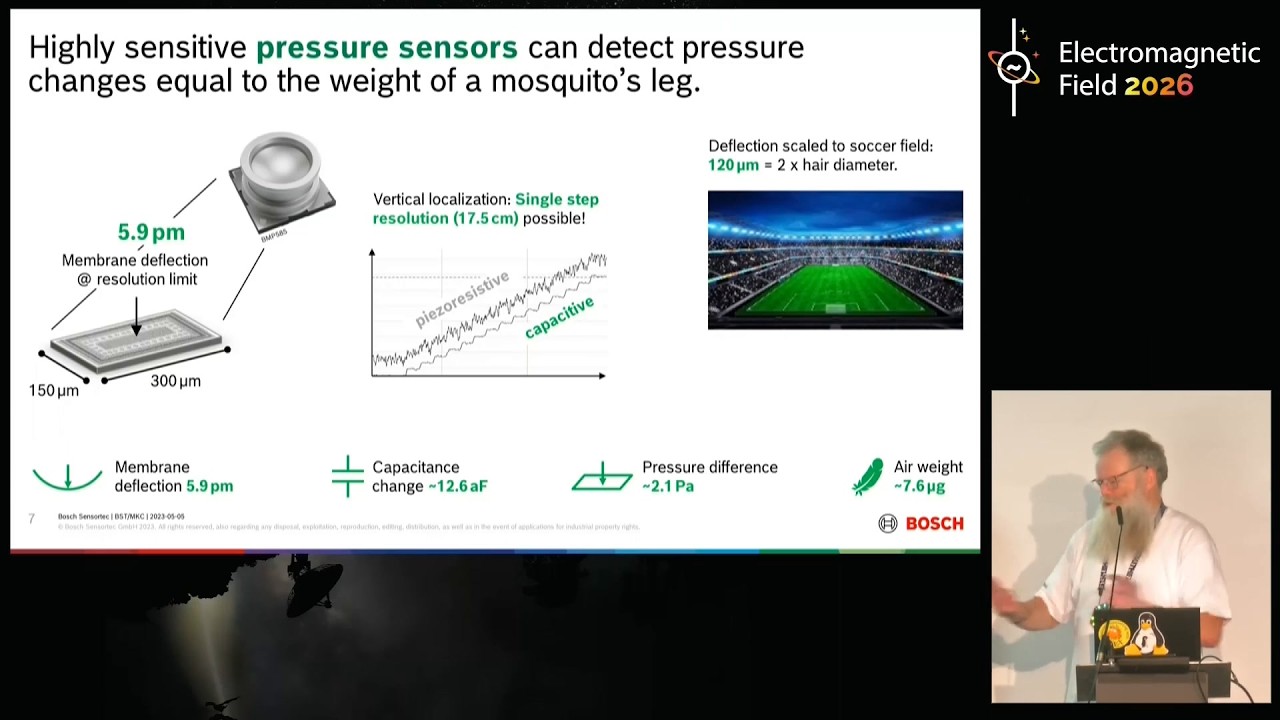
As artificial intelligence and robotics advance, the demand for precise sensing data has grown exponentially to enable autonomous behaviors. The talk highlights how modern sensors allow robots to perform delicate tasks, such as picking up a strawberry without crushing it or interacting safely with humans by measuring force and pressure. Advanced applications include using magnetometers not just for compass functions but to detect minute movements of nearby objects, and utilizing high-resolution pressure sensors to determine floor levels in buildings even when GPS signals are unavailable indoors. These capabilities are crucial for ensuring that autonomous robots can navigate complex environments, avoid obstacles, and handle fragile items with the same tactile sensitivity as a human hand.
The speaker also delves into the physical evolution of these sensors, explaining how they have shrunk from early prototypes to microscopic components where membranes are only a few micrometers thick. Modern designs often stack mechanical structures directly onto electronic circuits using silicon-on-insulator technology, eliminating bulky plastic housings and reducing the overall footprint. While there are limits to miniaturization regarding noise levels and power consumption, the trend is clearly toward stacking multiple sensor layers into single packages. Furthermore, these devices are becoming increasingly intelligent through embedded neural networks that can automatically interpret raw data to recognize activities like walking, cycling, or sitting down without requiring manual programming of complex algorithms.
To further explore these technologies, the presenter invites the audience to upcoming workshops where they can handle 3D-printed models of working sensors and engage in hands-on programming using microcontrollers. The session offers opportunities to connect various sensor types, such as pressure and gas sensors, to read measurement data and control outputs like LEDs. With manufacturing hubs located in Germany producing these critical components for both consumer electronics and automotive sectors, the field is booming with new job opportunities in electronics, semiconductors, and AI data analysis. The talk concludes by emphasizing that while sensor technology continues to push the boundaries of size and precision, the integration of smart algorithms ensures that future robots will be more capable, safe, and versatile in sensing our world.
Read the full video transcript
So, welcome to to EMF and my talk about
MEMS in general, the micromechanical
measurement systems um in very small
silicon things. uh one of these
wonderful no two in in a new batch. We
actually have two of these MEMS things
uh an acceleration sensor which was two
years ago already which was sponsored by
Bosch and a second one which I just
learned a magneettometer compass from a
Chinese company and I want to talk a
little bit about what's possible these
days and give some ideas also what you
might be able to do with your Tagon.
So what's vamps in general these are
micromechanical
systems where you have one silicon I
will show that in more details in one
block there's something moving where you
can measure the acceleration the
rotation magnet field things like that
and it's always a little bit of
electronics in the second chip where you
do the measurement on the analog things
um and then have an interface for
getting the data out to your
microcontroller
um the things are very small. I will
have samples where you can have then
look on later in the Q&A tent or in the
workshops how small things are getting
in the meantime. Uh but it's most of the
time it looks like this or similar. I
have also other examples how
mechanically these things are handled in
the meantime. Those sensors are around
for quite a long time already. you used
it every time in your gaming toys
whatever everything which is moving um
your mobile phone uses that the first
step was always just having guest just
that if your mobile phone is up and down
very slow in the meantime this I don't
know how you call it vacuum cleaner
automatic robotic cleaning things use it
for doing motion control and do indoor
navigation to know how how they moved
and if they have to rotate and things
like that. Uh we also have gas sensors
where you can do air quality or alcohol
measurements and all these things. They
are in hearables, you can do head
shaking and a lot of things which I
never used myself. So a lot of these
things are already in the consumer
electronic
technology wise. Um making
micromechanical
sensors at least that Bosch started up
in the automotive industry with a famous
Elk test from Daimlo where a car flipped
over and they realized they need
something for ESP for controlling the
braking. [clears throat]
Sorry. And then because they had a ESP
sensor, but it was bulky and very
expensive for special things in cars,
they decided we needed small, cheap, and
now. And then the very first silicon
sensors got invented. And a bit later,
they got so small and so cheap that it's
plenty of those sensors are in every
mobile phone, in every smart device, in
every batch, things like that. These
days everybody's talking about AI and
everything is done with AI and
mobilization and robotics and autonomous
blah whatever. The problem is with all
this robotic and autonomous driving in
the AI they need input they need data
and they need sensing. If they have no
clue what your delivery autonomous
robot is doing it's not working. If your
robot is trying to touch something and
you have no information what the robot
is doing, it's not working well. And
this is the reason why in the last
decades sensors got changed a lot for
how they've been using. It started with
you have a robot and you just have an
acceleration sensor to make sure the
robot arm is not shaking too much and
it's a smooth operation and you know
where it's heading to. That's not all
possible with only angle sensors and
things like that. Then that famous
indoor cleaning device uh which can use
for indoor navigation. Then it's 20
years later the measurement of the
sensors is a bit more accurate and it
knows when it accelerates and you can
measure how much it's rotating. if the
wheels are slipping on your pocket,
carpet, whatever. Um, to make uh
reasonably precise
movements or for your uh lawn,
what's it called? Lawn grass cutting
things. They're also using that.
The next uh step was those coats really
doing tactile things and trying precise
positioning and uh getting hands on
things in laboratory.
making sure that they don't have too
much faults and things like that and
can't harm anyone. And now everybody's
talking about humanoid robots. They can
do everything and help you with
everything. The problem is when they
really have to touch you something
someone else. Um it's not helpful if the
robot doesn't know what's the pressure
the force uh it's touching to. This is
the reason there's also measurement data
the AI needs that the robot behaves
softly to you. And here you can see
someone teaching a robot or whatever in
a laboratory and now the robot tries to
take a glass or whatever and not crush
it because yeah force would be possible.
And this is why pressure sensors which
before have been using used in mobile
phones just for yeah pressure
measurements for weather forecast and
things like that. Um nowadays
and where also for indoor navigation
that um the mobile phone can um measure
which floor your for that body reckoning
if something happens and maybe you can't
see or you're just uh unconscious. uh
the pressure sensor can tell how high
you're from the base of the basement of
the uh building. This is because they
really measure we'll show that in the
next slide I think uh in the accuracy of
centimeters in the meantime but
[clears throat] uh pressure sensors also
can be used now within the fingers uh
with some fluid or whatever that if uh
the fluid in the fingers with a soft
tissue um start pressing on the glass or
we have an example where the robot tries
to touch a strawberry and shouldn't
squeeze that and make juice out of it,
but just pick it up and put it somewhere
else. Um, then the pressure goes up a
little bit and the sensors are so
precise that you feel that pressure
increase in the tissues of the fingers
uh with some fluid that you really can
softly handle people, strawberries,
whatever you like. And also magnet
meters which have been used just for
having a compass and things like that uh
also can be you not not at misused can
be used because they're horribly
precise.
Am I shaking that thing? No it's it's
the wind. Um
if you have a small not only measuring
the earth magnet field but if you have a
very small magnet somewhere nearby you
can detect very well how your sensor the
mechanics are moving. So you if you have
anything where you want to make sure
it's not slipping or moving or you want
to measure the distance um then the
magnets are so simple. In the workshop I
will have a model a 3D model of a
sensor. If you maybe can show that very
is a 3D printed model of a whole sensor
an acceleration sensor and it's really
working. You can move all the plastic
parts and instead of doing the
electronic measurement because it's all
plastic there are small magnets and
exactly
with that sensor we can measure how
those parts are moving and how an
acceleration sensor is really working
can be displayed on a tablet play with
that later in a Q&A tent or in the
workshops which I will give. So these
are possibilities using magnets for
other things. Actually old hall sensor
things have been what I told in washing
machines for decades where it's on the
axis and of your washing machine. And
that way if it bent down a little bit
they realize how high is the load of
your washing machine and how much cloth
you put in and how much water you leave
things like that. But that's now on a
much finer scale also for having tactile
robot things. So that's what's possible
these days with modern sensors. And here
you just in the middle see the
measurement things of the most decent uh
generation of pressure sensors which in
the old times they had resistors and for
the membran bending a little bit with
the resistor. You mentioned
uh the change of the length of the
resistor
got that way a pressure difference in
pressure. And this is the upper signal.
If if you walk upstairs in a building,
it's with a lot of noise and zixs and
now it's so less noise. So uh that you
really can see every single staircase
and uh play around with measuring hats
in centimeter quality.
And if you look at that thing that's a
very small sensor, I have a real one
also in my sample kit. And looking at
the dimensions, it's just you can't
really find that the capacity change is
some auto farat. Typically, if you're
doing electronics, it's you have many
magnitudes of morphs for everything. The
membrane itself is only
about six pometer
deviation which get gets detected for a
step and for the small resolution and
pressure difference. So we have 10
100,000 hector pascal is the base
pressure and it's two pascal. So 150 one
over 50,000 uh to the vector thing. And
just to get a little bit an idea
everything is soccer these days or foot
is it football here? I think soccer is
only American. Um and that that membrane
if you look at that it's really 120
micrometer or two hair diameters on top
of the base plate.
If the membrane would have been the
whole soccer field
and similar pictures we have for
magnetometer. Um the most recent
versions uh use some quantum effects for
doing measurements. The older ones had
also have been magneto restrictive
things which is what's been used here on
the sensor and newer technologies and
measurement things just made it a bit
more precise and for doing that very
short distance measurements and also
here the size is just um if you that
very small medium gray insulator this is
the main part where uh the physics
happen for tunneling
electrons which where the tunneling
current changes if the magnet field
changes and the size on scaled up to a
uh soccer field again is two micrometer
lawn height you needed that precise to
make sure that all the magnetic stuff is
working as you expect and not just I
think last example what also can happen
now I talked a little bit about pressure
sensor magnet sensor for tactile things
that it's not slipping. Uh a very
classical
uh usage now of the acceleration sensor
which we are using also in the tagon is
uh image stabilization. It's been used
in expensive cameras for decades already
for SLR cameras. Now it's standard in
all the mobile phone sensor chips that
you measure that your camera chip is
shaking and you do a lot of measurements
or pictures and you then uh dig it all
that uh that's very important for all
the autonomous things which use cameras
for looking in their region that it's
not an unsharp thing where you can't
detect the cat anymore that you get a
sharp picture and have a nice picture of
the cat makes AI much easier detecting
cats even they're reasonably good in
detecting heads but maybe not in green
plants and other things. Yeah. And a lot
of other things uh somewhere was uh for
the motion control if your robot tries
to walk around and that you easily can
detect when it slips over the border of
a caret or whatever and hopefully is
agile enough then uh to not fall down
and break things. So a lot of new
opportunities where you can play with
sensors. Um, now a little bit uh what's
ah this is the old tagon but I just
managed it's over there the new til
again. I just uh build it up this
morning. Sorry for the old picture.
Didn't think about that slide but it's
more or less the same. This is really
the sensor which is on the baseboard for
both both generations for the baseboard
uh thing. This is now an IMU in the
inertial measurement unit. So it can do
acceleration in all three dimensions. So
both gravity or if you accelerate
something if you move it in any
direction that's getting measured by the
thingy and also the rotation. So you
really can integrate that because now uh
they're getting more and more precise in
every generation that you just can add
how much you accelerated or how much you
turned and do indoor navigation with
only that and you really can count if
you did a full circle rotation with 360°
because they have resolutions of some
millere whatever things that I've seen
samples pe colleagues walking with
sensors years ago around our main mil
building in the Cambara uh in our
company and walking 10 times around the
building and doing image track
not image tracking uh walk way tracking
uh both with a sensor and a GPS and
since the high building the GPS
reception was quite bad and running 10
times around our main building uh the
track looked much better and more
precise and came to the front door more
precise than with the GPS signal because
GPS wasn't that great. Indoor GPS is not
working at all. So that's all possible
with those very small mechanical sensors
where we have a real 3D printed thing.
And uh these are the times for the
workshops which I give. So the first one
this afternoon at 3:00, Saturday 1:00
and Sunday 3:00. So where we can talk
about MEMS's technologies, about what's
in the sensor, how you can program the
sensor. I'm prepared for just playing a
little bit with micro python uh that you
can connect with a cable write your own
very small program getting measurement
data switching on LED see how easy it is
with all the microcontrollers these days
uh playing with that and also if someone
is interested I'm prepared didn't try
that so far uh talking a bit about how
we can connect other sensors and playing
around with other sensors as a tagon
extension having a extension board. I
used a breadboard and try to connect
some of the others. For example, a
pressure sensor thing. Oh, all right. If
you're interested in that, get in
contact with me in the Q&A session. Have
a look at the samples
um or in the workshops where there way
more time than doing really hands-on
programming. If you're interested in
that, bring your notebook, your tilder
gun that we can do some programming
examples if you like. Uh, other than
that, yeah, Bosch sensor tech is doing
all these sensor things only for the
consumer electronic. The real Bosch
Gmbbh, robot Bosch GBH is doing that for
the automotive. All the sensors are I'm
not sure if there's a
uh all the sensors are built up in a FEP
in Royan in German. It's near near
Stokot in the southwest.
And here you can see a little bit size
of those things. I I also have a real
wave with me that you can see a little
bit of silicon and gold. And that's
what's over there. Can have a look on
that later. This is now really a scan of
real acceleration sensor with the same
size thing. If if you have a soccer
stadium then because now the whole
mechanical things things which are free
to swing around in all the three
directions for X Y and Z axis to do that
measurements and if you scale it up on
uh the socket plate again that upper
steel plate or the silicon plate where
you see those small spring things um
that's uh about 10 cm
above the grass and the structure
thickness of that steel plate
measurement plate is 1 m. So we have a a
plate of 1 m thickness which is uh 9 mm
plus minus uh so very precise thickness
and it's only 10 cm with less than a
millm um variation on top of your soccer
press that those measurement things in
today quality are working. Yeah. And we
really
still Bosch has a lot of problems um
with automotive things but yeah or the
consumer electronic is using more and
more sensors in the robotics and AI and
whatever needing more input to think
about. So our tech technology thing is
booming and we we are hiring a lot of
people look for people for electronics,
semiconductors,
programming AI for
uh understanding data. the the old
sensors they had a little bit of
handprogrammed assembler code where you
could detect if it's upside down or step
counting is done in the sensors with a
small CPU and more and more this is not
programmed any anymore manually but you
have small models in the old time I did
AI in university in the 80s end of the
80s for biomechanics and it was just a
matrix and neural networks it's exactly
the same and it's also what happens in
sensors more and more that you have very
all neural networks where can interpret
the measurement data and things like
that and making the sensors the itself a
bit bit more intelligent. I don't like
that work, but they have more features
and it's you don't have to program them
manually and try to figure out what's
the best algorithm in C assembler or
whatever to detect if there was a step
if you stand up or sit down if you're
walking or cycling with a bicycle or sit
in a car thing. sensors can detect all
those things in the meantime
both by programming and more and more
just having a lot of sample data and
then analyzing the sample data with some
AI if you like that. So
I'm way too fast. What else can I Yeah,
maybe you can uh switch on the camera
for last thing. So
what's yeah I've contrast is horrible
but I have some more presentation. This
is a big sample of that pressure sensor
and here we can even show how how the
sensors are built up internally. It can
be opened and you can look into the
silicon things where the mechanics are
and the ASIC chips or the electronics
are in and can have a little bit diving
in.
those things for different types of
sensors and and this is a very small
sample. The camera won't get it about
the real sizes of real sensors how they
look. So these are the small
acceleration sensors. That's a pressure
sensor which you can have a look at.
It's a few pixels here but with good
eyes you can get an idea what's in your
mobile phone and your robots and what
you can use for the next generation of
your own gadgets.
Okay. Thank you very much for your
attention. [cheering]
[applause]
>> Thank you very much, Harold. Uh I
believe you're going to be doing Q&A in
the Q&A tent afterwards.
>> So that's on the other side of the robot
arms.
>> If there are now one or two questions,
if it's possible to have time.
>> I think we do actually.
>> So anything the stage
>> was horribly unclear or extra
information.
>> Anyone like to raise their hands with a
question?
No,
>> maybe not.
>> Anyone interested in coming to the
workshop and playing with mess with
sensors with programming? Ah, I see some
heads. Wonderful. So, oh,
oh, that's just another picture which I
don't have anywhere. The old pressure
sensors and gas sensors look like that.
That's a gas sensor. It's always a metal
housing and there's a hole that gas or
pressure can get in and out.
um the last pressure sensor of that
generation. The problem is always uh
with that hole also fluid uh dust
particles uh uh humidity can get in
which is not good for all the sensors no
matter if it's the gas sensor or
pressure sensor. Uh the last generation
of that hardware had two very small
holes uh a tenth of that diameter. You
can't barely see them by eye. And now
the new one is uh there is no metal
shielding, no housing whatever it's only
a gel inside and so you can use then
it's completely covered and you can use
it even in fluids and whatever. This is
why it works for the tactile things in
robot arms
and this is where I wanted to step on.
The workshops are in the workshop tent
number six
and always in the afternoon playing
around and asking around whatever. I
have some ideas which I would like to
learn the next days. Let's see what's
interesting for you and me.
Other comments also always welcome.
>> Is there a limit to like how small these
sensors can be? Is there a limit like
>> is there like a limit to how small you
can make the sensor door?
There's always a limit what the
customers say. It should be smaller
because yeah when I'm only working for
the company now 12 years and I never did
sensors myself but uh the old sensors I
was working on an optical system which
was 5.5 mm in high and it was planned to
go in smartphones
12 years 15 years ago but when we have
been ready with technology there was no
smartphone around anymore which allowed
any device having 5 and a half
millimeters in height so it didn't went
into smartphones uh then sensors had in
a typical head of 2 mm. Then again, a
this is way too high. Our G is more slim
and we have more electronics. So modern
sensors are 6 mm something like that. A
third of that heat and yeah look at the
small sensors. They always complain it's
too big and it uses too much current.
Depends what you do. Uh the tendency is
going that you have multiple sensors. uh
what now happens also for the size for
the footprint of uh the sensors that we
don't put uh the the mechanical sensors
what I've shown before this is old
technology the mechanical sensor and the
electronics side by side now it's
getting stacked uh that we really have a
mechanical thing and put the electronics
and everything in silicon on top and no
plastic cover and anything that's then
called
basic cap so you have the cap on top and
it's only silicon things with the
mechanical things and the electronics
and the CPU and everything in two slices
which are glued together no plastic no
nothing that it's getting as small and
also then you shrink down the footprint
you can see that in 3D printed model how
this looks like a little bit one example
is for example then yeah also it depends
a little bit how how many pins you need
for what your sensors is all doing I
just noted that magnet sensor which is
on it has exactly four pins
power data. That's it. So, this one,
what is it? It's an acceleration sensor.
Has six pins. Look at the data sheet
what it's good for. And this is exactly
something like that. This is the
electronics, the ASIC, the analog and
electronic part. Here is the mechanical
thing with all the springs and
measurement analog parts. And you glue
that together. And on the silicon side
of the electronics output, you get the
uh soldering balls. It's BGA bolt array.
This is also what you use for your CPU,
big CPUs and your big computers. And
this is a small example in a real way
for where you can see that tin balls
which can be used as the contacts for
your small things. So this is also and
dimensions of these things depend it's a
little bit can be in a distance of 6 mm
the old one like this 4 mm and it's
always difficult to get contacts if you
need that and things like well that's
mechanics don't collect have to solve it
and the smaller you make the things some
effects are getting better but you get
more noise and depending is always how
much electricity you need how good the
signal quality is but tendencies It's
getting smaller and smaller and smaller
and some sensors are really
horribly small and you can't see the
pins anymore and have a look at that in
the Q&A tent.
Okay. And maybe I wrap up and we can
meet wherever the Q&A tent is if you
want to have a look at that or come to
the workshops and we can play around and
fantastic.
>> Thank you very much.