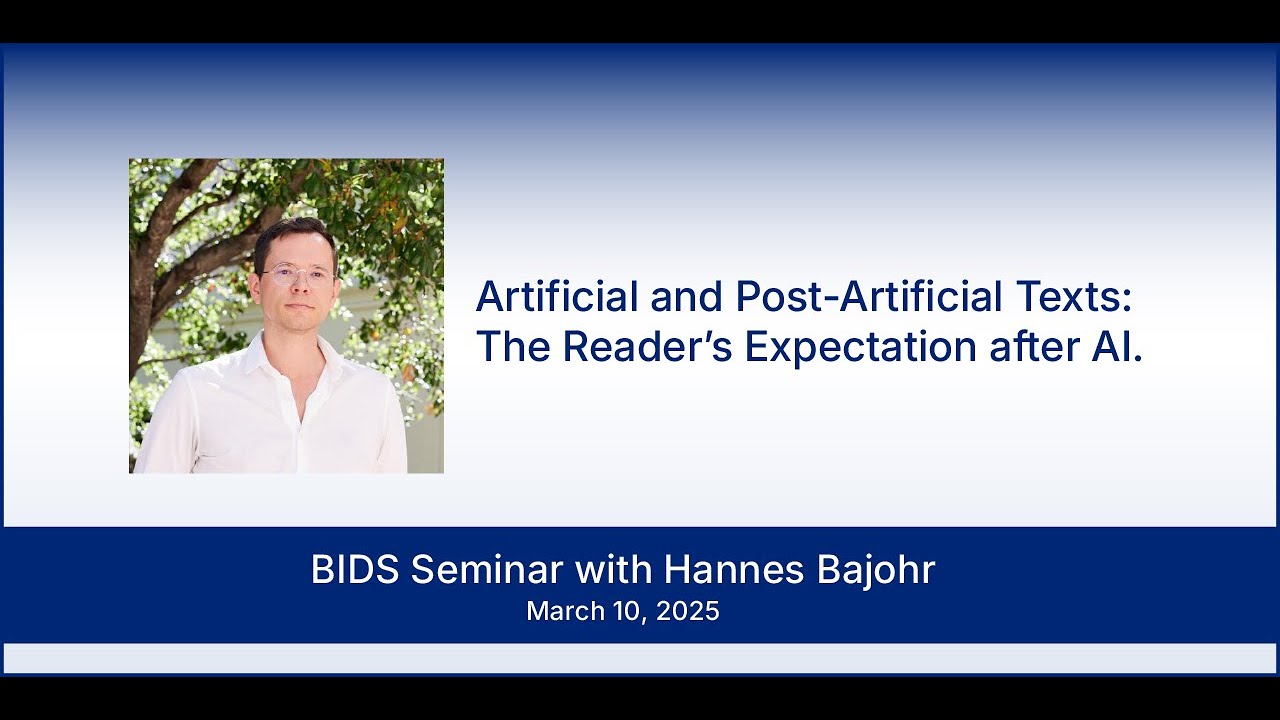
Seminar with Hannes Bajohr "Artificial and Post-Artificial Texts: The Reader’s Expectation after AI"
Watch on YouTubeVideo summary
Hannes Bajohr, an assistant professor at UC Berkeley and practitioner of digital literature, argues that the rapid ascent of generative AI is fundamentally reshaping reader expectations regarding the origins of text. Drawing on Max Benza's 1962 distinction between "natural" poetry, which is human, intentional, and grounded in consciousness, and "artificial" poetry, which is algorithmic and rule-based, Bajohr posits that readers currently operate under a "standard expectation" assuming unknown texts are naturally written by humans with communicative intent. This assumption persists only because artificial text remains an exception; however, as AI-generated content becomes ubiquitous, this standard will dissolve into a permanent state of doubt, marking the transition toward "post-artificial" texts where readers become agnostic about authorship and focus solely on the content itself.
This shift presents complex challenges regarding truthfulness and validity, particularly in factual contexts like legal letters or news, while offering different possibilities for literature. Bajohr identifies two primary strategies for resisting AI homogenization: emphasizing human origins through genres such as autofiction and memoirs, or highlighting unpredictability through experimental language use. Conversely, he warns of risks such as "model collapse," where models degrade when trained on synthetic data, and stresses the urgent need for media literacy, especially for children exposed to incoherent AI-generated content. The speaker also highlights the tension between legislative requirements, such as marking provisions in the EU AI Act, and the ease with which these markings can be circumvented, raising concerns about reader autonomy and over-reliance on third-party verification systems that may intercede between readers and information.
The interpretation of any text ultimately depends on the specific poetic stance and context, creating a dynamic tension between traditional views of expression attributed to nature or God and experimental literature that utilizes random processes and distancing mechanisms to exclude subjectivity. An interesting case study illustrates how labeling an artificial text as AI-made can shift its perception from being merely artificial to becoming a recognized form of digital literature, even when it clashes with traditional poetry. Ultimately, Bajohr predicts that once society loses the ability to distinguish between human and machine writing, it will likely abandon the question of origin entirely, accepting texts based purely on their semantic value rather than their source, thereby redefining the very nature of reading in the age of artificial intelligence.
Read the full video transcript
Welcome everyone. Thank you so much for
joining our second bids seminar of the
um spring semester. Uh uh my name is
Kirsty Whitaker. I'm the executive
director for bids, the Berkeley
Institute for Data Science. Um really
really excited to have so many of you
here today to listen to what is going to
be I think an extraordinarily relevant
question of how we receive and sort of
respond to artificial and postartificial
texts. Um our speaker today is Hannes
Bayor. He's an assistant professor in
the department of German um here at UC
Berkeley. He's published extensively on
the impact of digital writing
technologies on language and literature.
And he is not only a theoretician but
also a practitioner of digital
literature. He's published numerous
generative works including in 2023 a
novel co-written with a self-trained
large language model. Um I have edited
my introduction. He is also extremely
prestigious has won many many prizes.
has many many um trophies all over his
cabinet walls. But we will have a listen
to his presentation. He's going to speak
for about sort of 25 minutes and then
we'll have lots of time afterwards for
questions. Um if you're able to hold
your question until the end, that just
means we have a nice complete talk. But
if there's something that is terribly
important for you to interrupt on,
please raise your hand and I will run
over to you uh with the microphone. A
little thank you as well to everyone
who's joining remotely. Thank you to all
of our remote participants on Zoom and
um thank you Hannis and Hickas away.
Thank you. Thanks Kirsty for the uh
introduction. Thanks for being able to
speak here. Um I want to go and start
right away because I I hope I will be on
time with my manuscript here. So within
uh three years basically we have a
situation where the widespread
availability of generative textual AI uh
shows that we are at the brink of a
somewhat new time uh one in which the
text we encounter may entirely be
generated by a machine uh sometimes or
even most of the time. So practitioners
of the hermeneutic disciplines which is
um German literature etc. uh we are
called to consider what impact the
current rapid advances in machine
learning uh might have on the ways in
which we understand and interpret text.
So in this talk I want to contribute to
an answer by rephrasing and thus
delimiting this question namely what
will be the impact of AI on the reader
expectations of unknown
text. What happens when we are
confronted with artificial text as
alongside natural ones, that is those
written in the traditional way? How, in
other words, do we read a text when we
can no longer be sure that it was not
written by an AI? And what direction
might this increasing doubt as to a text
origin take if at some likely point the
distinction between natural and
artificial itself becomes obsolete so
that we no longer even seek to
differentiate and read post artificial
text instead. that there is a standard
expectation that readers have when
confronted with unknown texts at all
that they are namely natural written by
humans becomes observable only once
there is an alternative to it where
they're also artificial text generated
by a machine. This distinction between
natural and artificial text was
introduced by German philosopher and
author Max Benza in his 1962 essay on
natural and artificial poetry. In this
essay, Benzu considers how
non-intentional computerenerated
literature differs from intentional
literature written by humans. To him,
this is clear in the case of natural
poetry. For Ben's meaning in language
arises from what he calls a poetic
personal poetic consciousness that links
the speaker's ego to the world,
embedding being into science and
grounding text and reality. Without this
consciousness, words become mere empty
symbols devoid of intrinsic meaning. And
it is precisely this case that Bender's
second category, artificial poetry,
describes. Benz defines artificial
poetry as literary texts created through
the execution of rules or algorithms
lacking any connection to consciousness,
ego or the world. He calls this a
material origin. If such texts mean
anything, it is purely accidental and
only for a human reader. And we know
this from the symbol grounding problem
and and arguments like this. Yet far
from defending a romantic notion of
human creative power, Benza seeks to
determine what can still be said
aesthetically about a text when
traditional categories like meaning,
connotation or reference are set aside
and that makes him very much a
modernist. Benz himself was involved in
several experiments with artificial
poetry. The most famous one was
certainly the stochastic texts which his
student tutz produced on the Souza Z22
mainframe computer at the University of
Stoutgart in 1959 in Germany in which
can be considered the first German
language experiment with digital
literature recombining lists of words
from Kafka's castle in a random way or
pseudo random way. It includes phrases
like not every castle is old, not every
day is old, or not every tower is large,
or not every look is free. Very much
appetic sentences that in in themselves
don't seem very uh poetic, but he
published it uh in a selection in Ben's
literary
magazine, also in 59.
The stochastic texts were artificial
poetry in Benza's sense. No
consciousness or world anywhere to be
found. That the computer itself could
actually be the author of this text
seemed absurd to both Benza and Lutz.
But both also knew how it had been
produced. Whether its artificial origin
can be recognized when this knowledge is
missing is less clear. The readers of
Agenlick were not compelled to ask this
question. An accompanying essay
enlightened them as to the details of
its creation. But when the following
year Lutz generated a second poem
according to the same pattern and
published it in the December issue of
the youth magazine Ya and N, there was
no explanation to be found. The poem was
placed on page three along the
miscellaneia just like any other poem.
Only the author's name, Electronis,
might have allowed one to guess who or
what was behind the text. The next issue
solved, but most readers had not even
identified as a riddle that a computer
had written the poem. Clearly, Lutz was
having fun here, as is evident from the
ironic captions under a photo of the
author, the Soua Z22, and a second poem
in the poem's handwriting, as the text
reads, that is in a teletype
printer. On the same page, he published
uh a series of letters to the editor.
their writers uh without knowing how it
had come about were quite divided in
their assessment of the poem. Quote,
"Perhaps you should reconsider whether
you want to open the columns of your
paper to such modern poets complained."
One while one another was on the
contrary quite impressed by the
avantgard stance. Finally, something
modern evident in these reactions is
what I would like to call the standard
expectation of unknown texts. The
electronis poem was artificial poetry in
Benz's definition, but because its
readers were unaware of the conditions
of its production, they took it for a
natural text and assumed it was written
by a human with the aim of communicating
meaning. The standard expectation of
unknown texts then can be captured as a
relationship between two elements which
sometimes is extended by a third. First,
that the text has an originator that a
human or sometimes more than one human
wrote it. and second that the text has
intentional and semantic content that a
communicative will to meaning or
sometimes uh just understood as a
reference to the world is expressed in
it. In some cases there's also a third
uh stance the text connection to an
author function that this constellation
can and should be subsumed under the
name of an author which organizes the
attribution and circulation of some
texts but not all. I leave this aside.
This is more thing for literary theory.
We can summarize the standard
expectation as such. We assume a text
was written by a human who wants to say
something. That there is a standard
expectation at all has only become
apparent since there's been an
alternative to it. And Benz's conceptual
distinction and Lutz's practical
demonstration have been illustrative
here. As the insensed letters show, to
recognize a text as violating that
standard as artificial always requires
additional information. If it is not
provided, the human origin is usually
assumed. Passing off an artificial text
as a natural one, one could say, is also
the poor principle of artificial
intelligence as such. Nine years
earlier, in an article that became the
founding document of artificial
intelligence to some degree, Alen Turing
had pondered whether computers could
ever be intelligent. He rejected this
question and replaced it with another.
If we assume that intelligence is a
property of humans, then all we need to
find out is whether a human would
consider the computer itself to be human
and thus intelligent. The point is not
that the answers in the conversation of
the imitation game have to be correct,
but that they sound human. Lying and
bluffing are explicitly allowed. If one
wants to examine the reader's
expectations of artificial text during
his test is still a helpful starting
point. First because the setup assumes a
teletype conversation and thus equates
intelligence with written communication
and second because the goal of this
communication is to misrepresent signs
that are meaningless to the machine as
meaningful to humans. To put it bluntly,
the essence of AI understood this way is
to pass off artificial text as natural
ones. It is only worthwhile to make this
attempt at all, however, because the
standard expectation of a known text is
that of a human
origin. Artificial intelligence as a
project, not in each of its actual
instances, is therefore based on the
principle of deception from the start.
This is an argument by media scholar
Simon Natal. I would like to call this
position strong deception. Because this
conception of AI is essentially
deceitful, we can ask whether the
expectations of a text could ever change
under these conditions. And I think not.
It insists that artificial and natural
text remain neatly separated so that one
can be mistaken for the other. If it is
suddenly revealed that a text that a
natural text is in fact an artificial
one, its readers will feel dis will feel
cheated and they will feel so not
without reason. Deception here turns
into disappointment.
We don't know how Tolutz's readers
reacted to the revelation that the
computer had written the poem, but one
can guess if one considers recent cases
in which the artist subsequently turned
out to be a machine. Most recently, this
happened to Japanese author Ria Kudan
who disclosed in an interview that she
had generated portions of her
prizewinning novel using Chipt. Public
scone followed and she was accused of
fraud. There are many such examples and
although these disappointed expectations
are usually exaggerated they reveal what
was actually expected namely artificial
sorry namely natural and not artificial
texts. However, neither the need
separation of Ben's ideal types nor this
expectation itself can remain intact as
soon as the exception becomes the rule.
That is as soon as we are surrounded by
text whose origin is
unclear. At first stand, such examples
seem to suggest that the reader's
expectations of unknown text have not
changed since lots time. We assume human
origins and communicative intent, which
is why deception can be a useful
strategy. But in fact, I believe that
the expectations are nevertheless
already in the process of shifting. And
this has become ever more clear in the
last three years because the number of
computerenerated text is constantly
increasing. And because we ourselves are
writing ever more with, alongside and
through language technologies, we are on
the way to a new expectation or rather a
new doubt. The more artificial text
there is, the more the standard
dissolves and the question of their
origin must arise even when we normally
would not think about it at all. That
there nevertheless has been a shift can
be explained by the fact that the
examples of texts that I've been using
so far are quite special ones. They are
literary texts, texts that are marked as
exceptional in our cultural tradition.
They appear to be intended and worked
through to the smallest detail and they
more than other texts are read as having
an author. Despite all the attempts of
the literary avantgards to create text
without a voice and despite more than 60
years of literary scholarship
proclaiming the death of the author, the
standard expectation of specifically
literary texts includes all of these
three elements, namely that they have
authors that are humans with some kind
of communicative intent. I will come
back to this uh what it means for
literary writing in the age of AI in a
moment. First, however, it is worth
taking a look at the other side of the
spectrum, at those rather unmarked
automated texts that remain in the
background, that are merely functional
and that do not assert themselves as
products of human intent or a strong
notion of authorship. For them, the
Turing test is simply a false
description of reality, and the standard
expectation is already in the process of
fraying. For there are forms of human
machine interactions other than strong
reception and other text types than the
artificial natural partition would
suggest. Especially when engaging with
interfaces, we're likely to find
ourselves in an intermediate stage
between natural and artificial. Here
already we can experience a looming
shift in the standard expectation. For
it is quite possible to know that
something has been produced by a
non-intelligence machine and at the same
time treated as if it were conscious. Um
in fact this is quite
normal. Natali whom I mentioned before
has proposed the term benile deception
for this phenomena. In contrast to what
I have called strong deception here
users are aware that they are being
deceived. We understand that Siri is not
human and does not have an inner life.
But smooth communication with her works
only if we treat her at least to some
extent as if she had one. Knowing this
is not a contradiction that suddenly and
unexpectedly destroys an illusion as in
the examples of competitions in which an
AI participates surreptitiously.
Instead, banel deception becomes a
condition of functionality. If I do not
play along, Siri will just not do what I
want. The situation is similar with
written text. It starts with a dialogue
box on the computer screen. After all,
the question, would you like to save
your changes? Enables an interaction
that is basically similar to one with a
human being. The answer yes has a
different effect than the answer no. And
both lie on a continuum of meaning that
connects natural language with data
processing without one suspecting any
meaningfully strong notions of intent
behind it. This would already lower the
expectations of unmarked text where we
act as if we expect human meaning and a
conscious interest in communication. We
kind of bracket the question that there
really must be such things involved.
This bracketing means discarding the
third element namely authorship while
entertaining the second one intent in an
assertive modality and possibly the
first one human origin in a fictional
one.
This bracketing, however, does not
always proceed smoothly. But null
deception is an as if that demands of us
the ability to hold a conviction and its
opposite
simultaneously. The self-contradictory
position quickly gives gives rise to a
doubt. The more convincing artificial
texts become, and the more the aesthetic
impression they make on us suggests
something like humanlike intent, the
more difficult does it become to feel
comfortable in the limbo into which
benell reception lures us.
If artificial texts become
indistinguishable from natural ones and
if moreover we know that computers are
capable of writing them, a new standard
expectation of unknown texts lies before
us. It is the doubt about their origins.
Rather than taking a human source for
granted or simply deferring the
question, the first thing we would want
to know about text would be, was it made
by a human or a machine? With the
increasing integration of LLMs into
existing software, it becomes
increasingly difficult for readers to
clearly classify such text as either
humanmade or machine generated. The
stakes may seem relatively low when it
comes to say LLM written marketing pros.
But what about uh the lawyer's letter
that might be automatically generated
even though it's about my own personal
case? What about political articles or
fake news stories? What about the
private, personal, intimate email, the
love letter? Are those AI products too,
in whole or in part? At least one reason
for the discomfort these ideas evoke is
that people have a stake in what they
write, and to varying degrees, they
vouch for their words. And while
scholars of literature have learned to
read without an eye to what an author
wants to say, and merely regard the
semiotic interplay of signifiers, this
is still the mode in which everyone else
reads almost any written document.
Even if a text ultimately turns out to
be inaccurate or misleading, the
standard expectation that a recipient
brings to reading it involves the
assumption that the author is making
what Jurgen Haram has called validity
claims among which the validity claim to
truthfulness or sincerity is the most
relevant in this context. Essentially,
it means that we have at a we have a
basic level of trust that speakers or
writers mean what they say rather than
try to deceive. This is the reason that
reading critically has to be learned at
all. Whether or not readers ultimately
judge a text as assertion to be true,
they tend to assume the existence of a
writer who does and that is
truthfulness. If truthfulness is thrown
into calamity over large language models
um when they can generate texts that
appear to have been produced and
sanctioned by an author, the same
obviously can be said of truth in an
understanding of correctness. Another of
Haramas's validity claims made in speech
acts. We know that LLMs are still
lacking when it comes to the handling of
knowledge understood as reporting
pre-established facts or correct data.
If knowledge is simply the probability
distribution of tokens over training
data, it may merely learn from the the
form for instance of a specific genre
without any uh insight. For instance,
the I mean Galactica is always the
example here with the scientific papers
that were produced. The current
situation is thus both a crisis of truth
and of truthfulness. To maintain the
standard expectation with its separation
of natural art and official text and its
assumption of human origins, intent and
especially for mark literary text
authorship is a challenge under these
circumstances to say the least. Given
the crisis of the standard expectation,
it's not unreasonable to suggest that it
is already shifting from the conviction
that a human being is behind the text to
the doubt of whether it not might be a
machine after all. But this would also
make the distinction between natural and
artificial text increasingly obsolete.
We would then possibly enter a phase of
host artificial text. After first the
tacic assumption of the human origin of
a text and second the doubt about its
origin, it would be the third
expectation of unknown texts. For doubt
about the origin of a text, like any
doubt, cannot be permanent. Humans have
an interest in establishing normaly in
reducing complexity and uncertainty to
tolerable levels. Already mechanisms are
put into place to keep that doubt in
check by assurance or by decree by
digital certificates, watermarks or
other security techniques designed to
increase confidence that the text at
hand is not just plausible nonsense.
However, to quote Hegel, one bear
assurance is worth just as much as
another, and the law does not abolish
the crime. The fact is that technical
checks can always be circumvented and
there's currently no shorefire way to
detect AI generated text. In fact, there
are good reasons to believe that none
are possible in principle. What this
means, however, is that once it is
possible to question whether a text
might have been generated by a machine
rather than written by a human, no
certificate or law can extinguish that
doubt. It can neither be resolved nor as
a belief uh born permanently. And then
the only solution is to undo its
premises. Should political regulation
and technical containment fail, then it
is not unlikely that the standard
expectation itself will become post
artificial. Instead of suspecting a
human behind the text or being haunted
by the skepticism as to whether it was
not a machine after all, we simply lose
interest in the question. We might then
focus only on what the text text says
and not on who wrote it. Post artificial
text would be agnostic uh about the
origin. If the standard expectation of
unknown text is shifting, if it is
increasingly riddled with doubt, perhaps
perhaps even capitulating to an agnostic
position, why the ostentatious
excitement over generated texts and
literary competitions. It is, I think,
because literature is slower than other
forms of text. And this is because
Benzinwithstanding of all text types, it
is special. It is marked in that it
makes the most emphatic claim to a
willful human origin. All the while
connecting it more forcefully than any
other type of text to the historically
grown notion of authorship. I've said
already that there are texts today whose
origins do not pose a question. A street
sign has no author and in our daily life
a new site's weather forecast is also
practically authorless. Until now,
however, we have always assumed that a
human being is behind it. But under post
artificial reading conditions, nothing
much changes if we simply make no
assumptions at all. My expectation is
that more and more texts will soon be
received in this way. Put differently,
the zone of unmarked texts is expanding.
Not only street signs, but also blog
entries, not only weather forecasts, but
also information brochures, discussions
of Netflix series, and even newspaper,
entire newspaper articles would tend to
be unmarked. then it is not unlikely
that they too become writerless and in
many cases
authorless. Literary texts on the other
hand are still maximally marked today.
The consequence of this marketness is
that art and literature themselves have
recently become the target of the tech
industry. Probably nothing would have
would prove the performance of AI models
better than a convincingly generated
novel. Ultimately, however, this goal is
still based on the paradigm of strong
reception. This seems to to me to be of
little use when it is the difference
itself that is at issue. More
interesting then is the question of the
circumstances under which this
difference becomes
irrelevant. I cannot go into a lot of
detail here but maybe give you some
bullet points. As has often been
remarked the standardization inherent in
AI generated texts arises from their
tendency to produce statistically
probable predictable outputs. This might
make them particularly suited for for
instance uh genres defined by recurring
elements such as uh what we call genre
fiction, fantasy, sci-fi etc. Tools like
pseudorite already enable authors to
create such literature with increasing
efficiency potentially transforming them
into brandlike entities overseeing
largely automated production. In
contrast, one might speculate that there
are two types of literature most likely
to res to resist this trend. The first
would be to emphasize human origins
through genres that need the person
behind the text. Autography, sorry,
memoirs or autofiction. Autofiction, the
one where the difference between the
physical writer and the author or the
the narrator is no longer clearly
delineated. Here in these cases, it
really matters who speaks. The second
strategy would highlight
unpredictability by an experimental
unconventional language use that defies
AI's prob probabilistic norms. We can
think of digital literature that
critically engages with the interplay of
natural and artificial elements as seen
in the works of Crystal Miller who
already writes outside the box of
predictability by not using letters at
all. Highlighting the artificiality of a
text on its text production means
offering a form of resistance to
homogenization marking marking human
machine collaboration as a deliberate
and analytical
act. This leads us into highly
speculative territory. I'm not
suggesting that narrative or broadly
speaking conventional literature is now
doomed or that only experimental or
explicitly digital literature is worth
pursuing. Nor do I mean to imply that
post artificial texts are necessarily
bad. One can certainly enjoy reading
them, discuss their merits, and unravel
their interpretive dimensions. Here I've
been primarily interested in analyzing
tendencies. And for this purpose, it is
worthwhile to consider possible
extremes. As far as literature is
concerned, there is of course a third
possibility that AI may through some
technological innovation be steered to
produce less probable and more
interesting output without losing all
the advantages that the power of
normalization provides in coherence and
meaning production. It is a matter of
optimism or lack thereof to consider
this a likely or unlikely future. Seeing
that sufficiently large OLM are still
tied to capital interests, I remain
somewhat apprehensive. In this talk, I
wanted to try to think about how
language is changing in the technical
age we inhabit today and which will
continue to unfold both without fearing
technology but also uh refusing to
succumb to it some of its ideologies. In
that context, one thing seems certain to
me with the increasing penetration of
language technologies with the triumph
of AI models our expectations as readers
will change. Thank you.
Thank you. Thank you so much. Um I am
curious to know if anyone has any
questions. I'm going to come to you with
the microphone so that the folks online
are able to hear your question as well.
effect.
As you know, artificial intelligence
systems are trained by scraping the
language from humans on the internet.
Soon you're going to having so much
computerenerated
um text and they'll be scraping from
other computers on the internet which is
not unlike an audio system in a feedback
loop. I'm wondering if you have done any
work uh to uh determine what the likely
outcome is to be when computers are st
start training on each other. Right.
What you're referring to is a is a a
phenomenon called model collapse. The
idea that uh the more you train an LLM
on text that already is a product of
LLM, the kind of variety the stat
statistical variety of difference is
reduced to kind of the the middle of the
uh kind of the the distribution. Um I'm
I have I have looked at this I have
looked at this as a practitioner of
literature and the in the novel that you
mentioned at the beginning. Um I try to
see to what degree you can make
narrative with AI and the last chapter
is trained on all the output of the
first couple of chapters and you can
really see how this does collapse in the
end. Um, but this is kind of a an
artistic way to deal with this. And I'm
I'm just trying to to show what happens.
As far as I know, and I mean, you all
know this much better than me. I guess
I'm not a I'm not a computer scientist,
this is kind of a extreme possibility
that can be mitigated somewhat, right?
That that uh if you really only use uh
synthetic text, you will have some type
of normal collapse. But if you spread it
out a little bit or try to mix it up,
you can probably go around this. What is
interesting in in questions of uh
selfless what what Benjamin Britain
calls the eurogoras problem like the the
snake that bites his own tail is that um
you become you get these models that
kind of are very different difficult to
change in their outlook they are kind of
conservative and uh what I find
interesting is how language change novel
for instance novel pronouns right how
they enter into into data sets and maybe
don't or are not able to change anything
really in the in the in the the final
output because they're just such a
little uh set of that data set. This
might be mitigated for but that is a
decision you have to make right and I
think one of the problems that that we
have is that um if uh if you simply
follow the law of scale then novelty in
language change will not really be
represented in in in future models.
Fernando, hold tight. I'm coming to you.
Thanks for the wonderful talk. My name
is Fernando. I'm
curious. You just mentioned kind of an
issue of temporality and and one of the
beautiful things about human generated
language and literature is that it comes
from a time and a place. And to first
approximation, most of these models are
trained in one giant smoothie. It's a
smoothie of all language they can find.
Right. I'm curious whether you have any
experience or whether there's any work
being that has been done on on finding
the temporal or spatial character of a
language of of of these kinds of texts.
We we read literature from the 17th
century. It sounds a little weird to
modern speakers of any language because
our modern languages evolved, but it has
a character and it has a beauty of its
own. And so I'm curious kind of what's
been done in that that direction. That's
that's a really good question. I I don't
have a good answer to this, but I think
you can the question of time is is is a
fascinating one because you can ask it
in several ways. You can ask to what
degree uh does a model as I just said
capture language change and then you do
have a strong difference between the
model trained on 20th century literature
and the model trained on 18th century
literature. But you can also ask to what
degree does it itself have history. And
I always wondered about this because one
argument would be that as soon as you
have kind of a destructive training
process through back propagation uh it
deletes its own history over time right
and you you that that is you only have
kind of a what uh medieval scholasticism
called the nst stance standing now that
is as it were moving forward um it is
this is a problem that I also looked at
in this in this uh novel because it's
kind of one one of the hypothes ES it
tried to engage with was by literary
scholar Angus Fletcher who's I think at
at Chicago who says because AI models or
language models are correlative they're
unable to produce causal relationships
narrative is a series of causal
relationships therefore AI cannot
produce narrative and what I find
interesting in in testing this with this
novel is well somewhat right but there
is an incredible large um tolerance for
bearing the absence of straightforward
causality and the role of the reader and
this is kind of a an old chestnut of of
reader response theory and literary
studies is that most of this is produced
by us. The act of reception is the one
that produces causality and projects it
onto a text. So to to which degree
causality is present in the model itself
is actually quite hard to answer because
the reception itself changes this. Um
and also we can say you know we are now
uh uh uh we have a long history of of
texts that are not narrative like you
have modernism you have Gretstein try to
read that and you know make a make a
clear chronology out of it it's
difficult but so these uh these
reception tendencies are also malleable
and this is partly something I'm I'm
interested in looking at
any other questions yeah and folks
online please uh put your hand put your
question in the chat and we can ask it
too. Go ahead. Thank you. Uh thanks for
the great talk. I'm curious if you could
comment uh along with in the age of post
artificial texts how you mentioned
things like memoirs and autofiction are
cases where the origin of the author is
important. Could you comment on
non-fiction more generally where as a
reader a lot of like the truth or
validity of what you're reading is hard
to verify so you lend credibility based
on the author's qualifications. Could
you comment on how that changes? Yeah, I
mean the question is to what degree um
we can I mean you always read within a
context right you you give uh
credibility to texts both on their
internal consistency and also the
context in which they appear. If you
have a publisher of you know well-known
and well reggarded scientific text then
this is a good marker. This will
obviously still be the case but maybe
this needs to be ramped up somewhat. uh
these kind of contextual uh
verifications and justifications of the
veracity of the facts in in a text. What
I'm interested in here is that we can
once you have that doubt that it could
be generated by an AI, it is actually
very difficult to get it uh to to um uh
uh mitigate for that technically but
also legally. So I'm I'm trying to think
at extremes here, right? If there's
nothing you can do um and you cannot
outlaw it and there's no tech technical
solution, you can still rely on you know
um reputability and so on but in the end
the doubt will remain and what happens
then and then the answer is this idea
that well maybe we can we can move a
little bit in in our reception. So maybe
you will have to do more work in trying
to uh kind of verify facts in in text
like this. But in literary texts, this
is slightly different question where you
just have to step back and let the text
be as it were and uh just judge it on
its own
merits. Um any other
questions? I'll I'll ask a question. So,
my um I work in data science now, but I
um my PhD was in developmental
psychology and neuroscience. And I'm
wondering um when you think about the
reader
engaging, how do you think that changes
across the lifespan of a a human child?
So, so are there responsibilities that
we should be taking to support children
as they engage in stories and as they
engage in sort of understanding that
it's not necessarily true because it
isn't it is not supposed to be a a
fact-based communication. Um, and do you
think there's a sort of almost like a
change in how we approach like education
for human beings and that you can then
expand out to like all of us human
beings that have existed pre large
language models? Um, but maybe to
constrain that question, what do you
what do you think it means for children?
Yeah, I mean um when it when it comes to
entertainment and uh there's there's
been I mean there's a lot of AI
generated children's shows on on YouTube
and they are completely incoherent.
They're absolutely nonsensical. It's
like I don't know if it's it's like a
Peppa Pig version of you know it's it's
it's it's something that maybe might be
a story but it's it's it's kind of
unhinged and uh there's there's
obviously I didn't I didn't know that.
That's amazing. Sorry. So I mean a lot
of parents bonk their children in front
of a computer and just press autoplay on
on YouTube and you get all this and that
is obviously a problem right what what
kind of you know talking about causality
what kind of connections do you make
with this as a developing brain and I
think that there probably is some some
danger there the other thing is maybe
you can talk about variety maybe you
want to make sure that the kind of media
diet is is more varied than this if
there's a kind of indeed a streamlining
or normalization of of content. Um I
mean I'm not a child developing
psychologist. I I can't really give a
good good answer to this except that
yeah obviously media literacy is is
important. Um and uh trying to make sure
that exactly this these new tools that
we need in order to deal with the
uncertainty of the origin of something
uh are taught that you are aware of
this. It could be something that is that
is produced and in the way in a way I
think in the long run this is training
us all collectively as a society to be
more critical towards towards something
like this if we cannot trust sources
anymore. Um one way to mitigate for it
is to kind of always be on the lookout
for it. Um I don't know what it would
mean for education in general but
essentially like
it becoming more concrete about what it
is that we're imbuing with that with our
trust. Right. Yeah. And then this is the
one I mean you still need to be
critical. But on the other hand at some
point if if this is really too much to
do on a daily basis I think this you
know more narrow focus on the text
itself seems the natural reaction to it.
Does this make sense or is it is it
complete, you know, incoherence
uh bunched together from a from a bunch
of Peppa Pigs episodes? Yeah. Yeah.
Any other any other questions? Yes. Uh
I'm going to come to the back and then
come to you. Yeah.
Um, so I guess judging a text based on
just like the merits of what it says is
a very timeconsuming thing where you
have to spend a lot of time like
thinking about what um like what is the
context for this and and like what are
what is it actually saying and what do I
think about it? And I think a large part
of how we get around that currently is
by using like authorship or if not like
a specific author like maybe like a a
publication or something that we trust
to sort of like go through that initial
steps of like is this actually worth
engaging with and trying to figure out
what I think about it. So I'm curious
what what do you think that looks like
after if we are sort of moving past
having that
likeation maybe or Yeah.
And probably it is it will become much
more important in a lot of ways to to
have this context. uh but again maybe
this model should be should be um kind
of divided a little that we we we are on
the lookout for this in this time of
doubt and we have to be but you as you
said it's time consuming you can't do
this all the time so what are the modes
of reception that we might develop over
time in which you can dispense with this
by kind of just letting the text be the
text and obviously this is much easier
with literature I'm a I'm a scholar of
literature this this interests me the
whole point about literary text is that
most of it is if not a lie then fiction,
right? It is not true. So the
cross-checking it with reality is not
really something we do. It becomes um a
problem as soon as we have really strong
assumptions about what it means for a
text to be from a human. So if you if
you look at a romantic idea of of
literature that says um literary or
poetic works are expressions of some
kind of um the the the inner life of an
author then this probably has to go and
then then we move to to a a reception
technique that really looks at the
formal characteristics of whatever it
does with us as on a reception side and
so on. So mostly I'm concerned with
literary texts but yes there must be
strategies to deal with with factual
texts as well. Of course
did you want to ask your question? Yeah.
Thank you.
My question is a bit similar to the past
question that was asked, but like in
terms of like author branding because I
know like as like a big reader,
sometimes I'll be like, "Oh my god,
there's a new book by like Marissa Mayor
coming out or like JK Rowling and people
will just read that book because that
specific author produced it without even
knowing what the book is about." Um, so
I was just wondering what that would
look like in like a world where it
doesn't really matter who the author is.
Yeah. And and I think this is a great
example of what what Michelle Fuku
called the author function. That is the
author function. And the author function
means that a bunch of texts clusters
around a name and that name orders these
texts. So if we have um uh texts that
are connected to I don't know
Shakespeare and one of them is
different, right? If you have an author,
this difference needs to be explained.
Why is it different? if it is from by by
fakes. If you have something that is
just the output of a language model and
one is different then it's just the
mistake right that is kind of the
difference here what the author function
does the thing is now that author
functions are not tied to natural
persons right you can have someone like
um Tom Clansancy I believe most of these
are written by committee right this is
not one person there's one person that
gives their name to it and it acts kind
of like a brand as you said um this is
probably similar to the other things in
that corpus and this obviously you can
still do when you when you have kind of
a literary production that is highly
automatized uh you have the name uh kind
of as a marker of coherence of the
corpus itself. Uh so I think in that
interestingly in that particular case
not that much changes. Uh what changes
is um things as I said kind of the
reception expectations as to whether the
author name stands for an experience of
a of a real human being. um which which
might be more the case with um well
specific types of poetry specific uh uh
uppercase L literature um rather than
than things that are mostly written for
consumer market but you can you can
really look what are you expecting from
from from the literary text when you
read it and how is this impact uh by
these changes
thank you I think probably last question
and then we'll finish thank you so much.
Good for Oh gosh, a little nervous. Um,
I was wondering if uh well, like the
first thing that came to my mind when
like from hearing your talk was the
concept of like
misinformation and like I was wondering
if you would classify like deceiving a
reader as um like with AI text as
misinformation and then it's kind of
like a two-parter. um in the
electronless I think that's what it was
called situation like what is the
minimum amount of credit that you would
need to attribute to AI generation to
like avoid um being deemed as
misinformation. Yeah. The question I
mean maybe you could ask do we have a
right to know in a way how was it
produced? I think some some legislation
does exactly do this. I think the EU AI
act has kind of provision for AI
generated content if it is you know such
and such percentage of the whole thing
needs to be marked and I think there is
something um to be said for this the
question that I tried to ask here is
what if this marking can cannot be
trusted because it's so easy to
circumvent right um you could also ask
the same for misinformation we could
imagine a type of reception of factual
texts uh in which some kind of
cross-checking factchecking is slotted
in between me and the text, right? So,
you would always read it through some
kind of system that that checks these
things. Um, that tool might might not
work perfectly. It also means that we
give ourselves more over to to certain
technologies. So, this is also a
question of I think autonomy of of
readers. Can we do can we as you know
human readers deal with texts directly
or do we now always need some kind of
third party to to check for that?
Um and the the final thing is to what
too much credit how much credit do I
want to give? Again, literature is
different than a factual text. There can
be a great variety in poetics, right?
You can be a romantic poet and say this
is my this is what what my inner life
looks like or this is some kind of
inspiration. That is actually not me.
Shelley writes about this a lot. The the
genius in the classic sense is one who
does not actually express themselves but
either nature or God, right? God speaks
through through the genius. Um but this
is this is dependent on the poetics that
we have and there is a completely
different experimental uh line of
literature that works with random
processes that works with found text
that works with all kinds of distancing
mechanisms that make sure that no
subjectivity was involved there. So you
have to kind of know in which context
and in which stance towards literature
you have to read it. And the whole point
here was um it was one was assumed
namely traditional poem but the other
one namely the artificial text was used
and in this clash this becomes an
interesting case. If it says underneath
how it was made then it would be an
instance of digital literature that is
slightly experimental and so on. But
that I think that's what what makes it
such an interesting case. This this
clash between these two
poetics. Grab my microphone back and
come back into the frame. So I'm going
to stand awkwardly close to you. Um I
just want to thank everyone online.
Thank you so much for joining us.
Everyone who joined in person, thank you
so much for being here. And could we
just give Hannah's um a big round of
applause and say thank you so much for
the for
Thank you.