Video summary
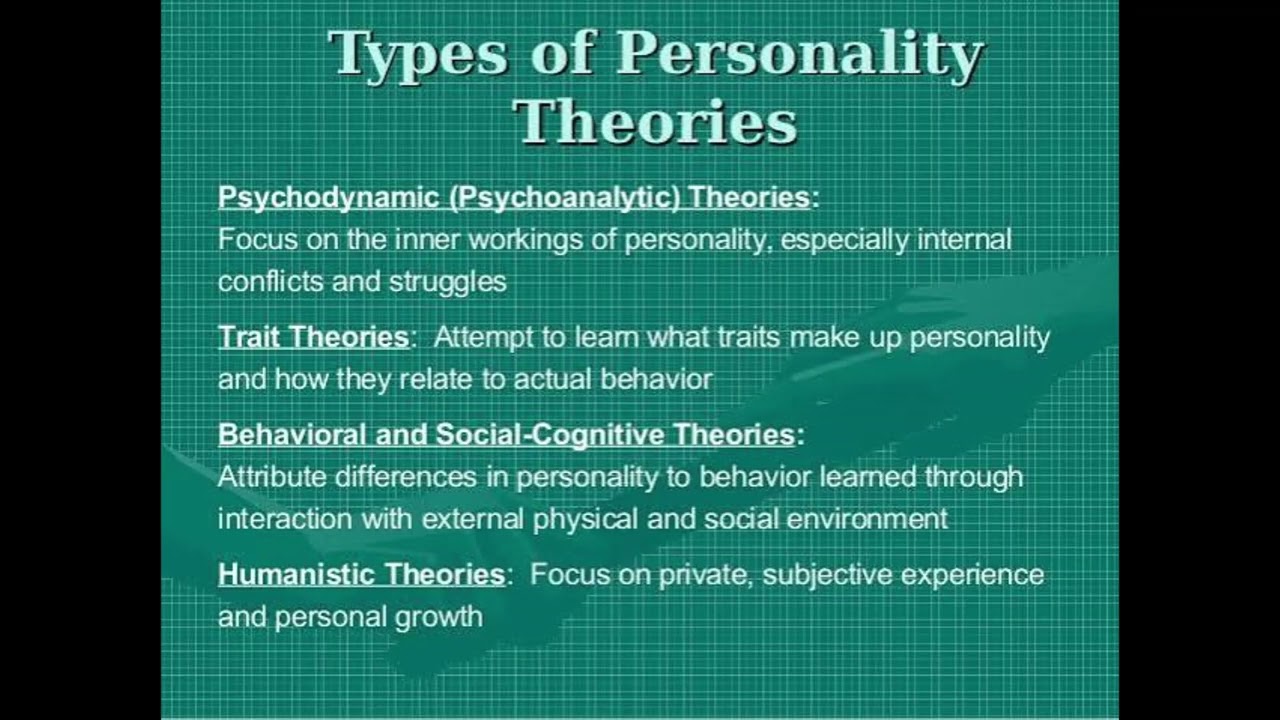
The video distinguishes between two fundamental psychological concepts: personality and self. Personality is described as an operational construct representing the sum total of behaviors, cognitions, emotions, and affects that remain relatively constant over a lifespan. While scholars debate whether this core kernel must be entirely immutable or merely stable for long periods like ten years, it serves as a basis for predicting behavior and understanding others through theory of mind. This internal framework allows individuals to create mental models of themselves and their relationships, forming what is known as an internal working model that guides how one functions socially.
In contrast, the self is defined not merely by these changing traits but as an organizing principle providing a profound sense of continuity. It represents the enduring feeling of being "you" regardless of changes in personality, physical body, environment, or time. Even if significant life events occur, such as amputation or decapitation, this core identity persists to maintain the sensation that one is continuous and unchanged. This internal stability acts as a foundation for mental health; without it, individuals may feel disjointed because they lack an intrinsic sense of who they are independent of external circumstances.
When the formation of the self is disrupted due to trauma, abuse, or adverse childhood experiences, this continuity breaks down, leading to severe psychological issues. In extreme cases like narcissism or borderline personality disorder, a defense mechanism called dissociation occurs, creating memory gaps that undermine identity since memories form the core of who we are. This results in conditions known as identity diffusion or disturbance, where an individual possesses only a fragmented, kaleidoscopic, or unintegrated self rather than a cohesive one. Consequently, those without this internal sense of continuity attempt to derive their feeling of being from external sources instead.
To compensate for the lack of an internal anchor, individuals may adopt strategies such as narcissism, which involves soliciting constant feedback and validation from others to regulate self-esteem and maintain a semblance of existence. The speaker emphasizes that while personality naturally evolves over decades through new habits, values, or relationships, the core identity should never change; waking up one day feeling like someone else is not normal but rather indicative of mental illness. Ultimately, many psychological disorders stem from this fundamental failure to establish an immutable sense of self, making the distinction between a mutable personality and a stable self critical for understanding human behavior and pathology.
Read the full video transcript
Smality is an uh operational
functional um construct. It it is the
sum total of behaviors and some say
cognitions and emotions affects sum
total of these things that is relatively
constant across the lifespan.
Relatively constant. So there's a core
some kernel that is [clears throat]
immutable across the lifespan. Other
scholars say that you don't need to be
that extreme. But if you have a
constant or a kernel or a nucleus that
is stable across 10 years for example
that would be your personality and that
personality can change but it just
changes over very long periods of time.
So at any given moment you would have a
personality because it takes years if
not decades for your personality to
change.
And by saying you have this personality,
it means I can predict reasonably your
behaviors. I mean, if I have prior
knowledge of you, I can predict your
behaviors a large degree. I can make um
educated guesses regarding your
cognitions and effects. I can correlate
your cognitions and effects to your
behaviors.
And therefore, I can construct a
paradigm or a model which will describe
you. It's known as theory of mind. I can
construct I can mentalize you. I can
create a theory of mind of you which
would also serve as a framework for your
interpersonal relationships. I in other
words I can infer from your theory of
mind or alleged theory of mind. I can
infer from that onto what is known as
internal working model. How you how you
would function in relationships and how
you view relationships.
And put all this together this is what
we call personality. However,
there is a a massive difference between
personality and self. And many many
people don't make this distinction. They
think it's synonymous. They're not.
The self
is an organizing principle. It's the
self is your sense of continuity.
The sense that you are you even when
your personality changes.
The sense that you are still you.
Even if your body has changed, you've
been amputated for example. So you both
your arms have been amputated or you've
been decapitated. That would be a bit
difficult. But you know what I mean.
>> This sense that I am me regardless of my
how my body changes, how my personality
changes, my environment, the context,
period in time, period in life.
Regardless of literally anything and
everything, there is this immutable core
that gives you the sensation which is
probably sorry, probably an illusion,
but there gives you the sensation that
you are continuous
sense of continuity.
When you don't have this,
then it's a major problem. So people who
who the um people who suffered abuse and
trauma adverse childhood experiences or
had parents which were overprotective
and and instrumentalizing identifying
bad parenting people have experienced
bad parenting for a variety of reasons
in in multiple ways. Uh they don't
develop there's a disruption in the
formation of the self. They don't have a
sense of continuity. They're disjointed.
And so some of these people in the
extreme cases like in narcissism,
borderline, they there's a mechanism, a
defense mechanism known as dissociation.
So they're dissociative. They have
memory gaps. Of course, memory underlies
identity and identity is the core of the
self. So the self is about identity
which is essentially sum total of your
memories. So if you're dissociative, you
won't have memories and your identity
will suffer. It's known as identity
diffusion or identity disturbance. And
then you will not have a self. You will
have a fragmented self, kaleidoscopic
self, non-constated self, unintegrated
self. There are many other phrases. Not
self, no self. So you will not feel
continuous.
And then because you don't feel
continuous, you will try to derive your
sense of continuity ex from the outside.
You can't get it from the inside. You
try to derive it from the outside.
And there are variety of techniques and
strategies to accomplish this. One of
them is known as narcissism where
actually you solicit feedback from the
outside in order to maintain a sense of
being and to regulate your sense of
self-esteem.
And so the self is an organizing
principle of the inner space of the of
the psychic space
and it is stable even when your
personality changes and personality does
change. I believe in and in in that
school your personality does change. It
takes very long time 10 years 20 years
whatever but it does change. Of course
it does change. Whereas your your core
identity or yourself never changes. You
never wake up one morning and says, "Oh
my god, my personality changed. I have
new habits. I have new values. I have
new beliefs. I have a new wife or
whatever girlfriend. And so it's not me.
I don't feel like me. It never happens.
Except if you are if you have certain
mental illnesses or certain so to not
have this sense of I am me. Whatever
happens, whatever may happen that is
mental illness. That is at the core of
many mental health issues.